Black Cloud Rising, by David Wright Falade*****

Black Cloud Rising, the historical novel that’s already been excerpted in The New Yorker, is the book I’ve always wished someone would write. Author David Wright Falade tells the story of the African Brigade, a unit of former slaves tasked with rooting out pockets of Confederate guerilla fighters in the Tidewater region of Virginia and in North Carolina’s Outer Banks. This outstanding work of historical fiction is one of the year’s best surprises, and it’s for sale now.

My thanks go to Net Galley and Grove Press for the review copy.

Sergeant Richard Etheridge is our protagonist; he is the son of a slave and her master. This is the only small criticism I have here; it seems like every time I see a fictional former slave that goes on to do momentous things, he’s the master’s progeny. However, Sergeant Etheridge did exist in real life; I have been unable to discover whether this aspect of his beginnings is fact or fiction. If it’s fact, then I withdraw my objection.

One way or the other, this is nevertheless a fantastic novel. In fact, since I taught the American Civil War for many years and have never heard if this sergeant, I wonder, initially, if his story is even true. But a little research shows Etheridge to be have been real. I had known about the existence of this brigade, but the only aspect of it I’d seen was–oh how embarrassing—from the movie, Glory, in which an all-Black military unit volunteers to lead the charge on Fort Wagner. But there, the story is told not from the viewpoint of infantrymen, but from the Caucasian officer chosen to lead them. It’s not as if I failed to do research; but during my years in the classroom, I couldn’t find a single thing that reflected the memories and experiences of the former slaves that fought for the Union. And although this book comes too late to help me teach the upcoming generation, it will be greatly useful to teachers that come after me.

At the outset of our story, Richard approaches his master at dinner, a thing that is generally not done, to tell him that he is going to enlist in the Union Army. Because he is the master’s son, he is able to get away with this, and this has also allowed him to learn to read and write, which in turn makes him officer material. Richard is a well developed character; it is wrenching to see his loyalty and devotion to his father, as well as to his half-brother Patrick, who is the legitimate heir to his father’s estate. Repeatedly the narrative points out that “the son will always seek out the father,” and it makes me ache for this young man. Nevertheless, he does go to war against his father’s wishes, and he demonstrates leadership and skill under pressure.

There is one visceral scene in which the Caucasian master of a plantation who is linked to the guerilla Confederates, is dragged to his own whipping post and beaten by his former slaves. I find it deeply satisfying. In the end and after much bloodshed, the unit is successful in its mission to clear the area of the guerillas that threaten the Union effort.

In many ways this is a coming of age story, but those that will love it most are those that enjoy military history and all things related to the American Civil War, as well as those interested in the Black struggle. It’s a great selection for Black History Month, but it will make excellent reading during the other eleven months as well. Highly recommended.

Invisible Child, by Andrea Elliott*****

I was invited to read and review this book by Random House and Net Galley, and immediately I accepted, because it’s right in my wheelhouse. However, I also understood that it would be a painful read, and I postponed it for months, because 2021 was already a terrible year, and I wasn’t feeling brave. So my apologies for the delay; at the same time, this book is not quite as wrenching as I expected, and the research and writing are stellar. It’s for sale now.

Dasani Coates is the firstborn child of an impoverished, disorganized African-American mother with few marketable skills.  She is named after the premium brand bottled water, because her mom thinks it’s a beautiful name. (Wait till you see what the next baby’s name will be!) They live in Brooklyn, and not long after Dasani is born, she has a sister. And another. And another, and then eventually a brother and a couple of step-siblings. None of them are the result of poor family planning; all are planned and wanted. But at the same time, they have very few resources, and the slender safety net provided by relatives doesn’t last forever; and the city fails to protect its most vulnerable denizens.

As a retired teacher that worked in high poverty schools, I have seen families similar to this one, and the children suffer the most, every stinking time. I’ve also seen children take on the role that Dasani assumes without ever planning to do so, that of the adult in the house (when there is a house,) caring for a large group of tiny people when the actual adult isn’t adulting. If you watch closely enough for long enough, it can eat you alive; as for the far-too-young surrogate parent, I have seen them cope admirably, right up until they become adults themselves, and often, it is then that they fall apart. I don’t know whether that holds true for Dasani, because we don’t see her as an adult, but I can well imagine.

Elliott, a Pulitzer winning journalist from The New York Times, follows this family closely for eight years, sometimes sleeping on the floor of their house or apartment. In her endnotes, she explains her methodology, her relationship to the family during this project, and the parameters determined by the paper, for whom she originally did this research. Dasani was the subject of a front page series on poverty in New York which ran for five days. Elliott’s documentation is impeccable, and she can write like nobody’s business.

Because I am running behind, I check out the audio version of this book from Seattle Bibliocommons, and I want to give a shout out to Adenrele Ojo, the narrator, who is among the very best readers I’ve yet encountered. Though I continue to use my review copy at times, I like Ojo’s interpretation of the voices for each of the large number of characters so well that I find I prefer listening to reading.

As I read, I become so attached to Dasani that I skip to the end—which I almost never do—because if she is going to get dead, I need to brace myself for it. I’ll tell you right now, because for some of you, this might be a deal breaker, and I’d hate for you to miss this important biography: it’s dark, but not that dark.

I don’t find myself feeling nearly as sympathetic toward Dasani’s mother, Chanel, as the author does, but I do think Dasani’s stepfather, who is the only father she knows, gets a bad, bad break. He jumps through every single bureaucratic hoop that is thrown at him in an effort to get some help for the seven children left in his care, and every time, the city turns its back on him, right up until a social worker comes calling, finds that they don’t have the things they need, and takes his children. This made me angrier than anything else, apart from a few boneheaded, destructive things that Chanel does.

For those that care about social justice and Civil Rights issues, this book is a must read. I highly recommend it to you.  

Breath Better Spent, by DaMaris B. Hill*****

At the start of this, her second published poetry collection, Hill mentions the lessons we have learned from Audre Lord and others. I like Lord’s poetry, too, but it’s time for Lord to move over and make some space. Hill is a powerhouse. Her recent collection about imprisoned women, A Bound Woman is a Dangerous Thing, is phenomenal, and it’s won her awards and many accolades, but this new book, an ode to Black girlhood, is better still. Her perception, intimacy, vulnerability and fearlessness all come through in what is most likely the best poetry collection we’ll see in 2022. My thanks go to Net Galley and Bloomsbury for the invitation to read and review; it becomes available to the public January 25, 2022.

In the preface, Dr. Hill discusses her influences, as well as the way she has divided this collection into sections. She starts by discussing the murder of Breonna Taylor, right there in her home state of Kentucky, and she goes on to point to the increasing incidents of disciplinary measures against Black girls in school, along with a disturbing rise in their incarcerations. Society is failing Black girls, and we need to do better.

In reading this collection, I find I process the poems best if I only read one or two each night. As I go, I highlight the titles of my favorites. There’s not a bad one in the bunch, but I am most taken with the first, “Jarena Lee: A Platypus in A Petticoat;” “How the Tongue Holds,” which is completely horrifying, and and so well done; “What You Talking ‘Bout;” “Hotter Than July;” and one dedicated to a family member that served in the military, “Those Sunless Summer Mornings.” At the end is a series themed around missing Black girls, here and in Africa. Again, I am drawn to a segment dedicated “to my niece and her bullies.” And breaking up the intensity are occasional moments of surprising humor that make me laugh out loud.

The thing that comes through, strong and long, is Hill’s affinity for, and understanding of Black girls. I have written scathing reviews several times, one quite recently, when authors include children prominently in their books without having taken the time to learn the developmental stages of their characters. Here, it’s the opposite. Hill knows girls, and she knows them well and deeply. She mentions that some parts of this collection are “semi-autobiographical,” but her knowledge runs much, much deeper than one gets simply by having been a girl. And so, though this collection will be useful to those teaching or studying courses in Black Studies, Women’s Studies, and of course, poetry, the people that absolutely need to read this collection are teachers in training. This should be mandatory reading for anyone planning to go into education. For that matter, it would also be excellent material for teacher in-services.

Several of Hill’s poems are contextual, dealing with the current political climate, and it’s now, with voting rights in question, cop violence rampant, and racism becoming increasingly overt, that we need books like this to counter the reactionary elements. It’s brave and powerful writing, and if you don’t order a copy, you risk missing out. Highly recommended.

Beautiful Country, by Qian Julie Wang*****

“Secrets. They have so much power, don’t they?”

Qian Julie Wang is born in China to a professional couple living under the shadow of governmental disfavor. Her father’s elder brother has written critically about Mao Zedong, naively signing his own name to the article, and as a result, the entire family lives under a cloud and the threat of violence, courtesy of Chinese Stalinism. When her father finds a way to relocate himself and his family to New York, it is under a tourist visa, and so they cannot legally remain in the USA, or get any sort of legitimate employment. Wang’s memoir tells of the deprivation and terror, combined with occasional lifesaving windfalls and ingenuity, of growing up as an “illegal,” and of how, against all odds, she ultimately finds success and citizenship.

My thanks go to Net Galley and Doubleday for the invitation to read and review, along with my apologies for being inexcusably late.

Wang comes to the USA, which in Chinese translates to “Beautiful Country,” as a small child. From the moment her feet touch American soil, her parents drill the story into her: “I was born here. I’ve lived here all my life.” Because they are in the US illegally, they must find work to do under the table, and so they are exploited by the most malevolent sweatshop owners. At first, Wang is also employed, toddling off to do piecework with her mother, but eventually she is enrolled in school, where she proves to be highly capable once she overcomes the barriers of language and culture.

More than anything, her life and that of her parents is dominated by fear and secrecy. Opportunities that would otherwise be helpful must often be bypassed because of the documentation required. Her parents’ emotional stability, their marriage, and her mother’s health are broken.

If this story seems unbearably grim—and I confess, this is why I delayed reading it, moving other, pleasanter stories to the top of my queue—it is ultimately a story of resilience and of triumph. Wang is a gifted writer, and she breaks up the horror by recounting small victories and pleasures that punctuate her youth. But the most important aspect of how the memoir is presented, is that everything is told through the lens of childhood, and so we see everything as a seven-year-old Chinese girl, a nine-year-old, etc. would see it.

Because I had fallen behind, I checked out the audio version of this memoir from Seattle Bibliocommons, and Wang does her own narration, which is my favorite way to hear a book, because there’s no danger that the reader will add emphasis or interpretation that conflicts with the author’s intentions. The climax arrived as I was wrapping Christmas gifts, which made me all the more aware of my level of privilege.

Wang tells us:

“Most of all, I put these stories to paper for this country’s forgotten children, past and present, who grow up cloaked in fear, desolation, and the belief that their very existence is wrong, their very being illegal. I have been unfathomably lucky. But I dream of a day when being recognized as human requires no luck—when it is right, not a privilege. And I dream of a day when each and every one of us will have no reason to fear stepping out of the shadows.”

Highly recommended.

Three Girls From Bronzeville, by Dawn Turner****

Dawn Turner is an award-winning journalist who grew up in Bronzeville, the historic home of the Black Community in the south end of Chicago. My thanks go to Simon and Schuster and Edelweiss for the invitation to read and review; I also extend my apology for missing the date of publication. This well written memoir is for sale now.

Turner looks back at her life through the lens of sisterhood. The two other girls mentioned in the title are her younger sister, Kim, and her best friend, Debra, whom she meets in elementary school. She takes us through the benchmarks of her life in a narrative that is both intimate and conversational, but that also features a keen depth of analysis, as she examines their experiences with regard to race, gender, social class, and of course, a few random, intangible but significant aspects of their experiences.

I enjoyed this book. There’s some terrific humor—for example, as a child, Dawn ascertains that a trip to the hospital is the equivalent of a death sentence, and when she needs a tonsillectomy, she gives away her most prized possessions, explaining that she is “going home to be with the Lord.”

And…about that. The humor is terrific, but the Lord dominates this story in a way that makes me uncomfortable, with passages that go far beyond the brief and the pithy. It’s her story, and she should tell it the way she chooses, but the almost constant religious references make this more of a Christian memoir than one for general audiences. It has a lot of nice moments and is told by a skillful scribe, but at the same time, I’m not sure I’d read another memoir of hers, should she choose to write it, because I find these frequent references tiresome. I have to wonder if the story would be any less authentic if this aspect were included with a gentler hand.

There are lots of meaty issues, thought provoking and common to the experience of a great many people. At one point, for example, she gives a speech at school, and although it is exhilarating and more than successful, Debra passes her a note asking why she sounds white when she speaks to an audience. Later, as an adult, Dawn and her husband confront other choices. Is it better to get a house in a low crime area that is mostly Caucasian, or should one stay in the Black community, even if there are fewer opportunities for their child there? Then the same issue arises regarding school choice. There are many other thought-provoking situations, but I’ll leave you to find these on your own.

This is a powerful memoir written by an accomplished wordsmith. For those that can read it with Jesus riding shotgun, this book is recommended.

At the Edge of the Haight, by Katherine Seligman****

At the Edge of the Haight tells the story of a homeless youth, Maddy Donaldo, who lives with her dog, Root, in San Francisco’s Golden Gate Park. But one day she runs across a young man lying dead, and the man that is almost certainly his killer locks eyes with her. He tells her, “Keep a handle on the fucking dog…I know where to find your ass.”

I was invited to read and review this award-winning novel by Algonquin Books. My thanks go to them and Net Galley for the review copies. It’s for sale now.

At first, I am not sure I’ll like this book. It seems a bit self-conscious, a bit like a public service announcement or an infomercial. I wonder what I have gotten myself into. But about a quarter of the way in, it wakes up and begins to flow. It becomes my dedicated bathroom book, since I’ve been given a physical review copy, and I find myself brightening when I enter the loo. There are any number of places when the author has the opportunity to use an obvious plot device, but she chooses something better. By the end of the story I believe Maddy as a character, and I appreciate the way it ends.

My home town, Seattle, has an enormous problem with homelessness, estimated in the tens of thousands, and most of them are native Seattle-ites that have been priced out of the housing market. I know one of the people out there; others have squatted in my yard until my dog made them feel unwelcome. Not one part of this city is entirely free of tents, cardboard shacks, and other makeshift shelters. So this subject is never far from my thoughts.

The fact is that there aren’t nearly enough shelter beds, whether in open rooms with mats on the floor, hotels with doors that close and provide privacy, or other options, but in reading this book, it is also clear that there are times when it’s better to walk away from free shelter. Take our friend Maddy. The shelter she sometimes frequents is one where the probable killer has seen her. She can’t go there safely. There are shelters where she can’t take her dog. There are others that sound pretty good, but a night filled with the screams of a neighbor experiencing a mental health crisis make the private niche way deep in the park more appealing. The cops range from businesslike 3 AM bush beaters (“You can’t camp here!”) to the overtly cruel, and most of the homeless know better than to try to confide in them. And so it goes.

The main part of this story involves a couple—Dave and Marva—that are the parents of Shane, the murder victim. They live on the other side of the country, and they never understood why Shane wouldn’t come home. No one besides Maddy recalls having seen Shane, and so although she has only seen him once—dead—they latch onto her, vowing to help her since they couldn’t help him. Between their grief and ignorance, however, they bumble around and breach boundaries in ways that are outrageously presumptuous, and when they drag her to their home for Thanksgiving, they introduce her as someone that “knew Shane,” which of course she didn’t. Maddy feels bad for these folks, but she doesn’t want to be their project. It’s a bizarre situation for her to be in.

Though it is marketed as commercial fiction, I think a lot of teens would embrace this story. I suggest that Language Arts teachers in middle and high schools add it to their shelves, as should librarians. The vocabulary is accessible, and despite the quote I lead with, there’s very little profanity.

Recommended especially for teenage readers.

Hell of a Book, by Jason Mott*****

It really is.

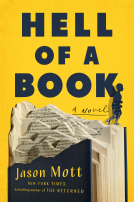
This book is a standout in more ways than one. First the obvious: look at that cover! Then again, how many novels have a nameless protagonist all the way through the book? Get into it deeper, and the distinctions become more complex. The buzz around it is wholly justified. My thanks go to Net Galley and Random House for the review copy. This book is for sale now.

Our author is on an odyssey that takes the form of a book tour, and it lands him, in the end, back where he grew up. He doesn’t tour alone; apart from the various organizers he meets in various locations, he is accompanied by a small Black child he refers to as “The Kid.” Alternately, we also see the story of a young Black boy, a very Black boy, nicknamed “Soot,” who grows up in the American South.

As I read, I am always on the back foot, understanding most of what it being said, yet developing questions as I go. Our author says (often) that he has a condition, and that this is probably why he can see The Kid when others cannot. My notes ask whether his condition is dissociative, and is The Kid just part of himself? Or is The Kid Soot? Are Soot and The Kid both part of the author? Every time I come up with a plausible theory, something else happens to undercut it. Yet one other thing becomes clearer all the way through: to be born an African-American boy in the United States is to be perpetually on the back foot; perpetually having to guess how best to proceed; to perpetually guess at one’s welcome or lack of same, at the quality of one’s relationships with Caucasians, to perpetually guard one’s own safety. And to be very Black—“Nigga, I bet when you get out of the car your daddy’s oil light come on”—is to invite not only the suspicion and hostility of Caucasians, but to draw the enmity of lighter Black people, too.

The synopsis of this story that initially drew me billed it as humor, and in places, it is not only funny, but laugh-out-loud funny. But the further we get in, the darker it becomes.

There are a number of sardonic references to the publishing world; editors, agents, and other promoters have told the author that while it’s fine to write about Black characters, He must not write about being Black:

“The last thing people really want to hear about is being Black. Being Black’s a curse—no offense—and nobody wants to feel cursed when they read something they just finished paying $24.95 for…The future of this country is all about patriotic, unity-inducing language. Post-Racial. Trans-Jim Crow. Epi-Traumatic. Alt-Reparational. Omni-Restitutional. Jingoistic Body-Positive. Sociocultural-Transcendental. Indigenous-Ripostic. Treat of Fort Laramie-Perpendicular. Meta-Exculpatory. Pan-Political. Uber-Intermutual. MOK-Adjacent. Demi-Arcadian Bucolic. Write about love. Love and Disney endings…”

Later, an interviewer asks if the past doesn’t still matter, and the author says, “It does. Not just three-fifths of it, but all of it.”

So, my friend, you can see why this book should be called a love story. Race? Oh, no no no. Fear? Injustice? Police brutality? Of course not. After all, this is a hell of a book!

Highly recommended; one of the year’s finest.

Home Stretch, by Graham Norton***-****

3.5 stars, rounded down.

Home Stretch is Graham Norton’s third novel, and because I absolutely loved his first, Holding, and his second, A Keeper, I expected great things from this one. It’s not a bad book, but it didn’t delight me the way the first two did.

My thanks go to Net Galley and HarperVia for the review copy. This book is for sale now.

We start with a tragic accident, and our protagonist, Connor, is unhurt, but three of his friends are killed, and Connor is blamed by everyone, including his family. It’s a small town, so trying to keep his head up and avoid people that dislike him is impossible.

His family feels the same, and so he is abruptly packed off to Liverpool, and from there to bigger and in many ways, better places. And in many ways this is a favorable development, as he is no longer forced to hide his sexuality; and yet, it’s a tough thing to live a life that’s separate from your family, one that you know would horrify them.

The story is set in the 1980s, the era of the AIDS epidemic. This reviewer lost friends to it during that time; a lot of people did. Norton does a serviceable job with setting, and with character too; and yet, this book lacks the spark of his earlier two novels. The pacing is not as brisk, and the surprising bursts of humor that made me laugh out loud never materialized here. At times it felt like work to read it, and I wonder if he found as much joy in writing it.

I still believe in Norton as a novelist; everybody has a “meh” moment now and then. I look forward to seeing what he writes next.

Unfinished Business, by J.A. Jance*****

Judith Jance has done it again. Unfinished Business is the sixteenth in the Ali Reynolds series; not only does she weave a compelling, tightly plotted tale, but she may have broken new ground with the role technology plays in solving crimes within the storyline. Add a sprinkling of social justice issues, and what emerges is an unmissable novel. My thanks go to Net Galley and Gallery Books for the review copy. This book is for sale now.

Ali is a former journalist, but now she and her husband, B. Simpson, own and run a cyber security firm called High Noon. B. is a nice enough fellow, but we see very little of him. Most of the time he is away on business, leaving Ali to flex her badass crime solving muscles, and providing her with a healthy chunk of disposable income that makes it easier. Other continuing characters are Cammie and Stuart; Frigg, the AI entity operating out of High Noon; and Bob and Edie Larson, Ali’s parents. Our two new characters are Harvey “Broomy” McCluskey, who is a serial murderer, and Mateo Vega, a second-chancer newly out of prison and in High Noon’s employ.

The best long-running mystery series are ones that go deep into the character of the chief protagonist and sometimes others, as well. When you think about it, there are only so many interesting crimes; only so many credible motives; and only so many believable plots an author can spin that involve only the mystery at hand. What makes the most successful ones stand out is the investment the reader has in the character and her life. Jance works her characters like a champ. Within this one, we have multiple interesting side threads. Ali’s parents are aging, and although she is more than willing to support them and advocate for them, they don’t tell her everything. They are independent and intelligent. They treasure their dignity, and their privacy. Sometimes this combination spells trouble, and so it is here. We see Ali trying to juggle the ever-changing aspects of the business while B is out of town, along with health issues facing her father, who won’t talk about them; one of her children gives birth; and then there are issues with her employees.

Point of view shifts between chapters, and so we first meet Harvey, who is a resentful, entitled jerk who has murdered his mother and gotten away with it. Unfortunately, Harvey is also a tenant of High Noon’s, and he’s in arrears on his office rent. No one at High Noon knows that he is dangerous; they figure he’s a deadbeat, and he has to go. Ohhh, honey, look out!

We also meet Mateo. Mateo has spent 16 years in prison for a murder he didn’t commit. His public defender told him the plea deal was the safe bet, and so he took it. He could have been released early if he’d expressed remorse, but nobody and nothing could make him say he did it when he didn’t, so he rotted there for his entire youth. But while inside, he continued to study technology, and earned an online degree. Now he’s released, comes out with skills, and is hired by High Noon.

I love the way Jance uses all of these characters, and the thread involving Cami is particularly interesting.

I read and reviewed most of the recent books in this series, and in number 13, I called this author out for making all of the bad guys in the story Latina or Latino, and all the good guys Caucasian, except for Cami, who is Asian. It’s great to see how she’s turned it around. The social messages here—the broken prison system; issues with keeping the aged safe; the difficulty former prisoners face in starting a new life; and of course, violence against women—are all progressive ones, and none of them hijacks the plot or slows it in any way. In fact, this novel is among Jance’s best, and that’s a high bar to meet.

Highly recommended.

Lightning Strike, by William Kent Krueger*****

Lightning Strike is the prequel to William Kent Krueger’s successful, long-running mystery series based on a Minnesota sheriff, Cork O’Connor. This is my introduction to the series; my introduction to this author came in 2019, when I read and reviewed This Tender Land.  I read this free and early, thanks to Net Galley and Atria Books. It will be available to the public Tuesday, August 24, 2021.

In the prequel, Cork is twelve, and he’s on a camping expedition with his friend Jorge when they come across a body hanging off the maple tree at Lightning Strike. What’s worse, it’s someone they know; the corpse is that of Big John Manydeeds, the uncle of a close friend. Cork’s father, Liam, is the sheriff, and although he’s been told to let the adults investigate this horrific event, Cork keeps coming up with useful bits of information.

Seems he has a knack.

One of the most admirable aspects of Krueger’s writing is the way he folds his setting, characters, and plot seamlessly to create an atmospheric stew that’s impossible to look away from. The story takes place in the far northern reaches of Minnesota in (fictitious) Tamarack County, near Iron Lake and the iron range, as well as the Ojibwe (Chippewa) Indian Reservation, and the tension and conflict between tribal members, which include Cork’s mother and grandmother, toward Caucasians, which include Liam, are a central feature of this mystery. Tribal members insist that Big John would never have taken his own life, and even had he done so, he would never done it at this sacred location. At first they aren’t taken seriously, but as events unfold, it becomes increasingly clear that they are right. This was no suicide.

The key suspect in Big John’s murder proves to be the town’s wealthiest citizen, a tightfisted, overtly racist, elderly Scotsman that owns practically everything. He’s a suspect too soon to be the actual killer, I figure, and I think I can see where the story is headed, but without giving anything away, I have to tell you, Krueger introduces all sorts of twists and turns I don’t see coming, and they aren’t far-fetched ones, either.

There is dark foreshadowing all over the place, and the tension and outrage that exists between the tribe and law enforcement—well, the sheriff, really—grow to ominous proportions. Liam insists on examining facts and hard evidence; the Ojibwe are eager to include portents and messages from the great beyond. They want that nasty rich guy arrested now, if not sooner, and when Liam tells them that it doesn’t work that way because circumstantial evidence isn’t enough, that hearsay can’t win a conviction, they scoff and point out that when the suspect is Ojibwe, those things are always more than adequate. And again, they have a point. A local business owner who is Ojibwe tells him, “Sheriff, you better believe every Shinnob on the rez is watching you right now. Every step you take.”

While Liam is busy with his work, nobody is paying much attention to the boys; Cork, Jorge, and their friend Billy Downwind, who is related to Big John, poke around some more, and what they unearth is both shocking and dangerous.

Lightning Strike owned me until it was done, and though I rarely do this, I’m headed to the Seattle Bibliocommons to find the next book, which is technically the first in the series, because for this series and this writer, once cannot possibly be enough. Highly recommended!