Patrick Radden Keefe is a much celebrated journalist with a list of honors and awards as long as your arm. He first drew my notice in 2019 with Say Nothing, his searing, meticulously researched book on The Troubles, that period of guerilla warfare in the North of Ireland, as its people tried (yet again) to break free of British imperial rule. That book rattled me to my core, and when I received a review copy for this book, I understood that there couldn’t possibly be another book as deeply affecting as his last. And I was right; it isn’t. It is, however, interesting in most places, and Keefe can write like nobody’s business. This book is for sale now; my thanks go to Net Galley and Doubleday for the galley.
Each chapter of this book is on a different topic; ostensibly, each is about a different rogue, or group of rogues, or—in one case—a whole family of rogues! However, there are a couple of chapters where that isn’t really true, and that is my strongest quibble with anything presented there. Most, however, are unquestionably about scoundrels. The first, about an obscenely wealthy wine snob who finds himself with some counterfeit wine, makes my blood boil. A private plane, burning enough fuel to melt the polar caps, or to transport a good many people to work for an entire year, is dispatched to fetch some wine. This one makes me cranky enough, and is lengthy enough, that I abandon it halfway in. The next, “Crime Family,” is a riveting expose of a notorious, yet strangely beloved Scandinavian kidnapper whose sister turns him in when she senses that he’s spiraling out of control. She owns five armored cars, because she knows her brother will never rest until one of them is dead. Chilling, indeed! Other favorites are about El Chapo, and about Mark Burnett, the promoter that turned Trump into The Apprentice, splicing and editing sufficiently to make the man sound coherent and businesslike. There is one about the Lockerbie bombing, and another about insider trading, that I tried to care about but couldn’t, so I skipped those. And there’s one about Jeffrey Epstein, too.
All told, this book is a meal. Even if you do as I did, and skip those that don’t spark your interest, this is a well written, worthwhile collection.
Recommended to those that enjoy well crafted journalism.
Seamas O’Reilly is an Irish journalist; as far as I can tell, this is his first book. He was just five years old, one of the youngest of eleven children, when cancer claimed his mother, leaving his father—an extraordinary man, if even half of Seamas tells us is accurate—to raise them all. This is their story. My thanks go to Net Galley; Little, Brown and Company; and Fleet Audio for the review copies. This memoir is for sale now.
Of all the ways in which one can write about the death of a parent, this is one that I never considered. O’Reilly describes his family, his mother’s demise and the impact it has on his family and the community; and the subsequent years of his own and his family members’ lives, and he is hysterically funny. How he manages to achieve this without breaching the boundaries of good taste and respect is nothing short of pure alchemy. Somehow he finds just the right combination of irreverent humor, poignant remembrance, and affection, and it’s pitch perfect.
His finest bits are assigned to his father. I’m giving you just one example, because I want you to experience everything else in context. This isn’t his most amusing anecdote, but it’s a worthy sample of his voice. After heaping praise on him for other things, he tells us:
“He is alarmingly cocky when it comes to his skill at killing mice, a species he hates with a malevolent, blackhearted glee. It’s an odd facet of his character; a man regarded by his friends as one of the kindest, gentlest humans on earth, and by mice as Josef Stalin. He takes particular joy in improvising weapons for the purpose, and has killed rodents with a shoe, a book, and at least one bottle of holy water shaped like the Virgin Mary. He famously dispatched one with a single throw of a portable phone, without even getting out of bed. I know this because he woke us so we could inspect the furry smudge on his bedroom wall…”
I have both the audiobook and the DRC, and rather than alternate between the two, or listening to the audio and then skimming the DRC for quotations and to answer any of my own questions, which is my usual method, I chose to read them both separately, because this story is good enough to read twice, a thing I seldom do these days. Whereas I usually think that having the author read his own audio is ideal, since the author himself knows exactly where to place emphasis and deliver the piece the way it is intended, this time I am ambivalent. O’Reilly speaks faster than any audio reader I’ve yet heard, and he doesn’t vary his pitch much, and as a result, there are some funny bits that I miss the first time through; I am doubly glad to have it in print also. As the audio version progresses, I grow more accustomed to his speaking style, and I miss less than I did at the outset. Nevertheless, if the reader has a choice and doesn’t greatly prefer audiobooks, I recommend print over audio. Ideally, I suggest doing as I did and acquiring both versions.
There’s no doubt in my mind that this will be among the most memorable and enjoyable books published in 2022. Highly recommended.
I hadn’t heard of Melissa Rivers, but when a friend mentioned that the daughter of the legendary comic, Joan Rivers, had an audio book nearing its publication date, I wanted it. My thanks go to Net Galley and RB Media for the review copy. This book is for sale now.
Joan Rivers was an icon, one of the first fierce women to breach the world of standup, an old boys club if ever there was one. She was scrappy, fearless, and very, very funny. Like all of the early women comics, she incorporated a good deal of self-deprecating humor, a defense against all of the nasty things that reviewers and audience members might throw at her, but she also made fun of the rich, the famous, and the powerful.
Joan died in 2016, and although she was eighty-one years old, news of her passing came as a shock. She hadn’t been ill, and had been admitted to a hospital for surgery of a fairly minor nature; her death was caused by errors made by the doctors and hospital. Her only child, Melissa, had been developing a standup career of her own, and now steps fully into the spotlight left vacant by her mother’s death.
I had never heard of Melissa or her work when I found this audio book, but I expected great things; often a talent is passed down within a family, after all. Sadly, there’s no joy to be had here. Melissa’s tone is grating and abrasive; whereas Joan sometimes veered in that direction, she had the skill and instincts that told her when to pull back or soften things. Joan’s trademark phrase, “Can we talk?” created a sense of intimacy, and drew me in. Melissa’s repels me. Apparently, I am not alone; I was playing this audiobook while preparing dinner, and when other family members came into the kitchen, they either wanted it turned off, or they left immediately. Nothing she said made any of us laugh, or even smile. Nothing. I have never heard a comic so obnoxious.
Wikipedia tells me that Melissa Rivers is known for her work in comedy, and for philanthropy, as heir to her parents’ considerable estate. I haven’t seen or heard any of Melissa’s other work, but if this book is representative, she might do better to focus on her charity work, brightening the world by embracing the causes dearest to her parents’ hearts, and her own.
John “Lucky” Luckadoo was a bomber pilot in World War II in the most dangerous period of the European theater, and he survived twenty-five bombing runs, which was unusual. This is his story, told to us by the skilled wordsmith Kevin Maurer, and narrated by Holter Graham and Luckadoo himself. My thanks go to Net Galley, St. Martin’s Press, and Macmillan audio for the invitation to read and review.
The first portion of the narrative tells about Lucky’s early years, as well as his yearning to learn to fly. I feel a bit impatient as I read this segment, because I’m dying, like Lucky, to go to war. However, some of what I think is extraneous material proves to be important later on, so I’m glad not to have skipped anything.
A quarter of the way into the story, and we’re off. I am impressed by the descriptions, which are brief and unmistakably clear, written for general audiences of today. An example is when he tells us that a Quonset hut looks like a tin can that has been split lengthwise, then put on the ground, cut side down. Everything, from the planes, to the target, to the flying conditions is easily understood without talking down to the reader. The chapters are a good length, and the dialogue crackles. But now, we have to talk about that.
When anyone writes military history, whether it’s a biography, a memoir, a reference book, or any other nonfiction work, there must be citations for the facts and especially for quotations and dialogue. (I am proud of myself for not using twelve exclamation marks here; if there were an audio version of this review, I would be shrieking, so it’s just as well that we’ve stuck to print.) The author provides a bibliography at the end, and it. Is. Not. Enough. No, no, no! This is why so many writers in this field use historical fiction as a vehicle; the very best historical fiction communicates the same material, but is not bound to document facts. A bibliography alone would be just dandy for a work of historical fiction…which this is not. In fact, (said the American history and government teacher,) the four star rating is evidence of my appreciation for the clarity, organization, and pacing of this story; ordinarily I would go no higher than three stars for anyone in violation of this clear requirement. (Where was the editor?)
Moving on. The pace in the middle segment is brisk, but I have no problem putting it down and walking away when I am interrupted in my reading. That all changes at the sixty-sixth percentile, when the B-17 pilots and crews are sent on a mission to bomb Bremen. This is a huge mission, and a very dangerous one, as they are trying to bomb the canal where German U-boats are housed in broad daylight. At the same time, Goering is done watching his pilots get pounded, and he orders them to fight to the last man, and those that will not will be transferred to the infantry (note here that the German infantry is starving and freezing; pilots are much better fed.) Consequently, their aggression in the air is unprecedented, with kamikaze-like maneuvers that none of the Allies have seen from Germany up till now. During the portion of the book, I would not have left this story unless my house was on fire.
The callous decisions by higher-ups as to what an acceptable attrition level looks like, with about sixteen percent of active American airmen making it home alive after their service is done, is horrifying.
I have read a number of biographies and other historical works regarding this topic, but nevertheless, I learned some new information. I recommend this book to readers that are interested, but not to researchers or students.
Although the narrators do a perfectly fine job, I realize early that I cannot keep up with this level of detail without seeing the words, so I jettison the audio version and stick to the digital review copy. I recommend the audio version for those quirky souls that understand and retain spoken information better than print.
Shawn Levy has taken on an ambitious project, researching and writing about the pioneers of women’s stand-up comedy. In his author’s note, Levy says that while it may seem counterintuitive for a man to write about women comedians in this era of #MeToo, nobody else has done it, and because they are heroes, forging the way forward, performing for audiences that were frequently hostile. The result is in On the Joke, a well-researched book that tells the stories of the women that emerged from the vaudeville era to make history, roughly between the World War II era and Watergate.
My thanks go to Net Galley and Doubleday for the review copy. This book is for sale now.
There are eight chapters in this book, each dedicated to a particular type of comic. He starts with Moms Mabley, whom I had never heard of, and continues down the line with Totie Fields, Phyllis Diller, and several others, and ends with “The Scrapper,” Joan Rivers. I confess it was Rivers’ face on the cover that drew me to this historical work.
Levy has cut no corners, and the documentation is flawless; his style of reporting is conversational and written for a general readership. All told, he’s done a fine job here.
My only sorrow—and one that isn’t the author’s fault—is seeing what horrible things these women had to do to themselves in order to meet with success. One after another, women comics have mounted the stage, day after day, night after night, to make self-deprecating jokes, many of them downright vicious. They tell about how ugly they were as children, and how ugly they are now; they tear themselves apart like Christians diving voluntarily into the colosseum pit where the lions await. I expected to laugh my way through this thing, but most of the time I wanted to sit down and sob for these artists.
As I expected, my favorite among them is Rivers. Eventually she eased up somewhat on the self-attacks and began roasting other public figures. I saw some of her work when she was still alive, and at the time, I thought some of her jokes were too mean to be funny, but as Rivers pointed out to her critics, she always “punched up.” Using her well known catch phrase, “Can we tawk,” she eviscerated the most successful celebrities, politicians, and other newsworthy public figures, and a lot of her material was absolutely hilarious. In fact, I’d have finished reading and reviewing this book much sooner had I not kept setting it aside to watch old footage of her routines, as well as some of the others Levy covers.
If you are looking for a book to make you laugh your butt off, this isn’t that book, but it’s an excellent history of the women that paved the way for the likes of Gilda Radner, Tina Fey, Hannah Gadsby, and many others.
Recommended to feminists, and those interested in entertainment history.
Hannah Gadsby appeared from seemingly out of nowhere—to those of us in the States—with a searing personal story about her own trauma that was built into her standup comedy routine. Nanette singed our eyebrows and made a great many of us absolutely love her. When I saw this memoir, I knew I had to read it. My thanks go to Net Galley and Random House Ballantine for the review copy; that said, I would have paid an exorbitant price for a personal copy had it been necessary, and I would not have been disappointed in what I bought.
This book is for sale now.
In some ways it seems useless to review this memoir, because those that are interested in reading it are already fans; those that recoiled in horror from her blunt revelations and assessments of the world around us won’t read it, no matter what I say. But for the few that haven’t seen her standup routine, I counsel you first to watch Nanette on Netflix, and then watch Douglas, too. Of course, you can go into this memoir green, but you’ll appreciate it more if you understand her references to the show.
For those that are fans but are wondering whether the memoir is going to be her standup material, recycled—and surely, plenty of other people have done that sort of thing—I can reassure you that it is not. There are references to Nanette, and there are also references to her newer release, Douglas, the show she named after her dog. But there’s a good deal of information here that you won’t get anywhere else, and that’s what makes it worth it.
After discovering that Gadsby made it in the entertainment business despite coming from no money whatsoever, with no connections to anyone in show business in her native Australia or elsewhere, and having a host of disabilities, foremost among them autism, I wondered whether her success was a piece of rare good luck, or the result of hard work and perseverance unseen by most of her viewers. It’s the latter. And not only has she worked long and hard to make it as a comic, she is also one hell of a fine writer. The depth of analysis and critical thinking in this memoir took my breath away.
Since I’ve been reviewing, I have built myself a bit of a reading routine. There are particular times of day when I read, and also times when I put my books down to get other things done. Gadsby destroyed my orderly timetable. It’s been a long time since any book, however enjoyable to read, has caused me to say, Nope. Not stopping. This one did.
I highlighted a lot of passages, but I’ve decided not to use any direct quotes here, because all of them are so much better in context. But I will say that I am truly ashamed at the way that teachers let her down. As a child she was disciplined, bullied, and received everything at school except the help she desperately needed. I am devastated that my profession failed this brilliant woman. I’d love to believe that things have improved significantly since she was a child, but in my heart, I know there are still little Hannahs out there. Some are falling through the cracks, whereas others are pushed. The horror!
Most of her story is not horrifying, however; it is immensely entertaining. Nobody could safely walk through the room while I was reading without having to listen to a passage or two. On the other hand, nobody minded much, either, because Gatsby.
The most engaging aspect of this memoir—and its author—is authenticity. She never pulls punches, whether describing her own poor choices, or those made by others. One or two very popular American performers have taken passive aggressive swipes at her, and she uses this opportunity to swipe back, right at the start of the book, no less! I wanted to stand up and cheer, but instead, I did it sitting down so as not to lose my place.
The only question remaining is whether you should read this brilliant, darkly funny and disarmingly frank memoir in print or audio. I haven’t heard the audio, but since she reads it herself, you know it’s good. On the other hand, there are several passages that are so well written that I went back over them before moving on; you might miss those with an audio book. True fans that can do so should get both versions.
Though I usually review books that are either newly published or are about to be, once in awhile I reach back and discuss books that have been around for awhile. This one is excellent, and I consider it unmissable.
This book is phenomenal. How much do any of us know about Genghis Khan?
One thing I learned in discussion with my spouse, who is a Japanese citizen, is that whereas we from Western cultures pronounce the warrior’s name with a hard G, Asians–including the Mongolian culture from which the Khan emerged–pronounce it softly, like a J. I figure Mongols know how the name should be pronounced, so I have begun to pronounce it that way, too.
I wanted to read this series, or at least the first entry, because although I have read at least something about most of the greatest warriors in the world over time, I had read nothing about Genghis. We have a nonfiction tome, but it’s the sort of slog one only undergoes out of desperation, or as assigned coursework.
The first two or three chapters seemed fine, but not great. I wasn’t even sure if I would read the rest of the series. By the halfway point, however, my mind had changed completely! I found myself online doing image searches for the housing, clothing, and other parts of the nomadic life.
I have purchased the next in the series. I rarely buy books for myself, because I have so many already and have such constant access to galleys that it isn’t necessary; yet now and then, there’s a book I’ve gotta have, and that’s how I feel about this series.
Highly recommended for those that are interested in this time and place in history; in Genghis himself; or in military history.
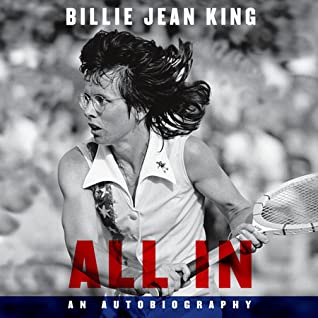
There are books, and then there’s this: the autobiography of an icon that will be read for generations. I passed—perhaps foolishly—on a review copy, because I was afraid there would be large passages of minutiae about tennis, which doesn’t interest me. I was mistaken in my concern, but it worked out well, because I borrowed an audio version from Seattle Bibliocommons, and the author reads her own book. She is an old woman now, and hearing her detail her own remarkable life is a matchless experience. It’s hard to imagine there will be a more important, or more enjoyable book published in the coming year.
Billie Jean Moffitt King is born in 1943 and grows up in Southern California in a conservative working class family; her dad is a firefighter, and her mother stays home, as most mothers did back then. There is Billie, and there is her brother, and the family are devoted Methodists. Who is to know that both children will be famous one day? Brother Randy becomes a professional baseball player, and Billie Jean becomes a record-breaking tennis star and a passionate social justice activist. If you, reader, are younger than sixty, you probably don’t even know how much you owe Billie Jean.
Growing up, King enjoys all sorts of sports, but when she is introduced to tennis, a light comes on. The problem is, tennis is a sport for the elite, even more so back then than now. To find a tennis court, you needed to either have a private court built on your palatial estate, or belong to a country club, and of course, to do that, you also have to be Caucasian. Billie Jean’s family is nowhere near affluent enough to belong. And so, early on, her passion and her obvious talent draw support from people with enough pull, or enough money, to give her access. She takes the time to thank them, but doesn’t let this bog the story down.
Over and over, however, she is shut out on account of her gender. Prize money typically pays enough to help an athlete pay their own travel expenses and buy equipment, but when women are allowed to compete in competitions prestigious enough to offer prize money, it’s only for the men. Women are expected to be grateful that they are included at all. And as King gets better at her sport and her confidence grows, she begins to push back. Nobody wants to watch women play tennis? Since when? And since when should people of color be shut out?
Although she doesn’t say so, it becomes obvious to me that in addition to athletic talent, confidence, intelligence, and almost endless energy, King has one more talent, one that isn’t recognized as such in the mid-twentieth century: she has amazing people skills. Over and over, she is able to reach compromises, make deals, and shorten the gap between conservative perceptions of women athletes, and what all athletes deserve. She discusses the various battles (though she doesn’t use this word) and how they are resolved, and I am amazed at the grace and dignity she demonstrates. Perhaps the most telling moment is when she befriends Bobby Riggs, the obnoxious bastard that she has defeated in front of the world, and later, when he is on his deathbed, takes a call from his wife. Riggs is asking for her, and he doesn’t have much time left. She is too far away to get to him in time, but she tells him on the phone that she loves him. Wow.
If you are or were a girl that participated in high school sports, or if you or your loved ones have benefited from Title IX, thank Billie Jean, who testified before Congress. She also started the first professional tennis circuit for women.
Over the years, King wins 39 Wimbledon Grand Slam titles and a host of others as well. I am a child when she plays Bobby Riggs in “The Battle of the Sexes,” and she beats him squarely. What I don’t know (and would still not have known if I’d been paying attention,) is that she does her very best not to play this tournament. Riggs is much older than she, and he hounds her—in fact, today his behavior would violate anti-stalking laws. But she calmly tells him, over and over, that she isn’t interested, and then she ignores his calls and turns away from his in-person visits. But when a fellow women’s tennis champion plays him and loses, Billie turns to her husband and manager, Larry King, and with a sigh, says, “Okay. You’d better set it up.”
At this point, I turn away from the audio book and head to YouTube to watch The Battle of the Sexes. This trip back to the society in which I grew up is hair-raising. The ways that men talk about women, in public forums! The remarks by Howard Cosell, who was the most liberal of sportscasters, about her physical appearance, and the patronizing remarks of others are appalling. I wouldn’t go back for anything in this world! But when she is asked antagonizing questions, Billie Jean comments, briefly, calmly, and without showing even the slightest offence. Her coolness on the court is mirrored in her cool public appearances. It’s remarkable.
When Gloria Steinem starts Ms. Magazine, King supports her, but she is always either asleep or busy, so husband Larry handles the mail. When he sees the request to add her name to a list of famous women that support a woman’s right to choose, as the controversy over Roe v. Wade heats up, he signs for her and then forgets to mention it to her; had he read more carefully, he would have noted the line, “I had an abortion!” King doesn’t know it’s about to be public knowledge, and her parents didn’t know she’d terminated a pregnancy. It’s not a good moment.
Later, when her feelings for other women grow stronger, she and Larry separate, but not completely. For years, she stays with him when they both show up in town at the same time, and they continue a romantic relationship, though infrequently. It is when she grows close to South African tennis player Ilana, and Ilana makes her choose, that she divorces Larry; again, they remain friends.
I could carry on all day about this woman, a champion on the court and off, but if you are interested enough to read this entire review, then you’re interested enough to get this book. I’m sure the print version is lovely, but the audio book—which sounds like a garrulous old lady telling her story, like Forrest Gump, but authentic and more accomplished—and hearing her voice wobble when she speaks of her most moving experiences, is simply unmissable.
“You never know what you are capable of until the day comes wen you have to go places you hadn’t planned on going.”
Laurie Zaleski knows how to make a debut. Funny Farm: My Unexpected Life With 600 Rescue Animals has created a tremendous buzz, and all of it is deserved. My thanks go to Net Galley and St. Martin’s Press for the review copy. This book will be available to the public Tuesday, February 22, 2022.
Laurie’s early childhood was in many ways an enviable one; her mother stayed home to raise Laurie, her brother, and her sister, and her father made enough money to hire household help and buy a couple of vacation homes, too. There was nothing they lacked for, other than physical safety. Because while her father could be warm, and loving, and generous, and funny, he could also be a monster. His reign of terror was worsened by alcohol consumption. As the beatings became uglier and more frequent, Annie, their mother, chose poverty for the children and herself over the constant terror and danger of living with their dad.
“’I almost became a nun,’ Mom would joke years later. ‘Then I met the devil…’ Annie McNulty and Richard Zaleski fell in love like tripping into an open manhole: one wrong move followed by a long dark plunge.”
There’s one searing episode Zaleski recounts, toward the end of their life with Dad, in which they are all hidden in a bedroom with the door blocked shut, and their father is sneaking up on them, commando crawling up the hallway toward them so they won’t see his shadow approaching, and he has a large knife between his teeth. It sounds like something from a Stephen King novel, doesn’t it?
And so, when Annie’s efforts to build a modest nest egg to finance their flight is uncovered, she has no other option but to leave without the money. She finds a dumpy cabin in the woods, half fallen down and in no way legally rentable, and strikes a bargain with the owner. To say that their standard of living decreases is the understatement of the year, but they make it work.
Once she has made her escape, apart from the creepy forays from an unseen enemy that occur from time to time, Annie can’t turn away anyone else, human or otherwise, that is in a dark and vulnerable place. The woods surrounding their little shack begin sprouting makeshift outbuildings; there’s a little lean-to here, and a sort-of paddock there. And it keeps growing.
Zaleski is a gifted storyteller, and she alternates her narrative from the present to the past, breaking up the nightmarish episodes of her childhood with hilarious stories, most of which are about the critters. Her writing is so nimble that I find myself repeatedly checking to see what else she’s published, because there’s just no way this can be her debut. But then, that’s what they said about Harper Lee, right?
Perhaps the most glorious aspect of this book is seeing how Annie McNulty’s can-do attitude, sterling work ethic, and positivity transformed her life and lit a path for her children. She provided them with an outstanding role model, and in return, they did everything possible for her when cancer forced her to slow down.
This book will inevitably be compared to Educated and The Glass Castle because it is a memoir of someone that has overcome horrifying challenges in childhood and emerged triumphant. But make no mistake, Zaleski’s story is in no way derivative, and likely will be held up as an example for future writers. It makes my feminist heart sing!
I was invited to read and review this book by Net Galley and St. Martin’s Press. I accepted because I do love a good spy story, and there aren’t many of them being published at this time. Tim Tate has had a long, illustrious career as a documentary filmmaker and as an author, but is new to me.
So, when I began reading and found my attention wandering, I thought it was a personal problem. Too many distractions. I tried again, and when that didn’t go well, I procured the audio version and listened to it while I prepared dinners during the week. Eventually, I threw in the towel and admitted that this is simply not an engaging book. The topic sounds fascinating, but just as a gifted, dedicated author can spin dull material to gold, so can an indifferent one tell an electrifying spy story in a way that leaves the reader checking the page numbers and the clock—is this thing over yet?
It’s not all bad news: the research here is top drawer. For the researcher, this book has use, although I would caution the uninitiated into reading carefully, because history is always politically charged. Every fact that is included, and every fact that is not; the interpretation; the language used, all give a biased account, even when a researcher and writer is endeavoring to be as balanced as possible. I don’t care for this writer’s interpretation, which makes him sound like a hardened right winger, but I have no doubt that the facts that he uses are accurate ones.
Then we come to the audio, and I must wonder why, if we’re primarily dealing with the CIA and its agents, we have a narrator with a clipped English accent (and a few pronunciations that sounded very odd to me,) telling the story. I found it disorienting, but if this had been a more engaging story, I would have overlooked it.
Ultimately it comes down to wordsmithery, and I didn’t find much of it. Those interested in dabbling in this genre would do better to read Ben McIntyre and Tim Weiner.



 Seattle Book Mama