Category Archives: nonfiction
Al Capone: His Life, Legacy, and Legend, by Dierdre Bair***
What is it about mobsters that draws our attention? National Book Award winner Deirdre Bair takes on America’s most famous mobster, Al Capone, and examines the myths and legends that have sprung up in the time since his death. I thank Net Galley and Doubleday for permitting me the use of a DRC, which I received free in exchange for this honest review. The book is available to purchase now.
Alphonse Capone was the first child in his large family to be born on American soil. His family was terribly poor. To steer him toward employment after he had left school, his father purchased a shoeshine kit for him so that he could begin his pursuit of the American dream; Al had other ideas, and his first racket was begun at age 16, shaking down other shoeshine boys as part of his very own protection racket. He was mentored by a man named Torrio, a mobster of the old school. Later Torrio would move his business to Chicago, and once New York became uncongenial, Al’s family sent him out there to join him.
The biography is intended to examine Capone’s life primarily from the vantage point of those near and dear to him; some of his grandchildren are still alive, and I gained the impression that the book was initiated by them. It is obvious from the start that the brutal killings—at the apex, Chicago saw a murder every day—and other vicious acts of retribution over what were sometimes small or even imaginary slights, are soft pedaled and his family life is emphasized.
I guess it’s all a matter of what you’re looking for.
Capone had an organizational genius, and since his entire empire was an unofficial one, he became the embodiment of capitalism unfettered. Bair tells us that the Harvard School of Business uses his business plan, or aspects of it, as part of the curriculum. And had the US Supreme Court not ruled in 1927 that income derived from illegal sources is still taxable income, chances are outstanding that Capone would never have gone to prison. He surely would not have found himself on Alcatraz Island without access to quality medical care; one wonders, however, whether having him live longer would truly have been desirable.
In fact, relatively speaking, I almost feel moved to thank the Bloods and the Crips for their restraint. Well, almost.
Capone was once called “The most shot at man in America,” and Bair examines the stories that are told or that have been written about him. For the diehard aficionado of all things Capone, hers is a must-read. For those with a more general interest looking to read just one book about him, I suspect that one of the many other biographers Bair quotes may be a better bet; it’s hard to say, though, because as Bair points out, after Capone’s death from pneumonia related to syphilis, his wife Mae burned all of his letters and other papers left behind, knowing that private business can quickly become public when one is sufficiently famous. And though Capone loved the limelight and even courted it, wearing flashy clothing and ostentatiously bestowing large gifts on total strangers at times, Mae was a private person. So there aren’t many primary sources to tap, when it comes down to it.
Nevertheless, I found myself highlighting in blue (which is the color I use when I see problems with a galley) the many times I saw the literary version of a flow chart drag down the pace: “…according to rumors”, “…what may have happened”, and similar catch phrases, along with the menu of choices of what may have happened here, there, everywhere. I think that as a reader just looking for one definitive biography, I would have been happier to see the actual facts that are known. Many of them are riveting! For example, when it became clear that rivals sought to kill him, Capone had his home remodeled to accommodate a machine gun turret. His dining chair had a bullet proof back, as did the windows of his car. There are a lot of fascinating little details that are unquestioned in their veracity, and these are the places where my interest is piqued.
Second to Capone, by far the most interesting character is his wife Mae. Mae was lace curtain Irish, and intermarriage between the two still very distinct cultures was unusual. As I read of the things she has done to keep her family together and herself sane, particularly during Frank’s decline after his final illness began to affect his thinking and motor skills, I am truly impressed. The fact that ultimately it is she, and not a male family member or associate to whom Capone’s men come for business decisions once Frank can’t do it speaks volumes about her intelligence and talent. I might like to read more about Mae Capone.
For those with an interest similar to mine, my recommendation would be to read this book if you can get it at your library or access it inexpensively, but barring deep pockets or strong interest, I wouldn’t pay full jacket price.
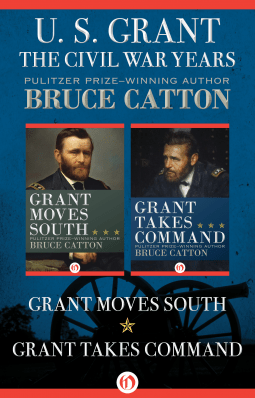
US Grant: the Civil War Years: Grant Moves South and Grant Takes Command*****
I was fortunate to receive a DRC of this two volume biography of America’s greatest general, US Grant. Thanks go to Open Road Media and Net Galley for providing it in exchange for this honest review. This is the sixth Grant biography I’ve read, and aside possibly from Grant’s own memoirs, which are valuable in a different way than this set, I have to say this is hands-down the best I have seen. Catton won the Pulitzer for one of his civil war trilogies, and this outstanding biography is in the same league. Those with a serious interest in the American Civil War or military history in general should get it. It’s available for purchase now.
When I had read a couple of US Grant biographies, I told myself that enough was enough, and that I should push away from this one subject in favor of others. I am glad I ignored my own advice, because I have come away from this prodigious, in-depth study with a deeper understanding than anything else has provided. It’s over 1100 pages long, and over 800 pages once one discounts the end notes and index, but it is as great a pleasure to read at the end as at the start, if not more so.
Is this a good choice for someone new to the American Civil War? Generally speaking (if you’ll pardon the pun) I’d say no, but for someone otherwise well versed in military history or with a tremendous interest level, time, and stamina, it could be. Because Catton is known as an expert in this field, I especially enjoy not having to review his citations. I know his sources will be strong, and one brief overview convinces me this is true.
The first volume starts with his less than glorious entry into the war. As many know, he had been a member of the regular US army during the conflict with Mexico, and had fallen apart and had to go home. Now he is back, but only after a string or two has been pulled by a family friend, and even then, his task is a daunting one. Volunteer soldiers don’t take orders or submit to discipline as a West Point soldiers do, and when he arrives, it seems the lunatics are running the asylum. One of the things that I am impressed with anew every time I read about Grant is his unerring judgment, the social radar that is an indisputable part of his talent. By knowing where to go easy on his men and how to bring them into conformity where it’s most important, he creates a solid force to move South with.
The battles of Belmont, Fort Henry, Fort Donelson, and the tragic but technically successful battle of Shiloh open up the Mississippi River for the Union and divide the South. Catton uses a number of anecdotes that are new to me, and his congenial tone, occasionally caustic wit, and spot-on analysis leave me both energized and contented at the same time.
The second volume, however, is where I learn the most. Until I read this biography, I haven’t understood exactly how great a risk Lincoln takes when he orders that the US military forces should be given the ballot, an unprecedented move, as he himself runs once more for the highest office. His opponent, McClellan, is a former Union general that at the war’s outset, was at the top of the chain of command. He didn’t go home a happy man, and now he is running as a Copperhead, the moniker given those in the North that want to end the war and let the South leave the Union, slaves and all. And though I know it is often the case that soldiers and sailors choose to support their Commander in Chief at the ballot box, I haven’t fully recognized how badly this may go for Lincoln. Doesn’t every soldier want to go home? This is the Democratic ticket’s promise; end it now and send them home.
On top of all that, Lincoln and Grant, who think a lot alike, clamp their teeth together and endure the white knuckled ride that they know they’ll be facing when they decide against further prisoner exchanges with the South. There are two strong reasons for this decision: first, the South refuses to recognize Black men in uniform as soldiers, and won’t exchange them, assuming that all of them must be escaped slaves, including those with Northern accents. Grant declares that no prisoners will be swapped until the South is willing to parole every Northern soldier, and he means it.
In addition, both Lincoln and Grant realize that the South is running low on manpower. There are thousands of their soldiers sitting in military prisons; to trade them out and risk seeing them back in uniform is to turn a military contest into a war of annihilation. With prisoner exchanges, the war will last longer, and there will be more death. In a peculiar way, refusing to exchange prisoners is the more humane policy.
In an election year, this is a tough sell. There are families up North that have been notified that their son, brother, father, is a prisoner of the enemy, and word has by now been spread as to what kind of conditions those poor men face. How much harder is it to vote for Lincoln and the fight for the reunification of the republic when to do so is to prolong the time their loved one sits behind bars, slowly starving? Lincoln and Grant could temporarily resume prisoner exchanges until after the election, but they stand on principle, and it pays off.
Another thing that I don’t really grasp until I read the second volume is Grant’s relationship with the Army of the Potomac, a collection of men that to some extent have been poisoned with McClellanism. It’s a real tightrope walk, and he is deft in his dealing with it. I can’t tell you everything he does here; that’s the point of the book, after all. But I came away with a renewed respect for General Sheridan, and an interest in reading biographies of that general also.
How much of Sherman’s march through Georgia and then to the sea is Grant’s idea, and how much of it is Sherman’s? I come away understanding this better than before as well, although I have read both Grant’s and Sherman’s memoirs. Catton has a way of crystallizing events without oversimplifying them.
And I nod with solemn satisfaction at the cold fury Grant experiences when he learns of the assassination of President Lincoln and the attempts on the lives of others, including himself.
I still shiver with pleasure when I reread the denouement, in which Grant sends General Weitzel and his troops, some of whom are Black, into Richmond when the Confederate capitol falls. I want to cheer as the throngs form for the military review in Washington DC after the war has been won; all those thousands of soldiers, all those citizens and international visitors in the stands and on the sidewalks, singing “John Brown’s Body”. Think of it!
I promised myself to be brief, and I haven’t really done that, but this is the least I can bring myself to say about this excellent biography. If my review is too long to hold your attention, then this two book series—even while allowing for the fact that Catton is a far better writer than I—will also be more of a meal than you are prepared for.
But for those with a sufficiently great interest level and stamina, I cannot imagine a better memoir of Grant for you to buy and enjoy. Enthusiastically recommended!

To Kill and Kill Again, by John Coston****
The Terrifying True Story of Montana’s Baby-Faced Serial Sex Murderer

They say you should do what you’re good at, and unfortunately, Wayne Nance was good at killing people. He enjoyed his work. This is the true story of the man dubbed “The Missoula Mauler”, who killed primarily based on opportunity, high in the rugged Rocky Mountains between 1974 and 1986. Thank you to Net Galley and Open Road Media, from whom I received a DRC in exchange for this honest review. The digital version of this true crime story was released October 18, and so you can buy yourself a horrifying Halloween present today. But turn all the lights on before you dive in. Lock your doors, and check your windows. If you have a basement, secure that as well. This isn’t a thing you want to read while you’re home alone at night.
I don’t read much true crime, because it’s dark stuff. To be honest, I wouldn’t have read this one, but an Open Road rep contacted me by email regarding another title I had read, and she was having a Monday moment; consequently, she asked me to review this title rather than the one I had read, and I figured I’d been invited to read it. I don’t turn down an invitation unless I know for sure I won’t like the book, so really, I read this one mostly due to a misunderstanding. By the time it was cleared up, I had downloaded it and was 20% of the way in, and I wanted to see how it came out.
The interesting thing about Nance is that he doesn’t seem to fit the serial killer stereotype. He was a quirky guy, true. But nobody said he kept to himself, or that he was quiet. He was sociable, and he was considerate, an apparently thoughtful young man that would run an errand, drop something off at your house while you were working, bring you your lunch…of course, there was always a chance he’d either forget to return your house keys or make a copy to keep, but that couldn’t hurt you if you didn’t know about it, right?
Well, actually it could. Sometimes it did.
I recently reviewed Open Road’s Fire Lover, a true crime story in which the killer seems drop-dead obvious. That isn’t the case here. At one point Nance came up as a suspect, but he had an alibi. I think when a person lives in a small Montana town and terrible things happen, it’s comforting to assume that the horrific, violent things that have been in the local news are done by an outsider, someone passing through. Maybe it’s a trucker that drives through from time to time, or some other outlier. Nobody wants to think it’s someone they work with, that they see every day.
I have to tell you, this story is not just scary, but it’s also tragic. There are children involved. The book’s blurb says there are photos, but these are not grisly photos of dead people; nevertheless, I found my stomach turning over a time or two. It’s dark, dark business, and you alone know whether you want to read something like this. The satisfying thing is that he is caught, and so other people didn’t die that undoubtedly would have. But as for me, I don’t want to read any more true-serial-killer tales for a good long while, if at all.
That said, Coston has to wade through a lot of data to tell this story, and he does so without getting bogged down in minutiae while setting an appropriate tone and pacing the story expertly. He tells us about the victims so that their own stories will not get lost while we learn the ugly deeds of Wayne Nance.
For fans of true crime that have strong stomachs, this may be the story for you. One thing’s for sure: all your own troubles will look smaller when you are done here.
Mission: Jimmy Stewart and the Fight for Europe, by Robert Matzen****
In Mission: Jimmy Stewart and the Fight for Europe, Robert Matzen provides an engaging, compelling memoir that focuses primarily on Stewart’s time as an aviator during World War II. Thanks go to Net Galley and to Goodknight Books for the DRC, which I read free in exchange for this honest review.
The book begins with Stewart’s childhood in a small Pennsylvania town. His is a close knit family with a strong military tradition. An outstanding student, he is educated at Princeton and falls in love with theater one summer. He hits the road for Hollywood to fulfill his dream.
Because of the title, I am taken aback at the amount of celebrity gossip that is included in the first portion of the biography. Matzen wants us to know that Stewart used his skinny-awkward-young-man routine as a sort of foreplay to work his way between the sheets with one well known actress after another; he lists many of them. I could have lived without this part, but maybe you’ll enjoy it. If like me you are really only interested in the military aspect of it, skip the Hollywood part at the start and pick it back up when he enlists. Eventually this is what I did.
Once there, the story is fascinating. Stewart resolutely straight-armed studio efforts to keep him in the USA or use him to entertain troops, as some actors that are drafted chose to do. He angers a studio head who actually tells him, “You’ll never work in this town again”. He decides he is going to do his part like any other man, apart from the fact that he had always wanted to fly and now has the money for a private plane and flying lessons. Once he is actually in uniform, he is able to become the aviator he has dreamed of being as a youngster.
As Martzen unspools Stewart’s story, which had to be difficult to research given Stewart’s resolute refusal to discuss that period, I am instantly engaged. I had known at one time that the planes were not heated back then, but hadn’t fully appreciated the dangers and challenges posed by the cold alone once in the air. A man could suffocate if he didn’t regularly break the ice off of his mask. Men could and did lose body parts to frostbite.
The stories of the men that would eventually serve under him as he rises in rank, not due to strings pulled by authorities but as he has wished, by merit and leadership capability, are also both interesting and poignant. Reading the way the pilots name and decorate their planes, how individual aircraft with idiosyncrasies that make them handle differently so that the pilots strongly prefer to fly their own ships, is interesting, and reading the personal details and in some cases, the deaths of these men is wrenching in some places, poignant in others.
When Stewart has completed his military service, he looks at least ten years older than he is. He’s seen a lot. If he returns to Hollywood, there’s no chance he will play the same roles he used to do. He stalwartly refuses to exploit his time in the service by making World War II films, which are enormously popular, and for a long time, his phone doesn’t ring. He’s sleeping at his parents’ house in his old childhood bedroom, wondering what will happen. But in time he hears from Frank Capra, who has an idea for a picture “based on a story titled ‘The Greatest Gift,’ about a man from a small town who wishes he had never been born. Jim was the only actor in Hollywood whom Capra considered for the role.”
Despite the sense of alienation he experiences with his return to the other-worldly, glitzy city after his gritty, intense experience in the war, Stewart is glad to be back, and he plays what will become an iconic role, that of George Bailey in “It’s a Wonderful Life”. He credits Capra with saving his career, and is overjoyed to be back:
“He was engaged in something magical again, something to interest people in the art of living, rather than the art of dying.”
The book also discusses Stewart’s lifelong friendship with Henry Fonda, and his marriage. We get a brief overview of the peacetime lives of the surviving members of Stewart’s first crew.
If it were up to me, I would remove all of the somewhat jarring photos at the end of the book that show Stewart alongside one actress after another, and I’d replace them with photos and maybe diagrams of the planes we hear so much about. A map here and there wouldn’t hurt, since we follow his flight paths and it’s sometimes hard to visualize where these places are. I used Google, but would like to see these included as part of the published memoir, perhaps in the center, where they’re most relevant.
I recommend this biography to fans of Stewart’s, and I recommend most of this book to those with an interest in military history. The book is available to the public today, October 24, 2016.
American Gothic:The Story of America’s Legendary Theatrical Family—Junius, Edwin, and John Wilkes Booth, by Gene Smith***
I was invited to read and review this title by Open Road Media and Net Galley. Thanks to them for the DRC, which I received in exchange for an honest review. This title was released to the public October 4 and can be purchased any time you want it.
Although I love a good night at the theater as much as anyone else, I came to this bearing a love of history and a strong affinity for the American Civil War. I didn’t realize to what extent this would be purely a biography of this family of actors, and it was because of this that I became somewhat disillusioned.
Smith has carefully documented the lives of Junius, Edwin, and John Wilkes Booth. He talks about their predecessors, their early development, and their careers, and he documents everything he talks about. Those studying nineteenth century American actors will want this book, because these men were the most famous of their time period, tickets to see them perform much sought after.
My problem is with the elephant in the room.
It’s hard not to approach John Wilkes Booth without thinking about military history, and about his role in what was essentially an incipient CIA within the Confederacy. Other sources neatly document the fact that it was not a case of simple mental illness on the part of an assailant that made President Lincoln, the greatest president in the history of the USA, die. There was a great deal of planning involved, of research about where he would be and when he would be there. Contacts were made, and a plot was launched that was initially much more far reaching in scope, but with the surrender of Lee’s army, others within the cadre left town fast and didn’t look back. Booth was the one that decided he was going to follow through, one way or the other. How much of it was due to a longing for an historical spotlight, how much was due to emotional instability, and how much was a calculated effort to revive the Confederacy by assassinating Lincoln, we do not know, but what we do know, and what Smith doesn’t say, is that this was not a matter of simply yielding to impulse, of losing one’s sanity and suddenly deciding to kill a great leader. It was done in a calculated way, and I can’t respect this biography when this information is omitted. All we hear about are references to early signs of “madness”, as if this horrible deed can be swept to the side by the use of one well-placed word.
That being said, The New York Times loved this book. If the history of acting is your wheelhouse, you may want to read it. There’s nothing of method or technique that will help a developing actor, but it doesn’t pretend to be. It’s about the actors’ lives and careers, and that’s pretty much it.
Those that treasure history as a bigger picture, or that are looking for some tiny morsel to help them understand what made John Wilkes Booth carry out this monstrous, well-planned killing will remain as much in the dark when the book ends, as they are now.
Being a Dog, by Alexandra Horowitz****
Horowitz is the author of Inside of a Dog, and here she follows it up with an examination of the sensory experiences a dog encounters, primarily that of smell. I received my DRC courtesy of Scribner and Net Galley in exchange for this honest review. And though I’ve never been a science maven, Horowitz’s unbridled enthusiasm for dogs had me at hello. It’s a book bound to engage any dog lover.
So, do you have a dog?
I’ve had a dog nearly all of my 58 years, with a brief interim here and there. I’ve never been dogless long, though; either a dog has found me, or I’ve gone looking for one. And so I was glad of the opportunity to read more about what makes my dog—right now it’s Ox, the oversized beagle puppy—work. I’d read a fair amount about dogs, particularly beagles, my favorite breed, and I thought I was well schooled, but I learned a great deal from Horowitz that I hadn’t known before, or in one main instance, in a way I had known intellectually, but not in my gut.
Almost every dog lover has heard at some point that a dog tends to be governed by its smell, and that this is its dominant sense. But until Horowitz took it apart for me and gave me the details, I didn’t grasp the implications. For example, when we throw the ball, the dog pauses before running after it, right? And with our last little dog, my husband and I would note that he wasn’t really looking in the right place, and we concluded that he was as dumb as a box of rocks. We’d yell; we’d point to it. And eventually, after he had sniffed its perimeter, he’d hone in on the ball and bring it back. And this book explains why that is exactly the correct way to do the job, if one is a hound (or other dog) rather than a human.
Sight is so important to us humans; next comes hearing. If we are in a carnival’s haunted house, and if the first room is sightless and soundless, what do we do? Do we sniff? Of course not! We fling out our arms in front of us or to the sides, partly to find out where things are, and partly to protect ourselves from slamming our face into a hard surface. And now when I consider Ox’s sense of scent, after which is hearing, I realize that by the time he has to look at something, he’s probably gained most of the information he needs already. Why would we fling our hands out in an ungainly manner if we can see and hear? And so indeed, why would my beagle do a visual scan if he can find what he wants through the use of sniffed air currents and hearing? After all, he always brings the toy back to us.
Chapters that engaged me less contained miniature chemistry and physics lessons, never my favorite, and some had longer passages having to do with human olfactory sense than I really wanted to read. I confess after the first few times the author moved from dogs’ senses back to those of humans I skimmed until we were back to the dogs.
There was so much here I hadn’t seen. For example, where does one find the best material for search and rescue dogs, or arson, bomb, drug, cadaver dogs, and so forth? I’ll give you a hint: I was crushed to find out that my beloved hound dogs aren’t necessarily the favorites here. But it sure is interesting!
Once I had read this book, I felt that I knew my dog a lot better, and this new information solved many of Ox’s previously puzzling habits. To learn more, check out Horowitz’s new release, which became available to the public yesterday.
Because although I don’t know whether a dog is man’s best friend…I know he’s mine.
The Big Change: America Transitions Itself 1900-1950, by Frederick Lewis Allen***
2.5 rounded up. The Big Change was a National Book Award finalist back in the day as well as a New York Times bestseller. I was invited to read and review it now that it’s being released in digital form; thanks go to Net Galley and Open Road Integrated Media. I’ve read and reviewed more than 50 titles for this publisher, and they’ve been wonderfully tolerant when I have written less than glowing praise for a book such as this, whose shelf life is well and truly over. This title is available for purchase now.
Allen’s book is written as a popular history. For a lot of people that makes it more accessible than a more scholarly approach would. As for me, I appreciate a citation, and I read those notes to see where the author gets his information. If he’s citing other secondary sources, the obvious thing to do is go read the secondary sources instead. If he’s done some real work, puttering from one obscure regional library to another in order to peruse their rare books, original diaries of heroes long gone, and so forth then I know I have found a researcher who can do me some good.
But for those delving into this period for the first time, this is in most regards a sound overview of the period in question, kind of like a contemporary history 101 for white men. Allen covers the turn of the century, when capitalism was unchecked and unashamed; The Progressive Era and World Wars I and II; the Depression, and the postwar boom. He devotes some of his space to the huge labor struggles and mentions the IWW (International Workers of the World, or ‘Wobblies’). The uses a friendly, readable tone and if there had been any women or people of color anywhere, anywhere, anywhere (other than a quick nod to suffrage) I might have found another star. Or half a star.
Having said that, I should also point out that Allen was not especially conservative or reactionary in comparison to other historical writers during the 1950’s, which is when he wrote and published this. In fact, anyone that did include women in a more than passing manner, or that included people of color, was considered a radical by many. Most academics would have laughed at them. So it’s all about context; some best sellers of the past, such as the Pulitzer winning Bearing the Cross, David J Garrow’s biography of Dr. Martin Luther King, just get better with time; others, like this title, have a more limited shelf life.
I’d recommend this title to those with a special interest in the time period, but only as supplementary material.
George Washington’s Secret Spy War: the Making of America’s First Spy Master, by John A. Nagy***-****
Nagy does a more than serviceable job in documenting Washington’s intelligence methods. Thank you for the DRC, which I received free in exchange for an honest review from Net Galley and St. Martin’s Press. This title is for sale today.
Washington first learned spy craft when he was fighting for the British Crown during the French and Indian war, a nasty conflict that puts the American Revolution in the shade in terms of lives lost and financial expense. Later he would take the education he had gained as a member of His Majesty’s forces and use it to lead the American colonists to victory as citizens of an independent nation.
Nagy conscientiously documents his case that it was this knowledge of spy craft that won the Revolution. He cites everything, and he uses primary documents that you and I would never ferret out in order to do so. Students of the American Revolution, the French and Indian War, or the history of American intelligence-gathering should consider this book an indispensible addition to your research material.
In the tradition that continues to this day, Washington found there were only two possible outcomes once a spy was apprehended. The first and most usual thing to do was hang them. Once in awhile one could turn them. And he had absolutely no scruples about torturing them first and hanging them later.
As a popular read, I rate this title three stars, and it’s really not due to any shortcoming of the author’s. He quotes extensively from primary documents such as Washington’s diary, and he didn’t use the same expressions and syntax that are used now, nearly two and a half centuries later. The accepted speech mannerisms for that time are unwieldy to us, and make for some difficult, hyper-literate reading that is not always enjoyable.
But for those that need the information, there are not a lot of places to go, and I think you need this one. As research material this is easily a four star book, and depending upon one’s area of study, it might even be more.
Recommended to researchers and students in this realm.
Michelle Obama: A Life, by Peter Slavin****
I received this book as a birthday gift from a gracious house guest. I think he chose it for me because he knew of my strong interest in civil rights issues. Although this is actually out of my wheelhouse, I decided to read it, and I was surprised how much of it I enjoyed. Of particular interest was the beginning of the book, where a surprising amount of the narrative was devoted to African-American history, especially in Chicago. I hadn’t expected it and found it both interesting and useful.
I don’t generally follow the lives and careers of mainstream American politicians or their spouses, so I didn’t know much of anything about Michelle Obama, other than that she had made it plain, upon taking up that famous residence, that her family would be her main focus and if the public didn’t like it they could lump it. After all, nobody was paying her a salary, so she had some choices.
Reading of how her parents struggled in order to get Michelle and her brother excellent educations, and of the tenacity with which Michelle approached school, social justice issues, and her career, I found myself feeling strangely sorry for her. Before her husband decided to pursue politics, her career outshone his. She was in demand and had a lot of choices. When she headed to the Ivy League, her classmates and professors were almost all white people, and the pressure was on her not only to succeed, but to be the one African-American that would be the example, the cultural education for a whole lot of privileged white people. That kind of hot spotlight would undo some people, make them decide to go on home and enroll at a school closer to home, but Obama—then Robinson—did it and did it well, and then she went back to her hometown, Chicago, to find ways to use her education to serve her community.
As the first Black first lady (FLOTUS), she’s had to make some difficult choices, and there would be a certain level of criticism no matter what she chose to undertake. Her career had been ascending like a rocket, and she took what will likely be a permanent leave of absence in order to keep her family well tended. She hadn’t wanted her spouse to go into politics, because she was convinced, as I am, that being a politician doesn’t end up making a difference. She urged Barack to become an inspirational instructor, or a school administrator, or go to work for a strong nonprofit, but that wasn’t what he wanted to do. He wrote a book; it didn’t sell. (Occupying the Oval Office would change that.) But when two parents put their careers on a fast track simultaneously, often the ones that pay the price are the kids, and she wouldn’t have that for their girls. If it came down to her career versus their development, she was determined to be there for them. And who am I to say that wasn’t the right thing to do?
Slavin is not an official biographer; in fact, after leaving the White House, Michelle plans to publish memoirs of her own. However, this writer was given interviews with people very close to the First Family with Michelle’s blessing, and maybe that is why some noteworthy items are glossed over.
Because whereas this memoir is about her more than him, a fair amount of the president works its way into the text. Their lives are joined, after all. And it does seem a little myopic not to have addressed the elephant in the room: the first Black president can’t prevent cops all over the country from shooting Black men—and sometimes women—all the damn time and for no good reason. After all the protests that took place all over the nation, with chants and signs of “Hands Up, Don’t Shoot!” and “I Can’t Breathe!”, you’d think it would merit at least a paragraph.
It’s like it never happened.
So if you are an admirer of the Obamas, this is not a bad book certainly. And it’s tempting to jump into their court, so to speak, based solely on the amazingly stupid things about birth certificates and loyalty that the ultra-right has come out with, questions that a white presidential family would never have to confront.
But when push comes to shove, this book won’t make a big difference, and sad to say, neither will the Obamas’ eight years in the White House. It’s good to know that American society has moved forward enough to elect a Black president, but like all the presidents before him, his authority is limited and to some degree, illusory.
I recommend this memoir to those with an interest in Michelle Obama. Those eternally present polls that reflect the public’s perception of those in the White House show that a much greater number of Americans admire her than approve of the president. But of course, one doesn’t have to be American to want to read this; one only needs to be interested in the life of this historically first, First Lady.