Scars of Independence, by Holger Hoock***

ScarsofIndependence I was invited to read and review this title by Net Galley and Crown Publishing. Thanks go to them for the DRC, and my apologies for being late, late, late. The title was published last month and is available now.

The strongest part of Hoock’s history, which seeks to set the record straight on the American Revolutionary War, is his research. He is an historian of some renown, and his entire life has been dedicated to studying and teaching about Britain. His sources are, as one might expect, thorough and impeccable. His thesis is that there was a great deal more violence over the course of this revolution than is commonly remembered, and

“By ‘violence’, I mean the use of physical force with intention to kill, or cause damage or harm to people or property. I also mean psychological violence: the use of threats, bullying tactics, and brutality to instill fear in people and influence their conduct and decisions…”

This is indeed a broad brush. In most courts of law today, a property crime is not considered a crime of violence, nor should it be. Better someone run away with your television set than shoot you, or knock you over the head, or hurt your family. And…bullying? Certainly such behavior gets more attention today, both legally and socially, particularly where young people are concerned; yet we are talking about a revolution here. A revolution! And this is part of what prevents me from engaging fully with the text. In the thick of a battle that will determine the futures of everyone concerned, a war to wrest control of its destiny from the mightiest naval power on Earth, it seems a bit of a stretch to expect that American Patriots and Loyalists would treat one another with perfect courtesy.

This brings me to the other part of this history that makes this reviewer cranky. The teaser suggests that this will be a balanced account, demonstrating that far more violence occurred on both sides than is widely taught in American schools, and it just isn’t so. In point of fact, although both Americans and Brits are discussed and shown to be more violent than most of us know, most of this book is dedicated to discussing the unprincipled, the unkind, the indecent ways British troops and loyal colonists were mishandled by brutal American Patriots. I went through my DRC with a highlighter, and far more space is given to bullying, demeaning, and other anti-British behaviors.

“Less careful individuals risked being investigated if they were overheard criticizing their local committee, if they drank a royal toast or sang “God Save the King” in the wrong company.”

My violin please.

There’s a lot of strong material here, and some of the tales of physical violence are graphic. In fact, the level of gory detail may be the summer reading dream of a nerdy teen with a strong reading level. And there is a lot of information that is new to me. Hoock depicts Lord North and King George III very differently from any other historian I have read; it would be easier for me to believe that Hoock’s viewpoint is the accurate one, had he admitted up front that he was writing from a largely Anglo-centric perspective.

The maps bear mention here. Rather than produce new maps that are legible on a DRC, Hoocks has chosen to use actual maps from the time period. This choice is hard to argue with; they’re primary documents, and although a second map that is more readable might be desired, I can’t argue that these maps should not be used. In fact, it’s interesting to see a map that includes what is now the Eastern USA and Eastern Canada with no line of demarcation, because nobody at the time regarded the US and Canada as separate entities. But I would say that those that want to read this book and that want the maps—which are important—should consider buying this title on paper rather than digitally, unless you intend to read it on large computer monitor.

Although the text isn’t as evenly balanced as the introduction implies, this is still a strong addition to the study of the American Revolution. It’s not an overview of the Revolution and does not pretend to be, so those looking to read just one book on the American Revolution should get something else. But for historians that want to deepen and enrich their understanding of this struggle and that think critically and independently, this book—in paper—is recommended.

Hannibal, by Patrick N. Hunt***

HannibalHannibal was the first general to defeat the forces of Rome, and Hunt is the man qualified to tell us about it. I read my copy free and early thanks to Net Galley and Simon and Schuster. This book becomes available to the public July 11, 2017.

Early history has never been my area of concentration, but since retirement, I push myself out of my usual comfort zone, often to excellent result. This time it proved to be a mixed blessing. On the one hand, Hunt is unquestionably qualified to discuss this topic. He is an historian of renown and has dedicated years to the study of Hannibal, even embarking on an expedition across the Alps in order to see what Hannibal experienced—or the closest proximity to it in modern times. On the other hand, I confess I was in it for two things: military strategy and history, which does interest me, and of course, the elephants.

Imagine riding into battle on the back of an elephant. Not only is an elephant massive, it is also impervious to most of the weaponry available at this time. Spears and javelins would just bounce off its hide. War elephants had their tusks sharpened, and being charged by such a force had to be terrifying. And in reading this history it occurred to me that Hannibal’s men would have been bemused indeed if they had known that elephants would be regarded by many of us, in future days, with great sentimentality. They would never have believed the elephant might become endangered. Who could kill elephants? But these are my musings, not Hunt’s.

Hunt is meticulous in demonstrating what Hannibal did and why he did it. He starts with his family background, in particular that he was the son of the great general Hamilcar, who took him to a temple, made him stand at the altar where the live sacrifice had been made, and swear lifelong hatred of Rome, whose government and military made war against Carthage and caused a lot of suffering. Hunt carefully separates what actually happened, from what probably happened, from what maybe happened, but the speculative language—may have, would have, almost certainly—slows me down, because each time the narrative picks up and I immerse myself in the text, I see the modifiers and draw back. I go back and reread in order to find out what is actually known, mentally removing all of the guesses and educated guesses, and then I am left with what is known. And although I appreciate that there are not vast treasure-troves of primary documents sitting around for Hunt to access, given the antiquity of the subject, I wish there were some way to read only the known facts. At the 70% mark I became frustrated and bailed.

Hunt quotes often from Livy and Polybius, both of whom I read many years ago as an undergraduate, and which still grace my shelves. My initial impression was that it might be more useful to go dig up those books, reread them, and give this one a miss. However, what Hunt does is sift through their information and provide an analysis that is deeper and more objective than theirs. Livy was, after all, a Roman; he is renowned as a scholar, but not necessarily objective.

And so those that have a serious interest in the history of Northern Africa and/or Southern Europe, or an interest in military history, can count this as a strong title to add to their historical libraries. To put it another way, what it lacks in terms of easy flowing narrative, it makes up for in accuracy and analysis.

Recommended to those that have a serious interest in world history or military history.

Summertime, and the Reading is Easy

On my radar for July and August:

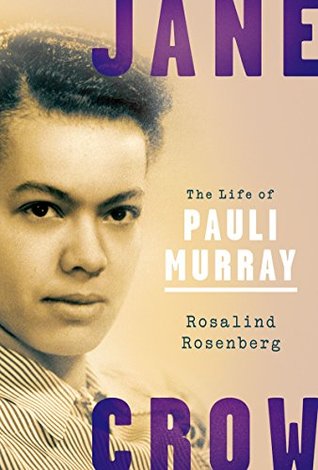
Jane Crow, by Rosalind Rosenberg****

JaneCrowPauli Murray is the person that coined the term “Jane Crow”, and was the first to legally address the twin oppressions of color and gender. I had seen her name mentioned in many places, but this is the first time I’ve read her story. Thank you to Net Galley and Oxford University Press for the opportunity to read it free in exchange for this honest review. This biography is for sale now.

Murray was born in North Carolina and was a labor activist during the turbulent 1930s. She was academically gifted and hardworking, but tormented by the issue of gender. 100 years ago, in the time and place into which fate dropped her, there was no recognition of trans people, and so her sense of herself (the pronoun she used) was that surely there was some unseen physical aspect to her body that must be male. She searched high and low for a surgeon that would perform exploratory surgery to discover whether she had an undescended testicle or some other material explanation to explain why she was convinced that she was actually male. It hurts to think about it. Those born after the early-to-mid-20th century cannot comprehend how the suggestion that gender could be binary was seen, and Murray was a devout Christian as well, and became an ordained Episcopal priest. By the time trans people gained respect from a significant percentage of Americans, Murray was no longer here.

Despite the misery and confusion that was inherent in such a life, Murray was prolific. She was declined a place at the University of North Carolina because of her race, and later denied a place at Harvard Law because of her gender. She graduated at the top of her class at Howard Law, the only woman in her class. Later she would be largely responsible for inclusion of the word “gender” in the title VII in 1964. Those of us that have benefited from that law—and there are a lot of us—tip our hats to her memory in gratitude.

Rosenberg has done a fine job in telling us about Murray. Her documentation is flawless and her narrative clear. At times—particularly in the beginning, before Murray’s career really catches fire—it’s a trifle dry, but I would prefer a clear, scholarly, linear narrative such as this one, over an exciting but sensationalized, less well documented telling any day of the week.

Those interested in the American Civil Rights movement and the history of the women’s rights movement in the USA should get this book and read it. Even if used primarily as a reference tool, it’s an indispensable resource, particularly to those with an interest in legal matters relating to discrimination and equity.

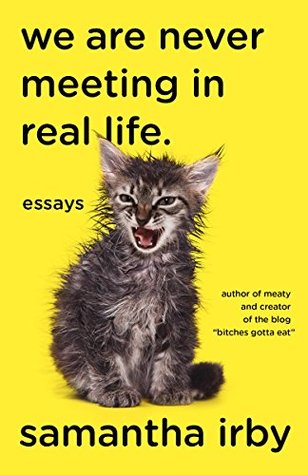
We Are Never Meeting in Real Life, by Samantha Irby*****

wearenevermeetingGet out your plastic and go use the restroom, because this book will leave you holding your sides. Samantha Irby mines what ought to be old material but isn’t, at least not by the time she is done with it, and her edgy, plain-truth humor may leave you breathless by the time the last page is turned. My thanks go to Net Galley and Knopf Doubleday for the DRC, which I received free and early in exchange for this honest review. This book has just been released and is available for purchase.

Much of the base level subject matter is eternal and well worn: needing to use the bathroom while stuck in traffic; dating; racism; attempting to lose weight. But Irby has a fresh take on everything. She refers to herself as “old”, and since at 36 she is the age of this blogger’s eldest child, I suspect that I am not her target audience. But so much of what she says is eternal, and her take on current social concerns such as cop violence and the horror of stumbling upon a bunch of white people in the hinterland performing a Civil War reenactment complete with Confederate flags is welcome and resonant. The thread in which she voices the horror of being away from a major urban center is one I share. I have not laughed at potty humor since I was twelve, but the essay containing the traffic jam bathroom emergency on the way home from the dorm made me laugh hard enough to shake the bed, and my husband—a silver-haired Japanese gentleman old enough for Social Security—laughed hard enough that he was doubled over. The passage where she discusses having squandered money on things she doesn’t need just to prove she can do it is just one instance where I laugh because I am surprised. What writer ever admits this? Irby does.

Other aspects of this wonderful collection of essays were more educational than resonant, but also good to read. Can Black women admit they have mental health issues and still be Black?

Her cover model represents the cat from hell, Helen Keller:

“’I know where they keep the euthanasia solution,’ I whispered into the downy fur on top of her head.”

Every book blogger knows the pressured feeling that comes with scooping up a galley right before publication. When I begin the book, all I want is to read it fast so I can review it in a timely manner; yet by the time I turn the final page, I am disappointed that we are done here.

Highly recommended to strong women with an offbeat sense of humor, and those that love them.

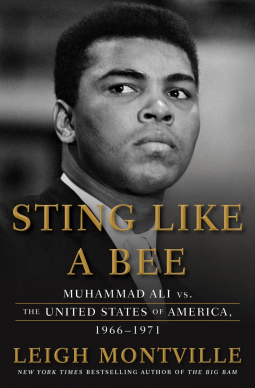
Sting Like a Bee, by Leigh Montville**

stinglikeabee“’It takes a lot of nerve for somebody, mainly a white, to ask me do I hate. I haven’t lynched nobody and hid in the bushes.’”

I received an advance copy free from Net Galley and Doubleday in exchange for this honest review. The book is now available for purchase.

Muhammad Ali died of Parkinson’s disease one year ago. By the time of his passing, he had earned the respect and recognition he craved. In this popular biography, Montville gives an overview of his rise to fame, but focuses primarily on Ali’s legal challenge to the US government, which strove to draft him to fight in Vietnam despite his professed status as a conscientious objector.

During the 1960s and 1970s, almost all of Caucasian America and a goodly number of African-Americans regarded Ali’s public statements either with derision or fear. Born Cassius Clay, he joined the Nation of Islam as a young adult and changed his name in the same way Malcolm X had before him. He did it in order to shuck the slave name given him at birth and adopt a new religion that taught him that Black men were not only equal to white folks, but better. Malcolm X had advocated Black pride and scared a lot of people, but he had done it from the point of view of a political activist. Ali was the first Black athlete to stand up tall and tell all of America that he was the greatest. The descendants of slave owners that willingly or not bore the guilt of the oppressors were absolutely terrified. This was the fear they seldom made themselves face, the notion that the descendants of those so grievously wronged might rise up belatedly and give back some of what their ancestors had been dealt. I was there; I remember.

Ali personified the white man’s fear of the jungle. Dude, here he comes; he’s strong, he’s angry, and he’s free!

Montville recognizes up front that when Ali died, he was an icon, both as an athlete and as a civil rights advocate. But the tone of his prose shifts from a more or less neutral journalistic tone, to a wry one—because Ali did say some outrageous things by anyone’s standard—and then, again and again, to a derisive one. The first time I saw it, I told myself I was tired and grumpy, and that I was probably being overly sensitive. My own family is racially mixed; I have raised a Black son. Sometimes I get touchy when I read things written by white authors about Black people. I should put the book down and examine it tomorrow with fresh eyes.

When I picked it up the next time I was immediately taken with the writer’s skill. His pacing is impeccable. Some of the quotes he chose are really delicious ones, although with Ali, it’s also kind of hard to go wrong. And at this point I considered that since we were on a roll, I should take the next step and examine the end notes and documentation.

Huh. Apart from a list of sources, most of which are biographies written by other people, there’s nothing. There are the in-text references a popular biographer uses, telling us, for example, that a direct quote comes from the magazine Sports Illustrated, without telling us what issue or who wrote it. And to be fair, that’s how a popular biography is written. It’s there for the masses that love boxing and aren’t going to check your footnotes. Everything within my academic heart recoils at this kind of biography, but it sells. I may not like it much, but people will buy it and they’ll read it.

But to write about a legal challenge of this magnitude and not provide specific documentation?
I could mention this within a review—as I have—and say that given this particular caveat, the biography is a four star read, and I thought that I might do that. But when I continued reading, there it was again. The author makes fun of the guy. And so just before the halfway mark, I started making careful notes of my own, because I wanted to see for myself how it is possible for a writer to appear to be neutral much of the time and yet also mock his subject. What I came away with is that the more straight-forward, respectful material is buried in the middle of each section, but the briefer sneering, snide material is usually right at the end of the section in one sentence, set apart from everything that came before it.

Writers do this for emphasis.

Fans of Ali will have to swallow hard to make it through this biography. Fans of boxing will find that it’s mostly about the legal challenge, and although Ali’s boxing matches are included, you’ll find a lot more about those in any one of the numerous other Ali biographies published earlier. And those interested in his legal fight may want to hold out for a more scholarly treatment.

When all is said and done, Ali was the greatest, but this biography is not.

Coming Up

Celebrations here in the family domicile have momentarily distracted me, but that all ends tomorrow. Before I commence partying with family tonight, I thought I’d show you the books you can expect to see reviewed here over the weekend. Some are memorable and others not-so-much, but I am surprised by which are which. Wait for it:

Hillbilly Elegy, by J.D. Vance*****

HillbillyElegyI confess I was miffed when I wasn’t granted a DRC for this title, and after reading a couple of reviews, I decided I could live without it. I began to wonder about my choice when I saw it hover on the best seller lists where it remains as of this writing nearly a year after its publication, But the clincher came when my younger daughter came to me and said that she had read it digitally and believed I would enjoy it. She said it had to do with the culture of mining families, and that the dedication was to the writer’s “Mamaw and Papaw”.

It hit me like a bolt of lightning.

A personal note of explanation: I am a grandmother myself now, and my own Mamaw and Papaw were both dead and gone by the time I learned that this was not a set of names that belonged to my family alone. I was the youngest among my cousins and siblings, and had somehow assumed that these grandparents’ names were the result of something said by one of the older kids when they were small. By the time I came along, they had left the mines of the rural Rust Belt and purchased a small working farm in central California. No one else I knew had grandparents with those names or had heard of them. Later my grandparents, aunt and uncle (who—I am not making this up—were an Aunt Sister and Uncle Brother) would relocate to the mountains of Southern Oregon, to the farthest outreaches, secret places up barely-there dirt roads that would make a survivalist happy. Neither California or Oregon is mentioned at all in Vance’s memoir, and so it makes me wonder just how far this culture has permeated across the USA.

Vance tells us that his memoir is particular to the culture of working class Scots-Irish people, primarily in the Appalachian Mountains. But of course, when one mine closes, miners follow the work, and so the culture has spread quite a long way. He himself didn’t grow up in Appalachia, because his grandparents had made a point of moving away from there when a factory opened in a small Southern Ohio town, and so that was where he spent most of his childhood. But the roots ran deep, and they often returned to the West Virginia area where most of the family remained.

The memoir itself is fascinating. His grandparents were enormously tough and tremendously loving. He recounts one experience in which a drug-addicted visitor appeared to be dying of a PCP overdose in the front room, and Mamaw ordered that the person be dragged to a nearby park, because “I don’t want him to die in my fucking house!”

Another time, the author’s immensely unstable mother had beaten JD, and Mamaw persuaded him to lie to the cops, who could never be a part of any solution to their family. Instead, once in the car, “We drove home in silence after Mamaw explained that if Mom lost her temper again, Mamaw would shoot her in the face.”

I am amazed at the similarities that exist between Vance’s culture and that of my father’s family. Over the years succeeding generations have become more educated and moved, for the most part, out of the tulles and to suburbs and cities. But many of the values and cultural nuances remain. And if this is true for me, a Seattle resident of nearly 30 years, how many others across the nation will recognize it as well? Perhaps this is part of the book’s tremendous success.

In closing I want to give a shout-out to Powell’s City of Books in Portland, Oregon, the city where I grew up. Powell’s has a daily drawing for its reviewers, and each day someone wins a $100 gift certificate. My prize is what made it possible for me to purchase this glorious brand new, hard cover edition.

Highly recommended to those interested in the culture of Scots Irish mining families and their descendants, and to those that love excellent memoirs.

The Song and the Silence, by Yvette Johnson*****

TheSongandtheSilenceI was browsing the pages of Net Galley and ran across this gem of a memoir. Often when someone that isn’t famous gets an autobiography published by a major publisher, it’s a hint to the reader that the story will be riveting. Such is the case here; my many thanks go to Net Galley and Atria for the DRC, which I read free in exchange for this honest review. You can order it now’ it comes out Tuesday, May 9.

It probably says a great deal, all by itself, that I had never heard of Booker Wright before this. I have a history degree and chose, at every possible opportunity, to take classes, both undergraduate and graduate level, that examined the Civil Rights Movement, right up until my retirement a few years ago. As a history teacher, I made a point of teaching about it even when it wasn’t part of my assigned curriculum, and I prided myself on reaching beyond what has become the standard list that most school children learned. I looked in nooks and crannies and did my best to pull down myths that cover up the heat and light of that critical time in American history, and I told my students that racism is an ongoing struggle, not something we can tidy away as a fait accompli.

But I had never heard of Booker.

Booker Wright, for those that (also) didn’t know, was the courageous Black Mississippian that stepped forward in 1965 and told his story on camera for documentary makers. He did it knowing that it was dangerous to do so, and knowing that it would probably cost him a very good job he’d had for 25 years. It was shown in a documentary that Johnson discusses, but if you want to see the clip of his remarks, here’s what he said. You may need to see it a couple of times, because he speaks rapidly and with an accent. Here is Booker, beginning with his well-known routine waiting tables at a swank local restaurant, and then saying more:

https://www.youtube.com/watch?v=GM-zG…

So it was Booker and his new-to-me story that made me want to read the DRC. Johnson opens with information from that time, but as she begins sharing her own story, discussing not only Booker but her family’s story and in particular, her own alienation from her mother, who is Booker’s daughter, I waited for the oh-no feeling. Perhaps you’ve felt it too, when reading a biography; it’s the sensation we sometimes feel when it appears that a writer is using a famous subject in order to talk about themselves, instead. I’ve had that feeling several times since I’ve been reading and reviewing, and I have news: it never happened here. Johnson’s own story is an eloquent one, and it makes Booker’s story more relevant today as we see how this violent time and place has bled through to color the lives of its descendants.

The family’s history is one of silences, and each of those estrangements and sometimes even physical disappearance is rooted in America’s racist heritage. Johnson chronicles her own privileged upbringing, the daughter of a professional football player. She went to well-funded schools where she was usually the only African-American student in class. She responded to her mother’s angry mistrust of Caucasians by pretending to herself that race was not even worth noticing.

But as children, she and her sister had played a game in which they were both white girls. They practiced tossing their tresses over their shoulders. Imagine it.

Johnson is a strong writer, and her story is mesmerizing. I had initially expected an academic treatment, something fairly dry, when I saw the title. I chose this to be the book I was going to read at bedtime because it would not excite me, expecting it to be linear and to primarily deal with aspects of the Civil Rights movement and the Jim Crow South that, while terrible, would be things that I had heard many times before. I was soon disabused of this notion. But there came a point when this story was not only moving and fascinating, but also one I didn’t want to put down. I suspect it will do the same for you.

YouTube has a number of clips regarding this topic and the documentary Johnson helped create, but here is an NPR spot on cop violence, and it contains an interview of Johnson herself from when the project was released. It’s about 20 minutes long, and I found it useful once I had read the book; reading it before you do so would likely work just as well:

https://www.youtube.com/watch?v=_xxeh…

Johnson tells Booker’s story and her own in a way that looks like effortless synthesis, and the pace never slackens. For anyone with a post-high-school literacy level, an interest in civil rights in the USA, and a beating heart, this is a must-read. Do it.

Michael Collins, by Tim Pat Coogan****

MichaelCollinsTo date, this is the single best volume that’s been written about Collins, and it’s a meal. I purchased this title on an annual pilgrimage to Powell’s City of Books in Portland, Oregon when I was there to visit family a few years ago. Although the length of the book is listed as 480 pages in paperback, the reader needs to come prepared. The type is tiny and dense, and it took me a long time to wade through it. If it were formatted using more standard guidelines, it would be a great deal longer.

As I write this review I am halfway through Coogan’s epic history of the IRA (Irish Republican Army), and the style in which he writes is consistent in both books. Coogan tells us everything that is historically important, and he also tells us everything else he finds out, with no apparent filtering. His writing is half Irish history, half family Bible in the sense that if someone was briefly or peripherally involved with Collins, their proud relatives can probably find that person and his or her historical role somewhere in these pages. His shoe size is here, and the names of every girl he flirted with. For a man that lived so briefly, he left a large shadow, and the author was plainly unwilling to let even the tiniest bit of research go to waste, relevant or no.

I am somewhat surprised that Collins doesn’t rate more favorably with the author, given that his name is the one most associated with the creation of an independent Ireland. But Coogan does due diligence in establishing the brutality of the British occupiers, who killed indiscriminately with the use of terror. At one point, soldiers opened fire on a school yard where little children were at play; these royal ambassadors were the original school shooters, killing six little ones for being Catholic. In the protests that followed, women and girls knelt before British tanks and said their rosaries for those that had been killed for their Fenian identities.

The Irish freedom struggle took place at a time when the whole world was on fire. The Russian Revolution was unfurling with breathtaking speed; at the same time, there was no established Marxist revolution to look to for guidance, and Irish freedom fighters had no single idea of what political ideology should shape the struggle. Most of the revolutionaries were barely old enough to shave, and a lot of errors were made because of this lack of clear vision. The results were often tragic.

There’s an interesting discussion of whether Irishmen should become German allies during World War I. There is a strong resistance to becoming shills for the British, and so the question, then, is whether to remain neutral, or take the side of Britain’s enemy in the hope of receiving reciprocal assistance. In the end, nobody was organized enough, in this era of little technology, to come up with a cohesive plan, so the point was a moot one.

Should you read this biography? I think it depends upon how much time you have, and how strong your interest level is. One consideration might be to purchase it as a reference volume and flip through it to tease out the most relevant information, but be forewarned: sifting through the minutiae is not an easy enterprise. For researchers, the photos alone might be of interest, since they constitute primary documents.

Recommended for those with strong basic knowledge of Irish history that want to flesh out the details, and for those building a reference library.