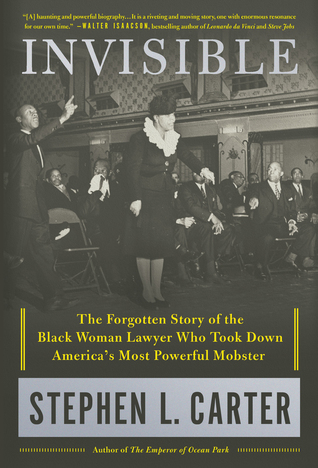
 I received a review copy of this affectionate, well-documented biography free and early thanks to Net Galley and Henry Holt. This book is for sale now.
Eunice Hunton Carter was the author’s grandmother, and though her name is little known today, she was an exceptional woman, a scholar, political activist, and social diva that did extraordinary things during a time period when it was nearly impossible for women of color to rise professionally. Carter tells of her impact on what he calls “the darker nation” and in particular, of her role in taking down notorious gangster Lucky Luciano. She was largely invisible to the mainstream press; this was a time when Black people virtually never won acclaim, and women didn’t either, but it was she that devised the strategy that was needed to try to convict him.
The author is a Yale professor and has a number of successful books to his credit already. This biography is written with the professionalism one would expect; the tone is conversational and keeps the pages turning; transitions are buttery smooth; and the documentation is flawless and meticulous. Those interested in African-American history, or particularly in that of African-American women should read this book.
Carter was born into a well-to-do Atlanta family, leaders among the Negro petite-bourgeoisie. (The author uses the term “Negro” because it was the accepted, polite term during the period in which his grandmother lived.) However, the rise of terrorist groups like the Klan forced successful families of color out of the South, and so most of Eunice’s story takes place in New York City, and it is there that she became a famous woman.
Eunice was a die-hard Republican, and the author reminds us that in the early 1900s, it was still known as the party of Lincoln. Though she did not initially aspire to be politically active—a hat that her mother, Addie, already wore—she became involved in Dewey’s various campaigns after working with him in the prosecutor’s office.
The story is well documented and the voice is distinctive. Two things got in the way of my enjoyment of this biography. The first and technically most significant is focus. The author seems at times torn between his desire to write his grandmother’s biography and perhaps a desire to write about his entire family. I’ll be absorbed in the events that shape Eunice, but then her mother is mentioned—as is appropriate, since her mother is so influential in Eunice’s development—but then we’ll see more about her mother. More, more, more. Pages of Addie. When the author smoothly returns us to Eunice I sigh with relief, snuggle into my chair, and then a few pages later, there we are again. Numerous times I have typed into my reader’s notes, “Whose story is this, anyway?” Eventually I become so frustrated by Addie’s success in hijacking her daughter’s story that I stop making notes and highlight every transition, from Eunice to Addie, Addie, Addie, and ah, back to Eunice (and then to Addie again).
This irritating diversion, one that makes me feel as I am sitting in the parlor of some elderly, garrulous, lonely individual that has just poured me more lukewarm tea and picked up yet another photo album—Did I tell you about my cousin Rudy? Now there was a character, they say—mercifully abates about halfway into the story, as we move into the Luciano case. Here we are focused, and it’s a fascinating read. But during the last portion of the book, it is brother Alphaeus that needs editing down. Again, this brother has good reason to be here, since Eunice is convinced that her career suffers from his membership in the Communist Party USA; yet I feel as if a strong editor’s pen would be useful for this relative as well. Or better still: maybe let’s not read about Eunice. Maybe let’s have a biography of Alphaeus instead, since it is he that is driven to try to make the world a better place.
Because Eunice, it’s clear, is really out there for Eunice. The author makes no bones about this; yet his glee at her snobbery, social-climbing, and vast ostentatious displays of wealth is not inspirational.
When all is said and done, however, Eunice Hunton Carter deserves a place in history. Had she been born Caucasian and male, who knows? She might have become president, or at least governor of the state of New York. Her drive, talent, and energy seem to have been limitless.
As a read for general audiences, I’d say this is a 3.5 star read, rounded upward, but for those with a special interest in African-American history, or that are doing research for a more specific topic such as African-American women in politics or law, this is a must read.



 I read my copy free and early, thanks to Net Galley and St. Martin’s Press. This book is for sale now.
 Derek Black was the heir apparent to the White Supremacist throne, godson of David Duke, and the son of the founder of the largest hate site in the U.S. This gripping biography tells the story of his transformation, from racist wunderkind to social justice proponent. Thanks go to Net Galley and Doubleday for the review copy. This book is for sale now.
 I was rooting around on Net Galley looking for some good nonfiction when I ran across this title. Many thanks to Net Galley and Doubleday for the DRC, which I read free in exchange for this honest review. This book is now available to the public.
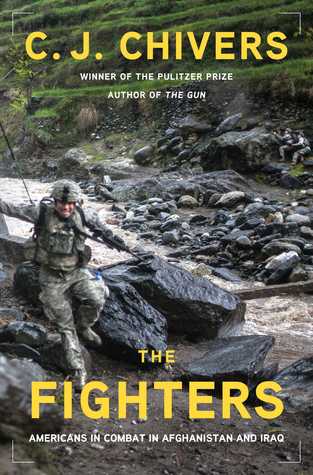 Chivers is a senior editor at The New York Times, and has won the Pulitzer for journalism. This meaty but readable book is the culmination of his years covering the U.S. wars in Iraq and Afghanistan. It is not the creation of a man parked in a library behind his laptop; he has personally gone to Iraq, Afghanistan, Syria, Ukraine, and Libya, and has either accompanied the people he writes about or retraced their footsteps. He covers the lives of six servicemen in the lower and middle ranks of the armed forces, and so he primarily uses eye witness reporting and interviews, in addition to American military data. I read it free courtesy of Net Galley and Simon and Schuster in exchange for my honest review. The Fighters will most likely be regarded in future years as the go-to book for those that want to know more about this war and the people whose lives were changed by it—including many of those whose homeland is or has been part of the war zone.
 Thanks go to Net Galley and Simon and Schuster for the DRC, which I received free in exchange for this honest review.
 I received this excellent Civil War tome from one of my sons as a Christmas gift. I don’t request a lot of books anymore because it’s so easy to get others free, but I asked for this one and I am glad I have it. I’ll be reading more by this guy. Despite one fact that I dispute—for which the citation also is sketchy—and some crummy maps, there’s no way to deny five stars here. The topic is among my favorites, and of course Sherman is my all time favorite general, hailing from a time when the United States government still attracted and produced heroes.
 I received a review copy of this book from Net Galley and Three Hills Publishing, which is affiliated with Cornell University, free of charge. This book is now for sale.
