Beautiful Country, by Qian Julie Wang*****

“Secrets. They have so much power, don’t they?”

Qian Julie Wang is born in China to a professional couple living under the shadow of governmental disfavor. Her father’s elder brother has written critically about Mao Zedong, naively signing his own name to the article, and as a result, the entire family lives under a cloud and the threat of violence, courtesy of Chinese Stalinism. When her father finds a way to relocate himself and his family to New York, it is under a tourist visa, and so they cannot legally remain in the USA, or get any sort of legitimate employment. Wang’s memoir tells of the deprivation and terror, combined with occasional lifesaving windfalls and ingenuity, of growing up as an “illegal,” and of how, against all odds, she ultimately finds success and citizenship.

My thanks go to Net Galley and Doubleday for the invitation to read and review, along with my apologies for being inexcusably late.

Wang comes to the USA, which in Chinese translates to “Beautiful Country,” as a small child. From the moment her feet touch American soil, her parents drill the story into her: “I was born here. I’ve lived here all my life.” Because they are in the US illegally, they must find work to do under the table, and so they are exploited by the most malevolent sweatshop owners. At first, Wang is also employed, toddling off to do piecework with her mother, but eventually she is enrolled in school, where she proves to be highly capable once she overcomes the barriers of language and culture.

More than anything, her life and that of her parents is dominated by fear and secrecy. Opportunities that would otherwise be helpful must often be bypassed because of the documentation required. Her parents’ emotional stability, their marriage, and her mother’s health are broken.

If this story seems unbearably grim—and I confess, this is why I delayed reading it, moving other, pleasanter stories to the top of my queue—it is ultimately a story of resilience and of triumph. Wang is a gifted writer, and she breaks up the horror by recounting small victories and pleasures that punctuate her youth. But the most important aspect of how the memoir is presented, is that everything is told through the lens of childhood, and so we see everything as a seven-year-old Chinese girl, a nine-year-old, etc. would see it.

Because I had fallen behind, I checked out the audio version of this memoir from Seattle Bibliocommons, and Wang does her own narration, which is my favorite way to hear a book, because there’s no danger that the reader will add emphasis or interpretation that conflicts with the author’s intentions. The climax arrived as I was wrapping Christmas gifts, which made me all the more aware of my level of privilege.

Wang tells us:

“Most of all, I put these stories to paper for this country’s forgotten children, past and present, who grow up cloaked in fear, desolation, and the belief that their very existence is wrong, their very being illegal. I have been unfathomably lucky. But I dream of a day when being recognized as human requires no luck—when it is right, not a privilege. And I dream of a day when each and every one of us will have no reason to fear stepping out of the shadows.”

Highly recommended.

Three Girls From Bronzeville, by Dawn Turner****

Dawn Turner is an award-winning journalist who grew up in Bronzeville, the historic home of the Black Community in the south end of Chicago. My thanks go to Simon and Schuster and Edelweiss for the invitation to read and review; I also extend my apology for missing the date of publication. This well written memoir is for sale now.

Turner looks back at her life through the lens of sisterhood. The two other girls mentioned in the title are her younger sister, Kim, and her best friend, Debra, whom she meets in elementary school. She takes us through the benchmarks of her life in a narrative that is both intimate and conversational, but that also features a keen depth of analysis, as she examines their experiences with regard to race, gender, social class, and of course, a few random, intangible but significant aspects of their experiences.

I enjoyed this book. There’s some terrific humor—for example, as a child, Dawn ascertains that a trip to the hospital is the equivalent of a death sentence, and when she needs a tonsillectomy, she gives away her most prized possessions, explaining that she is “going home to be with the Lord.”

And…about that. The humor is terrific, but the Lord dominates this story in a way that makes me uncomfortable, with passages that go far beyond the brief and the pithy. It’s her story, and she should tell it the way she chooses, but the almost constant religious references make this more of a Christian memoir than one for general audiences. It has a lot of nice moments and is told by a skillful scribe, but at the same time, I’m not sure I’d read another memoir of hers, should she choose to write it, because I find these frequent references tiresome. I have to wonder if the story would be any less authentic if this aspect were included with a gentler hand.

There are lots of meaty issues, thought provoking and common to the experience of a great many people. At one point, for example, she gives a speech at school, and although it is exhilarating and more than successful, Debra passes her a note asking why she sounds white when she speaks to an audience. Later, as an adult, Dawn and her husband confront other choices. Is it better to get a house in a low crime area that is mostly Caucasian, or should one stay in the Black community, even if there are fewer opportunities for their child there? Then the same issue arises regarding school choice. There are many other thought-provoking situations, but I’ll leave you to find these on your own.

This is a powerful memoir written by an accomplished wordsmith. For those that can read it with Jesus riding shotgun, this book is recommended.

Bird Uncaged, by Marlon Peterson****

I’ve never felt so ambivalent about a Civil Rights memoir. I read this book free and early, thanks to Net Galley and Public Affairs. It’s for sale now.

At the outset, Peterson describes his early years as the son of Trinidadian immigrants living in Brooklyn. His family belongs to the Jehovah’s Witnesses, and so that is an angle I haven’t encountered before. He describes his brilliance as a student, and the glowing future that has been predicted for him, scholarships, fine schools, and a ticket to the top. It doesn’t happen that way, though. He is involved in a robbery that becomes a homicide, and he wants us to know none of it was his fault.

What?

This is what concerns me throughout most of the book. He describes the limitations on young Black men in America, the limitations of poverty; the racist assumptions; and the “toxic masculinity.” He is sexually assaulted as a youngster, and he considers that an element in his decision-making, the trauma of his past informing the crimes he commits later. He talks about this at length, but I’ll tell you what he doesn’t talk about much. He doesn’t talk much about the near-rape in which his was the pivotal role. He asks a “chick” out, and he and his friends are planning to “run a train” on her. But she is alarmed when she realizes that there are other men in the bedroom where they’re making out, and she gets away fast. He doesn’t recall her name, and he wants us to know he wasn’t that interested in her, anyway. She wasn’t “the pretty one,” she was the friend of the pretty one. And I keep wondering why he includes this if he feels so badly about what he and his homies nearly did to her. He pleads ignorance; he was a virgin. He just wanted to lose his virginity. He had believed she would welcome a roomful of men lining up to use her.

Uh huh.

There are also a good number of solid aspects to this memoir, most of them having to do with the dehumanizing American prison system. There’s not a lot that I haven’t seen before, but obviously, the system hasn’t been significantly altered as a result of the other memoirs that have seen publication, and so there’s a further need for stories like his. He speaks of how, while doing his time, after a visit from his mother, he kisses her on the cheek, and the guards swarm him to check the inside of his mouth before his mama is out the door. I’m guessing that after that farewell, the woman is out the door in a matter of seconds. What would it hurt to hold him there for 30 seconds, let the parent get out of the room, and then check him? It’s little things like this that increase the alienation felt by those that are incarcerated. Other countries don’t do it this way, and you have to wonder why the U.S. has to be so ugly about it. He leads a program and conducts protests while he’s inside, and is successful in making small changes. Other men learn from his work and are improved by it, and that’s something to be proud of.

But back to the robbery. He keeps reminding us that he was only nineteen years old, and I cannot, for the life of me, think why he considers this a mitigating circumstance. Ask a youth psychiatrist or counselor when men are at their most dangerous, and they will tell you that the teenage years are the worst, hands-down, because young men haven’t developed impulse control. And Peterson himself points out, later in the book, that when ex-cons get out of prison after spending a long time inside, they don’t go straight because they’re rehabilitated; they go straight because they’re older, and have outgrown that nonsense. It’s inconsistencies such as this one that weaken the narrative.

Toward the end, he pulls it together and claims responsibility, and he does so eloquently. But it makes me wonder why he didn’t go back and rewrite the earlier passages. Because there are a lot of red flags back there, things that those of us that have worked with at-risk youth know to listen and look for. For example, there are a lot of passive references to his crimes, things that “happened” rather than things that he did, or things that went differently than he expected; there’s an awful lot about his trauma, the environment, and allll the “toxic masculinity,” but thefts, robberies, and the homicide for which he was the lookout man but “didn’t even have a gun,” are given relatively little ink.

I’m carrying on quite a bit about this, but I have seen glowing reviews, and he’s gotten awards for this book, and nobody is talking about the red flags, and so I feel it’s important to mention them. The fact that the book ends with much more accountability is what’s kicked my rating up to four stars.

Read this book, but do it critically. There are lessons here that are intentional, and others that aren’t.

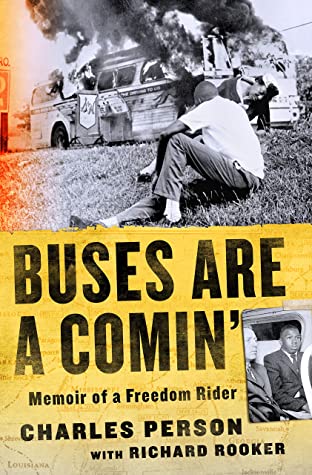
Buses Are a Comin’, by Charles Person and Richard Rooker*****

I’ve read my share of Civil Rights memoirs, and this is one of the best. My thanks go to Net Galley and St. Martin’s Press for the review copy. This book is for sale now.

Charles Person grew up in an all-Black Atlanta neighborhood in the 1950s and 60s. At the story’s outset, he describes how sleeping arrangements were juggled inside their two-room apartment, with four family members sleeping in the front room, and three, himself among them, back in the kitchen. Since everyone in the neighborhood had roughly the same economic standing, it didn’t occur to Person that his family might be considered poor. He was at the top of his class academically, college-bound. His family were faithful church goers, and his father worked two-plus jobs to provide the bare necessities, but they never went hungry. It was only later, when his neighborhood was featured on a news program addressing “Urban blight,” that he learned that the place he loved and called home was part of a “tenement.” The overall tone of his home life is set at the beginning, when he describes an incident from childhood. He and another child stole peaches off of a neighbor’s tree, and his mother marches them to the door, makes them confess—which meant looking the owner in the eye and using the word “stole,” rather than a softer euphemism—and pay for the fruit they ate. Thus we know there’s a definite moral compass here.

It isn’t until he’s grown that Person learns about racism. He gets his first job at a bowling alley, and he learns what parts of that place and the surrounding businesses he is allowed to access, and which are for whites only. Later, he insists on sending his test scores and application to a Georgia university, knowing his marks are excellent, but is notified by mail that the school will not admit Negro (the accepted term at the time) students. As the lunch counter sit-ins in North Carolina draw headlines, Person becomes part of a local student effort to end segregation at the lunch counters in their area. Person is thrown in jail, and when he is released a short time later, he is experienced, primed, and ready for more.

The story of Person’s life, and of the Freedom Rides, which make up most of the memoir, is riveting. It’s told in first person, in a you-are-there kind of narrative that drew me in. I listened to part of this story using the audio book that I borrowed from Seattle Bibliocommons, but although the reader generally does a serviceable job with the text, I recommend the print version. I winced when the reader mispronounced “mimeograph”; there are no mimes in there, honey. But mostly, there are a lot of freedom songs interspersing the story, as the riders sing in jail, sing in the bus, sing, sing, and sing some more, and I don’t know about you, but it sets my teeth on edge when in the audio version the lyrics are simply read, with or without rhythm. Many of these are well-known songs, and if I see the words on the page, I will hear the music in my head. Listening to someone recite the words in a bloodless, wooden recitation is just sad.

For anyone that misses the connection, Person draws the connection between the Freedom Rides and the struggle of the present:

“It is sixty years later, and politicians do the same today when the devalue and disrespect important African-American societal concerns by turning Black Lives Matter into All Lives Matter. Of course, all lives matter. No one argues against that, but changing the issue from “Black” to “All” steals the legitimacy of a vital concern that needs political attention and a political solution. The intentional and insidious shifting on an issue through language is a calculated move. It was by [Georgia Governor] Vandiver in 1960, and it is today. It avoids and insults at the same time.”

There is no better time to learn the lessons of the Civil Rights Movement of the mid-1900s, and apply them to the struggle against racist cop brutality in the present. If this subject makes you sit up a little straighter, you need this book. Of course, it’s also great reading for anyone that likes a good memoir, but even so, read it actively. There’s so much more work to be done.

The Soul of a Woman, by Isabel Allende*****

Isabel Allende has long been a guiding light for women, immigrants, and social justice activists. She is an old woman now, and her wisdom and word smithery have only grown deeper and wider. Thanks go to Net Galley and Random House Ballantine for the review copy. This book is for sale now.

There are four sections to this compact memoir, and overall, it is a memoir of Allende’s feminist philosophy and experiences. She also describes the trajectory of the feminist movement and the gains that have been made.  One of Allende’s most agreeable attributes is her candor, and she discusses her relationships with the men she has married with disarming frankness and humor. Her voice is like nobody else’s.

Generally speaking, I find it annoying when an author uses space in the book they’ve sold us to advertise a product or beg for funds, nonprofit or not; however, this time I wanted to stand up and cheer! Allende’s foundation exists to support women’s reproductive choices, and that includes abortion. Out of all the years I’ve blogged, over one thousand reviews I’ve scribed, and I have never seen abortion rights advocated so forcefully. I bow in admiration.

If I could have something more from this iconic writer, it would be an overall autobiography. She has written numerous memoirs, but all of them focus fairly narrowly on one particular aspect or time period. I would love to have her whole story in her own words.

Highly recommended.

Easy Crafts for the Insane, by Kelly Williams Brown*****

Kelly Williams Brown is an experienced author, but she is new to me. I ran across this odd little book at exactly the time I needed it, and maybe you do, too. My thanks go to Net Galley and Putnam Penguin for the review copy; this book will be available to the public July 6, 2021.

Brown points out that mental illness remains one of the few conditions that are cloaked in secrecy and shame. Nobody afflicted with bipolar disorder chooses it, and although it can be successfully treated, there’s no cure, either. The title of the book reflects her choice to simply own it. “This is the water I swim in…I wanted to talk about how I have come to be content in my own skin.”

In sharing her journey, she tells us how nearly impossible it is to find a psychiatrist within a reasonable commute, who takes your insurance; now try doing it while you are in a precarious state of mental illness. At one point things come to a head, and in a fugue of which she has no memory at all, she rises from bed and attempts suicide, nearly succeeding. Had her boyfriend not found her when he did, she would have died. “’Lots of people, they just take a few aspirin and say they want to die, but you meant it!‘  the very kind ER doctor says with something that sounds a tiny bit like begrudging approval.”

The crafting aspect of this book is partly a device, used to share what kind of mindset caused her to resort to it, and also which crafts are soothing at life’s most difficult times; several of the crafts she discusses are just as mysterious to me after reading her instructions as they were before. Her favorite little origami stars, which grace the book’s cover, are among these. And there are some crafts for which she tells us she has no clear instructions, and recommends YouTube tutorials, so that part’s kind of a wash. However, there are a couple of things that do sound interesting and that I might try. I initially rated this book four stars, thinking that if a person puts crafts in the title, the crafts should be clearly taught, but later I decided that this book really, truly isn’t about crafts.

Brown has money, and at times I am a little alienated by her wealth, that is obvious in her narrative. But she recognizes this, and she uses it to drive home the point:

“I had good insurance, and open schedule, and no internal conflict over therapy—and yet it was still fucking impossible. My privileged ass could barely make it happen. Think about the hurdles that Americans who don’t have these advantages face every day when they’re trying to access help!”

I have deliberately left out the humor here, the places that at times make me laugh out loud. You can find them for yourself. They are well placed, preventing the overall tone from becoming too grim.

 I found this book the day after dropping a close family member off at the psych ward of a local hospital, and it seemed almost like an omen that I should read it. If you are contemplating reading it, whether due to mental health issues of your own, or of those close to you, or simply out of curiosity, I highly recommend you do it. This little gem may become a cult favorite, and it would be a shame to be left out of the loop. And if it inspires you to be more vocal in advocating for mental health awareness and treatment, and of dragging this pervasive problem out of the attic and shining some light on it, then the world will be a better place.

Broken, by Jenny Lawson****-*****

4.5 stars, rounded up.

Jenny Lawson, AKA The Bloggess, has a new book out, and I do believe it’s my favorite. My thanks go to Net Galley and Henry Holt for the review copy. This book is for sale now.

Lawson bucks a somewhat disquieting trend, and I am so glad. The trend is to make the first three chapters—most likely what sells the book—sterling, and then fill the rest with mediocre, highly missable prose. In contrast, the earliest part of this memoir is good, but it’s not great. She starts slow and then builds toward most of her best material, leaving me smiling as the book concludes.

But let’s go back to the material at the start, which I find to be random in a way that yearns for the hand of a high profile editor. I’m throwing my hands up, wondering just why a professional writer would blather on like this. Can she write a coherent sentence, and then end it when it’s over? Of course, I continued reading and loved the essays in the middle, and as we draw near the end, she refers to the challenges she encounters in writing, citing her inclination to overwrite, and the resultant paragraphs that contain “a run-on sentence that would make an English teacher cut herself,” and I howled, because that’s it, exactly. Almost exactly, I mean; I was moaning, but I hadn’t reached for anything sharp.

What is it about depression and humor, and the connection between them? It’s hard to tease apart all of the components that make Lawson’s writing so compelling; to a certain extent, it’s alchemy of the human spirit, I suppose, combined with skill at self-expression. But there are other components much easier to spot. One is her disarming frankness; for example, she mentions that people, remarking on her twentieth wedding anniversary, ask about her secrets for a long and happy marriage, and she tells us that actually, not all of those years have been happy. There are good periods, and there are bad periods. And then she adds, not entirely jokingly, that part of the reason she is still married is that there are things in her marriage that she doesn’t write about.

But even more compelling is her level of perception, and her ability to understand the subtext of just about everything.

I’ll mention my favorite parts, but I am not giving up any more humorous quotes, because that’s a crappy thing to do to a humor writer. There’s a funny part having to do with shoes, and the kayaking trip from hell, which she dubs “Divorce Creek.” The chapter about Transcranial Magnetic Stimulation, which is a serious bit for the purpose of informing us, is interesting and may be of help to a number of readers. (However, the searing honesty about her suicidal impulses might actually be a trigger for a profoundly depressed reader.) And the infuriating experiences she has had dealing with insurance makes me want to throw things, but it is important that she includes them here.

If you’re a fan of The Bloggess’s writing, you have to get this book. If you are new to her work, you can dive into this memoir without reading her previous ones. Highly recommended.

On the Plain of Snakes, by Paul Theroux****-*****

Paul Theroux has been a successful travel writer for a very long time, but he is new to me. Lucky me, I read this free, thanks to Net Galley and Houghton Mifflin Harcourt. It’s for sale now.

The first thing that took my notice was that this is a gutsy writer. Though he’s in his late seventies, he hops in his personal vehicle and motors south to Mexico, and then all over that nation independently, venturing into out-of-the-way spaces, mostly eschewing the usual tourist haunts that draw the spring break crowd from the US and other parts. Over and over again, locals explain to him that this road, or that, or the other is very dangerous right now; sometimes he revises his route; sometimes he takes the route but at a different time; and sometimes he goes anyway, but takes somebody with him. What he doesn’t do is go home early, or store his car somewhere and follow a tour guide around. I stand in awe.

Theroux approaches his journey as a researcher, rather than as a tourist advisor. He interviews countless individuals, even learning a little of one of the indigenous languages—in addition to Spanish– in order to communicate. I gave up trying to trace his route, instead just going with the narrative as it unspools.

I have to tell you, this is a tome. I might never have finished it had I relied exclusively on my review copy. I recognized it would be a hefty commitment to get through all of it, so once again, I turned to Seattle Bibliocommons for the audio version. I found it went much faster once I was able to do something else with my hands as I listened. Joseph Balderrama is a wonderful reader, and I quickly found myself absorbed into the journey, as if I were an unseen passenger.

Theroux takes us through the ordeal at the US/Mexico border, which was a nightmare during the time this was written, during the Trump administration. (If you have a MAGA cap in your closet, you may not enjoy this book.) He listens to Mexican citizens that live near enough to the border that they can actually see it from their homes, or from their workplaces. Some of them have lived in Mexico but worked in Texas for a long time, and the hardship they experience once the rules are changed is dreadful. And the insight I gain from listening to his interviews with people there about immigration to the US is most enlightening.

The most amazing thing to me is the way the cartels and the Mexican police force overlap, and in a number of places are exactly the same people! He describes multiple shakedowns by traffic cops while he is driving. It seems that the state pays its cops next to nothing, and so in order for them to support themselves, (particularly, we assume, those not being paid by cartels also,) they are permitted to stop anyone they believe has some money, and essentially intimidate them into a bribe. But it’s not complete chaos: once a driver has been shaken down, they are entitled to a receipt for the money they have had to forfeit so that another cop up the road cannot do the same thing.

The one tourist area Theroux passes through is Puerto Vallarta, which also happens to be the only place in Mexico that I have visited. About ten years lapsed between my visit—a very pleasant one—and Theroux’s, and I was saddened to learn how unsafe it has become, and how badly the locals, who were mostly middle class when I was there, have it now.

There are a number of fascinating passages, and I learned a lot. One village is awash with what sounds like a new sort of trans woman, (new to an American from Seattle, at least,) and another where the handmade sandals are finished with a jaw dropping method. There’s one very poor village where earthquakes occur so frequently that most of the homes are no longer standing, but many people won’t sleep indoors anyway for fear of being crushed to death. No aid from the Mexican government or any international body has ever reached them. Those people are on their own, and they are suffering.

Perhaps the sweetest parts have to do with the friendships that the writer forms with the people he meets there. I especially enjoyed reading the interviews with his new author and artist friends.

For those like myself that approach this with general interest, I’d call this a four star book. My stamina is greater than most, yet as much as I enjoyed it, it did feel a little bit lengthy. For those with a particular interest in the socioeconomic, cultural, and political realities of Mexico, it’s five stars, hands down.

Recommended to those with an interest in this field.

The Autobiography of Mother Jones, by Mary Harris Jones*****

Note: I wrote this review before I began this blog, and I was shocked when I found I had somehow not included it here. There’s no disclosure regarding a review copy, because I didn’t get one. I bought this book and paid full cover price, and I will keep it until it is pried from my cold, dead hands.

Mother Jones has been called “the most dangerous woman in America”. Some refer to her as an anarchist, but in her autobiography, she denounces anarchism, though allows that these folks have their hearts in the right place. She has been called a syndicalist (which is probably closer to the truth), but the fact is that she was motivated by what she saw right there on the ground in front of her. When the Russian Revolution unfolded, she was by her own account past 90, and by the account of another biographer, in her mid-80’s, so either way, she was very, very elderly, yet she championed its achievement at the Pan-American labor conference held in Mexico:

“…a new day, a day when workers of the world would know no other boundaries than those between the exploiter and the exploited. Soviet Russia, I said, had dared to challenge the old order, had handed the earth over to those who toiled upon it, and the capitalists were quaking in their scab-made shoes.”

Jones’ career as a political organizer began shortly after she turned 30. She was a married woman, her husband an iron worker, and she stayed home with their four small children. “Yellow fever” (which I think is malaria) came and killed her whole family, and then as if that wasn’t enough, the great Chicago fire swept away her home and all her possessions.

Some would have turned to suicide. Some would have gone looking for an elderly widower to marry. Some would have gone off to find distant relatives and live with them as little more than domestic servants.

Jones reinvented herself and gave the next fifty-plus years of her life to making the world a better place.

Still clad in a widow’s black garments, she put her hair up in a chaste bun and left Mary Harris Jones behind. From this time forward, she would be “Mother Jones”. Think of it! The cinders from the American Civil War were barely cold, and women had no position in American political life, including the labor unions. Yet by becoming a mother to workers everywhere, including the women and small children laboring in mines and textile mills, she became a force to be reckoned with. It was a brilliant piece of theater, entirely sincere in its intention and in many cases successful. She was one of the most ardent champions of the 8 hour day:

“The person who believed in an eight-hour working day was an enemy of his country,a traitor, an anarchist…Feeling was bitter. The city [Chicago] was divided into two angry camps. The working people on one side–hungry, cold, jobless, fighting gunmen and policemen with their bare hands. On the other side the employers, knowing neither hunger or cold, supported by the newspapers, by the police, by all the power of the great state itself.”

When Mother speaks, people feel they should listen, and if she speaks in their better interests, they listen harder. And in the early days, at least, the boss’s goons and the local law thought twice about putting a hand on Mother. It wasn’t nice!

Later, as her impact on their wallets hardened their resolve, they would deal with her less gently. She didn’t care. She spent nights in jail when she could have left town instead. Sometimes she traveled into a coal mining enclave where every bit of property besides the public roads was owned by the mine owners. Even homes that had been rented to miners were closed to her, as was made clear enough to break almost anyone’s heart. She describes a mining family that held a union meeting at which she was present in the coal fields of Arnot, Pennsylvania. The following day the company fires and evicts the family, and “they gathered up all their earthly belongings, which weren’t much…and the sight of that wagon with the holy pictures and the sticks of furniture and the children” made the local miners so angry that they decided to strike and refuse to go back to work till their union was recognized.

The quote most well known that shows up on tee shirts, posters, and coffee mugs among the liberal and radical milieu today is knocked clean out of context, in my view. “Pray for the dead and fight like hell for the living” was delivered in order to get working men out of the local church, where the priest was trying to cool down the heat and persuade the coal miners to wait for a reward in heaven. “Your organization is not a praying institution,” she reminded them, “It’s a fighting institution!” She tells them to leave the church and meet in the local school, which their own tax dollars had bought. And she later tells other miners that striking is done to provide “a little bit of heaven before you die.”

From Chicago to the coal fields of West Virginia, from New Mexico to Pennsylvania, she was found among railroad men and their families, machinists, textile workers, and above all, miners. She had no use at all for union officialdom, and though she occasionally praised a senator or governor who saw the light of day and called off the hounds of vengeance so that unions could be organized and the workers represented, more often than not she saw them as perfidious and untrustworthy.

When Eugene Debs became a candidate for U.S. president, she embraced his campaign, though she stayed among the workers, which I think was the correct thing to do. But when Debs comes to speak to coal miners and the union officialdom wants to meet his train quietly with a few representatives, Jones proposes all the union members go to greet him. They stampede down to the train, leap over the railings, and lift Debs onto their shoulders, she says, shouting, “Debs is here! Debs is here!”

I could have been finished with this slender volume quite quickly if I hadn’t been making notes (most of which, as usual, I cannot fit into my review, but then I should leave you some choice tidbits to find for yourself, and there are still many of them!) The chapters are brief, and so the book can be read just a few minutes at a time. And the introduction is written by one no less auspicious than Clarence Darrow himself.

You may look at the price and wonder whether you should pay that price for this slender little volume. The answer is, oh hell yes. Please remember that the words of the woman herself are worth twice as many from some armchair hack who wants to pick it apart and wonder whether she was really 83 or 85 at such-and-such moment? Spare yourself the blather and go straight to the primary source. It’s worth double the cover price!

Bright Precious Thing, by Gail Caldwell*****

My thanks go to Net Galley and Random House for the invitation to read and review. This book is for sale now.

Gail Caldwell was the chief book reviewer for The Boston Globe, and she won the Pulitzer for Criticism. Once I began reading this luminous memoir, I could see that level of quality in her prose. She writes about her childhood in Texas, and about her travels and experiences growing up in the mid-twentieth century. More than anything, this is a feminist memoir, a chance to see how far we have come through a personal lens.

I missed the publication day here, and so I hunted down the audio version to supplement my reading. The author narrates her own work, and so it conveys the feeling that I am sitting by the fire with a dear friend, hearing about the challenges she’s faced as a single woman. Female readers will recognize the sensation: you start talking with a woman that you don’t really know, and before you know it you are talking and listening as if you’ve known one another for ages. That’s the essence of this book. In fact, I listened to it in the evening while preparing dinner, because I knew I’d be left alone during that time, and frankly, I didn’t want anybody to come barreling into the middle of my time with Gail. There’s a sense of intimacy that makes me feel a bit protective when I listen to it. Later, I go over what I’ve read and nod. Yes. Oh, yes, I remember that.

The title works in a number of ways. The darling little neighbor girl that becomes part of the family Gail chooses, bookends the memoir, coming in at the start as a very young person and ending it as an adolescent. But there’s more to it than that; life is a bright precious thing, and though she never says it overtly, I recognize that each woman is a bright precious thing as well.

I am a grandmother myself, but Gail is about the age to be my older sister. Women like Gail gave women like me a guiding light during our coming-of-age years. Our mothers were often resigned to their status as second class citizens, and ready to accept that there were things that women should probably not even try to do, and they couldn’t help transmitting their fears and reticence to us. It is women like Marge Piercy, Gloria Steinem, Wilma Mankiller, and yes, Gail Caldwell that provided us with a beacon, a way forward through the ocean of “no” to the bright shores of “yes,” that gave us courage to be insistent, even when we knew some would label us pushy broads, or worse. We needed role models badly, and they stepped up. They’re still doing it.

The calm, warm tone that came through this audio book, right during the turbulent period after the November election, was an absolute balm.   Sometimes I would be shaken by the things I saw in the national news, and then I would head for my kitchen (perhaps an ironic place to receive a feminist memoir, but it worked for me,) and once I had had my time with Gail, I knew I’d be all right.

Highly recommended to women, and to those that love us.