

“It doesn’t do any good to just run away from something, you’ve got to be running to something.”
Alex’s mom has been hit one time too many by Alex’s dad, and she wakes Alex up and says to get a few things together and get in the car. They’re out of there. The rest of the story is an odyssey, both externally and internally, and within it, Alex comes of age. The story is beautifully crafted with gritty, nearly-tangible settings; however, it is the meticulous, absolutely believable characters that makes this story sing. It is the first outstanding work of fiction I’ve seen that features a transgender teen, and like so much great fiction, it provides an education to those of us that haven’t known anyone that claims this identity. In fact, this book may become the Rubyfruit Jungle for trans people and those that care about them. I read this novel free and early, thanks to Net Galley and Crown Publishing; it’s available to the public August 1, 2017.
Feminists have to cheer for Alex’s mother, who Alex calls “Ma”. Ma has a car, she has maps, she has some food, and she has Alex. When a state trooper pulls her over because both she and her car have been reported missing by Alex’s father, Ma tells him point blank that the car is in her name, and that Alex is hers, not theirs. No, she doesn’t need to come with him. No, she doesn’t have to make a phone call. It wouldn’t always play out this way for everyone, of course, but just seeing it work once, right here, is satisfying and it’s credible. In fact, there’s never a hole in the plausibility of this story, even though the events that unfold here are far from ordinary.
This trip, one that initially has a destination but turns into a wandering trek all across North America, gives Alex the first real taste of learning who Ma is. Any parent that has raised a teenager and has had a car understands the value of car talk. Both driver and passenger look straight ahead, and then sometimes things just naturally fall out of their mouths that otherwise would remain unsaid. Not having the money to keep a smart phone alive facilitates this even more; when there’s nothing else to look at, the choices are talk; silence; and sleep.
And so Alex learns that Ma was raised largely in foster care, and the road trip provides a chance to trace back the string, to see the places life bounced her in and out of through adult eyes. Essentially, they are homeless much of the time, sleeping in the car, in the occasional down-at-the-heels motel, and every now and then alighting long enough to procure an apartment, though never the sort you’d want unless you were desperate. Sometimes she works; sometimes they steal; sometimes they are given a handout; still, they survive, and the trek goes on. And we see the disastrous failure of the public school system to accommodate a kid like Alex, who is expected to check either the male box on the enrollment form, or the female box, and whose refusal to do so is treated as a behavioral issue.
There are times in my notes when I find myself referring to Alex as “she”, and it shows how ingrained our social system is, particularly for those of us that are older and have to work harder to think flexibly. At times I feel the same urge as those obnoxious school children Alex encounters in the story that want to know exactly what reproductive organ is inside Alex’s pants, because when I was growing up, that was how we identified gender. But as I watched Alex’s character take form within Taylor’s deep, intimate prose, I found that knowing Alex as Alex was enough. We never learn what’s between Alex’s legs, and by the end of the book, it no longer matters. That’s an accomplishment in and of itself.
As for Alex’s future, it’s a conundrum. What Alex wants most is for Ma to point the car toward home, toward Dad. Oh, please please please. It’s the refrain of children the world over whose parents have split, children clinging to the illusion that if they are all reunited, everything will be fine. Oh, of course it will! And we know early in the story that this will never happen, and we don’t want Ma to go back there. But Alex wants Ma, and Alex wants Dad. And this is a quandary that many readers will recognize as their own childhood longing.
One last word here is directed at teachers and parents. The literacy level here will be accessible to high school age students; however, there are sexual situations—as well as a sexual assault—and a lot of very profane language. If you wonder whether you want to put it on your shelf at school or home, get a copy and read it yourself first. I would have chosen to offer it to my own children when they were teens—they are grown now—but every family is different, and schools also have such a wide range of standards that you’re better off using your own judgment.
That said, this pivotal novel is highly recommended.
 Hannibal was the first general to defeat the forces of Rome, and Hunt is the man qualified to tell us about it. I read my copy free and early thanks to Net Galley and Simon and Schuster. This book becomes available to the public July 11, 2017.


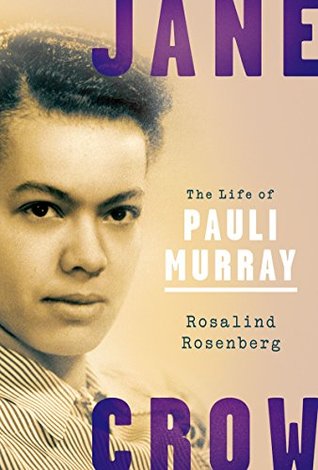 Pauli Murray is the person that coined the term “Jane Crow”, and was the first to legally address the twin oppressions of color and gender. I had seen her name mentioned in many places, but this is the first time I’ve read her story. Thank you to Net Galley and Oxford University Press for the opportunity to read it free in exchange for this honest review. This biography is for sale now.
 Had I no obligation to the publisher, I might be tempted to write a rare one-word review: bleak. Our protagonist is grieving the death of her beloved grandmother, and the dog died too. She’s stuck in a place she can’t get out of mentally, but since she is an artist, she takes her ennui and lets it guide her through art, and the narrative follows a pattern in which each grim thought leads her to a different art theme mentally. The story is told in the first person, and so we follow her miserable wandering thoughts from one grim topic to another, and then at some point each train of thought ends with “Works about [ fill in noun here: beds, rabbits…whatever].”
 I am a big fan of Laurie R. King’s contemporary thrillers, and this one is no exception. Thank you to Net Galley and Random House Ballantine for the DRC, which I read free and early in exchange for this honest review. It’s for sale today, so now everyone can read it.
 Ann Beattie is a seasoned writer with a list of accolades as long as your arm, and this is why I requested a DRC of her soon-to-be-published short story collection, whose theme is visitors and travel. I was not disappointed. Thank you Net Galley and Scribner for letting me read it free and early in exchange for this honest review. This book will be available to the public Tuesday, June 13.
 Amish Guys Don’t Call is funny, absorbing, and ultimately lifting. Dodds has a great heart for teenagers, and this title is one that should grace every high school and middle school library, and will also attract parents and teachers of adolescents. I read it free and early thanks to Net Galley and Blue Moon Publishers. This book will be available to everyone June 13, 2017.
 “We know so very little about the people we are closest to. We know so little about ourselves.”
 Lisa Wingate is an established author, but she is new to me. I received this DRC free and early, thanks to Net Galley and Random House Ballantine; it is available to the public Tuesday, June 6, 2017. And although I would love to tell you to run out and buy it right now, in all honesty I have never felt quite so ambivalent about a novel, at least not in recent years. There’s so much that’s good here, but there’s also some terrible material—albeit brief—that any sensible editor would have to question, and that every reviewer that’s paying attention has to notice.
 Seattle Book Mama