Unknown's avatar

About seattlebookmama

Greetings! I am Donna Davis, a retired teacher living in my favorite city in the world. I've found that one of the greatest comforts in life is a good book. We can all use a little of that. Welcome, and enjoy! Donna Seattle Book Mama

The Crowded Hour, by Clay Risen*****

The Spanish-American War sparked the earliest fire of U.S. imperialism, and the eccentric rich man that pushed it forward, Theodore Roosevelt, was at its center. Risen provides a contemporary view of this badly managed chapter in American history, dispelling longstanding myths and examining the long term effect of the conflict on the U.S. military. My thanks go to Net Galley and Scribner for the review copy, which I read free in exchange for this honest review. This book is for sale now.
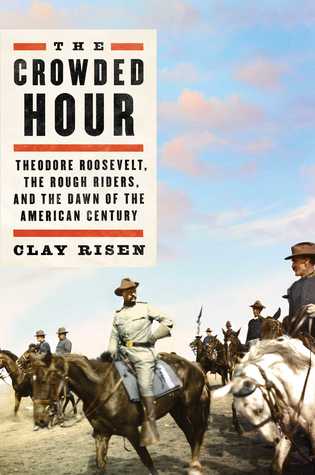
Roosevelt was challenged with a number of health problems as a youngster, but instead of embracing his sedentary, privileged existence, he embarked on a series of physically demanding adventures in order to strengthen his constitution and affirm his masculinity.

When Cuban nationalists sought independence from Spain, Teddy began campaigning for American intervention. Men of his generation was had not known the destruction of lives and property that touched every part of this nation during the American Civil War, and like most young people, they were unwilling to listen to their elders. Roosevelt believed that war was a splendid thing, and that in facing death, men were elevated to a higher level. He joined his voice to those in the press advocating military aid to Cuba, and after tapping every powerful connection his wealthy family could access, he was successful.

 His own unit—all volunteers—were dubbed the “Rough Riders.” Most had no military training of any kind; the mighty Union Army had been all but disbanded once the nation was reunited. Though they were promoted as cowboys, the rugged individuals of the Wild West, a goodly number hailed from Wall Street and Harvard. In addition to being able to fund their own wartime excursion, they were noteworthy in their riding capability.

There was no San Juan Hill. There was a series of them.

The American invasion of Cuba cast a spotlight on its unpreparedness. Transporting troops, beasts and equipment across the Atlantic was a debacle of the worst order. There weren’t even close to enough seaworthy vessels, and because of this, most of the so-called cowboys fought on foot the entire time; horses and mules were stuck back in Tampa waiting to sail. There wasn’t enough food, potable water, or appropriate clothing for most of the men; the wealthiest among them fared best, but there were many occasions when there wasn’t any food to be bought at any price. There had been no reconnaissance and so they went in blind; the heat and disease killed more Americans than the Spaniards did. Vultures and immense land crabs that measured 2 feet across and traveled by the thousands made short work of the dead when not buried immediately. American losses were nearly triple those of the Spanish, and when the war ended there were no hospitals or sanitation ready to receive the legions of sick and wounded when they returned from the Caribbean.  

Roosevelt used the occasion to point to the need for a standing army and U.S. readiness, and ultimately this was his one useful contribution. In other regards, the man was an ass hat. His bald-faced racism, though not unusual at the time, went over badly with the Cuban freedom fighters that were supposed to benefit from their presence. He crowed to his friends about how much he enjoyed shooting an enemy soldier from just a few feet away “like a jackrabbit,” and called his 45 days of combat the ultimate hunting trip. Mark Twain hated the guy, and it’s not hard to see why.

Risen has an engaging writing style, and he uses lots of well-chosen quotations. His research is excellent as are his sources. I would have liked to see more of a breakdown along the lines of social class and other demographics, but this war did not yield a rich archival treasury like the one that came from the Civil War, so this may not be possible.

All told, this history is a find. Right now it seems that every second historian on the planet is writing about World War II, whereas this cringeworthy but significant chapter of American history has been largely left by the wayside.  I highly recommend this book.

Queen Meryl, by Erin Carlson**

I read this biography free and early thanks to Net Galley and Hachette Books.

I have enjoyed Streep’s movies and her feminist moxie since the first time I saw her, and so I figured this would be a good fit for me. Sadly, there’s nothing new here at all. There’s no depth of analysis, no stories of inner struggle or insight into her development. The overall tone is uniformly adulatory, which is fine as far as it goes; I don’t enjoy seeing a journalist do a hatchet job on a performer, so if she has to lean in one direction or another, I’m glad it’s on the positive side. But once again—I have seen every single thing in this book somewhere else already. I knew about the friction between Streep and Dustin Hoffman (who is also a great favorite of mine,) and I knew she takes roles that show strong women. I knew she wanted to sing, and she did it in Mama Mia. Readers that have followed this actor’s career over the decades with a magazine article here and there can’t expect to cover new ground. It’s shallow and superficial for the most part, and for me, the only good thing is that I didn’t pay for this book.

Streep’s fans that haven’t followed her career in the press may find more joy than I do here; nevertheless, my advice is to read it free or cheap if you decide you want it. It will be available to the public September 24, 2019.

Never Have I Ever, by Joshilyn Jackson*****

Amy Whey has everything she has ever wanted: a successful marriage, a lovely home in Florida, an adorable baby and a stepdaughter she genuinely loves. Her roots in the neighborhood are deep and secure, and her dearest friend is right there as well. Then all of it—every last bit—is threatened by a newcomer with an agenda all her own.

Jackson has had a string of bestselling novels, most notably Gods in Alabama and Between, Georgia.  She is among my favorite writers, and this is her best book to date. My thanks go to Edelweiss and William Morrow for the review copy; however, this is one novel I would have paid full jacket price for if it had come down to it. This is the finest mystery you’ll see in 2019, and it will be available to the public July 30, 2019.

It’s time for the monthly book club to meet, and although Char is the host, the group has temporarily relocated to Amy’s for logistical reasons. The members have gathered, but then there’s a rap on the door. Who in the world…?  It’s the newcomer, a renter that has taken residence in “the Sprite house,” named for its unfortunate paint color. She hasn’t been invited, but she’s come, just the same:

She was the pretty that’s on television: symmetrical features, matte skin, and the kind of long, slim, yoga body that still made me feel self-conscious about my own. I hadn’t been seriously overweight since I was a teenager, but looking at her I was instantly aware of the little roll of baby weight still clinging to my middle…She didn’t look like my own destruction to me. She looked…the world was ‘cool.’…An odd thing to think. I was forty-two years old…I looked at the loaded gun on my doorstep, and, stupid me, I hoped she had the right house.”

This new neighbor is Roux, and she is a darker, more adult version of The Cat in the Hat. Instantly divisions are sowed, and old established friendships are tested as she manipulates these women into competing for her approval.  She’s done her homework, and she knows everyone’s darkest secrets, especially Amy’s. But Roux hasn’t bargained for the kind of adversary she has chosen. Amy proves to be a bad enemy.

This is a compelling thriller, the sort that takes over my life until it’s done. I finished reading it months ago and have read dozens of other books since, but something in me still stirs when I glimpse the book’s cover. In fact, I wasn’t able to write this review until I had allowed myself to read it a second time.

Part of Jackson’s magic is in addressing real parts of women’s lives that seldom make it into our literature. It is gratifying to see her address emotional overeating as a component of Amy’s story; yet I would love to see her write another novel in which the protagonist is a good person with heart and dignity, and yet is still obese (rather than formerly.) If anyone can do that well, it’s this author.

Run along now; you’ve got a book to order. If you’re stone cold broke, get on the library’s waiting list. Nothing else can take the place of this story.

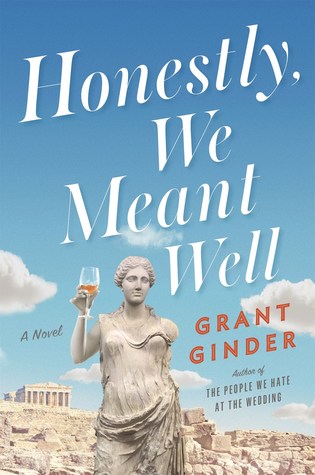
Honestly, We Meant Well, by Grant Ginder****

“All art is appropriation.”

Sue Ellen Wright is a professor of Greek classics; she’s headed for Greece to deliver lectures and reminisce about the experiences of her youth. At the last minute, her philandering husband Dean and the couple’s lovesick son Will decide to tag along. Grant Ginder has made a career of writing hilarious prose about disastrous families, and Honestly, We Meant Well made me laugh out loud more than once.  Thanks go to Net Galley and Flatiron Books for the review copy. This book is for sale now.

The book opens as Sue Ellen is conferring with a freshman who’s come to her office to challenge his midterm exam score:

“’I’m pretty sure I got this one right.’

“Connor points to a picture on his midterm…it’s an artifact that he was meant to identify.

“’That’s not a bong, Connor. That’s a Corinthian urn from the fifth century B.C.E…’

“But can’t you see how it could have been a bong?’

“’No,’ Sue Ellen says, ‘Actually, I can’t.’”

Teachers, are you experiencing flashbacks here? And those of you that aren’t teachers can appreciate that Sue Ellen needs a break, one that takes her as far away as possible. Her bags are packed.

Dean is a professor as well, and he’s a celebrated one. As the writer of a bestselling novel, The Light of Our Shadows, he is permitted to cherry-pick which students may enroll in his seminars. He knows he ought not to have sex with any of them, but they’re so insistent; and why shouldn’t they be? He’s a genius. At the moment, though, he’s a genius with writer’s block, and he thinks a Grecian holiday might just be what he needs; it will strengthen his marriage and get his creative juices flowing as well.

Will is a student, but who can chart a course, academic or otherwise, when his heart has been shattered? His boyfriend broke up with him and has instantly turned up on Instagram with kissy-face photos of himself with his new squeeze. It’s humiliating. It’s horrifying. Worse: everyone is liking those photos. Meanwhile, he has committed an unforgivable academic sin, one he’s desperate to keep his parents from learning.

Ginny Polonsky works at the university, and she knows where the bodies are buried. Readers know what Ginny knows—well, most of it anyway—and as the family unknits itself and copes with one unforeseen event after another, we are waiting for Ginny’s other shoe to drop on them. It’s immensely satisfying when it does.

There’s not a lot of character development here, but not much is needed. I believe each of these characters, which are written with admirable consistency. The prose is tight and the resolution surprises me. I would read this author again in a heartbeat.

The Wrights are Caucasian and middle class, and this is the demographic most likely to enjoy this book. It’s just the thing to toss into your suitcase or carry on when you’re headed on a trip of your own.

Summer Reading

When it’s too hot to get much done, you’ll need a tall, frosty drink; a fan to flop in front of; and one of these. Reviews for all will be on this site soon!

Call Your Daughter Home, by Deb Spera*****

Deb Spera is a force; small wonder that Call Your Daughter Home is the book that bloggers have been talking about. This barn burner of a debut goes on sale today.  My thanks go to Net Galley and Harlequin for the review copy.  It curled its fingers around me on page one, and by page ten I knew it wouldn’t let me go till it was done with me. It ended as powerfully as it began.

The year is 1924. Gertrude Pardee lives with her four little girls in a shack in the swamp in Third World conditions; they are nearly feral. A storm is coming, but Gert has a job to do. Her brutal ass hat of a husband lies dead in the swamp, dispatched by the bullet she blasted into his brainpan. As the storm bears down, she peels off her only dress and strides naked into the muck to deal with his corpse:

“Alligators feed once a week, and sometimes, if the prey is big enough, they don’t need to eat for almost a year. But I don’t know how long it takes a gator to eat big prey. Daddy never said nothing ‘bout that and I never asked.”

Our other two main characters are Retta, the first free woman in her family, and Annie, Retta’s employer. Retta cares for Mary, Gert’s youngest, when Gert is too sick and injured from the broken face she sustained the last time Alvin beat her; Retta’s husband Odell and her neighbors all tell her that it’s trouble to bring a white child into Shake Rag. “Don’t get messed up with that white family. No good can come of it,” and she knows it’s true. What if the girl dies? But Gert coaxed her into it, telling her it would be the Christian thing to do, and Retta is moved by this sick, helpless five year old. She assures everyone it’s just for three days.

Miss Annie is a Caucasian small businesswoman and wife of a farmer, yet she has trouble of her own; there’s some dark family baggage she’s been avoiding for a good, long while. As the storm bears down, evidence comes to light and she is forced to see it. Not one of us would want to be Miss Annie; believe it.

Spera weaves a captivating tale, and we see the world from the disparate points of view of all three women, each of them told alternately in a first person narrative, and we’re also told how they see each other. The setting is dead accurate, brooding and thick with dread, and it scaffolds the development of each character more capably than anything I have read recently.

It is Retta that tells us that as we give birth, we must call out to our child so that “whichever soul is at the gate will come through.” She called out to her girl as she birthed her, but now she is gone. In fact, each of these three women has lost a daughter, and this provides the central theme of the story.

Feminists and those that love Southern fiction have to get this book and read it. There’s nothing like it. Do it.

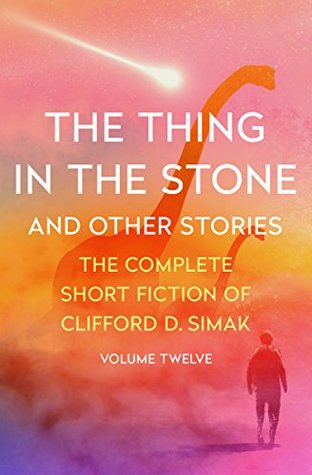
The Thing in the Stone and Other Stories, by Clifford D. Simak***-****

Clifford D. Simak was given the third Grand Master Award by the Science Fiction and Fantasy Writers of America; he wrote short stories proliferately for several decades in the last century.  His work was generally published in magazines, but with the digital age comes the release of his collected work in twelve volumes.  My thanks go to Net Galley and Open Road, from whom I received a review copy…two years ago. Ouch. As you might expect, this title is for sale now.

Here’s the thing about this collection as a whole: not all of it is science fiction. Simak wrote a lot during the 1940s and 1950s, and back then it was Western stories that sold big. For fans of science fiction, then, these stories are definitely a mixed blessing. The Thing in the Stone and Other Stories is the twelfth and final collection in the series.

The tltle story is excellent, and it shows why the editor has not chosen to separate Simak’s sci fi and Western stories into separate volumes: some of his stories—some of his best ones in fact—blend the two genres. In this one, Daniels sits on his farmhouse porch and chats with the sheriff; there are concerns about chicken thieves in the area. But even at the outset, small references here and there tell us that this is no ordinary Western story. For one thing, up North is an area casually referred to as “the Canadian Shield.” And as the sheriff departs and the rest of the story unfolds, Daniel learns that he is not alone, and his visitor is an unusual one indeed. This story contains a beautifully written inner monologue, and I find myself rereading passages out of admiration for the word smithery involved.

The next two stories are fun ones. “The World of the Red Sun” is suspenseful, and “Skirmish”, which is a man-versus-machine tale with a degree of prescience is laugh-out-loud funny in places. These stories, alas, are followed by an interminable Western—not blended, just cowboys and more cowboys—that I finally gave myself permission to skip. The rest of the stories offered after it are good, but the first three are the ones I like best.

Should you buy this collection? I suggest that if you are new to Simak’s writing, you purchase the first collection in the set, I Am Crying All Inside and Other Stories. It doesn’t matter whether you read the collections sequentially, but this is a solid short story collection and his best selling one also. I have read and reviewed eight of the twelve volumes in the set, and although The Thing in the Stone and Other Stories is well written and entertaining, there are five volumes, all reviewed here, that I rate as five stars. Of course if you have the opportunity to buy the entire set and have a serious love of old school sci fi, you won’t be disappointed.

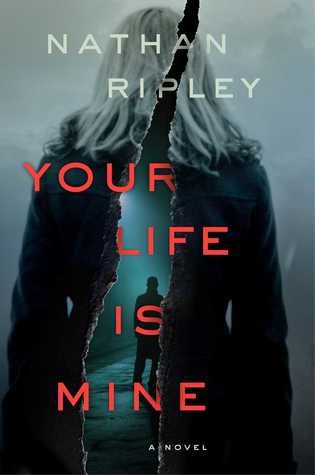
Your Life is Mine, by Nathan Ridley***-****

Last spring, author Nathan Ripley set the world on fire with his sinister debut novel, Find You in the Dark, and so I could hardly wait to read his new release. Big thanks go to Net Galley and Atria for the review copy.  Although this psychological thriller is a solid effort, there is an unevenness of quality that holds it back.

The opening is strong, both urgent and original:

Before a shooter is a shooter, he’s just a man in a room. It’s what follows that brings the background to the scene, to the way we remember it. The domestic dispute reports, the spotty employment record, the legal and illegal firearms history, the I-always-knew neighbors. Before all of that, he comes into the room with his gun, hidden or not, and he is a just a man. Chuck Varner was holding his daughter’s hand when he walked into the mall. My hand. He took me up that escalator and told me that he loved me. He told me to walk away from the mall and go back to my mom once he was done…I was seven years old.

Blanche Potter is a journalist, and she tells us that she is fine now. She has shed her horrifying past and her psycho parents like a ratty old coat, and her way of processing the experience that marked her childhood is by creating a documentary about it. The only person in her life now that knows who is she is, is her childhood friend Jaya. Jaya’s mother took Blanche in, introduced her to normal life. Jaya means everything to Blanche.

Unfortunately, another journalist has uncovered her past and is making demands. Emil Chadwick is the son of the biographer that spilled her family’s private details to the world back when Blanche was still a child; he threatens to out Blanche if she doesn’t cooperate with the work he is doing now.

The story is told in the first person primarily by Blanche, but it’s punctuated by Emil’s narrative and that of his mother Jill. We learn that Varner left followers that are still intent on fulfilling the mandate of chaos that Varner named “Your Life is Mine,” and at least one more mass shooting is in the offing. As Blanche untangles the truth, she reveals the secrets that she has withheld from her colleagues as well as her loved ones for all these years.

Blanche’s character is expertly handled, and of course she isn’t fine at all; she’s just good at compartmentalization. Ripley is deft as he introduces elements that tug at one fragile string and then another that are holding Blanche together emotionally. No one can read this story without believing Blanche and cheering for her, the plucky, bright young woman determined to proceed with her life despite a desperate, harrowing childhood.

But a thriller like this has to have a powerful resolution, and this one doesn’t. Within the last fifteen percent of the book, Blanche makes errors that don’t characterize her as we know her, and that cannot be accounted for by her development. The ending is more fizzle than boom, and to add insult to injury, Ripley moves to a third person narrative at the ninety percent mark; it’s awkward and jarring.

I like this author’s work and will continue to read it. As for you, I recommend you get it free or cheap, unless your pockets are deep ones.

The Lazarus Files, by Matthew McGough*

It’s almost as if two crimes are committed inside these pages: the first is the premeditated murder of Sherri Rasmussen, and the second is this atrocious book.  How many writers can take a compelling story—that of a cop killing her romantic rival, and her arrest and conviction—and make it this dull? So I still thank Net Galley and Henry Holt for the review copy, but nothing and nobody can make me read anything written by this author again. It appears that very few reviewers even forced themselves to finish it; those of us that soldiered on till the end either deserve commendations for our determination, or a mental health referral for not cutting our losses.

The book’s beginning comes the closest to competent writing as any part of this thing. We get background information about Sherri and John’s courtship and marriage, as well as John’s relationship with the murdering woman he scorned, Stephanie Lazarus. Don’t get me wrong; I am not saying this part is well written. Even here, there are serious issues with organization and focus, yet I continue, believing that when we get to the meat of the story where the truth is revealed and the killer arrested, tried and convicted, it will be worth the wait. In that, I am mistaken.

The author wanders anywhere and everywhere, apparently unwilling or unable to exclude one single fact about anyone, even those tangentially involved. Why do we need pages and more pages devoted to the life and times of people the victim barely knew? To add insult to injury, many of the facts he’s uncovered are inserted into multiple places in the narrative in a way that emphasis doesn’t justify.  It appears as if he is attempting to reveal a cop cover-up, but his inner attorney forces him to equivocate, hinting throughout without ever reaching the punchline. He infers that maybe Sherri’s husband John knows more than he’s saying, but again we see innuendo everywhere without an accusation being made outright. The writing is riddled with clichés. In many places he tells us how one character or another feels, or what they are thinking, and yet there are no citations anywhere for anything; this is a cardinal sin in writing nonfiction. I go to check the notes at the end of the book and there are none. The copious gushing over Sherri’s excellent character and intelligence, while it sounds warranted, is salted so liberally over 597 interminable pages makes me wonder if there is a connection between the author and the victim’s family, but again, if it’s true, he doesn’t say so. All told, it’s a very unprofessional piece of…writing.

By the time I consider abandoning this thing, I have put in the time required to read over a hundred pages, and so I see it through. I skip the section about the murder of someone else; had it shown up before I was completely disgusted, I’d read it in case it provides strong evidence to back up what the author is inferring but not saying, but as it is, I just want to get to the meat of the matter and be done with this thing.

Imagine my surprise when the Rasmussen murder case is not reopened, and Lazarus is not investigated, arrested, tried and convicted until…the epilogue.

There is not one redeeming feature of this book. It’s a train wreck from the start to the blessed ending. If I feel this way after reading it free, how might you feel if you paid money for it?

Fifty Things That Aren’t My Fault, by Cathy Guisewite****

Guisewite began publishing the comic strip “Cathy” in 1976, the year that I graduated high school. It was a time of high expectations for women, and the unrealistic suggestion that we would be able to “bring home the bacon, fry it up in a pan, and never let you forget you’re a man,” as Madison Avenue decreed, was daunting.  Through her sharply perceptive humor, Guisewite let her peers know that it wasn’t just us; we were judging ourselves with an unfair yardstick. She kept it real, and in doing so, kept us sane.

My thanks go to Net Galley and G.P. Putnam for the review copy.

So how does cartooning translate to prose?  Whereas the cute, punchy single-page entries and single sentence proclamations—and the lists—are her most familiar territory, my favorite parts of this memoir are the least cartoonish ones. Yes, I love the way she takes down the women’s fashion industry and the unhealthy way it affects our body images.  She was good at it forty years ago, and she’s good at it now. But the passages that drew me in and let me get lost in her story are the more vulnerable, deeply perceptive parts of the narrative, her fears for her aging parents; the struggle and triumph of raising a daughter, one with special needs, alone; and the failure of her marriage. I am in awe of the fact that she and her ex made each other laugh until the tears came as they planned their divorce. Who does that? And of course, she made me laugh too.

Guisewite stays inside her usual parameters, never veering outside of the middle class Caucasian realm with which she has experience. Younger women won’t get much joy out of this memoir; women that came of age between 1965 and 1985 are right in her sweet spot, and it is to them that I recommend this book. It’s available now.