Unknown's avatar

About seattlebookmama

Greetings! I am Donna Davis, a retired teacher living in my favorite city in the world. I've found that one of the greatest comforts in life is a good book. We can all use a little of that. Welcome, and enjoy! Donna Seattle Book Mama

Black Cloud Rising, by David Wright Falade*****

Black Cloud Rising, the historical novel that’s already been excerpted in The New Yorker, is the book I’ve always wished someone would write. Author David Wright Falade tells the story of the African Brigade, a unit of former slaves tasked with rooting out pockets of Confederate guerilla fighters in the Tidewater region of Virginia and in North Carolina’s Outer Banks. This outstanding work of historical fiction is one of the year’s best surprises, and it’s for sale now.

My thanks go to Net Galley and Grove Press for the review copy.

Sergeant Richard Etheridge is our protagonist; he is the son of a slave and her master. This is the only small criticism I have here; it seems like every time I see a fictional former slave that goes on to do momentous things, he’s the master’s progeny. However, Sergeant Etheridge did exist in real life; I have been unable to discover whether this aspect of his beginnings is fact or fiction. If it’s fact, then I withdraw my objection.

One way or the other, this is nevertheless a fantastic novel. In fact, since I taught the American Civil War for many years and have never heard if this sergeant, I wonder, initially, if his story is even true. But a little research shows Etheridge to be have been real. I had known about the existence of this brigade, but the only aspect of it I’d seen was–oh how embarrassing—from the movie, Glory, in which an all-Black military unit volunteers to lead the charge on Fort Wagner. But there, the story is told not from the viewpoint of infantrymen, but from the Caucasian officer chosen to lead them. It’s not as if I failed to do research; but during my years in the classroom, I couldn’t find a single thing that reflected the memories and experiences of the former slaves that fought for the Union. And although this book comes too late to help me teach the upcoming generation, it will be greatly useful to teachers that come after me.

At the outset of our story, Richard approaches his master at dinner, a thing that is generally not done, to tell him that he is going to enlist in the Union Army. Because he is the master’s son, he is able to get away with this, and this has also allowed him to learn to read and write, which in turn makes him officer material. Richard is a well developed character; it is wrenching to see his loyalty and devotion to his father, as well as to his half-brother Patrick, who is the legitimate heir to his father’s estate. Repeatedly the narrative points out that “the son will always seek out the father,” and it makes me ache for this young man. Nevertheless, he does go to war against his father’s wishes, and he demonstrates leadership and skill under pressure.

There is one visceral scene in which the Caucasian master of a plantation who is linked to the guerilla Confederates, is dragged to his own whipping post and beaten by his former slaves. I find it deeply satisfying. In the end and after much bloodshed, the unit is successful in its mission to clear the area of the guerillas that threaten the Union effort.

In many ways this is a coming of age story, but those that will love it most are those that enjoy military history and all things related to the American Civil War, as well as those interested in the Black struggle. It’s a great selection for Black History Month, but it will make excellent reading during the other eleven months as well. Highly recommended.

The Golden Couple, by Greer Hendricks*****

Audio Narrated by Karissa Vacker and Marin Ireland

 My thanks go to Net Galley and St. Martin’s Press for the invitation to read and review. The Golden Couple is the third novel I’ve read by Greer Hendricks and Sarah Pekkanen, and it’s the best so far. This book becomes available to the public, in print and in audio, March 8, 2022. Those that enjoy a solid psychological thriller should order it right now.

We have three major characters. The first is Avery, the therapist, and she is the only one to use the first person, so if we have to choose one character as protagonist, she’s the one. The other two are Marissa and Matthew, two halves of the married couple she is counseling. The narrative shifts between them, with the lion’s share going to Avery and Marissa, and less to Matthew.

Before we go farther, I will tell you that when I learn that Avery is a therapist, my initial reaction is the eye roll. Seriously? Another therapist, as in An Anonymous Girl? Can we have a little variety here, maybe. And suspicious type that I am, I think I smell a good writing team becoming hacks, too comfortable with a formula. But oh no no no, that’s not at all what is happening here! This is nowhere near the same story.

The premise is that Marissa wants to come in with Matthew for counseling. She has cheated on him—just once—and she wants to tell him, but she is afraid of his reaction. She treasures her marriage, and the little family they have created with their son, eight year old Bennett. She doesn’t want him to leave her, and he has a bit of a temper. She’s come to ask a pro for help, and has heard fine things about Avery’s work. Avery has a ten-step method that she swears will help every couple, whether it’s to find a way to stay together, or the best way to uncouple. She believes the marriage can be saved.

Now, Avery, our therapist, is an odd duck. She’s lost her license to practice as a psychologist because of some unconventional methods, and we learn this right at the outset, so we’re already on the back foot, watching to see if she does something hinky. She seems like she may be a bit sketchy, and the couple seem almost too good to be true, both ready to do whatever it takes to salvage their relationship and move forward. And yet, clearly, not all is as it seems.

I can’t tell you more than that. You don’t want a lot of information going in. Because this is a work of suspense, you can’t guess who the baddy is by keeping track of the facts as they are revealed; just sit back, and enjoy the ride.

I also received the audio version, and I alternated my reading between it and the review copy on my Kindle. Voice actors Karissa Vacker and Marin Ireland do a fine job; it’s really a toss up as to which version is better, so go with the medium you most enjoy.

Highly recommended to those that like the genre.

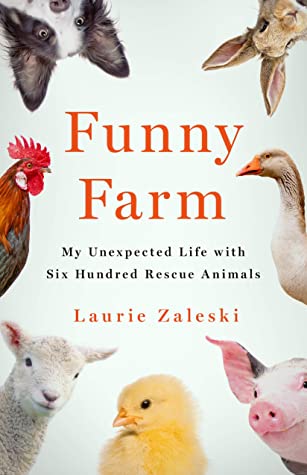
Funny Farm, by Laurie Zaleski*****

“You never know what you are capable of until the day comes wen you have to go places you hadn’t planned on going.”

Laurie Zaleski knows how to make a debut. Funny Farm: My Unexpected Life With 600 Rescue Animals has created a tremendous buzz, and all of it is deserved. My thanks go to Net Galley and St. Martin’s Press for the review copy. This book will be available to the public Tuesday, February 22, 2022.

Laurie’s early childhood was in many ways an enviable one; her mother stayed home to raise Laurie, her brother, and her sister, and her father made enough money to hire household help and buy a couple of vacation homes, too. There was nothing they lacked for, other than physical safety. Because while her father could be warm, and loving, and generous, and funny, he could also be a monster. His reign of terror was worsened by alcohol consumption. As the beatings became uglier and more frequent, Annie, their mother, chose poverty for the children and herself over the constant terror and danger of living with their dad.

“’I almost became a nun,’ Mom would joke years later. ‘Then I met the devil…’ Annie McNulty and Richard Zaleski fell in love like tripping into an open manhole: one wrong move followed by a long dark plunge.”

There’s one searing episode Zaleski recounts, toward the end of their life with Dad, in which they are all hidden in a bedroom with the door blocked shut, and their father is sneaking up on them, commando crawling up the hallway toward them so they won’t see his shadow approaching, and he has a large knife between his teeth. It sounds like something from a Stephen King novel, doesn’t it?

And so, when Annie’s efforts to build a modest nest egg to finance their flight is uncovered, she has no other option but to leave without the money. She finds a dumpy cabin in the woods, half fallen down and in no way legally rentable, and strikes a bargain with the owner. To say that their standard of living decreases is the understatement of the year, but they make it work.

Once she has made her escape, apart from the creepy forays from an unseen enemy that occur from time to time, Annie can’t turn away anyone else, human or otherwise, that is in a dark and vulnerable place. The woods surrounding their little shack begin sprouting makeshift outbuildings; there’s a little lean-to here, and a sort-of paddock there. And it keeps growing.

Zaleski is a gifted storyteller, and she alternates her narrative from the present to the past, breaking up the nightmarish episodes of her childhood with hilarious stories, most of which are about the critters. Her writing is so nimble that I find myself repeatedly checking to see what else she’s published, because there’s just no way this can be her debut. But then, that’s what they said about Harper Lee, right?

Perhaps the most glorious aspect of this book is seeing how Annie McNulty’s can-do attitude, sterling work ethic, and positivity transformed her life and lit a path for her children. She provided them with an outstanding role model, and in return, they did everything possible for her when cancer forced her to slow down.

This book will inevitably be compared to Educated and The Glass Castle because it is a memoir of someone that has overcome horrifying challenges in childhood and emerged triumphant. But make no mistake, Zaleski’s story is in no way derivative, and likely will be held up as an example for future writers. It makes my feminist heart sing!

Highly recommended.

Don’t Say We Didn’t Warn You, by Ariel Delgado Dixon***-****

I was invited to read and review by St. Martin’s Press and Net Galley, and it sounded like a winner; a debut to boot. I am disappointed not to be able to read further, because this is clearly a writer with talent, and the story is an interesting one thus far.

Here’s the thing:  I see foreshadowing that suggests the family dog is going to meet with a lot of pain, and I am not up for it.

There’s been a trend away from this lately, and I suspect this is why: there’s a lot of push-back against it these days. There was a time when the sacrifice of a (fictitious) pet was considered a lesser evil. Rather than kill or torture a character that the protagonist loves and the reader may have bonded with, take out the dog, cat, horse, etc. It’s sinister foreshadowing, but nobody is dead yet. But these days, animals in general and pets in particular are out of bounds. If a writer goes there at all, it must be well in the past and with as few details as possible. Less is more, and usually, none is even better.

Were it not for the animal cruelty that other reviewers have referenced, both with the dog and the wilderness camp, I would gladly finish and review this galley. I wish the author well, and look forward to seeing what they publish next, assuming this deal breaker doesn’t make it into their next endeavor.

My rating isn’t based on much because I didn’t get far; four stars is the rating I give most often, but this time it should be taken with a grain of salt.

City of the Dead, by Jonathan Kellerman*****

The Alex Delaware series began in 1985 with the publication of When the Bough Breaks, and it’s been going strong ever since. City of the Dead is number 37, and in many ways, its style is closer to the original than more recent editions, and I consider this a good thing. My thanks go to Net Galley and Random House Ballantine for the review copy. This book is available for purchase today.

The story begins with a moving van, and two drivers looking to beat that nasty Los Angeles traffic by starting early. They’re making their way through an upscale residential neighborhood when something hurtles toward them in the dark, and the van makes a sickening crunch as it rolls over it. It’s a man, clad in his birthday suit alone; nobody can see the face anymore, because that’s where the wheels went. Once it becomes clear that the man was already dead when he was tossed into the street, Detective Lieutenant Milo Sturgis is called in. Milo is a homicide cop; Alex Delaware, our protagonist, is a child psychologist as well as Milo’s best friend. Milo often consults with Alex—sometimes officially, sometimes not—when a case has tricky psychological contours.

There are two threads to our plot. The first is the aforementioned corpse under the van; a small trail of blood leads the police to the house from which it came, where they find another body, that of the woman that lived there. There are all sorts of twists and turns; the woman turns out to be someone Alex knows slightly from a case in which he testified, but the man proves much harder to identify.  The second thread is more straightforward, a custody case he’s been asked to evaluate for the court. Ultimately, there is some overlap between the two threads, and this is not something I can recall seeing in other books in the series. It’s very well done.

One thing I often forget between Delaware novels is how funny Kellerman can be. In this case, the story unfolds fast, and it isn’t until about the 70 percent mark that the humor is interjected. Delaware and Sturgis are interviewing a couple of enormous bodyguards, and the scene makes me snicker out loud. The pacing never flags, and there is a lot of dialogue that crackles and makes the pages turn

There are two elements I’ve complained about in recent Delaware novels. The first is the sordid stuff; kinky sex that comes off as a bit seedy and leaves me with a sour gut. None of that this time! I’m so pleased. The second is the unrealistic elements in which Alex does way too much cop stuff for a civilian. There have been times, in other books, where Alex tackles bad guys, or is given a Kevlar vest, and when that happens, the magic is compromised. It makes me think about the author, because I’ve stopped believing 100 percent in the characters. Again, that is scaled way back here. In fact, there’s one instance where Alex suggests that he be the one to entice a suspect into giving up a coffee cup or something else containing DNA, and Milo shuts that down. It’s not necessary, and they’re not doing that.

The last several Delaware novels have been four stars from me, because although I did enjoy them, the elements that I just mentioned kept me from going all in. This time I feel everything was exactly right. You can jump in if you’re new to the series, but once you do, you’ll want to go back for the others. Highly recommended.

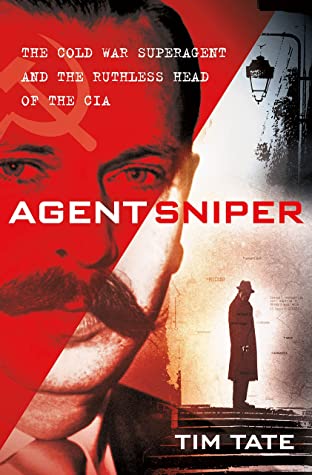
Agent Sniper, by Tim Tate***

I was invited to read and review this book by Net Galley and St. Martin’s Press. I accepted because I do love a good spy story, and there aren’t many of them being published at this time. Tim Tate has had a long, illustrious career as a documentary filmmaker and as an author, but is new to me.

So, when I began reading and found my attention wandering, I thought it was a personal problem. Too many distractions. I tried again, and when that didn’t go well, I procured the audio version and listened to it while I prepared dinners during the week. Eventually, I threw in the towel and admitted that this is simply not an engaging book. The topic sounds fascinating, but just as a gifted, dedicated author can spin dull material to gold, so can an indifferent one tell an electrifying spy story in a way that leaves the reader checking the page numbers and the clock—is this thing over yet?

It’s not all bad news: the research here is top drawer. For the researcher, this book has use, although I would caution the uninitiated into reading carefully, because history is always politically charged. Every fact that is included, and every fact that is not; the interpretation; the language used, all give a biased account, even when a researcher and writer is endeavoring to be as balanced as possible. I don’t care for this writer’s interpretation, which makes him sound like a hardened right winger, but I have no doubt that the facts that he uses are accurate ones.

Then we come to the audio, and I must wonder why, if we’re primarily dealing with the CIA and its agents, we have a narrator with a clipped English accent (and a few pronunciations that sounded very odd to me,) telling the story. I found it disorienting, but if this had been a more engaging story, I would have overlooked it.

Ultimately it comes down to wordsmithery, and I didn’t find much of it. Those interested in dabbling in this genre would do better to read Ben McIntyre and Tim Weiner.

This book is for sale now.

Psycho by the Sea, by Lynne Truss*****

Lynne Truss is hilarious, but with this fourth installment of the Constable Twitten series, she has outdone herself. My thanks go to Net Galley and Bloomsbury for the review copy. This book is riotously funny, and it’s for sale now.

Truss first came on my radar with her monstrously successful nonfiction grammar primer, Eats, Shoots & Leaves: The Zero Tolerance Approach to Punctuation. A decade later I began reviewing, and one of my first reviews was for Cat Out of Hell, and later, the first in the Constable Twitten series, A Shot in the Dark, followed by the second, The Man That Got Away. I somehow missed the review copy for the third, Murder by Milk Bottle, which I discovered when I received the review copy for this fourth in the series; after sulking for a bit, I took myself to Seattle Bibliocommons and checked it out so that I’d be up to date when I began reading this one. It proved to be a good idea.

I tell you all this so you’ll see why I thought I had this author figured out. She had proven to have a distinctive, rather odd fiction writing style, which began in a sort of corny, groaning, oh-my-God-is-this-the-best-you-can-do style, but then sneakily grew better and funnier until by the second half, I’d be laughing my butt off. So as I open Psycho by the Sea, I have fortified myself to give Truss a minute or two to warm up. It will be funny, I am sure, but probably not just yet.

Surprise! This time, Truss had me laughing right out of the gate.

For the uninitiated, this satirical series is set in Brighton, a coastal resort town in England, in the 1950s. Our protagonist, Constable Twitten, is brilliant but irritating. He joins a small force that consists of Chief Inspector Steine, who has, until recently, been more interested in boosting tourism by pretending that Brighton has no crime, than in breaking up the formidable organized crime gang that runs amok, than in solving any of the crimes that have been committed. That was true until the last installment, when he inadvertently covered himself in glory and is now basking in the limelight, some of it literal as he is invited to speak on television or receive yet another award for his cleverness and courage. We also have Sergeant Brunswick, who would solve crimes gladly if he weren’t so everlastingly stupid; instead, he yearns to go undercover, even when there is no earthly purpose in it; when he does, he always manages to be shot in the leg at least once.

By now the readers know that the cleaning lady in charge of the station is a criminal mastermind. Mrs. Groynes is part cleaner, part den mother, and part overlord, and she makes herself loved and indispensable by showing up with cake, providing constant cups of tea, and listening to the cops to make sure that her operation is nowhere close to being discovered. In the first of the series, Twitten discovers what Groynes has been up to, but not a single, solitary cop or civilian will believe him. He’s new, after all, and they’ve known Palmyra Groynes forever. Mrs. Groynes, a crime lord? Don’t be ridiculous!

Now it seems that Palmyra has a competitor, someone that wants her turf and is willing to mow down her operatives in order to take it. I never would have seen this coming, and it’s an ingenious development. Old characters come back, and a new one, a formidable secretary sent down from London, turns the cop shop into a much more legitimate enterprise, and also sends Groynes packing. Even Twitten wants her back.

My favorite moment is when Twitten is being held at gunpoint, and he is so pedantic and obnoxious that he bores his assailant out of shooting him.

Not only does this book hit my funny bone right away, it also features a more complex, well balanced plot, and more character development. Until now, I had assumed no real character development was being attempted, because it’s satire, satire, satire, but now, it appears one can do both, and Truss does both bally splendidly.

“Flipping hedgehogs!” You have to get this book, but it will be more enjoyable if you read the other three first. Highly recommended.

The Eternal Audience of One, by Remy Ngamije*****

“Life is not hard in Windhoek, but it is not easy, either. The poor are either falling behind or falling pregnant. The rich refuse to send the elevator back down when they reach the top. And since cities require a sturdy foundation of tolerated inequalities, Windhoek is like many other big places in the world. It is a haven for more, but a place of less. If you are not politically connected or from old white money, then the best thing to be is a tourist. The city and the country fawn over tourists. The country’s economy does, too. That is when it is not digging itself poor.

That is Windhoek. The best thing to do in the city is arrive and leave.”

And now, raise your hand if you find yourself wondering where Windhoek is. Don’t be shy. You’ll have plenty of company…ah. Yes. I applaud your bravery, being the first. And you, and you…and you in the back. Anyone else? That’s what I thought. Look around. Almost all of you. So now, I’ll relieve your discomfort and tell you, it’s in Namibia. Our protagonist, Seraphim, and his family must relocate there during the upheaval in their native Rwanda. This is his story, told in the first person.

My thanks go to Net Galley and Gallery Books for the review copy. This book is available to the public now.

Seraphim’s parents are strivers, working industriously to ensure that he and his siblings will have excellent educations and better lives. As a young man, he works hard and is fiercely competitive in school, but once he is at university in Cape Town, he becomes a party animal, using Cliffs Notes to dodge the assigned reading and embarking on booze fueled, all night romps. Ultimately, this is a coming of age story in a different time and place than that which most Western readers are accustomed to. And oh, my friend, if you are going to spread your wings and stretch your global literacy just a teensy bit, then this is one painless way to do it.

Once he’s inside South Africa, Sera deals with Apartheid, and during the course of his education, is advised by a wise friend, who tells him that if you want decent notes, you must befriend BWGs. These are Benevolent White Girls, and they seem to know some sort of educational code that young Black men have somehow been shut out of. There’s a funny passage about how to tell if a Caucasian is the sort one can hang out with, and to explain the difference in his own social class growing up, in contrast to others in his social group, he describes a problem with desks. There are fifty children in the class, he says, and not everyone can have a desk. Little Sera gets busy, and eventually is able to rise from chair number 50, to chair number three. Then, after a struggle with Gina and Hasham, the first and second place students, he rises to the first chair, first desk. When a friend asks what became of Gina and Hasham, Sera shrugs with his characteristic cocky arrogance, and he tells him, “I like to think they married and had second and third place children.”

Part of what I love is the way the voice here sounds like young men in their late teens and early twenties, here, there, or probably just about anywhere. In my experience, his demographic is the most hilarious of any in real life, and it comes shining through here, full of irreverent wit.

The narrative isn’t linear, and there’s some creative jumping around that, when combined with the internal discussions the narrator calls “The Council of the Seraphims,” can be difficult to keep up with. Don’t try to read the second half of this novel after you’ve taken your sleeping pill.

All told, this is a brainy, hilarious work, which is perhaps why Ngamije is being compared to Chabon and Zadie Smith.  He resembles neither, apart from being very literate and extremely funny. In fact, this book is worth reading just for the snarky texts sent by Sera and his friends; their handles crack me up even before I see what they have to say. Highly recommended, even at full price.

The Road Less Traveled, by Philip Zelikow***

Is this going to be on the test?

My thanks go to Net Galley and Public Affairs for the review copy. This book is for sale now.

I am initially drawn to this title when I see the subtitle—an opportunity to make an early peace that went unanswered—and I also want to read more about World War I. I love military history, and am sick to death of World War II material, so this felt like it might be a breath of fresh air.

Or not.

There is no doubt that Zelikow knows his field, and his research is above reproach. Students and researchers may find this book useful, albeit with a careful eye toward a very conservative point of view that affects his analysis. However, for those of us just in it for the joy of learning, I must caution that this is a slog. I read the first half in the digital format I was given, and after publication, I also availed myself of the audio version available at Seattle Bibliocommons, and it’s difficult to focus on either for long at a time, because it’s just Zzzzzzzz

Oh, I’m sorry! Was that me? Let me try again. The research is splendid; the analysis is reactionary; the presentation is a little zzzzzzzzzzzzzzzzzzzzzzz

I might have spared myself some frustration had I researched the author. Once I was able to focus long enough to get a feel for his political leanings, I ran a brief Google search, and discovered he’d been with the U.S. State Department under the Reagan and Bush administrations.

Oh.

At this point, you know enough to decide whether you want to read this thing. If you have a strong interest in the topic and aren’t squeamish about drawing information from the far right, then this is your book. Not mine, though.

Happy Release Day!

I reviewed this outstanding collection earlier, but today it is available to the public. Hill won awards for the first collection, and this is, if anything, even better.

https://wordpress.com/view/seattlebookmamablog.org