The Briar Club, by Kate Quinn*****

I had never read a novel by Kate Quinn, but my friends on Goodreads raved about it and I was overcome by the fear of missing out. Happily, I was not too late to get a review copy; my thanks go to NetGalley and William Morrow, along with my apologies for lateness. From the get go, I could tell this book was too good to speed read, and so I set it aside for a time when I could sink into it and appreciate it. This fall I was able to get the audio version from the library to help me along; narrator Saskia Maarleveld is outstanding, and those that enjoy hearing their books should strongly consider ordering that format.

Our story takes place just after World War II, and it takes place almost entirely within the confines of Briarwood House, a women’s boarding house owned by the selfish, odious Mrs. Nilsson. The book’s prologue comes to us from the point of view of the house, and for a brief spell I wonder whether the house itself will become the main character. It doesn’t, and that’s probably just as well, because the women that rent its rooms, along with Pete and Lina, Nilsson’s two children, fill the story quite nicely, and all are beautifully developed, some more than others, with Nilsson herself being the only truly static character. In fact, I could argue that even the house’s character is developed somewhat.

I seldom do this, but the prologue is so juicy that I’m going to reprint a considerable chunk of it here, because Quinn’s voice—and okay, the house’s—provide a more convincing incentive to read on, than anything I can offer:

If these walls could talk. Well, they may not be talking, but they are certainly listening. And watching…Now its walls smell of turkey, pumpkin pie, and blood, and the house is shocked down to its foundations. Also, just a little bit thrilled. This is the most excitement Briarwood House has had in decades. Murder. Murder here in the heart of sleepy white picket fence Washington, D.C.! And on Thanksgiving, too. Not that the house is terribly surprised by that; it’s held enough holidays to know that when you throw all that family together and mix with too much rum punch and buried resentment, blood is bound to be shed sometimes…This was a very enthusiastic murder, the house muses. Not one moment’s hesitation from the hand swinging that blade…Briarwood House doesn’t like Mrs. Nilsson. Hasn’t liked her since she first crossed the threshold as a bride, complaining before she’d even shaken the rice out of her hair that the halls were too narrow (My halls! Too narrow!), and still doesn’t like her twenty years down the road. No one else in this kitchen does, either, the house knows perfectly well. It knows something the detective doesn’t. The killer is still very much in this room.

Now that the murder has been mentioned, I must caution you not to identify this story foremost as a murder mystery; it isn’t. The murder doesn’t come till nearly the very end, and the reason that it affects us so deeply is because of the author’s success in making every character here feel tangible and known to us. By the time anyone is enraged enough to swing anything, we know all of these women, or most of them at least, well enough to feel as if they are family. Boarder Grace March is revealed to us more slowly than the other women, but there are reasons for that, and by the end, I may love her best of all. No, this is first and foremost a stellar work of historical fiction.

At the outset, no one knows anyone else. Some are married, waiting for spouses to return from the conflict; some are single; some are professionals. Almost everybody has at least one serious secret. But as they grow to know one another, bonds are established that in some cases are stronger than those of blood relatives.

I won’t go through the plot or describe individual characters; as far as I’m concerned, that would be gilding the lily. Instead, I urge you to get a copy of this outstanding novel in whatever form is your favorite, with a slight nudge toward audio if you’re undecided. Highly recommended!

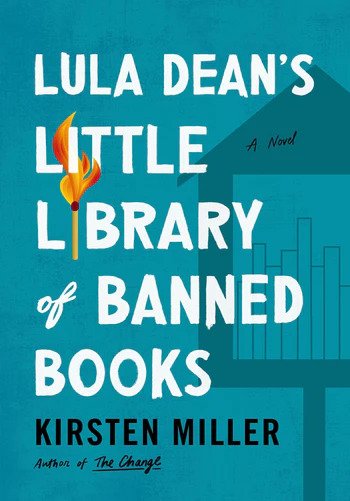
Lula Dean’s Little Library of Banned Books, by Kirsten Miller

Lula Dean is a deeply unhappy woman. Neglected by her children, alone and unappreciated, she strikes on a way to gain the attention she knows that she deserves. She embarks on a crusade to remove books she deems objectionable from local libraries, and she sets a sterling example for her town by erecting a little library on her lawn, a collection of the wholesome material she thinks is most appropriate. Little does she know that one of the town’s youths has snuck out in the dead of night and inserted banned books inside the dust jackets of the books she originally placed there. Her library becomes wildly popular, and Lula hasn’t a clue why.

My thanks go to NetGalley and William Morrow for the review copy. This book is for sale now.

The moment I saw the synopsis for this novel, I knew I had to read it. The First Amendment is a hot button for many people in the U.S., and as a language arts teacher, it’s been at forefront of my mind for most of my adult life. And I think I can safely say that Lula Dean is a soft sell; readers are generally a receptive audience, and so any novel containing the word “book” or “library” in its title should, I would argue, be held to a slightly higher standard. It’s not that hard to preach to the choir.

I love the premise of this story, and I laugh out loud more than once at the beginning. After that, though, things flatten out a bit. There are a lot of characters here, and whereas I have no difficulty keeping them straight, their numbers may have prevented author Kirsten Miller from fully developing them. I feel as if I am reading, for the most part, about cartoon cutouts rather than real people;  had I felt as if the characters were real, I would have been more deeply invested in their outcomes. However, everyone in this thing is either a fine, enlightened character or a despicable, ignorant blowhard. It accurately represents the way many Americans regard those around them, blue versus red, and that is not helpful. Two characters that stand out better than others are side character Beverly Underwood, and the young Elijah. However, even these are not dynamic characters. Nearly everyone here is the same going out as they were coming in.

Those looking for a short, funny novel to toss in their suitcase over the holidays could do worse; they could also do better. The sad thing is that had this been written in a more intentional way, with the literary standards one would hope to see in any novel, it could have been impressive, might even have changed a few hearts. This book isn’t going to do that, and so I see it as an opportunity squandered.

Margo’s Got Money Troubles, by Rufi Thorpe****

Margo’s Got Money Troubles, by Rufi Thorpe, is a bold, inventive, and very funny novel about a young woman cut adrift in a difficult, expensive world. My thanks go to NetGalley and William Morrow for the invitation to read and review. This book is for sale now.

Margo is the daughter of a Hooters waitress and a former pro wrestler, an absentee father with a family of his own; her mother had been his woman on the side. Consequently, Margo has always understood that she would have to hit the ground running when she grew up, and so she’s enrolled in a junior college. When the brief affair with her English professor leaves her pregnant, she has nobody reliable to advise her. The women she confides in urge her to terminate the pregnancy, and of course, the professor does, too; yet Margo likes the idea of becoming a mother, and it’s her fetus. Nobody can make her do anything. She decides to keep it.

Her mother is about to marry a man with money and conservative values, and she sees Margo as a loose cannon that just might upset the whole ship, so she tells her to terminate or be cut off.

Wow, Mom. Really?

Margo’s roommates hadn’t agreed to share an apartment with a baby. They need to sleep! They have to get up early!

Early on, I’m rolling my eyes. Part of me is thinking that Margo is about as dumb as they come; part of me is wondering why no author in this entire world is writing—or, more likely, why no major publishing house is publishing—novels in which a young woman chooses to have an abortion and take back her body and her life. But I’m overthinking, because soon, Margo—who after all, is just young, naïve, and rudderless—admits her error. She loves her little boy, but she had no idea he would be so expensive, or that motherhood would be so difficult. She tells her father, who re-enters her life as her mother steps away,

 “’I shouldn’t have had him,’ as though some rip cord had been pulled inside her. ‘I know that, okay? Everyone told me it would ruin my life and it did. They were right, and I was stupid, and I didn’t get it. Okay? But now I’m here.’ And her father, who strangely enough becomes the most reliable adult in her life, says, ‘Yes. Now we’re here.’”

Later, Margo will comment that nothing can make a person pro-choice like having a baby.

Margo has been waiting tables, but she can’t find child care, and when she brings the baby to work, she’s fired. And the truth is, she doesn’t like leaving her baby. Then one day, while looking at her naked self in a full length mirror, she observes that she has huge boobs for the first time in her life. Men would pay to see this. She opens an account on OnlyFans.

And so this controversial choice becomes the crux of the story. Some friends reject her, and her mother has really had it with her now. But there are a lot of meaty conversations that are thought provoking, and so, even though this old lady schoolteacher reviewer is mighty uncomfortable reading about an online sex worker’s film process, there are related questions that cannot be ignored. For example, Jinx—her father—advises her against it, saying that she shouldn’t get mixed up with these kinds of girls, and she asks him, “What are ‘those kinds of girls’?” And it’s true. A man can send his dick pix out into the world any number of times and places, and whereas many will consider these gross, or obscene, which they are, how many people will condemn the guy’s entire character, his moral fiber, for having done it? So the double standard is screaming to be recognized.

Margo goes through a lot of grief, defending custody of her son when the skeevy professor resurfaces, as well as having to deal with housing crises and other problems. But the central issue lurking in the shadows is that of a young mother choosing sex work as a career.

I have to tell you quite frankly that I was way out of my comfort zone through much of this book. I am probably not part of its target audience, despite the fact that I was approached to cover it. Partway in, I considered not finishing it, but the quality of the writing is so strong that I kept going, and I’m glad I did.

The story is told from a third person omnipotent perspective, but it shifts in a surprising and funny way, and that’s all I will say about that, lest I ruin it. I wonder from time to time if we have an unreliable narrator, but this is more than that. This unusual point of view a brave choice, and I think she carries it off well.

There are a lot of worthwhile discussions that can spring from this novel; it’s fertile territory, if you’ll pardon the expression, for book clubs. It’s also being adapted for Apple TV. I recommend this book for any feminist that likes to laugh, and isn’t afraid to think outside the box.


Pay Dirt, by Sara Paretsky*****

Sara Paretsky is a badass author with a badass protagonist. Her hero, Vic Warshawski, is a rough and ready private eye, and though based in Chicago, she sometimes—as now—finds herself elsewhere when duty beckons. Author Paretsky is one of the three that pioneered the hardboiled female private eye subgenre; the first in this series, Indemnity Only, came out in 1982, over 40 years ago, and that is how long I have been reading them. And though I was lucky to receive a review copy, thanks to NetGalley and William Morrow, this is one of those rare books that I would have paid full price to read if that was the only way I could get it.

This book is for sale now.

This story finds Vic in bad shape, both mentally and physically. She has attempted to help a student of her boyfriend Peter’s, a trans youth whose father blew out the kid’s brains rather than accept their new identity. The brains stuck to Vic, and the experience sent her reeling emotionally. She’s been forgetting self-care, not eating or exercising. What she needs is rest and quiet.

But that’s not how it goes.

Her godchild Bernie persuades Vic to attend a basketball championship game in Kansas. A group of them will be going down there; it’s just what Vic needs, she says. Reluctantly, Vic agrees, but once they are there and the game is over, one of the parties disappears, and Vic is enlisted to find her. When Vic finds the missing basketball player, she inadvertently finds a dead body. The cops in Lawrence, Kansas as well as the FBI like her for the killing. It’s so convenient to have a mouthy, street smart outsider blunder in; hopefully, they can pin it all on her, and then life will go on as it has been. And so Vic must stay behind because she’s been told not to leave town, but also in order to clear her name.

Now, this is one of the elements that generally irritates me in most mysteries; the whole clearing-my-name trope is desperately overdone. There’s another trope that shows up later in the story, but I won’t share it here because it’s a spoiler. But for every rule, there is an exception, and in the case of both tropes, Paretsky breezes through, and I barely bat an eye; this is because the characters are so real to me, and the situation they’re in is so immediate, that I blow it off so I can find out what happens next.

And as is so often the case, Vic Warshawski finds herself up against the town’s wealthy power brokers, who have a vested interest in not having the real killer caught. As for Vic, she makes friends with a few people that have no wealth and no power, but the small ways they assist her make all the difference.

Once she solves the crime, persuades the local police and others that she is innocent and that the blame lies with the men in the suits, are they hauled off in shackles? Don’t hold your breath. As one of her new pals reflects, “That is justice in America, plain and simple, before you wrap it up in a pretty package of Constitutional rights that only the rich get to have.”

The thing that sets this particular book apart from the other very good mysteries I’ve read recently is the development of the protagonist. She’s vulnerable because of her earlier trauma; her boyfriend left the country on business, and he hasn’t been responding to her texts. She is miserable, and she’s isolated. But as the pressure builds, Warshawski delivers. The last quarter of this novel is impossible to put down, and even before that, I set aside my usual rotation of books, because I wanted to read this, and only this.

This novel is written in such a way that a first time reader can jump into the series, but chances are good that once you do, you’ll reach back for some or all of the others. Highly recommended to those that love gritty, rough and tumble detectives; feminists; and those that lean to the left.

Mother-Daughter Murder Night, by Nina Simon****

Nina Simon’s debut novel, Mother-Daughter Murder Night, marks a fine beginning to an auspicious career. My thanks go to Net Galley and William Morrow for the review copy. This book is for sale now.

The story unfolds with three generations of women—Lana, Beth, and Jack—solving a murder mystery together. Lana, the grandmother, has just received dreadful news from her doctor, and she’s forced to rely upon Beth, her estranged daughter, for help to and from chemo appointments. Jack is her granddaughter, Beth’s daughter. Although all three are important characters, Lana is the protagonist.

Lana doesn’t deal well with helplessness.

No sooner has she moved into the little beach house in central California where the other two reside, than Jack, a teenager with a job as a kayak tour guide when not in school, finds a dead body while she is working. Suspicion initially falls on Jack, and so Beth and Lana dive in, first seeking to prove that Jack is innocent, and then, led by Lana, to find out who actually did it.

Amateur sleuth books come with an inherent challenge to the author, because obviously, civilians that have never worked in law enforcement are badly outmatched by actual cops. They don’t have the tools, the connections, or the experience to carry it off, and so such mystery novels sometimes end up looking ridiculous. Simon holds her own here nicely.  Another issue I see frequently is with characters that are children. Jack is a teen, and she’s a bright girl, but Simon doesn’t fall into the trap of creating an unbelievably smart teen in order to justify making her walk and talk exactly like an adult. Jack has the naivete and occasional bad judgement common to kids her age, and because of this, the story rings true.

There are a couple of things that I’d change if I could. First, the whole “fiercely independent” and “tiny firecracker” personas are badly overused and becoming a cliché. The second may be partially due to my own false assumptions. Between the cover and the title, I initially thought this would be a comic caper, with the women planning to mete out some vigilante justice with hilarious missteps and hijinks along the way. Although the book has its moments, it’s not as funny as I anticipated.

Nonetheless, this is a fun read, easily followed, and with more character development than one usually sees in a novel of this nature. The chemo occasionally seems a little too easy on Lana, but it’s not beyond the pale; after all, different people tolerate these things at different levels. There’s never a moment where I slam down the book due to disbelief. I appreciate the working class realism in Beth and Jack’s lives.  

I recommend Mother-Daughter Murder Night  to those that enjoy the genre, and I look forward to seeing what Simon writes next.

Yellowface, by R.F. Kuang****

Rebecca F. Kuang lights a match, and the literary world explodes! Her new novel, Yellowface, takes on issues of racism, cultural appropriation, cancel culture, and identity politics. My thanks go to Net Galley and William Morrow for the review copy; this book is for sale now.

Our protagonist is Juniper Hayward, a struggling writer. June’s longtime friend, Athena Liu, is spectacularly successful, and though June tries not to be bitter, Athena is a bit oblivious to June’s distress, and so although June likes her, she also kind of hates her. Then one day, as the two of them are discussing Athena’s newly completed masterpiece, which took a decade to create and has been seen by no one yet, Athena chokes to death on a bit of food. June employs the Heimlich maneuver, but it doesn’t work. Now Athena is dead, and June has in her possession the unpublished manuscript.

What comes next makes my jaw drop! June leaves with the manuscript, which still needs cleaning up before it can be published, and using every lame attempt at justification one can imagine, she edits it and publishes it under her own name. She rationalizes:

“The truth is fluid. There is always another way to spin the story, another wrench to throw into the narrative. I have learned this now, if nothing else…My only sin is loving literature too much.”

To make matters worse, her publisher suggests she use her middle name, Song, as a pen name. (Oh, snap! There’s already a mystery series that stars Juniper Song, though this doesn’t make it into the novel.) The book is a brilliant success, but during her book tour, audiences cannot help noticing that June is, well, Caucasian.

Man your battle stations!

Initially, June seems like a decent enough person that has made one self-serving mistake, but as the narrative unfolds, her judgment, behavior, and moral character deteriorate. The suspense is thick and absorbing as I wait to see just what will happen next.

In places, this story is drop dead funny.

I recommend this book to those that love to see good fiction based on current events.

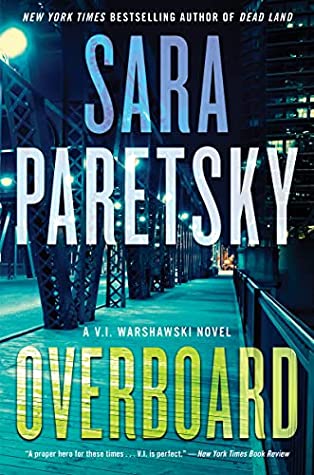
Overboard, by Sara Paretsky*****

Sara Paretsky is one of my all-time favorite writers; I’ve been reading her Victoria Warshawski detective novels for most of my adult life. Paretsky is one of four living authors to have received both the Grand Masters Award from the Mystery Writers of America and Cartier Diamond Dagger Award from the Crime Writers’ Association of Great Britain. She, together with the late Sue Grafton and Marcia Muller, have pioneered the image of women detectives in fiction, departing from the femme fatale of yesteryear who could only reveal the truth by using her sexuality to coax disclosures from men, instead creating capable women professionals that can ferret out the truth using their brains and bulldog persistence. A sympathetic cop friend tells Vic, “You’re a pit bull, Warshawski. You’ll go into the ring with anyone, as long as they’re at least three times your size.”

My thanks go to Net Galley and William Morrow for the review copy. This book is for sale now.

If I knew nothing of this author and her scrappy detective, the first line in the book would have reeled me in: “It was Mitch who found the girl.” As it is, I already know that Mitch is one of the two dogs she shares with her elderly neighbor friend, Mr. Contreras, and I feel as if I am greeting an old comrade.

The girl in question is in bad shape, and she doesn’t speak. For a while her identity is a mystery. Vic would be happy to offload her to medical professionals and get back to her own life; she’s got a lot of clients, and Lotty, her doctor friend that serves as a mother-figure in Vic’s life, is urging her to investigate the rash of attacks on the local synagogue. She doesn’t need more work.

But the cops—generally not friends of Vic’s at the best of times—are ready to haul Vic in. In fact, given their track record, Vic is amazed at the attention the girl is getting. All manner of monied movers and shakers show intense interest in the girl, and it makes Vic suspicious.

She’s right.

A sixteen year old boy comes to her office, asking her to look into a dicey situation involving his father. He believes his dad is in danger, and his parents won’t tell him anything. And so, there’s this kiddo, and there’s the girl: “Two teens, two life-threatening secrets—I have to assume they’re connected somewhere, somehow.”

She’s right again.

Before we know it, her apartment and office have been searched and bugs are left; her phone is being tracked; and Vic has to resolve the case in order to get her life back. She’s jumping in the cold river to elude capture, hiding in the least likely places, and keeping the kids safe from the forces that would harm them. Her attorney chuckles that “You get in over your head faster than Houdini in a water tank.”

He’s right, too.

When I opened this galley, I was already reading a handful of others that I liked, and figured I’d put this one into the rotation, but as often happens when I read Paretsky, everything else sat untouched until I’d torn through this book feverishly, as if the lives of Vic, her clients, and Chicago’s working class depended upon it.

Highly recommended to those that love strong detective fiction; feminists; and champions of the working class.

Autopsy, by Patricia Cornwell*****

Autopsy is number 25 in the Kay Scarpetta series, the first forensic thrillers ever to see print. This series began in 1990, and I have read every single one, but this is the first time I’ve scored a review copy. My thanks go to William Morrow and Net Galley.

When the series began, Scarpetta was the chief medical examiner in Virginia. When last we saw her, she was working in Massachusetts, but now she’s come full circle, brought back to her old position in order to root out corruption and restore the office to the integrity it held when last Scarpetta was in charge. She didn’t expect it to be easy, and it surely isn’t.

There are long running characters that have been so well developed over the years that I almost feel as if I would know them on the street. Her husband, Benton Wesley, holds a sensitive position within the FBI, and the necessary secrecy and sudden need to pack a bag and go somewhere has led to marital tension over the course of the series, but not so much this time. Kay’s niece, Lucy, is more like a daughter; she has been estranged from her mother at times, a high-strung, self-absorbed woman that looks out for number one every minute of every day. The mother—Dorothy—is now married to Pete Marino, with whom Scarpetta has worked closely for the length of the series, and they live nearby.

At this juncture, new or inconstant readers may wonder if there’s any point to jumping into a book this far into the series. I read it with that question in mind, and whereas you won’t have the background and depth of context that faithful fans possess, you can understand everything that happens here; Cornwell doesn’t burden the reader with assumed knowledge.  And if you are a new reader, likely as not, you’ll find yourself headed to the library or bookstore to pick up others from this series. It’s that addictive.

The only background information that might make a difference is that from the outset, Kay’s whole family (except Dorothy, of course) fears for her well-being. A murder occurs in the area, and the victim is a neighbor of Pete and Dorothy’s. Immediately, there’s this sense of urgency, and it’s more than one would ordinarily expect. A neighbor has been killed; the circumstances are weird, and we don’t know whodunit; everyone is edgy about personal security, and again—especially regarding Kay’s safety. So let me help you out, if you’re new: over several of the most recent episodes, someone has attempted to kill Kay, nearly succeeding more than once, and though the occasional thug has been caught, the schemer behind the attempts is still out there somewhere. The narrative makes no specific references to any of this, which I appreciate. It’s obnoxious when a book costs as much as new books do these days, for the author to insert what amount to advertisements to buy her other books. But for those not in the know: If the beginning seems a little overwrought, that’s why.

Add to this that the old guard is still entrenched in Kay’s workplace, with people whispering behind her back, and her secretary clearly plotting against her. She’s just arrived, but she is on the back foot, trying to find out what’s going on and who can be trusted, and trying to establish her own authority without making enemies unnecessarily. As I read, I find myself urging her to assert herself. Because to me, Scarpetta isn’t a fictional character at all. I believe in this character, and I believe in Benton, Lucy, and Marino, too. I’ve known them longer than a lot of people I see in real life, after all.

Those of us that read a lot of mysteries, thrillers, and so forth become accustomed to timeworn plot devices. I have a little list of things I hate to find in books of this genre, and Cornwell avoids them all. There is no alcoholic protagonist that just wants a drink, a drink, a drink. There’s no kidnapping of the protagonist and stuffing her in the trunk (or backseat, or whatever,) nor does this happen to any of her loved ones. Scarpetta is not being framed for a murder she didn’t commit, nor is anyone she loves.

Instead, we get an autopsy in outer space, supervised remotely by Scarpetta. How cool is that?

One other aspect of this book, and this series, that I love, is that there is just enough interesting information included about forensic investigation without the story turning into some tedious science lecture, as I have found in books scribed by Cornwall’s imitators.

The pacing is swift, the dialogue crackles, and a new character, Officer Fruge, is introduced. Hers is the last word in the book, and for some reason, it made me laugh out loud, a first for this series.

Welcome home, Scarpetta.

God Spare the Girls, by Kelsey McKinney*****

Journalist Kelsey McKinney makes her debut as a novelist with God Save the Girls, and I have a hunch we’ll be seeing a lot more of her work. Lucky me, I read it free and early; thanks go to Net Galley and William Morrow for the review copy. This book is for sale now.

Caroline and Abigail are the daughters of the charismatic head pastor at a megachurch in Hope, Texas. This opening paragraph had me at hello:

“For that whole brutal year, Caroline Nolan had begged God to make her life interesting. He sent a plague instead: grasshoppers emerged from the earth in late June, crawling across the dry grass, multiplying too quickly, staying long past their welcome. Now they carpeted the land she’d inherited with her sister, vibrated in the sun like a mirage. As Caroline drove the ranch’s half-mile driveway, she rolled over hundreds of them. She threw the car in park, stepped out into the yellowed grass beside the gravel drive, and crushed their leggy, squirming bodies beneath her sensible heels.”

Teenagers are people that are exploring their own identities, and there’s often some rebellion mixed into those years, but for Caroline and Abigail, there’s not a speck of wiggle room. They are constantly reminded that everything they do reflects upon their father. Forget profanity, street drugs, shoplifting, booze. These girls have even the most minute aspect of their appearances proscribed. Is that V-neck deep enough to show even a smidge of cleavage? Cover it up, or go change. How much leg? Why aren’t you wearing makeup? Not just your smile, but what kind of smile? How you sit. How you stand. And if these confines were not enough to drive any teen bonkers, they live in a fishbowl that every adult seems to own a key to. People come in and out of the family home all day and all evening, so showing up to watch television in your robe and fuzzy slippers in the family room is a risky prospect, too.

I’ll tell you right now, I couldn’t have. I really couldn’t.

But these are girls raised to believe that the Almighty is always watching, and always knows your heart, and so they do their best to shed petty resentments, whereas others must be buried deep. Buried, that is, until a shocking revelation is made about their father’s extracurricular activities.

The story is primarily told through Caroline’s point of view; Abby is the most important secondary character, and she’s interesting, but we see her through Caroline’s lens. I admire the way that McKinney develops both of them, but more than anything, I admire her restraint. In recent years, fundamentalist and evangelical Christian preachers have gone from being rather shocking, daring novelists’ subjects to low-hanging fruit. As I read, I waited for the rest of it. Which girl was Daddy molesting? What else has he done? Has he embezzled? Does he have a male lover on the side somewhere–or Lordy, a boy? But McKinney doesn’t go to any of those places. She keeps the story streamlined, and in doing so not only stands out from the crowd, but is able to go deeper into Caroline’s character.

At the end, when Abigail prepares to marry the dull, dependable boy her parents like, the scene is downright menacing; their mother, Ruthie, is helping her into her dress, and she “wielded a hook like a sword,” and as everyone takes their positions, the walkie-talkies “hiss.”

There’s a good deal more I could tell you, but none of it would be as satisfying for you as reading this book yourself. Your decision boils down to text versus audio, and I advocate for the audio, because Catherine Taber is a badass reader, lending a certain breathless quality to key parts of the narrative. But if you’re visually oriented, you can’t go wrong with the printed word here, either.

Highly recommended.