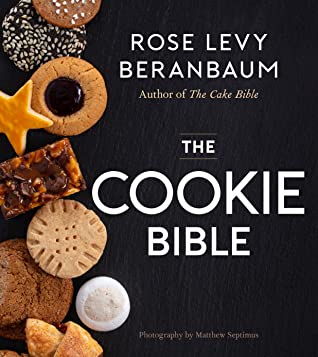
Biranbaum is the author of The Cake Bible, a book that I used to own, never used, and finally handed off to my daughter. Had I realized this at the outset—and I should have, as it was included in the promotional blurb—I probably would have stepped away from this cookbook. However, cookies are generally an approachable baking project, and it didn’t occur to me that this author might provide recipes that are not.
My thanks go to Mariner Books and Net Galley for the review copy. This book will be available to the public on Tuesday, October 18.
My rating is a compromise, because recipes such as these will elicit a variety of responses, none more valid than another, and so I can see this collection as two stars for unpretentious and somewhat lazy souls such as me, and four stars for those looking for a tremendous challenge, or an opportunity to impress.
I was on a weight loss regimen during the warm months, looking forward to fall and the chance to get back in the kitchen and bake. I held onto this galley as a reward for all the weight lost, and I planned to test a couple of recipes before writing a review. That hasn’t happened, nor will it. I confess I didn’t understand what I was in for. These recipes are the sort one uses for a grand occasion if at all. If there’s a dessert auction on the horizon, or if you are simply looking to flex your baking muscles, or even intimidate other bakers, this book is your book. Be prepared to buy a LOT of ingredients that aren’t standard. Super fine sugar; candied lemon peel; brandy or freshly squeezed orange juice, strained; unbalanced hazelnuts! I believe I’d have to be unbalanced to attempt any of this. Fine sea salt; hulled sesame seeds; Muscovedo light brown sugar; sour cherry preserves. Mine are ordinary cherry preserves. Fail. Crystalized ginger. Oh, and once you procure your super fine sugar, you’ll need to grind it in your spice grinder. You have one of those somewhere, of course.
I found one recipe that I thought I could manage. There were 2.5 pages of densely printed instructions. I could see that I was supposed to have 60-62% cacao dark chocolate, but after reading the recipe four times, I couldn’t find the place where I was supposed to have added it. I did find the place where I should have added something else on top of it, but as far as I am concerned, if the recipe isn’t clear after four readings, then it’s not clearly written.
Next!
Once again, if you have occasions when you are ready to pull out all the stops, you may like this thing, but do make sure you read your recipe well in advance, as I suspect you will have to special order tools and ingredients.
Priscilla Presley is the ex-wife of the king of Rock and Roll. I was a teenager when he died, and neither I nor most of my peers were fans; in the event his name did come up, we’d invariably ask, “Wait. Do you mean young hot Elvis, or old pudgy Elvis?” But I do love a good memoir, and those written by or about musicians are high on my list. My thanks go to Net Galley and Macmillan Audio for the review copy. This audio version of the author’s 1985 memoir is for sale now.
The relationship between Priscilla and Elvis took place in a completely different time, with completely different sexual mores and assumptions. That said, this was still a truly messed up pairing. Today, Elvis would probably be considered a predator, but within the context of the American South in the 1950s and early 1960s, he was regarded as a romantic, and women threw themselves at his feet. A quick online peek at old film and television clippings says it all.
Priscilla grew up in a strict but loving household. Her stepfather, the only father she knew, since her own died when she was an infant, was a military man, and so the family moved often. It was while they were stationed in Germany that one of Elvis’s employees saw Priscilla and invited her to meet with Elvis, who was doing his own tour of duty.
I have to feel for the bind her parents were in. On the one hand, she was just fourteen years old, and Presley was twenty-four, a grown man. On the other hand, if they refused to let her go, she would never have forgiven them; this was an invitation that literally millions of girls yearned for. Seeking a happy medium, her stepdad set boundaries: they were to be chaperoned, never alone together, and he wanted her home at a certain time. He groused about the fact that someone other than Elvis would be transporting her, but the reason was a legitimate one: Elvis could not drive himself anywhere without the car being mobbed. It was genuinely unsafe.
Rather than being the single event that the family anticipated, Elvis made their visits regular ones; when her parents balked, Elvis spoke to them personally, turning all of his charismatic charm on them, and telling them everything they wanted to hear. Most of it was untrue, of course, but the one thing he adhered to was not having sexual intercourse. During this time period, the Madonna-Whore dichotomy was alive and well, and any girl or woman known to have sex outside of marriage was likely to be ostracized by former friends and in some cases, family. It’s hard to imagine now, but at that time, no birth control pill had been invented, and a pregnancy outside of marriage was likely to ruin a young woman’s entire life.
Priscilla reads this memoir to us herself, and that makes it much more fun to hear. As we age our faces and our bodies change a lot, but our speaking voices change very little. Remembering some of the silly moments from that time, the author lets out a brief, girlish giggle, and it’s almost impossible to believe that she is now a grandmother.
Priscilla acknowledges that this was a monstrously unequal relationship. Elvis dictated whom she could talk to, what she wore, and sometimes even what room in the house she was supposed to be in. At one point, when he is going to be touring for months on end and she will be left at home with his grandmother, she goes out and gets a job. She’s so proud of herself. He makes her quit immediately. When he phones from the road, she had by God better be there. Priscilla compares this to Pygmalion. He has all the power, and she is in his thrall before she has even had a chance to grow up.
I have read two other Elvis biographies, and as dreadful as all of this sounds, the other authors were less gentle. In fact, this is part of Priscilla’s stated reason for deciding to tell her own story.
There are advantages to reading this particular biography. The official version of events is often what is published, but Priscilla is positioned to know the real story, more often than not. For example: when Elvis is drafted, the official story is that, although stars of his caliber are often offered soft assignments that involve singing to the troops, or making inspirational training films, Elvis insisted on doing the same job as every other American man. On the other hand, Priscilla states that this is all his manager’s doing, because it will make Elvis appear noble. Enough new songs were taped in advance for there to be regular new releases on the radio throughout his tour of duty; toward the end, Elvis feigns illness because he’d prefer to be in the hospital being swarmed by nurses than marching around and getting dirty.
Her memory of Elvis, despite everything he put her through, is mostly a tender one. The spiral that led to his death, his issues with mental health, back before much was known, coupled with the immense number of strong prescription drugs he used to wake up in the morning and go to sleep at night—or to NOT go to sleep at all, and just stay up, night after night—set him up for relationships with unscrupulous characters, and nobody could rein him in, because he was the King.
Recommended to those that like vintage rock music or well-written memoirs of famous musicians.
Saloma Miller Furlong is the author of two memoirs that focus on her decision to leave the Amish faith and community; this is her third. I received a copy for review purposes from the author; this book is for sale now.
Furlong hasn’t had the typical Amish childhood. In her earlier works, she explains that her father was unable to function normally; given to sudden, inexplicable rages, he was a frightening man when he was angry, and he was angry often. Sometimes his rages occurred at predictable times; other times, they came from nowhere. He was unable to do the necessary work to support the family, as is usual in Amish households, and Saloma’s mother, siblings, and Saloma herself had to scramble to pick up the slack. These things are described in Why I Left the Amish and Bonnet Strings. Her experience is also featured in two PBS Experience films, “The Amish,” and “The Amish Shunned.” These documentaries are available free of cost online.
None of Saloma’s books provides light reading; her experience is a brutal one, her childhood traumatic. She is assaulted numerous times, and some of these involve sexual assaults. She tells her mother, who does nothing to protect her. And so, if you are looking for a book that details the typical Amish life, its cultural and religious practices, what technology is acceptable and what is forbidden, and so forth, this is probably not the book you’re looking for, although the two documentaries mentioned above will provide a good overview. Instead, her books demonstrate what happens when an Amish household or some of its members are in crisis.
The extremity of her trauma is glaringly obvious by the fact that her first two memoirs completely overlook her mother’s own brutality towards Saloma, as well as her complicity in assaults by Saloma’s father and older brother. For more than fifty years, this author buried this part of her own trauma, the betrayal she experienced by the person most responsible for her protection as a child. Only recently has she permitted herself to acknowledge it within her own mind, let alone write about it. In the email she sent me requesting that I read and review this new memoir, she told me that she wishes there were a way to recall every single copy of that first memoir, because it omits so much. But I believe one can also read it, and for that matter, all three of these books, with the understanding that we learn as much by what is not said, as by what is.
Saloma’s decision to leave home, to abandon the culture that is all she’s ever known, is driven by two factors. The first and greatest, of course, is self-preservation, the need to find physical safety. But another strong motivator is intellectual inquiry. Amish girls do not attend school after grade 8. This isn’t a general rule; it’s an absolute one. In rare cases an exception may be made for a young man, if his course of study will ultimately benefit the community, but at the end of eighth grade, girls are done. Informal study and reading are also nearly impossible. Amish homes contain the Bible and essential Amish teachings; novels, art books, even resource materials have no place there. An Amish family member that is curled up with a book or newspaper is a slacker at best, using time that could instead be used to benefit the family. At worst, it is a sign of moral corruption, reading worldly content that is not necessary and may even be regarded as evil. No, Saloma couldn’t get away with such things; she once purchased a magazine subscription of the tamest variety, and that was allowed, though it was seen as strange.
Sometimes we know a book is good because of the thinking it inspires after we finish the final page. So it is for me here. I find myself wondering why there aren’t more Amish youngsters that are unable to turn away from the written word. Surely there are other bright, intellectually curious boys and girls that chafe at being forcibly wrenched from their education? Initially I assumed, as many non-Amish do, that most Amish youth might slip through the open door represented by Rumspringa, hit the road, and never look back, but I learned that this isn’t true. The overwhelming majority of Amish teens remain Amish all of their lives, and the majority that do leave, return home later and stay put. And so I wonder; have they simply bred for passivity? It’s a conundrum.
I am initially surprised by Furlong’s decision to use the same book cover here that she used on her first, but I believe it may have been done with an eye toward replacing the old memoir with this new one.
As for the writing quality here, I like the quality of her analysis, and so for those that enjoy a memoir with depth, I recommend this book to you.
I enjoy a good memoir, and so I was all in when I saw this singular work; my thanks go to Bloomsbury and Net Galley for the review copy. It’s by “the beloved founding editor of Buzzfeed Books,” but somehow, I either missed that part or forgot about it, so I read it and assessed it as if he were just some random guy, and ultimately, that’s probably the fairest way to do so anyway. This book is for sale now.
Fitzgerald has seen and done just about everything. His family life growing up is dreadful, and he is delighted to bail out of the screaming, wretched mess called home in order to attend boarding school. He is the scholarship kid, but he benefits plenty from the largesse of his classmates. Post education, he takes himself to San Francisco, with an entire continent stretching between himself and his family. Upon arrival, he continues his favorite pastime, drinking, which he began doing with his older brother when he was just twelve. His parents didn’t do it, so he figured it might be a good choice.
The promotional blurb says that this is the story of the author’s “search for a more expansive vision of masculinity.” Perhaps this is why I find it so hard to relate to. There are moments, though. A huge chunk of the first half in particular describes his affinity for bars, which he identifies as his safe spaces. My notes from the start of this segment say “Oh boy, I always wanted to read yet another alcoholic memoir.” Soon afterward, though, he says, as if reading my mind, that if we expect him to discuss the way he quit drinking, we’ll be in for a long wait, because he still drinks, though not nearly as much. That much was good for a chuckle. Then there’s another segment about his period with the porn industry. I confess I straight-up skimmed some of that, although again, there’s a moment, when he talks about the importance of consent, and how the porn industry, in his experience, is more careful and respectful of this boundary than anyone else he’s encountered.
The book is billed as being humorous, but this is a massive overstatement. Most of the content is dead serious. But then again—yes, you guessed it. There are moments.
What takes me by surprise, and happily so, is the message that he’s spent the whole book building toward, and I never see it coming until we’re there. I highlighted it in case I wanted to use it as a quote here, but that would be an epic spoiler. You didn’t know that memoirs can have spoilers? Oh yes. They can. And when I see this one, my disgruntlement fades and I am once again a perfectly gruntled reader and reviewer.
One aspect that I appreciate, and particularly appreciated during the rougher patches, is that the brief essays that, strung together, make up the memoir, make very short chapters, and they’re clearly marked. This is a terrific bedtime book, because I am able to find a reasonable stopping place when I need to turn out the light (or, as it happens, turn off my Kindle.)
If you’ve read this review and are interested, then I recommend it to you. I anticipate that men will enjoy it more than women.
Patrick Radden Keefe is a much celebrated journalist with a list of honors and awards as long as your arm. He first drew my notice in 2019 with Say Nothing, his searing, meticulously researched book on The Troubles, that period of guerilla warfare in the North of Ireland, as its people tried (yet again) to break free of British imperial rule. That book rattled me to my core, and when I received a review copy for this book, I understood that there couldn’t possibly be another book as deeply affecting as his last. And I was right; it isn’t. It is, however, interesting in most places, and Keefe can write like nobody’s business. This book is for sale now; my thanks go to Net Galley and Doubleday for the galley.
Each chapter of this book is on a different topic; ostensibly, each is about a different rogue, or group of rogues, or—in one case—a whole family of rogues! However, there are a couple of chapters where that isn’t really true, and that is my strongest quibble with anything presented there. Most, however, are unquestionably about scoundrels. The first, about an obscenely wealthy wine snob who finds himself with some counterfeit wine, makes my blood boil. A private plane, burning enough fuel to melt the polar caps, or to transport a good many people to work for an entire year, is dispatched to fetch some wine. This one makes me cranky enough, and is lengthy enough, that I abandon it halfway in. The next, “Crime Family,” is a riveting expose of a notorious, yet strangely beloved Scandinavian kidnapper whose sister turns him in when she senses that he’s spiraling out of control. She owns five armored cars, because she knows her brother will never rest until one of them is dead. Chilling, indeed! Other favorites are about El Chapo, and about Mark Burnett, the promoter that turned Trump into The Apprentice, splicing and editing sufficiently to make the man sound coherent and businesslike. There is one about the Lockerbie bombing, and another about insider trading, that I tried to care about but couldn’t, so I skipped those. And there’s one about Jeffrey Epstein, too.
All told, this book is a meal. Even if you do as I did, and skip those that don’t spark your interest, this is a well written, worthwhile collection.
Recommended to those that enjoy well crafted journalism.
John “Lucky” Luckadoo was a bomber pilot in World War II in the most dangerous period of the European theater, and he survived twenty-five bombing runs, which was unusual. This is his story, told to us by the skilled wordsmith Kevin Maurer, and narrated by Holter Graham and Luckadoo himself. My thanks go to Net Galley, St. Martin’s Press, and Macmillan audio for the invitation to read and review.
The first portion of the narrative tells about Lucky’s early years, as well as his yearning to learn to fly. I feel a bit impatient as I read this segment, because I’m dying, like Lucky, to go to war. However, some of what I think is extraneous material proves to be important later on, so I’m glad not to have skipped anything.
A quarter of the way into the story, and we’re off. I am impressed by the descriptions, which are brief and unmistakably clear, written for general audiences of today. An example is when he tells us that a Quonset hut looks like a tin can that has been split lengthwise, then put on the ground, cut side down. Everything, from the planes, to the target, to the flying conditions is easily understood without talking down to the reader. The chapters are a good length, and the dialogue crackles. But now, we have to talk about that.
When anyone writes military history, whether it’s a biography, a memoir, a reference book, or any other nonfiction work, there must be citations for the facts and especially for quotations and dialogue. (I am proud of myself for not using twelve exclamation marks here; if there were an audio version of this review, I would be shrieking, so it’s just as well that we’ve stuck to print.) The author provides a bibliography at the end, and it. Is. Not. Enough. No, no, no! This is why so many writers in this field use historical fiction as a vehicle; the very best historical fiction communicates the same material, but is not bound to document facts. A bibliography alone would be just dandy for a work of historical fiction…which this is not. In fact, (said the American history and government teacher,) the four star rating is evidence of my appreciation for the clarity, organization, and pacing of this story; ordinarily I would go no higher than three stars for anyone in violation of this clear requirement. (Where was the editor?)
Moving on. The pace in the middle segment is brisk, but I have no problem putting it down and walking away when I am interrupted in my reading. That all changes at the sixty-sixth percentile, when the B-17 pilots and crews are sent on a mission to bomb Bremen. This is a huge mission, and a very dangerous one, as they are trying to bomb the canal where German U-boats are housed in broad daylight. At the same time, Goering is done watching his pilots get pounded, and he orders them to fight to the last man, and those that will not will be transferred to the infantry (note here that the German infantry is starving and freezing; pilots are much better fed.) Consequently, their aggression in the air is unprecedented, with kamikaze-like maneuvers that none of the Allies have seen from Germany up till now. During the portion of the book, I would not have left this story unless my house was on fire.
The callous decisions by higher-ups as to what an acceptable attrition level looks like, with about sixteen percent of active American airmen making it home alive after their service is done, is horrifying.
I have read a number of biographies and other historical works regarding this topic, but nevertheless, I learned some new information. I recommend this book to readers that are interested, but not to researchers or students.
Although the narrators do a perfectly fine job, I realize early that I cannot keep up with this level of detail without seeing the words, so I jettison the audio version and stick to the digital review copy. I recommend the audio version for those quirky souls that understand and retain spoken information better than print.
Shawn Levy has taken on an ambitious project, researching and writing about the pioneers of women’s stand-up comedy. In his author’s note, Levy says that while it may seem counterintuitive for a man to write about women comedians in this era of #MeToo, nobody else has done it, and because they are heroes, forging the way forward, performing for audiences that were frequently hostile. The result is in On the Joke, a well-researched book that tells the stories of the women that emerged from the vaudeville era to make history, roughly between the World War II era and Watergate.
My thanks go to Net Galley and Doubleday for the review copy. This book is for sale now.
There are eight chapters in this book, each dedicated to a particular type of comic. He starts with Moms Mabley, whom I had never heard of, and continues down the line with Totie Fields, Phyllis Diller, and several others, and ends with “The Scrapper,” Joan Rivers. I confess it was Rivers’ face on the cover that drew me to this historical work.
Levy has cut no corners, and the documentation is flawless; his style of reporting is conversational and written for a general readership. All told, he’s done a fine job here.
My only sorrow—and one that isn’t the author’s fault—is seeing what horrible things these women had to do to themselves in order to meet with success. One after another, women comics have mounted the stage, day after day, night after night, to make self-deprecating jokes, many of them downright vicious. They tell about how ugly they were as children, and how ugly they are now; they tear themselves apart like Christians diving voluntarily into the colosseum pit where the lions await. I expected to laugh my way through this thing, but most of the time I wanted to sit down and sob for these artists.
As I expected, my favorite among them is Rivers. Eventually she eased up somewhat on the self-attacks and began roasting other public figures. I saw some of her work when she was still alive, and at the time, I thought some of her jokes were too mean to be funny, but as Rivers pointed out to her critics, she always “punched up.” Using her well known catch phrase, “Can we tawk,” she eviscerated the most successful celebrities, politicians, and other newsworthy public figures, and a lot of her material was absolutely hilarious. In fact, I’d have finished reading and reviewing this book much sooner had I not kept setting it aside to watch old footage of her routines, as well as some of the others Levy covers.
If you are looking for a book to make you laugh your butt off, this isn’t that book, but it’s an excellent history of the women that paved the way for the likes of Gilda Radner, Tina Fey, Hannah Gadsby, and many others.
Recommended to feminists, and those interested in entertainment history.
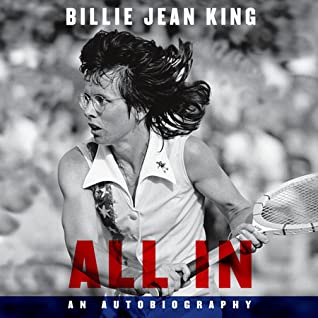
There are books, and then there’s this: the autobiography of an icon that will be read for generations. I passed—perhaps foolishly—on a review copy, because I was afraid there would be large passages of minutiae about tennis, which doesn’t interest me. I was mistaken in my concern, but it worked out well, because I borrowed an audio version from Seattle Bibliocommons, and the author reads her own book. She is an old woman now, and hearing her detail her own remarkable life is a matchless experience. It’s hard to imagine there will be a more important, or more enjoyable book published in the coming year.
Billie Jean Moffitt King is born in 1943 and grows up in Southern California in a conservative working class family; her dad is a firefighter, and her mother stays home, as most mothers did back then. There is Billie, and there is her brother, and the family are devoted Methodists. Who is to know that both children will be famous one day? Brother Randy becomes a professional baseball player, and Billie Jean becomes a record-breaking tennis star and a passionate social justice activist. If you, reader, are younger than sixty, you probably don’t even know how much you owe Billie Jean.
Growing up, King enjoys all sorts of sports, but when she is introduced to tennis, a light comes on. The problem is, tennis is a sport for the elite, even more so back then than now. To find a tennis court, you needed to either have a private court built on your palatial estate, or belong to a country club, and of course, to do that, you also have to be Caucasian. Billie Jean’s family is nowhere near affluent enough to belong. And so, early on, her passion and her obvious talent draw support from people with enough pull, or enough money, to give her access. She takes the time to thank them, but doesn’t let this bog the story down.
Over and over, however, she is shut out on account of her gender. Prize money typically pays enough to help an athlete pay their own travel expenses and buy equipment, but when women are allowed to compete in competitions prestigious enough to offer prize money, it’s only for the men. Women are expected to be grateful that they are included at all. And as King gets better at her sport and her confidence grows, she begins to push back. Nobody wants to watch women play tennis? Since when? And since when should people of color be shut out?
Although she doesn’t say so, it becomes obvious to me that in addition to athletic talent, confidence, intelligence, and almost endless energy, King has one more talent, one that isn’t recognized as such in the mid-twentieth century: she has amazing people skills. Over and over, she is able to reach compromises, make deals, and shorten the gap between conservative perceptions of women athletes, and what all athletes deserve. She discusses the various battles (though she doesn’t use this word) and how they are resolved, and I am amazed at the grace and dignity she demonstrates. Perhaps the most telling moment is when she befriends Bobby Riggs, the obnoxious bastard that she has defeated in front of the world, and later, when he is on his deathbed, takes a call from his wife. Riggs is asking for her, and he doesn’t have much time left. She is too far away to get to him in time, but she tells him on the phone that she loves him. Wow.
If you are or were a girl that participated in high school sports, or if you or your loved ones have benefited from Title IX, thank Billie Jean, who testified before Congress. She also started the first professional tennis circuit for women.
Over the years, King wins 39 Wimbledon Grand Slam titles and a host of others as well. I am a child when she plays Bobby Riggs in “The Battle of the Sexes,” and she beats him squarely. What I don’t know (and would still not have known if I’d been paying attention,) is that she does her very best not to play this tournament. Riggs is much older than she, and he hounds her—in fact, today his behavior would violate anti-stalking laws. But she calmly tells him, over and over, that she isn’t interested, and then she ignores his calls and turns away from his in-person visits. But when a fellow women’s tennis champion plays him and loses, Billie turns to her husband and manager, Larry King, and with a sigh, says, “Okay. You’d better set it up.”
At this point, I turn away from the audio book and head to YouTube to watch The Battle of the Sexes. This trip back to the society in which I grew up is hair-raising. The ways that men talk about women, in public forums! The remarks by Howard Cosell, who was the most liberal of sportscasters, about her physical appearance, and the patronizing remarks of others are appalling. I wouldn’t go back for anything in this world! But when she is asked antagonizing questions, Billie Jean comments, briefly, calmly, and without showing even the slightest offence. Her coolness on the court is mirrored in her cool public appearances. It’s remarkable.
When Gloria Steinem starts Ms. Magazine, King supports her, but she is always either asleep or busy, so husband Larry handles the mail. When he sees the request to add her name to a list of famous women that support a woman’s right to choose, as the controversy over Roe v. Wade heats up, he signs for her and then forgets to mention it to her; had he read more carefully, he would have noted the line, “I had an abortion!” King doesn’t know it’s about to be public knowledge, and her parents didn’t know she’d terminated a pregnancy. It’s not a good moment.
Later, when her feelings for other women grow stronger, she and Larry separate, but not completely. For years, she stays with him when they both show up in town at the same time, and they continue a romantic relationship, though infrequently. It is when she grows close to South African tennis player Ilana, and Ilana makes her choose, that she divorces Larry; again, they remain friends.
I could carry on all day about this woman, a champion on the court and off, but if you are interested enough to read this entire review, then you’re interested enough to get this book. I’m sure the print version is lovely, but the audio book—which sounds like a garrulous old lady telling her story, like Forrest Gump, but authentic and more accomplished—and hearing her voice wobble when she speaks of her most moving experiences, is simply unmissable.
“You never know what you are capable of until the day comes wen you have to go places you hadn’t planned on going.”
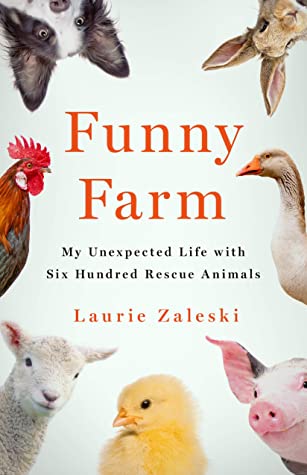
Laurie Zaleski knows how to make a debut. Funny Farm: My Unexpected Life With 600 Rescue Animals has created a tremendous buzz, and all of it is deserved. My thanks go to Net Galley and St. Martin’s Press for the review copy. This book will be available to the public Tuesday, February 22, 2022.
Laurie’s early childhood was in many ways an enviable one; her mother stayed home to raise Laurie, her brother, and her sister, and her father made enough money to hire household help and buy a couple of vacation homes, too. There was nothing they lacked for, other than physical safety. Because while her father could be warm, and loving, and generous, and funny, he could also be a monster. His reign of terror was worsened by alcohol consumption. As the beatings became uglier and more frequent, Annie, their mother, chose poverty for the children and herself over the constant terror and danger of living with their dad.
“’I almost became a nun,’ Mom would joke years later. ‘Then I met the devil…’ Annie McNulty and Richard Zaleski fell in love like tripping into an open manhole: one wrong move followed by a long dark plunge.”
There’s one searing episode Zaleski recounts, toward the end of their life with Dad, in which they are all hidden in a bedroom with the door blocked shut, and their father is sneaking up on them, commando crawling up the hallway toward them so they won’t see his shadow approaching, and he has a large knife between his teeth. It sounds like something from a Stephen King novel, doesn’t it?
And so, when Annie’s efforts to build a modest nest egg to finance their flight is uncovered, she has no other option but to leave without the money. She finds a dumpy cabin in the woods, half fallen down and in no way legally rentable, and strikes a bargain with the owner. To say that their standard of living decreases is the understatement of the year, but they make it work.
Once she has made her escape, apart from the creepy forays from an unseen enemy that occur from time to time, Annie can’t turn away anyone else, human or otherwise, that is in a dark and vulnerable place. The woods surrounding their little shack begin sprouting makeshift outbuildings; there’s a little lean-to here, and a sort-of paddock there. And it keeps growing.
Zaleski is a gifted storyteller, and she alternates her narrative from the present to the past, breaking up the nightmarish episodes of her childhood with hilarious stories, most of which are about the critters. Her writing is so nimble that I find myself repeatedly checking to see what else she’s published, because there’s just no way this can be her debut. But then, that’s what they said about Harper Lee, right?
Perhaps the most glorious aspect of this book is seeing how Annie McNulty’s can-do attitude, sterling work ethic, and positivity transformed her life and lit a path for her children. She provided them with an outstanding role model, and in return, they did everything possible for her when cancer forced her to slow down.
This book will inevitably be compared to Educated and The Glass Castle because it is a memoir of someone that has overcome horrifying challenges in childhood and emerged triumphant. But make no mistake, Zaleski’s story is in no way derivative, and likely will be held up as an example for future writers. It makes my feminist heart sing!
I was invited to read and review this book by Net Galley and St. Martin’s Press. I accepted because I do love a good spy story, and there aren’t many of them being published at this time. Tim Tate has had a long, illustrious career as a documentary filmmaker and as an author, but is new to me.
So, when I began reading and found my attention wandering, I thought it was a personal problem. Too many distractions. I tried again, and when that didn’t go well, I procured the audio version and listened to it while I prepared dinners during the week. Eventually, I threw in the towel and admitted that this is simply not an engaging book. The topic sounds fascinating, but just as a gifted, dedicated author can spin dull material to gold, so can an indifferent one tell an electrifying spy story in a way that leaves the reader checking the page numbers and the clock—is this thing over yet?
It’s not all bad news: the research here is top drawer. For the researcher, this book has use, although I would caution the uninitiated into reading carefully, because history is always politically charged. Every fact that is included, and every fact that is not; the interpretation; the language used, all give a biased account, even when a researcher and writer is endeavoring to be as balanced as possible. I don’t care for this writer’s interpretation, which makes him sound like a hardened right winger, but I have no doubt that the facts that he uses are accurate ones.
Then we come to the audio, and I must wonder why, if we’re primarily dealing with the CIA and its agents, we have a narrator with a clipped English accent (and a few pronunciations that sounded very odd to me,) telling the story. I found it disorienting, but if this had been a more engaging story, I would have overlooked it.
Ultimately it comes down to wordsmithery, and I didn’t find much of it. Those interested in dabbling in this genre would do better to read Ben McIntyre and Tim Weiner.