The Fisherman’s Gift, by Julia R. Kelly*****

“Why is it, she asks herself, that we only ever remember the things we did wrong?”

Julia R. Kelly’s novel The Fisherman’s Gift tells a luminous tale of long ago, and it is one of the year’s best. My thanks go to NetGalley and Simon and Schuster for the invitation to read and review. This book is for sale now.

Dorothy lives alone in Skerry, a tiny Scottish fishing village, in the year 1900. She is an outsider, having moved here to teach the children; she marries and has a child, but when the child is tragically drowned, her husband leaves her, and now her life is one of solitude and regret.  Then a little boy washes up, a shipwreck victim, and Joseph, a fisherman that shares a past with Dorothy, brings him to the village; it is Dorothy that takes care of him, and every day, he seems more like her own lost boy. She wonders from time to time whether God has sent him back to her.

This is a beautifully written novel, glorious not only for what is said, but for what isn’t. Kelly crafts every character in the story with nuance, and so there are no bad people, and also no perfect ones. The entire book is written in third person omniscient, so we get a peek into one character’s thoughts, and then another’s. Sometimes this can be frustrating, because I want to climb onto the page and explain to one of them or another that what they’re thinking is wrong, and can’t they see that they have misunderstood a person, or an event? But when I yearn to do this, it’s because I believe every single word about every single character.

It’s a bittersweet tale to be sure, but readers can rest assured that Kelly won’t burn everything to the ground.

To those that love historical fiction, and to those that enjoy a good love story, I highly recommend this sweet story.

Broken Country, by Clare Leslie Hall*****

I am late to the party, but it would be a crime not to review Broken Country, the stirring love story by Clare Leslie Hall that can make even the hardest cynic weepy-eyed. My thanks go to NetGalley and Simon and Schuster for the review copy. This book is for sale now.

The story is set in a small village in Britain during the mid-1900s. The setting bounces back and forth between the present day and the past; it’s easy to keep track of, partly because the author takes care to delineate which chapter is which, and partly because there are few characters to keep track of. Our protagonist is Beth, and she and her husband, Frank, are farmers, have lived in the same community for their whole lives. A farm accident claimed the life of their only child, Bobby, a few years before, but they are both still fragile, ragged in their grief.

Then, oh my my, who comes back to town but Beth’s old flame, Gabriel, a man that came from money and went on to make a name for himself as a novelist. Gabriel has inherited the family house and land, and in the wake of his divorce, has brought his son Leo to live here. Here. Right next door to Beth and Frank.  And to complicate old feelings all the more, his son Leo is about the same age as Bobby was when he died.

Is it possible to be in love with two men at the same time? Beth would tell you that it is. Frank can see what is unfolding, and he tries to reason with Beth, but she assures him that everyone is grown up now, the past is the past, and there’s no reason that they and their new old neighbor cannot be friends.

Well.

I seldom reach for novels like this one, wary as I am of schmalz and schlock, but reader, I see none of either one in this story. The writing is disciplined and restrained, yet oh, so intimate. When a formula or trope comes into view, Hall goes the other way instead. And though I may have thought I knew where we would all end up, I was mistaken; the ending is beautifully planned and executed.

Because I had fallen a bit behind, I checked out the audio version from Seattle Bibliocommons; reader Hattie Morahan does a stellar job with the narration.

Highly recommended.

The Family Recipe, by Carolyn Huynh*****

“We all need to feel needed. Otherwise, what’s the point of living?”

Carolyn Huynh made her authorial debut in 2022 with The Fortunes of Jaded Women. It was one of my favorite novels not only of that year, but of all the thousand-plus galleys I have read since I began reviewing. She’s back again with The Family Recipe, and it’s every bit as good as the first. My thanks go to NetGalley and Atria Books for the invitation to read and review, but make no mistake: I would have hunted this thing down and bought it with my Social Security check if it came down to it. I wouldn’t have been sorry, either.

This book is available to the public now.

Once again, our protagonists are Vietnamese and Vietnamese-Americans, mostly women, and once again, they are siblings and other family members that must come together; it isn’t a voluntary reunion. And that’s where the similarities between the first book and this one end.

Duc Tran, the patriarch, has laid out the terms by which his children may inherit his fortune. Once upon a time, he was the Vietnamese sandwich king, and in order to become his heir, each of his four daughters must relocate to a city she doesn’t want to live in, and revive a down-at-the-heels restaurant in a now undesirable end of town. It’s a contest; that is, unless Duc’s one son, Jude, succeeds in getting married within the one year’s time limit of the contest. If he can do that, he wins. (His sisters aren’t worried; who would marry Jude?)

The story is told from several points of view; these include the siblings, their uncle—a shady lawyer, and Duc’s best friend; their mother, who abandoned them when they were small, when her mental health collapsed, and never went back; Duc’s second wife; and briefly, Duc himself, who mostly serves as a mysterious figure that doesn’t even return to the States to lay out his children’s requirements, sending their uncle as his proxy.  As the story unfolds, we learn more about each sibling, and about the traumas they have experienced, as well as their successes.

The thing that makes it work so well is Huynh’s unerring sense of timing. It’s a dramatic tale, but it’s shot full of humor, as we see at the outset, when we learn the sisters’ names. Their father was a huge fan of the Beatles, and so the girls are named Jane, Paulina, Georgia, and (wait for it…) Bingo!

There are plenty of twists and turns, and the dialogue crackles. The internal monologues are mesmerizing. This book would make a fantastic movie.

Since I was reading this galley digitally, I highlighted quotes that I thought I’d like to use in this review, but there are 28 of them. Obviously, I cannot share them all here, but let that inform you, if nothing else here has, how much I love this book.

Highly recommended to anyone that has a beating heart, at least a passing interest in Vietnamese-American culture and/or family stories, and can use a few good laughs.

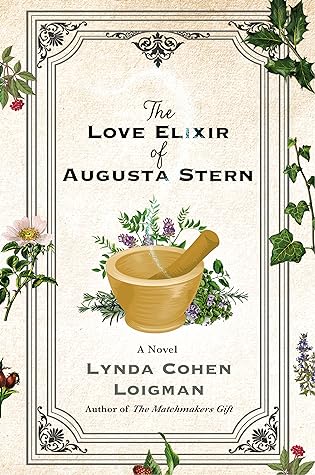
The Love Elixir of Augusta Stern*****

Augusta Stern is about to turn eighty, and she’s being forced into retirement, darn it. Her beloved niece persuades her to leave New York and spend what remain of her golden years in a Florida seniors’ community. From there, a wave of surprising events unfolds, changing Augusta’s life.

My thanks go to NetGalley and St. Martin’s Press for the invitation to read and review. This book is for sale now.

Loigman’s debut novel came in 2016, and as of now, she’s published three more. Every single one is golden. This author writes with warmth and intentionality, and although the first was wonderful, each subsequent one has been better than the last. And so, although I have gone on to read other novels by other authors since I finished this one, this is the one I’m still thinking about.

You see, in 1922, Augusta’s mother became gravely ill. Try though they might, neither the doctors nor her pharmacist father were able to help her, and she died. Augusta, her sister, and her father were all plunged into a dark and terrible place without her.  Great Aunt Esther showed up to run the household, and she brought with her a case full of herbs and tinctures; Esther was an apothecary. Her methods, which were sometimes unconventional, put her at odds with her nephew, but they got results, sometimes where conventional medicine had failed. Soon Augusta was spending her hours after school helping her father in the pharmacy, and sneaking out of bed in the middle of the night to observe Esther devising natural concoctions of her own. Esther declared Augusta to be her heir; she had a loving heart and a healer’s instincts.

Her social life was very limited, absorbed as she was with the family business, but the brightest spot in her day was when Irving Ripken, her father’s delivery boy, came to work. Often, they would talk as they worked; in time, they fell in love. Imagine her horror, then, when he abruptly married someone else and moved to Chicago! Augusta never recovered from the blow, and so she has never married.

Now, imagine her astonishment when sixty years later in Rallentando Springs, Irving shows up at the pool!

Much of what follows is what a reader might expect, but the details and character development take the story to a higher plane, and as we follow it, we also see the events of 1922, and these enable us to understand these characters and what drives them. There’s an unusually clever twist at the end, and it’s one that I absolutely do not see coming.

Ordinarily I would include ways in which the novel fell short or could be improved, but that’s impossible in this case. Loigman has spun magic for us from start to finish, and all I can do is bow in appreciation, and recommend this novel to you.

Bright Lights, Big Christmas, by Mary Kay Andrews****

I tend to avoid heartwarming holiday stories and romances because so many of them are infused with saccharine and require the reader to put their I.Q. in a box until the book is over. But two years ago, I was happily impressed with Mary Kay Andrews’ The Santa Suit, and so when I was invited to read and review Bright Lights, Big Christmas, I happily agreed. My thanks go to Net Galley, St. Martin’s Press, and Macmillan Audio for the review copies. This book is for sale now.

The Tolliver Christmas tree farm is an institution, not only at home in North Carolina but as far north as New York City. As a child, Kerry sometimes accompanied her family to New York to set up a tree stand and sell the trees, but as an adult, she’s had other priorities. This year, though, she finds herself unexpectedly jobless, while at the same time, her father’s health prevents him from executing the task. Kerry must take his place, traveling to the Big Apple with her brother, Murphy. They set up the stand, and they sleep in the ancient pink trailer nicknamed “Spammy” because of its resemblance to a canned ham. Adventure awaits.

Kerry’s love interest pops up before we’re even ten percent into the story, but it appears that the author planned for us to know that, and it doesn’t hurt anything. Over the weeks they are in New York, various small (and large) crises present themselves and are worked out with team work, ingenuity, and the occasional well-placed bribe. They have Murphy’s dog Queenie with them, but she is primarily left in the background where she belongs.

What I appreciate most about this novel is how well grounded the plot is, and the author’s restraint in not permitting any elements to go over the top. There are a host of stereotypes possible, but every time I see one coming, Andrews chooses a different path, and it keeps the story fresh and original. Small details that might be overlooked by someone less detail oriented are seen to, and it keeps the narrative credible. Examples are the need for a shower or bath, given the length of their stay in a trailer without working plumbing; the cost of living in New York; the hazards of theft and vandalism, especially active at Christmas. None of these sidetracks the plot or slows the pace, but the questions a reader might have are tidied away, and this makes for greater enjoyment.

One small criticism involves a situation where theft and vandalism occur at a time when Murphy has to be away, and immediately, other men folk clamor over the need to have someone—someone with a Y chromosome, folks—to do lookout duty, protecting the fair damsel, her trees, and so on.

Apart from that, this is a delightful story. However, for awhile I wasn’t sure I liked it, because I was listening to the audio version, which is poorly done. The male characters are voiced in a way that is choppy, wooden, and unconvincing; but worse is Kerry’s voice, which is performed in a high-pitched, girly-girl voice so off-putting that it took me awhile to realize that the problem wasn’t the author’s, but rather the voice actor’s. The children’s voices are much better, and I actually howled with laughter when the baby in a stroller wailed!

As the story reaches its climax, Kerry has to make some serious choices, and I admire the way this part is resolved. The side character Heinz, an elderly man that lives in the neighborhood and often stops by the tree stand, is terrific.

When all is said and done, I rate the printed version of this novel 4+ stars, and the audio version 3+ stars, with an overall score of 4. I recommend the print version of this book, but not the audio.

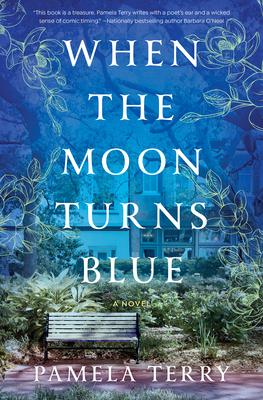
When the Moon Turns Blue, by Pamela Terry*****

Once in a while the odd thing happens,

Once in a while the dream comes true,

And the whole pattern of life is altered,

Once in a while the moon turns blue.

The tiny Georgia hamlet of Wesleyan is preparing to bury one of its own, and Mother Nature is preparing to cover the entire town in ice. But nobody—well, almost nobody—knows that a source of local tension is about to go nuclear, as someone is planning to topple and destroy the statue of a Confederate general in the park inside the boundaries of Old Man Griffin’s land. “The fight was just getting going good, and now somebody’s declawed the cat.”

This riveting, curiously charming and sometimes hilarious novel is the second by Pamela Terry, whose outstanding debut novel was The Sweet Taste of Muscadines. This one may be even better. My thanks go to Net Galley and Random House Ballantine for the invitation to read and review. This book is for sale now.

With the death of Harry Cline, we find ourselves at his funeral, a massively attended affair. But his wife, Marietta, develops a disabling, blinding migraine, and although they have been on the outs for years, Butter, her (former) best friend, comes to the rescue. By the time they’ve snuck out the side door of the church, we already know at least a little about both women, and now we want to know everything.

With just two novels published, Terry has already proven herself to be among the best authors when it comes to character development. Soon we’ll meet others—Marietta’s obnoxious brother, Macon and his beleaguered wife Glinda, who will have a large part in this story and is one of my favorite characters, as well as a host of others, who have smaller roles but are each so unmistakably established that it’s no work at all to keep track of them. But perhaps her finest achievement here is in creating a masterpiece that is ultimately a feel good book, despite the use of a red hot real world controversy within its pages.

I generally read several books at a time, and this one is the one that I saved for bedtime, because I wanted to be able to read it uninterrupted, and it is the one I wanted in my head when dreams came. It didn’t let me down.

This inspirational work of Southern fiction stands shoulder to shoulder with the finest classics, To Kill a Mockingbird and Fried Green Tomatoes. I wholeheartedly recommend it to you.

Black Cake, by Charmaine Wilkerson****-*****

“I was not the first person to go through the world living two separate lives, one out in the open and the other locked up inside a box.”

Elly Bennett dies and leaves a detailed recording for her children. Wilkerson’s novel is about Elly’s life, but more than that, it’s about secrets. Everyone in this book has one or has been impacted by one in a major way, and for most, both are true. Elly and her late husband had a whopper, and they built their lives and their family around it. Their two children are Byron and Benny, and Benny’s secret is all consuming for much of her life; it has had a role in estranging her from her once-adoring older brother and parents. Meanwhile, there’s a child—now grown to middle age—in Europe that is herself a secret, and whose very identity has been obscured by one. Elly’s closest childhood friend carries a particularly potent secret, and so does the nanny that raised her. Even the lawyer that handles the estate has one.

When is it safe to let go of a secret?

I was invited to read Wilkerson’s debut novel by Random House Ballantine and Net Galley, and I thank them for the review copy. This book is for sale now, and everyone is talking about it. You’ll want to get in on it.

Our story unfolds with seventeen year old Coventina Brown, known as Covey, quietly launching a plan to join her boyfriend, Gibbs, in London. He’s gone there to go to school, and when she’s done with school, she will join him. That is, until her father, who has raised her alone, gets into big trouble with a loan shark, a local thug who now holds title to her father’s store and his home, and now wants the one thing this father has left: Covey. If Covey marries this nasty old man, the debt will be squared. Most fathers would send their daughters to safety, and then square their shoulders and solve their problem, even when their own lives hang in the balance. But alas, Johnny Lyncook is not most fathers. He’s not a particularly nice man. As one of our characters will observe later, “A shit is a shit, young or old.”

Covey escapes on her wedding day (at which Black Cake, similar to fruitcake, is traditionally served), and her experiences from that time forward will form the foundation of her own life, her (future) husband’s, and their children and other loved ones.

The story is told in the third person omniscient, with the point of view changing by chapter, along with the time period. Readers will find themselves wretchedly confused if they fail to note the chapter titles, which are the key to everything that follows. The result is a story that is assembled like building blocks, and although it works out in the end, with everything coming together for a satisfactory resolution, I am frustrated at times, because just as a character begins to take shape for me, we leave them and join someone else.

I would have enjoyed more integration and perhaps a wee bit of streamlining. For example: we learn that Johnny, Elly/Covey’s father, is ethnically Chinese, and that there are a lot of them in the Caribbean, but there appears to be no reason whatsoever to include this. It is as if Wilkerson wants to include every interesting fact about life in the Caribbean, and so there are components her that add nothing to the narrative. It’s a distraction. The story is complex enough without tidbits thrown in for no benefit. There are some small credibility issues as well. Two people within the story become famous enough to be recognized on the street, and receive breaks that they ordinarily wouldn’t; one is a distance swimmer, and the other an oceanographer. I can imagine how one or the other might be charismatic and photogenic enough to achieve this, but two? Name a famous oceanographer. Name a famous distance swimmer. See what I mean?

Nevertheless, this is in many ways a story for our time, and as such, it will make meaty discussion material in book clubs and in classrooms.  When is a person black enough, and must a biracial person choose one side of their heritage over the other? How much information do adoptive parents owe their child, and when should they provide it? What about biological parents? When is it acceptable to keep secrets related to their children’s heritage, and when not? There are MeToo and other women’s issues at play, and there are issues of race. You could probably read this thing three or four times and still come away with observations, ideas, and questions that you hadn’t found the other times.

I am grateful that this story never devolves into a cookbook.

As debuts go, this is a strong one, and I look forward to seeing what else Wilkerson publishes. I recommend this novel as a welcome distraction from the stormy months ahead.

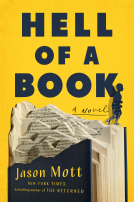
Hell of a Book, by Jason Mott*****

It really is.

This book is a standout in more ways than one. First the obvious: look at that cover! Then again, how many novels have a nameless protagonist all the way through the book? Get into it deeper, and the distinctions become more complex. The buzz around it is wholly justified. My thanks go to Net Galley and Random House for the review copy. This book is for sale now.

Our author is on an odyssey that takes the form of a book tour, and it lands him, in the end, back where he grew up. He doesn’t tour alone; apart from the various organizers he meets in various locations, he is accompanied by a small Black child he refers to as “The Kid.” Alternately, we also see the story of a young Black boy, a very Black boy, nicknamed “Soot,” who grows up in the American South.

As I read, I am always on the back foot, understanding most of what it being said, yet developing questions as I go. Our author says (often) that he has a condition, and that this is probably why he can see The Kid when others cannot. My notes ask whether his condition is dissociative, and is The Kid just part of himself? Or is The Kid Soot? Are Soot and The Kid both part of the author? Every time I come up with a plausible theory, something else happens to undercut it. Yet one other thing becomes clearer all the way through: to be born an African-American boy in the United States is to be perpetually on the back foot; perpetually having to guess how best to proceed; to perpetually guess at one’s welcome or lack of same, at the quality of one’s relationships with Caucasians, to perpetually guard one’s own safety. And to be very Black—“Nigga, I bet when you get out of the car your daddy’s oil light come on”—is to invite not only the suspicion and hostility of Caucasians, but to draw the enmity of lighter Black people, too.

The synopsis of this story that initially drew me billed it as humor, and in places, it is not only funny, but laugh-out-loud funny. But the further we get in, the darker it becomes.

There are a number of sardonic references to the publishing world; editors, agents, and other promoters have told the author that while it’s fine to write about Black characters, He must not write about being Black:

“The last thing people really want to hear about is being Black. Being Black’s a curse—no offense—and nobody wants to feel cursed when they read something they just finished paying $24.95 for…The future of this country is all about patriotic, unity-inducing language. Post-Racial. Trans-Jim Crow. Epi-Traumatic. Alt-Reparational. Omni-Restitutional. Jingoistic Body-Positive. Sociocultural-Transcendental. Indigenous-Ripostic. Treat of Fort Laramie-Perpendicular. Meta-Exculpatory. Pan-Political. Uber-Intermutual. MOK-Adjacent. Demi-Arcadian Bucolic. Write about love. Love and Disney endings…”

Later, an interviewer asks if the past doesn’t still matter, and the author says, “It does. Not just three-fifths of it, but all of it.”

So, my friend, you can see why this book should be called a love story. Race? Oh, no no no. Fear? Injustice? Police brutality? Of course not. After all, this is a hell of a book!

Highly recommended; one of the year’s finest.

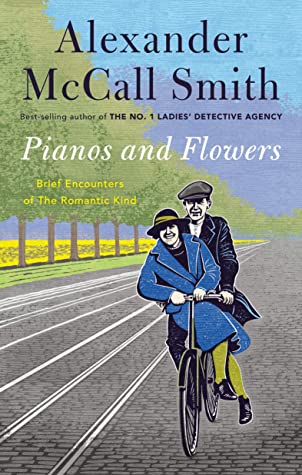
Pianos and Flowers, by Alexander McCall Smith**

Well, heck. I have so loved this author’s most famous #1 Ladies Detective series, and more recently have loved his new, satirical series starring Mr. Varg. When I saw this stand-alone collection of short stories—a genre I enjoy—I leapt at the chance to read and review it. My thanks go to Net Galley and Doubleday, but this one fell flat for me.

The collection is scaffolded by vintage photographs from The Sunday Times. Smith provides one of these photos at the start of every story, and then writes something (fictional) about the people and events displayed. I am initially deflated by these, thinking it might be a good fit for some readers, but for me more of a cure for insomnia, because Zzzzzz, when I find the italicized portion, which is intended to be a you-are-there insert. Why, why, why does every Caucasian reader under the sun think that the best way to add some World War II spice to a story, is to interject some of the racist slurs used widely at that time against Japanese people? True, it was a much more mainstream practice back then for white people to use nasty, racist terms to describe anybody and everybody that wasn’t Caucasian; you weren’t entirely safe if you were from Eastern or Southern Europe, so predominant was this tendency. Yet every author understands that if your book is to see wide circulation, you’d better not go tossing anti-Black references in as casual conversational terms. But ah—the Japanese! Now, that’s different. The Japanese don’t fight back all that much, so probably it means they don’t care. (Pause while I retch for a moment or two.)

This cheap-and-easy bit of vile, racist pop culture took this collection down from three stars to two. However, I can assure the reader that had it initially been a four or five star read, it would nevertheless have dropped to an unfriendly rating when I ran across such ugly language.

I am so done with that.

This thing is for sale if you really want it.

The Reckless Oath We Made, by Bryn Greenwood*****

People talk about having an angel on one shoulder and a devil on the other. I had a pair of imaginary bill collectors, so no matter which way I turned, there was somebody to remind me I needed money. That’s how I ended up on a train at four o’clock in the morning with my nephew and a hundred pounds of weed.

Bryn Greenwood met acclaim with All the Ugly and Wonderful Things, which I also read and reviewed, and I liked it a lot, but The Reckless Oath We Made is special, possibly the best novel we’ll see in 2019. The charm of the narrative voice is just as strong as the last if not more so, but there’s greater character development. It’s quirky and groundbreaking, and I will love this story until the day I die. My thanks go to Net Galley and Putnam for the review copy. You can buy it now.

Zhorzha—you can call her Zee—is in a state of perpetual crisis. Her father is in prison for robbery, and her mother has fallen apart, become a hoarder, massively obese, and agoraphobic to boot. At age 12, Zee was forced to leave home, and has been sofa cruising ever since. Recently she’s been staying with her sister LaReigne, but now LaReigne has been kidnapped. Zee and her nephew Marcus are stranded with nobody left to call for a ride; then her stalker steps forward and offers them a lift, and she takes it.

It’s the beginning of something beautiful.

Gentry has been following Zee for years; he saw her at physical therapy when she was recovering from a serious accident, and the voices in his head told him that he must be her champion. He doesn’t harass her, but he is always there. When all hell breaks loose, Gentry transports her to her mother’s house, but it’s even worse there. She is humiliated to have him—or anyone—see what kind of squalor her mother has chosen, but Gentry  sees her mother entirely differently, and since his narrative is peppered alternately with Zee’s and occasional glimpses of side characters’ perspectives, he tells us:

There, in the inner chamber, reclined upon a throne of red leather that scarce contained her serpentine hugeness, was the dragon Lady Zhorzha called Mother. My lady was blessed with a great mane of fire that ne comb ne blade might tame. Mayhap in the dragon’s youth, she had worn such a mantle, but in her age, her hairs weren grayed.

Fearless, Marcus approached the throne and flung himself upon the lady dragon. For a time, there was kissing and lamenting, for they weren greatly distressed with the fate of my lady’s sister…I would go upon my knee, but the dragon’s hoard was too close upon her.

At one point someone asks Zee whether she talks like Gentry too, and she replies, “Honestly, I don’t always understand what he says. I got a C in English in high school, and we never got to Shakespeare. I wasn’t in the advanced class.”

In fact, the juxtaposition of Gentry’s old world speech and Zee’s contemporary, frank responses that keep the story hopping. I laughed out loud several times when we moved from his speech to hers, for example:

Lady Zhorzha! Art’ou well?

Oh, thank fuck, Gentry. Yes. We’re okay.

But as much as I love Gentry, I love Zee harder. Zee is utterly believable, and she is unlike any other character I have read anywhere. She explains, when she’s asked whether she goes hunting with Gentry, that she wouldn’t know how; she comes from generations of “citified white trash whose main food-related struggle has to do with “opening dented cans of off-brand Spam from the food bank.”  

Zee is a large woman, and I am so heartily tired of tiny-firecracker female protagonists that I am cheered tremendously.  She’s nearly six feet tall, and her uncle says she is “Built like she could hunt bear with a stick.” When she is leaving the emergency room after a scare involving her mother, a staff member advises Zee to lose weight herself. One of Gentry’s friends notes that “Honestly, if she dropped fifty or sixty pounds, she would be pretty hot.”

And the thing I appreciate the most about this is that her weight not our central problem. It isn’t a problem at all. Zee is a romantic heroine who is fat, but this is an incidental part of her character. The problem is the kidnapping, and it’s complicated by all of the other challenges faced by poor people, challenges that Zee has to face without much of a tool kit; but between the kidnapping and the point when LaReigne is found, other life-changing events take place, and the Zhorzha we see at the story’s end is both wiser and happier than she is at the outset.

Greenwood doesn’t just avoid stereotypes in recounting Zee’s plight; she knocks the knees from beneath them and gives us breathing human beings and real world plot points instead, and she does it without being obvious about it. This is no manifesto; it’s more like a magnificent modern-day fairytale.

Take Gentry again, for example. Gentry is autistic, but he is not friendless, and he has some mad skills that take bullies unawares. Also?  Gentry is adopted. He is white; his adoptive mother is Black. Again, this is incidental to the story, but readers cannot miss it; there’s a very brief spot that brings it front and center, and I cheer when I see it.

Those that read my reviews know that I seldom gush, but this story is perfect in so many ways that I cannot help myself. By this time next year, I will have read roughly 140 more books, but I will still remember Zee, and I will still remember Gentry. This is among the sweetest stories of  2019, a new favorite.

I highly recommend this book to everyone that has the literacy skills and stamina to brave Gentry’s prose. Get it at full price or discounted, from the library or stolen. You won’t be sorry.