Radio Girls, by Sarah-Jane Stratford*****

radiogirlsFearless women change history.

Radio Girls is a fictionalized account of the British Broadcasting Corporation and the remarkable women that shaped it. As we near the centennial of women’s right to vote in the USA and the UK, Stratford’s riveting historical fiction could not be better timed. I received my copy free and in advance thanks to Net Galley and Berkley Press in exchange for this honest review. I am overjoyed to be able to recommend this new release unequivocally. You have to read it.

Maisie Musgrave is born in Canada and raised in New York City. Tossed out of the nest without a parachute by unloving family, she makes her way to Britain, the place her heritage began. She wanders into the BBC half-starved and looking for an honest way to pay for her room and board, hoping in the meanwhile to meet a man she can marry for financial security.

At the BBC she meets supervisor Hilda Matheson, who fears nothing:  “Give that woman an inch and she takes the entire British Isles,” a colleague remarks.

Under the firm and commanding wing of Matheson, Maisie’s confidence and talent grow daily. It’s a very good thing, because over the course of time, more will be demanded of her than secretarial skills and errand-running.  My busy fingers marked one clever, articulate passage after another to share with you, but to enjoy Stratford’s fresh, humorous word-smithery, you really need the book itself.

Occasional historical figures drop in—Lady Astor, who was a moving force in the development of the BBC and a champion of women; Virginia Woolf, early feminist writer and crusader. Yet Stratford metes out these references in small enough batches that it’s clear she isn’t relying on them to hold her story together; rather, they are the cherry on the sundae.

Setting of time and place, pacing, and a million twists and turns in plot make this a good read, but it’s the character development that makes it a great one. I found myself wanting to talk to Maisie and cheering her on when she broke through to higher ground personally and professionally. I feared for her when she veered into dangerous waters and nearly wept with relief each time she was able to extricate herself and move forward. There isn’t a slow moment or an inconsistent one, and the protagonist is just the character women need to see right now as we move forward too.

How much of this is based on truth and how much made up for the sake of a great story? Read the author’s notes; she spills it all.

All told, Sarah-Jane Stratford’s historical feminist tale is perfect for today’s modern feminists—and those that love us.

This book is available to the public Tuesday, June 14. Change the screen and order a copy for yourself now. You won’t want to miss it!


The Fat Artist and Other Stories, by Benjamin Hale*****

Happy release day! Today this title and another winner, Everyone Brave is Forgiven,  hit the shelves. I don’t reblog all titles upon release; only the ones I really like. Don’t let the cover scare you away, because once I had gotten into the title story, I understood why this was exactly the right cover art. Happy reading!

seattlebookmama's avatarSeattle Book Mama

thefatartistI like short stories. My Goodreads library tells me I have munched my way through 89 collections and anthologies; yet I can tell you that there is nothing even remotely similar to what Hale offers here. Thanks go to Simon and Schuster and Net Galley for permitting me to view the DRC for the purpose of an honest review. You should get a copy May 17, 2016 when it is released, so that when it is immediately banned by various school boards you will know what they’re screaming about.

The ribbon that binds these brilliant, bizarre tales is that each of them features a social outlier as a protagonist. We start with the airline flight from hell in “Don’t Worry Baby”; you have doubtless flown at least once on a flight with a small child whose mother you long to smack upside the head for her dreadful parenting skills, but…

View original post 473 more words

Britt-Marie Was Here, by Fredrik Backman*****

BrittmariewashereOh hey, today is Seattle Book Mama’s second birthday! Break open a bottle of sparkling water and toast my humble blog. I’ve done a lot of reading, and so much more is to come.

Britt-Marie is starting a new life after 40 years of marriage, and while she is driving with no destination in particular other than not-home, her car breaks down in a little burg called—wait for it—Borg. While  it’s being repaired, she becomes enmeshed in the life of this small, down-at-the-heels, economically depressed town. It sounds like a lot of stories, but oh, it isn’t. And I was really lucky to score this, a new one favorite, free of charge from Net Galley and Atria Books, in exchange for a fair review.

The beginning didn’t grab me. I incorrectly suspected that there was only one central point to the narrative and we were being hit over the head with it far more than was necessary. But I was fooled, because Backman is a sneaky-smart writer with a wicked sense of humor and a surprisingly philosophical bent. I was amazed at the depths this seemingly simple tale plumbed.

I don’t want to give you too much, and I could easily do it, having once again been carried away with my notes, which number over 300 in my kindle. I kept finding moments that were hilarious, or fascinating, or that just made me think. But here are some broad contours to start: Britt-Marie has lived at home all her life, first with her mother and later with husband Kent, who moved into her flat when they married, and so she has not even changed residence over the course of her life. When she was young she took classes and worked up a resume, but each time she got close to finding employment, Kent persuaded her that she was needed more at home, and so she has never had a job. Not once.

So after decades of marriage she decided not to notice the perfume on his shirt collar when she did the laundry, even though she herself does not wear scent of any kind. But when the woman phoned her home to tell her that her husband had had a heart attack, it became too obvious, too humiliating, and once she knew he was going to recover she tossed some things in a bag and got herself gone.

Now she wants a job, because she is afraid that otherwise she will die alone and no one will miss her. When you don’t show up for work, people notice, and she doesn’t want to pass from the Earth unnoticed and unmourned.

In the beginning some of the most hilarious passages involve socially clumsy, rude, or outrageous things that Britt-Marie does or says without intending harm. She’s clueless, but the further into the story we delve, the more we see more. We see that she is angry, too; she’s afraid of her own anger.

Although she has been taught through lifelong experience that her own needs should come last and that others should occupy the limelight, the residents of Borg, many of whom have plenty of quirks of their own, teach her that she has more value than she had previously realized.

They like her.

As the story progresses, all sorts of unforeseen twists and turns present themselves, and our formerly obnoxious protagonist turns out to have a tremendous amount of heart. I was watching to see whether the plot would become cloying or formulaic, but it never happened. And although the ending seemed a tiny bit contrived, at the same time I liked what it represented.

To learn more, you have to get the book and read it. And here there is great news: this book is available to the public, just released May 3, 2016. Highly recommended to all readers that are female or have women in their lives that mean anything at all to them. Seriously.

The Kaminsky Cure, by Christopher New***

thekaminskycureThe Kaminsky Cure is a satire of Nazi Germany previously published and now offered anew in digital format. Thanks go to Open Road Integrated Media and Net Galley for the invitation to read and review, and for the DRC, which I received free of charge. This title is available to purchase now.
Who would have thought it possible to satirize such a terrible time and have it come out in anything other than terrible taste? But New carries it off, using a pre-school aged child in a mixed family—with one Jewish parent and one Anglo parent—as his narrator. Several times the precocious tot points out aspects of his own narrative that are actually impossible, as for example when the child tells us exactly what is contained in something written and then blandly points out that he cannot read yet. It just makes it funnier.

The appealing thing about this novel is that it brings up the reality which should be obvious to any thinking person that has paid any attention to this particular time and place: most Germans as well as Austrians were entirely in favor of Hitler’s takeover, and although there were Jewish families, many of them in fact, that wanted out of Nazi-occupied Europe as quickly as they could go, there were others that had never embraced their culture and had converted to Christianity in some cases generations earlier; and such is the case with our protagonist’s family, which wants only to pass itself off as Aryan so that it can join in the party. Young Martin, the protagonist’s older brother, longs to become a member of the fearsome SS, Hitler’s storm-troopers. Ah, the uniforms! The ferocity! The authority!

Our toddler-narrator, meanwhile, observes his own family with platonic remove, contemplating which members have violated one edict or another and should therefore be turned in to the authorities. After all, that’s one of the things he has learned in school. Children are the future, and it’s up to them to weed out those older folk that fail to comply with important social changes.

It’s what Hitler would want him to do.

There’s one twist and then another, but overall I found that the story’s momentum lost steam as it progressed, because there was really just one joke here, and it could only be played so many ways before it became repetitious. Nevertheless, it’s wholly original, and when faced with an event as horrific as the Holocaust, one either has to laugh or cry.

And amazingly, New has created a way to help us laugh, at least for a little while.

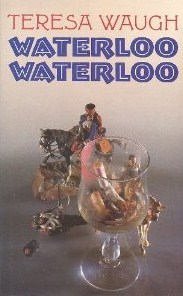
Waterloo, Waterloo, by Teresa Waugh*****

waterloo waterlooI would have reviewed this title sooner, but I was laughing too hard! Thank you, Endeavor Press, for the complimentary DRC, which I received directly from the publishers in exchange for an honest review. Waugh’s clever, sly satire still has me snickering. Those with a rudimentary knowledge of European history should not let this one slide by unread. Laughter is good for you, and as long as you know the broad contours regarding Napoleon’s life, loves, and battles, I defy you to read this novel without chortling.
To start with, we have Jack and Peggy on a cruise together off the coast of Greece and through the Corinth Canal; the year is 1974. Jack is retired from the British Navy, and has saved for a long time in order to be able to visit great historic sites. His recent marriage to the glamorous Peggy, a divorcee considerably younger than himself, is the icing on the cake. He’s waited a very long time to see the sites of great historical events; later, he will recreate those of Napoleon with thousands of toy soldiers stored in the garage at home.

History bores Peggy, but she loves shopping whenever the ship docks. Spending money is the thing she loves best…not unlike the Empress Josephine, wife of the French legend Napoleon. In fact, Jack and Peggy have even named their only child Josephine.

I’ve read various other reviews that complain about the dysfunctional relationships within the protagonist’s family, and the shallow character development. I want to personally find each and every one of those clueless reviewers and—metaphorically only, of course—smack them upside the head. It’s not supposed to be about character development, get it? Read the title! Although the story itself is a sharp, satirical romp, you need some background knowledge or it will sail right over your head. You won’t understand the allegory without a frame of reference! If you know nothing about Napoleon, you won’t understand the humor.

None of it.

Once I latched onto what the author was doing, I was eager to see how far he would carry it, and to what extent Jack’s life would mirror that of Napoleon. At the end, as soon as I stopped sniggering, I could only shake my head in admiration. The basic contours are there, but one doesn’t have to be a scholar specializing in French history to enjoy the book; you just need the basics regarding Napoleon’s reign and fall.

Smart, smart satire, well worth your time and money…if you have a working knowledge of European history.

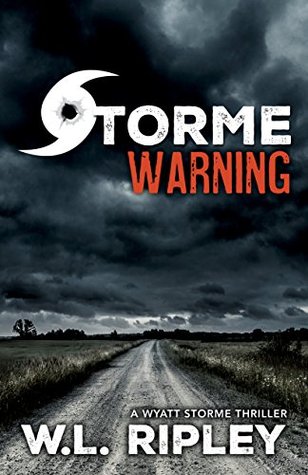
Storme Warning, by WL Ripley****

stormewarningStorme Warning is the fourth and thus far final installment in a terrific series. I have read three, and will read the fourth if I can find it. The snappy patter and nonstop action and suspense make it hard to put down once you’ve begun. I rate it 4.49 stars, and thank Brash Books Priority Readers Circle for providing me with this DRC in exchange for an honest review. The book is available for purchase right now.

Wyatt Storme is retired from football. He divides his time between his cabin in Missouri and another cabin in Colorado; this story takes place in Missouri. He owns a considerable piece of land because after having the press follow him hither and yon for the duration of his NFL career, he craves simplicity and solitude. “Reclusive”, as his best friend Chick explains to an outsider.

Because all of a sudden, Wyatt’s land is chock full of outsiders. Hollywood director Geoffrey Salinger wants to shoot his hot new movie on location; his star has received death threats, and Chick has been tapped as bodyguard. Wyatt doesn’t like it much, but Chick wants the work, so he agrees to tolerate the intrusion, but he sets terms in a way that provide him with an unusual amount of control over industry hotshots that aren’t accustomed to leaving the driver’s seat. Combine this scenario with the smart, snappy patter between Wyatt and Chick; throw some 70’s song lyrics into the narrative as if they are merely part of the story; add some mobsters from out of town; and you have a really fun, fast-paced story.

The final .51 star is denied because of the way the author deals with race. He means well to be sure. But racist terms that are sprinkled in an almost nonstop stream throughout the book are going to make this a prohibitively painful book for most African-American readers. It’s true that Ripley uses the “n” word and other slurs (against other races also, but mostly Black folk) to determine who is a bad guy, but when one is close enough to the heat those terms create, all the fun stops as soon as the word appears. It’s like finding a rattlesnake in the cookie jar; you’re having a good time, expecting good things to continue happening, and then, bam, there it is.

Depending on who you are, it’s enough to take your breath away.

To be sure, I don’t know what it is like to be a person of color; I am not one. But for many years I have been the only Caucasian person in my house, with others here being either Asian, Black, or mixed, and I do know what it is to be the wife and mother of people that don’t enjoy white privilege. The “n” word and others like it are serious, serious things. And insult is added to injury by having the African-American character unable to enter a scene without race issues being the first to fall from his lips. Most Black people don’t really want to engage white people in discussions of race unless it’s in a formal political setting, and even then, it’s more comfortable to talk to another person of color, or a room that is mostly people of color. But LeBeau is clearly in this story for no purpose other than to be the Black character. He isn’t developed, and what is worse, he isn’t capable of much that is positive. As with the Black girl in the brief restaurant scene, a white guy has to come to the rescue. To depict all characters of color as victims and set them up to be saved every stinking time by Caucasian characters is inexcusable. (LeBeau tries to carry off a rescue once, but it doesn’t work out, and Chick emerges the hero once more.)

Should the writer continue the series, I recommend that he simply use white folks, if that’s his comfort zone, or include multiple people of color and develop them. Give them characteristics beyond coming into the room and making readers aware they aren’t white. And don’t diminish them by making them unable to stand up for themselves or others. I further recommend not using that word, ever again. It’s cheap and easy, but it costs some readers dearly. I would not give this book to my son to read. The pain would outweigh the enjoyment; in fact, I guarantee he wouldn’t finish it. There are more subtle yet unmistakable ways to demonstrate that a character is racist, if that is a key goal. There are other ways just to show that a character is a bad guy, too.

Hollywood and television have learned how to create actual characters of color, as opposed to casting someone to “be the Black guy”. Ripley has skill enough to do the same.

I’ve given the downside of this novel more space than the 90 percent that I enjoyed, but I have done so because no other reviewer I’ve seen so far has addressed it, and someone has to do it.

With the single clear caveat provided here, this fast-paced, mostly-funny detective story is recommended .

The Portable Veblen, by Elizabeth Mckenzie*****

theportableveblen“There is a terrible alchemy coming.”

Veblen has led an insular life, focusing her energies on genealogy, a love of nature, and oh dear heaven, her mother. The fact is, her mother is both dominant to an extreme degree, and frankly more than a little bit squirrely. But when Veblen meets Paul, her life changes dramatically; but even more so than most young women, she finds that she needs to be flexible to accommodate Paul, whose needs are different from her own.

A huge thank you goes to Net Galley and Penguin Random House Publishers for permitting me a DRC. I nearly let this title pass unread by me, thinking, because of the cover art, that it was going to be a cutesy animal story, its humor no doubt cloying. I could not have been more mistaken, and so thanks are also due to whatever journalist’s review was posted in my hometown newspaper. Realizing my error, I rushed to the computer to see if it would still be possible, at this late date, to read it free.

It was indeed.

Dr. Paul Vreeland, neurologist and researcher, seeks some normalcy and order in his life. He was raised in a communal environment by parents determined to avoid the rat race and its social conventions as well. All of them. Had he been raised in an urban environment, someone would have probably called the authorities and had him removed from the filth, the drugs, and oh yes, the dreadful embarrassment. When he meets Veblen, he senses that she is fresh and unpretentious, but does not fully grasp just how much she wants to be like his parents—well, minus the drugs.

When Veblen is under stress, she starts anthropomorphizing squirrels. She is certain she can talk to them and that they understand what she’s saying. The stranger her mother behaves, the more Veblen is drawn to squirrels.

And now, a personal note. A good friend of mine took a respite from the grinding, long hours of social work, and for awhile she worked as a wedding planner. It didn’t last long. Having had so much experience dealing with disparate personalities in her initial career, she often felt the urge to hurl herself between the prospective bride and groom, upon whose union tens of thousands of dollars was being lavished. She wanted to cry out, “Just get away from each other, both of you! This marriage will be over before the year is over, so just don’t go there!”

And this is what I wanted to do as of the 33 percent mark. I wanted to haul Veblen back to the rundown cottage she occupied by preference, and haul Paul back to his state-of-the-art medical facility, and have them never see one another again.

Then again, their relationship is hysterically funny, and all of us can use a good laugh, followed by another, and yet another.

The reader can approach this hugely original tale on one of two levels. It can be read as literary fiction, with the squirrel as metaphor. Or one can just read it, and sit back and howl with laughter.

One way or the other, this unbelievably clever, hilarious book is available for purchase now, and it is highly recommended to everyone.

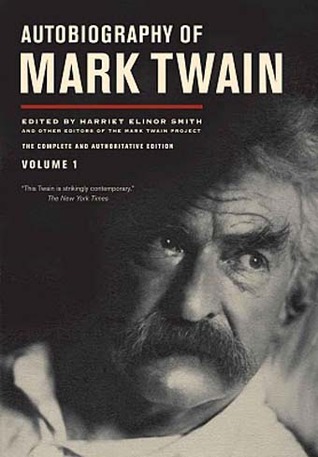
Autobiography of Mark Twain, Volume I, by Mark Twain*****

automarktwainoneInitially I was surprised not to have seen the autobiography of such a famous individual before. Twain, I learned at the outset, composed his memoir with the stipulation that it not be published until 100 years following his death, because he wanted to be entirely frank about some situations and persons without incurring the displeasure of them, their children, or their grandchildren. Twain died in 1910, and his memoir had been finished just four months. For those of us living now, it was worth the wait. Although I was fortunate enough to snare the DRC for volume 3, I had to go out and hunt down volumes 1 and 2. It’s well worth obtaining and reading for those with the attention span and literacy skills it requires.

There is a lot of material here, and you may be tempted to sample bits here and there using the table of contents. I strongly advise against it. Some of Twain’s most brilliant writing regards things you would not expect to care about. The dispute with a landlord in Italy as his wife lay dying in the villa has the full intensity, concentration, and fire he has to offer. Although I will never know for sure, I suspect that Twain was one of those rare individuals who became even more savagely articulate when angry. The heat of his rage is tremendous and oh so eloquent.

A lot of this writing is gut-bustingly funny, but some of it is also really subtle, and if you rush, you may miss it. I enjoyed reading what he thought of Jay Gould and John Rockefeller; of President Theodore Roosevelt; and of Satan, for whom he confesses that he feels a tremendous sympathy. In other passages he becomes poignant, particularly in speaking of the deaths of his wife and daughter. Nobody but Twain could say it just like this.

Should the reader ignore my advice and choose to jump around, thus missing occasional references to things mentioned earlier in the text, at least do this: be sure to read his remarks about dueling.

The memoir is not linear. He tried several times to sit down and write his life end-to-end, and destroyed some drafts; others he merely abandoned, and they made the assembly of the autobiography, most of which he dictated, all the more complicated as a result. The University of California has done a splendid job of isolating the random repetitious bits at the back of the book in an appendix, while putting the rest of it together in a way that while not linear, makes sense. There are a few interesting photos at the end as well.

Those engaged in the teaching of college level creative writing, of simile, metaphor and other figurative language may indeed want to read this magnificent memoir and pluck some favorite passages for use as examples.

Twain’s life story is not for those with limited focus or who need immediate gratification with minimal effort. This volume, all 738 pages apart from the appendix, kept me company at bedtime when everyone else in our home had the lights turned out and I was the only one still awake. In those small quiet hours I studied the prose of the master, and occasionally had to leave the bedroom in order to laugh out loud, lest I wake my spouse. I would be sorry to have finished, but volumes 2 and 3 still await my attention.

For those that love the English language, and for those with an eye for history, this memoir is not to be missed!

Pilgrims: A Lake Wobegon Romance*****

PilgrimsOh my stars. Keillor is at his finest here. I’ve never read anything funnier. Every now and then I permit myself to read a title that isn’t a new release but that I’ve been considering reading for a long time. This is one of those.

By now you probably have an idea whether or not you are a Keillor buff. His appeal is largely (but not limited to) the boomer generation. His trademark capacity to satirize people from rural Minnesota, and in particular Lutherans and Norwegians and most of all himself, is legend. He somehow manages to tug the heartstrings occasionally and evoke bittersweet feelings that are experienced by those of us who grew up in the USA during a particular time period, even if we are not from his part of the nation or his culture.

Keillor seemed to me to be sort of a hit-or-miss writer for awhile, but lately, he’s been hitting, at least for me. Liberty, Pontoon, and this one, which parodies Chaucer’s pilgrims in the Canterbury Tales, carries on without slowing or hitching or ceasing to be interesting and at many times (especially the end) a total crack-up.

If you have never read Chaucer and don’t intend to, that won’t wreck it. The basic contours: Chaucer wrote about people going far away, in a limited group, and Keillor uses the same style of poetry Chaucer used to mark the beginning and end of this book. If there are other parallels, then I am not deep enough to find them, but if I found this to be a good bedside read with only that much recollection, then it will likely suffice for you too.

Here are the story’s components. (I actually flagged fifteen hilarious passages, and then realized that if I quoted them here, it would ruin it to you, so I’ll just give you the basics and set you free.) Margie is 53 and very unhappy. Life has sort of ground to a dull halt; the nest is empty, and husband Carl has moved to a different bedroom. She doesn’t know why. She hopes that if they take a romantic trip to Italy, it will rekindle the flame.

Writer Gary Keillor comes to town. No one includes him in anything. They all assume he is being standoffish by not coming, and he is hurt that no one invites him; very Scandinavian. Before he knows it, he has livened up the speech he is giving (and which is obviously boring his audience senseless) by offering to fund the trip to Italy. Holy smokes! What has he done?

On top of all of it, the town hero, Gussie, their fallen Norwegian soldier who fought in World War II, should have his grave decorated. His daughter Margo, born in Italy outside the sanctity of wedlock, has never gotten around to coming to the USA to meet him, and his remaining brother, very elderly and in a nursing home in another part of the USA, has long wanted someone to convey a photo of Gussie to his grave site. A simple request, and nobody would do it. Now, Margie calls to tell him she’ll be happy to help, and joy of joys, he sends her a big pile of money, and on his deathbed, he refers to her as his “daughter, Margie.” She is entirely untroubled about taking his money as the little band from Lake Wobegon sets out on its vacation and its mission to decorate Gussie’s grave.

This should give you enough information to decide if you want to see the rest. I will only tell you this: the story has some surprises in store at the end; it is not as predictable as it appears to be at the 75% mark.

I found my copy during an annual pilgrimage of my own, to Powell’s City of Books in Portland, Oregon. It has been available to the public for some time.

Hilarious, and highly recommended!

Hail Storme, by W.L. Ripley**-***

HailStormeIn 2015, I reviewed Storme Front, the second of four books in the Wyatt Storme series. I loved it and rated it 5 stars. Given the opportunity to read and review this first in the series, thanks to Brash Books Priority Reviewers Circle, I didn’t have to think twice. Thank you to Brash for the DRC, which I read free in exchange for this review.

In this first installment, Storme, a retired football hero and Vietnam veteran, goes bow hunting for deer in Missouri and runs into trouble. Tracking deer, he literally walks into a field of marijuana; before he can decide what if anything to do about it, a snarling Doberman charges him, and he has to kill it. From there, the action unspools, taking him into town and leading the reader to a series of conversations and confrontations Storme has with the local law, the local goons, and of course, women.

The local law can’t quite decide what to make of him:
“’You a wiseass, Storme?’ McKinley asked.
“I shrugged. ‘It’s a gift.’”

Of particular interest is Willie Boy Roberts, a local businessman that has full time body guards, here in this tiny town. So right away, we know there’s trouble a-brewing that extends far beyond a simple field o’ weed.

Storme also meets Chick Easton, who will become his wisecracking, crime-fighting partner continuing on into the series. Easton has been a green beret, has killed people for the CIA, and is also a Vietnam vet. He has considerable regret about the life he has led, but he’s a great guy to have in your corner. He also provides the perfect counterpart for all of the genuinely funny snappy patter in the book.

I also genuinely appreciated, as I did with the second Storme book, having a protagonist that drinks coffee rather than whiskey or beer, but doesn’t constantly agonize over his alcoholism. It seems like two out of three works of fiction these days feature alcoholic protagonists or important secondary characters, and I have had my fill. Just pour the coffee and shut up already! A welcome change.

This first novel started out a little bit uneven, but hit its stride well before the halfway mark. I really thought it would be a four star read till I got to the last ten percent. There, it gets ugly. There’s a steady stream of anti-gay venom. Easton discusses a suspect with Storme, and he deliberately lisps—gee, I’m not laughing—and does the whole limp-wristed thing when he speaks of the character’s possible motivation. I won’t say more here lest I spoil a (small) part of the whole who-dunnit, but there is so much ugliness toward gay men, not just the offensive jokes, but some plot moves that left me feeling as if I’d eaten spoiled food, packed into this last portion of the book that it’s impossible to disregard it and move on.

I checked the copyright date, longing for something that would permit me to give this otherwise really good story the four stars it deserved up to then. It was originally published in the 90’s. No, no, no. Not okay.

Because of this factor, I rate this novel 2.5 stars and round it up with a fair amount of ambivalence.

The writer makes a point, subtle yet distinct, that Storme is a Christian. Fine with me. But if the anti-gay aspect of this novel is tied to dearly held principles Ripley possesses, I can’t become a constant reader. If it was simply a failure of the writer to update his work to reflect a more widely held social view—and here I am thinking of the occasional novel that gets written, sits on someone’s desk for several years, and then sees publication much later—then he and Brash might want to have a conversation about editing. Don’t get me wrong; I support the First Amendment right to express one’s ideas freely. But when those ideas brim over into hate speech and homophobia, I also can’t give a positive review, or consider myself a potential customer of the work presented me.

If you are homophobic and love mysteries, this one is your book, and it’s available for purchase now. Otherwise, consider moving on to Storme Front. You don’t have to have read the first in the series to enjoy the second.

Am I game to read #3 and #4, knowing that #2 is free of these challenging issues? If I can get the DRC’s for them, I’ll dive right in. Everyone is entitled to make a mistake early in their career. But right now, I wouldn’t lay my money down