The Rulebreaker, by Susan Page*****

Barbara Walters was a force to be reckoned with. She was the journalistic pioneer who singlehandedly smashed the glass ceiling that kept women from anchoring network news; over the years she would conduct television interviews with heads of state, criminals, otherwise reclusive stars, and anyone else she deemed newsworthy. She was ruthless in the pursuit of a story, but during interviews, she used velvet gloves to deliver the most searing questions, and her subjects responded.

My thanks go to NetGalley and Simon and Schuster for the review copy. This book is for sale now.

Page has written a full, epic autobiography, starting with Walters’s childhood, which was fraught with uncertainty, and ending with her death. She has written it the way the story of a luminary should be written, touching on the many remarkable aspects of Walters’s life without lingering too long on any one of them. She keeps the pacing brisk, and the tone respectful but frank, never fawning. I can’t imagine anyone doing a better job, including Walters herself; the autobiography, Audition, is the most cited source in the endnotes, but Walters had a tendency to drone while telling her own story, particularly about her childhood, while Page keeps it moving.

Walters grew up in a show business household; her father, Lou Walters, produced live shows, and when they were successful, the family lived in style; when they weren’t, it was hand-to-mouth genteel poverty. His gambling addiction caused the family terrible hardship on numerous occasions, and once she made it in the industry, Barbara was forever writing checks to bail him out of debt. Her younger sister, Jackie, was intellectually disabled, and needed constant care and attention. Barbara remarked that in looking back, she doesn’t feel that she was ever young, as she carried so many adult responsibilities at such an early age.

Breaking into mainstream journalism—not fashion or cooking stories, but hard news—was a tough road. She did it at a time when women weren’t expected, or allowed, to do much of anything outside of mothering, housekeeping, and a small number of stereotypical positions. Any female that dared step outside these tight confines was labeled, not as an attorney, manager, or journalist, but as a “lady journalist,” and so forth. Her job on the Today show was announced—with a bit of urging from Barbara herself—in the New York Journal-American thusly:

“’Dawn Greets Barbara, A Girl of Today,’” the headline over the story read. ‘A very attractive, shapely, well-groomed, coiffed and fashionably frocked feminine member of NBC’s dawn patrol” …adding that she had ‘no wish to become a personality.’ She wants to remain as she is…the prettiest reporter in television.’”

That didn’t last, if it was ever true at all. She fought, tooth and toenail, for every single advancement in her career; mainstream news anchors, male of course, resented her and resisted her, particularly when she was hired to appear as a co-anchor. Her early career was marked with restrictions, with Harry Reasoner and Walter Cronkite subjecting her to endless bullying and requirements of when she could speak on the air—not until they had—and other petty, petulant rules.

But she never gave up, and she never went home.

As is often true for anyone that lives for their career, Walters wasn’t able to maintain any of her marriages or raise her own child. She was busy. This is the one regret she voiced at the end of her life, when she found herself alone, with only her longtime paid assistants to see to her needs.

Page narrates her own audiobook, which I checked out from Seattle Bibliocommons in order to catch up, and I immediately noted how much her voice and intonations resemble those of her subject, albeit without the speech impediment. I enjoyed listening to her.

Perhaps my favorite moment in this book is the moment when a very elderly Barbara Walters falls on a marble staircase after refusing to take the arm of the younger woman offering it. She faceplants, is badly injured, but when she regains consciousness, the first thing out of her mouth is an imperial order: “Do not call an ambulance. Do not call an ambulance.” (Of course they did. They had to.)

Although Walters was never a feminist crusader and generally looked out for herself, her family, and friends rather than her younger peers, we women owe her a debt of gratitude. She forced doors open that were bolted shut, and the ripple effect was immeasurable.

Highly recommended to those interested in Walters, feminist history, and anyone that just enjoys a good biography.    

The Stepford Wives, by Ira Levin*****

Ira Levin, legendary novelist and playwright, published The Stepford Wives in 1972, a time when feminist ideas were at a fever pitch for many, and a frightening development for others. Women’s rights were at the forefront in a way that they had not been since the suffragists had won the right for women to vote over 50 years earlier. Now the book is re-released in audio format, at a time when the advances won during that time have been rolled back in some places, and appear to be under attack everywhere. So although I was already familiar with this book, I jumped at the chance to listen to it and promote it; I wish Levin was still alive today, because we can use men like him.

Version 1.0.0

My thanks go to NetGalley and Blackstone Audio for the review copy. This book is for sale now.

Stepford, Connecticut appears to be idyllic; beautiful homes; rolling lawns; good schools. There’s no crime to speak of in Stepford, and Joanna and Walter jump at the chance to move their young family away from the city and into a lovely new home. The children make friends almost immediately, but for Joanna, it’s a little harder. All the women are stay home mothers—not unusual in 1972—but they are insular, preferring housework and beauty regimens over any outside interests, including other women. She finds two women that are friendly, and that have moved here fairly recently themselves, and she turns to them for solidarity. But then one of them begins to change, and Joanna has become suspicious. Is it something in the water? Why are Stepford women such docile, ornamental drudges?

This is a brief book, more of a novella than a novel, and that’s part of what makes it so effective. Levin uses spare prose and doesn’t let anything clutter his central message. In doing so, he creates a more spine chilling effect than a more description laden, dialogue rich novel could have done. And once you read it, you’ll never forget it.

I highly recommend this classic work of horror for women and those that care about them.

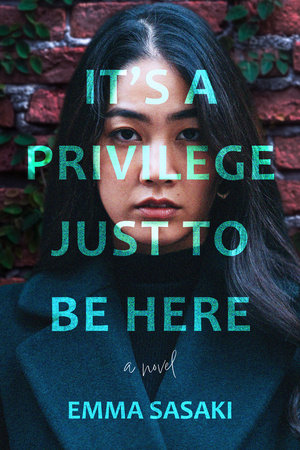
It’s a Privilege Just to Be Here, by Emma Sasaki****

Emma Sasaki makes her fictional debut with the darkly amusing story of a mother and daughter caught up in a scandal at a prestigious private school. My thanks go to NetGalley and Dreamscape Media for the audio galley. This book is for sale now.

Wesley Friends School is the prep school to which presidents and other high placed politicos send their teens, a place where they are nurtured as completely as any hot house flower, and then sent onward, hopefully to an ivy league college. Aki Hiyashi-Brown abandons her PhD and accepts a teaching job there in order for her daughter, Meg, to be able to attend; otherwise the tuition would be impossibly expensive. The school is overwhelmingly Caucasian, and so perhaps it’s unsurprising that Aki finds her face prominently displayed on all of the promotional materials the school disseminates, along with those of the few other teachers of color.

That’s all fine and good until the day when the fence outside is vandalized by spray paint reading, “Make Wesley white again.” Aki is ready to do what she’s been taught from the cradle: keep her head down, do her job, and not say anything. But Meg and her classmates have no intention of remaining silent. Before she knows it, Aki finds she has been assigned to be the head of the Racial Equity Task Force, a token job on a token committee that has more to do with appearances than with any actual desire for change.

She is given a script to follow and told not to offer up any of her own observations or opinions.

Soon, things spiral beyond the control of Wesley’s administration, and Aki is caught between doing what her bosses want her to do, and supporting her daughter and students in their quest for genuine change.

This book, which the author notes is based on her own experience, has me at hello. Though I am not a wealthy or connected individual, I did send my child to a private school for a few years, one which was very white, and which used my half-Japanese daughter’s face on its pamphlets a lot. I can’t not read this book, and whenever I have earbuds in, this is what I listen to. I find it well paced and engaging, setting just the right tone without over-moralizing or becoming strident. There are some great side characters as well; I like Aki’s husband and mother particularly, and appreciate the bond between Aki’s half-Japanese daughter and her Issei (first generation) grandmother.

However, my own husband is also Issei, and I asked him to listen to the reader during one of the many passages in which the grandma speaks to Aki in Japanese. “Is this reader’s Japanese as good as I suspect?” I asked, somewhat proud of my first year Japanese skills. He listened to two lines, laughed, and shook his head.

For this, I really do have to knock one star off my original five star rating. Perhaps if I had a digital review copy I could have rated that version higher, but I have what I have, and it’s problematic. Nevertheless, I appreciate this novel and the message it delivers, and I greatly look forward to reading whatever Sasaki publishes next.

The Forgotten Girls, by Monica Potts***

My thanks go to Net Galley and Random House for inviting me to read and review The Forgotten Girls, by Monica Potts. I generally enjoy reading books that focus on the working class, and so I thought this would be a good fit. And it might have been, had it been better written.

In broad contours, it’s a memoir that examines the lives of Potts and her best friend, Darci, both of whom grow up in a tiny, isolated town in the Ozark Mountains. The community is long on religion and red hats, and short on jobs, opportunity, ambition, and encouragement for girls to make something of themselves. Nevertheless, Monica, whose mother has raised her with the expectation that she complete her high school education, go to college, and then live somewhere else where there are more possibilities, has done all of those things, while Darci, who is every bit as talented and has just as much potential, is raised by a dithering mother that lets her do whatever she chooses because she dislikes conflict, and who has no expectation that her daughter will make a better life for herself, since she herself did not.

Okay.

Potts wonders why she made it out of there and Darci didn’t, and yet I’m not seeing the mystery, nor anything that’s all that different from what’s happening all over the country. And indeed, part of the time, Potts discusses this fact, that it is happening in many places that lack resources and that don’t prioritize education. And so, sometimes the story seems to be a sociological study that uses Monica and Darci as examples, and at other times there is so much anguished self-flagellation that I find myself wondering why she thinks the public needs to hear about her friend’s failure to thrive, and whether this isn’t mostly therapeutic writing for the author’s own benefit.

In other words, the book seems like a lengthy treatise in search of a thesis. We wander in and out of both girls’ lives, with a good deal of attention paid to the death of Potts’s sister, but there’s no real direction or clear purpose that I can find.

In the back of my mind, I can hear choruses of other readers asking whether this situation is considered special because it’s about white girls. Nobody makes a fuss when girls in rural areas that are Black or of Latinx heritage fall through the cracks; hell, it’s been happening for more than a hundred years.

Many other reviewers seem to find merit here, but I confess I don’t see much. If you choose to read this one, I suggest getting it free or cheap.

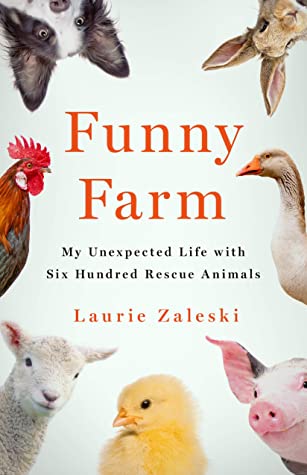
Funny Farm, by Laurie Zaleski*****

“You never know what you are capable of until the day comes wen you have to go places you hadn’t planned on going.”

Laurie Zaleski knows how to make a debut. Funny Farm: My Unexpected Life With 600 Rescue Animals has created a tremendous buzz, and all of it is deserved. My thanks go to Net Galley and St. Martin’s Press for the review copy. This book will be available to the public Tuesday, February 22, 2022.

Laurie’s early childhood was in many ways an enviable one; her mother stayed home to raise Laurie, her brother, and her sister, and her father made enough money to hire household help and buy a couple of vacation homes, too. There was nothing they lacked for, other than physical safety. Because while her father could be warm, and loving, and generous, and funny, he could also be a monster. His reign of terror was worsened by alcohol consumption. As the beatings became uglier and more frequent, Annie, their mother, chose poverty for the children and herself over the constant terror and danger of living with their dad.

“’I almost became a nun,’ Mom would joke years later. ‘Then I met the devil…’ Annie McNulty and Richard Zaleski fell in love like tripping into an open manhole: one wrong move followed by a long dark plunge.”

There’s one searing episode Zaleski recounts, toward the end of their life with Dad, in which they are all hidden in a bedroom with the door blocked shut, and their father is sneaking up on them, commando crawling up the hallway toward them so they won’t see his shadow approaching, and he has a large knife between his teeth. It sounds like something from a Stephen King novel, doesn’t it?

And so, when Annie’s efforts to build a modest nest egg to finance their flight is uncovered, she has no other option but to leave without the money. She finds a dumpy cabin in the woods, half fallen down and in no way legally rentable, and strikes a bargain with the owner. To say that their standard of living decreases is the understatement of the year, but they make it work.

Once she has made her escape, apart from the creepy forays from an unseen enemy that occur from time to time, Annie can’t turn away anyone else, human or otherwise, that is in a dark and vulnerable place. The woods surrounding their little shack begin sprouting makeshift outbuildings; there’s a little lean-to here, and a sort-of paddock there. And it keeps growing.

Zaleski is a gifted storyteller, and she alternates her narrative from the present to the past, breaking up the nightmarish episodes of her childhood with hilarious stories, most of which are about the critters. Her writing is so nimble that I find myself repeatedly checking to see what else she’s published, because there’s just no way this can be her debut. But then, that’s what they said about Harper Lee, right?

Perhaps the most glorious aspect of this book is seeing how Annie McNulty’s can-do attitude, sterling work ethic, and positivity transformed her life and lit a path for her children. She provided them with an outstanding role model, and in return, they did everything possible for her when cancer forced her to slow down.

This book will inevitably be compared to Educated and The Glass Castle because it is a memoir of someone that has overcome horrifying challenges in childhood and emerged triumphant. But make no mistake, Zaleski’s story is in no way derivative, and likely will be held up as an example for future writers. It makes my feminist heart sing!

Highly recommended.

The Soul of a Woman, by Isabel Allende*****

Isabel Allende has long been a guiding light for women, immigrants, and social justice activists. She is an old woman now, and her wisdom and word smithery have only grown deeper and wider. Thanks go to Net Galley and Random House Ballantine for the review copy. This book is for sale now.

There are four sections to this compact memoir, and overall, it is a memoir of Allende’s feminist philosophy and experiences. She also describes the trajectory of the feminist movement and the gains that have been made.  One of Allende’s most agreeable attributes is her candor, and she discusses her relationships with the men she has married with disarming frankness and humor. Her voice is like nobody else’s.

Generally speaking, I find it annoying when an author uses space in the book they’ve sold us to advertise a product or beg for funds, nonprofit or not; however, this time I wanted to stand up and cheer! Allende’s foundation exists to support women’s reproductive choices, and that includes abortion. Out of all the years I’ve blogged, over one thousand reviews I’ve scribed, and I have never seen abortion rights advocated so forcefully. I bow in admiration.

If I could have something more from this iconic writer, it would be an overall autobiography. She has written numerous memoirs, but all of them focus fairly narrowly on one particular aspect or time period. I would love to have her whole story in her own words.

Highly recommended.

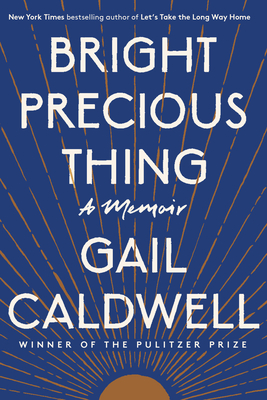
Bright Precious Thing, by Gail Caldwell*****

My thanks go to Net Galley and Random House for the invitation to read and review. This book is for sale now.

Gail Caldwell was the chief book reviewer for The Boston Globe, and she won the Pulitzer for Criticism. Once I began reading this luminous memoir, I could see that level of quality in her prose. She writes about her childhood in Texas, and about her travels and experiences growing up in the mid-twentieth century. More than anything, this is a feminist memoir, a chance to see how far we have come through a personal lens.

I missed the publication day here, and so I hunted down the audio version to supplement my reading. The author narrates her own work, and so it conveys the feeling that I am sitting by the fire with a dear friend, hearing about the challenges she’s faced as a single woman. Female readers will recognize the sensation: you start talking with a woman that you don’t really know, and before you know it you are talking and listening as if you’ve known one another for ages. That’s the essence of this book. In fact, I listened to it in the evening while preparing dinner, because I knew I’d be left alone during that time, and frankly, I didn’t want anybody to come barreling into the middle of my time with Gail. There’s a sense of intimacy that makes me feel a bit protective when I listen to it. Later, I go over what I’ve read and nod. Yes. Oh, yes, I remember that.

The title works in a number of ways. The darling little neighbor girl that becomes part of the family Gail chooses, bookends the memoir, coming in at the start as a very young person and ending it as an adolescent. But there’s more to it than that; life is a bright precious thing, and though she never says it overtly, I recognize that each woman is a bright precious thing as well.

I am a grandmother myself, but Gail is about the age to be my older sister. Women like Gail gave women like me a guiding light during our coming-of-age years. Our mothers were often resigned to their status as second class citizens, and ready to accept that there were things that women should probably not even try to do, and they couldn’t help transmitting their fears and reticence to us. It is women like Marge Piercy, Gloria Steinem, Wilma Mankiller, and yes, Gail Caldwell that provided us with a beacon, a way forward through the ocean of “no” to the bright shores of “yes,” that gave us courage to be insistent, even when we knew some would label us pushy broads, or worse. We needed role models badly, and they stepped up. They’re still doing it.

The calm, warm tone that came through this audio book, right during the turbulent period after the November election, was an absolute balm.   Sometimes I would be shaken by the things I saw in the national news, and then I would head for my kitchen (perhaps an ironic place to receive a feminist memoir, but it worked for me,) and once I had had my time with Gail, I knew I’d be all right.

Highly recommended to women, and to those that love us.

Fifty Things That Aren’t My Fault, by Cathy Guisewite****

Guisewite began publishing the comic strip “Cathy” in 1976, the year that I graduated high school. It was a time of high expectations for women, and the unrealistic suggestion that we would be able to “bring home the bacon, fry it up in a pan, and never let you forget you’re a man,” as Madison Avenue decreed, was daunting.  Through her sharply perceptive humor, Guisewite let her peers know that it wasn’t just us; we were judging ourselves with an unfair yardstick. She kept it real, and in doing so, kept us sane.

My thanks go to Net Galley and G.P. Putnam for the review copy.

So how does cartooning translate to prose?  Whereas the cute, punchy single-page entries and single sentence proclamations—and the lists—are her most familiar territory, my favorite parts of this memoir are the least cartoonish ones. Yes, I love the way she takes down the women’s fashion industry and the unhealthy way it affects our body images.  She was good at it forty years ago, and she’s good at it now. But the passages that drew me in and let me get lost in her story are the more vulnerable, deeply perceptive parts of the narrative, her fears for her aging parents; the struggle and triumph of raising a daughter, one with special needs, alone; and the failure of her marriage. I am in awe of the fact that she and her ex made each other laugh until the tears came as they planned their divorce. Who does that? And of course, she made me laugh too.

Guisewite stays inside her usual parameters, never veering outside of the middle class Caucasian realm with which she has experience. Younger women won’t get much joy out of this memoir; women that came of age between 1965 and 1985 are right in her sweet spot, and it is to them that I recommend this book. It’s available now.

Finding Dorothy, by Elizabeth Letts*****

“Don’t let anybody steal your marbles.”

Maud Gage Baum is one of a kind. The godchild of Susan B. Anthony, child of first-wave feminist Matilda Joslyn Gage and an indulgent, progressively inclined father, she is unhampered by many of the traditional expectations that shackled women born during the American Civil War. But though her parents encourage her to develop her mind and talents, they have little prepared her for the wider world that greets her, and when she arrives at the women’s dormitory at Cornell University, she is considered peculiar by her classmates. She is a lonely young woman, until her roommate sets her up with Frank, an eccentric, clever man whose whimsy equals her own. My great thanks go to Net Galley and Random House Ballantine for the galley, which I received free in exchange for this honest review. It will be available to the public tomorrow, February 12, just in time to be wrapped in red paper and given to the bookworm you adore.

Maud’s story comes to us from two different time periods, one of which starts in 1871 during her childhood and moves forward in linear fashion, and the other in 1939, when she comes to the set where The Wizard of Oz is being filmed to fulfill her beloved Frank’s dying wish; he has asked her to look after Dorothy.  And though it initially means gaining access to the studio through duplicitous means, Maude befriends the unhappy but massively talented Judy Garland, and advocates for the intention behind her character, sometimes successfully, sometimes not.

I love this book hard. It has an unusual appeal, not a thriller nor a grab-you-by-the-hair page turner, but rather a strangely comforting novel, one that offers us the chance to follow Maud to another time and another place. I read several books at a time, and this one became my bribe to myself, the reward I could look forward to after completing increments of other books that I wouldn’t abandon, yet didn’t love as I did this one.

How many times have I reviewed a book favorably yet with the caveat that it isn’t bedtime reading, and maybe not good for mealtime either? Listen up. This one is good for both. It will make you appreciate your meal as you move through the hungry years of the Depression, and as you read about poor Judy being starved with lettuce and cottage cheese, her penalty for reaching puberty when the studio wanted her to look like a scrawny waif. And at bedtime, even the sorrowful passages are wonderfully hypnotic.

The love story between Maud and Frank is one for the ages, and without Letts, who would have guessed? Midway through the story I felt the need to know how closely the author kept to the truth, and I skipped to the notes at the end. I am delighted to say that this writer did a great deal of research, and she tells the reader specifically where and when she departs from historical fact for the sake of the story.  The way that the character of Dorothy is invented, based on a string of actual events from the Baums’ lives, is riveting, and in fact had the author not told us otherwise, I would have assumed that much of it was made up, because it’s almost too cool to be true.

Letts develops her characters subtly, with never a caricature or stereotype. Though her settings are well drawn, this is a character based book if ever I read one, and it must truly have been a labor of love. I’ve read a dozen books between this one and the present, yet this is the title that makes me smile.

This beautifully crafted story is bound to rank high among the year’s best historical novels. Sweet, soothing, and highly recommended.

My Own Words, by Ruth Bader Ginsburg****

MyOwnWordsThis one is a crushing disappointment. I seldom buy books anymore, but I was so pumped about this collection that I went all out and got a hard copy, expecting to love it enough to keep it in my home library forever. Sadly, this isn’t what I expected.

Obviously, no U.S. Supreme Court justice is going to have enough time to sit down and write his or her memoirs, let alone an octogenarian justice, but I had hoped to find a collection of her meaty and sometimes even audacious opinions, particularly her dissents. Instead, this slender volume is packed with filler. There are two co-authors whose names are written on the cover in miniscule print, and it is they that write sometimes windy introductions to just about everything;  to make matters worse, they don’t tell us anything you cannot find in other biographies written about this feminist luminary.

And what of Ginsburg’s writing? I didn’t buy the book to see the precocious things she wrote as a child, as an adolescent, or in college. I just want to read her court opinions. That’s it. And that’s not what I got.

I can’t give anything that bears Ginsburg’s name a rating below four stars, but seriously, if your discretionary income forces you to buy books strategically, either skip this one or get it used. Surely at some point something more scholarly will be released, and then I’ll wish I still had the dollars that I spent here.