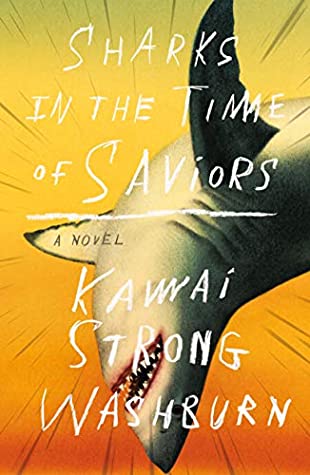
Sharks In the Time of Saviors, by Kawai Strong Washburn*****

A story like this one only comes along once in a rare while, luminous, intimate, and deeply affecting. My great thanks go to NetGalley and also Farrar, Strauss and Giroux for the review copy. This book is available to the public, and you should get it and read it.

Initially I was drawn to this book for several fairly superficial reasons. The cover is certainly arresting; the title is perplexing. But the biggest draw for me was that it was set in Hawaii, and all of the characters are native Hawaiians. In my corner of the world, the Pacific Northwest, there are a lot of Pacific Islanders. Why anyone would leave such an idyllic climate for the dark, soggy winters we see here used to be a mystery to me, but ultimately, people follow the jobs, and so many Seattle residents come from there.

As a history teacher, I’ve always felt that my students deserve to be included in the curriculum, and so in addition to teaching about Caucasians during whatever time period we’re examining, I work in African-Americans, Latinx, Native peoples, and a variety of Asian ethnicities, but time and again I hit a wall when I tried to find something for my Islander students. And when I’ve taught literature, it’s been the same struggle. Islander kids get shut out every time.  And so now I am retired, and here’s my appeal to other educators out there. Put this book in your classroom.

For the rest of you: apologies. Let’s get on with it.

As we open, the setting is Hawaii in 1995, and the protagonists are two parents and three children, all members of the Flores family. They’re on vacation when seven year old Noa falls into the ocean where sharks are circulating. But instead of devouring the boy, one of the sharks delivers him back to his family, carrying him gently in its jaws, “Like you were made of glass, like you were its child.” The first chapter is told in the second person, with Malia, the mother, recalling the event, speaking to Noa. She tells him, “The gods were hungry for change, and you were that change.” It’s obviously a miracle, and others see it happen also. Their lives will never be the same.

As the story continues, we hear from all of the family members. At first, Noa appears to be gifted with a magical healing ability, but he is still a child, and the demands on him are grueling, exhausting. But this is not the only change his magical abilities produce. Noa is the youngest child in the family, but now the siblings’ hierarchy is completely flipped, and the resentment felt by his brother and sister is dreadful. At one point Kaui, who is academically talented, fumes that she is “just his shadow, shaped like a sister.”  And his brother Dean, who is an athlete, explains:

You’re out at breakfast without him, eating cereal and joking with Mom and Dad, Kaui coming in, and you get them all laughing and smiling, just because of you. But then Noa shows up right, and suddenly it’s all questions about what’s happening with his day and did he sleep okay and here’s some thoughts about which extracurricular program he should enroll in…Hard not for get angry at that. I felt it like a fist flexing inside my own chest.

To make matters even more fraught, there’s an economic downturn that makes it impossible for the parents to support the family. They begin charging people that come to be healed by Noa, and so the youngest child is not only the golden favorite because of his miraculous ability; he’s also the family breadwinner. And again: it’s an awful lot to put on the shoulders of one small child.

The dialect combines with the authorial voice to create characters that I swear I would know if I ran into them, and in many ways, they remind me of the adolescents that I taught. Because I was so unconscionably late here, I checked out the audio version at Seattle Bibliocommons, and I have never heard an audiobook I loved more. The voice actors are so convincing that I can hear them now, more than a month and several other audiobooks, after I finished it.

For me, that would be enough. Create visceral enough characters and I don’t even care much about the plot. But the plot is also gobsmackingly brilliant! I believed I could track where it was headed up until perhaps the 60% mark, and then there’s one surprise turn, and another, and another, till at the end I was simply sitting with my mouth open and my eyes on the text as the audio gave way to the afterword and credits. I had to remind myself to breathe.

This is one of those rare galleys that I could see reading again just for the love of it. This review is my 923rd for NetGalley, and I have chosen to reread fewer than 10 of them, so let that indicate the measure of esteem in which I hold this novel.

I Did It for You, by Amy Engel****

Amy Engel is the author of The Roanoke Girls and The Familiar Dark, both of which were unrelentingly creepy, and I loved them. When I saw that she had written another, I had to read it. My thanks go to Net Galley and Random House Dutton for the review copy of I Did It for You. This book is for sale now.

Greer Dunning’s sister, Eliza and her boyfriend, Travis, were murdered when they were teenagers. One minute they were making out in his car, and the next, boom. Someone shot them dead, right through the window. The guilty party was eventually caught and charged, and eventually admitted what he’d done, but it never made sense, especially not to Greer. She had a hunch that the killer, an intellectually disabled fellow with little imagination, had not acted alone. But he has said nothing about it, refused to provide a motive, and what he knew, he took with him to the electric chair.

Greer moved on. She finished school, moved from her hometown of Ludlow, Kansas to Chicago, where she works as a middle school counselor. But now a similar crime has occurred back in Ludlow, and Greer feels the pull, the urge to turn toward home and find out for real just what is going on.

This is a solid mystery, though not one with the sort of page turning urgency as the other two. It’s deeply atmospheric, and there’s a melancholy, brooding mood that’s thick and rich, and this is becoming Engel’s signature quality. The internal monologue is an absorbing one.

The choices that she makes while she is home make sense in a strange way, and parallels form in the most unexpected of places.

The solution itself doesn’t work for me. What? No. But the journey we take to get there makes this novel worth reading.

The only problem with writing a big-deal debut novel is that you’ve set the bar high, and readers develop stratospheric expectations for each subsequent book. So it is here. I Did It for You is a decent read, but it isn’t The Roanoke Girls, and it isn’t The Familiar Dark. Instead, it is simply a good book.

For mystery lovers that have never read anything by this author, this book is recommended. For those that have, you may want to get this one free or cheap, rather than paying full cover price.

Unlikely Animals, by Annie Hartnett*****

There are indifferent writers; good writers; outstanding writers; and then there are writers like Hartnett, that leave me with my jaw dropped down to my knees, thinking that I like to write, and you probably do, too, but friend, neither one of us will ever write like this. Not ever.

My thanks go to Net Galley and Random House Ballantine for the review copy.

Emma Starling is our protagonist, and she was born with healing powers in her hands. She went away to medical school, but was expelled for reasons that we don’t understand until later, and her healing touch is gone. She has quietly left school without telling a soul back home. She hasn’t even returned for a visit, but now she has been summoned unequivocally; her father is dying, and her mama wants her to come home. NOW.

There are enough points of view in this story to make your head spin. We have the graveyard crowd, for example, and since Everton, New Hampshire is such a tiny town, everybody knows everybody, dead or alive. When I first see that the dead are discussing the affairs of the living, I am dismayed, because the legendary Fannie Farmer has already done this in The Whole Town’s Talking. But soon it becomes obvious that this story isn’t derivative in the least; Hartnett takes this device and uses it in a different way, and it doesn’t dominate the story as Flagg’s does; these characters are there to provide a slightly more objective perspective than those that still live.

There are several points of view from among the living, too. And there are references throughout to the writings of Harold Baines, a naturalist instrumental in shaping the town and in particular, the iconic yet bizarre Corbin Park, which is open only to a chosen few. There are points of view offered from the critters as well; not all of the critters are real, however. And at the EXACT moment when I begin to think that the author should have pared this thing down, for heaven’s sake, because the organization appears to be all over the place, the narrative explains that “A good story doesn’t always follow an arrow, sometimes it meanders a little instead, so we hope you’ll excuse this tangent…It might seem unrelated, but sometimes a minor character doesn’t become important until later…The lives of the living often get tangled up in unexpected ways, especially in a town as small as ours, even when a ten-foot electrified fence splits it up.”

I howled, because it felt as if the author had read my mind!

An important plot point is the disappearance of Crystal Nash. Crystal was Emma’s best friend, and had lived with the Starling family as sort of an informal foster child. Crystal developed an addiction and disappeared; Emma and Crystal had had a falling out, and Emma tries not to think about her too much now. Clive, Emma’s father, seldom thinks about anybody else. He’s turned over every rock; slapped a poster on every telephone pole.

To say the least, it’s an interesting homecoming for Emma.

As if the many points of view don’t make for a complex enough story, Hartnett takes us back in time—sometimes just a few years, at other times, way back in the past—and I am awestruck at the way she pulls all of it together at the end, with no loose ends hanging. At the outset I had been sure that this story should have been streamlined, but at the end, when I look back to see what, if anything, could be cut without detracting from the story, there is nothing that’s superfluous. Not one thing. All of these odd bits and pieces are essential to the story she is telling; “meandering,” indeed.

Because I had fallen behind in my reading, I checked out the audio version from Seattle Bibliocommons, and it is brilliantly performed. Usually a story this complicated doesn’t work for me as an audiobook, but this one is outstanding and not hard to follow (although I did go back over the DRC for some quotes.)  Mark Bramhall and Kirby Heyborne do an exceptional job as narrators.

This is undoubtedly one of the finest novels we’ll see in 2022. Highly recommended in whatever format makes your heart happy.

Let’s Not Do That Again, by Grant Ginder*****

“Justice always comes first.”

Grant Ginder is one of the funniest writers alive. I read and reviewed Honestly, We Meant Well when it came out in 2019, and I knew then that I’d read whatever he wrote from that time on. Is Let’s Not Do That Again as funny? No, friend, it’s even funnier.

My thanks go to Net Galley, MacMillan audio, and Henry Holt for the review copies. This book is for sale now.

Nancy Harriman is running for Senate in New York City, with the assistance of her loyal son, Nick, and hindrance from her rebellious daughter, Greta. She’s focused; she’s determined. And that’s a good thing, because her daughter is focused on ruining Nancy’s life.

Parents don’t always know what their children get up to online; this is doubly true when there’s only one parent, and she’s busy running for the public office her late husband used to hold. And so Nancy doesn’t know that Greta is in league with the devil, till Greta has obtained an ungodly sum of travel money from her grandmother, and has flown to Paris to be with him.

With Greta is Paris, one thing leads to another and in a breathtakingly short amount of time, the wicked little Frenchman has manipulated her into causing destruction on a level that makes international news. Nick, the good son, is sent across the Atlantic to retrieve his sister, who appears penitent, but isn’t.

From there things spiral further out of control, and it’s hard to imagine just how this story will play out, but when I see where Ginder takes it, I bow in awe.

I am fortunate enough to have received both the digital and audio versions of this delightful spoof. Susannah Jones is such a skilled narrator that at times, I forget that there’s only one person telling the story. On the other hand, there’s some creative, very funny spelling peppered into the narrative that you’ll miss out on if you don’t see the text. All told, I’d say it’s a toss-up. Go with whichever mode makes you happiest.

Highly recommended, especially if you lean a little to the left.

The Recent East, by Thomas Grattan*****

The Recent East introduces novelist Thomas Grattan, and it’s an impressive debut. It follows a family of German-Americans from 1965, when the eldest emigrates from East Germany with her parents, to the present. I initially decide to read it because of the setting; it’s the first fiction I’ve read set in the former Soviet satellite country. However, it is the characters that keep me engaged to the last page.

My thanks go to Net Galley and McMillan for the review copy; this book is for sale now.

The story opens in 1965 as Beate and her parents are defecting:

Everyone talked about the West as if it were a secret. They leaned in to share stories of its grocery stores that carried fresh oranges, its cars with bult-in radios. Covered their mouths to mention a Dusseldorf boulevard that catered to movie stars and dictators, whole Eastern month’s salaries spent on face cream. There were entire, whispered conversations about its large houses and overstuffed stores, its borders crossed with a smile and a flick of one’s passport. Some talked about it as if it were the most boring thing. Others like it was an uppity friend. But everyone talked about it…

The first chapter makes me laugh out loud. Teenage Beate is mocked when she enrolls in school in Cologne, because her clothing is nowhere near as nice as what the kids in West Germany wear. Since her parents cannot afford to upgrade her wardrobe just yet, Beate comes up with the genius idea to alter the clothes she owns to make them look as Soviet as possible, and she “put on her Moscow face, worked on her Leningrad walk.” Sure enough, the kids at school are terrified of her now. She still doesn’t have friends, but she isn’t bullied anymore.

Morph forward in time. Beate is a mother now, living in upstate New York with her two adolescent children and unhappy husband. When the Berlin Wall falls, so does her marriage. Soon afterward, she is notified that her late parents’ house now belongs to her. She packs up her belongings and her children, then buys tickets to Germany.

Adela and Michael have always been close, but the move shakes their relationship. Their usual routines are shattered, and their mother, reeling from the divorce, becomes withdrawn and uncommunicative. What a terrible time to disengage from parenting! Both Michael and Adela roam the city of Kritzhagen at will, at all hours of the night. Michael is just 13 years old and gay; sometimes he doesn’t come home at all at night. I read these passages, written without obvious judgment or commentary, with horror. A new house, new city, new country, new continent, and it’s now that their mother forgets to set boundaries? I want to find this woman and slap her upside the head (though I guess that’s a different sort of boundary violation.) Half the houses in town stand empty, and since they have no furniture of their own and their mother is doing nothing to acquire it, Michael breaks into houses and steals furnishings. Look, Ma, I found us some chairs.

My jaw drops.

Adela goes in the other direction, becoming a conscientious student and social justice advocate. But their mother pays her no attention, either.

For the first half of this story, it seems like a four star novel to me; well written, competent, but nothing to merit great accolades. This changes in the second half, because all three of these characters are dynamic, and the changes in them are absolutely believable and deeply absorbing.

I have friends that do social work, and what they have told me is this: children that are forced to become the adults in the family, taking on responsibilities they’re too young for when a parent abdicates them, often appear to miraculously mature, competent beyond their years. Everything is organized. They may do the jobs as well as any adult, and sometimes better than most. How wonderful!

But because they aren’t developmentally ready for these things yet, what happens is that later, when they are grown, they fall apart and become breathtakingly immature, because they have to go back and live their adolescent years that were stolen from them. (As a teacher, I saw this in action a couple of times.)  And so I am awestruck by how consistently our Grattan’s characters follow this pattern.

As the second half progresses, I make a couple of predictions, one of which is sort of formulaic, but Grattan does other things, and they’re far better than what I’d guessed. We follow these characters for several decades, and at the end, we see the relationship that blooms between Beate and her grandson. When it’s over, I miss them.

Because Michael is gay and is one of our three protagonists, this novel is easily slotted into the LGTB genre, but it is much more than this. Instead, one should regard it as a well-written story in which one character is gay.

But whatever you choose to call this book, you should get it and read it if you love excellent fiction.

The Drowning Kind, by Jennifer McMahon****

“’There was someone there, in the water.’ Her hand trembled as she held her teacup. ‘Ethel, if I tell you what I saw, you mustn’t think me mad.’”

You bring the hot dogs and marshmallows; I’ll bring the matches and a real good story. It’s time to head for the campfire, and—hey, look! It’s getting dark already. Do you scare easily?

My thanks go to Net Galley and Gallery Press for the invitation to read and review. This is a fun one! I was able to access both the print and audio versions, and I moved back and forth between them.  I would give a slight edge to the print version here, but the audio isn’t bad, either.

Our story takes place in Vermont, mostly, and the time period and point of view alternate. We begin and end with the present day; our protagonist is Lexie, a social worker. Jax grew up very close to her older sister, Lexie. As they grew older, however, bipolar disorder gripped her elder sister, and Jax has been forced to set boundaries with regard to her sister’s obsessions, lest she be pulled under herself. And so, when she finds nine missed calls on her voice mail, all from Lexie, Jax figures she’s off her meds again, and she chooses not to respond. She has work to do. But the next call comes to tell her that Jax is dead. She drowned in her backyard pool.

Our alternate protagonist is Ethel Monroe, and the year is 1929. Ethel is nearly too old to conceive; she and her husband desperately want a baby. The doctors are stumped; then she hears of a resort whose springs are said to have healing powers. With nothing to lose, she and her spouse hop in the car and make their way to the magic waters. In time, they are told that the water should be avoided. Whenever it grants a wish, it takes something else back for itself, often something that devastates those it has aided. But Ethel is pregnant now, and there is nothing, nothing, nothing more important than her baby.

Of course, there are all kinds of connections between Lexie and Ethel; after all, they are using the same waters, nearly 100 years apart from one another.

McMahon has a well established writing career, but the first time I read her work was when the last book, The Invited, was published. Both stories have certain elements in common, and perhaps because of this, I enjoyed the last one a wee bit more than this one, because it was completely new to me then. Both stories take a sensible, modern-day female character that doesn’t believe in spooks at the outset, and then spin them around every which way until they do. And in both, I see classic elements that include urban legends, but the story McMahon tells is fleshier, updated, and original.

In listening to the audio version, I was at first taken aback, because when the reader shifts from Jax’s story to Ethel’s, no mention is made that we are changing protagonists. The print version captions the new chapter, and since I had both versions, I grabbed the print version once I became confused and saw what had happened. However, it would have taken me longer if I had simply purchased the audio book and been forced to figure it out. The two characters are voiced (in the first person), and Ethel is given a very distinctive speaking style; I found the style to be annoying at first, a bit contrived, but once I got used to it, I was all in. Ethel’s odd speaking style does make it easier to tell when we have switched characters, and perhaps that’s why the reader chose to do it this way.

The pacing never flags. I believe Jax from the first page, and eventually I believe Ethel as well. I successfully predicted the ending, but we are eighty percent of the way in by the time I make my prediction, so I am not disappointed.

For those looking for a deliciously creepy tale, look no farther. This book becomes available to the public Tuesday, April 6, 2021.

The Unwilling, by John Hart*****

This one was worth the wait! John Hart’s new historical mystery, The Unwilling, is simply magnificent. My thanks go to Net Galley and St. Martin’s Press for the galleys; this book will be available to the public February 2, 2021. Those that love excellent fiction should get it and read it.

The French family is troubled. The father is a cop in their small hometown in North Carolina; the mother, Gabrielle, has some sort of emotional disability. Bipolar? Anxiety disorder? Who can say. All we know is that her nerves are shot, and she loses it quickly and easily. The couple have three sons; the first two are twins, but Robert, the golden one, is dead, killed in Vietnam. Jason went to ‘nam too, and rumors say that he killed 29 people there in his first year. He is rumored to be bad news and has already done a stretch in prison. That leaves the youngest, Gibson, known as Gibby. Both parents are possessive of him. As adolescence sets in, it begins to chafe, the way he is overprotected, and now that he’s a high school senior, he’d like a little more room.

And then Jason is released, and he comes home. He isn’t welcome at the family manse, so he stays elsewhere, but he wants to spend some time with Gibby before he blows town.

The title is a chewy one. Initially, I associate it with the daredevil stunt that some high school seniors—mostly boys—consider a rite of passage. It involves jumping into the quarry from a very high bluff; make the jump wrong, and you’ll be dead when you land. Gibby doesn’t jump. Jason does.

The basic framework of the story has to do with crimes Jason has done time for, and others that are committed while he’s in town. A girl he’s spent time with is viciously tortured and murdered, and many in the community make assumptions. But in reality—and we know this early on—he is being framed by a man known as “X” in prison. Truth be told, X is actually the weakest element of the story, and he’s mostly superfluous, but since this is supposed to be a thriller, the thread involving him adds suspense, particularly at the end. The climax is something else again.

But the most interesting aspect of the narrative has to do with the family, and by extension, one could say, all families. Over the course of time, a family’s story is told, and eventually labels develop. The small town setting in a pre-internet era makes this especially true, since most people’s interactions are limited to those that live in the same vicinity. And so, Robert French is the tragic hero, cut down in his prime while fighting for his country; Gibby is the baby of the family, a good kid, a good student; and then there’s Jason. Not long after the murder, Detective French speaks with the medical examiner about Tyra’s murder, and he asks the ME what would make someone do this; not just murder, but torture and mutilate. And the ME tells him that although it’s not the accepted clinical expression, “People like that are born wrong.”  And though French is reluctant to say such a thing about his own son, he wonders if he should accept this as true. His wife, mother of all three sons, tells him, “Gibby is all that matters.”

But as the story progresses, we see that there’s more to this story; a lot more. Jason has simply given up trying to defend himself. Refusing to do so is why he spent time in prison. When the world gives up on you, why try? To be sure, he’s no innocent, sad-eyed puppy. He’s seen things, and he’s done things. But people are complicated, and when we try to drop them into neatly labeled boxes, we shut ourselves off from learning details that don’t fit the picture we’ve painted.

For me, this story was less about solving a crime, and more about the characters. I was thrilled that the main story wasn’t about Robert. I’ve read too many novels lately that focus on the dead sibling, and it’s becoming trite. But Hart is a seasoned author, and he doesn’t drop into that well-worn channel. Instead, we see why various well-crafted, complex characters think and act as they do. Reading it, I find myself thinking about my sisters, and the small ways in which we developed labels as children and young adults; happily, none of us was labeled the bad seed, but if we’d been boys…? And I think also of my own children. For a brief, terrible time, I saw my eldest as that person, the one dragging his sister into trouble. Later, much later, I learned it was actually the opposite, but he figured it was better if one of them was still in good standing, and so he took blame that wasn’t entirely his. It’s not a great feeling, but at the same time, my own experience made this story more interesting, and I’m willing to bet there are a great many other readers that will read this book and think about their own families as well.

There are appealing side characters here, and the most compelling is Gibby’s best friend, a kid from the wrong side of the tracks who wants to make good.

So who is the unwilling one? Is it Gibby, for not jumping off the bluff? Is it Gabrielle, for not entertaining the possibility that her son, Jason, deserves more than she is willing to give him? Is it Detective French, for not being willing to completely give up on him? You can take this title in a lot of different directions.

Hart’s literary prowess shines here. It’s not always an easy read; during the more violent patches, I took it in small bites. I received both the print and audio galleys, and I moved back and forth between them, leaning more toward the audio, whose reader, Kevin Stillwell, does an outstanding job; but at times I forgot something, or wanted to check a detail or highlight a quote, and then I dove into my digital review copy. You can go either way without fear of disappointment.

Highly recommended.

Florence Adler Swims Forever*****

It’s hard to believe that Florence Adler Swims Forever is a debut novel. Rachel Beanland has stormed our literary beaches, and I hope she does it forever. Big thanks go to Net Galley and Simon and Schuster for the review copy. This book is for sale now.

The title character dies almost immediately, which is a bit unusual all by itself. The central storyline centers on Fannie, Florence’s sister, who is in the midst of a dangerous pregnancy. She’s already had one premature baby that died at 3 weeks, and so this one Is being closely monitored. Because of this, the family closes rank in order to prevent Fannie from knowing that Florence has died until after the baby’s birth, lest she miscarry. However, Fannie isn’t the main character; the point of view shifts between the present and the past, from one family member to another, eight all told, in fairly even fashion.

My first reaction to this premise—keeping her sister’s death from Fannie for what, two months—is that it’s far-fetched to think such a plan could succeed. But as the story unfolds, I realize that information was not a constant presence during the late 1930s, as it is now. There was no television yet; a radio was desirable, but not everyone had one. Fannie asks for a radio for her hospital room, but she’s told they’re all in use. Too bad, hon. Newspapers and magazines were explicitly forbidden for visitors to bring in; the lack of news is explained in general terms as “doctor’s orders,” and back then, doctors were like little gods. If “Doctor” said to jump, everyone, the patient most of all, leapt without question. And then I see the author’s note at the end, that this story is based on an actual event from her family’s history! It blows me away.

Besides Fannie and Florence, we have the parents, Joseph and Esther, who have a meaty, complicated relationship; Fannie’s husband Isaac, who is an asshole; Fannie and Isaac’s daughter, Gussie, who is seven; Florence’s swim coach, Stuart; and Anna, a German houseguest whose presence creates all sorts of conflict among the other characters. Anna’s urgent need to help her parents immigrate before terrible things happen to them is the story’s main link to the war. All characters except Stuart are Jewish.

Because I missed the publication date but was eager to dive into this galley, I supplemented my digital copy with an audiobook from Seattle Bibliocommons. This is a wonderful way to read, because when something seems unclear to me, I can switch versions, and in the end, I feel well grounded. The audio version is read by eight different performers, and the result is magnificent.

Read it in print, or listen to the audio; you really can’t go wrong. The main thing is that you have to read this book. As for me, I’ll have a finger to the wind, because I can’t wait to see what Beanland writes next.

A Long Petal of the Sea, by Isabel Allende*****

Allende has long been one of the writers I admire most, one of the few novelists to gain permanent space on my bookshelves. Her stories are distinguished by her devotion to social justice issues, particularly in Latin America, and to feminism. She’s known in particular for her use of magical realism, which I confess makes me a little crazy when she imbeds it in her nonfiction titles, and also her wry, sometimes subtle humor. Much of what she writes is historical fiction, as it is here, and she is a stickler for accuracy. Her research is flawless. She has prestigious awards from all over the world. Literature teachers love her.

My thanks go to Net Galley and Random House Ballantine for the review copy. This book is for sale now.

In A Long Petal of the Sea, she takes on a particularly ambitious task, creating a fictional family and charting its course from Spain following the failure of the Spanish Revolution, to Chile, to other points in Latin America, and then back to Spain once more. There are a lot of characters to keep track of, with different threads for each that separate, then braid together again and so on. There are at least three generations here, but primarily the story is Roser’s.

It’s a well written story, though it is also the sort of literary fiction that takes a fair amount of stamina. If you’re in search of a beach read, this isn’t it. I confess I didn’t enjoy it as much as I often enjoy Allende’s work, but I also believe it’s unfair to judge an author solely by what they have already written. If this was the first book by this author that I had ever read, I would give it five stars, and so that is what I’ve done.

My one disappointment is that we don’t learn more about the Spanish Revolution and the Spanish Civil War. This is an event that’s very difficult to find in quality historical fiction and literary fiction, at least in English, and I was excited when I saw this book was based on it. Then by the 25% mark, we’re out of Spain and it leaves me sad, because I wanted to know more about that period and place.  I also missed the usual Allende humor, which she uses in other books to break up tense passages and shoot down sexist behavior in her characters; her last book, In the Midst of Winter, made me laugh out loud more than once. That humor is in short supply here. The feminist moxie, however, is in splendid form, and the class and internationalist perspectives that I treasure are alive and well.

A book should be judged on its own merits, and I’ve done that, but I want to add a shout out to an iconic writer who’s still publishing brilliant, ambitious books at the age of 78. My own goals for that age, should I be fortunate enough to see it: I’d like to be breathing; to be able to see and hear most of what’s around me; and I’d like to not be completely crazy. Publishing great literature? Perhaps not. I am delighted that Allende can do this, and I hope she has more stories in the works.

A note on the audio version: I supplemented my review copy with an audiobook I found at Seattle Bibliocommons. It’s an approachable way to get through a complex, multifaceted story, but I don’t like the way the reader voices the elderly male character. The harsh, guttural-sounding tones are too near to a stereotype. Happily, the story is mostly Roser’s, but the unfortunate noise pops in fairly regularly all the way through, and it makes for a less enjoyable listen. For those with the time and inclination for the print version, it may be your better choice.

For those that love epic historical fiction, I recommend this book to you, although if you haven’t read Allende, also consider some of her early work.

Africaville, by Jeffrey Colvin****

Narrated by Robin Miles

My thanks go to Net Galley and HarperCollins for the review copy; after publication, I used an audio book to finish it, thanks to Seattle Bibliocommons. It’s available to the public now.

There are two reasons I was drawn to this story. The first is the setting, which is primarily in Nova Scotia’s Black community. I have never read or heard a story set there, and so I was intrigued. There’s also a Civil Rights Movement tie-in, and for me, that sealed the deal.

The book starts out as a rough read, involving dead babies and “bad luck” babies that weren’t dead but needed killing. I was so horrified that I had to restart the book several times to get past it. Now that I have, I can assure you that once you’re past the introduction, that’s it. The dead babies are done. I’m not sure I would have lead off with this aspect, because I’m probably not the only reader to pick the book up and put it down fast. In fact, had I not owed a review, I would not have returned to it. I’m glad I did.

The story itself is ambitious, covering three generations of a family there. At the outset we have Kath Ella, who has ambition, but also a mischievous streak. I find this character interesting, but there are times when I don’t understand her motivation. The story is told in the third person and not all of her thoughts are shared with us, and so there are times when I’m left scratching my head. When the end of the book arrives, I’m still wondering.

Kath’s son and grandson comprise the second and third parts of the story; apparently the term used back then for passing as Caucasian was called “crowing,” and we see some of that. There are too-brief passages involving the Civil Rights Movement against Jim Crow in the Southern U.S., and I am disappointed not to see more about this or have the characters involved more deeply. What I do see of it is the surface information that most readers will already know.

Toward the end there’s a subplot involving getting an elderly relative out of prison, and I like this aspect of it, in particular the dialogue with the old woman.

The setting is resonantly described throughout.

All told, this is a solid work and a fine debut. I look forward to seeing whatever else Colvin has to offer. As to format, although Miles does a lovely job reading, something of the triptych is necessarily lost when we don’t see the sections unfold. For those that can go either way, I recommend the print version.