Coffin Moon, by Keith Rosson*****

“One thing you can be certain of, boy. Things change. Even for those such as us.”

In 2018, I read a book by a promising local author titled Smoke City. It was complex and kept me on my toes, and all told, it was a good novel. Since I enjoyed it, the small publisher he was working with sent me another of his books, The Mercy of the Tide. I liked it, too.

Fast forward. I received a galley this year by the same author, but he was no longer working with the itty-bitty press. No, he was published by Random House. This made me sit up and take notice! My thanks go to NetGalley and Random House for the invitation to read and review Coffin Moon, the scariest straight-up horror novel you’re likely to find on the shelves this year. It will be available to the public September 9, 2025.

The premise is this: our protagonist, Duane Minor, is back from Vietnam. The year is 1975; the place, Portland, Oregon. His wife Heidi is living in an apartment over the bar her parents own, and Duane goes to work for them. Heidi’s 13-year-old niece, Julia, comes to join them as well after her mother is sent to prison. Duane is a bit shaky, following his tour of duty, but he’s sober, has pulled himself together, and things are going pretty well. That is, until the vampire takes over the bar.

That’s all you need to know of the plot to get started. In fact, I don’t even recommend reading the promotional blurb, because it’s better if you come to it on your own. What I will say is that this is not just any horror novel. There is more depth to it than you typically see, philosophical questions inextricably wound into the decisions that Duane and his niece must make. There’s also far more character development than I generally see in this genre. Finally, the word smithery Rosson brings to it makes this book grittier, more heart-rending, and far more thought provoking than other books of its ilk. Mr. Rosson was a good author before, but the brilliance of his prose has surged since his early work.

As I get older, I find I only have enough fortitude to read one or two horror novels each year; the rest of the time, I reach for other genres. If you are also an infrequent reader of horror, I strongly urge you to make this story a priority. It’s the sort of novel that stays with you long after the last page is turned.

But the sun is coming up; I must leave you.

The Hunter, by Tana French*****

In 2020, Tana French gave us The Searcher, the first in the Cal Hooper detective series. By that time I was already an established fan, but I loved that book particularly well, for reasons I’ll revisit in a moment. Now we have the second in the series, The Hunter, and if anything can reduce this crusty old English teacher to a blushing fan girl, this is it. Two books in, this is already on my short list of favorite series. My thanks go to NetGalley and the Penguin Group for the review copy. This book will be available to the public Tuesday, March 5, 2024.

The series debut introduced the characters, with the protagonist being a retired Chicago cop that found this tiny Irish village on vacation and, needing a new home far from his ex-wife, yet affordable, discovered a bargain fixer of a home and decided to stay. The story’s main problem revolved around a nearly feral tween that kept popping up at Cal’s place. The scrappy little stinker that was relieving Cal of food, occasionally, and doing other unsettling things turned out to be a girl; her name is Teresa, but she’s known as Trey. Her family was in dire straights following the departure of Trey’s father; her brother had left, intending to return, but never had. The mystery was where Trey’s brother had gone, what had become of him, and why. In the interim, she became greatly attached to Cal, who enjoyed her company and taught her some woodworking skills, but also kept a careful distance, lest rumors start and grow.

Now Trey is a bit older, and she is more civilized. She is close to both Cal and Lena, the local woman that Cal has been seeing. But as life settles into a civilized hum, one that would be comfortable had climate change not created a drought that has local farmers at the near end of their wits and their bank accounts, the unexpected happens once again: Johnny Reddy, Trey’s no-account father, has returned. Cal is prepared to step back, if need be, in case Trey wishes to bond with her actual dad rather than himself. Meanwhile, Johnny vows to visit Cal with some local moonshine, and “make a night of it.”

“Trey says nothing. If he does that, she’ll get Cal’s rifle and blow his fucking foot off, and see can he make his way down the mountain to Cal’s after that.”

Johnny never succeeds in bonding with Cal, who doesn’t like the look of him. “Johnny gives him the urge to pat him down and ask him where he’s headed. There are guys like that, who flunk the sniff test just going to the store; it’s a good cop’s job to work out whether they’re actually doing something hinky, or whether it’s just that they will be sooner or later, probably sooner.”

The village is a tiny one, and outsiders are few. Everyone in the vicinity knows that Johnny’s back; everyone wonders what he’s up to. They haven’t long to wait; he’s brought a man with him, one whose family once lived here, or so he says; and the man is interested in seeing if there’s gold on some of the local properties. “He has a rich man’s smile, easy and understated, the smile of a man who isn’t required to put in effort.”  Now the question is whether this “plastic Paddy” is a shyster trying to rip off the locals, or if he is someone that Johnny is seeking to fleece. Meanwhile, Trey has a different agenda, a private one.

The thing that makes this story so much better than your standard mystery is the characterization. If you are in search of a thriller that is all page-turning action, this isn’t your book. However, if you love a layered story with complex, convincing characters, this is for you. I said in my previous review of the first in the series that Trey is what makes an otherwise solid story a golden one, and that’s even truer here. One could even argue that it’s really her series, with Cal existing as scaffolding. Time will tell.

In particular, though, anyone that works with, or has worked with at risk youth cannot, must not miss this story. French has taken hold of my heartstrings hard, and I don’t want her to let go. Highly recommended.

The River We Remember, by William Kent Krueger*****

William Kent Krueger has been writing since the late 1990s, but he only came onto my radar in 2019, when he published This Tender Land. To read Krueger once is to want to read him again and again, as often as is possible, and that’s what I’ve been doing. The River We Remember is his most recent mystery, an achingly atmospheric novel set during the 1950s in rural Minnesota. My thanks go to Net Galley and Atria Books for the review copy. This book is for sale now.

The protagonist in this stand alone whodunit is the local sheriff, Brody Dern. Brody is a thoroughly believable character; there’s nothing of the TV sheriff about him. When the wealthy, universally hated Jimmy Quinn is found floating dead in the river, Dern does not lose sleep while vowing to find and reveal the entire truth. His first response is his own deep resentment that Quinn had to go and die in what had been, until now, Brody’s favorite spot to relax. How dare stupid, rotten Jimmy Quinn ruin this special place with his bloated corpse? And his second instinct is to minimize the damage to everyone else concerned. For example, the Quinns are Catholic, and if Jimmy committed suicide, they can’t bury him with the family. If not suicide, then perhaps a family member could stand it no more and shot him dead. Again, if so, no great loss, and let’s make sure the family is taken care of. And so, Brody’s first instinct is to wipe down Quinn’s truck so that, if other authorities should become involved in the case, none of these poor people will have to suffer for it.

Then, he goes to the evidence cabinet and removes some of the confiscated drugs so that he can get a decent night’s sleep.

Part of what fascinates me here is the culture of small town Minnesota during this time period. People don’t lock their doors most of the time. When a prisoner that Brody knows is almost certainly innocent requests a sharp knife in order to carve something, Brody gives it to him, right there in the cell. There are a number of interesting secondary threads, and all contribute to the steamy, smoldering ambience in which this story is set.

But oh lordy, the racism. And in this, I know there is no exaggeration. The culture among the Caucasian population of this tiny town, with regard to Native peoples and those of Japanese descent is not so very different from what I experienced as a child, growing up in the 1960s and even the 1970s in suburbs on the American West Coast. It’s bad. It’s really bad.

A feature of Krueger’s work—a signature aspect, in fact—is the inclusion of American Indian cultures and sociopolitical issues in Northern Minnesota. In other stories I’ve read, it’s been the Chippewa; this time, it’s a Dakota Sioux man named Noah Bluestone, and his Japanese wife, Kyoko. The author develops his characters well, with no stereotypes or hackneyed pop culture. This alone makes his work worth reading, but there’s so much more.

Over the course of just a few short years, Krueger has joined other luminaries on my list of authors whose work I read without question. I highly recommend this book to all that love the genre.

Happiness Falls, by Angie Kim*****

Angie Kim’s barnstorming best seller in 2019, Miracle Falls, showed us that she is a force to be reckoned with. Now she’s written something even better. My thanks to go Net Galley and Random House for the review copy. This book is for sale now.

I admired Kim’s debut novel, but because of its complex nature, it was a fair amount of work to read. Happiness Falls is every bit as brainy, but it’s streamlined, with just five important characters and a handful of secondary ones, so the reader can spend more time enjoying it and trying to puzzle out the solution, and less time trying to keep up with the plot and recall the intermittently appearing characters as it progresses.

As with her debut, this story features a main character with special needs. Eugene Parson has Angelman syndrome, a rare disorder that has rendered him incapable of speaking. This is a problem, because one day, Dad and Eugene go to the park for their daily walk, but Eugene comes home alone, bloody, disheveled, and tremendously upset. What happened? The family’s concern intensifies when Dad’s backpack is found floating downstream, but Eugene cannot speak. And so, the mystery that is interwoven into this family drama is established.

The story is told in the first person by Mia, Eugene’s older sister. Mia’s twin, John, rounds out the siblings, and their mother is the fifth family member. It’s set in Virginia during the pandemic; however, plot and character are much more important here than setting.

The mystery—what has happened to Dad—is wholly original because of the critical role played by Eugene’s communication challenges. Originality becomes more important to me every time I pick up a mystery; once you’ve read several hundred of these things, sameness can produce tedium. But this novel has much more going for it than that. The characters are absolutely believable. The teenagers are all convincing; they are age appropriate, bright but occasionally impulsive. Best of all is that there is no abuse story tucked in here. Their dad is or was a loving one, and the same is true of their mother. The parents have navigated bumps in their marriage, but by the time we hear of them, they’re fine. There’s no horrific baggage waiting to ambush us. These are nice people whose lives are complicated solely by the need to assist Eugene, whom everyone also loves. I make a point of telling you this, because I am sick to death of stories about terrible mothers. I’ve had enough of them, and am delighted Kim doesn’t go there.

Our narrator, Mia, is cleverly drawn; she is the family cynic, and she’s the family motormouth, and so if we occasionally wonder why Mia is telling us everything in such detail, it’s because Mia is a talker.

There are twists and turns all over the place. Just when I begin to think I might have a handle on this mystery, Kim throws in something else that leaves me gaping like a guppy. What? Huh? Oh. Well, there goes my theory. What now?

Because I came to this post-publication, I checked out the audio version at Seattle Bibliocommons to help me catch up. The audio is very well done. Initially I didn’t find Mia’s narrative voice appropriate because she seemed mighty chirpy for a girl that may have just lost her father; however, once Mia’s character is further developed, which doesn’t take long, I realize that the chirpiness is part of Mia’s denial. She’s very close to her dad, and she can’t bear to think that he is in danger, or worse.

I have rarely felt any interest toward any profound learning disability, but Kim made me care about Eugene and Angelman’s.

This novel is brilliant, a standout for 2023. I highly recommend it to all that love a good mystery or family story.

Bright Lights, Big Christmas, by Mary Kay Andrews****

I tend to avoid heartwarming holiday stories and romances because so many of them are infused with saccharine and require the reader to put their I.Q. in a box until the book is over. But two years ago, I was happily impressed with Mary Kay Andrews’ The Santa Suit, and so when I was invited to read and review Bright Lights, Big Christmas, I happily agreed. My thanks go to Net Galley, St. Martin’s Press, and Macmillan Audio for the review copies. This book is for sale now.

The Tolliver Christmas tree farm is an institution, not only at home in North Carolina but as far north as New York City. As a child, Kerry sometimes accompanied her family to New York to set up a tree stand and sell the trees, but as an adult, she’s had other priorities. This year, though, she finds herself unexpectedly jobless, while at the same time, her father’s health prevents him from executing the task. Kerry must take his place, traveling to the Big Apple with her brother, Murphy. They set up the stand, and they sleep in the ancient pink trailer nicknamed “Spammy” because of its resemblance to a canned ham. Adventure awaits.

Kerry’s love interest pops up before we’re even ten percent into the story, but it appears that the author planned for us to know that, and it doesn’t hurt anything. Over the weeks they are in New York, various small (and large) crises present themselves and are worked out with team work, ingenuity, and the occasional well-placed bribe. They have Murphy’s dog Queenie with them, but she is primarily left in the background where she belongs.

What I appreciate most about this novel is how well grounded the plot is, and the author’s restraint in not permitting any elements to go over the top. There are a host of stereotypes possible, but every time I see one coming, Andrews chooses a different path, and it keeps the story fresh and original. Small details that might be overlooked by someone less detail oriented are seen to, and it keeps the narrative credible. Examples are the need for a shower or bath, given the length of their stay in a trailer without working plumbing; the cost of living in New York; the hazards of theft and vandalism, especially active at Christmas. None of these sidetracks the plot or slows the pace, but the questions a reader might have are tidied away, and this makes for greater enjoyment.

One small criticism involves a situation where theft and vandalism occur at a time when Murphy has to be away, and immediately, other men folk clamor over the need to have someone—someone with a Y chromosome, folks—to do lookout duty, protecting the fair damsel, her trees, and so on.

Apart from that, this is a delightful story. However, for awhile I wasn’t sure I liked it, because I was listening to the audio version, which is poorly done. The male characters are voiced in a way that is choppy, wooden, and unconvincing; but worse is Kerry’s voice, which is performed in a high-pitched, girly-girl voice so off-putting that it took me awhile to realize that the problem wasn’t the author’s, but rather the voice actor’s. The children’s voices are much better, and I actually howled with laughter when the baby in a stroller wailed!

As the story reaches its climax, Kerry has to make some serious choices, and I admire the way this part is resolved. The side character Heinz, an elderly man that lives in the neighborhood and often stops by the tree stand, is terrific.

When all is said and done, I rate the printed version of this novel 4+ stars, and the audio version 3+ stars, with an overall score of 4. I recommend the print version of this book, but not the audio.

The Sweet Spot, by Amy Poeppel*****

“Brood parasites, like certain birds, intentionally lay their eggs in the nests of other birds.”

Amy Poeppel is fast becoming one of my favorite authors; she wrote Small Admissions, Limelight, and Musical Chairs, and I read and loved them all. Her new novel is The Sweet Spot, and it is destined to become one of the best books of 2023. My thanks go to Net Galley, Atria Books, and the author for the review copies.

One of the aspects of Poeppel’s writing that sets her apart is her ability to create female characters that are so dynamic, so well developed that I feel as if I know them. Here we have four that span a wide range of ages and income levels, yet somehow wind up forming an unlikely sorority. The first, Lauren Aston-Shaw is an artist, and she’s in the midst of moving into a brownstone in New York City’s famed Greenwich Village, along with her husband, children, and large dog, Bumper. The boxes are only partially unpacked when she receives a mostly-delightful surprise: a prominent businesswoman and influencer has decided to place a massive order of Lauren’s handmade porcelain for her boutiques. The house is already in a state of happy chaos, and it’s about to be more so.

During a conversation with Felicity—the retailer in question, who is pregnant—Lauren makes an offhand remark, which Felicity interprets as an engraved invitation to break up the decades-long marriage of the baby’s father, Russell. Miranda, the spurned wife, learns of Lauren’s role and decides, in a fit of grief and rage, to burn Lauren’s life to the ground. Miranda, then, is our second of the four women.

Olivia, our third main character is one of Felicity’s employees. She is in her twenties, low on the management chain, but she is ambitious, hardworking, and determined to climb; that is, until she becomes a casualty of Miranda’s rampage. Olivia is also the beloved daughter of Dan, who runs The Sweet Spot, a neighborhood bar located in the lower level of the brownstone currently occupied by the Shaw family. Dan is a lovable, level-headed sort, and through his eyes, we see the drama unfolding between Lauren, Miranda, and Felicity through a more objective lens.

The novel’s promotional blurb tells us that these are the women that the story is about, but I would add one more. Evelyn is Lauren’s mother; they have a complicated relationship. But under the strain of the sudden and unexpected increase in work, Lauren reaches out and begs her mother to come assist her with the children until she has things in hand. Evelyn can only stay for a weekend; she has so many social obligations back home. And yet, a weekend grows to a long weekend, and then to a week. Evelyn is far too interesting to be considered a side character; she is our fourth main character.

Despite her despair and fury, Miranda finds herself caring for Russell and Felicity’s baby; it is supposed to be for a couple of hours, but in the solipsistic way of the wealthy and entitled, both parents depart for the West Coast without making childcare arrangements, and Lauren and Olivia find themselves also assisting as hours turn to days, and then to weeks.

This story has everything I want in a novel, and when I got a go-to-bed-and-die flu virus, I curled up in bed and spent my waking time there reading it. I’ll tell you from experience that it’s good for what ails you. The plot is deftly managed, and that is no small feat given its complexity. The pacing never flags and no balls are dropped (except possibly Russell’s.) The dialogue sizzles. But the thing that turns a good novel to a great one is Poeppel’s insight into the human condition. Her level of perception is what makes the characters shine, and it’s also what makes the entire book drop-dead funny. Lastly, Amy Poeppel is one of a very few authors that can write a feel-good story that never insults the reader’s intelligence.

Admit it. You need this book! Happily, it will be available to the public January 31, 2023, and you can pre-order it now. Highly recommended.

Everyone in My Family has Killed Someone, by Benjamin Stephenson****

When life gets you down, it’s time to kick back and relax with a nice little book about multiple murders. Benjamin Stevenson’s nifty little mystery is just the ticket. This book is for sale now.

My thanks go to Net Galley and Random House for the review copy.

Once in a while, a novelist will disarm his audience by speaking to them directly; this is known as breaking the fourth wall. Stevenson doesn’t just chip a corner of plaster; he comes in with a wrecking ball, because that’s just the kind of writer he is. The product is as funny as the title. Each chapter is devoted to a family member, and some of them get more than one.

The premise is this: narrator Ernest Cunningham is invited to a family reunion at an out of the way mountain lodge, a ski resort in the dead of winter. The event is timed to coincide with Ernest’s brother, Michael’s, release from prison, where he was sent for…well. You know. And as is true with all families, there’s all kinds of baggage, both literal and figurative; there are grudges, guilt, and oh yes, secrets. So many secrets!

The first body turns up in less than twenty-four hours. Is there a mass murderer at large, perhaps the one in the news dubbed “The Black Tongue?” If so, is s/he a Cunningham?

The whole story is told in a jocular, familiar tone, explaining to the reader what the rules are when writing a murder mystery. He assures us that he is a thoroughly reliable narrator, which immediately makes us wonder, because if so, why bring it up? Most narrators are reliable. So…?

I enjoy reading this thing, and am impressed at how well the author juggles a sizeable collection of characters. It doesn’t take me long to straighten out who everyone is, and this may be because we are apprised of who is annoyed with whom over what, fairly quickly. When he brings in reasons why certain people avoid each other, it helps me recall who they are.

There are two things I would change if I could. The book would be even funnier if he cut back on the side remarks to the reader long enough to let us forget he’s doing it; then, when it surfaced again, it would get more laughs. I note that toward the end, he tells us—in another side reference—that his editor has suggested he pare back some of the chatty parts, and that he isn’t going to do it. That makes me laugh too, because I have been harboring the same notion.

The other thing that I’d change is a detail that distracts me. The author refers early on, and then another time later, to a plot hole big enough to drive a truck through, but he never tells us what it is; possibly the detail that distracts me is the thing he refers to. Early on in the story—so probably not a spoiler—Ernest is badly injured, to the point where one of his hands isn’t usable. Yet throughout the story, when he could go to a hospital, he doesn’t do so, and he doesn’t even address the possibility. People come; people go. Yet there’s Ernest, with an oven mitt stuck over one hand to protect it, and nobody suggests he hop into town and have it looked at. Toward the end of the story there’s a general reference to the Cunningham stubbornness preventing family members from leaving the reunion, but it doesn’t hold water with me.

Nevertheless, this is a fun book. While I was reading it, I was reading several others, but this one became the go-to at lunchtime and whenever I had a spare minute, and so I recommend this book to those looking for a light, amusing read.

Mecca, by Susan Straight*****

Susan Straight is a force to be reckoned with. I knew this after I finished reading I Been in Sorrow’s Kitchen and Licked Out All the Pots after it came out in 1992, and after I sought out, bought, and read everything else she’d written that was available. When I discovered that her new novel, Mecca, was available on Net Galley, I leapt on it. My thanks go to Net Galley and to Farrar, Strauss, and Giroux for the review copy. This book is for sale now.

Mecca, an ironic title if ever there was one, is a story of race, class, and gender, and the way that they play into the “Justice” system in California. Add a generous seasoning of climate change and its horrific effects in dry, dry Southern California, and a fistful of opioid addiction, and you have a heady mix indeed. But these are all well worn ground at this point, and this book is exceptional, not because it examines complex current events, but because of Straight’s facility in building visceral characters we care about, and launching them into this maelstrom in a way that makes it impossible to forget.

We begin with Johnny Frias, an American citizen of Latino heritage. As a rookie and while off duty, he kills a man that is raping and about to murder a woman named Bunny. He panics and gets rid of the body without reporting what’s happened. Frias is on the highway patrol, and he takes all sorts of racist crap all day every day. But his family relies on him, and when push comes to shove, he loves his home and takes pride in keeping it safe.

Ximena works as a maid at a hotel for women that have had plastic surgery. One day she is cleaning a room and finds a baby! What to do? She can’t call the authorities; she’d be blamed, jailed, deported, or who knows what. She does the best thing she can think of, and of course, there’s blowback anyway.

And when a young Black man, a good student with loads of promise that has never been in any trouble at school, or with the law, is killed because the cops see his phone fall out of the car and decide it’s a gun…?

I find this story interesting from the beginning, but it really kicks into gear in a big way at roughly the forty percent mark. From that point forward, it owns me.

As should be evident from what I’ve said so far, this story is loaded with triggers. You know what you can read, and what you can’t. For those of us that can: Straight’s gift is in her ability to tell these stories naturally, and to develop these characters so completely that they almost feel like family. It is through caring about her characters that we are drawn into the events that take place around them, and the things that happen to them.

This is a complex novel with many moving parts and connections. I read part of this using the audio version, which I checked out from Seattle Bibliocommons. But whereas the narrators do a fine job, I find it easier to keep track of the characters and threads when I can see it in print. If you are someone that can’t understand a story well until you’ve heard it, go for the audio, or best of all, get both.

Highly recommended.

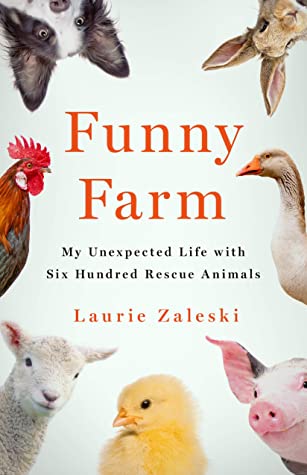
Funny Farm, by Laurie Zaleski*****

“You never know what you are capable of until the day comes wen you have to go places you hadn’t planned on going.”

Laurie Zaleski knows how to make a debut. Funny Farm: My Unexpected Life With 600 Rescue Animals has created a tremendous buzz, and all of it is deserved. My thanks go to Net Galley and St. Martin’s Press for the review copy. This book will be available to the public Tuesday, February 22, 2022.

Laurie’s early childhood was in many ways an enviable one; her mother stayed home to raise Laurie, her brother, and her sister, and her father made enough money to hire household help and buy a couple of vacation homes, too. There was nothing they lacked for, other than physical safety. Because while her father could be warm, and loving, and generous, and funny, he could also be a monster. His reign of terror was worsened by alcohol consumption. As the beatings became uglier and more frequent, Annie, their mother, chose poverty for the children and herself over the constant terror and danger of living with their dad.

“’I almost became a nun,’ Mom would joke years later. ‘Then I met the devil…’ Annie McNulty and Richard Zaleski fell in love like tripping into an open manhole: one wrong move followed by a long dark plunge.”

There’s one searing episode Zaleski recounts, toward the end of their life with Dad, in which they are all hidden in a bedroom with the door blocked shut, and their father is sneaking up on them, commando crawling up the hallway toward them so they won’t see his shadow approaching, and he has a large knife between his teeth. It sounds like something from a Stephen King novel, doesn’t it?

And so, when Annie’s efforts to build a modest nest egg to finance their flight is uncovered, she has no other option but to leave without the money. She finds a dumpy cabin in the woods, half fallen down and in no way legally rentable, and strikes a bargain with the owner. To say that their standard of living decreases is the understatement of the year, but they make it work.

Once she has made her escape, apart from the creepy forays from an unseen enemy that occur from time to time, Annie can’t turn away anyone else, human or otherwise, that is in a dark and vulnerable place. The woods surrounding their little shack begin sprouting makeshift outbuildings; there’s a little lean-to here, and a sort-of paddock there. And it keeps growing.

Zaleski is a gifted storyteller, and she alternates her narrative from the present to the past, breaking up the nightmarish episodes of her childhood with hilarious stories, most of which are about the critters. Her writing is so nimble that I find myself repeatedly checking to see what else she’s published, because there’s just no way this can be her debut. But then, that’s what they said about Harper Lee, right?

Perhaps the most glorious aspect of this book is seeing how Annie McNulty’s can-do attitude, sterling work ethic, and positivity transformed her life and lit a path for her children. She provided them with an outstanding role model, and in return, they did everything possible for her when cancer forced her to slow down.

This book will inevitably be compared to Educated and The Glass Castle because it is a memoir of someone that has overcome horrifying challenges in childhood and emerged triumphant. But make no mistake, Zaleski’s story is in no way derivative, and likely will be held up as an example for future writers. It makes my feminist heart sing!

Highly recommended.