
God’s Country, by William Kent Krueger*****

“In the myth of Windigo, there is only one way to kill the creature. A man has to become a Windigo himself.  His heart has to turn to ice. The danger is in the possibility of that man remaining a Windigo forever. What must happen is that once he’s killed the monster, someone has to be waiting with hot tallow for him to drink, to melt his icy heart.”
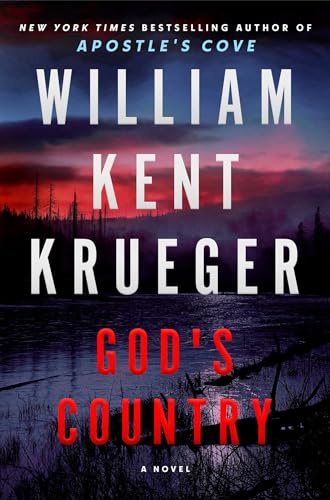
God’s Country is the 21st entry in William Kent Krueger’s long running Cork O’Connor series. My thanks go to NetGalley and Atria Books for the review copy. This book will be available to the public August 18, 2026.

The regular characters are all here; we have the (now retired) cop himself, along with his wife, who is a member of the Ojibwe (Chippewa) tribe. His grandson, affectionately called Waaboo, has visions, and has recently dreamed of a wolf eating Cork’s heart. The boy is shaken, and the family takes it seriously; after a trip to the doctor and some tests, Cork has the green light to proceed with the trip into his favorite wilderness area, known as the Boundary Waters. He goes along with generations of other men in his family, but not until he has first seen Henry, the tribe’s centenarian wiseman, with whom Cork has a close bond. But Henry isn’t big on straight answers; he merely asks Cork whether Cork himself might be the wolf.

A side note: is this an established practice within the tribe, that the men all go to the wilderness while the women all stay home? I’ve read a few of the books in this series, and though they are written with respect for women, the roles are always sharply divided by gender.

Moving on.  

The expedition hasn’t traveled far when they find an alarming sight. Various aspects of their first camping location show that someone has been there before them, and that it hasn’t gone well. Cork concludes that the previous group is led by Cordell Bishop, a close friend; Cork believes his friend may be in danger, and the group trip is aborted, with the other men herding the young boys safely back home while Cork searches for his friend and whoever is with him.

From this point, I won’t tell you much except that in addition to confronting the enemies that lurk in the Boundary Waters, Cork also is forced to confront the enemy within himself. In that respect, this book differs from the earlier ones, and I can see the sense in it. Most of these books have featured Cork going off into the wilderness and meeting up with baddies. I’ve enjoyed all of them, but breaking up the trend before it becomes monotonous was smart thinking on Krueger’s part.

From previous experience, I knew this was going to be a solid mystery, and so I shook off the summer doldrums by jumping over some galleys with earlier publication dates to get to this one. I’m not one bit sorry, either.

Highly recommended, whether you’re a faithful fan of the series, or heading into it brand new.

Apostle’s Cove, by William Kent Krueger****-*****

Apostle’s Cove is the 20th novel in the Cork O’Connor mystery series by William Kent Krueger. The series takes place in a fictional town of Aurora, Minnesota near an Indian Reservation. Most of the characters are all or partly Ojibwe (also known as Chippewa, or Shinnob). Apostle’s Cove is an area with spectacular views, and it is home to the malign widow of an enormously wealthy man, who built a mansion there.

My thanks go to NetGalley and Atria Books for the review copy. This book is available to the public now.

This story commences with Cork receiving a call from his son, Stephen, who’s working with The Great North Innocence Project, an organization that helps people that have been wrongly convicted. Cork is a restauranteur and private detective now, but Stephen tells him that during his time as sheriff, Cork sent an innocent man to prison. For 25 years, Axel Boshey has been serving out a lifetime term for a murder he didn’t commit. He confessed to it in order to shield the person he thought to be the actual killer. Now Stephen wants Cork to go back, untangle the mess, and get Axel out of lockup.

The story—and the series—is helped considerably by its appealing recurring characters. The two most compelling ones are the very oldest—Henry Meloux, an ancient wise man that lives in the forest and counsels those that seek his help—and the very youngest, the seven-year-old grandson affectionately known as Waaboo, a child with supernatural powers to whom the spirits speak.

Halloween is fast approaching, and there is great excitement as the small community prepares for it. Waaboo is excited, yet also troubled. The Windigo, a cannibalistic spirit, is nearby, and it’s hungry. It isn’t here for Waaboo, but nevertheless, he is disturbed by it.

The story is complex and, in most regards, believable. I read multiple books at a time, but while I read this one, the others became sidelined much of the time. This series is reliably well written and entertaining, and so it is with Apostle’s Cove.

Can you jump in mid-series? I did. I began reading it with the 18th in the series. Whereas it’s more fun once you recognize the characters, there’s nothing that will confuse a new reader.

Highly recommended to those that enjoy the genre.

The River We Remember, by William Kent Krueger*****

William Kent Krueger has been writing since the late 1990s, but he only came onto my radar in 2019, when he published This Tender Land. To read Krueger once is to want to read him again and again, as often as is possible, and that’s what I’ve been doing. The River We Remember is his most recent mystery, an achingly atmospheric novel set during the 1950s in rural Minnesota. My thanks go to Net Galley and Atria Books for the review copy. This book is for sale now.

The protagonist in this stand alone whodunit is the local sheriff, Brody Dern. Brody is a thoroughly believable character; there’s nothing of the TV sheriff about him. When the wealthy, universally hated Jimmy Quinn is found floating dead in the river, Dern does not lose sleep while vowing to find and reveal the entire truth. His first response is his own deep resentment that Quinn had to go and die in what had been, until now, Brody’s favorite spot to relax. How dare stupid, rotten Jimmy Quinn ruin this special place with his bloated corpse? And his second instinct is to minimize the damage to everyone else concerned. For example, the Quinns are Catholic, and if Jimmy committed suicide, they can’t bury him with the family. If not suicide, then perhaps a family member could stand it no more and shot him dead. Again, if so, no great loss, and let’s make sure the family is taken care of. And so, Brody’s first instinct is to wipe down Quinn’s truck so that, if other authorities should become involved in the case, none of these poor people will have to suffer for it.

Then, he goes to the evidence cabinet and removes some of the confiscated drugs so that he can get a decent night’s sleep.

Part of what fascinates me here is the culture of small town Minnesota during this time period. People don’t lock their doors most of the time. When a prisoner that Brody knows is almost certainly innocent requests a sharp knife in order to carve something, Brody gives it to him, right there in the cell. There are a number of interesting secondary threads, and all contribute to the steamy, smoldering ambience in which this story is set.

But oh lordy, the racism. And in this, I know there is no exaggeration. The culture among the Caucasian population of this tiny town, with regard to Native peoples and those of Japanese descent is not so very different from what I experienced as a child, growing up in the 1960s and even the 1970s in suburbs on the American West Coast. It’s bad. It’s really bad.

A feature of Krueger’s work—a signature aspect, in fact—is the inclusion of American Indian cultures and sociopolitical issues in Northern Minnesota. In other stories I’ve read, it’s been the Chippewa; this time, it’s a Dakota Sioux man named Noah Bluestone, and his Japanese wife, Kyoko. The author develops his characters well, with no stereotypes or hackneyed pop culture. This alone makes his work worth reading, but there’s so much more.

Over the course of just a few short years, Krueger has joined other luminaries on my list of authors whose work I read without question. I highly recommend this book to all that love the genre.

This Tender Land, by William Kent Krueger*****

“God is a tornado.”

Odie and Albert are orphans, the only two Caucasian children at the hellish Lincoln School in Minnesota, which is primarily a boarding school for American Indian children. The year is 1932, and the Depression is in full swing. As things unravel, the two brothers sneak away, together with a mute Indian friend and a small girl whose parents have recently perished during a storm; the odyssey on which they embark raises questions for all of them about what they believe about themselves and the natures of God and man. My thanks go to Net Galley and Atria Books for the review copy. This book is for sale now.

This is the first of this author’s work that I have seen, and it’s clear that he is one gifted individual. At the same time, however, this is not easy to read. The first fifteen to twenty percent is brutal. There are triggers all over the place including sexual assault, child abuse, and both put together. I read only a few pages at a time because more would have wrecked my head, and I never let it be the last printed material my eyes saw before bed. Those that soldier through the beginning can be assured that the worst is over, although there are many other passages in which Odie, Albert and friends are tried severely. For me, though, it was worth it.

The get-away trip takes them down the mighty rivers of the North American interior. There’s a lot of rich historical detail along the way, and it will be especially interesting for those unaware of the culture that existed before anyone in America had food stamps, or subsidized housing, or a social worker, or compulsory education.  There was no safety net of any kind; people existed at each other’s mercy. The travelers meet all sorts of interesting people, but when others get too close or ask too many questions, they leave rather than be identified. Albert points out that others are often untrustworthy, and that those we love are often taken from us; he says that if God is a shepherd, He must be the sort that eats his flock. But a man that hires them to do farm labor says that God is in the land, the air, the trees, and in each person.

Ultimately the journey is a search for home, for family, and for a role in the world. The original destination is St. Louis, Missouri, where Odie and Albert’s families live, but as they make their way toward it, they find out that there is more than one kind of family, and more than one kind of home.

Highly recommended to those that love the genre and have robust literacy skills.