The Readers of Broken Wheel Recommend****

thereadersofbrokenwheel“What is it with this town?”

Sara comes all the way from Sweden to visit Amy, who lives in Broken Wheel, Iowa. When she arrives, she learns that Amy is dead, yet the townspeople ask her to stay anyway; in fact, they expect her to stay. And once she is there, Sara seems to belong to the town, like the last jigsaw puzzle piece being thumbed into place. She brings Hope to Broken Wheel, both figuratively and literally.

And now I have to pause for a moment in order to acknowledge Net Galley and Sourcebooks for providing me with a galley to review, free of cost. This romantic beach read rates 3.5 stars by my reckoning, and I round those stars upward. I was greatly entertained.

Sara doesn’t have a lot going on back home. She worked at a bookstore, but it closed. At first, upon arriving in Broken Wheel and finding that her host has died, she figures she should leave, but everyone insists that Amy knew she was dying and wanted Sara to use her house for two months nevertheless. They make is sound like a sacred bequest; also, without a volunteer to drive her to the airport, she is sort of stranded anyway. The icing on the cake comes when her parents order her home. What young woman wouldn’t stay right where she is in such circumstances, since she doesn’t need parental funds? Oh heck yes!

The story evolves, developing multiple characters, the town itself, and of course, Sara. Multiple romances pop up. There are problems with pacing and the writing is uneven in its proficiency, but those problems are all within the first third of the book. Once the reader pushes past that point, I can guarantee you’ll want to finish the rest of it.

A fun read, enjoyable for those looking for a fluffy, engrossing book to take on vacation or curl up with over a solitary weekend.

When Breath Becomes Air, by Paul Kalanithi*****

whenbreathbecomesairPaul Kalanithi was a promising young physician who had nearly finished completing ten years of training as a neurosurgeon when he was diagnosed with Stage IV lung cancer. His twin ambitions had been to become a neurosurgeon and to write. When he realized how little time was left of his too-brief life, he decided to spend his remaining time writing this book. Thank you, Net Galley and Random House Publishing House for the DRC. Dr. Kalanithi died in March 2015, but he left this luminous memoir behind as part of his legacy. It is available to the public January 19, 2016.

The memoir starts with fond adolescent memories that left me dumbfounded, not only at the level of privilege he was born into, but the assumptions that go along with that. I was afraid I would fall into the uncomfortable place of not being able to generously review a dead man’s memoir. To make matters worse, I read two other memoirs that bitterly recounted the arrogance of doctors. I set this one aside about a third of the way into it until I could look at it with fresh eyes, and I am glad I did.

The spell of entitlement is broken by the forty percent mark; in fact, when he decides to continue in college simply because he isn’t done learning—a luxury that would never occur to most of us—I find myself interrupted mid-eye-roll when he mentions that in order to afford his apartment, he has to take a part time job. Now we are back in the realm of the real, and I can relate to the author.

With deft pacing and remarkable eloquence, he takes us into the world of the medical student, and we go with him to his first dissection and learn a few basic facts about the brain, including what tumors, both benign and malignant can do, and what priorities are generally set in maintaining its function. He explains why doctors sometimes recommend against heroic measures to continue a patient’s life when the patient inside is forever gone. There is information that should be shared, and information that should sometimes be saved for later; we see this from a much more personal vantage point later on.

And upon Kalanithi’s own diagnosis of terminal cancer, which has invaded his lungs and his brain, he is left “searching for a vocabulary with which to make sense of death.” Once his medical options are gone—oh, so swiftly!–he delves into poetry, philosophy, and even religion in order to come to terms with what he knows will happen, as well as the frustratingly ambiguous aspect of not knowing how long that will take.

Despite the fact that his death interrupted his writing, Kalanithi’s work is eloquent and absorbing, and it really didn’t feel as if it were under length to me. Maybe its brevity is what prevents it from becoming too emotionally taxing for the reader to absorb. It should rank high along with the work of Mitch Albom and Randy Pausch as a story that helps us learn to let go. Because as he points out, death will come for each of us. It always wins; the only question is when.

This book contains an epilogue written by his wife Lucy, but it stands quite nicely on its own.

Recommended for those facing death or dealing with loss, as well as for those who just like a powerful, hyper-literate memoir.

Angels Burning, by Tawni O’Dell*****

angelsburningTawni O’Dell is an experienced writer, but she is new to me. I was attracted to her working class setting and protagonist Dove Carnahan, the fifty year old police chief in a tiny Pennsylvanian coal town. I received this galley free for an honest review thanks to Net Galley and Gallery Threshold Pocket Books, and I liked it so much that now the rest of her work, some of which has been featured in the Oprah Book Club, is on my to-read list. Dispensing hilarity and palpable real life truths in equal measure, O’Dell is a keeper.

The strong characterization and the stirring immediacy of this storyline had me at hello. O’Dell’s genius and deft skill are shown by her capacity to develop her small town characters into flesh, bone, and sinew. We know Dove as if she were in front of us; we know her sister Neely; we even know Neely’s dogs.

In her 27 years in law enforcement, Dove has never had to deal with a murder before, and this one is particularly nasty. Camio Truly was just 17 years old when someone smashed her head in, dropped her down a sink hole and set fire to her body. Naturally, this murder isn’t Carnahan’s job; of course not. She has two deputies, one office worker and a busted vending machine. No, the larger and better funded neighboring cop department will deal with this problem. Yet in such a small town, every problem leads into every other problem, so she’s up to her neck in it in no time anyway.

The victim was one of many children in the Truly family. The Trulys are local rednecks whose days run into one another lulled by a steady dose of television viewing. The baby’s bottle has something brown and fizzy in it. Since the narrative is in the first person, Dove tells us herself:

“I marvel as I always do at this very specific kind of American poverty. The Trulys by most people’s standards would be considered poor, yet they were able to buy everything here that has ended up as trash in their front yard. They have a $3,000 TV and the latest phones, and I can’t imagine what they spend monthly on beer and cigarettes, but they couldn’t afford a laptop for their daughter to help her with her schoolwork or a copy of Psychology for Dummies.”

O’Dell gets some good ones in at the expense of this generally ambition-free family, but she also avoids turning them into a caricature. Eldest son Eddie lives away from the family home now, and when she talks to him about his last visit from Camio, she recognizes Eddie’s own traumatic past, which includes the deaths of two brothers and the horrors of Vietnam.

And in her interrogation of Shawna, the perpetually neglectful mother of the Truly brood, she throws us some surprises, establishing dignity and gravitas for this woman stoically enduring disappointment, heartbreak, and perpetual discouragement.

Interwoven into the murder mystery are two subplots that are more important than they appear. One is that her brother Champ, who’s been gone for twenty years, suddenly surfaces with a son; the other is that the man that spent a long stretch in jail for the murder of Dove and Neely’s mother is out of prison and harassing Dove endlessly, claiming that she sent him to prison knowing that he was not guilty.

Put it all together and it’s so much more than the sum of its parts. In fact, it’s pure gold. Janet Evanovich may have to move over and save a stool for a new regular at the Sassy Murder Writers’ Saloon. This title is super smart and the pages turn rapidly, leaving the reader with a sense of loss when it’s over. Whether you buy it for a beach trip or to curl up by the fire, this one’s a must-read, and it comes out January 5, 2016.

The Children’s Home, by Charles Lambert*****

thechildrenshomeLambert is a brilliant writer, and his absorbing new novel, The Children’s Home, is the best literary fiction I have read in some time. Thank you to Scribner and Net Galley for the DRC, which I received free in exchange for an honest review.

We start with Morgan, a bitter recluse rattling around in his immense family mansion, afraid to leave its walls for fear someone will see his face and ridicule him. His sister Rebecca runs the family business, and she hires Engel to serve as housekeeper and cook to him. Moira and David are two children that magically appear at his estate. Unlike normal children, they don’t leave messes lying around, whine, or need to be cleaned up; Morgan notices that whenever he wants to concentrate or not have the children around, they seem to vanish, appearing again when wanted.

Motherhood should be so sweet.

But back to the manse. Soon more children come, first in ones and twos, then in waves. Eventually Morgan can’t tell how many children are on his estate. Investigators show up eager to find that he’s breaking the law; they sniff around and leave without seeing anything. And to the burgeoning household a doctor is added. Morgan wants someone discreet and trustworthy to deal with his medical issues, and soon Dr. Crane is not only making house calls, but has a room of his own. And subtly, the power dynamics start to shift. A seismic change is in the wind.

Morgan doesn’t dare leave the estate. At first, the reader believes it is because he is afraid his appearance will be ridiculed, but then others also mention fear for his safety should he leave the walls of his property. And eventually we see the flipside of all this bitter privilege, the big house with the on call servants and medical care. Because someone has to pay in the end; there’s not enough wealth to go around when the few get so much of it, and we learn what is taking place outside those walls. That said, this is not a simple nod to social justice, but a juicy tale full of surprises.

I won’t take you any farther than that, but I must say that Lambert is a writer of undeniable talent. The Children’s Home is brilliant literary fiction. The allegory is a mite on the heavy handed side, but it doesn’t matter when the spell woven is as magical as it is here. I was expecting something along the lines of Miss Peregrine’s Home for Peculiar Children, but this is so much more than that.

Parents may want to be aware that there’s a great deal of violence inherent here. For some adolescents, it will be all the more delicious for it, but it is written for an adult audience, and some parents may want to read it themselves before passing it on to younger folk.

When you come down to it, you want to read it anyway. It comes up for sale January 5, 2016, but you can order it now, and you know you want to!

Target Tobruk, by Robert Jackson****

targettolbrukMilitary history and World War II buffs will enjoy this well written third installment in Jackson’s  Sergeant George Yeoman series. I hadn’t read any of the others in the series, but it didn’t matter; it serves just fine as a stand-alone novel. Thanks go to Net Galley and Endeavour Press for the DRC, which I received free of charge in exchange for this review.
Yeoman is a pilot; Jackson served as a pilot himself in the Royal Air Force Reserve and flew many different types of planes, so he has personal experience with his topic. The story centers around the battle for Northern Africa before the USA has entered the war.

And did you know how hot the desert is? Those that are considering reading this need to know this one thing: have some water beside you as you commence. I don’t think any novel has ever made me this thirsty!

Those that are not native English speakers may find this too challenging, and so will high school students. The vocabulary, as well as the military and geographic references, calls for a solid literacy level, and those with some knowledge of World War II and the Mediterranean region will be happier reading it than those that don’t. The four star designation is for this demographic; for general audiences unfamiliar with the Africa campaign, I’d take it down to three stars.

The book would really benefit from a couple of maps and some photographs of the many different types of weapons and especially aircraft that are mentioned here.

I am slightly touchy about the racist term that was used during this time period for Japanese; I understand they were adversaries, and yet the ugly racial terms–which went so far further than anything that was said about European members of the Axis forces–turn my stomach. Because of this, I veer away from fiction that has to do with the Pacific theater of this war, because I just know it’s going to be there, probably in liberal doses. The “J” word pops up here just once. On the one hand, it really doesn’t add anything to the plot and could have been left out, but on the other, at least it is in quotation marks, reflecting a character’s mindset rather than the overall tone of the narrative. Given the nature of the story, I felt the author did pretty well in this regard.

Recommended for those with a strong interest in World War II history, this book is more of a novella in length; just 142 pages. It is available for sale digitally now.

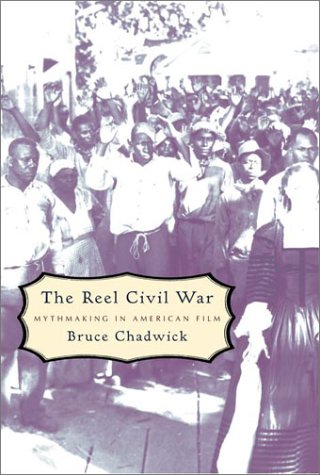
The Reel Civil War: Mythmaking in American Film, by Bruce Chadwick****

thereelcivilwarI found this gem at my favorite used bookstore in Seattle, Magus Books, which is just a block from the University of Washington. Its strength, as the title suggests, is in tracing the story of the American Civil War as told by the cinema. Those interested in the way in which movie impacts both culture and education in the USA would do well to find this book and read it.

Chadwick spends a considerable amount of time and space carefully documenting the myth produced by Gone with the Wind, a completely unrealistic, idealized portrait of the ruling planter class of the deep South. Many of us would, in years gone by, have been inclined to dismiss this concern by saying that after all, the book and movie were primarily intended as a love story, but Chadwick demonstrates that this is not so. He ferrets out actual interviews with Margaret Mitchell herself in which she insists that this is exactly the way it was. Her sources? Former plantation owners, of course.

To this day, if an avid reader goes to Goodreads.com and under the caption “explore”, goes to “listopia” and from there selects a list of readers’ favorite Civil War titles, GWTW will place within the top ten, and sometimes be the foremost title, selected over nonfiction as well as more accurate fiction. I find this horrifying.

The research regarding the Civil War itself is nothing I haven’t seen before, but Chadwick makes excellent use of strong secondary sources to document the fact that Black folks in the pre-war South were neither happy nor well treated. He takes apart the myth Mitchell constructed in a meticulous manner, one damn brick at a time. Hell yes. About ten percent of the way into the book, Chadwick’s removed, scholarly tone changes to one of articulate outrage, and I found this tremendously satisfying.

Chadwick follows Civil War films forward, after first also examining Birth of a Nation, a painfully racist film which was famous at the time because of its length; its original claim to fame was not content, but technology. For those that have not seen the film, this will be interesting reading also, and those that have seen it may pick up some new information as well.

A couple of generations later, the more realistic and highly acclaimed Roots television miniseries told the story of Black America in a way that hadn’t been represented on film before. Chadwick is again careful in his documentation and clear in his explanation.

The book’s final film treatment is of the most positive and accurate film depiction of African-Americans is the film Glory. This reviewer used this film in the classroom. It depicts the Black Massachusetts infantry that tried to take Fort Wagner and in doing so, inspired President Lincoln to order more Black troops to be armed and trained for combat in the American Civil War.

For those interested in the connection between film and American history, and of the American Civil War in particular, this book is recommended.

The Travelers, by Chris Pavone****

thetravelersChris Pavone is rapidly becoming a huge name in the psychological thriller genre. He is king when it comes to suspense; I was lucky enough to read the DRC for The Accident, his very successful mind-bender that came out in 2013. I was impressed enough by it that I also picked up his first novel, The Expats, on my annual pilgrimage to Powell’s City of Books in Portland. And so when I saw this little gem dangling on Net Galley, I wanted it right away, because Pavone had already shown me twice that he is a strong writer. Thank you Net Galley and Crown for the terrific read; I got this free in exchange for my review.

Will Rhodes works for a travel magazine, a journalist in a dying industry. He flies hither and yon, sampling food at promising little bistros; he knocks around the European countryside searching for the perfect photo, the little out-of-the-way piece of paradise no one else has written about. And while he is abroad, he makes a mistake, one that will come back to disrupt his life immeasurably. That’s how most spies are recruited: not out of patriotism or any ideological sense of mission, but in order to keep one’s darkest business concealed. Play it our way, friend, and nobody’s gotta know what you did.

Will’s boss Malcolm is also his closest friend. Well, he thinks so, anyway. There are a few things Will doesn’t know about Malcolm. He doesn’t know about the secret room. He doesn’t know to what extent he’s being monitored.

Will and his wife are trying for a baby, but there are things about Chloe he doesn’t know, too.

At the story’s outset, I began to feel as if the book was more about who sleeps with whom, and who knows what about each other’s sex life, than it was a thriller. I was ready to throw up my hands at one point, but I knew Pavone’s work and trusted that there must be a reason for all this, and oh my, yes there is. We can’t get to the spy versus spy material without going into all those hotel rooms.

The ending was deeply satisfying, if a trifle unlikely. We believe it could happen this way because Pavone has sold us the rest of the story, and so we follow him up one rocky cliff side and down another to the denouement.

This captivating thriller is available for purchase March 8, 2016. Put it on your list.

The Fugitives, by Christopher Sorrentino****

The fugitivesSandy Mulligan is a renowned author, but he’s hit a crisis. He’s left his wife and children for someone else, and it didn’t work out. Now he’s taken to the hinterlands to try to write the book he’s contracted to produce. Meanwhile, he runs across John Salteau, who claims to be an Ojibway storyteller, but it doesn’t ring quite true. Like Mulligan, Salteau is hiding from something. And if that isn’t enough, we have Kat Danhoff, herself a refugee of sorts, and she has landed in the same tiny burg, first to write about Salteau, and then to write about Mulligan interviewing Salteau. And before I can say more, I need to tell you that this clever satirical work was given me free of charge by Net Galley and Simon and Schuster in exchange for this honest review. It goes up for sale on February 9, 2016.

Early in the book we read of Mulligan’s infidelity, and I have to tell you, reader, that the explicit sex scenes and above all, the words selected to describe them, are not words that I am comfortable with. I am from the Boomer generation; if you are younger and don’t mind passages of erotica dropped into your novel, you might find this is a five star read for you. I was horrified, and read through it quickly.

Where are my smelling salts?

Where were we? Ah yes, the story. The dialogue in this thing is absolutely hilarious at times, and although Mulligan’s literary agent is a secondary character, I loved the sly, deliberate way Sorrentino crafted what we must regard as the typical agent, one who just wants him to write something, anything for heaven’s sake, so they don’t lose the deal. If Mulligan needs to retreat to the wilderness of Northern Michigan, then fine. Go. “Go walk in the footsteps of Hemingway, catch a trout or something…”

Mulligan does a lot of walking, alrighty, but what he does not do, is write. The internal dialogue is rich in many places; in a few, I wanted a red pen to edit it down a bit. The fact is, Mulligan is an exasperating character, but that’s okay; he is intended to be so. Not every protagonist is supposed to be lovable.

And so he ruminates endlessly, thinking of everything except his book. He recalls his affair, the one that snapped his already-fragile marriage like a twig. When the whole thing is over, he realizes that he could as easily had a conversation with the other woman’s underwear as he could have with her. But it’s too late now; water under the bridge. A lot of it.

Kat is from Chicago; she is married but also restless. She cheats in her marriage, but doesn’t turn it into a spectacle the way Mulligan does. Her work involves travel, and what Justin doesn’t know won’t hurt him.

Underlying all of this is the question of the storyteller, John Salteau. He’s a fake. Danhoff can smell it a mile away. At one point she witnesses him telling school children a Nigerian folk tale. What the hell? Her journalist antennae twitch, and she is on a mission.

Sorrentino is not a novice, and has been nominated for the National Book Award for Sound on Sound, a novel he published in 1995. His experience shows. His capacity to render setting immediate (and sometimes really funny) is important, because he constantly changes it up, bouncing us back and forth to the points of view of three different characters, switching from first person to third in the wink of an eye. If he isn’t proficient, the reader will get lost. As it is, this is a hyperliterate read, which suits me just fine, but if your mother tongue is not English, you might want to consider something else.

No one could possibly predict the way this story ends!

Recommended for those that love strong fiction.

Chameleo: A Strange but True Story of Invisible Spies, Heroin Addiction, and Homeland Security, by Robert Guffey****


ChameleoastrangeChameleo is a twisted but true story of an addict who unwittingly becomes an experimental subject in a classified government research program, and the bizarre events that took place then and in the aftermath. My thanks go to the author, who provided me with a copy in exchange for an honest review.

Dion Fuller (not the person’s actual name) had been released from a psychiatric hospital in Southern California. He had procured some heroine and nodded off, permitting various equally marginal characters access to his home. Sometimes he was out of it and had no idea what was happening. It was likely during this time that the guy with the stolen classified documents and a couple dozen pairs of night-vision goggles belonging to the US government made his way into Dion’s apartment. The ensuing chaos proves once and for all that just because a person is crazy does not mean nobody is out to get them. Just ask Dion!

Guffey, the author, is a Cal State creative writing teacher who found himself involved in Dion’s situation. He had a free term at the same time that Dion, an old childhood friend, called for help. With a certain amount of necessary remove, he did his best to advise his friend while taking copious notes. Soon he became convinced that his old friend was not hallucinating.

“Imagine a ridiculous college fraternity with the resources of the entire black budget of the United States of America deciding to play one long prank on some faceless guy in San Diego. And imagine that the faceless guy is you.”

The author’s description of a malicious antic known as “Street Theater” in government circles reminded me of the dirty tricks that the Democratic Party played on the Nixon camp during the early 1960’s—cruising into town in advance, for example, and moving street signs around so that the Republicans would get lost and be late to a speaking engagement—which were later used in turn by Nixon’s Committee to Re-Elect the President in 1972. Dion hoped that leaving his home, which was located very near a Naval installation, would make it all stop, and it did. He left California and headed cross country, but every time he got close to a US military installation, a whole train of personnel would follow him once more, like a trail of ducklings after their mother, right out there in the middle of the freaking desert.

Guffey’s story, which includes the Masons, the Illuminati (note the cover), and assorted other conspiratorial ingredients that would ordinarily cause me to stay completely fucking clear of this whacked out tale, follows Dion as far north as Minnesota, then oh dear God, to Seattle where Guffey was staying. But just as it seems it can’t get any more strange and stressful, the whole thing becomes hilarious! Your humble reviewer sat and laughed out loud about two-thirds of the way into the story, and the lighter tone that marks the book until near the end is what prevents the whole thing from degenerating into a bottomless abyss.
My only quibble with this story—and it’s a small one—is that if we must read entire transcribed passages of conversations, then the persons involved in the conversation in question should all be named, with no pseudonyms involved, so that the reader can use that transcript as a primary document if they want or need to. If that can’t happen, then some of these conversations ought to be summarized or paraphrased, at least in places. But this shouldn’t keep you from getting a copy of this memoir and reading it.

In fact, those that question authority and wonder just how far the US government has strayed from its stated ideals will welcome this strange little book, which is just well documented enough to convince me that it’s entirely true.

It’s available for purchase now.

Lonesome Dove, by Larry McMurtry*****

lonesomedoveSince when do I read westerns? Since never…until a Goodreads friend recommended this title. He knew I liked history and historical fiction, and I couldn’t dismiss the recommendation, not only because this person has never steered me wrong, but because this book won the Pulitzer. That doesn’t guarantee I will like it either, of course, but it certainly enhances the likelihood. So on one of my increasingly-rare ventures to my favorite local used bookstore, I searched out the title. There it was, 857 pages bound in a beautiful hard cover, foliated-paged tome, for less than ten bucks. Sold!

It took me a long time to read, not because of its length—psssh, my readers know me better than that—but because of its physical size. A very lengthy book in an electronic reader is light weight no matter how many pages it has, but this gorgeous, old school novel was hell on a frozen shoulder. So for a long time I read it in little chunks, propping it on top of pillows on top of my lap. It took awhile, but it was worth it.

McMurtry earned his laurels, that much is certain. I was mesmerized by the way he took us to a place that no longer exists, immense swaths of nothing across the Midwestern USA and Northern Rockies. The idea that a person could travel long and hard for days and still not even be out of Texas just blew me away, and then there was still most of the journey yet to come. There are no roads; the protagonists have a kind-of, sort-of map; a list of rivers to sustain themselves, replenish their drinking water; water their mounts, with water being the equivalent of gassing up; and also water their herd.

I realized that one reason I never chose to read westerns is because I grew up during a time when cowboys were considered the enemy of the American Indian. I didn’t want to be allied with the white guys on the horses. And of course, that was one stereotype I later realized I should not have bought into, because not all cowboys were white guys; most were, for sure, but some were of Mexican heritage, some were Black, and once in a rare while there would be an American Indian riding with the cowboys. And cowboys did not always fight Indians; sometimes they were just moving cattle.

Apart from the almost tangible settings the author creates, we also have some complex relationships. I confess that some of the more peripheral characters among the cowboy crew were hard for me to keep straight. Which one is Dish, and which is Pea Eye? But it didn’t matter that much in terms of ability to enjoy the novel, because the main characters were so well developed, and there wasn’t a stereotype in the pack. Gus is the chief protagonist, and in my mind he was somewhere between Ralph Waite and Tom Hanks. Call, his very quiet, solitary partner, was a tow-headed version of Robert Redford. Lorena, the complicated woman that fell in love with Gus, eventually formed herself in my own mind to resemble country singer Miranda Lambert. Sometimes you just need a face to go with your main characters. Jake turned up as Dan Ackroyd without the sense of humor. Blue Duck is one of the most terrifying villains in literature!

Why go north? There was never any really good reason apart from Call’s wanderlust, and Gus’s unwillingness to be separated from his partner, with whom he had worked since their days as Texas Rangers. Gus also wanted to look up a woman from his past who had settled in Nebraska, and I loved how that played out.

And when all was said and done, I realized that this is one of those haunting stories that will forever remain in my mind. That’s saying a lot; I usually read 8-10 books per month, and often by the time I am invited to host a book giveaway or blog tour by the publisher, I have forgotten the name of the main character and all but the broadest contours of the story being promoted. They approach me 3 months after I wrote the review, and there are 30 books in between that story and the present. But that won’t happen here. In fact, because this wasn’t a galley, I waited to review it until I had the time and felt the urge. I still remember so much, and there have been several books gone by in the interim.

If you have the stamina to read a book of this length—and I have to tell you, though it’s a western it is not all actionactionaction, but rather deeply insightful in many places—and if you enjoy historical fiction, you ought to give this book consideration. It isn’t hard to find it used, and given its exalted status in literature, your local library probably also has a copy. But even if you have to pony up the cover price—pun intended—you could do much worse for your reading dollar.

An outstanding novel.