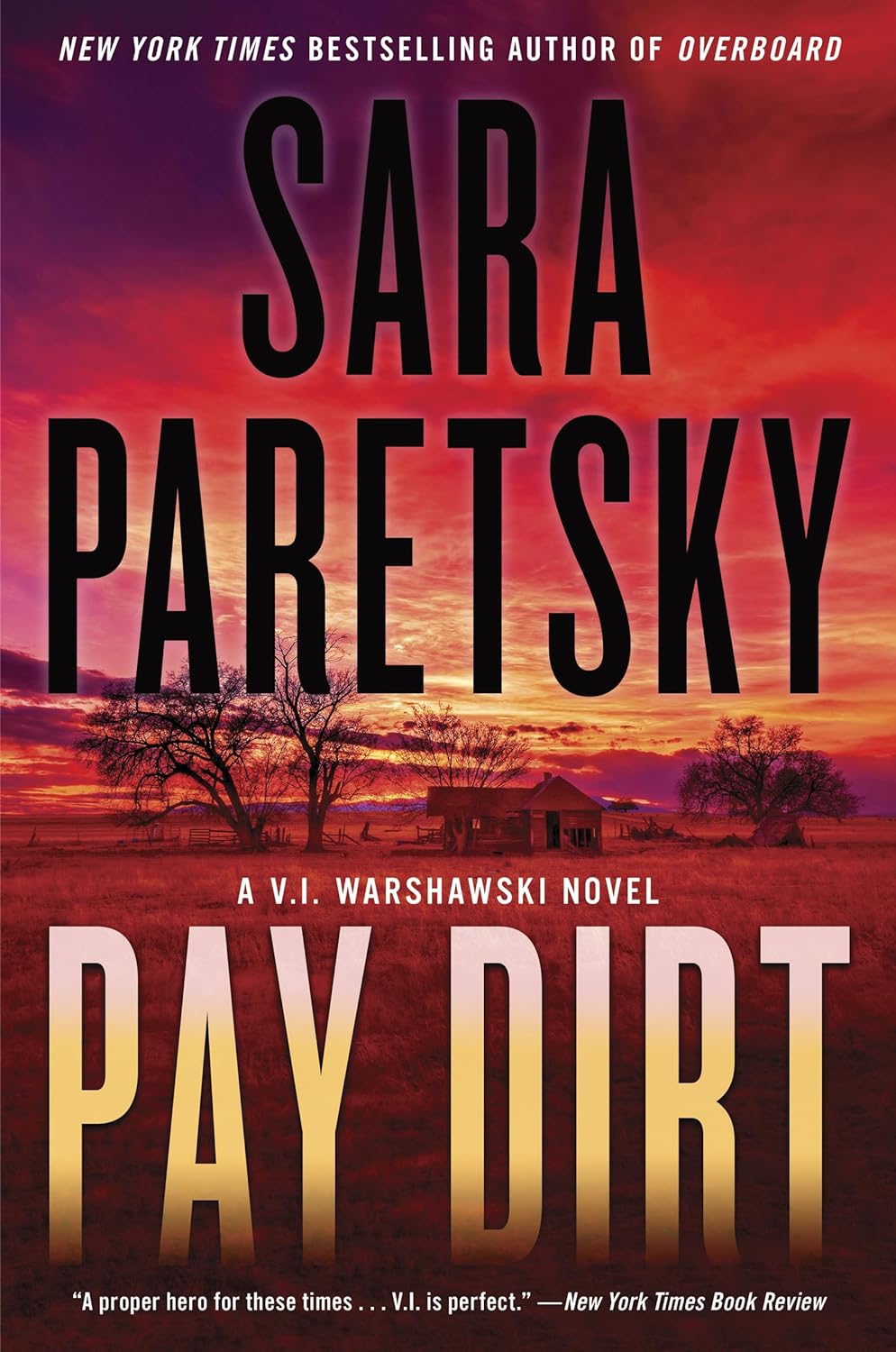
Pay Dirt, by Sara Paretsky*****

Sara Paretsky is a badass author with a badass protagonist. Her hero, Vic Warshawski, is a rough and ready private eye, and though based in Chicago, she sometimes—as now—finds herself elsewhere when duty beckons. Author Paretsky is one of the three that pioneered the hardboiled female private eye subgenre; the first in this series, Indemnity Only, came out in 1982, over 40 years ago, and that is how long I have been reading them. And though I was lucky to receive a review copy, thanks to NetGalley and William Morrow, this is one of those rare books that I would have paid full price to read if that was the only way I could get it.

This book is for sale now.

This story finds Vic in bad shape, both mentally and physically. She has attempted to help a student of her boyfriend Peter’s, a trans youth whose father blew out the kid’s brains rather than accept their new identity. The brains stuck to Vic, and the experience sent her reeling emotionally. She’s been forgetting self-care, not eating or exercising. What she needs is rest and quiet.

But that’s not how it goes.

Her godchild Bernie persuades Vic to attend a basketball championship game in Kansas. A group of them will be going down there; it’s just what Vic needs, she says. Reluctantly, Vic agrees, but once they are there and the game is over, one of the parties disappears, and Vic is enlisted to find her. When Vic finds the missing basketball player, she inadvertently finds a dead body. The cops in Lawrence, Kansas as well as the FBI like her for the killing. It’s so convenient to have a mouthy, street smart outsider blunder in; hopefully, they can pin it all on her, and then life will go on as it has been. And so Vic must stay behind because she’s been told not to leave town, but also in order to clear her name.

Now, this is one of the elements that generally irritates me in most mysteries; the whole clearing-my-name trope is desperately overdone. There’s another trope that shows up later in the story, but I won’t share it here because it’s a spoiler. But for every rule, there is an exception, and in the case of both tropes, Paretsky breezes through, and I barely bat an eye; this is because the characters are so real to me, and the situation they’re in is so immediate, that I blow it off so I can find out what happens next.

And as is so often the case, Vic Warshawski finds herself up against the town’s wealthy power brokers, who have a vested interest in not having the real killer caught. As for Vic, she makes friends with a few people that have no wealth and no power, but the small ways they assist her make all the difference.

Once she solves the crime, persuades the local police and others that she is innocent and that the blame lies with the men in the suits, are they hauled off in shackles? Don’t hold your breath. As one of her new pals reflects, “That is justice in America, plain and simple, before you wrap it up in a pretty package of Constitutional rights that only the rich get to have.”

The thing that sets this particular book apart from the other very good mysteries I’ve read recently is the development of the protagonist. She’s vulnerable because of her earlier trauma; her boyfriend left the country on business, and he hasn’t been responding to her texts. She is miserable, and she’s isolated. But as the pressure builds, Warshawski delivers. The last quarter of this novel is impossible to put down, and even before that, I set aside my usual rotation of books, because I wanted to read this, and only this.

This novel is written in such a way that a first time reader can jump into the series, but chances are good that once you do, you’ll reach back for some or all of the others. Highly recommended to those that love gritty, rough and tumble detectives; feminists; and those that lean to the left.

Piglet, by Lottie Hazell****

“Such a special day.”

Piglet is an offbeat novel that marks the debut of author Lottie Hazell. The protagonist is a young woman named Pippa, but everyone calls her Piglet. This author has me before I open the book, because with a nickname like this, I have to see what’s behind it, and where it’s going. My thanks go to NetGalley and Henry Holt for the review copy; this book is available to the public now.

Piglet lives in London, far from the working class area where she was raised, and where the rest of her family still resides. She’s a cookbook editor for a publishing company, is engaged to marry Kit, who is handsome and comes from a well to do family, and they have recently purchased a gorgeous home. Her star is clearly rising.

It’s a tightrope walk, to be certain. People with money have expectations, and so it’s not easy for Piglet to advocate for herself in the presence of his family. But she genuinely likes them, and so she works with them—which generally means that they get their way. Her own family mildly embarrass her when the two families meet, but her folks won’t often cross paths with these people once she and Kit are wed.

Then, two weeks before the wedding, Kit confesses a terrible, terrible betrayal, and Piglet has to decide whether she is in or out. As she unravels, I watch in horror. Piglet, you see, is an emotional eater.

In many ways, Piglet is the protagonist I have been wanting to read all my life. So often female main characters respond to stress by not eating. The lesser characters around them cluck over how pale, how thin they’ve become, and I sit back on my ample behind and say, “Yeah, right.”

But Piglet’s stress eating is epic in scope, and I also worry that the resolution will involve therapy, a new diet and a wedding gown in a size smaller than anything she’s ever owned. And since this much comes from my own imaginings rather than the book, I’ll go ahead and tell you, no. That doesn’t happen, and I am so grateful.

For most of this novel, I feel an intimacy with the protagonist that is rare. I can’t wait to find out what happens next, but I also can’t tolerate interruptions, and so I choose my reading sessions carefully. I am fortunate enough to receive both the digital review copy and the audio galley, and at the outset, I do what is my usual routine in such circumstances, listening to it while I am doing something else, but with the DRC nearby so that I can make notes or highlight likely passages for quotes. But by the time I am about thirty percent in, that’s over, and instead I am listening while reading also, because how can I think of anything else?

There are two things that I am dying to know. First, does she stay with Kit? And more importantly, what terrible thing did he do? Piglet keeps this information close to her vest, but the few people she tells are uniformly horrified, and so I know it’s bad. But what is it? Just what the hell did he do?

The ending feels incomplete to me. There are so many things that Hazell could have done and didn’t that I am disappointed by what feels like a slightly bland resolution. This is a good book, but it could have been a great one.

Hazell’s word smithery skills are stellar, and when I was done, I found I’d highlighted over 150 passages. Obviously, I won’t use them all here. Most of the novel’s tone is quite serious, but there are a few moments of dark humor that leave me shaking my head in admiration. In particular, there’s a wedding photographer that makes me howl!

The narrator is outstanding.

One way or another, Lottie Hazell is an author to watch. I look forward to seeing what she produces next.

On the Line, by Daisy Pitkin*****

On the Line, a labor memoir by Daisy Pitkin, tells the true story of a grassroots struggle to organize a nonunion laundry in Arizona as part of an industry-wide unionizing campaign. My thanks go to NetGalley and Algonquin for the invitation to read and review. This book is for sale now.

Daisy is an organizer for UNITE, a labor union that organizes textiles, laundries, transportation, service workers, and some others, created by the merger of ILGWU (International Ladies Garment Workers Union) and ACTWU, the American Clothing and Textile Workers Union (of which this reviewer was once a member and union activist.)  She is working at the ground level, approaching workers in the parking lot, partnering with a woman named Alma that worked there and could talk to other workers inside the factory.

The memoir is written in the second person to Alma, and at first this seems odd, but as I read, I realize this is an effective and intelligent choice. By addressing Alma and the things that Alma has said and done during this fight, as well as the things the author did, along with what they did together, and the occasional differences of opinion they had and how they resolved them, she avoids making herself sound like a martyr to the cause. It would not read nearly so well in the first person, with the reader as audience.

The tasks of the workers all revolve around the commercial laundering process. Immense bags of dirty linens weighing up to 300 pounds are pushed off of the delivery trucks in rolling carts.

“The linen moves down the belt, you said, and then you flicked your arms back and forth to demonstrate how you and the other sorters toss sheets into one bin, towels to another, gowns to a third, and so on. You said, Sometimes they speed up the conveyor, and we don’t have time to be careful. There is a lot of blood and puke and feces. You said, We don’t get shoe covers, so some of us take off our shoes and drive home in our socks. You said, Our gloves are too big—they slip off our hands. Sometimes when they tear open, we have to handle the soiled linen with exposed skin…you were demanding a seemingly simple thing: to work your eight-or-ten-hour shift and come home unharmed. You wanted gloves that hospital needles cannot puncture. You wanted face masks to keep the blood and fluids from other bodies from entering your bodies. You wanted safety guards put back on machines where they had been removed. You wanted linen dust cleaned from the rafters to prevent fires.”

Safety rules are routinely flouted. Dirty linens land on the belt, and the belt feeds them into the mouth of a tunnel washer. When the washer jams, workers sometimes have to crawl through hot, bleachy, contaminated water to clear it and get it working. The supervisors are supposed to cut power when someone is in there, but they don’t. Ultimately it’s a choice for the owners to risk a possible, but unlikely fine from the government, or frequent decreases in production, which cut into profits. The workers are expendable; they can always find more. The wash and dry departments of industrial laundries are the most fatal of all industries, according to U.S. government statistics.

Daisy and Alma are working on a shoestring. When they have to be away from home overnight in order to meet workers as they go in or come out, they sleep in the car. Their signs are made by hand with posterboard and Sharpies. Initially, all of the workers sign cards, but then management begins a campaign of threats and intimidation. Not all of the workers are in the States legally, and most of them don’t know their legal rights. Most of them rescind their votes, and then it’s an uphill climb to get them to sign again.

This is a topic that is of great interest to me, and I was supposed to have read and reviewed this book in April of 2023, but my stomach twisted as I read of the horrific obstacles encountered by workers and by Daisy, and halfway through I had to put it down. Only recently did I slap myself upside the head and resume reading.

In any labor union, there are two sets of obstacles. The first, the one that is obvious, is the company, the bosses. Unions cut into profits, so the owners or boards of directors nearly always fight unionization. The second, and lesser known, is the union officialdom at the top. These people spend more time around the bosses and other highly paid union officers than they do around the workers, and they become jaded, sometimes contemptuous of those that they are supposed to represent, whose dues pay their salaries. When Daisy is eventually promoted, she discovers it’s harder to do anything that is in the interests of the clientele.

The book also includes a fair amount of union history, and it’s clearly explained, well woven throughout the narrative.

For those that are interested in unions and labor history, this is an excellent resource. But don’t read it at bedtime; it will do things to your dreams.

Dogboy Vs. Catfish, by Luke Garcias*****

“Dirty deeds, done dirt cheap,

Dirty deeds, done dirt cheap.

Dirty deeds, done dirt cheap;

Dirty deeds and they’re done dirt cheap.”

AC/DC

This may have been the biggest sleeper of 2023. Dogboy vs. Catfish is a true thriller by Luke Gracias, one that grabbed me by the front of my shirt at the beginning and didn’t let me go till it was done with me. My thanks go to NetGalley for the review copy. This book is for sale now.

A couple of Goodreads friends raved about this book, and right away, I was curious. The title: not your usual formulation. Then there’s the setting; I haven’t read many books set in Australia, and fewer Australian mysteries and thrillers than fingers on my hand. And finally, the book’s premise: a well-to-do, famous, glamorous woman turns up at a lawyer’s office, and she’s excited, because she’s been married to this man she doesn’t care much about for nearly 18 months, and in Australia, that is the magic time length that will entitle her to take him to the cleaners, particularly with regard to her daughter’s support. He has a lot of money, but it’s about to be hers. She expects this attorney will be thrilled, because what a payday it will be! Sadly for her, the attorney has principles and scruples, and she backs away from the case.

But then the man—Dogboy, of course—turns up missing. He’s told his best friend that he is certain his wife is going to leave him and take almost everything, and he’s not sure what he can do about it; now he is nowhere to be found. Is he alive? Nobody seems to know.

In investigating the man and his estranged wife, the internet darling named Catfish Kelly, it soon becomes clear she is mixed up in money laundering and drugs. The search takes the cops to Thailand, where their informant is literally shot to death before their very eyes. And all of these things happen early, so I am giving nothing away. The book goes quickly at the start, then ramps up to an even more heart pounding pace.

It’s difficult, with a thriller that moves so rapidly, to find a way to establish characters. Nobody here is a truly dynamic character, but we don’t need a lot of character development. What is most admirable is the lightning quick way Gracias bonds us to Dogboy, whom we mostly don’t even see. We know three things about him. First, we know that he married a terrible woman who’s about to bleed his assets out from under him. Second, we learn early on that he is concerned that his investors’ funds will likewise be siphoned away, and to prevent this happening, he returns all of their investment moneys to them before he disappears, so that he will be Catfish’s only victim. And third, we know that he is unusually appealing to dogs, to the point where dogs that do not know him and have never met him, nonetheless seek him out, and also try to protect him when danger is present.

With just these three facts, given to us briefly, we cannot not love Dogboy. I’ve never seen this done so fast and so smoothly.

I know nothing whatsoever about Australian law or its justice system, and perhaps that helps, too. At one point, the investigators are burning through what appears to be a lot of the state’s resources without obvious or immediate results, and just as one of my eyebrows lifts and I begin to think that this could never…I realize that I don’t know whether it could happen or not. Probably not in the U.S. Most likely not in England. Australia? What the hell do I know about Australia? So instead, I just take the author’s word for it.

There is not a single misstep in this story, no slow part, no inconsistency. The ending is enormously satisfying. For all that love the genre, this book is highly recommended.

Happiness Falls, by Angie Kim*****

Angie Kim’s barnstorming best seller in 2019, Miracle Falls, showed us that she is a force to be reckoned with. Now she’s written something even better. My thanks to go Net Galley and Random House for the review copy. This book is for sale now.

I admired Kim’s debut novel, but because of its complex nature, it was a fair amount of work to read. Happiness Falls is every bit as brainy, but it’s streamlined, with just five important characters and a handful of secondary ones, so the reader can spend more time enjoying it and trying to puzzle out the solution, and less time trying to keep up with the plot and recall the intermittently appearing characters as it progresses.

As with her debut, this story features a main character with special needs. Eugene Parson has Angelman syndrome, a rare disorder that has rendered him incapable of speaking. This is a problem, because one day, Dad and Eugene go to the park for their daily walk, but Eugene comes home alone, bloody, disheveled, and tremendously upset. What happened? The family’s concern intensifies when Dad’s backpack is found floating downstream, but Eugene cannot speak. And so, the mystery that is interwoven into this family drama is established.

The story is told in the first person by Mia, Eugene’s older sister. Mia’s twin, John, rounds out the siblings, and their mother is the fifth family member. It’s set in Virginia during the pandemic; however, plot and character are much more important here than setting.

The mystery—what has happened to Dad—is wholly original because of the critical role played by Eugene’s communication challenges. Originality becomes more important to me every time I pick up a mystery; once you’ve read several hundred of these things, sameness can produce tedium. But this novel has much more going for it than that. The characters are absolutely believable. The teenagers are all convincing; they are age appropriate, bright but occasionally impulsive. Best of all is that there is no abuse story tucked in here. Their dad is or was a loving one, and the same is true of their mother. The parents have navigated bumps in their marriage, but by the time we hear of them, they’re fine. There’s no horrific baggage waiting to ambush us. These are nice people whose lives are complicated solely by the need to assist Eugene, whom everyone also loves. I make a point of telling you this, because I am sick to death of stories about terrible mothers. I’ve had enough of them, and am delighted Kim doesn’t go there.

Our narrator, Mia, is cleverly drawn; she is the family cynic, and she’s the family motormouth, and so if we occasionally wonder why Mia is telling us everything in such detail, it’s because Mia is a talker.

There are twists and turns all over the place. Just when I begin to think I might have a handle on this mystery, Kim throws in something else that leaves me gaping like a guppy. What? Huh? Oh. Well, there goes my theory. What now?

Because I came to this post-publication, I checked out the audio version at Seattle Bibliocommons to help me catch up. The audio is very well done. Initially I didn’t find Mia’s narrative voice appropriate because she seemed mighty chirpy for a girl that may have just lost her father; however, once Mia’s character is further developed, which doesn’t take long, I realize that the chirpiness is part of Mia’s denial. She’s very close to her dad, and she can’t bear to think that he is in danger, or worse.

I have rarely felt any interest toward any profound learning disability, but Kim made me care about Eugene and Angelman’s.

This novel is brilliant, a standout for 2023. I highly recommend it to all that love a good mystery or family story.

Livid, by Patricia Cornwell*****

I really enjoyed this, the 26th entry into the Kay Scarpetta series. From time to time, people publish unhappy reviews, but for me, it never gets old. In this one, a terrorist attack is made locally, and it’s associated with an attempt on the life of the U.S. president, who is in town at the time it occurs. Kay is, of course, the chief coroner, and she’s forced to perform the autopsy on someone she knows.

The ending isn’t satisfying, and with any other author, I’d knock off the last star. But with Cornwell, I know from experience that when she does this, it’s because it isn’t really over. This will come up again, if not in the next book, then in another soon after it.

Because I couldn’t get the galley, I checked out the audio book at Seattle Bibliocommons. The audio is kind of a mixed bag. I like how the narrator voices the protagonist, and she also does recurring character Pete Marino well. I thought it was wrong to read the voice of Lucy, Kay’s badass adult niece, with a higher pitched voice than any of the other characters. She is a daredevil that doesn’t suffer fools, and if anything, her voice should be lower in pitch than Kay’s. I also thought she made the judge a bit too languid sounding, which is at odds with the things she says. In short, if you are a reader that enjoys both audiobooks and print ones, go with the print. If you like only audiobooks, then go ahead.

If you haven’t read this series, I do suggest you begin with the first and work your way up. I might not have enjoyed this one so much if I didn’t know the characters.

Kunstlers in Paradise*****

4.5 stars, rounded upward. My thanks go to Net Galley, Henry Holt Publishers, and Macmillan Audio for the review copies. This magnificently quirky novel is for sale now.

Julian Kunstler is kind of a mess. He’s a twenty-something New Yorker whose girlfriend has just dumped him. He has no job, and he doesn’t want one; at least, not the low-paying, entry-level variety of jobs for which he is qualified. He takes himself home to his parents who have been paying his way, confident that they will understand his plight and increase his allowance. Instead, he hits a wall. What are your plans for the future, Julian? (None.) What do you plan to do for money? (Get it from you.) Just as a dramatic situation has begun to unfold, they hear from his 93 year old grandmother, Mamie, who lives in Los Angeles. She wants him to come to stay with her awhile; she needs assistance. He’s not so sure that he wants to go, but when his parents insist, he gets on that plane. Once there, the pandemic strikes, and he is trapped in lockdown with his grandmother and her elderly companion, Agatha.

Mamie has always been fond of Julian, and although she does need a driver for doctor appointments and the like, what she wants, more than anything, is to tell her life story. Most of it, anyway. It begins in Austria, as Jewish artists like her father, a successful composer, are being pushed out of public life by the Nazis. (Here, I emit a small moan; I am heartily sick of Holocaust stories. Happily, we don’t stay there long, and this story is worth it.) She goes on to describe the shock she experiences in suddenly being transplanted into a completely different climate, language, and culture, and much of Mamie’s story is droll. And Julian, who never would have sat still for these tales had they come from his parents, listens. At first, he listens impatiently, assisted by Mamie’s generous liquor collection. As time goes on, he begins to listen with greater patience and understanding. And by the end of a year’s time, he listens with genuine interest. His own exile from New York is pale, after all, in comparison to the exile his predecessors endured.

The most dynamic character is, of course, Julian, but through Mamie’s stories, we see how life has already changed her. Agatha is enigmatic until the book is nearly over, and I love what Cline does with her, too.

If I were to change one thing, I would edit down the material about the genius composer friend that emigrates from Austria and is close to the family. This reviewer was a music major once upon a time, and if this part of the narrative is a bit much for me, then probably many others will feel the same. Of course, if the reader comes to the book with a deep interest in Schoenberg, then it may prove quite satisfying.

I am fortunate to have access to both the digital print galley and the audio version, and reader Jesse Vilinsky is hands down the funniest, most skillful voice actor I have ever had the pleasure to hear. Cline’s book is very good, but in the hands of Vilinsky, it is infinitely better. Her interpretations of Mamie and Julian are spot on, hilarious at times, moving at others. The way she voices Agatha is absolute comic genius!

For those that love quirky humor and historical fiction, this book is highly recommended.

The White House Plumbers, by Egil “Bud” Krogh and Matthew Krogh

Egil “Bud” Krogh was one of the men known as the “White House Plumbers,” which was a small group of operatives that dressed as tradesmen in order to illegally break into and ransack private offices for the purpose of digging up dirt on political opponents. Krogh’s job, together with E. Howard Hunt, was to lead a small team of men to burglarize the office of Dr. Fielding, the psychiatrist that treated journalist Daniel Ellsberg, in search of a way to discredit Ellsberg, whom President Richard Nixon regarded as an opponent.

My thanks go to Net Galley, St. Martin’s Press, and Macmillan Audio for the review copy and audio book. This book is for sale now.

Few people shy of the Boomer generation will have personal recollection of the Watergate scandal that brought down a sitting U.S. president for the first time, and the burglary of Fielding’s office was the first illegal event that set it all in motion. Nixon was furious that the Pentagon Papers had been released and that the U.S. Supreme Court had come down on the side of the First Amendment and the free press. Consequently, the president decided that the executive branch must go it alone, and sought a way to discredit the journalists behind it. That was how all of this came about. He howled about national security, and may or may not have believed it; or, he may have sought to cover up lies he had told to the American people about the war in Indochina, and  since he couldn’t force the publication out of circulation, the next best thing would be to persuade the public that its authors—or annotators, at any rate—were crazy and not to be believed. This background information comes from me, not from the book.

At any rate, this political memoir comes to us courtesy of Bud Krogh, and also his son Matthew, who completed it after Bud’s death. For the purpose of this review, I will use the name Krogh to refer to Bud, unless otherwise noted.

Krogh was brought into this mess by John Ehrlichman, one of the two advisors that were nearly as close as a second skin to Nixon during his time in office. Other accounts refer to both as cold-blooded thugs, and my earlier reading leads me to agree with them, but to Bud, Ehrlichman was a noble soul dedicated to his country and his president, a fine, devout individual that was like a second father to him growing up. It didn’t occur to him, initially at least, that anything he was being asked to do was corrupt or scandalous; here, I find myself shifting in my seat. Surely he must have wondered why this secret little group of men, not even government employees, were being tasked with this job, rather than the agencies that ordinarily do the cloak-and-dagger jobs? He claims that Nixon couldn’t trust FBI director J. Edgar Hoover, who was a slimy character, and that makes at least a little sense to anyone familiar with him. Yikes.

The writing as well as the accountability are uneven throughout this book. The prologue sounds sketchy to me. Those of us that have spent any time at all watching criminal trials take place is familiar with the vaguely nebulous language I see and hear at the beginning of this thing. Instead of saying that he has done something very wrong and is sorry, he says he has made bad choices, and he is sorry about “what happened.” This is the language that guilty people use when their attorney has told them to show remorse. Someone not listening carefully might think that the speaker has apologized, but they’ve actually distanced themselves from wrongdoing. During this portion of the memoir, I glanced at the text and also the device playing the audio, half expecting to see a little slime leaching from its margins.

And yet, at the end, the prose is more eloquent, and the accountability rock solid. Krogh goes to the psychiatrist in order to apologize in person, once he is out of prison. He visits Nixon to apologize to him (which baffles me, but okay.) He claims to have declined a presidential pardon. He never loses an opportunity to put on a hair shirt prior to his many speaking engagements. And so it goes.

One could surmise that the early portion was written by Krogh, and the end written by his son, but even if that is true, those speaking engagements were taken by Bud, not by Matthew, and likewise the specific apologies rendered. So who knows?

The narrator for the audiobook is Peter Krogh, who does a fine job.

If you are interested in studying the Watergate scandal and haven’t read any other books about it, this is not the one. Krogh’s involvement ended with the break-in to Fielding’s office, and he helped cover it up, lying under oath as he was told to do, but he had nothing to do with the Watergate Hotel burglary of the Democratic National Committee’s offices. In short, though famous enough to be remembered for his actions, he was not a central player. For those interested in reading just one book about this scandal, I’d go with All the President’s Men, by Woodward and Bernstein; The Nixon Defense, by John Dean; or Nixon: The Life, by John A Farrell. These are all fairly lengthy; if you are looking for something less lengthy, try One Man Against the World, by Tim Weiner.

As a general read for the uninitiated, I’d give this book 2.5 stars. For Nixon and Watergate buffs, I rate it 3.5 stars.

The Matchmaker’s Gift, by Lynda Cohen Loigman*****

“The heart is big enough to hold both grief and love.”

I read Loigman’s debut novel, The Two-Family House, followed by The Wartime Sisters, and I loved them both, so when Net Galley and St. Martin’s Press invited me to read and review The Matchmaker’s Gift, I leapt. Once again, Loigman has me at hello. This outstanding historical novel is for sale now, and you should get it and read it.

The story is told from the point of view of two protagonists, a woman and her grandmother; they were close, but Sara the grandmother has died, so her story is told in the past, beginning in 1910, when she arrives in the U.S. as a child, along with her family. Abby is her granddaughter; her story begins in 1994. Their stories are told alternately, but both are in the third person omniscient and told in a linear time frame, so I am free to lean back, relax, and get lost in their stories, without any confusion or doubling back to check things.

Sara was a matchmaker, although she initially had to be very careful, because Jewish tradition dictated that matchmakers be married men, and she was still just a girl. But she was gifted with visions of a sort, and could tell who belonged together. And so she was forced to create matches “in secret, pairing people together like a rogue puppeteer.” She never missed. And upon her passing, she leaves a cryptic message indicating that upon her death, Abby will inherit her special talent.

Abby is nonplussed by this, and even as she grieves her beloved grandmother’s death, she is confused as to what she should do. She’s a divorce lawyer, for heaven’s sake! Is she to toss her education and become a modern day yenta? She hasn’t even found a man for herself yet, let alone for others.

It’s always a joy to find a story that diverges from the well-worn path, and novels involving Jewish matchmakers—or any others, for that matter—are thin on the ground. But that is only a small part of this novel’s appeal. I love Sara and Abby; I almost feel they are my friends. I feel their sorrows and admire their courage and integrity. When either of them meets with unfair opposition, I want to smack their detractor with my cane.

But there’s something extra that’s infused into Loigman’s stories, an intangible but unmissable warmth. Nobody can teach anyone this. I can count on one hand the number of authors that can write heartwarming stories that don’t follow formulas or insult the reader’s intelligence. Loigman is one, and this makes her golden.

When I was halfway finished reading this glorious novel, I saw that an audio galley was available. I was a bit cautious, because I had already developed a firm sense of how these women sounded in my head, and I was afraid I might not like the narrators’ interpretations, but my concern was unfounded. I had a road trip ahead of me, and I listened to the next forty percent as I drove, and there wasn’t a single moment that I didn’t love. Narrators Eva Kaminsky and Gabra Zackman do a lovely job, and I have never had such a seamless transition from the digital galley, to the audio, and back again.

Highly recommended, and bound to be one of the year’s best loved books.

Cold Fear, by Webb and Mann*****

“Christmas is special here. In Reykjavik, nothing bad ever happens at Christmas.”

Cold Fear is the second in the Finn thriller series. Last year authors Webb and Mann launched the first, Steel Fear, to widespread acclaim, and I loved it, too.  My thanks go to Random House Ballantine and Net Galley for the invitation to read and review. This book is for sale now.

Our protagonist, Finn, is a singular fellow. A Navy Seal (like one of our authors,) he is currently on the run, being sought for questioning regarding war crimes that took place in Yemen. He doesn’t think he is guilty, but he isn’t sure; a large chunk of his memory of that time has vanished, leaving him—and us—slightly off balance. But Finn is a survivor, and now, in Iceland, three members of his own team are here too; he thinks they may have the information that he needs to fill in the gaps he can’t access. There’s another more worrisome person, an assassin, looking for him as well.

Meanwhile, a woman has been found dead, face up under the ice. Suicide has been suggested, but that notion quickly falls apart. When her body disappears from the morgue, the police kick into overdrive. Iceland has almost no crime of any kind, let alone murder, and so immediately, they begin eyeing the Americans in their midst, including Finn.

Finn is a memorable character. He’s funny looking, like a cross between a Gecko and E.T., and yet, thanks to his training, he can merge seamlessly into a crowd and be invisible. His traumatic childhood haunts him, but the authors don’t beat us to death with this aspect of his personality. To my delight, he is burdened with none of the overused tropes used by lesser authors such as alcoholism. He is not on a mission to avenge the deaths of people in his personal life, and he doesn’t get kidnapped and thrown in the trunk of a car or van. Bad guys don’t try to harm his family—of which there is none, in any case—or his pets. He doesn’t get neurotic and bite his lip till he tastes blood, or bunch his fists up so tightly that he cuts his palms with his own fingernails. Feel me? I have quite a list of things I never want to see in a novel again. This happens, once one reads over a thousand novels in this genre, and for awhile I quit the genre entirely, thinking that there was nothing new left to read. Webb and Mann have proven me wrong, and I couldn’t be happier about it.

One last word about setting. Though Finn is a resonant protagonist, the setting is more important here than in most thrillers; that was the case in Steel Fear, which was set on the aircraft carrier, the USS Abraham Lincoln, and it’s true here, as well. The descriptions are resonant, but they don’t slow us down. This is a true thriller, with a pace that never flags.

I’m in this series for the duration. I also urge other women to ignore the promotions that boast that this is Alpha Male material. Last time I looked, I was an old lady school teacher, and I am all in. If you love a good thriller, I highly recommend both Finn books to you.