
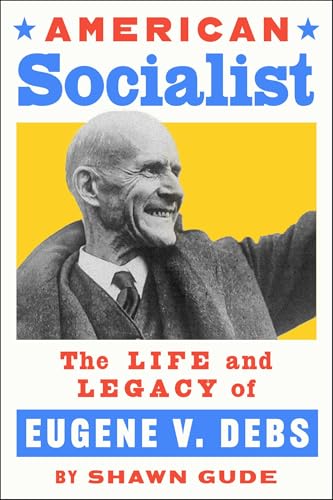
I first heard of Eugene Debs as a college student in the late 1970’s. Since that time, Debs has been one of my most revered heroes, the U.S.A.’s first popular Socialist, a dynamo who held to his principles even when jailed for his beliefs and his speeches, who ran for president from behind bars. His health was broken in the process, but his integrity held. And the period in which we live today is the perfect time for a popular biography of a leader from whom we can learn. I am thrilled that Shawn Gude has given us the opportunity by writing American Socialist: The Life and Legacy of Eugene V. Debs.
My thanks go to NetGalley and Simon and Schuster for the review copy. This book is for sale now.
Debs grew up in Indiana in a middle-income home, the child of a scholarly father and forward-thinking mother. Against his parents’ wishes, he left school at age 14—which was not unusual back then—to go to work on the railroad to help with the family’s expenses. He was hardly a fire-breathing radical. His boss was relatively benign, and when he helped found the working men’s organization associated with the railroad, it was more of a benevolent society than a union. In fact, he opposed the first railroad strike he heard of; but as time marched forward and the greed of the owners, known soon as “Robber Barons,” his ideas changed. When the depression of 1873 saw many left jobless, and those that were retained had their wages cut, then cut again until families began to starve, Gene recognized the need to organize and fight back.
At this time, strikes were brutally repressed; railroad owners would demand militias intervene, and innocent bystanders, including children, were sometimes mowed down, shot dead for throwing rocks and jeering.
Gene entered the political arena as a young man; his first elected position was city clerk in Terre Haute, Indiana. As union battles grew and the public became even more sharply polarized, he became more invested in the lives of working people. As he learned more of the connection between social struggles and those of the working class, he became a supporter of women’s suffrage as well as the rights of Black people, and received warm support in his campaigns from a number of their newspapers and political organizations; they quoted his speeches in their press, and he in turn often quoted W.E.B. DuBois, a leader of the Black struggle. Both DuBois and Debs, in turn, celebrated the achievements of the Russian Revolution, which Debs correctly called the first democratic government in the world.
He stood against the U.S.’s entry into World War I; the Espionage Act made it illegal to publicly oppose the war, and for this, Debs was jailed. He ran for president while in jail, and when some people wondered whether it would be wasteful to cast their votes for a candidate that had no chance of winning, he responded with a quote that this reviewer has repeated often for decades: “It is better to vote for what you want and not get it, than to vote for what you want and get it.”
I shake my head when I run across the many, many occasions in which Debs mixes Christianity and Socialism, which logically collides with the dialectical materialism at the base of scientific Socialism; apparently author Gude has no issues with it, however, or at least he doesn’t say so. But ultimately, Debs was the hero that we sorely need now; he would certainly not have opted to be photographed shaking hands with Wilson or Roosevelt, as the more reformist DSA politicians of today do with the current president, even while waving the Socialist banner.
Those that have any interest whatsoever in socialism, labor history, or alternative political ideas in general should get this book and read it. I’m glad I did.