
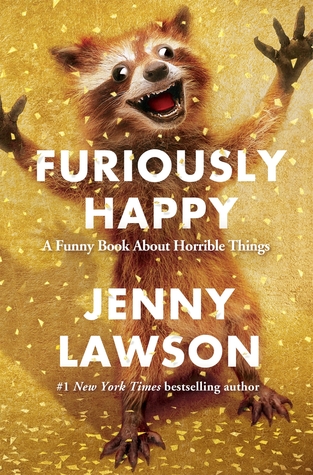
Furiously Happy: A Funny Book About Horrible Things, by Jenny Lawson****

furiouslyhappyJenny Lawson is well known as The Blogess (the blogger that came up with Beyonce, the metal chicken). She won awards for her previous memoir, Let’s Pretend This Never Happened.  The only DRC I saw for this title was for readers in UK and Australia, so I waited till I could scoop it cheaply and bought it digitally. Those that read my reviews often know I almost never do this. For the $3 it cost on an Amazon Prime daily deal, it was worth it to me.

Lawson is one of a handful of authors that talks candidly and often very humorously about her own struggle with mental illness and autoimmune disorders. Her capacity to create imaginary scenarios totally out of left field is her greatest strength, second only to the ability—sometimes—to find a way to laugh at the nest of spiders that occasionally takes over her brain. And sometimes she is painfully candid. Try this one on:


“Sometimes being crazy is a demon. And sometimes the demon is me…And some of us just carry around our tiny demon as he wreaks havoc in our mind, tearing open old dusty trunks of bad memories and leaving the remnants spread everywhere. Wearing the skins of people we’ve hurt. Wearing the skins of people we’ve loved. And sometimes, when it’s worst, wearing our own skins.”


She rants about the well intentioned but ignorant advice she’s received from clueless amateurs. At various times she’s been told to shake it off, to stop eating gluten, and to let Jesus into her heart in order to experience a full and immediate cure.

Sure.

Her musings about flying, which her fame requires her to do a great deal of, though she is afraid both of flying and of leaving home, are brilliant. This reviewer crowed out loud from glee at Lawson’s suggestion that flight attendants be permitted “to whack one person per flight with a piñata stick for being the stupidest damn person on the plane.”

My favorite section is the one in which she details the horrors of remodeling in a way that makes me howl. And goodness knows we all need to do that.

Lawson inserts women’s reproductive anatomy into almost any sort of discussion, and whereas I applaud the feminist spirit that demands the word “vagina” no longer be treated like a dirty word, I confess it was a bit much for me. But then, I am probably older than you are; this may be a generational thing. And there may also be plenty of women from the Boomer generation that think her use of the word is great.

Now and then there’s an odd moment in which I stop reading and stare at the text. What? Did she proof read this, and did her editors? There are occasional remarks that strike me as racially insensitive. She spins a thread about the wild things in the out of doors, and cautions us that since bears don’t play, we should shoot one first and ask questions later. Assuming said bear is in one’s back yard or trying to fit through a window of one’s home, I can see the point, but it came out of left field and made me wonder. Really? Just shoot bears? And the thread further spins itself into a bison-and-Native-Americans discussion in which she assures us that it’s not great to have bison in one’s yard, but it would be awesome to keep a lot of Native Americans out there. My e-reader says, “?!?”

But then she drops and is off onto another stream-of-consciousness spiel before I can fully digest what’s been said. She does it a couple of other times also. And it occurs to me that she has perhaps the ultimate excuse, having said up front that she has known for most of her life that she is “not right” in the head, but I still wonder that her editors didn’t look at that and say, “Umm…Jenny? This part right here…?” There are no overt racial slams or this review would have a lot of empty stars, but there are small moments where I wonder if she understands how others may read what she’s said.

Many of her entries if not all of them are drawn from her blog, and it’s possible that if you’ve read her blog faithfully, you won’t want to pay for this book. As for me, I found it worth the three bucks to be able to get everything at once in a well organized format—known as a book—that I could read comfortably. I confess I would not have paid full jacket price for it now that I get most books free and also have less money to spend on them than when I was working, but for others it may well be worth it.

On the whole, this is a courageous and often eloquent, fall-down-funny memoir, and with the small reservations mentioned above, I recommend it to you.

The Goldfish Bowl, by Laurence Gough***

thegoldfishbowlIt’s seldom that I find myself so ambivalent about a galley; I read this free thanks to Net Galley and Endeavor Press in exchange for an honest review.  The writing skill is probably closer to a five; the respect level for women, people of color, and anyone that isn’t oriented straight as a bullet’s path is closer to a one. So those that are constantly inveighing about how tired they are of trying to be PC, here. This is for you. For those of us that have moved along, I am not so sure. This book was released digitally in January, 2016 and is now for sale.

I spent a good portion of this book confused, because it is billed as a new release, yet it really reads like a novel from the 1980s might.  A little digging revealed that it was initially published in 1988, and this explains a good deal. Mainstream attitudes have come a long way since then, and so some re-released novels stand the test of time, whereas others should perhaps be consigned, as Trotsky put it, to “the dustbin of history”.

The story is set in Vancouver, British Columbia, and this is part of what made me want to read this mystery. I don’t see a lot of fiction set there, and I know the area, so I thought this would be fun. And setting is done well.

Then we have our sniper:

“The sniper sat in the orange plastic chair, hunched over a Lyman ‘All American’ turret press. His hands were large and strong. The thick blunt fingers, nails carefully painted with a glossy red polish, moved with precision and grace as he assembled the shiny brass cartridges, primers, powder and fat 500-grain copper-jacketed slugs.”

Our sniper, who must surely be a baddy if twisted enough to put on women’s clothing and makeup, is referred to as clown-faced and is always designated as “he”. In the 1980s that boat would float with most of book-buying North America. Now, not so much.

There is one victim after another, and the beginning is paced at breakneck speed, relaxing readers only to suddenly shock us repeatedly, so there’s a sort of emotional whiplash. There are two detectives in charge of the sniper shootings, and one is a woman. That’s unusual in the department, where women are routinely referred to in demeaning ways and where hard core porn kept in a file cabinet is just a thing the boys in blue do. None of this appears to be there to make a point about what women put up with, however; it seems to be injected for realism and urban grit. And though none of the cops is particularly brilliant, Parker, the female cop, is particularly incompetent, emptying an entire gun at close range without hitting the target even once.

Okay.

Bright spots come with particular scenes. The climax is brilliant, and I love the detail of the guard horse in front of the evidence room. The author is clearly talented, but every time I found myself engaging with the text and not thinking about anything that had offended me, something else would come to the forefront, popping up like a turd in the punch bowl. Those that visit psychiatrists are all ‘fruitcakes’, and at one point, “a huge black” stands in the doorway. At this point my temper flared and I tapped into my tablet, “Huge Black WHAT, motherfucker?”

Yes, I know. Amazon won’t print that quote. It’s worth editing to have it in my blog, because that’s exactly how I feel about it.

There are good moments with figurative language, but then once in awhile a glaring fact that nobody checked pops up. Do people in Vancouver genuinely believe that the West Coast goes from British Columbia, to Washington, to California? Didn’t think so. Someone needs to apologize to Oregon, which is larger than some European nations.  The denouement, social justice issues aside, was a mighty long reach.

If you are already a tried and true fan of Laurence Gough—and he is an established writer with over a dozen published novels—then you will probably enjoy this one too.

As for me, I’ll pass.


Notorious RBG, by Irin Carmon****

notoriousrbgIf I were to review the subject of this memoir rather than the book itself, it would be a slam-dunk five star rating. As it is, I can still recommend Carmon’s brief but potent biography as the best that has been published about this fascinating, passionate justice of the Supreme Court of the United States. I have no doubt many more will follow, and it’s possible I will read every one of them. As it stands, this is a rare instance in which I turned my back on my pile of free galleys long enough to ferret this gem out at the Seattle Public Library, because I just had to read it. You should too.

I’m an old school feminist from the seventies, but Ginsberg is one from the fifties. How is that even possible? Imagine the courage it would take to step forward at a time when no women’s movement even existed! She sued Rutgers University for equal pay and won. Later, she was the first female law professor at Columbia University, and she sued them for equal pay too. She volunteered as an attorney for the New Jersey American Civil Liberties Union, represented custodians in a class action suit, and later, when the Free Speech Movement on campuses in the 1960s began to warm up, she was already red hot and ready to go.

The best parts of Carmon’s memoir are the primary documents, because we get to see RBG’s own words. Ginsburg was made a federal appeals judge by President Jimmy Carter and moved to fill a vacancy on the U.S. Supreme Court by President Bill Clinton. She’s issued a number of tremendously eloquent decisions, and has chosen to read her dissent aloud, a thing not usually done, a record-breaking five times at the time this book was written. The lacy-looking necklace that fans out on all sides of her neck is her dissent collar, and so those that hear the Court deliver its decision can see exactly where Justice Ginsberg stands as soon as they see what she is wearing.

At times such as these, in which a woman in Indiana was recently sentenced to 20 years in prison for having an abortion [reference mine], it gives women hope to know that there is a fighter on the Supreme Court who’s looking out for our interests. It doesn’t mean that women can step away from this political battle, but it’s a thing that encourages us and lends us fortitude.

In January, it is rumored that Ginsberg will release her own memoir, one that relies heavily on her court decisions. Likely this will be an even better memoir than this one. For now though, this uplifting, funny, well-documented memoir is as good as it gets. Go get it.

All the Ugly and Wonderful Things, by Bryn Greenwood****

alltheuglyandwonAnd you thought Fifty Shades of Gray was controversial.  Just remember that you heard it here first: if this novel has legs and gets around, it’s going to create a lot of noise.  I could almost smell the book-burning bonfires as I read the last half. And lucky me, I read it free thanks to Net Galley and St. Martin’s Press, from whom I received a DRC in exchange for this honest review.

Wavy grows up in the North American heartland, smack dab in the middle of nowhere. When you consider it for a moment, that’s obviously the place for a meth lab to be. No sophisticated, well funded cops will sniff around and shut down your operation; there’s plenty of cheap land for the various vehicles and outbuildings such a business might require.

It’s not as if guests are welcome to drop in.

Guests don’t drop in, in fact, but two children do, one at a time, to proprietors Liam and his estranged and dysfunctional wife, Val. First Wavy arrives, a daughter that grows up with instructions never to let anyone touch her, especially her father; next comes little brother Donal, whom Wavy undertakes to raise as best a small child can do, since nobody else is available for either of them. Val struggles with mental illness and has given in to addiction with no struggle at all. Liam lives elsewhere with a small harem of junkie women that he uses sexually and as part of his drug business. When Wavy sees him, he usually yells for one of the women to get her out of there and take her somewhere else. He doesn’t seem to care who she’s with, or what they do with her.

Wavy lives briefly with her grandmother, a nurturing woman who despairs of Val’s habits but is more than willing to take care of her grandchildren, and slowly Wavy begins to bloom. But Grandma is elderly and sick, and she dies. During the brief time Wavy is with her, Grandma teaches her to read the stars. Wavy has a quick, sharp mind, and with just a little encouragement she learns the constellations. They form her only reliable connection to the world, since they are the sole immutable part of her life. Take her to live here; take her to live there. Put her in school; yank her back out. No matter what happens, she can still find Cassiopeia.

Liam’s mechanic and sometime-employee is a man named Kellen. He sees Wavy left like yesterday’s mail by the side of the road and gives her a lift on his motorcycle. To stay on board, she must touch his jacket in spite of what her mother has told her about never touching other people. We all need to be touched, and children of course most of all, and a bond is formed.

As to Kellen, he’s a strange bird, and the reader is never fully informed what his deal is. Is he, as some say, a slow learner? Is he mentally ill? All we really know comes from the inner narrative we hear from him in alternate chapters, and what others say about him. And we know what he does. When Wavy’s parents don’t show up to pick her up from school or to attend parent conferences, Kellen goes. And we know that other members of Liam’s meth crew consider Kellen to be the kind of man that won’t pull the trigger, but will help move the body when the deed has been done.

Sadly, Kellen really is the best parent figure in Wavy’s life. For those that think this is melodramatic nonsense: teach in a low income school district for a decade or two, and then come back and tell me that. Because these kids are out there.

Greenwood is dead smart when it comes to developing character. The peculiar behaviors that Wavy develops along with the period in which her physical development ceases to move forward are right on the money. The author states that portions of the story are autobiographical, and that sounds about right.

The relationship that develops between Wavy and Kellen will cause plenty of fireworks way after Independence Day has passed. Those that have triggers related to anything at all should steer clear. But for the rest, this novel is worth your time and dime. As the relationship between Wavy and Kellen begins to change, readers may lean in, or may want to hurl the book at a wall, but no one will be left unmoved.

This book is available to the public August 9, 2016, but you can order it now.

I Will Send Rain, by Rae Meadows****

iwillsendrainAnnie Bell could have chosen to marry a well-to-do member of the gentry in her home town, a man with fine china and a full time kitchen servant. Young and buoyant, she chooses love instead, and moves to Oklahoma with Samuel Bell to start a brand new life on the free land that’s been provided. What could go wrong when two young people are strong and dedicated to one another? Oh, it’s an old, old story in so many ways, but Meadows makes it brand new. Thanks to Net Galley and Henry Holt Publishers, I read it free and in advance in exchange for this honest review. It will be available to the public August 9, 2016.

When we join the Bells they are no longer newlyweds; a lot of water has gone under the bridge. They have Birdie, a teenager determined to find a way out of Mulehead, and their younger child Fred, a child beset with heavy health issues. He’s sturdier, however, than the baby that didn’t make it. So Annie and Samuel have had success, some fine fertile years on their farm when the wheat was tall and the rain came when it was needed, but they’ve also endured some heartache. Regardless, every Sunday they gather at the only house of worship in town and send up their thanks and prayers for the blessings of nature, and perhaps to ward off its curses as well.

But then, things deteriorate in a horrifying way. Without the sturdy prairie grasses to hold down the topsoil, it is depleted and finally just blown away in the horrible wind storms that come in terrifying intensity, a veritable hurricane of dust instead of water. There is no insulation that withstands the fierce and immeasurable storms, ones that turn day dark as night and fill every crevice in every home, barn, and public building with a layer of grit. Dust isn’t just on the bed, it’s in it. Dust is everywhere, including inside the lungs of little children. And so it is that Fred is stricken with dust pneumonia, an ailment akin to Black Lung disease but without even a paycheck to show for it.

In the midst of it all, Samuel has a message from God: the rain will come, and Samuel must build a boat. And so as the wheat dies beneath the remorseless sun, as the water is rationed and the cattle grow thin, Samuel goes to the barn and commences planning and building the ark that will save his family from the flood.

Everyone in town is laughing at him, but that doesn’t matter to Samuel; he has heard from God.

Meadows is a clever wordsmith, and her capacity to spin setting and develop character are impressive. Young Birdie is in so many ways her mother all over again, and yet Annie is unable to breach the abyss that separates her from her teenage daughter. Annie has learned a lot and she’s learned it the hard way, through experience; Birdie wants nothing to do with any of it, or with Annie. At times I longed to grab that girl by the shoulders and send her into the kitchen for a chat with her mother, but if I could have done so, she wouldn’t have listened anyway. Hopefully this gives the reader a glimpse of how real these characters became to me.

Most of the way through this compelling novel I was sure it would merit five stars, yet the ending left me dissatisfied. Even if I could explain this without spoiling it for you, I’m not sure what the writer should have done instead, but the denouement felt contrived to me even though in many ways it seemed like a reasonable ending. Perhaps you will feel differently.

You may have read other historical fiction set in the Dust Bowl, but you haven’t read anything like this. Check it out and see what you think. I’d hate for you to miss it.

Salvation Lake, by G.M. Ford*****

salvationlakeFord is the rightful heir to the late great Donald Westlake, a writer of monstrously amusing mysteries full of quirky sidekicks and kick-ass, zesty dialogue. There’s nobody like him in Seattle or anywhere else. I gobbled up the DRC when it became available via Net Galley and publishers Thomas and Mercer,  so I read this free in exchange for an honest review. But I’ll tell you a secret: if I’d had to, I’d have paid for this one had it been necessary. And so should you. It’s for sale today, and you can get it digitally at a bargain rate.
But back to our story.  We open at a bar called the Eastlake Zoo. The band of misfits to which detective Leo Waterman is tied through bonds of family history and quixotic affection are rocking the house in “well-lubricated amiability”. In fact, there’s a story being told right as we begin, and if it doesn’t hook you, check your pulse, because you’re probably dead. Here:

“Red Lopez was a spitter. When Red told a story, it was best to get yourself alee of

something waterproof, lest you end up looking like you’d been run through the

Elephant Car Wash.

‘So we was comin’ down Yesler,’ Red gushed. “Me and George and Ralphie.’

Everyone had found cover, except the guy they called Frenchie, who was so tanked

he  probably  thought it was raining inside the Eastlake Zoo…”


Right?

As it happens, Waterman, who’s inherited his old man’s ill-gotten wealth, has been lying low and enjoying the good life, but now his late father’s hideously distinctive overcoat has been found on a corpse, and  Timothy Eagen of the Seattle Police Department want to talk to Leo. Now.  There’s bad blood between them:

“…he hated my big ass the way Ahab hated that whale…Eagen was a skinny little turd with a salt-and-pepper comb-over pasted across his pate like a sleeping hamster.”

Since SPD has been under the eye of the Feds lately, Eagen can’t give full rein to his attack-Chihuahua impulses. SPD needs to provide “the kind [of law enforcement] that doesn’t look like Ferguson, Missouri or Staten Island, New York.” So Waterman doesn’t get shaken down or tossed into a cell, but his curiosity is piqued, and since he has no paying job and time on his hands, he finds himself checking into a few things. One thing leads to another.

What relationship does the victim, known as the Preacher, have to Mount Zion Industries, whose pamphlet is found among his effects? Before we know it, Leo is off and running, checking out Salvation Lake, located at the end of Redemption Road. Events tumble one upon the next, and I found that instead of reading in my bed that evening, as is my usual bedtime custom, I was reading on it, bolt upright and clicking the kindle to go a little faster please.

Waterman may have come into money midway through life, but his perspective is a working class perspective. His take on the city’s thousands of homeless denizens and the relationship that cops have to those in need strike a sure clear note that must surely resonate with anyone that’s been paying any attention at all.

Meanwhile, Salvation Lake is written with warp speed pacing, sharp insight, authority, and the kind of wit that can only come from a writer that has tremendous heart.

Don’t miss it. Get it now.

Good Night, Mr. James: and Other Stories by Clifford D. Simak*****

goodnightmrjamesSimak was a prodigious writer of science fiction during the middle of the twentieth century; he was the third Grand Master of the Science Fiction and Fantasy Writers of America, and won numerous other awards, among them the Nebula and multiple Hugo Awards. His short stories are being republished digitally, and as fast as Open Road Integrated Media can publish them, I snap them up, having already read two volumes; this is volume eight. Thanks go to ORIM and to Net Galley, from whom I received a DRC in exchange for this honest review.

There’s a special sort of satisfaction that comes from reading science fiction written during the era that followed World War II, and in seeing what technology science fiction writers imagined might be around the corner. Many times we read stories of passenger flights to other planets and galaxies, stories of mind control, and yet nobody ever imagined that one day we would each have a small telephone in our pocket that would double as a camera, wristwatch and telegram service. But the musings and imaginings of old school science fiction are just plain fun, and they don’t require the technical proficiency that some of today’s writers often require in order to read, understand, and enjoy the stories they produce.  Sometimes a bit of philosophy and world view sneaks into these stories, and we may find kindred spirits in the most unlikely places.

The title story used to open this collection is a fun one, and the tension that accompanies Mr. James as he approaches the enclosure where he believes he’ll find the ‘puudly’, a creature from another world unwisely snuck into the present one, is almost unbearable.  What follows on his journey home is absorbing as well. But this wasn’t my favorite story. There are two others I found even better, but first, let’s get this other news out of the way.

The bad news is that there is just a trace of the racist stereotyping common to white folk of this time period, but it’s limited to one story, and it’s scarce. If you read my reviews often, you know that if I see it, I call it out, and my tolerance level is much lower than that of most reviewers. It’s in one story which isn’t all that good anyway, and it pertains to Asians that are featured briefly. The story is “The Gunsmoke Drummer Sells a War”, and it’s a cowboy tale of the sort that was popular in the USA during the 1950’s. A man of Chinese origin is referred to as ‘The Chinaman’, and during his short tenure in the story, he is untrustworthy.  He speaks in a “sing song” cadence. This story cost the book half a star, but it’s my view that you could buy this collection, skip this story, which is overlong and contains some less than stellar dialogue, and you’d still get your money’s worth. That’s all the bad news there is here.

“Reunion on Ganymede” made me tremble with mirth, nearly causing me to wake Mr. Computer, who slumbered peacefully beside me. In this story Gramps is dying to go to the reunion of veterans of a war that took place between the “Marshies” (Martians) and the “Earthies” .  His family is trying to dissuade him from taking his flame gun with him. They tell him the weapon is too old to be trusted, but clearly it isn’t the gun, but rather the owner that they’re worried about. As developments take an unexpected turn, it becomes obvious that there are some things for which one just can’t plan. Eventually we see that Gramps and other characters unforeseen by his kinfolk are on a collision course, and what follows is pure poetry.

However, my very favorite story is “Kindergarten”. A man has bought a cabin and retreated to it; he’s been told he has a short time to live, and so he’s determined to do it in pastoral solitude. Imagine his surprise when he goes for a stroll one day and finds the mysterious machine on his property! It’s certainly not a saucer, yet it’s also not from Earth. It couldn’t be. And the whole thing unspools in a way I interpret as being subversive and delicious. Please note that the entire collection is edited and introduced by a close friend of the author’s, the latter having died in 1988. The editor’s spin on this story is completely different from my own, and yet knowing this didn’t make me enjoy it any less.

If you’ve had the pleasure of reading the We Install story collection, or Grotto of the Dancing Deer collection, you know what kind of prose Simak spins, and if you like old school science fiction, you almost have to like most or all of his. If you haven’t dipped a toe in the water yet, hop on in. Between this collection and at least nine others, there’s plenty to keep you reading happily for quite some time.

As a last note to teachers looking for suitable classroom stories, there’s no sex or foul language here, but be prepared to discuss or explain some of the slang of the period in question.

Highly recommended and available to the public now.

Cryptoscatology: Conspiracy Theory as Art Form, by Robert Guffey***

cryptoscatologyThis particular book is not in my wheelhouse, but I was offered a free copy in exchange for a fair and honest review, and the person doing the offering is a friend of the author’s and of mine. Thus, I found myself spiraling down the rabbit hole, reading about everything from Watergate  to the connection between the Freemasons and the Mormons. This book is available to the public right now.
Guffey’s purpose as stated at the outset is to offer an encyclopedic view of every conspiracy theory prevalent today. He organizes his book into sections dealing with pop culture and ‘mind control’; secret societies; conspiracies and the dominant Western religions; conspiracies in ‘high places’, which refers to heads of state, with the most attention being focused on Bush, Cheney, and Hitler; and conspiracies and the paranormal.  He tells us he wants to tease apart the conspiracies that have been proven to be true, such as the Watergate cover-up, from those that are from among the lunatic fringe, such as those that claim, despite all evidence to the contrary, that President Obama is secretly a Muslim and not really an American citizen. But most of what he discusses is material that he considers to be fuzzy and ambiguous, a matter of perspective.  Most of these things I regarded before and after reading Guffey’s book as more material for the lunatic fringe.

To be sure, there are some vital nuggets to be found here. Many people aren’t aware, for example, of programs of involuntary sterilization. Guffey points out that that Ronald Reagan, when he was governor of California, had been convinced that there was no moral wrong in sterilizing African-American men that landed in Californian psychiatric wards and in prisons, because after all, these had been proven to be the most violent members of the population…right? Furthermore, Black kids, categorized as “pre-delinquents”,  that hadn’t actually done anything wrong might receive brain implants without their knowledge or consent so that they might be tracked and studied. However, Guffey also points out that this program was killed by more sensible people in state government and it was never implemented. This and much of the other meaty, credible material in his book was made available through the Freedom of Information Act, and because it was relatively easily found, I was frustrated that Guffey didn’t offer more widely known sources to back up his statements.  And I was also frustrated that he didn’t discuss the involuntary sterilizations of poor Black women in New York that sought abortions in the 1970s. It was ripe fruit hanging from a vine, but he left it where it was, and without providing it any mention, went on to talk about Jonestown and mind control.

Reading Guffey’s findings in a wide variety of places, one might readily accept his leaps as he adds his facts to sometimes astonishing conclusions, because he’s a good writer. He’s very fluent, but as a researcher I found him wanting. This reviewer’s spouse, who more or less skimmed, said it looked like solid work, but he didn’t read the sources cited at the ends of the chapters. Anytime something seems peculiar or surprising—no, anytime one is reading nonfiction material based on research—it’s absolutely essential to read the sources. Such audacious claims as are bandied about here should have multiple citations from as wide a variety of well known sources as is possible. In some cases it would have been fairly easy to come up with a lot of great sources in a relatively short time span, yet it isn’t done.

My conclusion: Guffey is a good writer but a less than conscientious researcher. Because of this, it’s impossible to tell which of the widely touted conspiracies examined here are actually verifiable when he hasn’t shown much proof, and which are scantly cited because there’s nothing out there beyond a few tin-foil-hatted survivalists that think it’s true.

There are those that will love this book because it offers at least the benefit of a doubt to the conspiracies to which they already ascribe. I can see these folks right now, sitting in a basement rec room somewhere telling each other, “See? And look here! He says…”

What I didn’t find was any basis for the art form mentioned in the title, beyond a few literary phrases tossed in here and there.

For those interested in today’s most popular conspiracies, this will provide hours of juicy reading. But for academics that need credible sources, this book won’t provide what you need. And that’s kind of a shame.


They Left Us Everything, by Plum Johnson***

theyleftus Plum Johnson is gathered, together with her siblings and other family members, at the family manse following the death of her mother. This memoir focuses on the things she’s learned and the insights she gains over the course of the year it takes to empty and sell the property. Thank you to Net Galley and Putnam Penguin for the DRC, which I received free in exchange for this honest review.
I knew when I requested this story that I was stretching my comfort zone. It paid off big time a couple of times recently–one of them was The Goldfinch—and since there seemed to be a lot of buzz generated around this title, I thought I’d go for it. And I have to admit, this time it was not a good fit. But I am confident that there are readers out there that will enjoy it. Different strokes and all that.

The first thing that jarred me was right up front, and it was a small thing, yet a big thing. The pet the author remembers so fondly—the one that’s buried on the property—was named Sambo. I felt like I’d been slapped, to be honest. If that was the pet’s name, I’d think an author today would have had the sensitivity to change it for purposes of publication.

Sambo???

Enough; let’s get on with the meat of the story. The author has spent years under the domineering gaze of her dying mother. The woman didn’t go fast, and she didn’t go out a pleasant person. In some ways it makes it harder to grieve when someone goes out ugly, because it sends all sorts of conflicting emotions rocketing through one’s senses, which are already jumbled sufficiently at the loss of a family member. And it is in taking time to go through her mother’s things, the more personal ones apart from the things that have resale value, the letters, the journals, the things she saved for so many years, that the author feels as if she really knows who her mother used to be.

I think there are a lot of us out here, Boomer-era adults that have said goodbye to parents or are still doing so, that can relate to this. Often it takes a fair amount of experience to appreciate our parents’ better moments, to realize that some of the things they did for us that we took for granted were not  the same things everyone’s parents did. Plum’s musings made me think of my own mother, a woman that died disappointed with life and darned cranky about it, but who told me about the internment of Japanese Americans and made me use standard English by the time I was five. Like Plum, I find myself wishing my mom could return for a visit to give me one more chance to thank her for the things she did right.

We get a glimpse of the author’s life, the choices she made and what her mother had to say about them. But it was difficult for me to relate to them, not only because of the level of affluence that is demonstrated here, but also because it’s depicted as being part of the everyday landscape. Plum doesn’t feel more fortunate than others, but rather this is what her normal looks like, and while I understand that for some people that is reality, I found it alienating. Art versus tennis? That’s the controversy? In addition, for most of the book we also assume that people are white, because that’s what normal looks like to Plum. There are a few places that break this up a little bit, and it is for that reason, together with the fluency with which the memoir is written, that I rated this 3 stars rather than 2.5.

Figure out who you are, and that will tell you whether this book is your book. It’s for sale to the public July 19, 2016.

The Hatching, by Ezekiel Boone****

thehatching I was never afraid of spiders until I read this book. Thanks to Boone’s monstrous, boisterous, hair-raising new novel, I now eye the ceiling for wolf spiders that hunt at night just before I fall asleep…and I usually find one. I received this DRC in advance thanks to Net Galley and Atria Books, in exchange for this honest review. This book goes up for sale July 5, 2016 and frankly, I don’t know how you’re going to wait that long!

Right at the start, something has gone very wrong.  In Peru, a shadow falls upon a group of helpless tourists and devours them with breathtaking speed. Soon thereafter, China tells the world that it has inadvertently nuked one of its own villages. Just an accident; terribly sorry. Please don’t push that button, because we aren’t gunning for you, oh mighty imperialist powers.

When a bizarre package arrives at the laboratory of Melanie Guyer, she immediately tucks its contents into an glass tank where it can be watched in a secure environment. There. See now, that’s sensible. And yet…

Clear on the other side of the continent, the greater Los Angeles area finds itself under quarantine. With a finger to the wind, one soldier in charge of the containment eyes the razor wire and holding pens springing up and decides to make a break for it while he can. He powers the hell through the closed gate, because there’s a time to sacrifice for one’s country, but there’s also a time to save yourself first:

    He took the last few steps to the truck and had his hand on the door handle  when  he  heard the sound.  It was a sort of scraping…and he noticed there was something wrong …with the shadows. Over there, maybe twenty paces away, one of the shadows seemed to be moving a little, pulsing. He watched it, fascinated, and it wasn’t until a thread of black seemed to fall out of the shadow and unspool toward him that he broke from his reverie.

Uh oh.

However, survivalists in Desperation, California aren’t panicked; they’re gloating. All that preparation for doomsday, and now it’s here. Let’s have a party! The doors are sealed against radiation, against spiders, against whatever. The dog has even been trained to go potty on a little piece of Astroturf. They are so ready.

I wasn’t sure I liked this book at first. The moment when the first spider popped out of the first human host, I made a note in my e-reader saying this is just another version of the 1970’s movie Alien, but with spiders. Still, I continued to read.

When the president of the United States asks quite seriously whether zombies are involved, right around the halfway mark, I wanted to throw my kindle across the bedroom. If it had been a library book, I would have slammed it shut and put it in my tote bag to return first thing in the morning. But it wasn’t a library book, it was a DRC, and so I had an obligation, and I gritted my teeth (president. Zombies! My ass,) and continued reading. And I am really glad I did, friends, because it got so much better.

Let’s go back to the movie Alien. For those unacquainted with this cult classic, the story devolves around aliens that seek human hosts. The setting of Alien is a space ship, so they’re a very long way from home and help; yet they are also contained.  And as I read on, I realized that in Boone’s setting—the entire planet—there are so many more possibilities. I hit about the sixty percent mark and had to munch my way through the rest, if you’ll pardon the expression, until the very last page was done.

I found myself pondering the possibility of a sequel.

I nearly tacked on the fifth star, because this was tremendously entertaining, and Boone breaks up the horror with odd places, few and unexpected, that are laugh-out-loud funny. But then I reflected on the fact that I rated every single thing Michael Crichton ever wrote as four stars, and I see this quirky, horrifying, delicious novel as on a par with Crichton. Rather than hustle back and re-rate everything Crichton ever wrote, which would be a bit impulsive, I stuck to the four star standard.

There’s no explicit sex here, but there’s plenty of gore. Those that love good horror and science fiction should snap this book up right away. And if one is looking for a summer read to keep your nerdy teen out of trouble for a hot minute over the summer, this is a good choice for that set also.

But you’ll never see a spider web in quite the same way once you’ve read it!

Huge fun for anyone not already genuinely afraid of spiders.