Somewhere Toward Freedom, by Bennett Parten*****

Bennett Parten is a fine historical writer, and here he examines General William Sherman’s renowned march through Georgia during the American Civil War through the lens of the formerly enslaved people that followed him. It’s a job that needed doing, and I’m glad that Parten was the one to do it. My thanks go to Simon and Schuster and NetGalley for the review copy. This book is for sale now.

The Union’s approach to formerly enslaved people evolved considerably over the course of the war. (This is your reviewer talking, not Parten.) In the beginning, when both North and South thought the conflict would be a brief one—ending, of course, in their own victories—anyone that left a plantation without permission to follow the Union army was promptly returned to their owner. But this was problematic from the start, if only logistically, as such practices slowed the army’s pace and drained resources from it, all in service to the enemy. For a while, then, everything was unofficial, as gradually, the formerly enslaved were sometimes folded into the army as support staff, helping cook, set up camps, pave roads, and whatever other noncombat roles needed to be filled. Eventually the practice was codified, not because slaves were declared free—not yet—but as “contrabands” of war. The idea was that by taking the enemy’s property that one runs across, be it livestock, crops, or (wince!) human beings, one’s own forces were strengthened, the enemy’s weakened. And after the Emancipation Proclamation, the formerly enslaved could theoretically go wherever they chose, but since guns and dogs can render such a proclamation from a far away and often unrecognized authority, it seemed like a wise plan for the formerly enslaved to follow the Union army.

Prior to reading this book, I was unaware of the relative size of the crowd of followers as opposed to the army itself. As Sherman’s forces made their way through Georgia waging total war, razing fields and burning cities, the crowd behind it grew from hundreds, to thousands, to tens of thousands!

Sherman’s first obligation, as he saw it, was to win this war. The army had to be his focus. Yet, as enthusiastic followers swarmed, they needed food, shelter, and sometimes other assistance. Initially, the troops were instructed not to give food to anyone other than those followers tapped to serve the army, but it proved difficult to enforce. There were children there, and they might well starve if not fed. The army had, as an intentional strategy, denuded the farms and villages of food and other necessary resources, so telling the followers to go find their own food was disingenuous. The army had nearly all the food there was; unfortunately, it wasn’t enough for thousands of extra mouths. And at times, Sherman and his generals made an effort to prevent, or to at least not help, the followers from remaining with them.

The greatest scandal was the one at Ebenezer Creek. (Sherman himself was not physically present for this, but what happened was consistent with his policies.) Georgia was full of rivers, swamps, creeks, and bogs, and in order to cross them, sometimes the engineers constructed bridges, and then either burned them behind themselves to prevent the enemy from following, or retrieved them for later use. In this instance, the enemy was close at the rear, and the order was given to pull up the bridges just as soon as the last soldier was across. The result was horrifying: with the hounds baying behind them, the desperate followers used every possible means to try to stay with the army. Some drowned; others were captured and either returned to slavery or killed. Women and children perished in those muddy waters, and later, the Federals launched an investigation.

There were other less dramatic, yet still tragic, incidents of the same sort.

In order to solve this conundrum, Sherman ordered a series of abandoned plantations in Port Royal, an island in South Carolina, to be turned over for the use of the freedmen and women. The book goes into a fair amount of detail about how these were run, with a fierce competition between two sides for control. Despite an overly colonial administration, formerly enslaved people were able to farm for themselves, and in some cases were able to buy land with the money they earned. It was a sound, if flawed program that was ultimately destroyed when Lincoln was murdered and Andrew Johnson, a sympathizer of the South, became president and gave the plantations back to their original owners, making no provision whatsoever for the farmers that now worked them.

It is this aspect of which I knew nearly nothing. Part of this is because I am a coward; I have a dozen or more books about Reconstruction that I say I will read, but then I don’t, and that is because I know the ending will be heartbreaking. But there’s also this: conventional histories of the Civil War tend to follow one or another army, general, and so forth, and very few tell the story of what happens after the army marches onward. And so I learned a good deal from this portion of the book; and yes, my heart broke, but not as much as those of the people that were first assisted, and then abandoned by the U.S. government.

Finally, I want to comment on the notes and sources used here. They are beyond reproach, with many primary sources used, multiple sources per endnote in most cases, and well-integrated. I particularly appreciated the quotations of the followers themselves.

I highly recommend this book to all that are interested in the American Civil War, Reconstruction, and the many social and racial problems that have continued to weigh on American society ever since.

Let Us Descend, by Jesmyn Ward*****

Reading Jesmyn Ward always hurts so good. In Let Us Descend, she conveys the heartbreak and sense of betrayal a young girl, Annis, faces when she and her mother are sold separately by their owner—who is also her father–and the ways that she copes, and also the ways she is helped by the spirits of her ancestors.

My thanks go to Scribner and Net Galley for the invitation to read and review. I’m sorry to be so late here, and am grateful that the literary world has recognized this book for the masterpiece that it is.

You may have seen other reviews in which I complain and gnash my teeth over historical inaccuracies; sometimes I rant over an author’s failure to portray a child in a way that is developmentally inaccurate. There will be none of that here. Ward has taken the time and done the research, and so her well crafted characters aren’t compromised by sloppy background details. I had to take this story in small bites because it is excruciatingly sorrowful.  For part of it I listened to the audio version; this is a treat in itself, as Ward reads her own novel.

Some reviewers have taken issue with the amount of magical realism Ward employs. I disagree with them. How can any novelist portray such a story and such a character as Annis with any glimmer of hope, unless they employ these literary devices? Does anyone really want to read a book that is miserable at the outset, miserable in the middle, and miserable even at its bitter, wretched conclusion? Without hope, there’s not much incentive to keep reading, nor would it have been satisfying to write; but Ward will not and does not revise history simply to make her readers more comfortable. There was only one way to tell this story and be true to history and her characters, and Ward found it.

Yes, it’s a rough read, but it’s so well written that many readers must have smiled through their tears. Know that, of necessity, this story is absolutely loaded with triggers; assuming that you can navigate them without coming undone, I highly recommend this story to you.

Mecca, by Susan Straight*****

Susan Straight is a force to be reckoned with. I knew this after I finished reading I Been in Sorrow’s Kitchen and Licked Out All the Pots after it came out in 1992, and after I sought out, bought, and read everything else she’d written that was available. When I discovered that her new novel, Mecca, was available on Net Galley, I leapt on it. My thanks go to Net Galley and to Farrar, Strauss, and Giroux for the review copy. This book is for sale now.

Mecca, an ironic title if ever there was one, is a story of race, class, and gender, and the way that they play into the “Justice” system in California. Add a generous seasoning of climate change and its horrific effects in dry, dry Southern California, and a fistful of opioid addiction, and you have a heady mix indeed. But these are all well worn ground at this point, and this book is exceptional, not because it examines complex current events, but because of Straight’s facility in building visceral characters we care about, and launching them into this maelstrom in a way that makes it impossible to forget.

We begin with Johnny Frias, an American citizen of Latino heritage. As a rookie and while off duty, he kills a man that is raping and about to murder a woman named Bunny. He panics and gets rid of the body without reporting what’s happened. Frias is on the highway patrol, and he takes all sorts of racist crap all day every day. But his family relies on him, and when push comes to shove, he loves his home and takes pride in keeping it safe.

Ximena works as a maid at a hotel for women that have had plastic surgery. One day she is cleaning a room and finds a baby! What to do? She can’t call the authorities; she’d be blamed, jailed, deported, or who knows what. She does the best thing she can think of, and of course, there’s blowback anyway.

And when a young Black man, a good student with loads of promise that has never been in any trouble at school, or with the law, is killed because the cops see his phone fall out of the car and decide it’s a gun…?

I find this story interesting from the beginning, but it really kicks into gear in a big way at roughly the forty percent mark. From that point forward, it owns me.

As should be evident from what I’ve said so far, this story is loaded with triggers. You know what you can read, and what you can’t. For those of us that can: Straight’s gift is in her ability to tell these stories naturally, and to develop these characters so completely that they almost feel like family. It is through caring about her characters that we are drawn into the events that take place around them, and the things that happen to them.

This is a complex novel with many moving parts and connections. I read part of this using the audio version, which I checked out from Seattle Bibliocommons. But whereas the narrators do a fine job, I find it easier to keep track of the characters and threads when I can see it in print. If you are someone that can’t understand a story well until you’ve heard it, go for the audio, or best of all, get both.

Highly recommended.

Favorites From the First Half

From January to June, here are the ones I love best.

Black Cloud Rising, by David Wright Falade*****

The Eternal Audience of One, by Remy Ngamije*****

“Life is not hard in Windhoek, but it is not easy, either. The poor are either falling behind or falling pregnant. The rich refuse to send the elevator back down when they reach the top. And since cities require a sturdy foundation of tolerated inequalities, Windhoek is like many other big places in the world. It is a haven for more, but a place of less. If you are not politically connected or from old white money, then the best thing to be is a tourist. The city and the country fawn over tourists. The country’s economy does, too. That is when it is not digging itself poor.

That is Windhoek. The best thing to do in the city is arrive and leave.”

And now, raise your hand if you find yourself wondering where Windhoek is. Don’t be shy. You’ll have plenty of company…ah. Yes. I applaud your bravery, being the first. And you, and you…and you in the back. Anyone else? That’s what I thought. Look around. Almost all of you. So now, I’ll relieve your discomfort and tell you, it’s in Namibia. Our protagonist, Seraphim, and his family must relocate there during the upheaval in their native Rwanda. This is his story, told in the first person.

My thanks go to Net Galley and Gallery Books for the review copy. This book is available to the public now.

Seraphim’s parents are strivers, working industriously to ensure that he and his siblings will have excellent educations and better lives. As a young man, he works hard and is fiercely competitive in school, but once he is at university in Cape Town, he becomes a party animal, using Cliffs Notes to dodge the assigned reading and embarking on booze fueled, all night romps. Ultimately, this is a coming of age story in a different time and place than that which most Western readers are accustomed to. And oh, my friend, if you are going to spread your wings and stretch your global literacy just a teensy bit, then this is one painless way to do it.

Once he’s inside South Africa, Sera deals with Apartheid, and during the course of his education, is advised by a wise friend, who tells him that if you want decent notes, you must befriend BWGs. These are Benevolent White Girls, and they seem to know some sort of educational code that young Black men have somehow been shut out of. There’s a funny passage about how to tell if a Caucasian is the sort one can hang out with, and to explain the difference in his own social class growing up, in contrast to others in his social group, he describes a problem with desks. There are fifty children in the class, he says, and not everyone can have a desk. Little Sera gets busy, and eventually is able to rise from chair number 50, to chair number three. Then, after a struggle with Gina and Hasham, the first and second place students, he rises to the first chair, first desk. When a friend asks what became of Gina and Hasham, Sera shrugs with his characteristic cocky arrogance, and he tells him, “I like to think they married and had second and third place children.”

Part of what I love is the way the voice here sounds like young men in their late teens and early twenties, here, there, or probably just about anywhere. In my experience, his demographic is the most hilarious of any in real life, and it comes shining through here, full of irreverent wit.

The narrative isn’t linear, and there’s some creative jumping around that, when combined with the internal discussions the narrator calls “The Council of the Seraphims,” can be difficult to keep up with. Don’t try to read the second half of this novel after you’ve taken your sleeping pill.

All told, this is a brainy, hilarious work, which is perhaps why Ngamije is being compared to Chabon and Zadie Smith.  He resembles neither, apart from being very literate and extremely funny. In fact, this book is worth reading just for the snarky texts sent by Sera and his friends; their handles crack me up even before I see what they have to say. Highly recommended, even at full price.

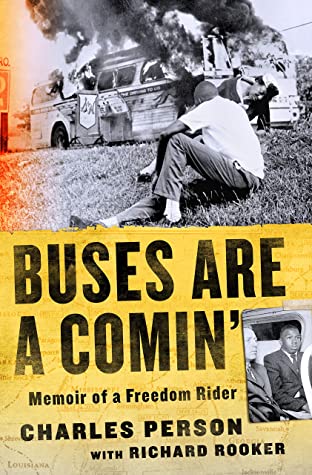
Buses Are a Comin’, by Charles Person and Richard Rooker*****

I’ve read my share of Civil Rights memoirs, and this is one of the best. My thanks go to Net Galley and St. Martin’s Press for the review copy. This book is for sale now.

Charles Person grew up in an all-Black Atlanta neighborhood in the 1950s and 60s. At the story’s outset, he describes how sleeping arrangements were juggled inside their two-room apartment, with four family members sleeping in the front room, and three, himself among them, back in the kitchen. Since everyone in the neighborhood had roughly the same economic standing, it didn’t occur to Person that his family might be considered poor. He was at the top of his class academically, college-bound. His family were faithful church goers, and his father worked two-plus jobs to provide the bare necessities, but they never went hungry. It was only later, when his neighborhood was featured on a news program addressing “Urban blight,” that he learned that the place he loved and called home was part of a “tenement.” The overall tone of his home life is set at the beginning, when he describes an incident from childhood. He and another child stole peaches off of a neighbor’s tree, and his mother marches them to the door, makes them confess—which meant looking the owner in the eye and using the word “stole,” rather than a softer euphemism—and pay for the fruit they ate. Thus we know there’s a definite moral compass here.

It isn’t until he’s grown that Person learns about racism. He gets his first job at a bowling alley, and he learns what parts of that place and the surrounding businesses he is allowed to access, and which are for whites only. Later, he insists on sending his test scores and application to a Georgia university, knowing his marks are excellent, but is notified by mail that the school will not admit Negro (the accepted term at the time) students. As the lunch counter sit-ins in North Carolina draw headlines, Person becomes part of a local student effort to end segregation at the lunch counters in their area. Person is thrown in jail, and when he is released a short time later, he is experienced, primed, and ready for more.

The story of Person’s life, and of the Freedom Rides, which make up most of the memoir, is riveting. It’s told in first person, in a you-are-there kind of narrative that drew me in. I listened to part of this story using the audio book that I borrowed from Seattle Bibliocommons, but although the reader generally does a serviceable job with the text, I recommend the print version. I winced when the reader mispronounced “mimeograph”; there are no mimes in there, honey. But mostly, there are a lot of freedom songs interspersing the story, as the riders sing in jail, sing in the bus, sing, sing, and sing some more, and I don’t know about you, but it sets my teeth on edge when in the audio version the lyrics are simply read, with or without rhythm. Many of these are well-known songs, and if I see the words on the page, I will hear the music in my head. Listening to someone recite the words in a bloodless, wooden recitation is just sad.

For anyone that misses the connection, Person draws the connection between the Freedom Rides and the struggle of the present:

“It is sixty years later, and politicians do the same today when the devalue and disrespect important African-American societal concerns by turning Black Lives Matter into All Lives Matter. Of course, all lives matter. No one argues against that, but changing the issue from “Black” to “All” steals the legitimacy of a vital concern that needs political attention and a political solution. The intentional and insidious shifting on an issue through language is a calculated move. It was by [Georgia Governor] Vandiver in 1960, and it is today. It avoids and insults at the same time.”

There is no better time to learn the lessons of the Civil Rights Movement of the mid-1900s, and apply them to the struggle against racist cop brutality in the present. If this subject makes you sit up a little straighter, you need this book. Of course, it’s also great reading for anyone that likes a good memoir, but even so, read it actively. There’s so much more work to be done.

The Dead Are Arising, by Les Payne*

I haven’t been this disappointed in a long time. From the moment I saw this book listed on Net Galley, I was eager to read it, given that the promotion promises a lot of new information about this courageous man, a powerful advocate for the rights of people of color. When I didn’t receive a galley, I awaited the book’s release, and I went out and bought it. Less than halfway into it, I was absolutely sickened.

For starters, not all new information is important or necessary information. There’s a lot of minutiae here, as well as a fair amount of Black History 101 material, interesting to those unfamiliar with the Civil Rights Movement, Jim Crow, Northern red-lining practices, and so forth, but a real snore for those of us already steeped in these things. But beyond that—and one could argue that these historical basics are necessary inclusions for a lot of readers—Paine goes to a great deal of trouble to destroy Malcolm’s legacy.

Academics do this sometimes, and surely it’s no coincidence that the top three examples that come to mind are all biographies of African-Americans that fought for their rights, and aren’t alive now to object to what is being said about them. (In addition to Malcolm, recent biographies of Frederick Douglass and Muhammad Ali come to mind, the latter two slandered by two different authors.) Picking through the tiny, often insignificant details of their lives and combing through their speeches and writing, these authors go to great pains to “expose” small details that conflict with one another, or other signs of inconsistency, with the clear implication that the subject was a liar and a fraud.

For shame!  

Let’s talk about that for a minute. I am a grandmother myself, and I can think of important aspects of my life, especially my younger years, for which my own motivations were and are complicated, and if asked about them I am sure I would have given different answers in my twenties, my thirties, and so on. Our own thoughts and motives have a lot of layers. Perhaps we become more insightful later in life, or perhaps our memories are no longer as sharp as we believe them to be. But because we are not famous, or notorious, depending upon points of view, we are unlikely to have some academic interviewing everyone that ever fucking knew us, or combing through every speck of written documentation we leave behind us, searching for all possible details that may bring our integrity and veracity into question.

For me, it matters very little whether Malcolm’s early life was exactly as he told it. It is his ideas, and his courage in expressing them, that made him a legend, and that’s what I look for in his biography. In the 1960s, almost no African-American (or colored, as they preferred to be called during that period,) Civil Rights advocates dared to come right out and say that Black people were not only as good, but in some cases better than Caucasians. And it is Malcolm’s political evolution during the last year of his life, the time when he broke with the Nation of Islam and embraced a working class perspective that included fighters of every race, that galvanizes me. Malcolm raised a powerful voice in opposition to the U.S. war against the Vietnamese people, quipping after President Kennedy’s assassination that it was a case of “chickens coming home to roost.”

This takedown of an iconic Civil Rights warrior is shabby in every sense. For those interested in Malcolm’s political and social evolution, I recommend the book titled Malcolm X: The Last Speeches. Usually, the best way to learn about someone is to see what they themselves had to say. In this case it’s doubly true.

I don’t recommend this book to anyone.

Well-Read Black Girl, by Glory Edim, editor****

Ahem. Yes, I am in fact, over two years late with this review. I can explain.

My dog ate…no, wait. I got a flat tire when…oh. Yeah, that doesn’t work.

So now I have to tell the truth, having failed miserably, as I usually do, at lying. Here it is. About a month after I received the galley to this book, courtesy of Net Galley and Random House, national news and social media went into a virtual frenzy discussing cultural appropriation. And I froze. I started examining everything I did through that lens, and I may have gone overboard. I looked at this galley and I thought, I have no right to review this thing. And when I read the introduction anyway, I feel it even more so. Not written with me in mind, was it? Was this the literary equivalent of reading someone else’s mail? And so I did the easy thing, which was to shove it onto the back burner and read something else. Repeatedly.  

Several months later, it occurred to me that nobody would even have to know if I were to sneak it out of my files and just read the article by Jesmyn Ward, which was actually why I had originally requested it. Ward is on my read-anything list. I read it, and I liked it, and then I shuffled it back into the file. No harm done.

This spring, as the world tentatively emerges, one hopeful toe at a time, from the isolation imposed on all of us by the horrific pandemic, I realize what I should have known all along: that anybody can read anything, and form an opinion about it; and that since I was granted the galley, I actually owe a review. I straightened my spine, dusted myself off, and sat down to read it. There was no blinding light or thunder from the heavens. Nothing smote me. I read it, and I lived to tell the tale.

Most of the authors here are new to me; in addition to Ward, I also know Jacqueline Woodson’s work a bit, mostly from my years teaching language arts, when I used her YA book. Everyone here included in this compendium is a strong writer, and they are largely preaching to the choir, since the audience are also bibliophiles. But the common thread, the point they drive home—and rightly so—is the importance of finding literature about girls that look like themselves. They speak of it as empowerment and validation.

Back in the stone age, when this reviewer was enrolled in a teacher education program, we were likewise taught the importance of inclusive literature. It seemed so obvious to me, this obligation teachers surely have to make sure all of their students are represented in the books their students read, or have read to them. I figured it was a no-brainer. But when I arrived at my first teaching position in elementary school, (heaven help me and those children both,) I was shown the supply closet and there were the classroom book sets. The main characters were Caucasian boys; Caucasian boys and girls; fluffy woodland animals, mostly male; and more Caucasian boys. I sadly examined my battered Visa card and drove to the bookstore to order better books. And I was further amazed to learn, later, that my colleagues, all of whom were Caucasian, believed that the school’s book collection was terrific. Their students loved those books, and that included the children of color that made up approximately half of the population there, they told me.

Sure they did.

The essays in Well-Read Black Girl are a much-needed reminder that racism isn’t always overt; sometimes racism is exclusionary, unintentionally so. And what silences young voices, and what teaches children that books, and life in general, are not about them, worse than discovering that they are not important enough to be included in books?

When I moved to secondary education, where I belonged, I visited the book room there, and I found a set of books about African-American boys, but the message inherent was that they are constantly exposed to drugs and gangs, and it will be hard as heck not to be drawn in. And once again, I scratched my head. These Black kids, most of them were from middle class homes, or loving, well supervised working class homes. Drugs? Not so much. And what did these books teach their Caucasian classmates about Black people? I sighed and got back in the car, already apologizing silently to my Visa once more.

This collection of essays is important, not because of any particular brilliance in composition; they are well written, but not memorable for the writing itself. Instead, they are the key to understanding, from primary sources, why Black girls need books that depict Black girls and women in a positive light.

I’ve assigned four stars to this book for general audiences, but for teachers in training, it is five stars. Every teacher training program should include these essays as required reading. We have to read it until we get it right.

The Water Dancer, by Ta-Nehisi Coates****

By now, nearly everyone that loves reading has heard of this debut novel by one of the century’s most celebrated writers. Not every strong journalist can also write fiction, but Coates can. I read it free and early thanks to Net Galley and Random House. It’s for sale now.

The concept is a strong one. Why have we seen so little historical fiction set during the period just before the American Civil War and from the point of view of a slave? In an earlier essay Coates has pointed out that African-Americans need to reclaim this time period, that shrinking back from studying it is in a way a concession that shouldn’t be given. That’s the perspective on which this novel is built. It isn’t an easy read by any means; readers need strong literacy skills and a cast iron gut. The level of pain and violence—especially at the outset—is wrenching, and it should be. I took a long time to read this book because I could only swallow it in small portions. You may not want it for mealtime or bedtime reading.

Our protagonist is Hiram Walker, and he is the progeny of an enslaved mother and the plantation’s owner. Hiram is strong, capable, and attractive. When his father pulls him from the “tasked” and brings him home, other slaves warn him to be on his guard; he will never be considered a full member of this family, and he’ll never be considered an equal with Maynard, his Caucasian half-brother whose work ethic, talent, and intelligence could fit together in a thimble with room to spare. Hiram is assigned to prevent Maynard from going off the rails; however, since the authority runs in the opposite direction, Hiram is ultimately unable to save Maynard, who drowns after overindulging.

Hiram has an unusual gift, a supernatural talent that lends interest to the story without becoming its central focus.

Ultimately our protagonist is going to have to run for his freedom. During the years just before the Civil War, owners of large plantations in Virginia and the Carolinas find themselves in desperate straits. The land has been badly over farmed, and both cotton and tobacco are demanding crops. The soil is used up; farmland that once produced bountifully is no longer productive. The solution that most of the large owners seize is to expand their holdings westward. Vast numbers of slaves are either sold and sent to the deep South “Natchez Way” or moved there to work for the same owner on different land. Those that go are treated severely, and their families are fragmented without a moment’s hesitation. While some slaves were able to negotiate for their own manumission in earlier years, this option is no longer on the table. Coates does a stellar job keeping this aspect of his story consistent with historical fact.

Hiram’s escape is ultimately successful after a number of nightmarish experiences, but he is persuaded to return and to assist in the Underground Railroad, and he does so partly with the goal of freeing those that mean the most to him. Along the way he meets Harriet Tubman, and the way Coates depicts her is credible and fascinating. But the thing I love most, apart from the story’s basis and the eloquent word-smithery that shines here and there, is the way Coates condemns the hypocrisy, the culture of the slaveowner that makes the most horrible men able to look at themselves in the mirror and like what they see:

For it is not simply that you are captured by slavery, but by a kind of fraud, which paints its executors as guardians at the gate, staving off African savagery, when it is they themselves who are savages, who are Mordred, who are the Dragon, in Camelot’s clothes. And at that moment of revelation, of understanding, running is not a thought, not even as a dream, but a need, no different than the need to flee a burning house.

My one concern is with the dialogue. This historical tale will spin along beautifully, but then one person will tell another, “Trust me on that,” or “Sounds like a piece of work to me,” and the effect this has on me as a reader is that the spell is broken, and I am no longer transported to the time and place of the story.  And to be sure, everyone that writes historical fiction has to decide how much language of the period to use, and when to use current grammar and sentence composition so that the modern reader can follow it. But this is something that jumps out at me at the beginning, in the middle, and even at the end. I tell myself to forget about it and I immerse myself in the story once more, but then there it is again. No other reviewers seem to have noted this, but a part of me thinks that the braver course would have been for Coates to write this story under a pseudonym, because I suspect that without the famous name attached to it, more genuine criticism about this single, pervasive glitch would have been forthcoming.

Be that as it may, this is one hell of a fine story, and it’s told just when readers need to see it most. I recommend it to you without reservation.

The War Before the War, by Andrew Delbanco****

You may not have had the grades or the money to attend Columbia University, but you can read Professor Delbanco’s book anyway. It’s meaty and interesting, and it clears up some longstanding myths about slavery in the USA. My thanks go to Net Galley and Penguin Random House for the review copy; this book is for sale now. 

At the outset I find this work a little on the slow side, and I wonder if I am in for five hundred pages of drone. Not to worry. By the five percent mark the whole thing wakes up. Slavery from the time of the early European immigrants to the American Civil War is mapped out, and I found myself wishing I had read it before I taught social studies instead of during retirement. Sacred cows are slain and there’s plenty of information that is new to me. For example, I did not know that the number of runaway slaves was always a fairly small, economically of little consequence but powerful in its example. I didn’t know that Caucasian people were retaliated against sometimes by sending them into slavery; since one couldn’t tell a person with a tiny amount of African-American heritage from a white person, it was possible to lie about someone whose roots were entirely European and send them down south. And although I understood that the great Frederick Douglass was hugely influential, I hadn’t understood the power of the slave narrative as a genre: 

“When [slave narratives] were first published, they were weapons in a war just begun. Today they belong to a vast literature devoted to every aspect of the slave system–proof, in one sense, of how far we have come, but evidence, too, of the impassable gulf between the antebellum readers whom they shocked by revealing a hidden world .and current readers, for whom they are archival records of a world long gone. Consigned to college reading lists, the slave narratives, which were once urgent calls to action, now furnish occasions for competitive grieving in the safety of retrospect.”

It is painful to envision a roomful of young people flipping through their phones or napping during a lecture or discussion about this damning aspect of U.S. history that haunts us even today; and yet I know it happens, because I have seen it among the teenagers I have taught. I want to roar, “Where’s your sense of outrage?” And yet it’s there; but many that are activists against cop violence and other modern civil rights issues haven’t yet made the connection between the present and our national origins. So I feel this guy’s pain. 

For the interested reader of history, the narrative flows well and the documentation is thorough and beyond reproach. Delbanco has a sharp, perceptive sense of humor and this keeps the reader further engaged. 

I recommend this book as an essential addition to the home or classroom library of every history teacher and reader.