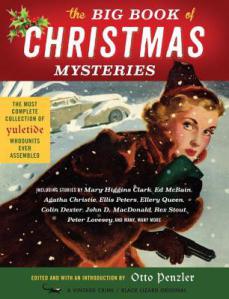
The Big Book of Christmas Mysteries, by Otto Penzler *****

Today I will be in the kitchen making the family’s feast, and tomorrow I will be opening presents, then lying around like a beached whale in recovery. Of all the Christmas books out there for adults, I think this is my favorite that is still in print, so I’m re-blogging it. Sorry about the sloppy juxtaposition of book jacket and text; couldn’t fix it for some reason.

seattlebookmama's avatarSeattle Book Mama

TheBigBookofXmas

I received this wonderful collection last year as an ARC from the “first read” program via the Goodreads.com giveaways. At the time, I didn’t have a blog; I reviewed it on Goodreads and because I liked it so well, I also reviewed it on amazon. Then, while I was on the site, I bought two copies to give as gifts. I have never done that with an ARC before or since (so far), but it is so wonderful that I wanted others to have it, and I wasn’t willing to share mine.

Now the season is upon us. This blog will be punctuated by worthwhile Christmas books of a secular variety. I guess it is a typical retired-teacher behavior to decorate my home with brightly jacketed Christmas books when others are getting out their craft supplies and hot glue guns. At any rate, if you buy just one Christmas book…

View original post 491 more words

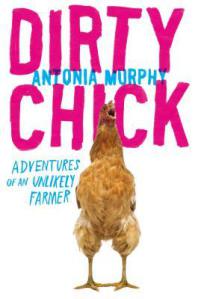
Dirty Chick: Adventures of an Unlikely Farmer, by Antonia Murphy *****

My most recent read turned out to be a dud, and I won’t put any stinking two-star books on this blog. So today, instead of sharing a book that isn’t worth your time, I am reblogging this extremely droll (and very well written) book, which will be released next month. Put in an order for a copy, or keep your eyeballs peeled! It’s a good one.

seattlebookmama's avatarSeattle Book Mama

dirty chickWriting humor is risky business. If one writes mainstream fiction or nonfiction and the book is not well reviewed, of course it hurts–writing is always personal, at some level–but few things are as painful as the I-thought-this-was-going-to-be-funny review. In writing about her own family and friends, albeit with a few small changes to protect the privacy of the individuals concerned, Antonia Murphy takes her bleeding heart in her own two hands and offers it up to the public for consumption.

Personally, I have never laughed so hard in my life, or at least not recently. My thanks go to her and to the Goodreads first reads program for the ARC.

If my earlier reference to Murphy and the bleeding heart made you wince, you won’t want to read her book, either, because it has lots of gooey, graphic, gross stuff in it. It is edgy humor out there on the…

View original post 786 more words

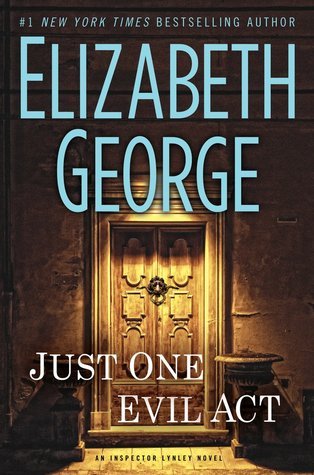
Just One Evil Act, by Elizabeth George *****

justoneevilact Barbara Havers has gone in over her head, and the morass into which she has slogged out of love and friendship is only getting deeper.

I’m a long time fan of Elizabeth George, a writer I would never have tried on my own initiative, preferring stories that star working class heroes, but one of her early works was given to me at Christmas one year, and I was sucked in by her combination of palpable settings rendered in a painterly fashion, and what at times is intense, tightly plotted crime fiction.

Every writer who maintains a successful mystery/crime/detective series of any length faces a conundrum, sooner or later. For the sake of a good story, they’ve already been forced to twist the real lives of their police officers (or their whoever) to make them more exciting, but in the beginning, it’s easier for the reader, who also wants a good yarn, to buy the premise. Sure, someone might become a hostage, or be forced to dig their own grave while the minutes tick by and we wait for the cavalry to charge in and save the protagonist. Certainly, a person could be pistol-whipped and stuffed into the trunk of a car.

But to no one will these things happen over, and over, and over. Eventually even the most faithful reading audience will roll their eyes and say, “What, again? Oh, I don’t think so.”

There appear to be two successful ways around this, and the author can utilize one or both and if they are skillful, they can keep their series going strong. Noteworthy writers like Sue Grafton, James Lee Burke, Sara Paretsky, Ed McBain, GM Ford, and a host of others have carried them off well.

One way to keep the string going is to create stories that are not only thrillers or mysteries, but are more novel-like in many ways. The protagonist’s personal life is further developed, and if this is done successfully, it gives us still more buy-in to the mystery plot into which it is woven. And here, George has been more successful at some times than others. There is always the danger that in presenting us with the protagonist’s deepest emotions, the story can turn into a soap opera. Mystery readers don’t need the corn. They’ll pass on the series if the writer crosses a line or is not credible. But referring back to most of the writers in the list above–and if you love a good mystery series, you can probably name others–it’s clear that it can be done.

The other way to keep the string active without burning out the protagonist is to further develop secondary characters and turn them into protagonists themselves. I have been greatly cheered to see George develop both Winston Nkata and Barbara Havers in this manner; this particular book has original protagonist Thomas Lynley working in the shadows, and his life pops up from time to time as well in ways I found appealing, but the chief protagonist of this work is Barbara Havers.

And Havers is beyond question a working class protagonist. She came from no money whatsoever, and her only living family is her mother, who is in a care home and partially dependent upon Barbara, whom she does not even recognize any longer. It’s one lonely life. What do such people do? They may become self-absorbed or clinically depressed, or both. Or they may get by with a little help from their friends.

And this is the crux of this particular episode, #18 in the Lynley series. (No ARC here; I got my copy from the library, but would otherwise have requested it at Christmas.) Havers has long had a friendly relationship with Lynley, her former partner. He’s a lovely bloke, but he doesn’t come from the same side of the tracks as she does, and there are definite limits to their friendship. His love life, and hers if she had one, are not up for discussion.

Her closest friend is her neighbor, Taymullah Azhar, and his daughter, Hadiyyah, a precocious nine-year-old who has become nearly a surrogate daughter to Havers. The two of them are often the bright spot at the end of a long, often thankless day at work.

When Hadiyyah is kidnapped, Havers is beside herself. She has to help. When her boss tells her that she is to stay away from this investigation, from which she has absolutely no professional distance, she looks for ways around the order. She can investigate when she is off-duty, right? Except she uses her police credentials to open doors. Well, she probably would not be the first.

But again, and again, and again she pushes the margin of what she may do and keep her job. The result is a tightly packed psychological thriller that at times kept me awake. Was that really 700 pages? It surely didn’t seem that long!

Because it is so easy to relate to Havers, the reader is likely to feel that frustration, the one we felt when we went to the horror movie at the local theater. You know the scenario I mean: the two youngsters are out on a date and they’re caught in the rain. There is no shelter anywhere in sight except for a house that appears to be empty. The rain pours down, and the background music takes on minor strains. We say to the teenagers, “Don’t go in the old dark house! Don’t do it! Better wet than dead. Don’t turn that doorknob!”

And here we are. Havers does, metaphorically of course, go into that house, the one with no lights and things that go bump in the dark. And all sorts of interesting ethical issues bump up against her.

When is lying to your boss justified? Well, that’s not so hard…but what about lying to a friend? What if, in lying to one friend, one may save the life of another…but the life of the friend to whom you have lied may be damaged? When should journalists be called in, even if they cannot be trusted not to assassinate the character of an innocent individual while carrying out your important mission? What if there does not appear to be any other way to save a life? To stop a killer?

I was surprised to read some fairly vicious reviews of this novel. I loved it, for the outstanding manner in which setting was incorporated so palpably without slowing the course of the plot; for the development of characters (and Isabelle Ardery, boss back at Scotland Yard, is another). And I enjoyed the ambiguity of the questions it raised.

Immensely satisfying, and highly recommended.

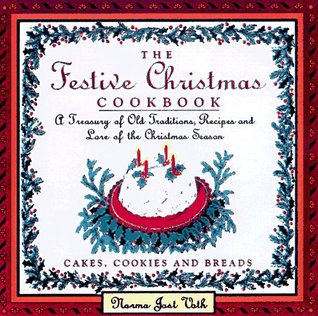
The Festive Christmas Book, by Norma Jost Voth ****

Where have I been, you may wonder. The truth is, I have been swallowed up not only in the holiday season, but also by the most recent bio of Napoleon, which clocks in at 993 pages, and Elizabeth George’s Just One Evil Act, which is over 700.

Meanwhile, I thought I would take a fond trip down memory lane and tell you about one of my favorite Christmas books. It is not newly published, but a person can get anything on the internet these days, and it makes a wonderful gift also. And hey…you just never know when you may need to make dinner for eighty people! How many cookbooks can tell you how to do that?

This was given to me at Christmas nearly 20 years ago by a really good friend.

thefestivechristmasbookAs a cookbook (or primarily, a baking book) I haven’t found it all that useful. Of course, by the time I got it, I had enough cookbooks, baking books, and related volumes (barbecue, confections, and so on) to fill a six-shelf bookcase. Perhaps if I’d received this one without already knowing what to do over the holidays, I’d have used it more.

The main joys this little treasure represents are the stories that precede each set of recipes. The recipes are broken down according to cakes, cookies, and breads “of Christmas”, and this essentially means that the recipes all come from Europe and the USA, with a couple of brief nods elsewhere. (At least the authors do not claim it represents the whole world, as some Euro-centric compilations have been known to do.)

There are stories that either go with, or precede, many of the recipes. And that is why my friend gave this to me, and why I have kept it over many moves of house since then, paring my cookbook collection down to less than half its former self. When I don’t really feel like hitting the kitchen so much as curling up in a cozy armchair thinking about baking, this is a lovely (and aesthetically rendered) little volume. There’s a lot more chat to it than any ordinary cookbook, and it is just right to fit comfortably in one’s hand.

Charming!

Here’s what is good (to me) about the recipes, just in reading them. NONE of them uses a pre-packaged mix as an “ingredient”. If a person wants to buy cookie dough already in a roll in the supermarket’s refrigerator section, let them go do it, and likewise cake and cookie mixes. These should not form the basis for a scratch recipe, to my way of thinking.

In the end, the part I liked–stories, lore, culture–were the bits that I needed, having already been handed down a score of family recipes that I already love.

For stories and recipes from the Old Order Amish (dinner for 80), the Greeks,Irish,Scandinavians,Germans, Moravians, Polish, and a few from Mexico as well, curl up and enjoy. And a note to those newly in charge of a celebration: don’t try to do everything! A little goes a long way.

Victorian Murderesses, by Mary S. Hartman ****

victorianmurderessesIt took me awhile to decide to include this title on my blog. The problem as I saw it was that it was marketed in October as a fun-but-naughty romp through history. The reality is less interesting, and to my eye, unbelievably dry. My daughter, a high school student, saw it differently. The four stars are our compromise between my three stars and her five.

“True crime” is a big house with a whole lot of rooms. Some true crime books are deliciously prurient; others are as dusty as the top of a ten foot tall bookcase. In this case, the title (“unspeakable”) and the jacket artist lead the reader to believe we are really going to get down and dish the dirt, and what is more…it’s all true!

Instead, what we have here is a very well-written, well-documented, extremely scholarly if surprisingly dull bit of research, maybe the author’s advanced degree work. The collision between the teaser and the product are somewhat jarring. This was a First Read sent me free through the Goodreads program and the publisher. I would have abandoned it more readily had I not felt a duty to get through it.

What would have fit the bill without ruining the author’s hard work is a good piece of juicy narrative nonfiction. Put in the documentation, but pick up the pace! As is, the book is sometimes a feminist treatise that all but blames Victorian society’s social contract for slut-shaming as an understandable excuse for murder in the case of unsuitable, unmarriageable mates of the lower classes (sorry, no sympathy here), or a self-defensive maneuver against constant verbal abuse, without the loss of a high standard of living that came with the ornery groom. A baby born out of wedlock gets snuffed when an abortion can’t be obtained. The author is inexplicably sympathetic to the not-for-long-I’m-not young mother. Don’t get me wrong; I am pro-choice and an ardent feminist, which you already know if you’ve been reading my blog long. But we’re talking about an infant carried to term, birthed, then suffocated. It turns my stomach to think of it.

At other times, the pace quickens a bit, as if the author is about to get excited and take us along with her, but then her dispassionate researcher’s mind grabs hold of her–stop it right now, you’re getting worked up!–and we go back to the librarian’s hushed monotone.

The font, while suitably Victorian, is really tiny and hard on the eyes.

It may be that I am being unfair to Hartman; she has done a good deal of work here, and the fault may lie with Dover or whoever is publishing and promoting her work. All I know is that I expected this to be a fun read, and it wasn’t. I kept pushing it away in favor of other reading, as if postponing the book might make me like it better once I returned to it.

My daughter, on the other hand, took it to a corner and became disconcertingly fascinated by it, not unlike a cat who’s just found an aquarium full of fish. Hmmm! Her explanation: “It’s even better than I expected!” Well…okay. And now, it’s HER galley.

A strong, scholarly effort that should have been marketed as such. Not a Halloween read.

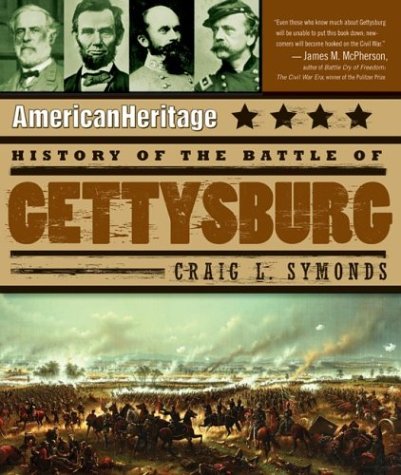
History of the Battle of Gettysburg, by Craig Symonds *****

historyofbattleofgettysburg Ordinarily I have little patience for anyone who picks up a book on US military history and just wants to look at the pictures.

But I read the text. In most places it’s fine, but once you start reading McPherson and Sears on Gettysburg, there isn’t much that Symond’s text will tell you that’s new. Symonds sticks to the basics, and he gives you the brass tacks, if you want to cut to the chase. He is the retired chair of the US Naval Academy. His background speaks for itself, and he is highly lauded as a Civil War scholar.

And look at the pictures!

The American Civil War was the first US war that had photography available. No, they couldn’t take action shots yet; the subject had to remain stationary for too long at a time for that to work. But there are a lot of primary documents here, photographs of leaders, of letters and memos as they were originally written (with the text beneath them if illegible; spelling was pretty much a discretionary practice back then). There are photos of battlefields with men still lying on them. (It is now considered a breach of national security for the press to go to Afghanistan and shoot photographs of US troops, whether in action or in closed coffins, for the American public to see.) There are photographs of the weapons available at the time, and of landscapes you can visit today that look nothing like they did then.

Look at the pictures!

My favorite is a full page photograph of Lincoln. His bow tie is dusty, faded, and crooked. His hair cut is terrible. His face is creased, and it bears the hardship of many sleepless nights, and perhaps also of the death of his son and the illness of his wife. It is a picture of a real person, long before the era when presidents became packaged goods to be marketed to the American public.

I have sometimes felt bad about the fact that I will likely never visit the Smithsonian. It is the dream of all serious students of American history. But my legs won’t let me get far now, and an airport is accessible only if I use the wheelchair service, which makes me feel quite conspicuous. It’s far easier to stay home and read.

This book, which I purchased some time ago in hard cover, will hold a place of pride on my bookshelves for many years to come. Primary sources aren’t that easily come by. Along with Sherman’s and Grant’s memoirs, this is an important addition to my Civil War library.

Betrayal of Trust, by J.A. Jance *****

betrayaloftrust Jance’s JP Beaumont detective series is one of my all-time favorites. Set (usually) in my own home town, it carries a gritty yet human, thoroughly believable flavor that I just can’t find anywhere else.

In this case, Beaumont is roped into a scandal unfolding at the governor’s mansion; it turns out he knows the governor. She was the girl who was too important to talk to him in high school, but now she wants his skill in discreetly looking into some things she’d rather not see on the front page.

It doesn’t work out that way.

This title has been re-released, and so I accidentally read this twice, but even once I had realized my error, I decided to plow through and finish it a second time. It wasn’t that I had no other books; but this series is on my very short list of things I don’t mind seeing a second time around.

Highly recommended to anyone who enjoys good detective fiction.

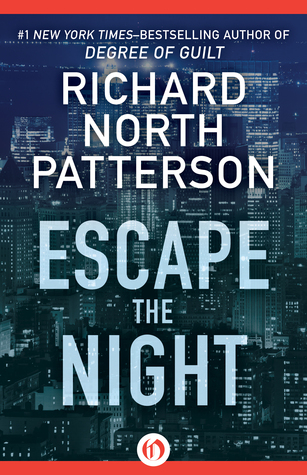
Escape the Night, by Richard Patterson ****

EscapethenightEscape the night? Envision being trapped in a tunnel, inside of a tunnel, inside of a tunnel. Some are metaphoric or symbolic, but there’s a whole lot of darkness in this espionage thriller, a suspenseful tale that will play with your head more than once before the author is done. Thank you to Net Galley and Open Road Media for the ARC.

The setting at the outset is New York City during the McCarthy era. Black Jack Carey owns a publishing house that carries work by a left-leaning writer that is being watched by the CIA. Pressure from HUAC comes to scrap the writer’s work. Son Charles, eldest and best-loved son of Black Jack, refuses to yield to the pressure. Resentful younger son Philip, weaker in character and more easily swayed, takes the side of the government. He hopes his sensible nature will cause his father to will Van Dreelen and Carey to him rather than Charles.

At multiple places within this white-knuckle thriller, I had to put the book away because even with the assistance of sleeping pills, I knew I could not fall asleep if this story was in my hands. Were it not for that, I surely would have finished it sooner. This title along with a nonfiction galley have occupied my interest and attention far more than any of the other four books I’ve been reading.

Our villain, a well-drawn government spook named John Joseph Englehardt, becomes obsessed with the Carey family:

“Englehardt had learned that men who spied on other men, out of the loneliness of such a job, came to like or dislike their chosen quarry. But in his soul, he knew that the secret passion for the Careys grew from something stronger.

“The brothers’ rivalry was also his.”

Eventually Englehardt is officially ordered to abandon the Careys, but his psychosis is too thoroughly developed to let go. He turns to the CIA and is able to extend his surveillance. Phillip Carey’s cause has become his own. He despises Charles and is determined to do whatever dark thing is necessary for Phillip to inherit everything.

Generally speaking, I don’t read books about wealthy folk, and this is for a variety of reasons I won’t go into here. But the characters of John, Phillip, Englehardt, and later, Peter Carey, are so intimately sculpted that I had to buy the author’s premise. Once I did so, the pace picked up and the story was unstoppable.

The ending came with hairpin turns and swift kicks to the reader’s solar plexus, but everything that occurred seemed eminently believable, because the main characters and setting were so palpable.

My one small quibble with the writer–and it’s a common problem in literature not specifically geared toward women, but someone has to talk about it–is that the people who were well developed and occupied center stage were all men. Women existed here only as a foil for what was going to happen to someone else. For the novel to go beyond “really good” to “outstanding”, a novelist needs to be able to develop characters of both genders.

That shouldn’t keep you from buying this title, though. It’s one helluva ride. But don’t think you’re going to read it in small easy pieces. Once you pass a certain point, you have to keep going, and you may see the new day dawning and wonder where the night went.

Also, you’ll want to avoid tunnels for awhile.

The Hurried Child, by Dr. David Elkind ****

thehurriedchildI’m using today’s book review to revisit a previously published book. I think it’s valuable to both parents and educators. Recently I’ve seen some reality TV competitions in which girls in their middle teens were dressed up to look like they were twenty-five. Sometimes that’s a judgment call, I guess, but this brief but authoritative book reminds us that it’s important to let kids be kids, and that when our girls feel rushed to become women, they may later thank us if we remind them to slow it down a bit.

To put it another way folks, don’t put mascara on your twelve-year-old, and don’t buy it for her, either.

Elkind makes a lot of really strong points here. This book is more geared toward those who are raising children (parent/guardians…so many, many grandparents raising kids these days!) than toward educators, who follow the school or district’s policies regardless, but since teachers often influence the choices made by the children they teach, it’s worth reading whether you have children in your home, your classroom, or both.

The last chapter draws a lot of extremely conservative conclusions with which I would not care to be associated, and this is why the final star is denied. However, in this day and age in which kids in fifth grade come home and announce they have a boyfriend, in which teensy children are packed off to beauty contests carefully coiffed, manicured, and covered in cosmetics, this is a breath of healthy, let’s-get-real common sense.

If you are a parent who is not sure what children should do as they move past early childhood, or if you have questions about adolescents, this is a good read. Sadly, the people who should most read this book probably won’t, and those who are already doing a pretty decent job probably will.

Still, highly recommended.

A Note Between Reviews

I am stepping outside my usual format for a day to let you know of a wonderful opportunity, if you haven’t caught wind of it elsewhere. (I can’t review a book today anyway, since I am still marching through Napoleon and halfway through a few novels.) But here it is:

Author Sara Paretsky, one of my all time favorite writers, posted on social media that if you tweet or Facebook post a book you are giving this holiday season along with the hashtag # GiveaBook, Random House Penguin will donate to Save the Children.

For me, this is a no-brainer. My whole family knows that unless they are that rare bird, the non-reader, they will be getting a book from me this year. I posted some I am giving and a couple more I wish I could give, if only I could match the brilliant book with the right recipient. You can do this as many times as your heart allows.

So if you wish you could give liberally to a good cause but are constricted by your bank balance, here’s one painless, actually kind of fun way to contribute to the greater good. Your title does not have to be a Random House title; it can be any book at all.

Why not? And if you’d like, just for giggles, feel free to post your titles in the comment section of this blog, too! I’d love to see what titles others are giving.