
 I was drawn to this title because it deals with the Civil Rights movement. Fifty years have gone by since the pivotal events of that time, and now, as a second movement unfolds in response to the disproportionate jailing of African-Americans and out-of-control cop violence, it seemed like a good choice. I have no particular interest in Mississippi as opposed to any other part of the USA, and absolutely no interest in the Methodist church, but I was willing to slog through the various ins and outs of church history in order to find the nuggets that were salient to the political struggle. Thank you to Net Galley and Oxford University Press for the DRC. I’ve rated this book, which reads as if it was perhaps someone’s thesis at some point, a 3.5 for general interest levels, but for those with a particular interest in Methodist history or the history of Mississippi, I suspect it would rate five stars.
Methodists take great pride in having participated in the Underground Railroad prior to the American Civil War, and George takes the church to task for having failed so miserably in upholding this standard following Reconstruction. As Jim Crow laws became the rule of the south, Caucasian Methodists in Mississippi closed their doors to African-American worshippers, and the central church administration, after a certain amount of struggle, folded like a card table. Separate churches became the law of the land. Only in recent years has this changed, and even then, change has been slow.
Neshoba County is of particular interest to Civil Rights scholars because it is there that the Freedom Riders, in addition to countless local black voters that opened their homes to Civil Rights activists and helped run the Freedom School, were murdered by the Klan and the cops; it was opened in the (black) Longsdale Methodist church to assist black voters in running the gauntlet of red tape and assorted obstacles through which its citizens had to pass in order to use the power of the ballot. In contrast to Longsdale, the Neshoba County town of Philadelphia is overwhelmingly Caucasian, and its vicious racism, along with that of most of white Mississippi, was a tough nut to crack. There has been progress made, but much work yet to be done.
I was aghast to see that 96 percent of white Mississippians supported the continuation of Jim Crow laws, and it was because of their conspiracy to keep the Old South in entirely white hands that it was nearly impossible to bring the killers of the Civil Rights workers to justice. Only recently have its residents been open to change. The Choctaw Indians opened a casino in the area and in doing so created more jobs, and therefore more turnover in those that reside in Neshoba County, and this is partially responsible for recent progress.
Should you go out and spend money on the hard cover book? I guess this depends upon how deep your pockets are, and whether or not you are interested in the history of Mississippi and of Methodism. I am glad I read it, although the recently re-released biography of Dr. King is unquestionably the definitive story of the Civil Rights movement. Still, for those that have the time and interest to read more than one book on the topic, and I hope you do, you could do much worse than to read this interesting study. I’m glad I did.
The Devil Wears Prada, by Lauren Weisberger ****
 The Devil Wears Prada is a fun, light read. By now many readers will have either seen or heard of the movie, and I had too. I tend to create mental pictures of fictional characters, sometimes using actors, and other times inserting the faces of people I have known in real life. In this case, I could not imagine anyone other than Meryl Streep as Miranda Priestly, the boss from hell.
Andrea Sachs has finished college and yearns to write for a big-name magazine, preferably The New Yorker. She stumbles across the opportunity to break into the publishing world as Priestly’s assistant at Runway, a fashion magazine. This is a job with a high rate of turnover, and one can see why from the moment the position commences. There is no such thing as off-the-clock time. Sachs is on call 24-7, often for such trifling things as a gift for Priestly’s snarky twin daughters, or the ubiquitous dry cleaning. If it rains, Sachs is blamed. If a flight is late, Priestly wonders why Sachs couldn’t anticipate this problem and deal with it. Sachs is constantly demeaned and belittled, and she puts up with it because of the immense amount of power Priestly represents in her chosen field.
Sachs watches her relationships flounder as she is constantly required to break personal engagements in order to leap whenever her phone buzzes. She keeps at it knowing that at the end of a year with Priestly, her career in print journalism will either be made or broken by her boss.
The book spins an over-the-top villain at the perfect place in time. The book was published in 2007, and this was a time when the First World had just begun to realize the downside that is inherent in the brave new world of satellite-based communications. People that used to enjoy going on vacation and walking away from their telephone now take it with them, and this is often either a plainly stated part of their job, or a better-safe-than-sorry aspect of damage control. I didn’t have to do this during my twenty years as a public school teacher; so far, teachers really can carve out a part of their time away from the classroom purely for personal privacy and enjoyment. However, my husband is in the tech field, and though work didn’t phone him while he was away, he constantly checked into his work e-mail via laptop computer, insisting that it was better to know if a crisis was unfolding so he could be prepared to meet it upon his return rather than being blindsided and unprepared.
The movie version of the story develops Priestly a bit more and keeps her character from being a cardboard cutout. Unfortunately, the book doesn’t do that. But then, this is not serious literature; this is a romp.
Though many modern professionals are married to their phones and other devices all the time, Weisberger has spun a tale that will make just about anyone gratefully reflect that their own job is better than that. So like horror stories, part of the joy in reading this fluffy beach read is in comparing one’s own life favorably to that of the protagonist.
If you have a generous book-buying budget and want a fun read to pack for your beach trip or an escapist weekend at home, this one is a great choice. If your budget is tighter, try your public library; that’s where I found my copy. Unless you have a schedule like Sachs’s, you likely won’t have difficulty finishing this one by its due date.
Great beach read; fluffy escapist novel.
Blanche Among the Talented Tenth: A Blanche White Mystery, by Barbara Neely ****
“Everybody in the country got color on the brain…white folks trying to brown themselves up and looking down on everything that ain’t white at the same time; black folks puttin’ each other down for being too black; brown folks trying to make sure nobody mistakes them for black; yellow folks trying to convince themselves they’re white.”
Timely? Why yes! So isn’t it interesting that this book was initially published in 1994?
My many thanks go to Net Galley and Brash Books for a fascinating DRC.
 The Blanche White series is a mystery series, but Neely uses this approachable medium as a forum to discuss race, primarily the unspoken caste system that has developed about and among people of color in the United States.
In our story, Blanche is invited to visit a black resort on the coast of Maine. Her sister is dead, and Blanche is now a parent to her two children. This book is the second in the series, and we are told that during the first, Blanche had come away from a bad situation with a bundle of money that she dedicated to the excellent education of her two elementary-aged children. Now Taifa, her daughter, is anxious that she use a hair “relaxer” to straighten her ‘fro. It’s bad enough that Mama Blanche is eggplant-dark. Bad enough that she is not part of the black petit bourgeoisie, but a working class woman…a maid, no less! And so Taifa’s loyalty is divided; she wants to fit in with these pale, wealthy folk, but she also loves her Mama Blanche. Blanche in turn is torn. She doesn’t fry her hair, but she does have a conversation about it with the children.
Meanwhile we learn that a woman named Faith is dead, and it may not have been accidental. Like Agatha Christie’s Murder On the Orient Express, it seems just about everyone here has a reason to want Faith dead. That isn’t Blanche’s business, of course…until it is.
I do love a good mystery, and will cheerfully sit down to a tower of Blanche books if I can find them.
The cover is what drew me initially; I looked at the wide hips and thought this was surely my kind of woman.
But race is more than academically interesting for me; my own family is blended and my Caucasian children grown and gone, which has left me the only white person in the house. Most days I don’t think about it, but for years, planning the family vacation was both eye-opening and interesting. One child at home is Caucasian and Japanese; the other (was) African-American. We enjoyed Yellowstone, but heartily regret having been forced to stop for gas in the Idaho panhandle, an experience we will avoid in the future. Now my African-American son is grown and out of the house, but I will never look at the world the same way. It’s been a real education.
Surely anyone who looks at this book’s title understands that s/he is in for more than just a mystery story. The depth of analysis kept me flagging pages and rereading passages. I love the feminist spirit our hero embodies.
I did find it interesting that although skin, hair, and attitude were discussed freely, African immigrants never even made it into the discussion, let alone into the exclusive resort.
The social message somewhat dominates the plot, but the mystery is also a fun read. Highly recommended for those willing to confront today’s issues.
As for me, I loved the blend of story and message. Because really, until the United States deals with the escalating issue of racial inequality, particularly regarding African-Americans… I can’t breathe.
Home from the Hill, by William Humphrey *****
 Home from the Hill, a National Book Award finalist about to be re-released, is the kind of story that lingers and affects the reader’s mood long after it is over. Upon completing the DRC, I felt a sense of loss that only comes with really splendid literature. So thank you Open Road Integrated Media, and thank you Net Galley for hooking me up. And if the spirit of the late, great author lingers among us, I want to thank him for tearing out my heart and feeding it to me with a spoon. It’s that good.
We know from the get-go that this one won’t end well. We think we are prepared for it. The people that live in that sleepy little Depression-era Texas town are a closed-mouthed lot, but the narrator is telling us things that the stranger in their midst doesn’t know. We know it’s a tragic tale because of this, but later we get so caught up in the magic being spun that we forget ourselves, and we cannot help hoping.
Boomer-gens like this reviewer may find colloquialisms and slang terms they had long forgotten; my own family, some of whom harkened from that neck of the woods, used them liberally some fifty years ago. Between this and the skillful use of setting and character, I felt as if I were sitting in the Captain’s den (though women are really not allowed there) listening to Chauncey spin his hunting stories, ones borne of longstanding oral tradition. I almost fell off the bed when I saw the word “larruping”. I had thought it was an onomatopoeia until I read it. I had forgotten the term entirely, but Humphrey brought it back, and I could hear it in my father’s voice, though he has been dead most of my life.
Ahem. The story. All right, let’s try this: what if Shakespeare had written Romeo and Juliet, but instead of his characters fantasizing and vowing not be Capulet or Montague, they had said, “Well of course, I am a Capulet, and you are a Montague, but we’ll give it time. They’ll come around.” But oh my my my, they would have been so very wrong. Nobody is going to do anything of the sort.
In a sense, Humphrey almost makes Shakespeare seem shallow, because the foundation of his tragic love story is this: we may love someone our families may not prefer, yet we are still what we came from. Even as we strive to be better people, different people than those who bore us and those that came before them, a piece of them remains at the core of what we are.
So although Theron wants to be someone better than his mother and certainly better than his father, it’s just not that simple. He is an independent, whole new person, with his own ideas, dreams, and resolutions…and he is still his father’s son. And he is still Hannah’s lad.
Libby loves her parents dearly, and when things go wrong, it is them she turns to. But of course, there is Theron. She loves him, and nobody else will really do. Surely, in a world made of fine people with the best of intentions, there ought to be a way?
Not so much.
I’ve read a few sad-sack reviews written by former literature students who have whined that they were required to read this in college. I want to smack those people upside the head and tell them to be grateful, and maybe go back and read it again.
All I know for sure is that it not only immersed me in another time and another place…it also reminded me of who I am.
The Refuge, by Sue Henry ***-****
 Sue Henry has two series. One is about Iditarod participant Jessie Arnold. The other is about Maxie McNabb, a widow who travels during Alaska’s coldest season and sometimes at other times also, usually in her Winnebago, and usually in the company of her miniature dachshund, Stretch. As she makes her way around the USA, the reader picks up all sorts of minutiae about the culture, history, flora and fauna of various places in the United States. For those of us who are curious yet sedentary, it’s an added benefit to reading the story, and she works her discoveries in as a natural part of what her character learns, so it doesn’t have the false, abrupt quality of (my pet peeve among cozy mysteries) dropping recipes into stories. *Shudder!* The Refuge, which I obtained free of cost at the local library to lighten up an otherwise heavy-duty reading load, is a Maxie and Stretch book, the third in the series.
I was disappointed to see that Stretch was left out of this book, except for a brief bit at the end. Maxie goes to Hawaii to assist a friend-of-a-friend who is attempting to move herself and her belongings back to Alaska, her original home, from Hawaii. She is laid up with injuries and has two weeks to get out of her rented home. Since Maxie didn’t especially want to go to Hawaii, it seemed odd she would do this for someone that wasn’t a close friend, but she does so, and then finds herself stalked by a strange man, who becomes more menacing as time goes by.
The good thing about this story is that the tone is congenial and the pacing is about right for bedtime. It is interesting yet not so heart-stopping, as some thrillers are, as to affect one’s dreams or ability to go to sleep once the book is set aside.
Once her obligation to this irritating, helpless-behaving woman is dispatched, Maxie has a few days remaining before she can return to Alaska. (Once again, one cannot help wondering, since she yearns to return to her own home and hound, why she doesn’t simply go to the airport and inquire about an earlier flight, but whatever.) She decides to rent a camper and see more of the Big Island, and her sight-seeing adventures include a place known as The Refuge. Historically this was a place built behind a wall of “lava rock” and was considered a sacred place which, if a criminal guilty of a capital crime could reach it without being apprehended, he was considered safe and permitted to live out his days. So it was rather a clever place to have the criminals follow Maxie and her travel guide and companion, and for the showdown to unfold.
As you can probably tell, I would not pay full price for one of these books, and I won’t read the other series after having tried it once and been bored in the extreme by Iditarod details. (If you think this might be interesting try the books, but I have to say that I read one with the same notion and came away glazed.)
Nevertheless, when a low key interlude is needed, Maxie and Stretch (when he is included) fit the bill, at least for me.
Recommended for cozy mystery fans that are ready to buy the premise in return for a soothing bedtime story.
The 19th Wife, by David Ebershoff ****
 Ebershoff is a strong story teller. In The 19th Wife, he weaves the stories of polygamy in and out of one another, often to hilarious result, and at other times thought provoking.
Ann Eliza Young was the 19th wife, at least according to some accounts, of Brigham Young, famous pioneer leader of The Church of Jesus Christ Latter Day Saints, referred to by members as LDS, and to most others as Mormons. Ann Eliza was a rebel, and she left Young, refusing to be stuck in a polygamous marriage. Ebershoff has used this real-life bit of history to create a fictional journal for her and other historical figures that played a role in her life, some of whom were real, and others who weren’t.
The formal prose that he uses in spinning her first person narrative, and that of others in her story, creates a startling juxtaposition with his present-day characters, chief among them Jordan Scott, one of the so-called lost boys who have been booted out of a current day polygamous sect in order to scale down the competition for young, nubile brides so that the old farts can have a greater supply of women. But the geezers didn’t really have to worry about Jordan taking their ladies, since he is gay. So honey, go from the formal speech of religious people in the 19th century, to that of a gay Californian in the year Y2K, and well there you go. The leaps that Habershoff depicts between their speech mannerisms almost have to make you laugh out loud.
I accidentally read this book twice, once around the time it came out, and then, having forgotten I’d already read it and given it away, I got another copy from the library and was almost done by the time deja vu struck.
Both times I read it (oh yes, I remember now) the story and dialogue were drop-dead funny at first, but by the end I just wanted to be done. Since I have a greater than average attention span and am generally fine with a really long book, I took a day to think about why the joy went out of this juicy novel toward the end.
There are two reasons, I think (though it is still a really good tale) that it loses steam. One is that Ebershoff goes from building situations for their hilarity, to trying to solve his character’s problems in a way that makes sense. My own opinion is that if he was starting with chaos–and the set-up is that Jordan’s mother has been framed for murdering his father, and he sets out to Utah in order to rescue her–then he should have stuck with chaos. It’s all outrageous in the beginning, but toward the end we seem to be veering toward a reasonable ending, at least in many ways, and a moral to the story that isn’t needed and is almost out of place.
The other reason is that the toxic waste that is polygamy isn’t something I want to steep in for very long. It’s a little like a trashy tabloid that momentarily excites our curiosity but leaves us feeling a little soiled if we flip through it for too long. For me, then, had this been wrapped up more quickly, the pacing would not have been lost and I could have emerged laughing as hard at the end as I was at the get-go.
All told: a fun romp that could have been even better.
The Kid: The Immortal Life of Ted Williams, by Ben Bradlee Jr. *****
 The Kid is the definitive biography of baseball legend Ted Williams, a hall-of-famer who still holds the record .406 batting average today, though he is (mostly) gone. Carefully documented, fluently told, and brilliantly edited, this baseball bio is not a quick read, yet there is also not a single word in it that is not necessary. Your humble reviewer walked away from the opportunity to receive a DRC, unsure I wanted to mow through over 700 pages with the amount of speed and diligence necessary to fulfill an obligation to the publishers. Recently I was able to get a copy to read at my leisure independently, and have enjoyed a fascinating glimpse at one of the most complicated figures in American sports history.
Williams was a tremendously gifted athlete, one with an intelligent approach who carefully analyzed his vocation and the physics related to it at a time when nobody in baseball was doing that yet. He spent one year in the minors, then went straight to the major leagues and the glory that quickly became his. Williams was an incredible hitter but struggled for a long time as a fielder, back before the “designated hitter” position existed. His career was twice interrupted for military service, and he chose to go down with his flaming fighter plane in Korea rather than risk breaking his legs—and possibly ending his baseball career—by bailing out and parachuting down to safety.
His personality was riddled with contradictions. Politically he was known for his rock-ribbed Republican conservatism, snubbing JFK’s overature but embracing Presidents Nixon, Reagan, and HW Bush. He avoided an endorsement of McCain for the presidency only because “Bush’s kid” was also running, and he wanted to remain loyal to the Bush family.
Yet with regard to race issues, he was among the most liberal. Bradlee says that the “curse of the Bambino”, i.e. the inability of the Boston Red Sox to win a pennant or a ring for a prolonged time period, was actually brought upon the team by its owner’s refusal to integrate the team long after the rest of Major League Baseball had done so. Williams, however, sent a letter of congratulations to Jackie Robinson when he broke the color barrier, and although Williams did not take part in the Civil Rights movement, not seeing it as his place as one who owed allegiance to the owners of his contract, nevertheless encouraged integration when it unfolded and was more welcoming toward Black players than most other Caucasian athletes in Boston. He paid tuition quietly and usually anonymously for promising young athletes on both sides of the color line.
It is speculated that part of this attitude toward minority players was due to his own Mexican heritage (on his mother’s side), but we will never know. He didn’t talk about it.
His antipathy toward the press, and particularly toward the local press, was legendary.
On the other hand, he secretly spent his time off visiting children in cancer units around New England, stipulating only that his time and money must never be publicized, apart from work done for his charity, the Jimmy Fund, which he established for sick kids whose families could not afford medical care.
In addition to being one of the most gifted hitters of all time, Williams was a prodigious, accomplished, avid fisherman, and spent most of his months away from baseball fishing in Florida, Canada, and even Latin America. In fact, everything he approached with great enthusiasm and with an analytical viewpoint, he seemed to master.
His marriages were disastrous, his children dysfunctional. The last years of his life were exploited badly by his only son, John-Henry, and Bradlee suggests, with good cause, that Ted perhaps was trying to make up in his dotage for his failure to guide and raise his children when they were young.
A tremendous scandal broke out at the end of his life when John-Henry sent Ted’s remains to a cryogenic facility to be decapitated and frozen. Denial may not, as Twain said, be “just a river in Egypt”, but some of us take it farther than others. John-Henry (and in time, his sister Claudia) wanted to have the family frozen in the hope they would one day all be thawed; the vagaries of age and disease scientifically reversed; and then they could all be happy together. A daughter from Williams’ first marriage was greatly upset by this and took the matter to the press; she was eventually paid to settle down and go away, but the family’s reputation was ruined beyond redemption.
Bradlee deserves a great deal of credit for his readable yet scholarly narrative. This reader was fascinated by most of Williams’ life story, though I never saw him play. (Readers who are also fishing enthusiasts will be delighted, no doubt, but I am not one, and confess that some of his fishing exploits and achievements left me glassy-eyed.)
Those looking for a strong baseball biography about one of the sport’s greatest players need look no further. The Kid is an absorbing look into both the life of Williams as well as the history of baseball. Recommended for those that love the sport and have the stamina required to read a comprehensive biography.
The Death of the Detective: A Novel, by Mark Smith *****
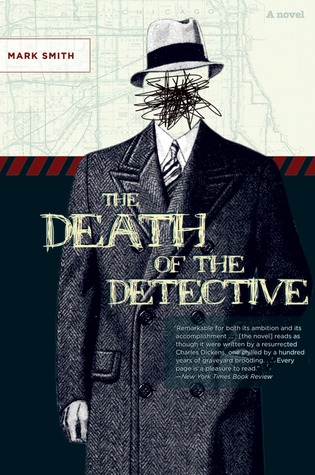 Mark Smith is one helluva writer. The Death of the Detective is complex yet hazy, with a million details both enumerated and obfuscated, not unlike a day in Chicago, the city in which it is set. All told, an enormously satisfying read. Tremendous thanks go to Net Galley and Brash Books for the DRC.
The time period is the post-war era. With the Great Depression well behind it and World War II a recent triumph, the USA is at the pinnacle of its wealth and worldwide power. The Death of the Detective is spun around the lives of a handful of men , all in Chicago during this time period, men whose lives intersect and then trail away from each other, sometimes joining again, and sometimes not. The style is a lot like that last sentence, compound sentences that last a long time and yet build up to something rather than becoming unwieldy. I have never read a voice like his before.
But back to our story. First we have the protagonist, Magnuson. He is retired from his life as the head of a locally famous security firm, and life has not been the same after his wife died. He is depressed. He’s invited old friends over to play cards and perhaps talk about their glory days, but the evening is ruined, because one of them has invited a man he detests without consulting Magnuson first. He is so irritated that eventually he abandons his guests and goes to bed. If only he would stay there!
Next up we have Farquarson, at least for a short time. Farquarson is a wealthy old man, and a mean one. Perhaps it is fortunate that he is dying. Unfortunately, he has just enough time and evil intent to send out a number of extremely unkind messages, some of them whispered, others sent as poison pen letters through the US mail. Once he is gone, his parting actions send things spinning in all sorts of directions, disrupting and ending the lives of good and decent people…and others’ also.
In addition there is Cavan. Cavan has lived his life in the self-absorbed, irresponsible, idly dilettantish manner of a sole heir to a vast fortune. After all, Farquarson has no children, and he is the only nephew. He spends and drinks recklessly while planning his scholarly (and expensive) trip to Africa. His field is anthropology, and his budget is one he assumes to be bottomless. What a surprise he has awaiting him.
Finally, we have our assassin. The man would probably be considered bipolar today; he has delusions of grandeur and a lot of other strange notions too. He was committed to a psychiatric hospital, but then getting over the wall is sometimes just a matter of persistence and athletic ability. Once he is out, he takes on a number of identities, foremost among them, Death. How fortunate, then, that he has wandered into a murder mystery where he can be useful.
At times, Smith’s noir fiction is reminiscent of the late, great Donald Westlake. At one point I was surprised to find myself laughing out loud over a wry turn of events.
Smith’s well-braided story also pulls in additional supporting players with more limited roles. We have a klatch of criminals, members of an organized syndicate, and we also have some hoods that want in and will do terrible things to prove themselves. We have local cops. We also have an assortment of young people associated with Cavan, as well as ordinary people across whose paths our story marches.
Because we’re all in this together, ultimately.
One thing of which the prospective reader should be aware is that the main characters are all Caucasian, and they are generally racist. The “N” word drops in now and then, and although its use is entirely consistent with the characters who are either using it out loud or thinking it—think of white Chicago businessmen and cops during the 1950s and 1960s—it is jarring. Perhaps it would have been more offensive simply to assume, as many writers still do, that characters in the story are all Caucasian; yet I think I would have enjoyed the novel more without that particular word, and perhaps with fewer racist statements and thoughts by the characters involved. This is my sole complaint about what is otherwise a truly outstanding mystery.
Smith is brilliant at conveying the emotions and thoughts of his characters through action. This reviewer was hooked at the end of the first paragraph, when the man in the diner cut his meat and then stole the knife. Smith’s internal dialogues are lengthy but so well done that rather than reacting with impatience, the reader must instead feel as if she is getting extra time with a remarkable story for no extra cost. His facility with figurative language, particularly simile, metaphor, and repetition are so skillful that I found myself flagging pages to share with students I no longer teach. It was both wondrous and disappointing.
I no longer have my students, but I have you, reader, and unlike most of them, you read what I have to say by choice. Pay attention! Sit up straight! Spit out your gum! Oh hell, I’m sorry; I forgot myself for a moment.
What I really want to point out is that not only do I consider this book well worth your time and money, but it was nominated for a National Book Award, and the author has an impressive list of credentials. But had he not, I would still recommend this amazing novel on its own merits. Originally released in 2007, it was re-released February 3, 2015. Get it and enjoy!
A Slant of Light, by Jeffrey Lent *****
 Some great novels are painterly, and we sink into them like a warm bath, lost in a wholly different time and place. Others are hair-on-fire page-turners that leave us unable to do one single thing until the book is done. Lent has managed to combine both kinds into one brilliant work, creating tangible characters and a setting that is nearly palpable as well. My thanks to Bloomsbury Publishers and Net Galley for the DRC. The book will be released in early April 2015. The novel opens with a scene of horrible violence; think of The Shawshank Redemption, or of Deliverance. Then we walk the string back to see whence it all came, and we see it from a variety of perspectives. Only then can we move forward to the conclusion. Malcolm Hopeton has fought in the American Civil War, and refused to buy his way out of his duty to the Union; when he was wounded in action, he could have gone home, but chose to stay and stamp out the Confederate threat instead. Had he known what was happening at home, he’d have chosen differently. Witness to the violence at Hopeton’s farm and all that preceded it is Harlan Davis. Harlan has been there since the death of his parents, first as orphan helping out to earn his keep, and then later as hired man. In fact, once the other players are dead or in jail, Harlan is the only one who has seen absolutely everything…and he isn’t talking. August Swartout, the widowed farmer who has hired Harlan’s sister as a housekeeper since the death of his wife, sees it as his Christian duty to bring Harlan back to his place after the dust has settled. He tries to do the right thing, but life is complex, and sometimes that choice can be fraught with little traps and riddles. Ultimately, A Slant of Light is about integrity, honesty, and loyalty. Ask Harlan. He knows. He may not say much, though. I was interested to learn that “The Friend” refers not to Quakers, but to a religious offshoot that took root during this time period. It’s an interesting historical tidbit, along with a great many other details that appear to drop into the story as naturally as can be, yet had to require meticulous research before it could be written. I have written over 700 reviews between one place and another, and this is the first time I have ever said that a book would be a good choice for a book club. I kept finding myself with questions and no one to discuss them with. It’s a fascinating story, and the ambiguity within makes it all the more so. Get it in hard cover, paperback, digitally; get it in a brick and mortar bookstore, order it online, or seek it out at a library; but if you like strong historical fiction, you have to read this book. Tautly worded, yet lushly descriptive; brilliant.
Joyland, by Stephen King *****
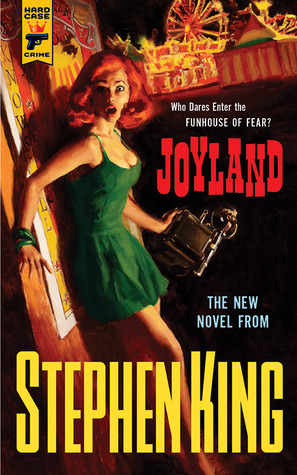 How many Stephen King stories have I read over the decades he’s been writing them? More than ten. A dozen books, maybe, or perhaps more; if we start counting single stories, then certainly more than twenty. And since he has become more sentimental as a writer as he’s grown older, I thought I knew what to expect from this one.
Mind you, I still wanted to read it; even had I guessed its contours, King tells a story with the humanity and every-day realness, despite his chosen genre, unlike anybody else, and so I would not want to miss it.
We have a young man who’s taking a summer job at an amusement park in North Carolina. And we have a past murder on one of its rides, its only “dark” ride. A young woman whose throat was sliced during a brief unlit interlude; she was cast over the side like someone’s leftover lunch sack, and found later.
I was pretty sure at some point all of the rides would come to life and do terrible things.
I was pretty sure the climax would occur on the dark ride, or the place where it was housed.
I was wrong on both counts.
Joyland was a quick read, and a deeply satisfying one. The teaser he wrote to sell his book promised I would consider mortality and be deeply moved, and I can’t say that occurred, but it surely left me thoughtful, as well as grateful that the master of the horror genre is still writing after all these years.
I was able to get a library copy, but would have purchased it if I had to; King is so reliably enjoyable.
If you love stories with supernatural elements and things that go bump in the dark, get this book and read it.
 Seattle Book Mama