Live From Death Row, by Mumia Abu-Jamal*****

livefromdeathrowMumia is a former Black Panther. The facts support his having been framed in the murder of the cop, a crime for which he was nearly executed.

Live from Death Row, written before his sentence was commuted, is not, however, a vehicle he uses to advocate for himself or plead his own case to the public. He has written other books I haven’t read, and I don’t know if he did that there.

Instead, here he uses his own situation to discuss the racism inherent both in the U.S. court system; he also talks about racism on death row.

The mandatory fresh-air time, prized and treasured by men who rarely see the clear blue sky, is an Apartheid one, at least in Supermax, RHU,SMU, and SHU (ultimate maximum security prisons, which he says have swelled since jailhouse overcrowding has made prisons tenser places and more people are tossed into “the hole”). The vast majority of prisoners are Black, though they are a minority of the population at large, and in the Pennsylvania prison he describes, 80% of those maximum security cases, those who wear Black skin, are crowded into a courtyard. They can’t see green grass or the outdoors, only four brick walls and way up there, blue sky. Why? And where are the other prisoners going?

The other prisoners (who are also maximum security) who are not Black have a SEPARATE courtyard, which is surrounded by chain=link fencing with razor-wire, but has the view. The 20% have the perk of a much less crowded space and the capacity to see Mother Earth during their treasured time outside prison walls.

As to the racist system that places Blacks on death row at such a startlingly high rate, he offers the following statistics and footnotes all of them like the scholar he was before being incarcerated, and continues to be behind prison walls. He uses a Georgia case because it is one which caused the Supreme Court to recognize the following facts:

*defendants charged w killing Caucasian victims are 4.3 times as likely to be sent to death row as those charged w/killing Blacks;

*the race of the victim determines whether or not a death penalty is returned;

*nearly 6 of 11 defendants who received the death penalty for killing Caucasians would not have received the death penalty if their victims had been Black;

*20 of every 34 defendants sentenced to death would not have been given the death sentence if their victims had not been Caucasian.

He continues to pound one damning fact upon another, and cites court cases to back them up; those above come from McClesky vs. Kemp (1987). If the case sounds old, I would argue that precedents are set by very old cases indeed, and of course, this book was published early into the 2000 decade. I doubt a more recent gathering of data would return more favorable information; in the case of jail overcrowding, I suspect the recession has made it worse.

A person would have to be hiding under a rock or in a coma not to be aware of the level of violence visited upon African-Americans by cops and vigilantes within the past year.

I applaud Mumia for using his well-known case to set the facts before us, rather than trying to build momentum to save himself. There was a considerable amount of public pressure NOT to execute him, and I do think that had to do with his sentence being commuted; as it was, my kids’ urban U.S. high school was “barely holding together”, according to a counselor I knew there, the day that Mumia’s case was turned away by the U.S. Supreme Court.

If you are interested in reading about social justice issues, this relatively slender volume holds an astounding amount of really critical information. I appreciate Mumia’s relentless effort to make the public, both in the US and internationally, aware of the atrocities that continue to visit Black prisoners in the USA, and it’s more relevant now than ever!
Gold Coast Blues: A Jules Landau Mystery, by Marc Krulewitch****

goldcoastblues“Tanya Maggio’s a missing person, and I got a feeling she’s missing on purpose.” This third entry of the Jules Landau series finds Landau searching for Eddie’s missing girlfriend. There’s a faded noir feeling in its pages as Landau bounces between Chicago and New Jersey trying to trace back the thread. Though confusing at times, a trifle overburdened by excess characters, it’s a fun, original story. Thank you once and thank you twice to Net Galley and Random House Alibi for the DRC. This title is available for purchase September 22.

The search for Tanya leads Landau to the mean streets of Irvington, New Jersey, where a crooked cop named Cooper explains that in their town, they don’t try stamp out crime…they manage it. So anyone that is hooked up to the criminal world is fair game; the idea, at least ostensibly, is that bystanders should not be caught in the crossfire.

Right.

Turns out the New Jersey people are running a scam. Those among the one percent that have more time and money than good sense invest in fine wine, wine that is worth hundreds of thousands of dollars for a case of a dozen bottles. Hey, its value appreciates, and some liken it to gold or silver. If a bottle gets busted, then that’s what insurance is for.

With a bizarre scenario such as this one, it’s only to be expected that someone would come up with the idea of counterfeiting labels and brewing up some fake stuff. After all, no one is going to drink it anyway, right? Who’s to know?

The plot twists, and it turns sometimes enough to confuse me. Hold up…are we in Illinois, or are we still in Jersey? But when push comes to shove, this romp is too enjoyable to walk away from. “That little shit Spike”, an heir to the Irvington mob, is one character that shines bright enough to keep those pages turning. Another, of course, is Landau’s ridiculous cat Punim, for whom he sits down to compose a legal trust fund when he is depressed and in danger. His own life may be on the line, but by god someone has to be paid to feed Punim his chicken hearts every day. And then there is Amy. Is she an enemy? A spy? She sure as hell isn’t really a psychic, but she knows enough that she has to be something. Maybe she has Tanya tied up in her closet. You never can tell.

The originality of the plot is assisted by Krulewitch’s affinity for figurative language. I loved his description of the “horror hotel” and the “stunningly verdant” house located on…wait for it…Bunnybrush Lane.

September is a good time to curl up under the quilts with a good book, or for those in warmer climes, it’s not too late to stretch out on the beach with one. Either way, if you need an escapist beach read, or a good noir mystery, this might be the book for you.

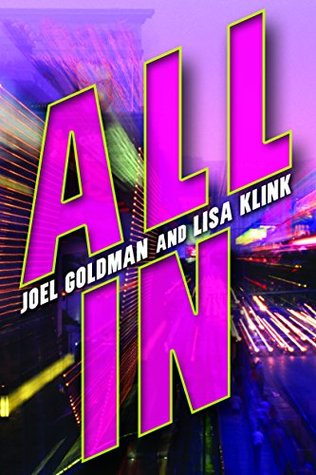
All In, by Joel Goldman and Lisa Klink *****

all inThis one is 4.75 stars, rounded up. Thank you to Net Galley and to Thomas and Mercer for the DRC. This absorbing thriller will be available September 8 for purchase.

Cassie Ireland is an asset recovery specialist; she views herself as a modern-day Robin Hood whose job it is to steal back money, goods, or even really embarrassing videos from those that originally stole them. Her employer is a shadowy individual code-named Prometheus–a moniker chosen because Prometheus was the sneak thief of the gods. Ireland’s nimble, silent in her work, and careful in trusting others. She really can’t be played.

Her job here is to steal select items from the home safe of crooked-wealthy magnate Alan Kendrick. In order to gain access to his treasure trove, she must first make it past a sophisticated security system, to which she gains access by deceiving Kendrick’s wife, Gina. Once Cassie found her way into that safe, I stopped breathing until she was out again. I think my fingertips turned blue. But once she’s been in and out, things once more begin to unspool at a heart-pounding pace.

Jake Carter is a professional gambler, and he too has a grudge to settle with Alan Kendrick. He plans to beat him at poker; he’s fast, smart, and fair. Unfortunately, the last whale he took down has sent goons after him. They want the money he took from Theo at the table, and they also want him dead. Jake’s challenge is to go after Kendrick while dodging Theo’s assassins.

Ultimately, Cassie, Jake, Theo and Kendrick all land on the same enormous floating gambling casino. You can run…but only so far. You can hide, but sooner or later, you’ll be found. On the other hand, you can also turn your stalkers into your prey, if you’re cunning and well organized, and if you can gain the loyalty of others nearby. And then too, you might be able to grab a helicopter!

All In is fast, escapist fun. Ordinarily I would call this a four-star review. Four stars are my default for books that are anywhere from pretty good to really good, but that don’t meet the gold standard of five stars. My four star reviews are big houses with a lot of rooms. If I hate a book but concede that others are likely to enjoy it, I will go with four stars and explain what I didn’t like. I also give four star reviews to books like this one that I like a lot, but can’t see them as the very epitome of their genre. Five stars means excellence that is above and beyond ordinary work.

The tipping point here that knocked this up to five stars is the use of race and gender. Nobody wants to be preached at in the middle of a thriller, and Goldman and Klink don’t do that. Rather, it is by the assumptions that are inherent in their choice of protagonist (Ireland is African-American, female, smart as hell and way more fit than any gum shoe I can recall); the way the plot unfolds, with no helpless damsels waiting for great big men to come save them; and the way secondary characters are handled, the butler foremost among them. It reminded me a bit of Barbara Neely’s writing, and so I wanted to stand up and cheer.

Fall is coming, and whether you are still basking in the sun on weekends or huddled by a fire, it’s a great time to treat yourself to a tightly paced, accessible thriller by authors that show their respect for all people, especially the working class, in the way they sculpt their characters and plot. It looks like a winner to me.

Why not order it while you can?

The “Colored Hero” of Harper’s Ferry: John Anthony Copeland and the War Against Slavery, by Steven Lubet **

thecoloredheroI was really looking forward to this biography, that of one of the Black men that fought alongside John Brown at Harper’s Ferry. It seems to have so many of my favorite elements tied together. There’s John Brown, one of my greatest heroes; the anti-slavery campaign that led up to the American Civil War, which is my field; and then, right as the Black Lives Matter movement has picked up speed, we see focus on one of the African-American fighters that was there. What’s not to love? And I had the chance to read it free, thanks to Net Galley and Cambridge University Press. I was pretty stoked.

But one of the ways in which people are disenfranchised is that their history is not recorded. Lubet has clearly given it his best shot, but there’s so much surmise (with the use of “perhaps”, “may have”, “would probably have”, and so forth) and guess work filling in the narrative, along with common information about the time and period that I already knew, that I finally just skimmed to the last chapters, which is where he seems to have some actual information as opposed to vague contours sustained largely by guesswork.

Whether it’s because of this or in addition to it, the pace is slow, slow, slow.

I can tack on a third star—and if you’ve read my reviews, you know I often do—if I can think of a niche audience that would enjoy the title I am reviewing or to whom it would be useful. Here, not so much, and in fact, at least one factual error leapt out and bit me, and I was not even fact-checking. W.E.B. DuBois claims in his biography of John Brown (which is listed in the works this writer includes in his end notes) that the only reason Harriet Tubman was not there was that she was desperately ill and unable to get out of bed. So this work is not only broader than its stated purpose and lacking in the anticipated focus, it is at least partially incorrect. If I can believe either DuBois or Lubet, I’ll roll with DuBois any day of the week. No third star.

One star reviews are few and far between. I reserve those for works that are either so badly edited and or illiterate (generally self-published works) that I just straight-up can’t read them, or else they are grossly offensive, enough so that I think the public will be offended more often than not.

Given the standards above, this work merits two stars. If you decide to read it, do free or at a deep discount unless you have really deep pockets and spend money fairly randomly. You can do that September 16.

Off and Running, by Philip Reed****

This little gem was released digitally today. Funnier than hell!

seattlebookmama's avatarSeattle Book Mama

offandrunningOff and Running is a comic caper set around Y2K. Jack is a writer looking for his lucky break; Walt is an old man, a beloved American icon who hasn’t published a memoir yet. Garrett is Walt’s ill-begotten, bad-tempered adult son, the worst celebrity brat imaginable. Reed tosses them all into his literary blender and what comes out is both hilarious and at times, genuinely suspenseful as well. Thank you once more to Brash Books and Net Galley for permitting me a sneak peek; this amusing tale will be for sale in August.

Jack has had one project after another not work out. His wife, Sarah, has had it with him, and wants him to go out and get a real job. Every day she schleps out to her full time job, coming home tired and ill tempered, and she doesn’t want to hear anymore about how Jack’s latest book…

View original post 389 more words

Brush Back, by Sara Paretsky *****

It’s out! In fact, it’s been out for a week. You can get it now, or you can wait for it to go to paperback, which of course it will. Such a riveting mystery deserves to be reblogged.

seattlebookmama's avatarSeattle Book Mama

brushbackA good mystery writer engages the writer at the beginning, and gets the adrenaline pumping by the 75% point in the story arc. A great mystery writer grabs us by the shirt right from the get-go, ramps us up into overdrive during the first quarter of the story, and doesn’t let us go till we turn the last page, exhausted, feeling both satisfied and bereaved because the story is over. And Sara Paretsky is a great writer, every single time. She’s only gotten better with this 17th installment of the Vic Warshawski series. Thank you and thank you again (and again, and again) to Putnam-Penguin Publishers and Net Galley for the DRC. You can buy this book July 28 if you want to. And you know you do!

Vic is a working class hero, but she’s left the mean streets of the south part of Chicago behind, and when she…

View original post 592 more words

Our Man in Charleston, by Christopher Dickey *****

A host of really good books were released July 21, when I was in the midst of my book giveaway, and so I’m reblogging the best of the best on any day I don’t have a brand new review to post. If you could only read ten books on the American Civil War, I’d include this one.

seattlebookmama's avatarSeattle Book Mama

OurmanincharlestonThis is the most fascinating book I’ve read in a long time! Equal parts biography and American Civil War nonfiction, it details the experiences of Britain’s foremost spy, Robert Bunch, who was living in Charleston, South Carolina when the Civil War began and for its duration. I am truly grateful to Crown Publishers and Net Galley for permitting me to read the DRC in advance. And perhaps it is just as well, in a way, that my kindle fell in the potty when I was done and with it went hundreds (genuinely) of notations that I made as I wended my way through it; I had procrastinated writing this review because there was so much I wanted to say. Too much, in fact! Sometimes I have to remind myself I am writing a review for would-be readers who might want to discover a few things on their own. Part of…

View original post 1,810 more words

Black-Eyed Susans Giveaway; My Very First!

The giveaway is over, and we have a winner! Sherry Garboden will hear from me shortly, and the book will be sent directly from Random House-Ballantine. Thanks to those that entered.

seattlebookmama's avatarSeattle Book Mama

I am pumped about this! I was contacted by a rep from Net Galley and offered a copy of Ballantine’s hot new mystery for a blog giveaway, which I have not done before. I hope a lot of people will enter. If you’d like to be included in the drawing, which will occur at the end of this week in a totally random manner, please go down to the bottom of the page where it says “Leave a Reply”. Type in your name (or a pseudonym for now if you prefer) and an e-mail address where I can reach you. If you win, I will send a message to your e-mail, and at that point you need to give me a real name and snail mail address, which will be released only to the Net Galley rep.

I promise not to use your e-mail address for anything else. Actually, I…

View original post 803 more words

Trust No One, by Paul Cleave *****

trustnooneMany times my daughter has come upon me reading a book and asked, “How is it?” And almost every time I have said, “I don’t know. I haven’t read the end yet.” This is completely true for this one. And oh my my my, what an ending. No, stop worrying, I have no intention of giving away anything.

But I will thank Net Galley and Atria Books. I appreciate the opportunity to read a free DRC in exchange for this honest review.

You can purchase this book Tuesday, August 4, or you could save the hassle and order it now.

Above all…you don’t want to forget. If you forget this, you might be forgetting other things, too. That’s a slippery slope that nobody wants to slide down.

Jerry is just 49 years old, and he has Alzheimer’s. After the diagnosis, he starts a journal, partially with the idea of recording all the things he doesn’t want to forget so that he can come back and find them later. But fate has other ideas for our protagonist, and for his nom de plume, Henry Cutter–a cute play on the actual author’s name…or is it his pen name?

As we find ourselves gradually creeping down that long dark tunnel with poor Jerry, the journal becomes more and more confused. Is he a killer? If so, how many people has he killed? Why can’t he remember doing any of it?

But then, he can’t remember much of anything these days…

Trust No One is a brilliantly paced, tautly written piece of psychological fiction, and it is proof that, contrary to the old saying, not all stories have already been written. And the title answers his question, a very good question: who can he trust?

The problem here is that someone in Jerry’s position has to be able to trust someone. And as the plot moves further along, the reader can’t help wondering whether all of the characters in the story actually exist.

Those searching for an absorbing vacation read—or even one to curl up with at home, hunkered under the air conditioner or fan on a dog-hot day—can’t really ask for anything better than this. Cleave gives the reader every possible frisson in this impossibly complex, yet strangely accessible novel.

Highly recommended.

Being Nixon: A Man Divided, by Evan Thomas ****

beingnixonSuddenly, everyone is writing Nixon biographies; it’s a Watergate junkie’s dream come true! Here Thomas does his best to take us inside Nixon’s skin and tell us what motivated some of the decidedly strange things he did. It makes for highly engaging reading. 3.75 stars get rounded up to 4, along with my thanks to Net Galley and Random House for the DRC. This book is available for sale now.

When I signed on for this galley, I imagined that perhaps Thomas had a background in psychology or psychiatry and was going to take a stab at diagnosing a mental illness that might explain what in the world Nixon was thinking when he did the things he did; if he’d had different meds, would things have shaken out differently? But that isn’t what this book is about. Instead, it is a glimpse at Nixon’s life, including his early childhood and adolescence, postulating that childhood experiences may have shaped the politician Nixon became.

To this, I will admit that I said, “Psssh. Right. Whatever.”

Because it’s a plain and simple fact that many presidents had lives that were scarred by events as bad or worse than what Nixon experienced, and most of them still managed to do their jobs without coming within a hair’s breadth of impeachment. So I don’t buy that theory.

Nevertheless, there are so many interesting tidbits and stories in this memoir that even if the reader doesn’t buy the overall thesis, it’s a compelling read. The conversational narrative kept me rolling along, and every time I found an opinion I thought was baloney, I made a note of it and kept going. I would have continued reading even if I didn’t have an obligation to the publisher, because it really is fascinating stuff.

Imagine, for instance, a solitary candidate with a love for classical music, sitting all by himself in his hotel suite, with the 1812 Overture blasting away, with his arms furiously directing an unseen orchestra. Just one aide saw this, and Thomas ferreted the incident out and presented it here. I doubt you’ll find these tidbits anywhere else!

In addition, few other biographers have managed any insights into what went on in the Nixon residence. I often wondered about Pat, Tricia, and Julie. When he showed up to home, did he storm in and turn the coffee table over? Get quietly drunk? Blame his family for all his ills? Drawing heavily on the memoirs written by family members that I am unlikely to ever read, Thomas gives us a little voyeuristic peek behind the curtains, and I found it intriguing indeed.

When it comes to Watergate, Thomas holds Nixon responsible for what he did, for the greater part, but I rolled my eyes at the repeated claim that if he hadn’t been too shy to socialize with the staff, with the Washington socialites who invited him to dinners, and so forth, maybe he would not have become so isolated…if his childhood hadn’t been so poor, and if his father hadn’t kept him home from his Yale scholarship because there was no money for dorm fees…if…if…if…

I felt much more certain that the author’s research, which is mostly done via secondary sources and the Nixon family’s memoirs, including heavy use of Nixon’s own (RN), was based on fact when he dealt directly with Nixon’s personal life. Although various quotes by the Watergate conspirators were interesting, some are more believable than others. I found one fact in this bio that directly conflicts with that of biographer Tim Weiner, and it has to do with the choice of Spiro Agnew as a running mate. Thomas cites reasons personal and political; Weiner documents that the choice was bought and paid for by Greek financial interests. Here, I believe Weiner. It’s just one directly conflicting fact, but when I found it, just as a humble reviewer rather than as a researcher, it called other things into question, which is where ¼ star fell off this review.

The author thanks a number of people in his after-notes. I always read those, because you can pick up little things lost elsewhere. He especially thanks the man that told him to beware the various items found in the prodigious memoirs by “that old thespian”, Richard Nixon, who was a student actor before he went into politics. It was strong advice.

In perusing this biography, I realized two things. The first is that the reason Nixon had so little domestic policy, and the reason the country moved so smoothly without him during the tortuous period prior to his departure, is because he didn’t have much of a tool kit to start with. The author notes that although Nixon has gained a sinister reputation as an evil, sneaking genius, in fact there were areas in which he really wasn’t all that smart, and this was one of them. He focused on three things: foreign policy, in which he was better equipped to carry out the wishes of the bourgeoisie than most presidents have been; running for office again and when that was done, honing his legacy, about which enough has been said; and of course, revenge, revenge, revenge.

The second thing I realized is that the reason he was virtually cast out of office in a situation in which other presidents might have been able to pull their chestnuts out of the fire, had to do with the fact that he believed himself, as US president, to be more powerful than the ruling bourgeoisie. He misjudged the relationship of power between himself and those that rule us quietly, usually in an unseen way. In attempting to yank the broadcasting license of CBS as part of a personal vendetta against the owner of the Washington Post, he took on a sector of the ruling rich, and he made of himself an object lesson.

By my count, this was my twelfth Nixon biography, though I may have read and forgot about some others. It’s neither the best nor the worst, but for those fascinated with Nixon’s rise and fall, and with Watergate, it should go on the to-read list. It’s just too good to miss!