Life of a Klansman, by Edward Ball*

“White supremacy is not a marginal ideology. It is the early build of the country. It is a foundation on which the social edifice rises, bedrock of institutions. White supremacy also lies on the floor of our minds. Whiteness is not a deformation of thought, but a kind of thought itself…
‘The story that follows is not that a writer discovers a shameful family secret and turns to the public to confess it. The story here is that whiteness and its tribal nature are normal, everywhere, and seem as permanent as the sunrise.”

I read this book free and early; thanks go to Net Galley and Farrar, Strauss, and Giroux for the review copy.

Edward Ball writes about his ancestor, Constant Lecorgnes, known fondly within his family as “our Klansman.” The biography is noteworthy in that it is told without apology or moral judgement, as if Ball wants whites to feel okay about the racism, the rape, the exploitation, the murders, the terrorism that membership in the Ku Klux Klan, the Knights of the White Camellia, and any and all of the other white supremacist organizations have carried out, and will continue to carry out, in the United States. Relax, he tells us, it’s normal.

Well, let’s back up a moment. The “us” in the narrative is always Caucasians. It apparently hasn’t occurred to him that anybody else might read his book. In some ways, the “us” and the “our” used consistently and liberally throughout this biography are even worse than the explicit horrors detailed within its pages. It’s as if there is a huge, entitled club, and those that don’t belong are not invited to read. Further, it’s as if all white people are of a similar mind and share similar goals.

Not so much.

Ball won the National Book Award some years back for Slaves in the Family, a title currently adorning my shelves downstairs. I have begun it two or three times, but it didn’t hold me long enough for me to see what he does with it. And this book is the same, in that the late Lecorgnes is not particularly compelling as a subject, except within the framework of his terrorism. He was not, Ball tells us, a key player; he was just one more Caucasian foot soldier within the Klan. And so, the reading drones along, and then there are the key pronouns that capture my attention, those that give ownership to his terrible heritage, and a couple of paragraphs of the history of the period, particularly within Southern Louisiana, follow; lather, rinse, repeat.

As I read, I searched for accountability. As it happens, I have one of those relatives too; but my elders, though not beacons within the Civil Rights realm by a long shot, understood that such a membership brings shame upon us, and consequently I was not supposed to know about him at all. I overheard some words intended to be private, uttered quietly during a moment of profound grief following a sudden death. My mother spoke to someone—my father? I can’t recall—but she referred to her father’s horrifying activity, and I was so shocked that I left off lurking and spying, and burst into the room. I believe I was ten years old at the time. I was told that the man—who was never, and never will be referred to in the fond, familiar manner that Ball does—was not entirely right in the head. He truly believed he was helping to protect Southern Caucasian women, but he was wrong. It was awful, and now it’s over; let’s not talk about it anymore. In fact, this topic was so taboo that my own sister didn’t know. She is old now, and was shocked when I mentioned it last spring. She had no idea.

As I developed, I understood, from teachers and friends more enlightened than Mr. Ball, that the best way we can deal with ugly things in our background that we cannot change, is to contribute our own energies in the opposite direction. I’ve lived by it, and so I was waiting for Ball to say something similar, if not in the prologue, then surely somewhere near the end; but he never did. If Ball feels any duty whatsoever to balance the scales of his family’s terrible contribution, he doesn’t offer it up. There’s no call to action, no cry for social justice. Just the message that hey—it’s normal, and it’s fine.

I’m not sure if I want to read his other work anymore; but I know that what I cannot do, and will not do, is recommend this book to you.

Behind the Red Door, by Megan Collins**-***

I enjoyed Collins’s debut, The Winter Sister, and so when I was invited to read and review this second novel, I jumped on it. My thanks go to Net Galley and Atria Books for the review copy. This book is for sale now.

Have you ever had someone in your life that’s a hot mess and makes terrible decisions, one after another? This felt a little bit like that, at least during the periods when I believed the character; and I did, some of the time. But whereas The Winter Sister held together beautifully until the implausible ending—a common issue with mysteries and thrillers—this one is riddled with difficulties throughout.

Fern had a traumatic childhood. Her father used her to conduct cruel experiments, deliberately terrifying his daughter in a variety of ways so that he could write about her responses. Now she’s grown and gone, though not surprisingly plagued by serious mental health issues, but healing nonetheless, and he summons her home. He says he needs her. Against the advice of stable people in her adult life, Fern packs her bags and comes a-runnin’. Who knows? Maybe her daddy wants to say sorry; perhaps he is terminally ill and set on making amends.

Well, um, no.

Upon her return, three terrible things happen almost immediately. First of all, her father, Ted, has not changed a bit, and he only called her back because he’s moving and doesn’t have time to pack. He wants her to pack for his move. He doesn’t plan to help pack his own crap, and he doesn’t plan to pay her for her time. Plus, he still plays cruel tricks on her, just like bad old times.

On top of this, her best friend’s sadistic brother, Cooper, is still around, and he’s still not a real nice guy. She discovers this almost immediately firsthand.

And on a trip to the store, she runs across a book, a memoir written by Astrid Sullivan. Flash! Bang! She knows that face, doesn’t she? Did she know Astrid?  Now Astrid has been murdered, and Fern has been having dreams about her, which might be flashbacks. Has she buried memories of the murder? And…WHO would have DONE such a thing?  Nobody SHE knows would do a mean thing like that! Unless…naw.

Oh dear.

The story is told in alternate narratives, Fern’s and Astrid’s, courtesy of her memoir. This method does build a sense of dread, but it feels a little choppy in the telling.  In addition, I had difficulty believing the character’s motivation. I could see reflexively running home—I’ve known people that would do the same—but what I cannot understand is why, when she found out what Ted’s big emergency was, she didn’t toss her bag back in her car, say Buh-bye and good luck with the move, and hightail it home.

There’s a lot of extraneous business here; we have Fern’s mental health problems, and on top of it all, she’s pregnant. (Oh, good idea. A baby. What could possibly go wrong?)

I believe Collins has a great book in her, but this isn’t it. That’s okay; back to the drawing board. Life is long. But reader, as for you, I recommend you either pass this one up, or read it free or cheap.

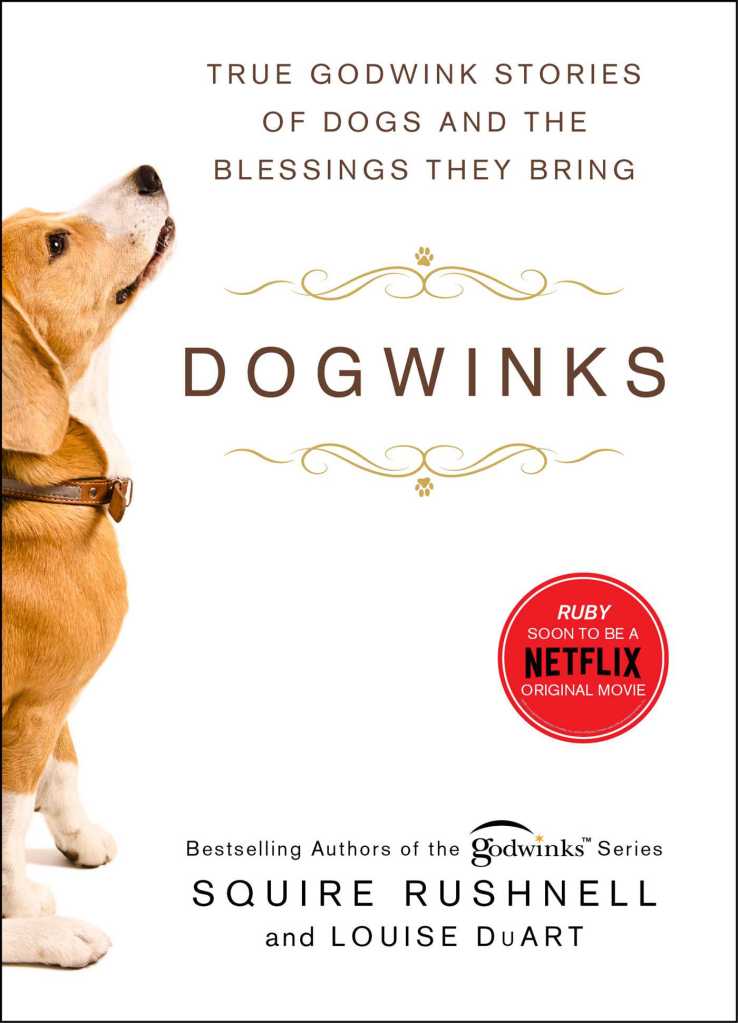
Dogwinks, by Squire Rushnell**

The old saw about not judging a book by its cover has come home to me in a big way. I was invited to read and review, and although I usually do some homework before accepting or disregarding such offers, I saw the beagle on the cover and leapt on the widget. And somewhere out there, at least one publicist must have my love of said dogs on file, because otherwise it would make absolutely, positively no sense to offer me this book. Dubious thanks go to Net Galley and Atria Books; I know you meant well. This book will be available to the public October 20, 2020.

Here’s the thing I didn’t understand when I signed on. This is not merely a book of dog stories, as I had supposed. Apparently, there is a “much-loved” series known as “Godwinks,” and so the title of this one is a play on that name. Since I read no religious material ever, it’s unsurprising that this fact eluded me.

Having foolishly committed myself, I tried to keep an open mind, because in addition to being religious in nature, this is also a collection of dog stories.  I want to be fair, and I hoped I could disregard the preaching and focus on the hounds.  But it’s impossible to enjoy these stories; the writing seems formulaic, the sort of thing you’d read in Reader’s Digest. The figurative language is stale, and the story arc of each is transparently manipulative. Guys, I just can’t.

By wild coincidence, my current reading includes Richard Dawkins’s The God Delusion, and I’m finding it to be better written and infinitely more agreeable than this superstitious bilge.

If you have a MAGA hat in your closet and a firm belief that your prayer group is protecting you from COVID19, then this collection may suit you down to the ground. Otherwise, I’d suggest you steer clear.

I Let You Go, by Clare Macintosh**

I read this book free and early; thanks go to Net Galley and Berkley for the review copy.

Ordinarily, a book that I don’t enjoy or admire gets reviewed when it’s released, the same way I would with a book I love. However, on this one, I choked. The protagonist is a woman who’s grieving the loss of her little boy, and the author’s notes mention that as she wrote it, she was thinking of her own child that had died. How do you pan a book like that? And so I made a conscious choice to bury it. It was released in 2016, and it is by far the oldest novel in my backlog.

Since that time, this book has made bestseller lists and received acclaim from far more auspicious (and lucrative) sources than this humble blogger, and I realized this evening that I can go ahead and write my review with little likelihood of rocking this writer’s world.

What I found is some competent use of setting, but the plot was all over the place, both choppy and unfocused. I realize it is the author’s intention to build suspense by revealing the past in increments, but it didn’t build suspense for me; I felt irritated instead. The protagonist never became real for me, and ultimately the story was mostly predictable, increments or no. There was tired figurative language and a lot of cliches and truisms. I looked everywhere for the magic, but I never did find it.

I don’t recommend this book to anyone but the author’s diehard readers. The good news is that you can probably score a used copy inexpensively by now, if you’re going to go there.

Louisiana Lucky, by Julia Pennell**

Three sisters buy a winning lottery ticket and it changes their lives. Thanks go to Net Galley and Atria Books for the review copy.

Every now and then, my collection of galleys gets too dark, and so I turn to Net Galley in search of humorous reading to lighten things up. This novel caught my eye with its engaging cover, and sadly, I didn’t realize that the cover was its only positive attribute.

The word choice, character development, and even basic ability to use correct grammar came up short here, and I find myself wondering what’s up with the editor? But even a strong editor can’t help this book, because there’s nothing to salvage. None of the sisters came alive for me, and the tired old trope about money not buying happiness draws an eyeroll of epic proportions. If my mama was right and my eyes could get stuck up there, this would surely have done it.

This book is for sale now, but I’d keep my card in my wallet if I were you.

Trust Exercise, by Susan Choi**

Ah geez. I had such hopes for this one, but in the end I was relieved when I finished it. Thanks go to Net Galley and Henry Holt for the review copy, and to Seattle Bibliocommons for the audio book that helped me push through to the end.

Conceptually, it sounds like a winner. (And to be fair, it did win the National Book Award.) Students enrolled in a citywide magnet school live in a cloistered bubble, isolated from the city—and the world—around them. The time is the 1980s. The drama teacher, Mr. Kingsley, has an oversized role and influence in their lives, not only academically but emotionally. Boundaries, not so much. And when Sarah and David fall for each other, and then un-fall, Mr. Kingsley serves as a sort of puppet master, telling them what to do. The same applies to friendships turned sour.

The premise is believable. This reviewer recalls a respected public school with a strong performing arts program that operated in real life in the late 1970s. Some of the teachers didn’t seem to know about boundaries, and the students—of which I was one—never complained, because it made us feel like respected adults. A student and teacher had an affair while I was there, and they married after she graduated. They remain so. And so when I saw the teaser for this book, I was ready to jump right in, because it spoke to me.

Sadly, it stopped speaking to me by the twenty-five percent mark. I tried restarting a couple of times, but I hit a wall. Finally, determined not to miss out on an award-winning novel, I ordered the audio version from the library and listened to it while I sewed my family’s first set of COVID masks. Both were grim tasks.

While there must be art present here for Choi to win such a prestigious award, the plot is convoluted and difficult to follow, and the characters, which are the heart and soul of this novel, never come alive. In the last half it becomes clear that we’ve had an unreliable narrator all along, but if anything, it makes the story muddier.

This might be a one star read for me, but I still say the premise is meaty, and for that I tack on the second star.

Overall, I can’t recommend this book.  

Handsome Johnny, by Lee Server**

I was invited to read and review this biography by Net Galley and St. Martin’s Press; it’s the story of Johnny Rosselli, known as “the gentleman gangster.” Sometimes I enjoy a good gangster story; my great-uncle (whom I didn’t really know) was Sherman Billingsley, the thuggish owner of the New York Stork Club, and so when I read about others, it sparks my imagination. Usually.

I didn’t engage with the book’s beginning when I sat down the with digital review copy, and eventually I got bored and set it aside for something more compelling. But often, the galleys that land on the back burner become more interesting once I can get an audio copy. After avoiding this book till publication, I found an audiobook at Seattle Bibliocommons, and I began listening to it in the evenings when I prepared dinner. In this way I found it more interesting. There’s a fair amount of background provided, because the writer (perhaps wisely) doesn’t assume his audience is proficient in American history, Prohibition and so on. I didn’t hear anything I didn’t know already, but it was okay. Gradually it took on the flavor of a documentary, not riveting but not bad. I listened to the first 25% and thought I would probably finish it this way.

Unfortunately, a deal breaker came up somewhere in the next ten percent. Rosselli has gone to Los Angeles because there was no mob out there yet. He figured he’d pioneer vice and leg-breaking on the West Coast. Fine, fine. He meets Al Capone, who is being harassed by cops and told he can’t stay in L.A., and Rosselli does Capone a favor and thereby comes into the Capone orbit. Okay, fine. But then we get into the women.

Now, I understand that mobsters were about as far as anyone can get from feminism, and of course in the 1940s and 50s, there wasn’t any women’s movement to speak of. The problem is that Server doesn’t differentiate Rosselli’s point of view from his own. I get the distinct impression that the two aren’t very different. There’s only one quality worth reporting in women, and that’s their physical appearance. So Rosselli falls for Jean Harlow, who is perfect. Completely perfect. What makes her perfect? Well, she’s got great legs. They are described. Breasts too; we hear about that. And she is a virgin! Every middle-aged mobster loves to get a virgin in the sack, right? At age seventeen she’s barely legal, but nobody worries about that. Oh, and also she’s very, very white. Porcelain skin. Just wonderful.

By the time Server is done explaining all of Harlow’s best qualities, and the misery that that bastard put her through (though he doesn’t describe it this way; in fact, the reader has a kind of bemused smirk to his voice throughout,) and oh how sad about her suicide at age 27, I am seeing red.

 I’m not chopping bell peppers now. I’m standing stock still in my kitchen, glaring at my tablet. Dinner may be a little late.

I try to continue with the book, but I am pissed.  Finally, I decide life is too short. I’ve tried this book twice, but I don’t finish it. In fact, I consider that second star in the rating to be generous.

This book is recommended to misogynistic assholes. Everyone else should give it a miss.

Marley, by Jon Clinch**-***

My thanks go to Net Galley and Atria Books for the review copy of Marley, a retelling of the Dickens classic told from a different point of view. This book is for sale now.

This work of historical fiction took off with a bang, and then fizzled.

I have not read any of Clinch’s earlier work, and at the outset of this novel, I am electrified by his prose. I love a good word smith, and Clinch’s facility with figurative language is impressive as hell. I was ready for a good Christmas book, and the October release date was right on the money. I snuggled beneath my favorite fleece blanket and immersed myself, savoring the clever phrasing and rereading parts of it before moving on.

There are two aspects of this work that hold it back; one is a quibble, but one worth mentioning, and the other is more significant. The quibble is that so much of the story isn’t about Marley. We know about Scrooge. If the author wants to write about Scrooge from a different angle, then the book’s title should reflect it. Instead, Marley’s effort at winning Scrooge’s sister Fan pulls us back into the Scrooge family, and there we stay for long stretches of the book. I echo other reviewers in asking, “But what about Marley?”

My larger objection, one that took awhile to gel as I read and ultimately prevents my recommending this book, is that the entire premise, the sacred message imparted by Dickens, is ground beneath Clinch’s authorly heel as he reframes Marley as a forger, smuggler, and criminal of the highest order. Dickens, in writing the original story, took pains to demonstrate that it is possible to be a “sound man of business,” to function entirely within the letter of the law, and still be morally bankrupt. A Christmas Carol was written to let readers know that those that succeed in legally building fortunes may nevertheless be damned if they are unwilling to extend themselves, whether through private charity or humane governmental programs. Scrooge made a point of telling his nephew that he pays his taxes, after all, and that’s the end of it.

In painting Marley as a man that brings money into the partnership through a multitude of illegal practices, Clinch not only ignores Dickens’s timeless moral and social message, but torches it, leaving only so much ash and cinder.

The chains that bind Marley in the afterlife reflect the chains of human bondage in his corporal one, as he invests the assets of Scrooge and Marley in slave ships, is a lovely literary device. I wish the author had found a way to use it without laying waste to the heart and soul of a timeless classic whose message is needed more today than ever.

Not recommended.

The Chalk Man, by C.J. Tudor**

It’s a rare book that I find abrasive right out of the gate, especially since there are no controversial social messages here, just a mystery that I didn’t like and didn’t finish. Thanks go to Crown Publishing and Net Galley for the review copy, which I received free and early in 2017. I should have written a review long ago, of course, but I found it hard to reconcile my antipathy for this story—a debut, no less—with the nearly unanimous adulation expressed by other reviewers. I am still a bit bewildered, but there it is.

This is a book that tries too hard. There are too many cutesy nicknames, and the structure of the plot feels gimmicky and formulaic, as well as mighty unlikely. Of course, most mysteries have aspects that are unlikely because most real-life murders and other mysterious doings have logical, obvious, dull explanations. We agree to pretend the murder mystery is plausible in exchange for being entertained. The problem is that I wasn’t, and so I couldn’t.

Two other factors that contributed to my grumpiness were the overwhelmingly male list of characters, and the cultural collision between British fiction and my brain. I’ve read and enjoyed some British fiction; if not, I wouldn’t have requested this galley. But here the culture and jargon are thick on the ground, and the inner narrative feels endless.

I no longer have to be concerned that I will crush this author’s hopes and dreams; Tudor’s debut is a huge success both in terms of sales and the corresponding enthusiasm of its readership. This author has gone on to publish more books, and I have had the good sense not to request those this time. Ultimately this came down to taste more than anything else, but I have to call ‘em as I see them, and I found nothing to love, apart from a compelling jacket and an attention-getting title.

The Broken Road, by Peggy Wallace Kennedy**

“I was perhaps Daddy’s most important legacy of all.”

Thanks go to Bloomsbury and Net Galley for the review copy, which I read free and early in exchange for this honest review.

I was a child during the Civil Rights era, and although I didn’t live in the American South, I recall news footage of Kennedy’s father, George Wallace, the man that the author rightly attributes as a harbinger of the Trump movement. Instead of “Make America Great Again,” Wallace urged his constituents—including the Klan, whom he openly welcomed to his campaign—to “Stand Up for America.” When the federal government signaled that it would enforce the segregation ban, Wallace made headlines around the world by literally standing in the door of the schoolhouse in order to turn the first Black student away from a public school in Alabama.  My own father was a redneck of the first order, but even he distanced himself from this extremist. Wallace ran for U.S. president but was defeated; upon returning to the governor’s mansion, he was shot and paralyzed from the waist down. By that time Malcolm X was dead and could not have told us that this was a case of chickens coming home to roost, and yet it may well have been.

Although the book’s summary suggests that Kennedy is vastly different from her father politically, her prose indicates that her true, bitterest grievances all center on his philandering betrayal of her sainted mother and his failure to be a strong provider and dedicated family man. She tells us that even in the 1960s, she felt his racist rhetoric was wrong, and so I waited for what I thought must surely come next: the moment she either confronted him or simply moved out of the house to another part of the country to restart her life in saner surroundings. None of this happened, as it turns out. She stayed in the governor’s mansion, thrilled by the relative affluence and privilege she regarded as her due following a tumultuous, sometimes impoverished childhood.

The title is taken from a Hemingway quote, and in her own story designated the location of her maternal grandparents, whose simple, homespun nurturance provided relief to her mother and herself when her father went on the road politicking and didn’t send money home for them to live off of. At the beginning of the book she uses the expression often enough to beat it to death, but once her father becomes governor she rarely speaks of these kind, gentle people. Toward the end, she parenthetically notes that her grandmother died at some point back in the middle of the book.

It’s interesting that although Lurleen Wallace was elected governor in order to circumvent what was at the time a state law against successive terms for her husband, the author says nothing at all about her mother’s civil rights policies. We see that she won the governorship in a landslide and was loved by all, and yet if her policies diverged much from George’s, that would have created screaming headlines. It’s just one of the many inconsistencies within this memoir.

The last several chapters are devoted to her father’s redemption politically, or so she asserts. He never hated African-Americans, she tells us, but only did and said those things in order to gain office. Later in life, he asked a handful of Civil Rights leaders for forgiveness and spoke in Black churches about his error. She follows this up by pointing to the large numbers of Black voters that returned him to the Capitol.

I find myself wondering a lot of things, and foremost among them is why anyone would consider a candidate that makes the cold-blooded decision to promote violent racism for the sake of gaining office to be morally superior to one holding the genuine belief in the inferiority of other races and ethnicities. Wallace, she tells us, didn’t sign onto the Klan’s program because of his convictions, but because of what they could do for him. And while the parallels she draws with Nixon are apt ones, the rationalization of her late father’s destructive, ethically bankrupt lifetime is chilling in its own way, but she underplays this aspect of his career.

Her “daddy” lived long enough to appoint her 26-year-old attorney husband to the state bench.

The second star here is reluctantly provided because she does some very nice things at the outset with regard to her description of time and place in the life of poor white folks in mid-twentieth century rural Alabama.  If you’re looking for a silver lining to this wretched work, there it is. It’s all I can find.

I would place this book in the child-revenge category along with Christina Crawford, Patti (Reagan) Davis, and Carrie Fisher.  Read it if you want to wallow, but when you’re finished, you will likely want to shower and gargle.