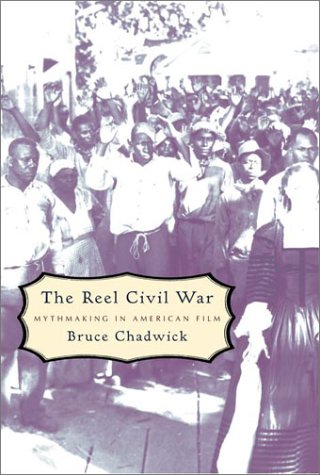
The Reel Civil War: Mythmaking in American Film, by Bruce Chadwick****

thereelcivilwarI found this gem at my favorite used bookstore in Seattle, Magus Books, which is just a block from the University of Washington. Its strength, as the title suggests, is in tracing the story of the American Civil War as told by the cinema. Those interested in the way in which movie impacts both culture and education in the USA would do well to find this book and read it.

Chadwick spends a considerable amount of time and space carefully documenting the myth produced by Gone with the Wind, a completely unrealistic, idealized portrait of the ruling planter class of the deep South. Many of us would, in years gone by, have been inclined to dismiss this concern by saying that after all, the book and movie were primarily intended as a love story, but Chadwick demonstrates that this is not so. He ferrets out actual interviews with Margaret Mitchell herself in which she insists that this is exactly the way it was. Her sources? Former plantation owners, of course.

To this day, if an avid reader goes to Goodreads.com and under the caption “explore”, goes to “listopia” and from there selects a list of readers’ favorite Civil War titles, GWTW will place within the top ten, and sometimes be the foremost title, selected over nonfiction as well as more accurate fiction. I find this horrifying.

The research regarding the Civil War itself is nothing I haven’t seen before, but Chadwick makes excellent use of strong secondary sources to document the fact that Black folks in the pre-war South were neither happy nor well treated. He takes apart the myth Mitchell constructed in a meticulous manner, one damn brick at a time. Hell yes. About ten percent of the way into the book, Chadwick’s removed, scholarly tone changes to one of articulate outrage, and I found this tremendously satisfying.

Chadwick follows Civil War films forward, after first also examining Birth of a Nation, a painfully racist film which was famous at the time because of its length; its original claim to fame was not content, but technology. For those that have not seen the film, this will be interesting reading also, and those that have seen it may pick up some new information as well.

A couple of generations later, the more realistic and highly acclaimed Roots television miniseries told the story of Black America in a way that hadn’t been represented on film before. Chadwick is again careful in his documentation and clear in his explanation.

The book’s final film treatment is of the most positive and accurate film depiction of African-Americans is the film Glory. This reviewer used this film in the classroom. It depicts the Black Massachusetts infantry that tried to take Fort Wagner and in doing so, inspired President Lincoln to order more Black troops to be armed and trained for combat in the American Civil War.

For those interested in the connection between film and American history, and of the American Civil War in particular, this book is recommended.

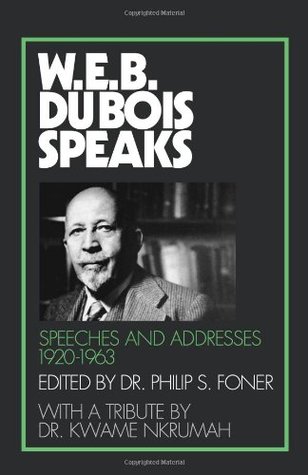
W.E.B. DuBois Speaks: Speeches and Addresses, by WEB DuBois*****

WEB DuBois SpeaksI read this book about 2 years ago, and then found I was intimidated by the 60 multicolored sticky notes that I had used to flag all the brilliant passages, and so I told myself I would review it…later. I didn’t have a DRC this time; I bought that book fair and square at full jacket price from Pathfinder Press many years ago, and then my life was too hectic for me to find time for it. And make no mistake, this is not a collection you want to take on while multitasking. This is deep, serious, articulate writing from one of the most brilliant civil rights leaders the world has yet known. And so although he has been dead for a long time, like Dr. Martin Luther King, his words have made him immortal. I recently read and reviewed another title about this luminary scholar and class fighter, and that reminded me that I had some unfinished reviewing to do for him…or maybe for me. Here we go.

It was DuBois that wrote The Souls of Black Folk, a wrenching reminder that even those Caucasian folks up north that think they have no racial biases, often have some issues they haven’t yet faced. It was true when he wrote it, and I’m sorry to say it is largely true today as well. In the letters and speeches, he takes the pain laid bare in that famous book and explains what the source of racism is, and what we can do about it.

Dr. King wrote the intro to this series of speeches and letters, and I actually liked that introduction better than I like the Dream speech. It has more substance. When you get this book, for heaven’s sake, don’t skip the introduction. In fact, the book is worth having just for the introduction.

Because it is a collection rather than a memoir, it isn’t linear. The opening text is a short overview of his own life, and so when we come to the second piece in the book, the reader steps backwards in time. Although it’s harsh and hard to read in some places because of the writer’s capacity to convey the pain that he and other Black folk have endured so that everyone can at least taste it for a moment, there is more to it than that. This volume is singularly useful, because in addition to laying America’s problem out bare and plain, DuBois has concrete recommendations for change. They are radical, but then we’ve seen what band-aid measures and the electoral process has done for Black folk, and anyone that regards the matter with any degree of seriousness has to recognize that what’s happened so far is a train wreck, primarily for African-Americans and other people of color, but also for all Americans, because those of us that have lived here for our entire lives have been denied the capacity to find out what it’s like to live without racism.

Is that asking too much?

DuBois became a deeply political individual, a Marxist that founded the NAACP, and eventually left that same organization because of political disagreement. He provides a thorough explanation of his experiences and reasoning. When he presents the problem as an economic one, it provides a path forward, and although he is gone now, it isn’t too late for the rest of us to climb on board, if we care deeply enough to do so.

DuBois’s speeches and letters reflect the progress of his thinking, and so some of what he says toward the end is very different from the ideas set forth earlier. It’s a good idea to read it in order, even though it’s a collection, because then the reader can see his personal and political evolution. I don’t think there has ever been anyone more articulate, more brilliant as a writer and speaker, than DuBois.

If you agree that the USA needs big change in order to end the institutions and practices that have created second-class citizenship for African-Americans, and if you want to see justice done for the families of all the men, women, and children that have lost their lives at the hands of racist cops and vigilantes even during the tenure of America’s first Black president, then you ought to get this book. It’s radical, but maybe it’s time to consider radical measures. Because the government and the elected officials that run it won’t correct this problem for us. We can’t leave it in the hands of others; we have to do this ourselves.

And DuBois explains it better than anyone else.

Blanche Passes Go: A Blanche White Mystery, by Barbara Neely*****

blanchepassesgo“Blanche’s mind rang with remembered slights and taunts, and echoes of that awful, heartbreaking instant of fear that was a part of every trip into the white world—a fear of being refused or given poor service because she was black, stopped by a cop because she was black.”

I finished reading Blanche Passes Go on the second anniversary of the death of Michael Brown, who was shot dead by a cop for jaywalking. Bernie Sanders, the candidate who fancies himself the liberal savior for all progressive-minded Americans, spoke here in Seattle that day. The purpose of his talk, apart from campaigning and fundraising, was to celebrate the birthday of Social Security. The speech was disrupted by a pair of African-American women who took exception to his myopia.

So I guess you could say that everyone, even those that don’t generally enjoy mysteries, ought to be reading this book right about now. In particular, if the reader is still trying to figure out why so many people, particularly people of color, get upset with the clueless slogan “All lives matter”, this book is here, just for you. Neely approaches issues of race, class, and gender in a way that is clear but not unkind. It’s her best work to date, and could not have been published by Brash Books at a more appropriate time. My great thanks go to them and the people at Net Galley for providing me with a DRC, and to Neely for laying it all out so that anybody who has a willing heart can get the picture.

In this fourth Blanche White mystery, Blanche has gone home to Farleigh, North Carolina for a vacation, and to try partnering a catering business with her best friend, Ardell. But Farleigh is a small place, and she can’t avoid running up against David Palmer, a Caucasian man that raped her. She never reported it, of course; were they really going to haul the well-heeled, powerful white man for a sperm sample, given the long history of Caucasian men raping Black women with impunity? Not likely! So when her long-simmering rage is ignited by the sight of him, she vows to not only get mad, but to get even as well.

Blanche White novels always have multiple threads that weave in and out of the plot line, but this is the most complex and impressive yet. Not only does Blanche have to grapple with Farleigh and Palmer, she is back in her home town, and her mama is still here. Like many women, Blanche has hit middle age and menopause with a renewed, powerful yearning to know more about her mama, who never stops talking but never gives away the personal information Blanche is almost begging for, and about her father, about whom virtually nothing has been told her. Blanche decides that once a person has children, their privacy is no longer as sacred as it was before, and a lot of personal information becomes family property. I loved that.

Well into the book, Ardell accuses Blanche of sounding exactly like her mother, and Blanche is dumbfounded to realize it’s true. I threw back my head and laughed out loud. It’s the rare woman that doesn’t hear her own mother coming out of her mouth sooner or later, and the moment was built so deftly and executed so well that it landed hard on my funny-bone.

Other Blanche novels have accentuated the protagonist’s tightly held independence. Here, she meets a fine man named Thelvin on the Amtrak coming into Farleigh, and at some point, she has to decide just how flexible (or inflexible) she is going to be.

Another component is Mumsfield, an acquaintance that has Down’s Syndrome and is about to be married to someone who may be after his money. This aspect of the story, like the others, is skillfully crafted. Mumsfield is not completely helpless, and the fact that he has Down’s does not make him Blanche’s friend, as he claims to be. There is still that division of white privilege. It’s not that Blanche could not have a white friend, but it would have to be someone with ownership of what that means.

Because all of these components are told in the third person omniscient, and because the writer is a complete badass, we are privy to all the intricacies involved here. Add a problem with domestic abuse next door to the Miz Alice where Blanche is staying, and you have an interesting stew indeedy.

Highly recommended.

One Man Against the World: The Tragedy of Richard Nixon, by Tim Weiner*****

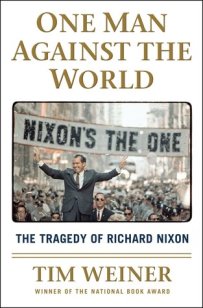
onemanagainsttheworldQuestion: What do an old typewriter, a copy machine, Scotch tape, and a razor blade share in common?

Answer: They were all tools used by White House employee Howard Hunt, at President Richard Nixon’s request, to forge a cable that would make (dead) President JFK appear to have ordered the assassination of South Vietnamese President Diem.

My, my, my. The things you can learn once you start digging. This is by no means the most important part of the Nixon story as told by veteran political writer Tim Weiner, nor even the most humorous, in a grim, gallows sense; it’s just a small sample of the bizarre, the paranoid, and above all, the crooked, reprehensible deeds committed by Nixon and his creepy co-conspirators during his administration. And by now I am already supposed to have told you that I read this book free, thanks to Net Galley and Henry Holt Company.

So, can we find a way to go back and make it look like I told you during the first paragraph, like I was supposed to? And for God’s sake, don’t tell anyone.

How much will it cost to keep this thing quiet?

I was just a kid during Nixon’s first term. But as young as I was, I have to tell you, dear reader, that the times were so polarized, so politicized (not unlike the time in which we now find ourselves) that issues like Civil Rights and the Vietnam War could not be relegated to the more traditional venues, such as the evening news or the newspaper. As soon as someone opened the newspaper, or turned on the television, or started to talk about something they had seen on the news, everyone within hearing range erupted in one direction or another. It happened at home; it happened at school; and it probably happened in workplaces. Even if I hadn’t been so fascinated, there was no getting away from it.

During the time Nixon was in office, most of the media criticism of his behavior was initially soft-pedaled out of respect for his office. It took awhile before anyone in the journalistic community used the word “lie”, for example. The words I heard were “discrepancies” and “evasions”. And all of us, kids and adults alike, were stunned by the number of times the words “expletive deleted” were used.

The fact that President Nixon referred to U.S. Supreme Court Justice Thurgood Marshall as “black of course…dumb as hell” was redacted until after Marshall’s death. The horror.

All that was a long time ago, of course, and Weiner is unfettered by any of the above considerations. His story is remarkably complete yet succinct, and oh so darkly funny. Even though others in my household do not share my absorption in things Nixon-related, I can’t get through more than three pages of this book without having to stop and repeat something on the page to whoever is walking through the room. For example, after having invaded Cambodia without the consent of Congress, and in direct violation of every US and international military law on the books, Nixon announced the invasion to the American people on television thusly:

“This is not an invasion of Cambodia.”

One more thing: Nixon’s cover up; the vast number of dead people, mostly young, who should have emerged alive and unhurt rather than killed against their will in an unjust war; the outrageous wrongdoings that unfolded in our capital and that were paid for with our tax dollars; and the outright theft of Federal monies for personal gain…the parallels that shake out between Nixon and Stalin, whose biography I reviewed two weeks ago, are disquieting.

And that much really isn’t funny.

Weiner, whose journalistic pedigree to date may make him America’s finest living political writer, does an outstanding job of eloquently stating what needs to be said and its significance without tossing in a lot of arcane trivia to muddy the water. Unlike most that have written about Watergate, he had no role in the crimes that took place and has no personal ax to grind. So if you want to just read everything that gets printed about Watergate, as I have so far, then read this along with everything else. But if you weren’t around during this time in American history and want to read one—and just one—book about Watergate and Richard Nixon’s resignation, then let this be it.

At the end of the book is a treasure trove of web links that will take the reader to primary resources, very valuable to those doing research.

Read it for your own political education, or look at it as grim, terrible humor, whichever suits you. For me, I guess it was some of each. But if you want to avoid stepping into the abyss, whether here in the USA or in whatever nation you call home, you’re better off being aware of what took place in the past.

Because it’s better to be watching, participating, and engaging in honest dialogue, and better to back your statements with actions that demonstrate integrity, than it is to hide in the fucking basement and scheme against enemies, real or imagined. Honest social and political discourse carried out as citizens of the world are what keep the rest of us from going down that rabbit hole.

Weiner’s masterpiece will be available starting July 21, but it’s probably best to order your copy now. So much of the future depends on what we know of the past.

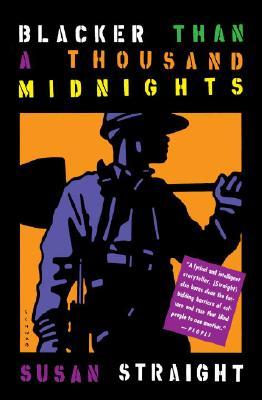
Blacker Than a Thousand Midnights, by Susan Straight *****

blacker than a thousand

Susan Straight is one of my favorite authors. I wish she had written more, but I suppose if you want quality, sometimes you have to sacrifice quantity.

As the parent of a young Black man, I recognize the fictional character Darnell’s dilemma: how do you play it straight while keeping it real (in other words, without playing the White man’s game to where you find yourself betraying some of your family and old loyalties)? How do you keep your friends from the neighborhood where you grew up and went to school, without landing your butt in jail right along with them? Remember that the US “justice” system is far from colorblind.

Darnell is tangible and believable. I came away feeling as if I knew him.

This is made all the more brilliant by the fact that Straight is a Caucasian woman. How dare she write in the first person as a Black man? Yet she carries it off, in my opinion, with grace and dignity. Her bio says that she grew up in an area in Riverside, California that was almost exclusively Black, so it may be that she considers herself culturally Black as well. That would explain a great deal.

Regardless of your political views, though, on race and everything else, this is strong writing, a character portrayed with immediacy and dignity. I like the way this woman writes, every single time.

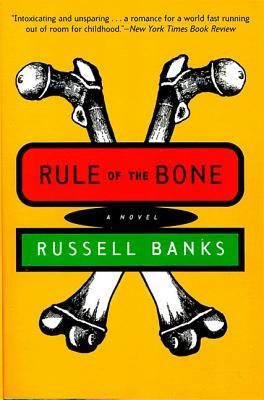
The Rule of the Bone, by Russell Banks *****

RuleofBoneBooks by Banks never disappoint. His writing is as harsh and beautiful as a New England winter. Rule of the Bone speaks with a social conscience that cannot be ignored or denied. The voice he uses carries credibility and authority characteristic of the seasoned master of fiction the writer has become.

This story is told in the first person. The protagonist is what those of us who work with poor kids refer to as a “throw-away”, those who don’t run away from home but are simply not welcome there anymore at an early age. Often, as is the case with the fourteen year old boy who renames himself Bone, it is a step-parent who in one way or another initiates the departure of a child who is far too young to make his own way in the world, and the birth parent who is passive and therefore complicit. Without job skills, social or interviewing skills, or any knowledge of how the social welfare system works apart from the fact that it doesn’t, he becomes a feral child, finding indoor shelter wherever he can: hiding in a custodial closet when the mall shuts down for the night; crashing with a biker gang that is dangerous and unpredictable but who tolerate his presence most days because he can find weed for them; and in an abandoned school bus.

Twice he tries to initiate a reconciliation with his mother and stepfather; twice he is spurned. His grandmother is no better. It is appalling, but also realistic. These kids are out there, and I am glad Banks put that fact in front of us. The protagonist points out that once he has been busted and released into the custody of his parents with the stipulation that he remain with them, and once they tell him to get gone (again), his way out of jail is to avoid parents, cops, and school, because each one of them will call another one of them in an effort to pass him to someone else. And the horrible truth is that he is right.

Our unlikely hero realizes that in his quest for survival, he has never actually learned what is right and wrong. None of his parents (mother, departed father, stepfather) has demonstrated any sort of consistent moral code, and he is cast adrift not only materially, but also in terms of his emotional growth and the development of his character. He finds it in a really unlikely place.

Like nearly everything Banks writes, Rule of the Bone is deeply disturbing in places and full of loss and anger. I have struggled with this when reading other books by this writer. Disturbing books are all the more disturbing when they are so well done that we cannot look away.

To other readers who have noted this (in reference to some of the other reviews I have read), I would advise that if you can’t take it, don’t read it. There’s no law saying you have to read this writer. Particularly if you have recently dealt with loss and are tender around the edges, go find another novelist. If you need a feel-good book, there are plenty of them out there.

For myself, I resolved my conflict of wanting to read one of America’s finest novelists versus wanting to avoid the abyss of depression they often inspire, by reading multiple books at a time. I move from Banks, to a nonfiction title, to a cozy feel good title, then back to Banks. Of course, there comes a point in the plot where Rule of the Bone can’t be put down, which is one more way we know it’s excellent literature. At that point, it’s time to dive in and finish.

I’m glad I chose to return to this man’s work. The tone is bleak, and yet in this case, it also carries with it a poignant sense of hope and yearning. Highly recommended.

Autobiography of My Mother, by Jamaica Kincaid *****

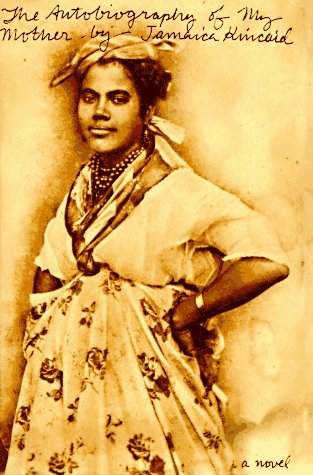
autobiography of my motherJamaica Kincaid is one of the best writers in the world, and of those who have gained a reputation for excellence, she is surely the angriest. In this fictional memoir, she unravels a tale of neocolonialism within a family, a hierarchy in which the child has the status of a servant. I was two-thirds of the way through it before I realized she had spun the entire story exclusively out of narrative, never flagging or losing momentum despite the complete lack of dialogue. Most of the action is within the protagonist’s mind rather than physical, though there more than one vivid depiction of abortion, and some really sensual sexual passages. In other words, it is outstanding, but not something to hand to an adolescent without due consideration.

Kincaid uses poetic devices, particularly repetition, in a way that is rare in prose, and she uses it deftly. Her narrator and protagonist is a woman whose mother dies in childbirth. Her mother is of African descent; her father is European. She describes the funeral for her half-brother, the favored one, and in doing so peels her father’s religion right down to its barest nub:

“And so again, what makes the world turn? Most of the people in that church would want to know. They were singing a hymn. The words were: ‘ Oh Jesus, I have promised/To serve Thee to the end:/Be Thou for ever near me, /My Master and my friend.’ I wanted to knock on the church door then. I wanted to say, Let me in, let me in. I wanted to say, Let me tell you something: This Master and friend business, it is not possible; a master is one thing and a friend is something else altogether, something completely different; a master cannot be a friend…Yes, but what really makes the world turn? And his mouth, grim with scorn for himself, will say the words: Connive, deceive, murder.”

The nostalgia the colonizers feel for England and for all things English, which are completely at odds with the tropical climate and Third World population of Jamaica, make for searing commentary. What else can I tell you, than that this book and this writer should be on your list? Whether for the social commentary that is part and parcel of everything this author sends out to the world, or whether for the outstanding craftsmanship that is so valuable to anyone who loves to read or wants to write, this book is highly recommended.

Native Speaker, by Chang-Rae Lee *****

native speakerNative Speaker has been praised by the most prestigious periodicals, from New York to London to Los Angeles, and yet, though it has won a number of awards, I had not heard of it until I found it in a special award-winners area of Powell’s City of Books, when I made my annual pilgrimage to my old hometown and my old bookstore this summer. Perhaps I first found him there because he teaches at the U of Oregon; or perhaps it is because Powell’s is the only brick-and-mortar bookstore I frequent anymore. At any rate, this book was a real find.
Our protagonist is Henry Park, who works as a spy of sorts for a private firm:
“Our clients were multinational corporations, bureaus of foreign governments, individuals of resource and connection.”
Henry is having problems with his work. He is supposed to insinuate himself into the lives of individuals who may be working against the interests of one client or another, find out all he can about them, develop a psychological profile. To do this, he has to pretend to become emotionally attached to them, and in some cases make them dependent upon him; then he files his final report on them and disappears from their lives.
His most recent subject was a psychologist named Luzan. He saw Luzan regularly, began telling him things he had never told anyone. What with his problematic relationship with his father, now deceased, and the accidental death of his beloved son, his only child, and his marital problems…the man actually needs a psychologist, and in the end the firm has to muscle their way into the shrink’s office and physically remove Henry from his subject in order to break the connection.
Now they have thrown him a really easy job to get him back into shape. He is supposed to cover and report on a politician, John Kwang. There is the Korean connection, which makes him a shoo-in; he begins by posing as a freelance journalist, but becomes more and more involved as a member of the campaign staff. His reports become scantier and fewer as he adopts Kwang as the father he never really had.
Beautifully interwoven throughout Lee’s narrative are the cultural understandings between those of Korean ancestry; the conflicts that arise between first and second generations in the US; the racist assumptions, stereotypes, and miscommunications between Koreans and Caucasians, whom he pointedly refers to as “Americans”. Black people are just Black, but white folks are “Americans”. Park is still in love with his “American” wife, but she recently figured out what he does for a living, and she isn’t sure she can live with it. His plan is to finish this assignment, he tells her, and then he’ll get out, go do something else.
There is such grace and care in Lee’s story-telling, both in what is said, and in what is not. I’ve never read anything like it. And one thing I really appreciate is that without overtly saying so, he lets us know that there is no such thing as an Asian-American. A certain skin tone, a fold at the outside of the eyelid, these are superficial things that don’t speak to culture, to language, to expectations. I also really appreciated the way he dealt with the hostility between Korean small shop owners and their African-American neighbors and customers, and the historical reality to which he deftly traces back, without ever stepping away from the central storyline.
Native Speaker is unlike anything else I have ever read. It doesn’t even have a genre, unless we drop it into the “Asian studies” category that his story demonstrates is artificial in any case. It’s a thoughtful, deep story, yet it is not hyperliterate or particularly lengthy. It’s there for anyone who will take the time to read it. A worthy and thought-provoking journey.

What Women Want, by Deborah L. Rhode *****

What Women Want

Yes, thank you, I am a feminist. And in the wake of the Supreme Court’s decision around the Hobby Lobby’s so-called “right” to deny its female employees the contraception of their choice via their health insurance, Rhode’s manifesto could not be more timely. The book is not only right on the money politically, but it is scholarly, accessible, and written by a woman whose credentials cannot be questioned. Rhode is a Stanford law professor who clerked for Thurgood Marshall. She founded the school’s course on gender, but still sees plenty of room for improvement…everywhere. She’s right. Thanks to Net Galley for promoting this important book.

Rhode points out that in spite of the all-too-common mistaken perception that gender bias is a thing of the past, women constitute less than one half percent of the content in the average history textbook. Furthermore:

In virtually every major dimension of social status, financial

well-being, and physical safety, women still fare worse than

men. Sexual violence remains common, and reproductive

rights are by no means secure.

Women are still primarily responsible for child care, and they are still penalized for this on the job. Abortion providers are rare due to local laws and increased insurance premiums, courtesy of virtually unfettered terrorism against women’s health clinics. Wealthy women will always be able to terminate an unwanted pregnancy because they can travel, but the poor, who often have the most urgent need to exercise this choice, are stuck if they can’t get to a county or state where the service is available, and pay for attendant travel costs associated with other red-tape hurdles such as waiting periods.

The USA has the second-highest rate of reported rape in the world, and a quarter of all women experience violence from their intimate partner; a fifth are raped or experience attempted rape.

Are you listening?

Rhode carefully delineates every problem faced by women in the USA today, and she argues, blow by blow, citation by citation, what is needed. Women should be organizing. We aren’t, at least not in the numbers that we need to in order to bring about social change. In fact, this reviewer would suggest that we are losing ground, and it is because so many of us don’t show up to carry a sign, wear an armband, or carry a bullhorn.

The only weak place in Rhode’s release, if there is one, has to do with women of color. Her analysis there is shallow. However, the other sections apply to all women, regardless of color or ethnicity. We all need respect in the workplace and parity with our male coworkers or colleagues in pay and advancement. We all need affordable–if not free–childcare. We all need reproductive freedom that is between ourselves and our doctors. And we all need to be able to speak up and be perceived as “assertive” rather than “aggressive”. We are not there yet.

This reviewer has twice marched in Washington DC for women’s right to reproductive freedom, and cannot believe that the Equal Rights Amendment is dead. What’s that about?

If you are female or care about someone who is, you should get this book. Rhode is crystal clear and absolutely correct; if women cannot be equal now, then when?

Breaking Rank: A Top Cop’s Expose of the Dark Side of American Policing, by Norm Stamper****

breakingrankDoes this look odd in my otherwise left-leaning collection? It ought to. I make no bones about the fact that I don’t like cops. I have seen it too often: the racism, the preference for protecting property over protecting human flesh and bone, the gratuitous violence. It is appalling.

Here in Seattle, the SPD has gotten so far out of control that the FBI, not exactly heroes or saints themselves, have been called in to reign them in, get the SPD to tone it down, for heaven’s sake. Don’t be so obvious about it. The recent shooting of an unarmed deaf American Indian who was plugged in the back for failing to stop-when-I-say-so, was the final straw where a lot of folks here were concerned. There was no call for anybody to shoot John Woodcarver. He was well known both among the homeless and the working crowd downtown, and one person after another testified that he was harmless. No history of any sort of violent crime; I can’t recall that he even had a record, though I can’t say I looked hard or cared. There’s never a call to shoot an unarmed man, and this was not an exceptional shooting. There’s been way too much. Furthermore, the FBI has grown frustrated with the local law’s intransigence. They mount dashcams; the cops turn them off, or point their cars facing away from the scene of action before they whip out the tasers and guns.

Just over a decade ago, Norm Stamper was the chief of police here. Prior to that, he was a cop in San Diego. During the WTO protests (World Trade Organization) in downtown Seattle, things got badly out of control. During the review that followed, Stamper’s was the head that rolled.

Rather than slink away with his tail between his legs looking for a quiet little hamlet to sheriff, he did the completely unexpected: he turned on his own. He wrote down all the dirty little secrets that he says are endemic not only here, but in pretty much every major metropolitan city in the USA. It’s endemic, he claims, and I believe.

Have you ever wondered why Black people are arrested at such a disproportionate rate? Some liberals may be inclined to write it off as a side affect of poverty and the lack of a solid foundation during childhood. (Michelle Alexander would later publish The New Jim Crow, which has all that data you need to put a stop to that lie.) Stamper says oh hell no. He has a special chapter, and it is for this chapter that the book receives my four of five stars rating, that is about why cops beat Black men. Brace yourself. He gives the code letters or names that are abbreviations for racist epithets you may have believed died in the ’60s. If so, you have led a sheltered life. Stamper proves it.

So if you can stand the heat, check out Stamper’s kitchen. It gives me joy to see one of these people come back to eat their young, and to shine a flashlight into all the dirty corners of urban police life.

A caveat from me, for those who have a beloved relative who’s in the biz: I don’t say every single cop in every city is corrupt, racist, and dirty. I only say there are too few good guys, at least those who stick around once they see what the job is really about, to make a significant difference. So relax about Uncle Tony or Grandpa Bob. If you say he is a gentleman and a hero, I believe you.