After Annie, by Anna Quindlen*****

After Annie tells the story of a family that is changed by the sudden death of the mother, a woman still in her thirties. My thanks go to NetGalley and Random House for the invitation to read and review. This book will be available to the public Tuesday, February 27, 2024.

I’ve read a number of books by this author, and I have come to notice a pattern. I read the synopsis, like the sentence I used to begin this review. I see what it’s about and shrug. Doesn’t sound like it would be all that special, but hey, it’s Quindlen, and I have liked her work before, so let’s give it a shot. After all, in past novels, the topics also didn’t seem engaging at the outset. One novel is about a family being forced to relocate due to eminent domain; another has to do with parking spaces in New York City. There’s a memoir about grandparenting, and another about—I kid you not—her dog. Nothing here seems all that appealing.

Yet in some ways, it is the very ordinariness of her subjects that draws us in. So many of us have had to move when we didn’t want to, and so we fought it; or we became so angry with a neighbor’s thoughtlessness that we fantasized about terrible revenge; or we dealt with a death that came out of the blue, striking down someone that was perfectly healthy, or that seemed to be. If we haven’t done any of these things, chances are excellent that someone else we care about has. By tapping into every day experiences and crises of various sizes, Quindlen finds commonalities.

But perhaps the most important feature of her books, particularly her novels, is the way that she crafts characters that are so visceral we would know them if we saw them on the street. Young Ali, the daughter who’s just beginning middle school, yet suddenly finds herself burdened by all of the things her mother did for the family, from child care to meals to housework, is so real to me that I nearly climb inside of her skin, and when Annie’s best buddy tries to tell Bill, Annie’s husband, Ali’s dad, that this isn’t okay and he blows her off, I want to cry out. We can see that he’s behaving selfishly, whether he knows it or not, because he is so poleaxed with grief. It’s hard to prepare a meal when you can’t stop crying. Hell, Bill can hardly go into the kitchen, because that’s where she died.

Grief was like spring, maybe. You thought you were getting out from under it, and then it came roaring back. And getting out from under it felt like forgetting, and forgetting felt like treason.

I began reading this story because I like the author, but it also serves as a grief book. I found this out when my sister died about halfway through. Unlike Annie, my sister was not in the prime of her life, nor was her death unexpected. She’d been horribly ill and in great pain for years on end. Her death was a relief, ending her pain, and ending the anguish of others that had been constantly seeing her that way, helpless to improve her life in any way. So I am not poleaxed like poor Bill. She didn’t leave behind a houseful of small children and a middle schooler trying to pick up all of the pieces. She didn’t have a six year old who would explain to everyone that his mommy wouldn’t be dead anymore once she came home from the hospital. But what I am saying is that I find this book more soothing than I would have guessed. If you or someone near to you is dealing with loss, After Annie may help you too.

Highly recommended.

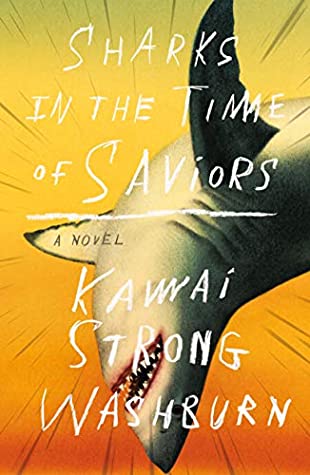
Sharks In the Time of Saviors, by Kawai Strong Washburn*****

A story like this one only comes along once in a rare while, luminous, intimate, and deeply affecting. My great thanks go to NetGalley and also Farrar, Strauss and Giroux for the review copy. This book is available to the public, and you should get it and read it.

Initially I was drawn to this book for several fairly superficial reasons. The cover is certainly arresting; the title is perplexing. But the biggest draw for me was that it was set in Hawaii, and all of the characters are native Hawaiians. In my corner of the world, the Pacific Northwest, there are a lot of Pacific Islanders. Why anyone would leave such an idyllic climate for the dark, soggy winters we see here used to be a mystery to me, but ultimately, people follow the jobs, and so many Seattle residents come from there.

As a history teacher, I’ve always felt that my students deserve to be included in the curriculum, and so in addition to teaching about Caucasians during whatever time period we’re examining, I work in African-Americans, Latinx, Native peoples, and a variety of Asian ethnicities, but time and again I hit a wall when I tried to find something for my Islander students. And when I’ve taught literature, it’s been the same struggle. Islander kids get shut out every time.  And so now I am retired, and here’s my appeal to other educators out there. Put this book in your classroom.

For the rest of you: apologies. Let’s get on with it.

As we open, the setting is Hawaii in 1995, and the protagonists are two parents and three children, all members of the Flores family. They’re on vacation when seven year old Noa falls into the ocean where sharks are circulating. But instead of devouring the boy, one of the sharks delivers him back to his family, carrying him gently in its jaws, “Like you were made of glass, like you were its child.” The first chapter is told in the second person, with Malia, the mother, recalling the event, speaking to Noa. She tells him, “The gods were hungry for change, and you were that change.” It’s obviously a miracle, and others see it happen also. Their lives will never be the same.

As the story continues, we hear from all of the family members. At first, Noa appears to be gifted with a magical healing ability, but he is still a child, and the demands on him are grueling, exhausting. But this is not the only change his magical abilities produce. Noa is the youngest child in the family, but now the siblings’ hierarchy is completely flipped, and the resentment felt by his brother and sister is dreadful. At one point Kaui, who is academically talented, fumes that she is “just his shadow, shaped like a sister.”  And his brother Dean, who is an athlete, explains:

You’re out at breakfast without him, eating cereal and joking with Mom and Dad, Kaui coming in, and you get them all laughing and smiling, just because of you. But then Noa shows up right, and suddenly it’s all questions about what’s happening with his day and did he sleep okay and here’s some thoughts about which extracurricular program he should enroll in…Hard not for get angry at that. I felt it like a fist flexing inside my own chest.

To make matters even more fraught, there’s an economic downturn that makes it impossible for the parents to support the family. They begin charging people that come to be healed by Noa, and so the youngest child is not only the golden favorite because of his miraculous ability; he’s also the family breadwinner. And again: it’s an awful lot to put on the shoulders of one small child.

The dialect combines with the authorial voice to create characters that I swear I would know if I ran into them, and in many ways, they remind me of the adolescents that I taught. Because I was so unconscionably late here, I checked out the audio version at Seattle Bibliocommons, and I have never heard an audiobook I loved more. The voice actors are so convincing that I can hear them now, more than a month and several other audiobooks, after I finished it.

For me, that would be enough. Create visceral enough characters and I don’t even care much about the plot. But the plot is also gobsmackingly brilliant! I believed I could track where it was headed up until perhaps the 60% mark, and then there’s one surprise turn, and another, and another, till at the end I was simply sitting with my mouth open and my eyes on the text as the audio gave way to the afterword and credits. I had to remind myself to breathe.

This is one of those rare galleys that I could see reading again just for the love of it. This review is my 923rd for NetGalley, and I have chosen to reread fewer than 10 of them, so let that indicate the measure of esteem in which I hold this novel.

A Fever in the Heartland, by Timothy Egan*****

Timothy Egan, winner of the Pulitzer Prize, is one of my favorite historians to read. His most recent book, A Fever in the Heartland occupied the bestseller lists for months, and rightly so. I took my time with it because it is a very uncomfortable read most of the way through, with the first half being much rougher than the last. I learned a lot from it, and this is clearly a case of truth being stranger than fiction.

The Klan was originally formed by former Confederate officers after the Union’s victory in the American Civil War. However, it was stamped out during Reconstruction, and was gone for fifty years. It was revived on Stone Mountain, Georgia, and the horrifically racist film by D.W. Griffin, The Birth of a Nation, which depicts African-American men as crazed rapists that drink to excess and lose their minds when a Caucasian woman is anywhere nearby, not only aided its reincarnation, but contributed one of its most feared symbols. No crosses were burned until it showed up on movie screens around the United States; the pointy hoods were shaped that way to make the men underneath them appear taller. Later, the women’s organization had robes with cardboard forms in their own pointy hats, because a night of terrorism is no excuse for a woman to let her hair get out of control.

At one point, one Caucasian man in three belonged to the Klan. There was even a children’s organization, with activities similar to boy and girl scouts.

The woman that is at the center of this story, Madge Oberholzer, was the secretary in the office of D.C. Stephenson, the Grand Dragon of the newly revived Klan. Despite the hugely moral speeches he gave around the country extolling traditional values (for the time) including the avoidance of alcohol; women that remain virgins until marriage and then live their lives in service to their husbands and young children; Protestantism, with regular church attendance; Caucasian separation from other races and ethnicities; and unquestioning patriotism, Stephenson himself was a drunk, as well as a serial rapist and sexual sadist, fond of using his teeth to mutilate the women that he savaged. Madge was the one victim that would not crawl into the shadows, and she literally used her last dying breaths to expose him.

I was given a hardcover copy of this book when it was at its height of popularity, but it took me a long time to get through it, because I could only stand to read a few pages at a time. The end was enormously satisfying, however, and even in the worst parts, there are occasional moments that made me want to stand up and cheer. For example: the Klan plot to go the University of Notre Dame—a Catholic university– and burn the golden dome there was foiled by its football team, and the melee that ensued when they physically attacked the Klan is the origin of their nickname, The Fighting Irish. (The dome survived.)

Often when I read nonfiction history, I can’t help imagining how much more interesting it would be if it were written as historical fiction. That was never the case here. Firstly, if this were a fictional account, reviewers everywhere would have been brutal, because nobody would ever believe a story like this one. But the fact is, it’s entirely true, and Egan is second to none when it comes to research. Also, his conversational narrative style is as interesting as the best historical fiction; the pace here is slowed in places, not by any lack of authorial fluency, but by the horrifying nature of this true story.

For those that have the capacity to read something like this without becoming morbidly depressed or coming unstuck, this book is highly recommended. For everyone else, I recommend finding something lighter and more uplifting to alternate with it, and to never read this at bedtime. You won’t want it in your dreams.

On the Line, by Daisy Pitkin*****

On the Line, a labor memoir by Daisy Pitkin, tells the true story of a grassroots struggle to organize a nonunion laundry in Arizona as part of an industry-wide unionizing campaign. My thanks go to NetGalley and Algonquin for the invitation to read and review. This book is for sale now.

Daisy is an organizer for UNITE, a labor union that organizes textiles, laundries, transportation, service workers, and some others, created by the merger of ILGWU (International Ladies Garment Workers Union) and ACTWU, the American Clothing and Textile Workers Union (of which this reviewer was once a member and union activist.)  She is working at the ground level, approaching workers in the parking lot, partnering with a woman named Alma that worked there and could talk to other workers inside the factory.

The memoir is written in the second person to Alma, and at first this seems odd, but as I read, I realize this is an effective and intelligent choice. By addressing Alma and the things that Alma has said and done during this fight, as well as the things the author did, along with what they did together, and the occasional differences of opinion they had and how they resolved them, she avoids making herself sound like a martyr to the cause. It would not read nearly so well in the first person, with the reader as audience.

The tasks of the workers all revolve around the commercial laundering process. Immense bags of dirty linens weighing up to 300 pounds are pushed off of the delivery trucks in rolling carts.

“The linen moves down the belt, you said, and then you flicked your arms back and forth to demonstrate how you and the other sorters toss sheets into one bin, towels to another, gowns to a third, and so on. You said, Sometimes they speed up the conveyor, and we don’t have time to be careful. There is a lot of blood and puke and feces. You said, We don’t get shoe covers, so some of us take off our shoes and drive home in our socks. You said, Our gloves are too big—they slip off our hands. Sometimes when they tear open, we have to handle the soiled linen with exposed skin…you were demanding a seemingly simple thing: to work your eight-or-ten-hour shift and come home unharmed. You wanted gloves that hospital needles cannot puncture. You wanted face masks to keep the blood and fluids from other bodies from entering your bodies. You wanted safety guards put back on machines where they had been removed. You wanted linen dust cleaned from the rafters to prevent fires.”

Safety rules are routinely flouted. Dirty linens land on the belt, and the belt feeds them into the mouth of a tunnel washer. When the washer jams, workers sometimes have to crawl through hot, bleachy, contaminated water to clear it and get it working. The supervisors are supposed to cut power when someone is in there, but they don’t. Ultimately it’s a choice for the owners to risk a possible, but unlikely fine from the government, or frequent decreases in production, which cut into profits. The workers are expendable; they can always find more. The wash and dry departments of industrial laundries are the most fatal of all industries, according to U.S. government statistics.

Daisy and Alma are working on a shoestring. When they have to be away from home overnight in order to meet workers as they go in or come out, they sleep in the car. Their signs are made by hand with posterboard and Sharpies. Initially, all of the workers sign cards, but then management begins a campaign of threats and intimidation. Not all of the workers are in the States legally, and most of them don’t know their legal rights. Most of them rescind their votes, and then it’s an uphill climb to get them to sign again.

This is a topic that is of great interest to me, and I was supposed to have read and reviewed this book in April of 2023, but my stomach twisted as I read of the horrific obstacles encountered by workers and by Daisy, and halfway through I had to put it down. Only recently did I slap myself upside the head and resume reading.

In any labor union, there are two sets of obstacles. The first, the one that is obvious, is the company, the bosses. Unions cut into profits, so the owners or boards of directors nearly always fight unionization. The second, and lesser known, is the union officialdom at the top. These people spend more time around the bosses and other highly paid union officers than they do around the workers, and they become jaded, sometimes contemptuous of those that they are supposed to represent, whose dues pay their salaries. When Daisy is eventually promoted, she discovers it’s harder to do anything that is in the interests of the clientele.

The book also includes a fair amount of union history, and it’s clearly explained, well woven throughout the narrative.

For those that are interested in unions and labor history, this is an excellent resource. But don’t read it at bedtime; it will do things to your dreams.

The Ghost Orchid, by Jonathan Kellerman****-*****

4.5 stars rounded upward. My thanks go to Random House Ballantine and NetGalley for the review copy. This book will be available to the public February 6, 2024.

The Ghost Orchid marks the thirty-ninth entry in the Alex Delaware series, one of the longest series in publication. It’s easy to see why it’s lasted so long. The protagonist and side characters are engaging, and the dialogue never loses its sparkle.  In this one, Alex has been recovering from a savage beating that he took at the hands of the murderer in our last mystery. Milo, his BFF, is a homicide cop who often hires him to assist the LAPD with cases where a psychologist is needed, but now Milo is so mired in guilt that he can hardly look at his friend. Finally, with a nudge from Delaware’s longtime (and slightly boring) girlfriend, Milo includes him in another case, and we find snappy dialogue that never fails to entertain.

This time it’s a double homicide in Bel Air. The man and woman are found by the pool, naked and dead. The investigation reveals that he is the son of a mega rich European shoe magnate; she is the wife of another rich man, a young, socially awkward member of the ruling elite who isn’t pleased to learn what his wife has been doing when he’s away on business. But then we learn that she was using an assumed name, and so the whole thing is even more mysterious. Who is this dead woman, and who killed her?

At the same time, Alex is engaged to interview a child in his early teens whose adoptive parents have decided to bail. They are divorcing; neither of them wants the kid.

The main storyline is a lot of fun. Everyone enjoys seeing the super-rich suffer. With wealth of this magnitude, there’s no chance any of Kellerman’s readers will identify with the male murder victim or the husband of the female victim, either. The way it’s resolved is believable, and it’s done without any of the prurient or kinky sex that Kellerman inexplicably included for a handful of books in this series a few years back. The half star is withheld from my rating because the other storyline, the one about the teenager, sort of fizzles without going anywhere, and it’s hard to see why he included it in the first place. Kellerman’s career, and this series, were originally launched around crimes where kids were involved, often as witnesses, and those initial books are fascinating. I’d love to see the author return to his roots, write some more episodes that incorporate his credentials and experience in child psychology.

You can read it as a stand alone novel if you choose, but you’ll want to read the others afterward.

Nevertheless, if you are looking for a fast, fun whodunit, this book is a hard one to beat. I highly recommend it to those that love the genre.

The River We Remember, by William Kent Krueger*****

William Kent Krueger has been writing since the late 1990s, but he only came onto my radar in 2019, when he published This Tender Land. To read Krueger once is to want to read him again and again, as often as is possible, and that’s what I’ve been doing. The River We Remember is his most recent mystery, an achingly atmospheric novel set during the 1950s in rural Minnesota. My thanks go to Net Galley and Atria Books for the review copy. This book is for sale now.

The protagonist in this stand alone whodunit is the local sheriff, Brody Dern. Brody is a thoroughly believable character; there’s nothing of the TV sheriff about him. When the wealthy, universally hated Jimmy Quinn is found floating dead in the river, Dern does not lose sleep while vowing to find and reveal the entire truth. His first response is his own deep resentment that Quinn had to go and die in what had been, until now, Brody’s favorite spot to relax. How dare stupid, rotten Jimmy Quinn ruin this special place with his bloated corpse? And his second instinct is to minimize the damage to everyone else concerned. For example, the Quinns are Catholic, and if Jimmy committed suicide, they can’t bury him with the family. If not suicide, then perhaps a family member could stand it no more and shot him dead. Again, if so, no great loss, and let’s make sure the family is taken care of. And so, Brody’s first instinct is to wipe down Quinn’s truck so that, if other authorities should become involved in the case, none of these poor people will have to suffer for it.

Then, he goes to the evidence cabinet and removes some of the confiscated drugs so that he can get a decent night’s sleep.

Part of what fascinates me here is the culture of small town Minnesota during this time period. People don’t lock their doors most of the time. When a prisoner that Brody knows is almost certainly innocent requests a sharp knife in order to carve something, Brody gives it to him, right there in the cell. There are a number of interesting secondary threads, and all contribute to the steamy, smoldering ambience in which this story is set.

But oh lordy, the racism. And in this, I know there is no exaggeration. The culture among the Caucasian population of this tiny town, with regard to Native peoples and those of Japanese descent is not so very different from what I experienced as a child, growing up in the 1960s and even the 1970s in suburbs on the American West Coast. It’s bad. It’s really bad.

A feature of Krueger’s work—a signature aspect, in fact—is the inclusion of American Indian cultures and sociopolitical issues in Northern Minnesota. In other stories I’ve read, it’s been the Chippewa; this time, it’s a Dakota Sioux man named Noah Bluestone, and his Japanese wife, Kyoko. The author develops his characters well, with no stereotypes or hackneyed pop culture. This alone makes his work worth reading, but there’s so much more.

Over the course of just a few short years, Krueger has joined other luminaries on my list of authors whose work I read without question. I highly recommend this book to all that love the genre.

Kinfolk, by Sean Dietrich*****

“Thanksgiving is not about being happy. The holiday is not about mirth and beauty and the warmth of gaiety. Thanksgiving is about fulfilling family obligations and being miserable the way the good Lord intended.”

When we meet our protagonist, Nub Taylor, it is Thanksgiving night, and he and his cousin and best friend Benny are three sheets to the wind, idling in a rusty old truck across the street from the dignified, stately home of Nub’s daughter, Emily. Nub has been invited to dine there, but knows better than to attend. Emily is a widow; she married up, and every mover and shaker in town has shown up. No, Nub won’t be joining them. Nothing good would come of it.

My thanks go to Net Galley and Harper Muse for the review copy. This book is for sale now.

Our story is set in the 1970s in a tiny town in Alabama. Nub is long divorced from Emily’s mother, who keeps her distance these days. He takes his meals at the Waffle House, and that includes today:

“Waffle House did not close on Thanksgiving because Waffle House never closed. Waffle House was like the Vatican, only with better hash browns. Nobody on staff at the Waffle House had a key to the store, not even the manager. Because there were no keys. The doors were never locked. Waffle House just went on and on. Sort of like a disco.”

It is here that he meets Minnie. Minnie is fifteen years old and well over six feet tall. Why is this girl spending her holiday here, instead of with her kin? The answer is that she has none. Her father is in prison, and her mother has just recently killed herself.  

Of course, Nub doesn’t know these things at first, but something about her calls to him. Perhaps all children of suicide victims wear something similar in their expressions; Nub had lost a parent the very same way, and he has never gotten over it. How does anyone? He knows “the cardinal rule about suicide. You don’t talk about it.”

Now, Minnie is orphaned and she is pregnant, courtesy of a thoughtless, spoiled local boy that told her he loved her, then laughed behind her back. And so it is that Nub realizes, as he learns more about Minnie Bass, that perhaps he may have a chance to redeem himself.

This is a wonderful story, full of warmth and a lot of heart. Dietrich is a master story teller, able to create viscerally real characters that leap from the page and a narrative that billows with home truths. There is no question that Kinfolk is among the finest books to be published this year.

Highly recommended.

The Celebrants, by Stephen Rowley***

I enjoyed Rowley’s novel, The Guncle, which came out in 2019. When I was invited to read and review The Celebrants, I jumped at the chance. Unfortunately, it didn’t do a thing for me. Nonetheless, my thanks go to Net Galley and Putnam Books for the review copy. This book is for sale now.

As a child, we once had a bird bludgeon itself to death on our sliding glass door, unable to accept that the invisible barrier was really there. Reading this book made me feel just a bit like that bird. I’d liked Rowley’s last book. Other Rowley fans liked this book. So why…(BAM!)…why…(BAM!)…why could I not get into it?

I think it all boils down to privilege.

Had I read the premise more carefully, I might have avoided this trap. A group of seven college friends, grief-stricken after losing the eighth friend, agree to meet every few years and give each other mock funerals to celebrate the lives that still exist among them.

What rarefied conditions must exist to make such a thing possible? Imagine having the resources to be able to drop everything and fly off to wherever the meeting is held. Air fare. Childcare. Housing. But as I read the abundant dialogue in this thing, such trivialities are seldom mentioned. These are people that for the most part came from money, and they have money now, and they assume they will have as much, if not more, in the future.

Of course, the story is not about money and privilege. It’s about taking stock of their current lives and comparing them to their youthful expectations. There are secrets. There is baggage. And now, in their middle aged years, they are older, wiser, and in many ways, sadder.

Oh honey. They think they’re old now? My ass!  My children are middle aged. Get a fucking grip.

So okay, I am probably not the ideal audience; and yet, I will remind you that I didn’t volunteer for this. I was selected. Someone clearly believed that I am within the target audience.

I initially felt some of this when I began reading The Guncle. The protagonist there was a successful actor with a pile of money; and yet, the challenges he faced, first with the death of his partner, and then with the homophobic relative that tried to keep him from taking the children that had been entrusted to him, won out. The presence of well-written children helped a good deal, and the humor was completely on point. I cannot fail to appreciate an author that can make me laugh out loud.

I didn’t laugh out loud this time.  It’s grim, but it’s wealthy-people grim, not working class grim. If you don’t know the difference, then we all know which one you are.  I rolled my eyes a great deal, but it’s even harder to read when you do that, so I borrowed the audio from Seattle Bibliocommons. It didn’t help a bit, apart from making it possible to take in the book and roll my eyes at the same time.

I see that this title has been nominated for the Goodreads Choice awards, so clearly, a lot of people have loved this book. But I am not one of them.

Recommended to rich people that believe their lives to be harder than they actually are.

The Meth Lunches, by Kim Foster****

Kim Foster and her husband, David, create a food pantry in front of their house—and later, inside it—during the pandemic. It begins with the employment of one hungry handyman who’s also an addict, and from there, it mushrooms. This is her memoir of that time, and also a philosophical treatise on poverty and hunger in the United States.

My thanks go to Net Galley, RB Media, and St. Martin’s Press for the review copies. This book is for sale now.

When Foster’s family moves from New York to Las Vegas, one of the first thing she notices is the meth. It’s everywhere. Perhaps it is the milder weather; addicts in New York have to find a spot out of the weather during much of the year, but Vegas is in the desert, mild enough for the unhoused to sleep just about anywhere, warm enough that addicts don’t have to hide themselves away to get high.

The pandemic hits Vegas hard. So many people make their living from some aspect of the entertainment business, and for a while, it is a dead industry. And so, after hiring a man with an obvious dependency to do work on their property—work that he never completes—and hearing his story, the Fosters decide to convert the little free library in front of their home to a little free pantry. And from there, it mushrooms.

The pantry begins small, but Foster is a chef, and she can’t stand the notion of just putting out pre-packaged crap when she can cook food with fresh ingredients that will make others feel better. And as the book takes off, I momentarily regret taking this galley, because I generally hate stories that drop recipes into the middle of the plot. If I want cooking information, I’d rather go to a cookbook, or to a recipe website. And it was right there in the title, after all: The Meth Lunches. It’s pretty obvious from the get go that lunch is going to be juxtaposed with social issues.

But as the story continues, I don’t hate it after all. For one thing, this whole book is nonfiction. There’s no plot that is sidelined by a recipe. The whole point is that that Foster considers food, and the act of feeding others, to be a sort of therapy. She makes the point well.

Eventually, the scale of the operation becomes mind boggling. Multiple freezers to hold meat; trucks that deliver food. The pantry begins as an out-of-pocket gift from the Fosters to the down and out of Las Vegas, occasionally supplemented via Venmo from friends, when they are able to help. Inevitably, the pantry finds its way into the local media, and networks form with other food banks and nonprofits.

In between all of this, Foster develops relationships with some of the people that come by. She and her husband are foster parents—ironic, given their name, right? And we hear not only about what the children they house and love have experienced, but also about the children’s biological families. Because although it’s officially discouraged, Kim strongly feels that the children heal best if their biological parents are in their lives in whatever limited way is possible. So before we know it, she is deeply involved with some horribly dysfunctional adults as well. And it is the stories she tells about interacting with them and the children, two of whom she and David eventually adopt, that make this story so riveting.

At the outset, she intends for the pantry to be a resource for local families that have homes and kitchens, but whose finances have taken a huge hit due to the pandemic. The very poor already have resources, she reasons. But of course, the homeless find her, and she doesn’t turn them away.

And here is the rub, the only aspect of this book that I dislike. She tells us that one unhoused person in four is mentally ill, and she believes that this official figure is low, at least in Las Vegas. And then she talks about those with addiction issues.

But what she never gets around to discussing at all—unless she does it so briefly that I miss it—is the unhoused people that are not chemically dependent on anything, whose mental health is stable, but who don’t have a permanent residence because they straight-up ran out of money. To hear her tell it, you’d think they don’t exist, and you know that’s not so. So many American families live from paycheck to paycheck, even when the economy is said to be booming. And I feel that she has left these people without faces or voices. And that, in turn, perpetuates a stereotype, the one that suggests that everyone that is homeless is there because they’re either crazy or junkies or both. I use the offensive terms intentionally, because that’s how the stereotype works. 

And the stereotype in turn begets a lie, the insinuation that nobody has to be unhoused. Don’t use drugs. Get mental health care. Get over yourself. And whereas I can see that Foster doesn’t intend to promote such thinking, and in fact takes a hard line over poverty existing at all in such a wealthy nation, when she doesn’t give space to the many, many individuals and families that are out there because the wage earner was laid off, or because they were just squeaking by but then the rent increased, it does distort her overall picture. I don’t come away from this book thinking that most of the homeless are not using meth or any other dangerous, life-altering street drugs, even though it’s true.

Nevertheless, this is a poignant, stirring tale that won’t be told by anyone else, because it can’t be, and bearing in mind the caveats above, I recommend it to you, both as audio and print.

The Mystery Guest, by Nita Prose****-*****

“The maid is always to blame.”

4.5 stars, rounded upward.

Author Nita Prose introduced Molly the Maid to us in 2022. Now Molly is back. She’s the head maid now, and considerably more confident than when we first met her. Her boyfriend Juan Manuel has moved in with her, but he is conveniently out of town for most of this novel, and it’s just as well, because there’s another murder about to occur at The Regency Grand Hotel, and once more, Molly will be instrumental in identifying the killer.

My thanks go to Net Galley and Random House Ballantine for the review copy. This book will be available to the public November 28, 2023, so you can plan your gift lists accordingly.

The hotel is in high gear, planning for the big gathering that will introduce the large, new, lovely tearoom. Business has been down at TRG since the murder last year, and this special occasion should bring new life into the hotel. In fact, Molly has given up her vacation with Juan so that she can see to the set-up; everything must be cleaned, shined, and buffed to perfection. You see, famous author J.D. Grimthorpe has an important announcement to make, and he’s chosen the tearoom as the venue from which to do so.

The stage is set, and the fans arrive. Molly’s protégé, Lily, has arranged the tea cart perfectly. Grimthorpe takes the podium, and is presented with his tea. After doctoring it to his own tastes, he takes a sip and ascends the stage once more, but before he can get to the surprise announcement, he keels over dead, right on top of Lily!

Lily is terrified. She’s always been a quiet one, but now she is virtually mute. When the police come in to question her, Lily is nearly undone.

“Molly, I’m afraid.” Her eyes are round pools of trepidation.

“I know,” I say. “But why?”

“Because a famous man is dead. Because they always blame the maid. You of all people should know that.”

“You’re not in any trouble, Lily.”

“Bit soon to tell,” the detective replies.

With that, we’re off and running. The book is one hell of a page turner, and it’s over before I know it. There’s lots of spunky dialog that jumps off the page. I seldom regret putting away my book because I spend so much time reading each day, but for this one, I stayed up late.

My only quibble—a small one—is that a key part of the solution is a bit of a reach. But this is a fun story, and so I make a quick note and move on.

For those that enjoy a sparkling mystery interspersed with wry humor, this book is for you. The profound respect for the working class is icing on the teacake.

Highly recommended.