Say Nothing, by Patrick Radden Keefe*****

The Irish have fought against oppressive British rule for centuries, but for many the most interesting—and for some of us, emotionally charged—period is that known as The Troubles, which unfolded in 1969 as Irish youth, inspired by the Cuban Revolution and the Civil Rights movement in the United States, sought to carve out some rights for working people living in the North of Ireland and concluded in 1997 following the ceasefire agreement struck between Sinn Fein, which was then the political arm of the revolutionary Irish Republican Army, and the British government. Keefe’s intense, compelling narrative is the most readable that I’ve seen, and the revelations it holds affected me more deeply than any literature I’ve read since I began reviewing books five years ago. Thanks go to Net Galley and Doubleday for the review copy, which I read free and early. You can buy it tomorrow, February 26, 2019. 

The history unfolds in three sections and is bookended by the quest of Jean McConville’s family to find her body and if possible, to learn who killed her and why. It’s an interesting choice given the number of dead the conflict produced, many of whom have never been found and identified, but the mystery and the ambiguity of her activities—was she merely a mother of ten as her children say, or working quietly for the IRA, or a double agent working for the British—is emblematic of the tension and secrecy maintained on both sides. We begin with Jean’s abduction in the first section, titled “The Clear, Clean, Sheer Thing,” move on to the meatiest and most tragic part of the struggle, “Human Sacrifice,” in which young hunger strikers and many others die, and conclude with “A Reckoning,” in which the ceasefire is signed and many Irish people that were involved in the guerrilla war are held accountable—and as usual, the British are not. The entire thing is carefully documented. 

Keefe notes that during the 1980s there was a good deal of “ambient” support for the IRA in the US, and this I know to be true. I participated in fund raisers for humanitarian aid to the six counties during that time, and I attended a presentation by Bernadette Devlin, an iconic leader of the struggle who for some reason barely bears mention in this work. It’s my only complaint about the book. 

The middle section left me shaking an in tears. I had not read Brendan Hughes’s claim about the deaths of the hunger strikers and the role almost certainly played by Gerry Adams, and it was a week before I could pick the book up again. I am still raw from it. I can recall seeing headlines in 1981 when Bobby Sands died, and at the time I was a practicing Catholic. When I saw the news, I picked up the phone and requested a special mass be held for him at my parish in the Midwestern city where I lived then. The parish priest thought it was a lovely idea but he needed the approval of the bishop. The bishop squashed it like it was a bug. There’s a metaphor in there somewhere. 

The final section discusses The Belfast Project, a series of interviews done under the promise that they would not see the light of day until the subjects were dead and buried. The names of the interviewees were coded as a further layer of protection, and the whole thing was stored in the vaults of the Burns Library at Boston College, where it was believed that the British government would never lay hands on it. Never say never. 

This book is a masterpiece. The writer is a journalist on the staff of The New Yorker, and this project took four years of steady effort by the author and his assistants, and a good deal of travel as well. The documentation is meticulous. Nevertheless, there are a number of details that are impossible to nail down, and the book’s title gives the reason for this. The only way to be sure a secret remains a secret is to keep your mouth shut, and that’s precisely what most of those involved in the struggle have done. A great many details that could doubtless condemn large numbers of working class Irish to lengthy prison sentences are buried with the bones of those that could have told. And although the author doesn’t explicitly say so, it’s obvious from the fate of the interview tapes that there is never any other guarantee of confidentiality; the code of silence still held to by the survivors of The Troubles has been all the protection that Irish participants have ever had. The vow to keep information private was decimated time and time again by the horrifying physical and psychological torture on the innocent and culpable alike by British jailers, none of whom will ever be brought to justice. 

Those that didn’t follow this fight in real time will likely not be as shattered by the things this book holds as I was. The author paints a vivid scenario—imagine coming home and noting that there’s a British soldier in uniform, gun drawn, in the rhododendrons in the front yard, for example—and peppers the account with well-chosen quotes. The slow deaths of Irish youth held in virtual dungeons are hard to read about, but then, war stories usually are. It’s fascinating stuff, though but necessarily material for bedtime, depending on your level of sensitivity. 

Highly recommended. 

Such Good Work, by Johannes Lichtman****

I was invited to read this debut novel by Net Galley and Simon and Schuster, but when I first saw it in my inbox, I recoiled. Another addiction memoir! Another chance to live through someone else’s excruciating nightmare! But then I read a few early reviews—they didn’t bear the numbed courtesy of an obligatory write-up.  And then my own sense of courtesy tipped me over the edge. I was, after all, invited. Did I not want to be invited anymore? Of course I should read it.

The story is Lichtman’s own written as autofiction, and his unusual writing style drew me in. I was surprised to see how quickly I went through it. At the outset, he is teaching creative writing and is crestfallen to find that a student he has championed has plagiarized her work for him, and not only is his anecdote written with great humor, it is immediately familiar to me, and most likely will be to all English teachers.  We want to believe; we want to be supportive. And once in awhile, someone younger than ourselves comes along and manipulates the hell out of us. It is a humbling experience.

Jonas is half American, half Swede, and he finds that to get off of opiates and opiods, he needs to be in Sweden, where street drugs are much harder to procure.  He is enrolled in a graduate program in Malmo, but finds his time is primarily consumed by the refugee crisis as he volunteers to teach in a language school. Young men from the Middle East come by the thousands, and he is proud that Sweden doesn’t close its border, doesn’t set a cap to the number of immigrants it will welcome. At the same time, the Swedish government has some double standards where race is concerned; the Roma people that set up an encampment are quickly swept away. Then the nightclub bombing in Paris provides officials with an excuse to shut it all down; it’s a tremendous blow to the refugees and to those that want to help them.

At times I fear for this writer, because he seems to have no filters with which to protect his own heart as he hurls himself into his volunteer work; he wants to make a difference so desperately.  Many years ago I saw a short film that showed a Bambi-like deer grazing in a forest, and then the massive foot of Godzilla smashes it like a bug, and in his ragged, hungry quest for social justice, the author reminds me of that deer. Social justice work requires sacrifice to be sure, but a little care toward one’s own mental health is also essential. Lichtman’s master’s thesis focuses on a Swedish writer that ultimately succumbs to despair, turning on the car and closing the garage door, and I found myself urging this author to have a care, lest the same happen to him, a danger he refers to himself in the narrative. (From the acknowledgements at the end, I see that he appears to have emerged in one piece, at least so far.)

The stories of the refugee boys are searing ones. A young man told of walking through Iran, followed by Turkey, Greece, Macedonia, Serbia, Hungary, Austria, Germany, and Denmark on his way to Sweden. The whole journey was done on foot. So many families were dead that the boys’ tutors learned it was sometimes better not to inquire too deeply about those left behind. At one point, Jonas decides to become a mentor to one person, but things go amiss and he ruefully recalls his own role as that of “clumsy Samaritan.”

Lichtman’s prose is gently philosophical in a style that is slightly reminiscent of Zen and the Art of Motorcycle Maintenance, though in no way derivative. His perceptive commentary regarding the events that unfold around him, along with the lessons he learns about himself, is witty and absorbing. Along the way I picked up a little knowledge about Swedish culture and society that I didn’t have before.

The title has sharp edges.

Recommended to those interested in Swedish culture, the refugee crisis, and addiction issues, as well as to anyone that just enjoys a good memoir.

The Nightingale, by Kristin Hannah*****

You could say I am late to the party, and you would be right. I had a chance to read a galley, but I read the synopsis and then scrolled past it. More World War II fiction? Ho hum. But the most well-worn subject matter can be made brand new in the most capable hands, and Hannah has done that. I thank the Goodreads friends that insisted I should read this book, and Seattle Bibliocommons for providing me with a copy. 

Our two protagonists are French sisters whose mother has died. Vianne, the elder sister, marries and leaves; Isabelle is sent to one boarding school after another by her grieving papa, who has nothing to give his daughters emotionally. The Nazi threat is far away and of little concern to the people of Paris—until they come closer, and then they’re here.

The Nazis sweep through Papa’s bookstore. They trash the shelves and confiscate all of his Marx, all of his Trotsky. They say these are terrorist materials. And then—they put him on their payroll.

Isabelle leaves yet another boarding school and goes home to her Papa, determined to remain at home. She receives a cold and unwelcoming return; then the Germans pierce the Maginot Line, once believed to be impenetrable, and Paris is no longer safe. Papa sends a bitter Isabelle to live with her sister, but she is traveling in the car of neighbors, and they are forced to abandon their vehicle. Isabelle is on her own.

Vianne, meanwhile, is tending to hearth and home. For years she miscarried one baby after another, late miscarriages at that, and the love her sister might have expected has instead turned to grief for the tiny people buried in a family plot in Vianne’s yard. Her husband has been conscripted, and she is alone with the one child she was able to bear. Vianne is not a risk taker, because she has too much to lose. Everything she does is in the interest of her daughter, Sophie, and her husband. Isabelle arrives and almost immediately begins making waves, behaving provocatively toward the occupying German forces, and Vianne is horrified. Isabelle has to go.

Over the course of the story both sisters are developed in a way that is so natural, so believable that I can sometimes predict what they will do, not because the writing is formulaic—it isn’t—but because I feel I know them so well now. I want to speak to the characters directly, so visceral is my reaction to them. Isabelle, who at the outset is reactive and reckless, joins the Resistance and becomes a disciplined patriot, code-named “The Nightingale”. She is still courageous, but she learns to weigh her actions against the benefits and risks to her cause. Vianne, who at the outset is conservative, becomes more willing to take risks on behalf of the Jewish children in her small community, children that are likely to either starve or be killed if they are not smuggled into safe homes.  All along, I am murmuring advice to them: “Do it! Do it!” and “Don’t you dare.”

A particularly interesting and unexpected development is the change in Papa; the drunken, abusive, uncaring lout has a side that nobody suspects, and he becomes a flawed yet heroic side character.

Once I realized that Hannah is a force in today’s literary world, I read the galley of her next novel, The Great Alone (reviewed by me also.) It was good, but nothing close to what this story is, and so I am glad I read them in this order, saving the better story as a tasty dessert.  If you haven’t read this book yet, do it now. Trust me.

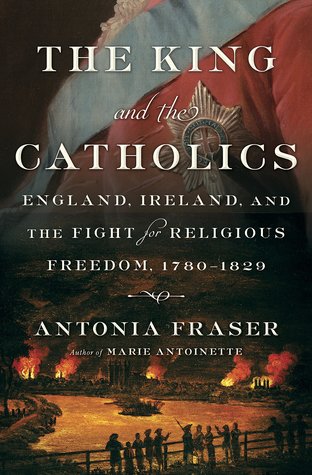
The King and the Catholics, by Antonia Fraser****

TheKingandtheCI was rooting around on Net Galley looking for some good nonfiction when I ran across this title. Many thanks to Net Galley and Doubleday for the DRC, which I read free in exchange for this honest review. This book is now available to the public.

Fraser examines the fight for Catholic Emancipation in Britain, from the anti-Catholic Gordon Riots of the late 1700s until roughly fifty years later. It is appalling that so much time, effort and money was needed for so small a thing as religious freedom, but there it is.

My own interest is more in the direction of Catholic history, with Irish history as a major part of that, and so portions of this well written, painstakingly researched and documented tome drew me more than others. I don’t care a whit what the king or any other members of the royal family say, want, or do, so for those with a closer interest than mine, this might well be a five star read. Parts of it are a trifle dry, but then Fraser livens it up with brief, lively sketches of the historical figures involved.

A major player in the struggle was the Liberator, Daniel O’Connell, and I read all of the passages in which this eloquent barrister is featured with tremendous interest. I also enjoyed seeing ways in which events in the larger world influenced events in the UK, from the French Revolution to the Boer Wars in South Africa.

An excellent addition to the library of any that are interested in the topic.

The Girl They Left Behind, by Roxanne Veletzos****

TheGirlTheyLeftBehindI was ready for something that was a little different, and then an online friend recommended this historical fiction for review. Thanks go to Net Galley and Atria Books for the DRC. It’s for sale today.
The story stems from the Bucharest Pogrom of 1941, in which hundreds of thousands of Jews were killed. And to show you how much I knew about this particular event before I read this book—my ignorance was so painful—I called to my spouse and said, “Honey?  Isn’t Bucharest in Hungary?”

The world-traveled, multilingual expatriate responded, “That’s Budapest. Bucharest is in Romania.”

Ahem. So this corner of my historical education was severely in need of help, and this was a good start for me.  If I were to rate this story solely on its merit as a novel,  I’d call it 3.5 because of some unevenness in the quality of writing, but the educational aspect of it is undeniable, and it makes a big difference.

The story centers on Natalia, a child that is abandoned during the pogrom when her parents flee from what they believe may be their death; they expect to be caught and killed. She is much loved, but her father persuades her mother that the only way the girl will make it out alive is if they leave her in the lobby of their apartment building with a note. She is adopted by a very wealthy couple that lavishes her with every possible comfort, until the regime falls and Romania comes inside of the Soviet orbit. After the coup, the conspicuously wealthy become government targets, and their assets—down to literally the clothes on their backs in some cases—are nationalized. Over the course of time, Natalia learns of her adoption and the parents to whom she was born.

The story uses the author’s family history as a framework, and notes at the end explain what aspects are autobiographical in nature, and which have been altered for the sake of the story.  There are family photos at the back of the book.

The voice is distinctly Eastern European, and that works in the author’s favor because it transports the reader to this time and place all the more effectively than a purely American-sounding voice would do. However, there are occasional lapses where clichés drop in, and it spoils the magic for awhile. The worst, perhaps, is “The walls have ears.”

The first forty percent of the novel is the most engaging, and I love the development of parents Despina and Anton, and little Natalia. The last half of the novel, however, is too busy and at times seems overwrought.

And then we are back to what I said at the outset: there is so much to learn here.  Historical detail is inextricably woven into the story, and our attachment to the characters, particularly at the start, makes the facts themselves more memorable. So when it comes down to it, I do recommend this book to you. If you can find a better work of historical fiction featuring the Bucharest Pogrom, then I may change my mind, but right now I would say Veletzos has cornered that market for those of us that read in the English language.

This book is one of a kind. Don’t miss it.

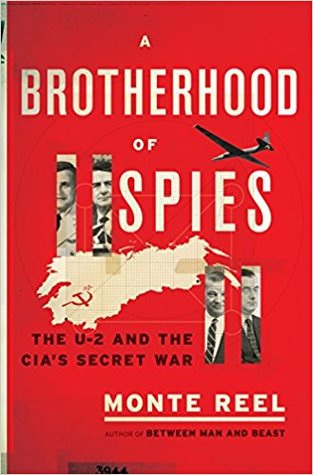
A Brotherhood of Spies, by Monte Reel****

BrotherhoodSpies3.5 stars rounded up. Thanks go to Net Galley and Doubleday for the DRC, which I received free and early in exchange for this honest review.

The story begins with a US spy plane being shot down over Soviet (Russian) airspace in 1960. This is embarrassing. Eisenhower’s people decide to make something up; after all, nobody survives an airplane crash over dry land. Moreover, the pilot was provided with a cyanide capsule—James Bond style—so even if he survived, he must be dead; likewise, the plane was likely blown to bits, with not much left for the Soviet investigators to learn.

Let’s say it was a weather plane. It wandered off course, and those mean Soviets shot it down.

But oh dear, this is even more embarrassing: the pilot lived, and he didn’t feel like taking the poison pill. Would you?  So the Russians know what he was flying, and they know who he is. They’re telling the world.

Just reading the teaser for this book, I was hooked. But just as a brilliant writer can take dross and make a good tale of it, so can an indifferent one take compelling information and make it into a snooze. For me, this was not an entertaining read. I had agreed to write about it, so I had to read it, and it felt like work.

I want to be fair here: there are people that will read this book and like it. There’s a lot of technical information about the spy plane, and about many other spy planes, some of which were never built. Apart from the truly bizarre one that was supposed to be landed on its belly (no landing gear), or the ridiculous idea of a nuclear powered plane, I found my attention drifting during these descriptions. But I am not interested in aviation, and if you are, you may like this.

The other aspect that causes my attention to wander is the history 101 aspect of it. I’m a retired history teacher. I don’t need an author to walk me through the Cuban Missile Crisis or the Bay of Pigs. However, I note that other reviewers came to this work with no knowledge of either, and they are delighted to be clued in. For newbies, count this as a win.

Finally, I have to credit the source work. Reel didn’t take the easy way out. His end notes are first rate.

For those that are relatively new to this chapter of American history, this may be a compelling read. For those interested in the history of American aviation, it is recommended. For those that are well read in the field, maybe not.

This book is now for sale.

Dangerous Crossing, by Rachel Rhys***

dangerouscrossingDangerous Crossing is an historical mystery set at the outset of World War II. I was invited to review it by Atria Books and Net Galley; it was published earlier this month, and you can buy it now.
Our protagonist is Lily Shepherd, a young woman in need of a fresh start. Her family’s scant resources are tapped in order to send her via cruise ship to Australia, where she is to enter domestic service. On board she meets Max and Eliza Campbell, wealthy, obnoxious, and carrying some skeletons of their own. We have Maria, a Jewish refugee, along with George, a Nazi sympathizer.  Helena and Edward are adult siblings, and there’s romantic tension crackling between Lily and Edward. Along the way are exotic ports of call such as Cairo, Egypt and Ceylon; these are places Lily would never have hoped to see under ordinary circumstances, but fate surprises her.

Rhys does a fine job of managing historical details, and in particular the social stratifications that existed in British society during this time period and the limitations they imposed.  The ending has more than one interesting twist. On the down side, I find the figurative language to be stale at times and the relationships overwrought in places. I felt that the story could do with some tightening up. However, fans of a traditional mystery will find this is a fine mystery to curl up with on a chilly winter night. The varying perspectives of the cruise’s passengers dovetail in many ways with those we see today, and many will notice an eerie familiarity in these characters from an earlier time.

Recommended to those that enjoy cozy mysteries and traditional historical mysteries.

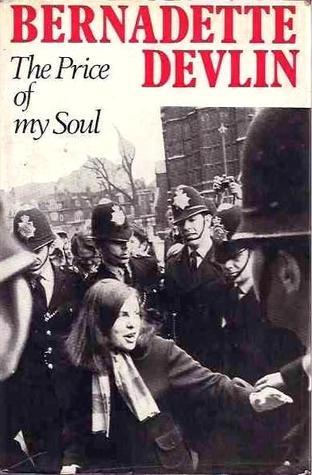
The Price of My Soul, by Bernadette Devlin*****

ThePriceofMySoulDevlin write this, her autobiography, when she was all of 23 years old. Had it been anyone else I would have considered it ridiculous, a juvenile pretention, but Bernadette Devlin was one of the primary fighters for Irish freedom during the tumultuous 1960s, ‘70s, and ‘80s, and given how events played out, it is likely that she wrote this while fully anticipating that she’d be killed in the struggle fairly early on. Goodness knows, the British cops tried. Here’s a bit of background information from Wikipedia:
 On 16 January 1981 she and her husband were shot by members of the Ulster Freedom Fighters, who broke into their home near CoalislandCounty Tyrone. The gunmen shot Devlin fourteen times in front of her children. British soldiers were watching the McAliskey home at the time, but failed to prevent the assassination attempt, indeed it has been claimed that Devlin’s assassination was ordered by British authorities and that collusion was a factor. An army patrol of the 3rd Battalion, The Parachute Regiment, entered the house and waited for half an hour. Bernadette Devlin McAliskey has claimed they were waiting for the couple to die. Another group of soldiers then arrived and transported her by helicopter to a nearby hospital. The paramilitaries had torn out the telephone and while the wounded couple were being given first aid by the newly arrived troops, a soldier ran to a neighbour’s house, commandeered a car, and drove to the home of a councillor to telephone for help. The couple were taken by helicopter to hospital in nearby Dungannon for emergency treatment and then to the Musgrave Park Hospital, Military Wing, in Belfast, under intensive care.

 Soon after her recovery, the author-activist went on a speaking tour, and this reviewer was able to hear her talk when she came to the University of Toledo in Toledo, Ohio.  Her intelligence, eloquence, and fierce, courageous nationalism left me spellbound. And yet, it was only recently that I learned she’d written a memoir over a decade earlier. I was even more amazed to find that it was available for sale, albeit used and fairly banged up; all praise to the internet. And so this time, instead of heaping praise upon the publishers, I will thank my youngest son for securing a copy for me at Christmas. It was worth the wait.

Devlin was orphaned, along with her sisters and brothers, when she was still a teenager. She and her siblings had a conversation and decided that they would raise themselves, rather than be parceled out to relatives and neighbors, broken up like pieces of a candy bar to be distributed willy-nilly by the church. But her parents left her a legacy, one that said not to let anyone shove a Devlin around. One of my favorite moments in her engaging narrative is early on, when her mother is being attended by a physician for a fallen arch in one foot. The doctor’s solution is to tightly bind it in hopes it will grow back to its proper configuration, but instead it becomes desperately deformed. One day when the doctor is rebandaging it, her mother complains of pain, and the doctor replies that there is no real pain; he says her mother is merely neurotic. In response, her mother raises her good foot and kicks the man across the room.

A woman after my own heart.

But the best passages, as the reader might expect, are those detailing the struggle for civil rights in Northern Ireland, and in particular the struggle based on social class regardless of religion. She tells of the horrific events of Bloody Sunday, when a peaceful parade including small children and babies in their strollers is gunned down by cops. Devlin speaks of the “evil delight” she sees on the faces of violent cops as they beat people down at an earlier demonstration.

There are lessons to be learned here, and now is the time to learn them.

Remarkably enough, there are still copies of this historical treasure for sale, used. Anyone that is interested in the Irish freedom struggle; cop violence; or Irish history should find a copy now, while you can still get them cheaply.

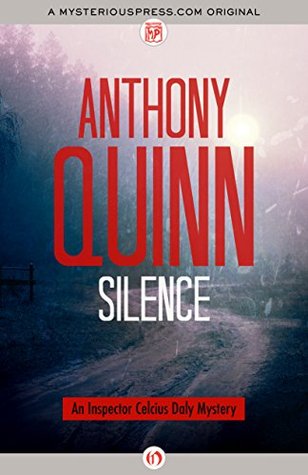
Silence, by Anthony Quinn*****

silenceSilence is the third in the Inspector Celcius Daly series, but I read it alone and didn’t realize I had missed anything until I got online and looked. I received my copy free from Net Galley and Open Road Media in exchange for this honest review. It’s been for sale for almost a year and I apologize for my tardiness; the book had been out for several months before I received my DRC, and so I kept setting this review aside in order to write about stories that were about to be published immediately.  None of this should keep you from rushing out to order a copy; as you can see I rated it five stars, and I am picky these days.

I am immediately drawn to this book because of the setting; it takes place in Northern Ireland during the Troubles of the 1970s. Although I am impatient with the trite expression used by the journalist in the story—“sectarian violence”—I find the setting resonant and the characters credible. The entire thing is wholly original, but it’s complex, so it’s not something you can read while you’re trying to do something else.

Our protagonist is the Inspector Daly, a lonely man with kind intentions and deteriorating mental health. We have a dead man in the priest’s hotel room, but then we learn the dead man isn’t Father Walsh. If that’s not Father Walsh, where has he gotten to, and who is our victim? Last is our villain, Daniel Hegarty, an IRA man captured and turned by the Special Branch.

I particularly appreciate the moment with the sheep.

The field of mysteries, thrillers, and others of this ilk are thick with mechanisms that make me want to throw things. I think everyone that’s read many books in this genre has a private list. I am simply ecstatic to find that no one here is trying to solve the mystery either because they themselves are framed for something they didn’t do, or because a loved one has been threatened; no one in our tale is kidnapped, blindfolded, gagged, and tossed into the trunk—er, boot—of a car.  It’s refreshing.

Of course, to get a five star rating takes more than just a lack of irritating features. The setting, in the dark, in the muck, and sweating past police checkpoints, is both visceral and at times, scary. It’s the sort of story that makes a reader snuggle under the covers and be grateful for a safe, warm place to lie down. The characters are not always lovable, but they are entirely believable. That’s what counts with me. And the ending is a complete surprise, yet also makes sense.

For those that like literate, complex mysteries, it’s hard to beat. Highly recommended.

The Prisoner, by Alex Berenson****

theprisoner Berenson has written a whole series of espionage thrillers featuring John Wells, a CIA operative fighting al Qaeda. I was unaware of this when I requested a DRC from Net Galley and Putnam Penguin, but I find it stands up quite nicely as a stand-alone novel. Would I have enjoyed it even more if I’d read the others first? We will never know.  However, if you’d like to read this tightly woven thriller either in sequence or singly, it will be available January 31, 2017.

To enjoy an espionage thriller, one has to buy the premise, namely that the CIA is a heroic organization, or at least has a segment of good guys that are fighting terrorism to keep innocent civilians safe. This is a premise I buy cheerfully for the sake of a good yarn; I do it when I read crime fiction in which the cops are morally righteous, or at least more good than bad, so why not here. In exchange, I got to enjoy an intense, interesting thriller that is different from a lot of the other fiction I read, and novelty is a meaningful selling point when one spends several hours daily with one’s nose in a book.

This is a literate read. In a world of dumbed-down fiction that plays to the lowest common denominator, I have come to value writers that have a strong vocabulary and aren’t afraid to use it. I also learned some things about the Middle East and how the USA operates there, including a few new specialized terms and some information about the cultures featured in that part of the world. Of course, this is fiction and it could also be true that Berenson made it all up, but his past includes work as a war correspondent in Iraq, and so perhaps this is what gives the setting its authenticity.

Our premise is that there is a mole at a high level inside of the CIA. John Wells has been feeling the itch to travel, impatient with his wife’s demand for more family time and suffocated by the dull sameness of everyday life in the States. He volunteers to return to the Mid-East and pose as an al Qaeda recruit so that he can be tossed into a Bulgarian prison and cozy up to the high-up operative that is interned there.

I blanched slightly at this; I have read a couple of former CIA employees’ memoirs, and I had to swallow hard to pretend that this guy would actually do this thing. But when we read thrillers, whether it’s crime, mystery, or a spy story, we don’t really want to read about tedium and paper pushing; we want excitement. Once I bought the premise, I was wedded to the narrative.

The other key characters here are Shafer, the CIA officer Wells reports to and who is also hunting for the mole; and the mole, whose name I can’t tell you without ruining the book.At first I thought I was seeing shallow characterization, but Wells’ character is developed in a way that is so subtle that the reader may not realize it’s occurred. Gradually we come to know who Wells is, how he thinks, how he will respond. On the other hand, our mole is a loser and remains a caricature throughout.

Every significant character here is male, but from what little I know, that’s consistent with the CIA, especially among the highest officers, a glass ceiling that’s hard to crack, so Berenson is merely reflecting US intelligence as it actually is.

The plot’s arc is a little different than one might usually expect.  The hook at the start is arresting, and I expected it to perhaps ratchet up, up, up from there. Instead, the pace flagged once we were about 15 percent of the way in, and then gradually began to ascend again. By the time I was 70 percent of the way in, I understood that the next time I picked it up, I would have to finish it.

When we hit the climax, set in France, I threw off the quilt and sat up. The pulse-pounding denouement was inconsistent with lying supine and I read the last 15 percent of the book sitting up and leaning forward.

This story is guaranteed to spike your adrenaline and chase away the winter blahs. Recommended to those that enjoy espionage thrillers.