Hillbilly Elegy, by J.D. Vance*****

HillbillyElegyI confess I was miffed when I wasn’t granted a DRC for this title, and after reading a couple of reviews, I decided I could live without it. I began to wonder about my choice when I saw it hover on the best seller lists where it remains as of this writing nearly a year after its publication, But the clincher came when my younger daughter came to me and said that she had read it digitally and believed I would enjoy it. She said it had to do with the culture of mining families, and that the dedication was to the writer’s “Mamaw and Papaw”.

It hit me like a bolt of lightning.

A personal note of explanation: I am a grandmother myself now, and my own Mamaw and Papaw were both dead and gone by the time I learned that this was not a set of names that belonged to my family alone. I was the youngest among my cousins and siblings, and had somehow assumed that these grandparents’ names were the result of something said by one of the older kids when they were small. By the time I came along, they had left the mines of the rural Rust Belt and purchased a small working farm in central California. No one else I knew had grandparents with those names or had heard of them. Later my grandparents, aunt and uncle (who—I am not making this up—were an Aunt Sister and Uncle Brother) would relocate to the mountains of Southern Oregon, to the farthest outreaches, secret places up barely-there dirt roads that would make a survivalist happy. Neither California or Oregon is mentioned at all in Vance’s memoir, and so it makes me wonder just how far this culture has permeated across the USA.

Vance tells us that his memoir is particular to the culture of working class Scots-Irish people, primarily in the Appalachian Mountains. But of course, when one mine closes, miners follow the work, and so the culture has spread quite a long way. He himself didn’t grow up in Appalachia, because his grandparents had made a point of moving away from there when a factory opened in a small Southern Ohio town, and so that was where he spent most of his childhood. But the roots ran deep, and they often returned to the West Virginia area where most of the family remained.

The memoir itself is fascinating. His grandparents were enormously tough and tremendously loving. He recounts one experience in which a drug-addicted visitor appeared to be dying of a PCP overdose in the front room, and Mamaw ordered that the person be dragged to a nearby park, because “I don’t want him to die in my fucking house!”

Another time, the author’s immensely unstable mother had beaten JD, and Mamaw persuaded him to lie to the cops, who could never be a part of any solution to their family. Instead, once in the car, “We drove home in silence after Mamaw explained that if Mom lost her temper again, Mamaw would shoot her in the face.”

I am amazed at the similarities that exist between Vance’s culture and that of my father’s family. Over the years succeeding generations have become more educated and moved, for the most part, out of the tulles and to suburbs and cities. But many of the values and cultural nuances remain. And if this is true for me, a Seattle resident of nearly 30 years, how many others across the nation will recognize it as well? Perhaps this is part of the book’s tremendous success.

In closing I want to give a shout-out to Powell’s City of Books in Portland, Oregon, the city where I grew up. Powell’s has a daily drawing for its reviewers, and each day someone wins a $100 gift certificate. My prize is what made it possible for me to purchase this glorious brand new, hard cover edition.

Highly recommended to those interested in the culture of Scots Irish mining families and their descendants, and to those that love excellent memoirs.

The Song and the Silence, by Yvette Johnson*****

TheSongandtheSilenceI was browsing the pages of Net Galley and ran across this gem of a memoir. Often when someone that isn’t famous gets an autobiography published by a major publisher, it’s a hint to the reader that the story will be riveting. Such is the case here; my many thanks go to Net Galley and Atria for the DRC, which I read free in exchange for this honest review. You can order it now’ it comes out Tuesday, May 9.

It probably says a great deal, all by itself, that I had never heard of Booker Wright before this. I have a history degree and chose, at every possible opportunity, to take classes, both undergraduate and graduate level, that examined the Civil Rights Movement, right up until my retirement a few years ago. As a history teacher, I made a point of teaching about it even when it wasn’t part of my assigned curriculum, and I prided myself on reaching beyond what has become the standard list that most school children learned. I looked in nooks and crannies and did my best to pull down myths that cover up the heat and light of that critical time in American history, and I told my students that racism is an ongoing struggle, not something we can tidy away as a fait accompli.

But I had never heard of Booker.

Booker Wright, for those that (also) didn’t know, was the courageous Black Mississippian that stepped forward in 1965 and told his story on camera for documentary makers. He did it knowing that it was dangerous to do so, and knowing that it would probably cost him a very good job he’d had for 25 years. It was shown in a documentary that Johnson discusses, but if you want to see the clip of his remarks, here’s what he said. You may need to see it a couple of times, because he speaks rapidly and with an accent. Here is Booker, beginning with his well-known routine waiting tables at a swank local restaurant, and then saying more:

https://www.youtube.com/watch?v=GM-zG…

So it was Booker and his new-to-me story that made me want to read the DRC. Johnson opens with information from that time, but as she begins sharing her own story, discussing not only Booker but her family’s story and in particular, her own alienation from her mother, who is Booker’s daughter, I waited for the oh-no feeling. Perhaps you’ve felt it too, when reading a biography; it’s the sensation we sometimes feel when it appears that a writer is using a famous subject in order to talk about themselves, instead. I’ve had that feeling several times since I’ve been reading and reviewing, and I have news: it never happened here. Johnson’s own story is an eloquent one, and it makes Booker’s story more relevant today as we see how this violent time and place has bled through to color the lives of its descendants.

The family’s history is one of silences, and each of those estrangements and sometimes even physical disappearance is rooted in America’s racist heritage. Johnson chronicles her own privileged upbringing, the daughter of a professional football player. She went to well-funded schools where she was usually the only African-American student in class. She responded to her mother’s angry mistrust of Caucasians by pretending to herself that race was not even worth noticing.

But as children, she and her sister had played a game in which they were both white girls. They practiced tossing their tresses over their shoulders. Imagine it.

Johnson is a strong writer, and her story is mesmerizing. I had initially expected an academic treatment, something fairly dry, when I saw the title. I chose this to be the book I was going to read at bedtime because it would not excite me, expecting it to be linear and to primarily deal with aspects of the Civil Rights movement and the Jim Crow South that, while terrible, would be things that I had heard many times before. I was soon disabused of this notion. But there came a point when this story was not only moving and fascinating, but also one I didn’t want to put down. I suspect it will do the same for you.

YouTube has a number of clips regarding this topic and the documentary Johnson helped create, but here is an NPR spot on cop violence, and it contains an interview of Johnson herself from when the project was released. It’s about 20 minutes long, and I found it useful once I had read the book; reading it before you do so would likely work just as well:

https://www.youtube.com/watch?v=_xxeh…

Johnson tells Booker’s story and her own in a way that looks like effortless synthesis, and the pace never slackens. For anyone with a post-high-school literacy level, an interest in civil rights in the USA, and a beating heart, this is a must-read. Do it.

Michael Collins, by Tim Pat Coogan****

MichaelCollinsTo date, this is the single best volume that’s been written about Collins, and it’s a meal. I purchased this title on an annual pilgrimage to Powell’s City of Books in Portland, Oregon when I was there to visit family a few years ago. Although the length of the book is listed as 480 pages in paperback, the reader needs to come prepared. The type is tiny and dense, and it took me a long time to wade through it. If it were formatted using more standard guidelines, it would be a great deal longer.
As I write this review I am halfway through Coogan’s epic history of the IRA (Irish Republican Army), and the style in which he writes is consistent in both books. Coogan tells us everything that is historically important, and he also tells us everything else he finds out, with no apparent filtering. His writing is half Irish history, half family Bible in the sense that if someone was briefly or peripherally involved with Collins, their proud relatives can probably find that person and his or her historical role somewhere in these pages. His shoe size is here, and the names of every girl he flirted with. For a man that lived so briefly, he left a large shadow, and the author was plainly unwilling to let even the tiniest bit of research go to waste, relevant or no.

I am somewhat surprised that Collins doesn’t rate more favorably with the author, given that his name is the one most associated with the creation of an independent Ireland. But Coogan does due diligence in establishing the brutality of the British occupiers, who killed indiscriminately with the use of terror. At one point, soldiers opened fire on a school yard where little children were at play; these royal ambassadors were the original school shooters, killing six little ones for being Catholic. In the protests that followed, women and girls knelt before British tanks and said their rosaries for those that had been killed for their Fenian identities.

The Irish freedom struggle took place at a time when the whole world was on fire. The Russian Revolution was unfurling with breathtaking speed; at the same time, there was no established Marxist revolution to look to for guidance, and Irish freedom fighters had no single idea of what political ideology should shape the struggle. Most of the revolutionaries were barely old enough to shave, and a lot of errors were made because of this lack of clear vision. The results were often tragic.

There’s an interesting discussion of whether Irishmen should become German allies during World War I. There is a strong resistance to becoming shills for the British, and so the question, then, is whether to remain neutral, or take the side of Britain’s enemy in the hope of receiving reciprocal assistance. In the end, nobody was organized enough, in this era of little technology, to come up with a cohesive plan, so the point was a moot one.

Should you read this biography? I think it depends upon how much time you have, and how strong your interest level is. One consideration might be to purchase it as a reference volume and flip through it to tease out the most relevant information, but be forewarned: sifting through the minutiae is not an easy enterprise. For researchers, the photos alone might be of interest, since they constitute primary documents.

Recommended for those with strong basic knowledge of Irish history that want to flesh out the details, and for those building a reference library.

Three minutes to Doomsday, by Joe Navarro***

threeminutestodoomsday“Nothing’s ever over till the fat lady sings.”

Trite? Yes. Abrasive? Absolutely!  Sexist? All the damn time. Profane? Seriously profane, and not in a way that some of us might find amusing. And yet, this memoir has a strangely fascinating aspect as well.  It combines two stories, the primary one an espionage case in which the author plays the primary role, and a secondary one, the implosion of the author’s personality and marriage. It’s not fun reading, but after a certain point, there’s no turning away from it either. Thanks go to Net Galley and Scribner for the DRC, which I received free of charge in exchange for an honest review.

Navarro is a hot-shot young FBI agent in 1988, and it is while conducting what is expected to be a fairly routine interview that he notes a “tell” from former US soldier Rod Ramsey. It becomes the basis of an espionage case that goes much deeper than anyone anticipated. Navarro uses his expertise in nonverbal communication to tell what Ramsey is feeling during the various phases of his interviews, and he also uses it to control and manipulate Ramsey into cooperating with the investigation. Ramsey is the one soul on this planet with fewer friends than Navarro, and so Navarro spends years making Ramsey believe that he himself is that friend, practically family. He does it so he can have this kid busted and send him away for a really long time.

Navarro knows a lot about reading and controlling others nonverbally, but he doesn’t know a thing about building a family life or about how to make friends, and it’s clear he knows this, yet he can’t help himself. He tells us that an agent he wants to assist him tells a supervisor that she would prefer to work with someone else, and specifically, with anyone, anyone, anyone else but him. A number of other people echo this, and yet his personality continues on its hell-bent-for-leather downhill trajectory.

While he continues his self-aggrandizement with a hearty side-serving of brazen braggadocio, Navarro recounts again and again how much he hates the office staff at work, little people that are getting in his way by attempting to do their jobs. Clearly they just don’t understand how very important he is, but that’s okay, because he is letting the world know now.  Regarding the office manager that dares remind him of small requirements like changing the oil in his official vehicle, he uses a tired aphorism:

“Don’t try to teach a pig to sing. It annoys the pig and it wastes your time.”

He lets us know that he swore at, patronized, and berated her constantly, and lest we take his admissions as a sign of penitence, he also lets us know that he hates her still. He has changed her name for obvious legal reasons, but he hasn’t changed his obnoxious attitude or gained a speck of humility.

Add to this the fact that, though this case is terrific book material, the guy isn’t much of a writer. Clichés abound, and very basic principles of narrative writing are either never learned or disregarded. He starts chapters with lists, apparently too busy and important to transform these into paragraphs. I’m not all that sure he ever edited his work (because he might have noticed his overuse of parenthesis) and I’m not sure he permitted anyone else to do so either (because surely they would have come to his rescue).

Still, it’s an interesting story. Whereas someone else could no doubt do a finer job of writing this thing, it’s undeniably compelling. I recommend this memoir to those that enjoy espionage thrillers and true crime stories, but don’t give up the full sticker price. Read it for free or cheap, and save your serious dollars for serious writers.

The Road to Jonestown, by Jeff Guinn*****

Jim Jones and the Peoples Temple

theroadtojonestownThe good news is that Jeff Guinn tells us everything there is to know about Jim Jones and the Peoples Temple.

The bad news is that Jeff Guinn tells everything there is to know about Jim Jones and the Peoples Temple.

This reviewer was just out of high school when the media frenzy emerged around the mass suicide of hundreds of Americans living in a cult called The Peoples Temple, which was sequestered in the equatorial jungles in Guyana, South America. No one could understand it; why would so many people follow such a flimflam man, and why would they be persuaded to ‘drink the Koolaid’?  I wanted to know; the whole thing boggles the imagination. I read it free and early, thanks to Net Galley and Simon and Schuster. I read it more slowly than I usually do, not because the narrative isn’t compelling, but because of the content.  The opening chapters of the story are darkly funny, but as we move forward, there are times when I feel as if I am gargling sewage. I deal with the conflicting emotions by alternating it with other books, and I finish all of them and move on to other things before I finish this one.  I could only take so much in one sitting! Just so you know; you’ve been warned.

Jones was obsessed with religion, even as a child. Unfortunately, he was also the kind of kid that would trick a puppy into walking out of a high window and falling to its death.

He just really liked control, and as he got older, the compulsion grew worse instead of better.

In the early 1960s, Jones started a church in Indianapolis. His wife, Marceline, was proud to be the preacher’s wife, and they shared a genuine desire to integrate the city at a time when the deep South was being forced to end Jim Crow, but nobody else was asking anything of the sort of Northern industrial cities. He funded his mission by conducting traveling revivals tent-style. He persuaded gullible audiences that he had a supernatural capacity to heal others; the audience plants that he brought understood that sometimes faith required a little help.

Fear and control enabled Jones to move much of his congregation with him when he packed up and headed for the supposedly nuke-proof town of Ukiah, California. After that, it was like a downhill snowball.  The amazing thing is that this man and his oddball group were so widely accepted for many years, even praised by local politicians and celebrities. But then things began to unravel, and he told his followers it was time for the most ardent believers to move with him to The Promised Land.

The most amazing thing to me is that he didn’t have to rope people in to move to the jungle; he made them compete for the honor.

Guinn’s documentation is strong, mostly based on interviews with survivors and the vast files left behind by Jones and his people. The narrative flows well and never slows, and part of that is due to the lack of formal footnotes, but the endnotes provided for each chapter, along with the list of interviews, in-text source references, and bibliography are beyond reproach. Best of all, he has no axe to grind.

For those that want to know, this is it. I doubt you’ll find a better single book on this subject anywhere. It’s available for sale as of today.

Nixon: the Life, by John A. Farrell*****

richardnixonfarrellHistory buffs rejoice; the definitive Nixon biography is here.  John A. Farrell is the renowned biographer of Clarence Darrow. Now he gives us a comprehensive, compelling look at the only US president ever to resign from office under the cloud of imminent impeachment. This is the only Nixon biography that answers the many questions that left Americans—and those around the world that were watching—scratching our heads. Why, why, and why would he do these things? Farrell tells us. I read this book free and in advance, thanks to Net Galley and Doubleday, but it would have been worth paying the full retail price if I’d had to. It’s available to the public now.
Anytime I read nonfiction, I start with the sources. If the author hasn’t verified his information using primary sources, I go no further. Nonfiction is only fact if the author can prove that what he says is true—and I have never seen more meticulous, more thorough source work than what I see here. Every tape in the Nixon library; every memoir, from Nixon’s own, to those of the men that advised him as president, to those written by his family members, to those that opposed him are referenced, and that’s not all. Every set of presidential papers from Eisenhower on forward; the memoirs of LBJ, the president that served before Nixon took office; reminiscences of Brezhnev, leader of Russia ( which at the time was part of the USSR); reminiscences of Chinese leaders that hosted him; every single relevant source has been scoured and referenced in methodical, careful, painstaking detail. Farrell backs up every single fact in his book with multiple, sometimes a dozen excellent sources.

Because he has been so diligent, he’s also been able to take down some myths that were starting to gain a foothold in our national narrative. An example is the assertion that before the Kennedys unleashed their bag of dirty tricks on Nixon’s campaign in 1960, Nixon was a man of sound principle and strong ethics. A good hard look at his political campaigns in California knocks the legs out from under that fledgling bit of lore and knock it outs it out of the nest, and out of the atmosphere. Gone!

Lest I lend the impression that this is a biography useful only to the most careful students of history, folks willing to slog endlessly through excruciating detail, let me make myself perfectly clear: the man writes in a way that is hugely engaging and at times funny enough to leave me gasping for air. Although I taught American history and government for a long time, I also learned a great deal, not just about Nixon and those around him, but bits and pieces of American history that are relevant to the story but that don’t pop up anywhere else.

For those that have wondered why such a clearly intelligent politician, one that would win by a landslide, would hoist his own petard by authoring and authorizing plans to break into the offices of opponents—and their physicians—this is your book. For those that want to know what Nixon knew and when he knew it, this is for you, too.

I find myself mesmerized by the mental snapshots Farrell evokes: a tormented Nixon, still determined not to yield, pounding on the piano late into the night. I hear the clink of ice cubes in the background as Nixon, talking about Prime Minister Indira Gandhi of India, suggests that “The Indians need—what they really need—is a mass famine.”

I can see Kissinger and the Pentagon making last minute arrangements to deal with a possible 11th hour military coup before Nixon leaves office. Don’t leave him with the button during those last 24 hours, they figure.

And I picture poor Pat, his long-suffering wife to whom he told nothing, nothing, nothing, packing all through the night before they are to leave the White House…because of course he didn’t tell her they were going home in time to let her pack during normal hours.

The most damning and enlightening facts have to do with Vietnam and particularly, Cambodia. Farrell makes a case that the entire horrific Holocaust there with the Khmer Rouge and Pol Pot could have been avoided had Nixon not contacted the Vietnamese ambassador and suggested that he not make a deal with Johnson to end the war.

Whether you are like I am, a person that reads every Watergate memoir that you can obtain free or cheaply, or whether you are a younger person that has never gone into that dark tunnel, this is the book to read. It’s thorough and it’s fair, and what’s more, it’s entertaining.

Get it. Read it. You won’t be sorry!

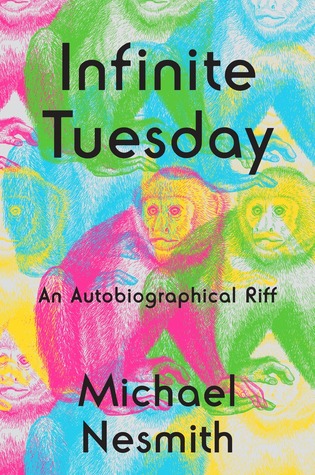
Infinite Tuesday, by Michael Nesmith****

infinitetues

Michael Nesmith is a veteran of the entertainment industry, but his name is most recognizable as the wool-beanie-wearing member of The Monkees. Nesmith has a treasure trove of experience and insight, and he’s very articulate. I really enjoyed this memoir, and if American musical and cultural history interest you, I recommend you get a copy when it comes out April 18, 2017. Thanks go to Net Galley and Crown Archetype for the DRC, which I received free of charge in exchange for this honest review.

Nesmith came of age in Texas, the child of a single hardworking mother, and was mentored by the profane elderly Uncle Chick, whose spoken cadence Nesmith would later find in his own sense of musical rhythm. Because Texas was the exclusive province, at the time, of country and gospel music, Michael and his pregnant girlfriend loaded themselves and Mike’s guitar into his mother’s car and took off for Los Angeles. It proved to be a good move.

Those that cannot remember the birth of rock and roll have no idea how polarizing it was. The cliché term “generation gap” represented a genuine source of friction and alienation in a lot of families; some parents decided that rock was not an art form but instead a type of devil worship. Some disowned their children over it and didn’t take them back later. I’m serious. And so when Nesmith credits his mother for her patience and forbearance—he actually didn’t ask if he could take her only car, for instance—he’s not just being gracious. Here, let him tell you:


It was unthinkable to everyone who had just fought World War II that the music…the whole cultural imperative of the victorious warriors would be torn down by their kids as if it were ugly curtains in the den.


Soon Nesmith would be chosen as a member of The Monkees, which catapulted four little-known young men to instant fame; Nesmith recalls that although seventeen to twenty-year-old Beatles fans were incensed by the TV imitation, the nine to twelve-year-old television kids—of which this reviewer was one—saw them as a fact:

What followed was what Nesmith calls “Celebrity Psychosis”, a sense of disproportion and entitlement caused by instant stardom, obsequious handlers, and bizarre social circumstances. He humorously recounts strange experiences, such as singing at a local school and being pursued by screaming adolescent girls, and being “sighted” shopping in a grocery store.

He recalls his experience as John Lennon’s house guest in London, and he cites Jimi Hendrix as the best rocker that ever lived. He also drops a rather nasty slam at Bob Dylan without any real explanation, and I confess that is part of the missing fifth star. What the hell?

Bette Nesmith, Michael’s late mother, invented Liquid Paper while he entered show business, and her fortune helped finance some of his creative products. Nesmith was a pioneer in the field of country rock as well as the music video. He produced movies and won a Grammy for “Elephant Parts”, an early music video:


He is also an ardent feminist, and his recollections show that he was one before it was cool. Thank you, Mr. Nesmith.

I have to admit that I find the first half of the memoir more interesting than the second half. The author goes on in the latter half of the book to speak at length about his spiritual experiences with Christian Science and the ways in which wealth distorts a person’s character, though he recognizes the latter doesn’t garner a lot of sympathy.  “Never complain about the air-conditioning a private jet.” He also does a lot of brow-beating about having stolen a friend’s wife, and attributes the failure of that marriage—his second, or his third maybe—to guilt.

Despite the aspects that I didn’t enjoy, I do recommend this memoir, because it eloquently describes a wide, enormously dynamic period in American film, music, and television. Nesmith unspools the last half of the 19th century with the wisdom of his experience, and it’s a perspective completely unlike any other I have seen.
Recommended for those with an interest in contemporary American cultural history, as well as to fans of Nesmith and The Monkees.

Hungry Heart, by Jennifer Weiner*****

hungryheart“I wanted to write novels for the girls like me, the ones who never got to see themselves on TV or in the movies, the ones who learned to flip through the fashion spreads of Elle and Vogue because nothing in those pictures would ever fit, the ones who learned to turn away from mirrors and hurry past their reflections and unfocus their eyes when confronted with their own image. I wanted to say to those girls, I see you. You matter. I wanted to give them stories like life rafts…I wanted to tell them what I wished someone had told me…to hang on, and believe in yourself, and fight for your own happy ending.”
Many thanks go to Net Galley and Atria for the DRC, which I received a couple of months after the publication date. Having read this memoir makes me want to read more of this author’s work. It’s for sale now.

The fact that I’ve never read anything by this author makes me something of an outlier in terms of her target audience. I’m also slightly older than she is, not in need of a mentor. But none of that matters, because quality is quality, and feminist messages like this one are always good to read.
Weiner writes with an arresting combination of candor and wit, and she talks about the things we grew up being taught not to mention. Those of us that saw role models like Twiggy—a British model with a nearly anorexic appearance—and Mia Farrow, yet were ourselves unable to shake the persistent amount of what kindly adults called baby fat, never thought to argue that we were as worthwhile as these bony fashion icons. Weiner deals with the topic of body image and media head on. And while she’s there, she talks about facing down anti-Semitism in the classroom, and the dry hiss of another child on the playground suggesting that she has killed Jesus. She talks about also being the chunky, unfashionable member of her kibbutz to Israel in the unforgettable chapter titled “Fat Jennifer in the Promised Land”.

At times I confess I am annoyed by appear to be petit bourgeois concerns. You struggled to choose between Princeton and Smith? Oh you poor dear! But later when I read that she is called in to the administration’s offices and told to get her things and go because her tuition hasn’t been paid, I forgive her immediately.

Weiner takes on questions that many feminist writers pass by. I’ve never seen another writer address the fact that if a woman cannot successfully breast feed her baby or even just doesn’t want to, the child will most likely not starve. This and a host of other seldom spoken issues having to do with combining career and motherhood can help other mothers, whether working or taking time away from the workplace to raise a child, feel less isolated.

Every woman needs a funny female version of Mister Rogers to tell us that we are fine just the way we are. Every mother needs another woman that can tell her—sometimes in hilarious ways—that every rotten thing that ever happens to her child is not her fault.

Highly recommended for women seeking wisdom and snarky kick ass commentary, and to those that love them.

Dear Friend, from My Life I Write to You in Your Life, by Yiyun Li**

dearfriendfrommylifei  It’s an honor to be invited to review any book by Random House and Net Galley, and so when the email came, I accepted without hesitation; I thank them for thinking of me and wish I could honestly recommend this one. Others have referred to this memoir, whose title is taken from a quote by Katharine Mansfield, as “exquisite, intimate, and lyrical”, and the author has won awards for her novels. I looked carefully to see if I could locate the genius in this book, but it eluded me completely.

The intimacy of the work is surely apparent. In essence, this is a mental health memoir, and the author writes of her fight with depression, her multiple suicide attempts and hospitalizations, of the expectation of others that she should continue to live when she didn’t want to. It’s brave writing, although mental health battles are now a fairly mainstream topic, but I am unable to find anything tangible to engage my interest.

My only real pleasure is in discovering that Li is already a successful writer; had it been a debut, I would have been scared silly. After all, if I say I don’t like the book, will the writer harm herself? What if I simply dodge the whole thing and let it get lost in the shuffle; will it happen then as well? But in seeing that this is someone with an established career and a wall full of accolades, probably the displeasure of one humble blogger won’t create a great deal of trauma.

The whole thing is bleak. The writer reminds us repeatedly that her life is private, that no one has the right to know any of its details and all I can think is, so what are we doing here, exactly?

Those that have read and enjoyed Li’s novels may find more to hang their hats on than I have found. All I know is that it is painful to read, has no beginning, middle or end that I can find, and is devoid of the literary qualities that can sometimes make a sad book enjoyable. I can’t recommend it.

Bluff, Bluster, Lies and Spies, by David Perry*

bluffblusterliesThe American Civil War is part of the curriculum I used to teach, and in retirement I still enjoy reading about it. When I saw that Open Road Media had listed this title on Net Galley to be republished digitally this summer, I swooped in and grabbed a copy for myself. I was so eager to read it that I bumped it ahead of some other DRCs I already had, and I really wanted to like it.  Unfortunately, this is a shallow effort and it shows.  Don’t buy it for yourself, and for heaven’s sake don’t advise your students to read it.

It begins gamely enough with a discussion of events in Europe and how the changing contours of that part of the world affected the attitudes of England, France, Russia, Prussia, and Spain. At this point my curiosity was piqued, because I had never read anything about which side of the Civil War the last three of these countries favored.  But if the rest of the text can be believed—and parts of it cannot—the reason we never hear about Russia, Spain, and Prussia with regard to this rebellion is that they decided they had no stake in its outcome. This part of the text could have been dealt with in one sentence rather than owning a share of the introduction and being dragged in again later, but this is not the only bit of obvious filler that burdens this misbegotten book.

I am tantalized initially when Perry brings in a controversy that does interest academics: would Britain have recognized the Confederacy in order to get cotton, or was it busy with other considerations and willing to obtain cotton from colonial holdings in Egypt, India and elsewhere for the duration? This question is discussed, leaves the narrative and is broached again several times, because although the book has chapters, it isn’t organized. The same topics of discussion, and the same quotations that serve as its meager, questionable documentation are dropped into the text again and again. It’s as if Perry doesn’t expect anyone to read it all the way through and is hoping we will drop into the middle of the book somewhere to look up a fact and then leave again without seeing whether he actually knows what he’s talking about.

He doesn’t.

For example, after citing the same obscure document for pages on end—since I read it digitally, I highlighted “Dispatch 206” seven times before noting that this section, at least, is garbage—he brings up Poland. He talks about Poland and Russia’s attachment to same as a buffer state, but never shows any relationship between Poland and the American Civil War other than that Russia had other greater priorities at this time, which had already been established in an earlier section.  And he misuses the term “Manifest Destiny”. Perry apparently believes this term has equal use to multiple governments in reference to themselves around the world.

He tells us that privateers are outlawed during the Civil War and infers that this, therefore, will surely mean that all the sad pirates will dock their ships and get honest jobs. No more privateers out there now, matey!

He says that Lincoln was a slow thinker, and he refers to American diplomats as ditherers.  He documents none of it.

I read the citation section to see if more joy would be had if I pursued this book past the halfway mark. I read his author bio, which indicates no expertise regarding this conflict, which by now doesn’t surprise me.  Frankly, I don’t understand why this book ever saw the light of day, or why Open Road would republish it.

I would love to say that those with deep pockets should go ahead and order it if they can afford all the books they want, but I can’t even say that. The book is unreliable, disorganized, and badly documented. It contains falsehoods and insults the reader’s intelligence.

Put your plastic away. This is dross.