My Name is Emilia del Valle, by Isabel Allende****

“Aren’t you afraid, Angelita?’ I asked her. ‘All the time, but I don’t think about it. I want to die with my boots on my feet,’ she answered…

“I did not know who I truly was until circumstances put me to the test.”

My Name is Emilia del Valle is the newest novel published by feminist icon and author Isabel Allende. The story is a fictionalized account of a journalist that travels from California to Chile, where war has broken out. Because she is a woman, her editor resists sending her, and then, under pressure, agrees that she may go, but only to cover human interest stories in the city. Those that have read any book ever by Allende will know instantly that this is not what our journalist does.

My thanks go to NetGalley and Random House Ballantine for the invitation to read and review. This book is available for sale now.

Like all of Allende’s protagonists, Emilia is a woman that refuses to be constrained by the expectations of the time regarding gender. She is possessed of feverish curiosity, and once she finds herself in the thick of the conflict, she has no interest whatsoever in finding and maintaining a safe, distant place from which to report. She assists the “canteen girls,” who provide water to fallen soldiers, along with minor first aid. Emilia learns first hand about the horrors of war, and she is forever changed by it.

This conflict is one that isn’t widely reported, and Allende writes about it so that it may not be forgotten. Ten thousand died here, mostly men from poor families, killed for no good reason. Emilia’s experiences highlight the disparity in treatment according to social class and wealth, as well as gender.

The writing is first rate as always. However, in most of her earlier novels, the author found a way to intersperse shocking or horrific passages with some that were uplifting, and often very funny. I would bark with sudden laughter at some witticism that I had not seen coming. I wish she had done that here. When there’s too much horror and bloodshed, it is tempting, natural even, for readers to tune out, let the words wash over us. And while there is romance here that provides some relief, I would have liked more.

Nevertheless, those that love historical fiction, social justice, feminism, and especially those that love Allende’s writing will want to read this book.

This American Woman, by Zarna Garg*****

Zarna Garg is an immigrant, born and raised in India. She was rich, except for when she was poor; more on that in a minute. Ultimately, she came here for the same reason many people do: she had to make a break for it.

My thanks go to Random House and NetGalley for the invitation to read and review. This book is available to the public now.

Garg works now as a stand up comic, but she has done many things, and worn many hats. First, of course, she was a runaway bride, more or less, bailing from India before her very wealthy father could marry her off as part of a business arrangement.

“If I hadn’t done that, right now I would be a Mumbai grandma in an arranged marriage to a much older, boring industrialist. I would be draped in brocade silk saris, but I would have a giant padlock on my big mouth.”

Garg’s immigration—fast and sneaky, which was the only possible way–was made easier by her older sister, who was already living in Ohio. Since then, Garg has finished law school and passed the bar, married another Indian immigrant, had three children, and done a number of other impressive things, but it was her own daughter that asked her mother whether she’d ever considered a career in comedy. It takes someone that’s mentally tough to succeed in that realm, but the streets of Mumbai, where she’d lived hand-to-mouth for two years as a runaway teen following her mother’s death, prepared her well, so she was ready for the gritty world she was entering. She explains,   

            “…I had played a show at a club on the Upper East Side and a cockroach fell on my head. The night before that, as I walked to the stage I had to step over a communal puddle of throw up from a bachelorette part who refused to leave. They just kept throwing up and laughing. So far my comedy career had been physically revolting—but it was still my dream! Now here I was in my very first New York City green room that smelled like air…I walked out on stage. Two thousand white ladies politely applauded. Oh my god. What was I doing? Would this audience even understand my humor? For them India is incense and chanting. Were they ready for a foul-mouthed real-life Indian auntie who hated meditation? “

I wondered, after watching some of Garg’s stand up work online, whether the book would be a duplication of her routine, more or less; it’s happened with other comic authors. But although there’s a small smattering of shared content, the memoir is mostly unique, and I never had the sense that I’d already seen this before.

Garg is funny enough that I’ve let her speak for herself here. Anyone that needs to laugh hard, and that enjoys reading about the disorientation and culture shock experienced by those new to America should read this book. Highly recommended!  

The Family Recipe, by Carolyn Huynh*****

“We all need to feel needed. Otherwise, what’s the point of living?”

Carolyn Huynh made her authorial debut in 2022 with The Fortunes of Jaded Women. It was one of my favorite novels not only of that year, but of all the thousand-plus galleys I have read since I began reviewing. She’s back again with The Family Recipe, and it’s every bit as good as the first. My thanks go to NetGalley and Atria Books for the invitation to read and review, but make no mistake: I would have hunted this thing down and bought it with my Social Security check if it came down to it. I wouldn’t have been sorry, either.

This book is available to the public now.

Once again, our protagonists are Vietnamese and Vietnamese-Americans, mostly women, and once again, they are siblings and other family members that must come together; it isn’t a voluntary reunion. And that’s where the similarities between the first book and this one end.

Duc Tran, the patriarch, has laid out the terms by which his children may inherit his fortune. Once upon a time, he was the Vietnamese sandwich king, and in order to become his heir, each of his four daughters must relocate to a city she doesn’t want to live in, and revive a down-at-the-heels restaurant in a now undesirable end of town. It’s a contest; that is, unless Duc’s one son, Jude, succeeds in getting married within the one year’s time limit of the contest. If he can do that, he wins. (His sisters aren’t worried; who would marry Jude?)

The story is told from several points of view; these include the siblings, their uncle—a shady lawyer, and Duc’s best friend; their mother, who abandoned them when they were small, when her mental health collapsed, and never went back; Duc’s second wife; and briefly, Duc himself, who mostly serves as a mysterious figure that doesn’t even return to the States to lay out his children’s requirements, sending their uncle as his proxy.  As the story unfolds, we learn more about each sibling, and about the traumas they have experienced, as well as their successes.

The thing that makes it work so well is Huynh’s unerring sense of timing. It’s a dramatic tale, but it’s shot full of humor, as we see at the outset, when we learn the sisters’ names. Their father was a huge fan of the Beatles, and so the girls are named Jane, Paulina, Georgia, and (wait for it…) Bingo!

There are plenty of twists and turns, and the dialogue crackles. The internal monologues are mesmerizing. This book would make a fantastic movie.

Since I was reading this galley digitally, I highlighted quotes that I thought I’d like to use in this review, but there are 28 of them. Obviously, I cannot share them all here, but let that inform you, if nothing else here has, how much I love this book.

Highly recommended to anyone that has a beating heart, at least a passing interest in Vietnamese-American culture and/or family stories, and can use a few good laughs.

The Message, by Ta-Nehisi Coates****

Ta-Nehisi Coates is an eloquent writer, and I look forward to reading whatever he publishes. My thanks go to NetGalley and Random House for the invitation to read and review. This book is for sale now.

This book is brief, and it consists of four essays. The first and briefest is about returning to Howard University to teach writing. The second details his first trip to Africa, specifically Senegal; it’s surprising that it took him this long, he says, what with being raised in an Afrocentric home, the child of a Panther. But it’s expensive, it’s time consuming, and now, he can finally do it. As I read both of these, I admire the way he crafts an essay, but at the same time, I also feel as if I am not his intended audience; at times I feel almost as if I am listening in on someone else’s conversation. But I remind myself that I am reading this thing at the publisher’s invitation, so I push on, and it’s outstanding material.

The third essay is the one I enjoy the most, particularly because I had just finished reading a harrowing memoir about book banning. Coates attends a South Carolina school board meeting in which his own book, Between the World and Me, is being challenged. He’s invited by a teacher there that wants to continue using his book in her classroom, and he’s amazed at the assertions being made by some of the speakers in attendance, right in the shadow of George Floyd’s murder. And speaking of this, he says

“I understand the impulse to dismiss the import of the summer of 2020, to dismiss the ‘national conversations,’ the raft of TV specials and documentaries, even the protests themselves. Some of us see the lack of policy change and wonder if the movement itself was futile. But policy change is an end point, not an origin…and whereas white supremacy, like any other status quo, can default to the cliched claims and excuses for the world as it is—bad cops are rotten apples, American is guardian of the free world—we have the burden of crafting new language and stories that allow people to imagine that new policies are possible. And now, here in Chapin, some people, not most (it is hardly ever most), had, through the work of Black writers, begun that work of imagining.”

The final essay, which is also the lengthiest, is about his trip to the Middle East. At the outset he mentions his trip to the World Holocaust Remembrance Center, and seeing the vast Book of Names, which catalogs all of the nearly 5 million Jews killed in the Holocaust. But a few pages later he gets to the meat of the matter and decries the way that Israel is treating Hamas. No wait, that’s not the way he words it. He dislikes the treatment of the Palestinians that chose to be ruled by Hamas. Whatever. All I know is that when he states flatly that he isn’t interested in hearing the other side of this conflict, completely ignoring the pogrom that set this entire conflict in motion, he loses me. I skim the rest of the essay in case there’s a surprise for me somewhere in there, but of course, there isn’t. Bandwagons are easily joined, but I would have expected a writer of his caliber to think and write more critically.

So, should you read this book? There’s no denying that Coates is a skillful writer, and the essay regarding censorship is worth reading all by itself. And in that spirit, I won’t say that you shouldn’t read this because I happen to disagree with the last nearly fifty percent of the book; but when you do so, keep your brain engaged and don’t take everything he says at face value.

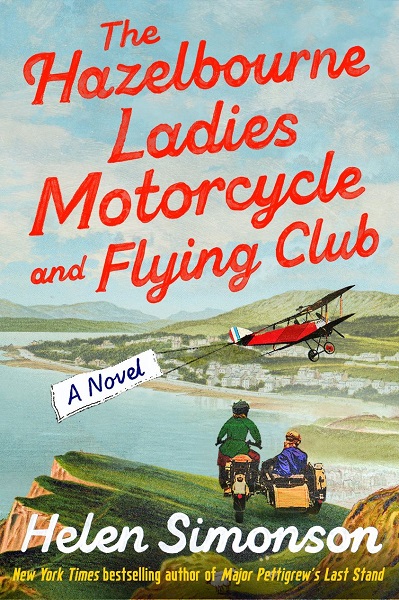
The Hazelbourne Ladies Motorcycle and Flying Club, by Helen Simonson*****

Helen Simonson is the author of the bestselling novel, Major Pettigrew’s Last Stand. With her new release, The Hazelbourne Ladies Motorcycle and Flying Club, she is once more in her element, creating believable characters and using them to skewer the pervasive racism and class snobbery of Britain, and also, in a smaller way, that of the U.S.  With outstanding word smithery and an unflagging pace, this historical novel should be number one on your summer reading list.

My thanks go to NetGalley and Random House for the review copy. This book is for sale now.

The year is 1919; the place is England. Constance Haverhill has been ousted from her job running an estate; the Great War has ended, and now the women that have been gainfully employed and done a fine job are unceremoniously ejected so that their jobs may go to the men that have returned from the conflict. For the time being, she has a position as a traveling companion to a family friend who’s recuperating at the seashore; once this situation ends, she has no idea where she’ll go or what she’ll do.

Out of nowhere comes Poppy, a daring young woman from a wealthy family. Poppy wears trousers and drives a motorcycle; she befriends Constance and sweeps her into her motorcycle club. Things become even more interesting when Poppy purchases a used biplane to bring home to her brother Harris, a handsome but severely depressed young man who’s lost a leg in the war. At one point he laments, “They look at me as if my brain has gone missing along with the leg. Or rather they refuse to look at me at all.”

Poppy is utterly fearless, challenging local authority and promoting women’s rights. She doesn’t care about the opinions of others; her eye is set on the horizon. And she can do that, because she has a soft nest in which to land. At the same time, Constance is always aware of the stark class division that prevents her from behaving as Poppy does.

“Respectability was the currency in which Constance knew she just trade for the foreseeable future. She…did not have Poppy’s wealth and position from which to defend herself against notoriety.”

There are a number of amusing side characters whose less progressive attitudes contrast with Poppy’s. The two women—also very wealthy—on the adjoining estate sniff at her exploits and declare them to be unladylike. The class division is also highlighted when Constance is offered a position with the hotel where she and Mrs. Fox, the family friend she accompanies, are staying. However, she is told that once she accepts the offer, she can no longer be a guest at the hotel, nor may she use the restaurant, which is a frequent gathering place of Constance’s new friends. No hobnobbing with the clientele will be tolerated; she must use the back door. Constance reflects to herself that wherever she goes, her friend Poppy will use the front door.

Britain’s racist attitudes toward people of color is also featured here, but in a way that does not hijack the plot. There’s an Indian guest of the hotel that is snubbed left and right; at one point, an American visitor attempts to have him excluded from the social events to which he’s been invited. This is resolved in a deeply satisfying manner, as is the issue of taboo friendships formed by Mrs. Fox.

If I could change one thing, it would be to add a bit more nuance. The bad characters are oh so bad; and while the good characters make the occasional mistake, we never doubt their complete goodness. However, this is a minor bone to pick, and overall this is a delightful book.

Highly recommended.

Rednecks, by Taylor Brown*****

“Law only serves them that’s in power. Ain’t no different than always…’Tis the victor who writes the history—and counts the dead.”

I’ve been an enthusiastic fan of author Taylor Brown since reading Gods of Howl Mountain, which was published in 2018. His new novel, Rednecks, is out now, and as with his earlier work, it is outstanding. My great thanks go to NetGalley and St. Martin’s Press for the invitation to read and review.

Brown tells the story of the Battle of Blair Mountain, a very real large scale battle, complete with machine guns, helicopters, tens of thousands of angry, armed miners, and the U.S. Army, an event which really did take place in the Appalachian Mountains in 1921. Over a million rounds were fired, and then the story was suppressed by the government, bosses, and big business media.

 In his author’s note, Brown tells us that the character of Dr. Muhanna, a heroic individual sympathetic to the cause of the miners, is based on his own great-grandfather. There is a meaty explanation of what parts of the story are based on the actual historical record, and what parts—small ones, to be sure—he has changed.

Apart from his skill as a writer and researcher, the thing that I have always loved best about Brown is his deep respect for the working class. It shines through every page of this novel. Mother Jones, the fiery Socialist labor organizer, is here as well, and she is possibly my favorite figure in American history. Unfortunately, she is not at her best here. Past ninety years of age and in poor health, she attempts to deceive the miners into quitting their struggle early once she learns that Washington, D.C. intends to send troops. It’s a pity that her many years of inspirational organizing and leadership are not on display here, but the facts are the facts, and this story is not, after all, chiefly about Mother, but about the miners, so I suppose that Brown has written it in the only honest way that it could be written. There are indeed passages that demonstrate her eloquence and loyalty to workers of every race and ethnicity.

As I read, I like to highlight passages to include as quotes in my review. This time, I came away with 53 quotes. Reluctantly, I am setting most of them aside; you will have to find them yourself. They’re better within the context of the story, anyway.

As a personal aside, I will mention that my own grandfather—“Papaw”—died of Black Lung disease in 1978 after having worked in a nonunion mine in South Dakota beginning in the eighth grade. He had to leave school and work fulltime, as there was not a social net back then, and he and his family would have starved if he had done otherwise. World War II brought him better fortunes, but coal dust, once lodged in the lungs, never leaves.

This is a gritty tale to be sure, one full of bloodshed and suffering, but also of immense courage and inspirational leadership. I read it in small bites lest it work its way into my dreams, until I reached the climax, at which point I had no choice in the matter, and was unable to put it down. This book is one of the year’s best. I highly recommend it to those that love labor history, historical fiction, or that just love a well-told story.

Charlie Chaplin vs. America, by Scott Eyman*****

Charlie Chaplin rose to fame over 100 years ago, but his fame hasn’t faded over the years. One of the most visionary movie makers in modern history, he rose from desperate poverty and homelessness during his childhood to become one of the wealthiest and most respected men in his chosen profession. And yet, for some odd reason, the U.S. government relentlessly pursued him as if he were an enemy agent, eventually forcing him to retire abroad. It’s a bizarre episode in U.S. history, and a fascinating one.

When I saw that Scott Eyman, an author whose biographies of actors I have previously enjoyed—John Wayne, Jimmy Stewart, Henry Fonda—had written about this case, I had to read it. My thanks go to NetGalley and Simon and Schuster for the invitation to read and review. This book is for sale now.

Charlie was born in 1889 in London. His mother Hannah was an actress, a loving mother whose health was dreadful. In addition to more conventional illnesses, she was sent repeatedly, and for longer stretches each time, to mental hospitals; it has been speculated that she suffered from syphilis, which eventually had devastating effects on her brain. Charlie’s father was a businessman who left the family and refused to pay a single shilling of child support because one of Charlie’s brothers was conceived with another man. And as an aside, if there is an afterlife, I sincerely hope that Charles Chaplin, Senior is roasting eternally in the flames of hell.

For a while, Hannah’s relatives cared for Charlie and his older brother, Syd, but eventually the boys found themselves in a workhouse, beaten, abused, sickened, and barely fed. It was his brother Syd who first discovered that acting could keep him out of the workhouse and put food on the table, and once he was so employed, Syd took his pale, sickly little brother to the theater and persuaded his boss to use Charlie, too. Thus was a star born.

His tremendous suffering during his childhood gave Charlie a lifelong sympathy with the working class, the impoverished, and the down and out. Early in his career, a director gave Charlie a costume and told him to come up with a character, and this was when he invented The Little Tramp.

I’ve known for most of my life about Charlie’s expulsion from the U.S., but I’ve never been sure whether he was a Communist. I’ve known people brought up in Communist households in America, and for many years, they existed strictly underground, so I wondered, did Chaplin deny his affiliation because he wasn’t a Communist, or because he was? Eyman’s meticulous research demonstrates once and for all that Charlie was not political. He told the truth about himself: “I am not a Communist. I am a peace monger.”

Nevertheless, once he gained prominence in the American movie industry, he had a target on his back. It’s difficult to understand why politicians and bureaucrats in California and in Washington, D.C. hated him so fiercely.

“A month after the revocation of [Chaplin’s] reentry permit, the FBI issued a massive internal report documenting more than thirty years of investigations focused on Chaplin, a copy of which was dispatched to the attorney general. The report revealed that, besides the FBI, Army and Navy Intelligence, the Internal Revenue Service, the Central Intelligence Agency, the Department of State, and the U.S. Postal Service had all been surveilling Chaplin at one time or another. In short, the entire security apparatus of the United States had descended upon a motion picture comedian.”

Eyman has done a wonderful job here. Because I had fallen behind, I checked out the audio version of this book from Seattle Bibliocommons, and I alternately listened to it and read the digital review copy. Of course, anyone reading this book for the purpose of academic research should get a physical copy, but those reading for pleasure may enjoy the audio, which is well done; this is a through, and a lengthy biography, and the audio makes it go by more quickly.

I confess I haven’t read any other Chaplin biographies, so I cannot say for certain whether this one is the best, but it’s hard to imagine a better one. For those sufficiently interested to take on a full length biography, this book is highly recommended.

The Great Divide, by Cristina Henriquez*****

I found The Great Divide, by Cristina Henriquez, on a short list of most anticipated novels of 2024. I don’t like to get shut out when a book gets this much buzz; then there’s the added draw of an unusual setting. The U.S. doesn’t see a lot of fiction published that’s set primarily in Panama during the early 1900s, and so that sealed it. My thanks go to NetGalley and Harper Collins for the review copies, both audio and digital. This story lives up to the hype, and I recommend it to you.

I am not so sure about it at the outset. There is a robust quantity of characters that are important to the story, and each of them is given a brief chapter all to themselves. I wonder whether they will ever intersect, or if this will turn out to be a collection of short stories, but before much longer, characters are meeting other characters. They don’t all end up together in the end, but we can see the ties that have formed. There are a lot of people to keep track of, and for me, having both the print version and the audio is tremendously helpful. Robin Miles narrates in a way that is natural and fluid, and I don’t notice much of what is around me when I listen to her. But once in awhile a character is mentioned and I draw a blank; here is where the Kindle version is essential, because I highlight the names of each of the characters, and this enables me to instantly flip back to where they were introduced to us without having to stop listening. Eventually, of course, I no longer need to do so, but knowing that I can makes for stress-free reading.

I am engaged with these characters, each of whom feels real to me, and I groan when I see them get into trouble, and sigh with relief once they are in the clear again. The ones that I care about most are a father and son that are estranged from each other, neither wanting to stay that way, yet both of them incorrectly interpreting the silence of the other. As we reach the climax, I can tell there are three ways for this situation to resolve: they can reconcile; one of them can die; or the son can decide to follow another character back to the U.S.A. without reconnecting with his dad.  It only now occurs to me that there was a fourth possibility, which was to leave them still estranged at the end; but by this time, Henriquez had shown herself to be a better writer than that, and while I won’t tell you how they wound up, I will say that she didn’t leave her readers dangling.

Because this is an intricately woven tale with a lot of equally important characters, I’m not including any quotes, but I will say that Henriquez is a talented writer, and anyone that loves good historical fiction should get this book and read it. This applies even more so to those interested in Latin American history and the building of the canal. I hadn’t read her work before, but she’s on my radar now, and I look forward to seeing what she writes next.

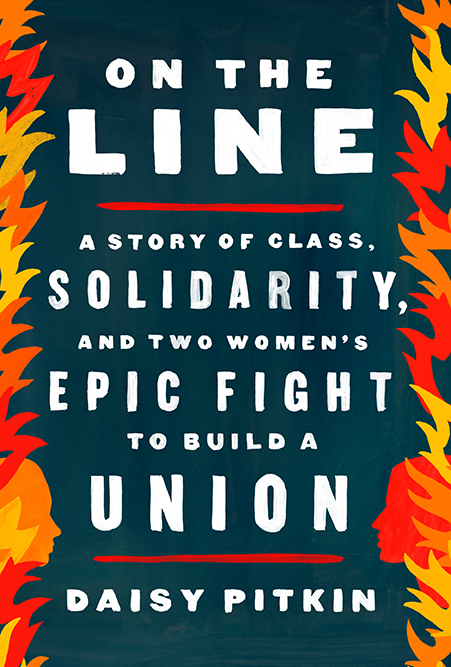
On the Line, by Daisy Pitkin*****

On the Line, a labor memoir by Daisy Pitkin, tells the true story of a grassroots struggle to organize a nonunion laundry in Arizona as part of an industry-wide unionizing campaign. My thanks go to NetGalley and Algonquin for the invitation to read and review. This book is for sale now.

Daisy is an organizer for UNITE, a labor union that organizes textiles, laundries, transportation, service workers, and some others, created by the merger of ILGWU (International Ladies Garment Workers Union) and ACTWU, the American Clothing and Textile Workers Union (of which this reviewer was once a member and union activist.)  She is working at the ground level, approaching workers in the parking lot, partnering with a woman named Alma that worked there and could talk to other workers inside the factory.

The memoir is written in the second person to Alma, and at first this seems odd, but as I read, I realize this is an effective and intelligent choice. By addressing Alma and the things that Alma has said and done during this fight, as well as the things the author did, along with what they did together, and the occasional differences of opinion they had and how they resolved them, she avoids making herself sound like a martyr to the cause. It would not read nearly so well in the first person, with the reader as audience.

The tasks of the workers all revolve around the commercial laundering process. Immense bags of dirty linens weighing up to 300 pounds are pushed off of the delivery trucks in rolling carts.

“The linen moves down the belt, you said, and then you flicked your arms back and forth to demonstrate how you and the other sorters toss sheets into one bin, towels to another, gowns to a third, and so on. You said, Sometimes they speed up the conveyor, and we don’t have time to be careful. There is a lot of blood and puke and feces. You said, We don’t get shoe covers, so some of us take off our shoes and drive home in our socks. You said, Our gloves are too big—they slip off our hands. Sometimes when they tear open, we have to handle the soiled linen with exposed skin…you were demanding a seemingly simple thing: to work your eight-or-ten-hour shift and come home unharmed. You wanted gloves that hospital needles cannot puncture. You wanted face masks to keep the blood and fluids from other bodies from entering your bodies. You wanted safety guards put back on machines where they had been removed. You wanted linen dust cleaned from the rafters to prevent fires.”

Safety rules are routinely flouted. Dirty linens land on the belt, and the belt feeds them into the mouth of a tunnel washer. When the washer jams, workers sometimes have to crawl through hot, bleachy, contaminated water to clear it and get it working. The supervisors are supposed to cut power when someone is in there, but they don’t. Ultimately it’s a choice for the owners to risk a possible, but unlikely fine from the government, or frequent decreases in production, which cut into profits. The workers are expendable; they can always find more. The wash and dry departments of industrial laundries are the most fatal of all industries, according to U.S. government statistics.

Daisy and Alma are working on a shoestring. When they have to be away from home overnight in order to meet workers as they go in or come out, they sleep in the car. Their signs are made by hand with posterboard and Sharpies. Initially, all of the workers sign cards, but then management begins a campaign of threats and intimidation. Not all of the workers are in the States legally, and most of them don’t know their legal rights. Most of them rescind their votes, and then it’s an uphill climb to get them to sign again.

This is a topic that is of great interest to me, and I was supposed to have read and reviewed this book in April of 2023, but my stomach twisted as I read of the horrific obstacles encountered by workers and by Daisy, and halfway through I had to put it down. Only recently did I slap myself upside the head and resume reading.

In any labor union, there are two sets of obstacles. The first, the one that is obvious, is the company, the bosses. Unions cut into profits, so the owners or boards of directors nearly always fight unionization. The second, and lesser known, is the union officialdom at the top. These people spend more time around the bosses and other highly paid union officers than they do around the workers, and they become jaded, sometimes contemptuous of those that they are supposed to represent, whose dues pay their salaries. When Daisy is eventually promoted, she discovers it’s harder to do anything that is in the interests of the clientele.

The book also includes a fair amount of union history, and it’s clearly explained, well woven throughout the narrative.

For those that are interested in unions and labor history, this is an excellent resource. But don’t read it at bedtime; it will do things to your dreams.

The Wind Knows My Name, by Isabel Allende****

Isabel Allende is a living legend, a literary genius and fierce defender of human rights, foremost of women and immigrants. The Wind Knows My Name is a novel that features the struggle of two generations of immigrants, those that came to the U.S. during the Holocaust, and those that are coming here now from Latin America. Allende moves us seamlessly from one set of characters to the next, and then back again.

My thanks go to Net Galley and Random House Ballantine for the review copy. This book is for sale now.

I have been reading Allende’s work for decades. To read her stories is to be transported. In this case, the protagonists include two small people designed to possess the human heart. Samuel is a Jewish violin prodigy, still quite small as this story unfolds; his parents send him to safety when the Nazi occupation of Vienna takes hold, thinking that they will square things away and join him later. Of course, they are never able to do that. Our present-day protagonist is Anita, a Guatemalan immigrant child that is nearly blind. She is separated from her family at the U.S. border, and does her best to stave off loneliness by talking to her sister, Claudia, who is dead.

On the one hand, Allende is, to my way of thinking, on the side of the angels here politically. She always is. But if this feels a bit lecture-like to me, a diehard fan, it seems unlikely that she will reach a lot of newer readers. Usually I bond with her characters and carry them around with me for some time after I have turned the last page, but this time I find I am watching the page numbers go by. The person I feel most affinity for is Samuel, the tiny child clinging to his precious violin, but he disappears quickly and when he returns, he is an old man. Another reviewer commented that too much is told here, and too little shown, and that sounds right to me. And as much as I love Samuel, I also am burned out on historical fiction set during World War II. I hope in her next project, the author will turn in another direction.

To Allende’s many devoted readers, this book is recommended with the above caveats.