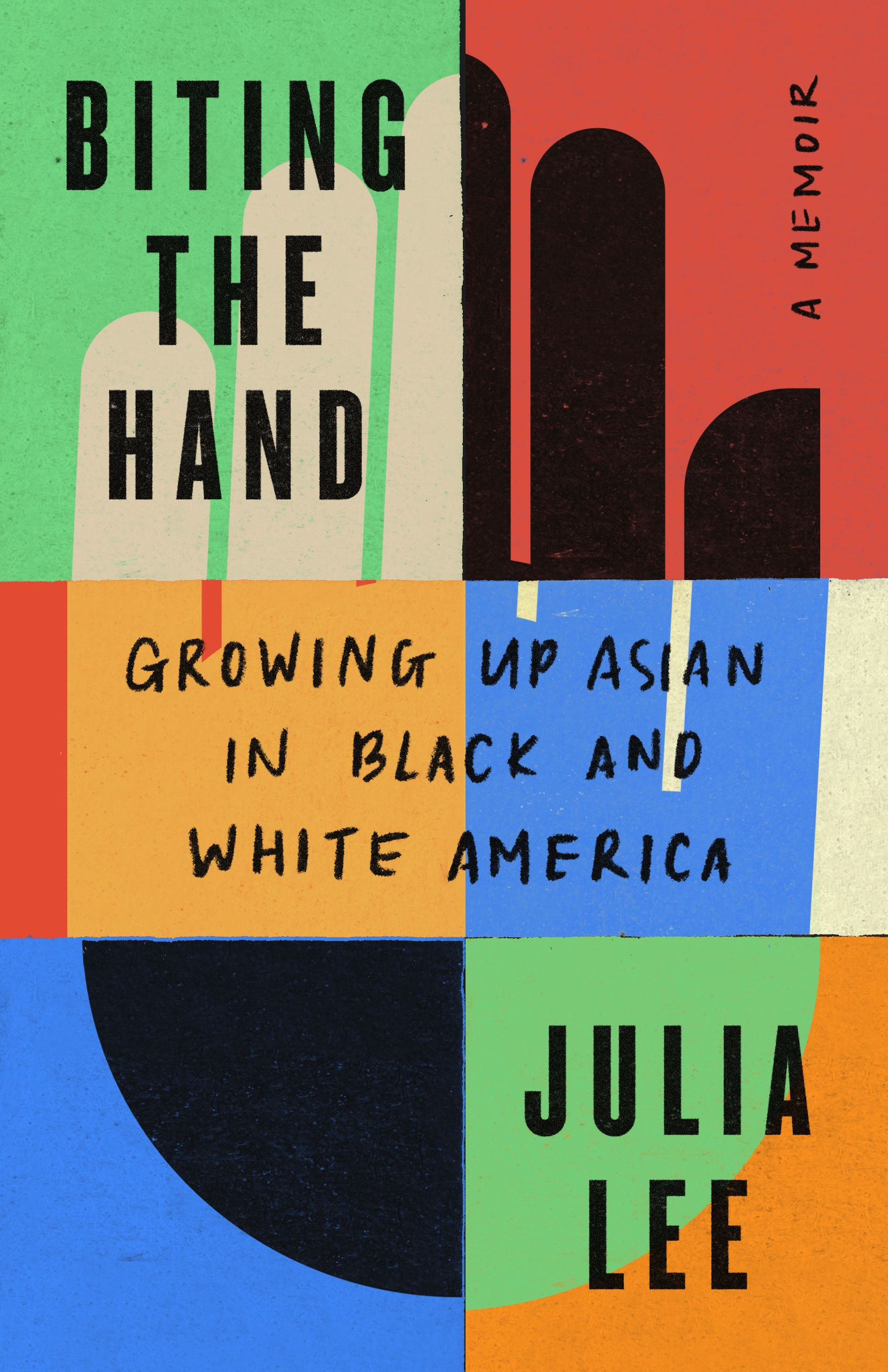
Biting the Hand, by Julia Lee****

Julia Lee is not amused, and she’s decided to say the things nobody else is saying. In this deeply analytical, provocative memoir, she tells us about her own experiences growing up, and the issues faced by Asian immigrants and Asian Americans in the United States, where “we are critical to the pyramid scheme of the American Dream.”

My thanks go to Net Galley, Henry Holt Publishers, and Macmillan Audio for the review copies. This book is for sale now.

In some ways, I feel as though I am reading someone else’s mail as I read this, because it is clearly intended for an audience of people of color. However, I did read it, and I’m going to review it.

When the discussion of race in the U.S. comes about, it is, as Lee states, almost always a conversation about Black people and Caucasians. Those that don’t fit into either group are sidelined. Perhaps more harmful is the way that people of Asian descent are presumed to be sympathetic to the status quo. Ever since a major news periodical dubbed Asians as “the model minority” back in the early 1960s, expectations and assumptions have leaned in that direction. And the roots of this division—Black versus Asian—make this a particularly thorny assumption to untangle. After all, a large percentage of African-Americans can trace their lineage to slavery; their ancestors weren’t born in the States, nor did they choose to come here, but were kidnapped and brought by force. Angry? You bet! But Asian immigrants came of their own accord, oftentimes fleeing untenable circumstances in their countries of origin. And so, their children, and those that have come after, have largely been indoctrinated to be appreciative. If things don’t go well, they tell them, then we must work harder!

This Caucasian reviewer comes to you without the Asian background, appearance, or experience that Lee speaks of; yet I live in a city that has one of the largest Asian populations in the U.S., and am married to an Asian immigrant, and parent to a child that is half-Japanese. So many of the stories—strangers that ask where you’re from, and won’t accept the truth of “California,” where Lee was born, or “Seattle,” my daughter’s hometown, are familiar ones.

Lee is fed up with the mainstream news stories that endeavor to pit Asian and Black people against each other. Her parents were small business owners in a mostly Black part of Los Angeles during the riots of 1992, and her experiences inform her conclusion, that there must be solidarity between all people of color in order to successfully fight for significant change.

The one bone I have to pick is the casual manner in which she dismisses the question of social class as a key factor. Her very brief note about this is that it’s a tomato and to-mah-to issue, not worth much discussion, because most people of color are working class. This is simply untrue, and it enforces a stereotype of Black people as being mostly poor and dispossessed, when in actuality, eighty percent of Black people in the US live above the poverty line. There are African-Americans that have far more money than I will ever see; some of the many Asian groups have a higher median income than Caucasians. So yes, social class is a huge factor here, one that Lee should examine more critically. There are working class Whites that can be allies; there are wealthy families of color that would shut down the struggle, given half a chance. The missing star in my rating reflects her failure to recognize this, and to offer concrete solutions to this problem.

The book’s title comes from Lee’s mentor at the otherwise very white-supremacist dominated Harvard—Jamaica Kinkaid. I actually gasped when I saw this. What a luminary she found to guide her!

Both the audio and print version of this book are equally readable, so go with whatever you usually prefer.

This is a fine resource for those seeking to examine Asian and Asian-American racial dynamics. Read it critically, but do read it. There’s a lot here that has needed to be said for a long, long time.

Poverty by America, by Matthew Desmond****

“Hungry people want bread. The rich convene a panel of experts. Complexity is the refuge of the powerful.”

Desmond is the author of Evicted, the Pulitzer winning examination of urban homelessness. Desmond himself grew up poor, and his family was forced out of their home when he was a child. These things give him a different and more authoritative perspective than most urban ethnographers.

 My thanks go to Net Galley and Crown Publishing for the invitation to read and review. This book will be available to the public tomorrow, March 21, 2023.

This book is written for a general readership, and it’s more readable than any other nonfiction work I’ve seen on this subject. His tone is conversational, and his research is impeccable, drawing from a wide variety of sources, well integrated and organized. He addresses the past and present roles of racism, explaining how the overtly discriminatory statutes and policies of the past have morphed into more subtly framed, yet still ubiquitous ones of today. He tells us “why there is so much poverty in America and…how to eliminate it.” He speaks to an audience of middle and upper class readers, warning that we must “…each of us, in our own way, [must become] poverty abolitionists, unwinding ourselves from our neighbors’ deprivation and refusing to live as unwitting enemies of the poor.”

In revealing the roots of American poverty, Desmond is thorough. He discusses the role played by medical costs, and the many workers that still cannot afford health care; the withering of unions, and the way that gig workers and independent contractors have replaced permanent employees; incarceration, and the debilitating effects it has, not only on the person sent away, but on their families for generations to come; the way that government assistance programs have been legally diverted to programs having nothing to do with the poor; the way that poor people are forced to pay more for the same goods and services that the better off pay. He discusses the ways that those living in poverty are cut off from political and economic opportunities. He does these things better than anyone else is doing them right now, and it makes me mad as hell, seeing millions of ruined lives all laid out so starkly.

It is when he approaches solutions that things become a little muddy. There are a few of his suggestions that I genuinely disagree with, but most of them are sound; the problem is that, despite his assurance that all of these changes can be made without much incursion into the lives of the wealthy and powerful, the chances of these people agreeing to implement such changes are somewhere between slim and none. He assures us that he is no Marxist (and that’s the truth, alas,) and that the rich can still have plenty; yet in reality, it’s clear to this reviewer that the kinds of changes that are needed are ones that working people will have to force from the tightly closed fists of the rich. This is where the fifth star falls off of my rating.

Nonetheless, Poverty by America is well worth your time and money, and I recommend it to you.

Kunstlers in Paradise*****

4.5 stars, rounded upward. My thanks go to Net Galley, Henry Holt Publishers, and Macmillan Audio for the review copies. This magnificently quirky novel is for sale now.

Julian Kunstler is kind of a mess. He’s a twenty-something New Yorker whose girlfriend has just dumped him. He has no job, and he doesn’t want one; at least, not the low-paying, entry-level variety of jobs for which he is qualified. He takes himself home to his parents who have been paying his way, confident that they will understand his plight and increase his allowance. Instead, he hits a wall. What are your plans for the future, Julian? (None.) What do you plan to do for money? (Get it from you.) Just as a dramatic situation has begun to unfold, they hear from his 93 year old grandmother, Mamie, who lives in Los Angeles. She wants him to come to stay with her awhile; she needs assistance. He’s not so sure that he wants to go, but when his parents insist, he gets on that plane. Once there, the pandemic strikes, and he is trapped in lockdown with his grandmother and her elderly companion, Agatha.

Mamie has always been fond of Julian, and although she does need a driver for doctor appointments and the like, what she wants, more than anything, is to tell her life story. Most of it, anyway. It begins in Austria, as Jewish artists like her father, a successful composer, are being pushed out of public life by the Nazis. (Here, I emit a small moan; I am heartily sick of Holocaust stories. Happily, we don’t stay there long, and this story is worth it.) She goes on to describe the shock she experiences in suddenly being transplanted into a completely different climate, language, and culture, and much of Mamie’s story is droll. And Julian, who never would have sat still for these tales had they come from his parents, listens. At first, he listens impatiently, assisted by Mamie’s generous liquor collection. As time goes on, he begins to listen with greater patience and understanding. And by the end of a year’s time, he listens with genuine interest. His own exile from New York is pale, after all, in comparison to the exile his predecessors endured.

The most dynamic character is, of course, Julian, but through Mamie’s stories, we see how life has already changed her. Agatha is enigmatic until the book is nearly over, and I love what Cline does with her, too.

If I were to change one thing, I would edit down the material about the genius composer friend that emigrates from Austria and is close to the family. This reviewer was a music major once upon a time, and if this part of the narrative is a bit much for me, then probably many others will feel the same. Of course, if the reader comes to the book with a deep interest in Schoenberg, then it may prove quite satisfying.

I am fortunate to have access to both the digital print galley and the audio version, and reader Jesse Vilinsky is hands down the funniest, most skillful voice actor I have ever had the pleasure to hear. Cline’s book is very good, but in the hands of Vilinsky, it is infinitely better. Her interpretations of Mamie and Julian are spot on, hilarious at times, moving at others. The way she voices Agatha is absolute comic genius!

For those that love quirky humor and historical fiction, this book is highly recommended.

Moonlight and the Pearler’s Daughter***-****

3.5 stars rounded upwards. My thanks go to Net Galley and Simon and Schuster for the review copy. This book is for sale now.

Eliza has always been close to her father, a man that runs a fleet of pearling vessels. Her mother is gone, so it’s only Eliza, her father, and her brother. Then one day, the fleet comes back, but her father isn’t with it. He’s gone missing! Did he fall overboard? No, not that anybody saw, but if he isn’t on the ships, it seems the logical explanation.

For a variety of reasons, Eliza doesn’t believe it. She is determined to find him herself; yet to do so, she must go places and do things that are absolutely unacceptable for a woman in Western Australia in 1886. Fortunately—and conveniently—a young German man wants to go these same places, and he accompanies her. From there, things proceed in about the way you might expect.

Other reviewers that came before me say that this story is beautifully written, but terribly sad. I steel myself, but though the story is melancholy in places, I don’t find it depressing. However, I am also less impressed than I anticipated.

The good: I love the setting, and the setting plays a large role in this tale. Australian pearl divers! I have never read anything like this before, and I learn some things. I have never thought before about how the pearls that jewelers sell are collected. Though I would imagine that the process has changed over the past 150 years, it is still interesting to me. Along the same lines, I appreciate the amount of detail in the author’s notes.

On the other hand, the character development is underwhelming. Neither Eliza nor Axel is much different at the ending of the story than at the start. Eliza is a bit wiser, and she has learned things about her father and brother that had been kept from her before, but I can’t call hers a dynamic character; Axel is even less so. The same applies to the quality of the writing. It isn’t bad, but after the buildup, I expected it to be better than this. But the worst thing is a plot twist, right within the climax, that is jaw-droppingly improbable. My mother used to warn me that if I roll my eyes up into my head, they may stay there, so I am grateful to have emerged from this novel with my vision intact. Ohhh, brother.

So for a bit I consider that this is a three star read, but the resolution involving Eliza and Axel is very nicely done, and it wins me back enough to round it up to four. I recommend this book to those interested in the setting.

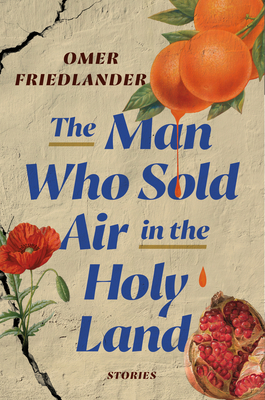
The Man Who Sold Air in the Holy Land***-****

The Man Who Sold Air in the Holy Land marks the debut of a talented writer. Omer Friedlander’s short story collection has already made reviewers sit up and take notice. My thanks go to Random House and Net Galley for the invitation to read and review. This collection is for sale now.

All of Friedlander’s stories are set in Israel, and all of them evoke their setting in a way that is fresh and immediate. My favorite stories are the title story; High Heels (except for the ending; more on that in a minute,) and Alte Sachen.

Here’s my issue with these stories, and it’s true of nearly all of them: the author uses endings that don’t feel like endings, leaving the reader to figure out for herself what happens. This is particularly painful when a story builds in a most suspenseful manner and then ends on a cliff hanger.

I don’t think so.

I understand that this is considered a valid choice in literary fiction, but I doubt it will ever become a popular one. When an author leaves the rarified world of literary journals and writers’ groups and opens his work up to a general readership, adjustments need to be made.

The sweetness of a well-built story that culminates in tremendous frustration when the end is left dangling finally got the better of me, and I didn’t read the last story.

Now you know; if you want it, go get it.

The Matchmaker’s Gift, by Lynda Cohen Loigman*****

“The heart is big enough to hold both grief and love.”

I read Loigman’s debut novel, The Two-Family House, followed by The Wartime Sisters, and I loved them both, so when Net Galley and St. Martin’s Press invited me to read and review The Matchmaker’s Gift, I leapt. Once again, Loigman has me at hello. This outstanding historical novel is for sale now, and you should get it and read it.

The story is told from the point of view of two protagonists, a woman and her grandmother; they were close, but Sara the grandmother has died, so her story is told in the past, beginning in 1910, when she arrives in the U.S. as a child, along with her family. Abby is her granddaughter; her story begins in 1994. Their stories are told alternately, but both are in the third person omniscient and told in a linear time frame, so I am free to lean back, relax, and get lost in their stories, without any confusion or doubling back to check things.

Sara was a matchmaker, although she initially had to be very careful, because Jewish tradition dictated that matchmakers be married men, and she was still just a girl. But she was gifted with visions of a sort, and could tell who belonged together. And so she was forced to create matches “in secret, pairing people together like a rogue puppeteer.” She never missed. And upon her passing, she leaves a cryptic message indicating that upon her death, Abby will inherit her special talent.

Abby is nonplussed by this, and even as she grieves her beloved grandmother’s death, she is confused as to what she should do. She’s a divorce lawyer, for heaven’s sake! Is she to toss her education and become a modern day yenta? She hasn’t even found a man for herself yet, let alone for others.

It’s always a joy to find a story that diverges from the well-worn path, and novels involving Jewish matchmakers—or any others, for that matter—are thin on the ground. But that is only a small part of this novel’s appeal. I love Sara and Abby; I almost feel they are my friends. I feel their sorrows and admire their courage and integrity. When either of them meets with unfair opposition, I want to smack their detractor with my cane.

But there’s something extra that’s infused into Loigman’s stories, an intangible but unmissable warmth. Nobody can teach anyone this. I can count on one hand the number of authors that can write heartwarming stories that don’t follow formulas or insult the reader’s intelligence. Loigman is one, and this makes her golden.

When I was halfway finished reading this glorious novel, I saw that an audio galley was available. I was a bit cautious, because I had already developed a firm sense of how these women sounded in my head, and I was afraid I might not like the narrators’ interpretations, but my concern was unfounded. I had a road trip ahead of me, and I listened to the next forty percent as I drove, and there wasn’t a single moment that I didn’t love. Narrators Eva Kaminsky and Gabra Zackman do a lovely job, and I have never had such a seamless transition from the digital galley, to the audio, and back again.

Highly recommended, and bound to be one of the year’s best loved books.

Mecca, by Susan Straight*****

Susan Straight is a force to be reckoned with. I knew this after I finished reading I Been in Sorrow’s Kitchen and Licked Out All the Pots after it came out in 1992, and after I sought out, bought, and read everything else she’d written that was available. When I discovered that her new novel, Mecca, was available on Net Galley, I leapt on it. My thanks go to Net Galley and to Farrar, Strauss, and Giroux for the review copy. This book is for sale now.

Mecca, an ironic title if ever there was one, is a story of race, class, and gender, and the way that they play into the “Justice” system in California. Add a generous seasoning of climate change and its horrific effects in dry, dry Southern California, and a fistful of opioid addiction, and you have a heady mix indeed. But these are all well worn ground at this point, and this book is exceptional, not because it examines complex current events, but because of Straight’s facility in building visceral characters we care about, and launching them into this maelstrom in a way that makes it impossible to forget.

We begin with Johnny Frias, an American citizen of Latino heritage. As a rookie and while off duty, he kills a man that is raping and about to murder a woman named Bunny. He panics and gets rid of the body without reporting what’s happened. Frias is on the highway patrol, and he takes all sorts of racist crap all day every day. But his family relies on him, and when push comes to shove, he loves his home and takes pride in keeping it safe.

Ximena works as a maid at a hotel for women that have had plastic surgery. One day she is cleaning a room and finds a baby! What to do? She can’t call the authorities; she’d be blamed, jailed, deported, or who knows what. She does the best thing she can think of, and of course, there’s blowback anyway.

And when a young Black man, a good student with loads of promise that has never been in any trouble at school, or with the law, is killed because the cops see his phone fall out of the car and decide it’s a gun…?

I find this story interesting from the beginning, but it really kicks into gear in a big way at roughly the forty percent mark. From that point forward, it owns me.

As should be evident from what I’ve said so far, this story is loaded with triggers. You know what you can read, and what you can’t. For those of us that can: Straight’s gift is in her ability to tell these stories naturally, and to develop these characters so completely that they almost feel like family. It is through caring about her characters that we are drawn into the events that take place around them, and the things that happen to them.

This is a complex novel with many moving parts and connections. I read part of this using the audio version, which I checked out from Seattle Bibliocommons. But whereas the narrators do a fine job, I find it easier to keep track of the characters and threads when I can see it in print. If you are someone that can’t understand a story well until you’ve heard it, go for the audio, or best of all, get both.

Highly recommended.

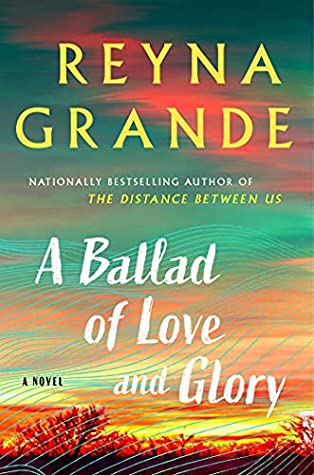
A Ballad of Love and Glory, by Reyna Grande****

“We Irish know what ’tis like to be oppressed by an aggressive neighbor.”

Reyna Grande can really write. This is the first of her novels I have read, but it surely won’t be the last. My thanks go to Net Galley and Atria Books for the review copy; this book is for sale now.

A Ballad of Love and Glory encompasses two genres, romance and historical fiction. It’s the story of John Riley, an Irish immigrant to the USA in the mid-nineteenth century, who is met at the dock by military recruiters that want him and his compatriots to serve in the US army, fighting the war against Mexico. Riley arrives half-starved and worried sick about the fate of his family that he left behind. The promise of soldier’s wages is enough to persuade him, and he enlists.

It’s also the story of Ximena, a Mexican naturopath whose husband is killed by Texas Rangers. She follows the army to help care for the wounded; she and Riley are drawn together.

As for me, I am drawn to this tale by my love of military history, whether nonfiction or fiction, and by the unconventional point of view regarding the U.S. land grab. At the time of the annexation of Texas, followed by the war against Mexico, most Americans accepted the official explanation and believed that the war was initiated by Mexican aggression toward U.S. citizens across the border. Some, including an up-and-coming politician named Abraham Lincoln, saw threw the ruse and understood that the whole thing was a pretext on the part of the US designed to capture Texas, California, and points in between. This is the background information that I bring with me as I begin reading this novel.

The title and book cover both focus on romance, and if a friend hadn’t mentioned this story, I would have passed it by; most romance is too sappy for my tastes. But an entire brigade of Irish immigrants that jump sides in the midst of the conflict and fight, instead, for Mexico? I have to read this!

Grande honors historical truth in her storytelling, and as such, this is one sad read. The Irish soldiers are treated more savagely by the American-born officers than I had known, and Grande gives us plenty of detail. And although I know, when I begin reading, exactly who wins this war, it’s hard to face the inevitable once I am bonded to these characters.

That said, I do think Grande does a better job with the military end of this thing, and of developing John Riley in other regards, than romance. There’s this tension between Riley and Ximena, because he is a married man with a child back home—and I can guess immediately how this conflict will be resolved. Until that resolution, the tension, part of the “honor” mentioned in the title, is drawn to nearly ridiculous proportions; at one point, as the two are straining passionately toward one another, they both stop simultaneously, whip out their rosaries, and start saying Hail Mary’s together. I threw back my head and laughed!

Nevertheless, this is a wonderful novel. If you enjoy historical fiction; unconventional points of view; working class fiction; or tales of forbidden love, this book is for you. If you are in need of a good ugly cry, this book is your catalyst.

Our Country Friends, by Gary Shteyngart*****

Gary Shteyngart is a funny guy. In Our Country Friends, he tells a story in which Sasha, a former literary luminary, up to his eyeballs in debt, invites five friends to join him and his little family at their country estate to weather the pandemic. The results are not at all what he anticipated.

My thanks go to Net Galley and Random House for the invitation to read and review. This book is available now.

Shteyngart does us the favor of listing the cast of characters (“Dramatis Personae,”) at the book’s opening, and I relied on it heavily. Because all of the characters are introduced at the outset, I took a ridiculously long time getting them straight, but it was worth it. The group’s dynamic would be fairly stable but for the introduction of “The Actor,” someone he knew back in the day but who is an A-lister now. But frankly, some, if not all, of the other guests would probably not have come but for the mention of The Famous One as a possible addition. When he comes, the women practically swoon in his presence, and then nothing is the same for the rest of the story.

The first third of the book seems relatively formless, but I suspect the author (should I say, “The Author?”) is warming us up, letting us get to know the characters before a lot of other action takes place. The promotional blurb tells us that this story encompasses six months and four romances, and that it’s about love, friendship, and betrayal, and that sums it up.

Generally speaking, I don’t enjoy novels about rich people, but because Shteyngart is setting them up for satirical misery and angst, I dive in, and I emerge shortly afterward, laughing. This sly humor is unmissable.

Because nearly all of the characters are over forty, I highly recommend this story to readers of a literary bent—if you know Chekhov, it’s even funnier—who are forty or over.

Black Cake, by Charmaine Wilkerson****-*****

“I was not the first person to go through the world living two separate lives, one out in the open and the other locked up inside a box.”

Elly Bennett dies and leaves a detailed recording for her children. Wilkerson’s novel is about Elly’s life, but more than that, it’s about secrets. Everyone in this book has one or has been impacted by one in a major way, and for most, both are true. Elly and her late husband had a whopper, and they built their lives and their family around it. Their two children are Byron and Benny, and Benny’s secret is all consuming for much of her life; it has had a role in estranging her from her once-adoring older brother and parents. Meanwhile, there’s a child—now grown to middle age—in Europe that is herself a secret, and whose very identity has been obscured by one. Elly’s closest childhood friend carries a particularly potent secret, and so does the nanny that raised her. Even the lawyer that handles the estate has one.

When is it safe to let go of a secret?

I was invited to read Wilkerson’s debut novel by Random House Ballantine and Net Galley, and I thank them for the review copy. This book is for sale now, and everyone is talking about it. You’ll want to get in on it.

Our story unfolds with seventeen year old Coventina Brown, known as Covey, quietly launching a plan to join her boyfriend, Gibbs, in London. He’s gone there to go to school, and when she’s done with school, she will join him. That is, until her father, who has raised her alone, gets into big trouble with a loan shark, a local thug who now holds title to her father’s store and his home, and now wants the one thing this father has left: Covey. If Covey marries this nasty old man, the debt will be squared. Most fathers would send their daughters to safety, and then square their shoulders and solve their problem, even when their own lives hang in the balance. But alas, Johnny Lyncook is not most fathers. He’s not a particularly nice man. As one of our characters will observe later, “A shit is a shit, young or old.”

Covey escapes on her wedding day (at which Black Cake, similar to fruitcake, is traditionally served), and her experiences from that time forward will form the foundation of her own life, her (future) husband’s, and their children and other loved ones.

The story is told in the third person omniscient, with the point of view changing by chapter, along with the time period. Readers will find themselves wretchedly confused if they fail to note the chapter titles, which are the key to everything that follows. The result is a story that is assembled like building blocks, and although it works out in the end, with everything coming together for a satisfactory resolution, I am frustrated at times, because just as a character begins to take shape for me, we leave them and join someone else.

I would have enjoyed more integration and perhaps a wee bit of streamlining. For example: we learn that Johnny, Elly/Covey’s father, is ethnically Chinese, and that there are a lot of them in the Caribbean, but there appears to be no reason whatsoever to include this. It is as if Wilkerson wants to include every interesting fact about life in the Caribbean, and so there are components her that add nothing to the narrative. It’s a distraction. The story is complex enough without tidbits thrown in for no benefit. There are some small credibility issues as well. Two people within the story become famous enough to be recognized on the street, and receive breaks that they ordinarily wouldn’t; one is a distance swimmer, and the other an oceanographer. I can imagine how one or the other might be charismatic and photogenic enough to achieve this, but two? Name a famous oceanographer. Name a famous distance swimmer. See what I mean?

Nevertheless, this is in many ways a story for our time, and as such, it will make meaty discussion material in book clubs and in classrooms.  When is a person black enough, and must a biracial person choose one side of their heritage over the other? How much information do adoptive parents owe their child, and when should they provide it? What about biological parents? When is it acceptable to keep secrets related to their children’s heritage, and when not? There are MeToo and other women’s issues at play, and there are issues of race. You could probably read this thing three or four times and still come away with observations, ideas, and questions that you hadn’t found the other times.

I am grateful that this story never devolves into a cookbook.

As debuts go, this is a strong one, and I look forward to seeing what else Wilkerson publishes. I recommend this novel as a welcome distraction from the stormy months ahead.