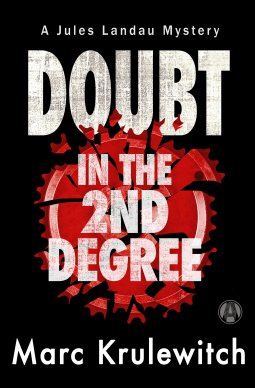
Doubt in the 2nd Degree, by Marc Krulewitch*****

doubtinthesecondThis is the fourth and best installment to date in the Jules Landau series. Thank you Net Galley and Alibi for the DRC, which I scooped on the date of publication in exchange for an honest review. This title is for sale now, and if you like a good whodunit, you should get it too.

The shores of Lake Michigan are inhabited by rich white people, and Jackie Whitney is one of them. Once she is found dead and stuffed on the shelf in her own walk in closet, however, the good times are over.  Kate, Jackie’s girl Friday who hails from Appalachia, is arrested and the public defender asks Jules to look into the case. She doesn’t trust the state’s own people to find reasonable doubt without some outside assistance, but she cautions him that she isn’t going to pay him to find out who did it; all she needs is for him to muddy the waters enough to prevent conviction.

She might as well spit into the wind.

Landau is fired up, and he knows that Kate will be convicted if he can’t find another suspect. Partly this is because cops like to wrap up a case, and once they think they have someone they can convict, they stop looking anywhere else; but there’s another reason, too:

“Corruption and Chicago followed each other like conjoined twins.”

The more rocks Landau turns over, the more suspects he finds. It’s getting to the point where he hardly has time to get home and feed the cat. There are many wry remarks that give this story its kick; it’s a novel that’s part noir, part cozy locked-room-mystery, and whereas the author’s disinclination to settle himself neatly into one area of the genre may cost him in sales, I have to admit that I really like it this way. His clear eye on class divisions and his snarky sense of humor lit me up like Christmas, and I can’t wait to see what he does next.

Although this is the fourth book in the series, I think it works just fine as a stand-alone novel.  Highly recommended!

The Whole Town’s Talking, by Fannie Flagg*****

 “Up on the hill, Lucille Beemer said, ‘Good morning, everybody.’

“Two hundred and three people just waking up answered, ‘Morning’.”

thewholetownstalking Fannie Flagg is legendary, and rightly so. In fact, at one point in my reading of this DRC, I reflected that someone with her power to move people has power indeed; how fortunate that she uses her gift to benefit the rest of us. I don’t know about you, but I am ready to read something that provides a level of reassurance that all has not gone sour in this world, and that everything passes, sooner or later.  I was  fortunate to read this free and in advance thanks to Random House and Net Galley, but it’s one of the very few books for which I’d have paid full freight if it came down to it. It hits the shelves November 29 and is available for pre-order right now.

Our story begins with the first residents of what will become Elmwood Springs. Lordor Nordstrom arrives from Sweden, and after months of searching, finds the perfect place for his dairy farm in a pleasant spot in Missouri. The year is 1889. He puts up a house, buys some cows, and then, as a founding father, he decides he will donate a piece of land, because every town needs one thing for sure…a cemetery.

“Lordor guessed that preparing a place to spend eternity and trying to figure out how many places to set aside for himself was what made him think about his future.”

I went back and reread that sentence a couple of times; it begins our second chapter. Oh my but Flagg is droll. If one were to read this gem with half a mind on other things, nuggets like this might be missed.

The years go on, and with brief, colorful chapters, Flagg develops the town, introducing new residents that move in or are born here, and at first it seems as if the story is cotton candy, all fluff and sugar. But just as the impression is formed, it is vanquished, because our author is just warming up. Moments that are poignant, bittersweet, and darkly funny are sprinkled in lightly as we start, because after all, we are new to Elmwood Springs.

But the longer we stay there, the more intimately we become acquainted with its denizens and their peccadilloes, and then the more emotional aspects of the story unfold, almost as they might within your own large family or tightly knit community. Flagg convinces me that these people are my people, and her characters are so brilliantly developed, so utterly convincing that even when one of them does something surprising, I understand how that has come to pass.  And every time I think I see where she is headed with one thread or another, she surprises me.

About a fourth of the way in, someone dies and we find them interred, of course, at Still Meadows. But there’s an engaging twist to this aspect of Flagg’s story: the first person to pass wakes up when someone new arrives and greets them. They may be six feet under, but they can see what’s happening at the cemetery, along with everything that can be seen from the cemetery, just fine. And so the discussions that took place in life continue after death, and the dead look on avidly and wait for word of the loved ones they left behind.

As the story develops and characters’ lives are more deeply explored—always remaining more light than dark, and without a single word anywhere that isn’t needed—it occurrs to me that she just may have done it again.

Some people like to take gadgets apart to see what makes them work; I enjoy doing that with literature. And so I find myself looking back at my highlights and notes, looking for what, apart from a dry, accurate wit, makes this writer’s work so special. Some of it is an alchemy whose elements can never be described perfectly, taking ordinary Americans and spinning them into gold. But part of it is undoubtedly her deep respect for working people, and her readiness to see redeemable qualities in characters that upon first glance seem abrasive and unlovable:

“Ida had always been different. At school, when all the kids used to play church and one would be the preacher, another the preacher’s wife, a deacon…Ida said she wanted to be God, because she was the only one who knew how to do it.”

But later, once she was grown, “Someone else remarked, ‘By God, if Ida had been a man, she would have made general by now.”

She also acknowledges that once in awhile, someone comes along that no matter what heroic effort is made on their behalf, will never do anything good for anyone. Hey, it happens.

The comments that are made by various characters reflect both the character’s outlook and usually, the prevailing attitude of the time period as she rolls the town steadily forward to 2016.

And this leads to one cautionary note: as with all of Flagg’s work, it is essential to read the chapter and section headings, which provide context. This reviewer once taught a group of teenage honors students that were unable to make heads nor tails of Fried Green Tomatoes, and I discovered it was because they weren’t reading the chapter headings, and so they didn’t know what the time period was or whose point of view they were reading. Don’t let that happen to you!

Finally, I want to thank the author for the kindly manner in which she draws teachers.  Fannie Flagg, every teacher I know that talks about books, loves your work. We need the encouragement sometimes, and your friendly regard means a great deal.

Highly recommended to everyone.

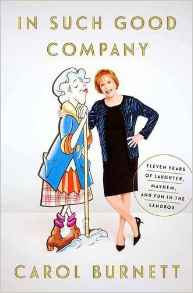
In Such Good Company: Eleven Years of Laughter, Mayhem, and Fun in the Sandbox, by Carol Burnett****

suchgoodcompany  When I saw that Burnett had published a memoir of her years as America’s favorite comedic performer on The Carol Burnett Show, which ran from 1967 through 1978, my first thought was, what, another memoir? She’s already published at least three others, one of which I have read and reviewed. But the fact is, she hadn’t used up all her juice yet. Each of her memoirs focuses on some particular aspect of her life, and so this book is new, it’s original, and it’s probably the stuff you were hoping she’d talk about in her other memoirs. Lucky me, I read it free thanks to Net Galley and Crown Archetype. It was published September 13 and I am sorry to be on the late side, but I scored my own copy just prior to publication; I had no idea it was available till Crown put a promotion up on Facebook and it showed up on my home page.  I genuinely held my breath as I logged onto Net Galley to see if I was too late, and happily, the Literature Fairy smiled on me.

As the memoir begins, I am at first a trifle disappointed, because it appears as if she is just going to list every single person that’s ever appeared on her show and gush about how nice they were.  But she’s just warming up, and it gets more interesting. She describes how she made her way into show business, and though she skims over the early years, knowing that the reader wants to get to the show, it sounds very much as if she was the overnight success that aspiring actors only dream of becoming.  She was on a show that I wasn’t around yet to watch called “The Garry Moore Show”, and she must have made not only a tremendous impression, but also a lot of friends, because she was offered her own variety show—think of it!—and then was able to bring a head writer, a choreographer, a bunch of dancers and some other people west with her from New York to Los Angeles.

This show was a fixture in my childhood and adolescence. One of Burnett’s regular satirical sketches lampooned soap operas, and it was called “As the Stomach Turns”. It was one of the few things that made my parents and me laugh out loud at the same time. My friends and I spent ridiculous, late night hours creating our own satire of a satire, which we dubbed “As the Stomach Churns”, and which featured imaginary illicit relationships among our own teachers along with the administration, janitorial staff, and especially our librarian, a book hoarder that chased away all potential clientele from her sacred gates.  So when I saw that Burnett was writing about the show, I had to see what she’d written, because she had been an intrinsic part of my own development.

All comers that want to read this should do it near an internet source if at all possible, because the comedic sketches can be viewed on television and now also on YouTube. This is fairly new: I tried to view them a couple of years ago and they weren’t there yet, so this is exciting all by itself.

And if you have never seen any of her work and wonder what I am carrying on about, check it:


and with Robin Williams:


The life that she led sounds like something most actors could only dream of. She got up, got her kids off to school, started work on the show mid-morning Monday-Friday, with a single run-through on Thursday followed by a live show before a studio audience Friday, and then they were done at three o’clock and she was done by the time her kids were out of school. It came down to disciplined behavior on the part of the cast and crew, and to the unusually respectful atmosphere in which the show was done. Once a guest misbehaved and when he threatened to storm off the set, she let him go and said good riddance; they did the show without him.  (She won’t give us a name, but he was short. I have been speculating ever since.)


She does tell the many spoofs that were done on movies of the past, and which actors called to say they just loved what the show had done with their film, and which either called up and were angry or sent indirect messages that they were not amused. And she  offers a retrospective look at the way women in show business were expected to behave back then; she was sometimes a doormat, and exultantly recounts how Edie Gourmet, on a guest visit, gave some of it back to those that bullied Carol.


Some of the funniest bits of writing are included, and some of the regular cast’s best onstage moments are recounted, along with those of favorite guest stars. A complete list of every show and which guests were featured is at the back of the book for those that want to look up particular entertainers, or  peruse it for fun.


But the bottom line is that this is pure gold for those that love Burnett and the show, and that can follow along some of the high performance points online. If you aren’t interested in her work, then the memoir won’t mean much to you.


Recommended to Burnett’s many fans.


A Killer’s Guide to Good Works, by Shelley Costa*****

Happy release day to one of my favorite mystery authors! This book is available today, and if you haven’t ordered it yet, now’s the time to do it.

seattlebookmama's avatarSeattle Book Mama

akillersguidetogoodShelley Costa is a writer to remember. Her dazzlingly dark humor and her ability to spin a tight original story that builds irresistibly caught my eye with her first Val Cameron mystery, Practical Sins for Cold Climates. I began checking in with Henery Press regularly when I logged onto Net Galley, and my stalking paid off big time. Thanks go to Henery and also to Net Galley, from whom I received a DRC in exchange for an honest review.

In this second Val Cameron mystery, our protagonist is back in the big city where she belongs. She is looking forward to lunch with her best friend Adrian, who promises to show her something rare and wonderful, but when she reaches Adrian’s office, her friend has been murdered and the artifact is gone. Val’s loss is our gain, as Costa unfurls another outstanding mystery. This title is available to the…

View original post 166 more words

All the Good Parts, by Loretta Nyhan*****

allthegoodpartsThere are times when a novel is more than the sum of its parts, and this is one of those times. Loretta Nyhan combines strong character development, our changing social mores, and sassy, kick-ass word smithery and this is the result. Thank you Net Galley and you too, Lake Union Publishing, for the DRC, which I received free in exchange for this honest review. The title is available today, hot off the presses.

Leona is 39 years old, taking online classes, working part time as a home health aide, and living in her sister and brother-in-law’s basement. She is unchallenged by any real ambition until her doctor—an old school friend—tells her that if she wants to have a baby, she’d better get to it before her eggs are dead. So now Leona—‘Lee’ to her family—is ready to get preggers and pop out a child. Let’s do it!

Leona is the woman I want to grab by the elbow and drag into the kitchen so I can tell her some hard truths. Instead, her sister Carly does it for me. Everything Carly says makes complete sense. She points out to Leona that she is so passive that even the baby idea is not her own; it was her doctor’s. Leona drifts through life letting people tell her what to do, and is that any way to raise a kid?

In addition, since Leona is not dating, she needs a sperm donor. The sperm bank and intro fertilization is crazy-expensive; she really only knows four possible donors. There’s an elderly patient growing accustomed to his status as a double amputee, but although he offers, it would be so unprofessional to take him up on it! There’s an online study-buddy that she hasn’t even met in the flesh; there’s her niece’s tutor, a very bright, handsome homeless man who’s actually even more passive than Leona; and there’s Paul, the son of the patient who dislikes her and fires her.

My, my, my.

This dandy little book is full of interesting philosophical questions and home truths that pop in and out of the narrative and dialogue like fireflies, blinking here and there without slowing anything down or stopping too long in any one place. And in some places, it’s drop-dead funny.  Nyhan uses deft, clever prose to move both the story and the protagonist forward, and in doing so she creates a very visceral, tangible protagonist. I don’t always like Leona, but I do always believe her.

I’ve never liked the category “chick lit”, because women read books featuring men—sometimes men only—and there’s no special category for that, so in the best world, men should want to read this book too. But in the world we have now, this will sell primarily to women. But whoever you are, you should get this book and read it. I have seldom enjoyed a DRC so much; it was my go-to book when I didn’t feel like reading another mystery or delving into George Washington’s past.  I would read something else out of duty, and then turn to this one as my reward. And I was sorry when it ended.

Recommended without reservation to anyone with a pulse.

Pancakes in Paris, by Craig Carlson****

pancakesinparisThe American dream has become harder for ordinary people to attain, but Carlson is living proof that it can happen; yet some of us may need to go somewhere else to find it. In his upbeat, congenial memoir, “the pancake guy” chronicles his journey, from the kid of a wretchedly dysfunctional home—and I don’t use the term lightly—to the owner of Breakfast in America, his own restaurant franchise in France. This title was a bright spot in my reading lineup last month, and it can be a bright spot in yours too. Thank you to Sourcebooks and Net Galley for the DRC, which I received free in exchange for an honest review.

Is this a thing that any kid in America could have done? Not so much. Carlson has a rare blend of  intelligence, organization, and social skills; above and beyond all else, he possesses unstoppable determination, clear focus, and a work ethic that never flags for one tiny minute until he discovers he is close to working himself to death. Those lacking talent and determination may never reach the end of the rainbow as this author has done; that much is clear. But oh, what fun to share the ride with him!

Given his family’s expectations for him, or lack thereof, it’s amazing he finished high school, and his acquisition of a college education is more remarkable still. But it is his junior year at a state college in Connecticut that plants the seed that will sprout and grow into a way of life; he is invited to spend his school year in Paris. Once he’s there, the tumblers click, and he knows that he has found his people.

As Carlson’s story unspools, he debunks stereotypes believed by many Americans, and a few of them are ones I believed too until I read this memoir. Carlson delivers setting in a way much more immediate than any number of Google searches can provide, but it’s his insights regarding French culture, law, and society that make his memoir so captivating. The prose is lean and occasionally hilarious. He plucks choice, juicy vignettes from his journey all along the way, and this makes us feel as if we are riding quietly on his shoulder taking it all in as he goes.

If you’ve never been to France and don’t intend to, you can still enjoy this book. If you don’t like pancakes or any aspect of the traditional American breakfast, it doesn’t matter. Carlson is enormously entertaining, and so his story stands on its own merits. I am furthermore delighted to see that the only recipe that is inserted into his narrative is actually a joke. A small collection of actual recipes is inserted at the end, and although I never, ever, ever do this, I intend to try one of them out tonight! But even if you skip the recipe section entirely, you should read this memoir. It’s too much fun to miss. The best news of all is that it’s available for purchase right now.

Get it, and read it!

A Killer’s Guide to Good Works, by Shelley Costa*****

akillersguidetogoodShelley Costa is a writer to remember. Her dazzlingly dark humor and her ability to spin a tight original story that builds irresistibly caught my eye with her first Val Cameron mystery, Practical Sins for Cold Climates. I began checking in with Henery Press regularly when I logged onto Net Galley, and my stalking paid off big time. Thanks go to Henery and also to Net Galley, from whom I received a DRC in exchange for an honest review.

In this second Val Cameron mystery, our protagonist is back in the big city where she belongs. She is looking forward to lunch with her best friend Adrian, who promises to show her something rare and wonderful, but when she reaches Adrian’s office, her friend has been murdered and the artifact is gone. Val’s loss is our gain, as Costa unfurls another outstanding mystery. This title is available to the public September 20, 2016.

Adrian had been looking forward to having her brother visit, and she had wanted Val to meet him. The brother, a monk on vacation from his usual life in an abbey, is the other primary character in this story. Val had already let Adrian know that she didn’t care for religion, for churches, for clergy…and she was absolutely not, positively not going to meet Adrian’s brother. No, no, and no.

That’s not how it works out.

Costa is a smart writer and she never wastes a word. The humor here is undoubtedly dark for the cozy mystery set, and so the reviews that are written by the cozy folk don’t reflect her writing ability. Those that want a house pet or caterer to solve a mystery will be disappointed every time they read Costa.  To my way of thinking, that’s more a matter of the wrong target audience than a reflection on Costa, who is razor sharp and wickedly hilarious.

Highly recommended.

The Grand Tour, by Adam O’Fallon Price*****

thegrandtourDoctors tell us that laughter improves our health. Now and then, I go in search of laughter in my favorite medium, between the covers of a good book. Thank you to Net Galley and Doubleday Publishers for this DRC. Not only is The Grand Tour achingly funny, it’s also strong fiction. It is available to the public August 9, 2016, and you ought to read it.
Our story centers around two protagonists in equal measure. Richard Lazar is an author who has written one lukewarm release after another, drunken, cynical, and utterly thoughtless of anyone other than himself. He’s lost his family and his health can’t be far behind, a “smoking Yugo of a body” constantly drenched in alcoholic beverages. Suddenly and unexpectedly, his most recent novel has become a blockbuster. A tender, idealistic young man, a fan club of one named Vance, our second protagonist, quits his job at the Pizza Boy, desperate to get away from home and spend time with the writer he idolizes. He becomes Richard’s roadie, dragging him out of one bar after another, conveying him across the western USA to speaking engagements and book-signings.

His Portland book signing takes him to a fictitious bookstore, a thinly disguised version of Powell’s City of Books, one of my favorite places. Richard manages to disgrace himself there, and it won’t be the last time he does so.

The journey through Las Vegas is the most resonant and brilliantly described I have yet seen in literature; each your heart out, Hunter Thompson.

Often literature billed as dark humor turns out to be merely dark, and I was delighted to discover otherwise here. I laughed out loud in a number of places. At the same time, the author does a tidy job of developing both main characters in much greater depth than I had anticipated. Hoping for a romp, albeit a grim one, I wound up holding my sides at the same time I absorbed a fine novel. It is excellent surprises such as this one that keep me reading galleys by new writers. This one is smart and wickedly clever. Of particular satisfaction was the denouement involving Vance’s character.

All told, it’s a savagely funny read. It comes out today, and you should get it and read it.

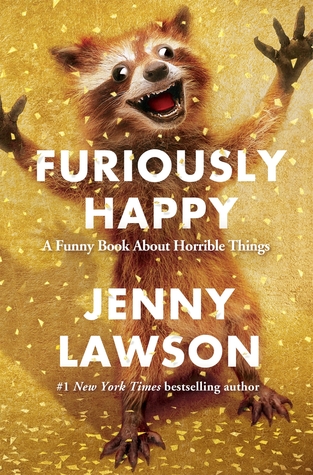
Furiously Happy: A Funny Book About Horrible Things, by Jenny Lawson****

furiouslyhappyJenny Lawson is well known as The Blogess (the blogger that came up with Beyonce, the metal chicken). She won awards for her previous memoir, Let’s Pretend This Never Happened.  The only DRC I saw for this title was for readers in UK and Australia, so I waited till I could scoop it cheaply and bought it digitally. Those that read my reviews often know I almost never do this. For the $3 it cost on an Amazon Prime daily deal, it was worth it to me.

Lawson is one of a handful of authors that talks candidly and often very humorously about her own struggle with mental illness and autoimmune disorders. Her capacity to create imaginary scenarios totally out of left field is her greatest strength, second only to the ability—sometimes—to find a way to laugh at the nest of spiders that occasionally takes over her brain. And sometimes she is painfully candid. Try this one on:


“Sometimes being crazy is a demon. And sometimes the demon is me…And some of us just carry around our tiny demon as he wreaks havoc in our mind, tearing open old dusty trunks of bad memories and leaving the remnants spread everywhere. Wearing the skins of people we’ve hurt. Wearing the skins of people we’ve loved. And sometimes, when it’s worst, wearing our own skins.”


She rants about the well intentioned but ignorant advice she’s received from clueless amateurs. At various times she’s been told to shake it off, to stop eating gluten, and to let Jesus into her heart in order to experience a full and immediate cure.

Sure.

Her musings about flying, which her fame requires her to do a great deal of, though she is afraid both of flying and of leaving home, are brilliant. This reviewer crowed out loud from glee at Lawson’s suggestion that flight attendants be permitted “to whack one person per flight with a piñata stick for being the stupidest damn person on the plane.”

My favorite section is the one in which she details the horrors of remodeling in a way that makes me howl. And goodness knows we all need to do that.

Lawson inserts women’s reproductive anatomy into almost any sort of discussion, and whereas I applaud the feminist spirit that demands the word “vagina” no longer be treated like a dirty word, I confess it was a bit much for me. But then, I am probably older than you are; this may be a generational thing. And there may also be plenty of women from the Boomer generation that think her use of the word is great.

Now and then there’s an odd moment in which I stop reading and stare at the text. What? Did she proof read this, and did her editors? There are occasional remarks that strike me as racially insensitive. She spins a thread about the wild things in the out of doors, and cautions us that since bears don’t play, we should shoot one first and ask questions later. Assuming said bear is in one’s back yard or trying to fit through a window of one’s home, I can see the point, but it came out of left field and made me wonder. Really? Just shoot bears? And the thread further spins itself into a bison-and-Native-Americans discussion in which she assures us that it’s not great to have bison in one’s yard, but it would be awesome to keep a lot of Native Americans out there. My e-reader says, “?!?”

But then she drops and is off onto another stream-of-consciousness spiel before I can fully digest what’s been said. She does it a couple of other times also. And it occurs to me that she has perhaps the ultimate excuse, having said up front that she has known for most of her life that she is “not right” in the head, but I still wonder that her editors didn’t look at that and say, “Umm…Jenny? This part right here…?” There are no overt racial slams or this review would have a lot of empty stars, but there are small moments where I wonder if she understands how others may read what she’s said.

Many of her entries if not all of them are drawn from her blog, and it’s possible that if you’ve read her blog faithfully, you won’t want to pay for this book. As for me, I found it worth the three bucks to be able to get everything at once in a well organized format—known as a book—that I could read comfortably. I confess I would not have paid full jacket price for it now that I get most books free and also have less money to spend on them than when I was working, but for others it may well be worth it.

On the whole, this is a courageous and often eloquent, fall-down-funny memoir, and with the small reservations mentioned above, I recommend it to you.

Salvation Lake, by G.M. Ford*****

salvationlakeFord is the rightful heir to the late great Donald Westlake, a writer of monstrously amusing mysteries full of quirky sidekicks and kick-ass, zesty dialogue. There’s nobody like him in Seattle or anywhere else. I gobbled up the DRC when it became available via Net Galley and publishers Thomas and Mercer,  so I read this free in exchange for an honest review. But I’ll tell you a secret: if I’d had to, I’d have paid for this one had it been necessary. And so should you. It’s for sale today, and you can get it digitally at a bargain rate.

But back to our story.  We open at a bar called the Eastlake Zoo. The band of misfits to which detective Leo Waterman is tied through bonds of family history and quixotic affection are rocking the house in “well-lubricated amiability”. In fact, there’s a story being told right as we begin, and if it doesn’t hook you, check your pulse, because you’re probably dead. Here:

“Red Lopez was a spitter. When Red told a story, it was best to get yourself alee of

something waterproof, lest you end up looking like you’d been run through the

Elephant Car Wash.

‘So we was comin’ down Yesler,’ Red gushed. “Me and George and Ralphie.’

Everyone had found cover, except the guy they called Frenchie, who was so tanked

he  probably  thought it was raining inside the Eastlake Zoo…”


Right?

As it happens, Waterman, who’s inherited his old man’s ill-gotten wealth, has been lying low and enjoying the good life, but now his late father’s hideously distinctive overcoat has been found on a corpse, and  Timothy Eagen of the Seattle Police Department want to talk to Leo. Now.  There’s bad blood between them:

“…he hated my big ass the way Ahab hated that whale…Eagen was a skinny little turd with a salt-and-pepper comb-over pasted across his pate like a sleeping hamster.”

Since SPD has been under the eye of the Feds lately, Eagen can’t give full rein to his attack-Chihuahua impulses. SPD needs to provide “the kind [of law enforcement] that doesn’t look like Ferguson, Missouri or Staten Island, New York.” So Waterman doesn’t get shaken down or tossed into a cell, but his curiosity is piqued, and since he has no paying job and time on his hands, he finds himself checking into a few things. One thing leads to another.

What relationship does the victim, known as the Preacher, have to Mount Zion Industries, whose pamphlet is found among his effects? Before we know it, Leo is off and running, checking out Salvation Lake, located at the end of Redemption Road. Events tumble one upon the next, and I found that instead of reading in my bed that evening, as is my usual bedtime custom, I was reading on it, bolt upright and clicking the kindle to go a little faster please.

Waterman may have come into money midway through life, but his perspective is a working class perspective. His take on the city’s thousands of homeless denizens and the relationship that cops have to those in need strike a sure clear note that must surely resonate with anyone that’s been paying any attention at all.

Meanwhile, Salvation Lake is written with warp speed pacing, sharp insight, authority, and the kind of wit that can only come from a writer that has tremendous heart.

Don’t miss it. Get it now.