
 I was ready for something that was a little different, and then an online friend recommended this historical fiction for review. Thanks go to Net Galley and Atria Books for the DRC. It’s for sale today.
The story stems from the Bucharest Pogrom of 1941, in which hundreds of thousands of Jews were killed. And to show you how much I knew about this particular event before I read this book—my ignorance was so painful—I called to my spouse and said, “Honey? Isn’t Bucharest in Hungary?”
The world-traveled, multilingual expatriate responded, “That’s Budapest. Bucharest is in Romania.”
Ahem. So this corner of my historical education was severely in need of help, and this was a good start for me. If I were to rate this story solely on its merit as a novel, I’d call it 3.5 because of some unevenness in the quality of writing, but the educational aspect of it is undeniable, and it makes a big difference.
The story centers on Natalia, a child that is abandoned during the pogrom when her parents flee from what they believe may be their death; they expect to be caught and killed. She is much loved, but her father persuades her mother that the only way the girl will make it out alive is if they leave her in the lobby of their apartment building with a note. She is adopted by a very wealthy couple that lavishes her with every possible comfort, until the regime falls and Romania comes inside of the Soviet orbit. After the coup, the conspicuously wealthy become government targets, and their assets—down to literally the clothes on their backs in some cases—are nationalized. Over the course of time, Natalia learns of her adoption and the parents to whom she was born.
The story uses the author’s family history as a framework, and notes at the end explain what aspects are autobiographical in nature, and which have been altered for the sake of the story. There are family photos at the back of the book.
The voice is distinctly Eastern European, and that works in the author’s favor because it transports the reader to this time and place all the more effectively than a purely American-sounding voice would do. However, there are occasional lapses where clichés drop in, and it spoils the magic for awhile. The worst, perhaps, is “The walls have ears.”
The first forty percent of the novel is the most engaging, and I love the development of parents Despina and Anton, and little Natalia. The last half of the novel, however, is too busy and at times seems overwrought.
And then we are back to what I said at the outset: there is so much to learn here. Historical detail is inextricably woven into the story, and our attachment to the characters, particularly at the start, makes the facts themselves more memorable. So when it comes down to it, I do recommend this book to you. If you can find a better work of historical fiction featuring the Bucharest Pogrom, then I may change my mind, but right now I would say Veletzos has cornered that market for those of us that read in the English language.
This book is one of a kind. Don’t miss it.
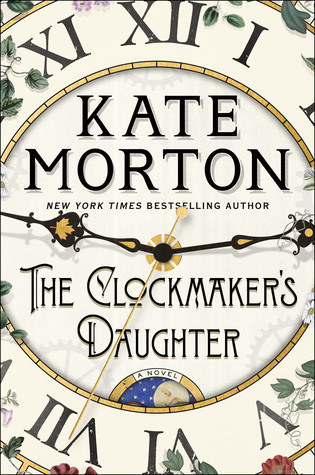 Kate Morton is queen of the British historical mystery, and so I leapt at the chance to read and review The Clockmaker’s Daughter. My thanks go to Net Galley and Atria Books. This book will be available October 9, 2018.
 Thanks go to Net Galley and Simon and Schuster for the DRC, which I received free in exchange for this honest review.
 I received this book free from Net Galley and University of Wisconsin Press in exchange for this honest review. It will be available for purchase on September 18, 2018.
 Kya Clark lives with her family in a shack deep in a North Carolina marsh. The year is 1969. They are miserably poor, but Kya’s mother tells her it will be alright, as long as the women of the family stick together. But then one day, she leaves. Older brother Jodie tells Kya that Ma will be back, because it isn’t in a mother to leave her children, but Kya isn’t so sure. Ma is wearing her alligator heels, and she doesn’t turn midway and wave like she always has. And one by one, everyone in her family leaves, and they don’t return. Kya is not even old enough to enter first grade, and she is alone.
 I received this excellent Civil War tome from one of my sons as a Christmas gift. I don’t request a lot of books anymore because it’s so easy to get others free, but I asked for this one and I am glad I have it. I’ll be reading more by this guy. Despite one fact that I dispute—for which the citation also is sketchy—and some crummy maps, there’s no way to deny five stars here. The topic is among my favorites, and of course Sherman is my all time favorite general, hailing from a time when the United States government still attracted and produced heroes.
 I received a review copy of this book from Net Galley and Three Hills Publishing, which is affiliated with Cornell University, free of charge. This book is now for sale.
 Ed Scott Junior was one of the first Black catfish growers in the USA, a “Delta titan,” and he was the very first to own a catfish processing plant. My thanks go to Net Galley and the University of Georgia Press for the review copy. It’s inspirational, well written, and well sourced. The book will be available to the public tomorrow, July 10, 2018.
 Nelson Mandela’s hundredth birthday approaches. His grandson Ndaba, whom Mandela raised following his release from prison, talks about growing up with the titan that led the movement against Apartheid in South Africa. He reflects on Xhosa culture and the role that it played in the struggle and in his own development, and it is within this framework that he talks about his grandfather, and about the future of his people.
 This one is a crushing disappointment. I seldom buy books anymore, but I was so pumped about this collection that I went all out and got a hard copy, expecting to love it enough to keep it in my home library forever. Sadly, this isn’t what I expected.
