Six Million Accusers: Catching Adolph Eichmann, by D. Lawrence-Young *****

sixmillionaccusersPlease lower the safety bar in front of you, and make certain your belt is securely fastened. We will be traveling at an astonishing rate of speed; keep your hands firmly on your book or digital reader. As you finish Six Million Accusers: Catching Adolph Eichmann, you may be disoriented and need to remind yourself where you are and what day it is. It’s that gripping.

My deep gratitude goes to Mr. Lawrence-Young, his publishers, and NetGalley for letting me read and review this amazing novel.

David Lawrence-Young packs a powerful story into a well plotted, brilliantly paced narrative in order to tell the story of the capture of Adolph Eichmann, one of the nastiest and most powerful Nazis responsible for the deaths of six million Jews in eight nations, not to mention millions more who were Gypsies, political opponents, disabled, gay, or who were mistaken for somebody else. And of course, these numbers don’t include those who died in the battlefields, seas and skies of the European theater of World War II. Only Hitler and Himmler were above Eichmann in the fascist pecking order.

Because story is such a potent vehicle for the truth, the author has chosen historical fiction over a more expository nonfiction format. I think he chose well. He has a long list of previously published books that precede this one, from Shakespeare to an English textbook to other works of historical fiction, but he says this one was the most difficult, and I believe it. As is true of the finest writers of this genre, he has a bibliography at tne end of his work to let us know that the story is absolutely true; he has filled in the cracks by inventing the dialogue instead of paraphrasing as he would have to do with a work of nonfiction, but this is the real deal nevertheless. This is what happened.

Once this was made plain (I always read the introduction, and I also read the author page before I begin), I dug myself into my favorite reading corner and prepared to concentrate, convinced that while compelling, the historical journey would require full focus and strong literacy skills. I was surprised to find that he wrote in a manner that will be accessible to just about anyone who wants to read it, and the need to focus is moot, because from the get-go, he has our eyes and full attention automatically. The pace builds in a glorious arc, reaching breakneck speed as we close in on Eichmann along with the team of spies and undercover representatives of Israel’s government.

The questions that arose in my mind were answered. Given that these agents slip into Argentina with the assumption that they will need to act outside that nation’s unfriendly rules of law, and are essentially going to kidnap Eichmann, I wondered why the fuss. If they were willing to go that far (not that they shouldn’t), why not just sail in under a black flag and cap him behind the ear? Why all the fuss and bother to smuggle him back to Israel to be tried?

And it became clear. Many other SS officers were dealt with in the manner I had been thinking of, but this man was so utterly symbolic of the Holocaust that the world had to see him tried, and Israel and her people had to lay out the facts, document them irrefutably, and wisely so, because half a century later would come the Holocaust deniers who would want to pretend the whole thing was a hoax, sham, or exaggeration, and the Nuremberg Trials make it much harder for anyone to do so.

A thing that gave me great pleasure was reading about the agents, including our nominally fictitious protagonist, Haim, who DID get out of Germany or other parts of Europe in time to avoid arrest, torture, and maybe death.

I was surprised, and surprised to be surprised, about the news that Israel had had to fight for its independence. As a history teacher, how is it that I did not know this? I think it’s simple. It was too recent to be in the curriculum, but since I had barely been born when it took place, I was too young to remember. And independence from Britain was important. On the surface, it looks as if they bit the hand that fed them; hey, they put up a Jewish homeland to help people escape Hitler, and now you’re going to shoot at them?

But it turns out this was very necessary. Part of Britain’s game plan was to limit how many could come out. They were more generous in their immigration policy than the USA, but that’s not saying much. Israel needed independence in order to have a nation where all Jews could safely exist. (I won’t even go into the Palestinian question which is worth many other books, a huge issue unto itself.)

Like a lot of academics, I have many Jewish friends, and though all are too young to have experienced the horror first hand, they have family stories, even legends. (“My grandmother personally rescued one of the last remaining Torahs from a burning synagogue”, a colleague told me.)

But even if I had not had their friendship, simple justice would have permitted me to sigh with satisfaction, once when Eichmann was in custody, and again when he was convicted.

Don’t just read this book; keep it. Share it with your children. The world must never, ever permit such a thing to happen again. It is by educating the next generation, and they the one after them, that we keep the neo-Nazis firmly on the fringes, which is the best place for them to enjoy the First Amendment rights they would gladly grind beneath their hobnailed boots for the rest of us if permitted to do so.
I Been in Sorrow’s Kitchen and Licked Out All the Pots, by Susan Straight *****

IBeeninsorrow'skitchenWho knew that there is a completely separate people living on the Sea Islands off the coast of South Carolina? They are descendants of escaped slaves, and the language they speak, known as “Gullah” or “Geechee”, is a dialect similar to Creole English, but it also uses sentence structure that is borrowed from African languages and what Wikipedia calls African “loan words”. I was introduced to this culture by this wonderful novel, written by the talented Susan Straight. It was written some time ago, but remains a personal favorite; your best bet is to order it used.

The story’s protagonist is Marietta, who grows up in this isolated environment in the 1950’s, She’s written several good novels, but this one may be the most memorable so far. Her protagonist lives in an almost unreachable island off the Carolina coasts. Deep back in a nearly impenetrable area that is technologically about 100 years behind, a flushing toilet and an electrical outlet are unseen. Yet tourists somehow get there (god, aren’t they everywhere?) and so she and her family eke out a living by cutting the reeds that grow in the swamps and weaving them into intricate baskets.

She learns early that if a girl (teenage life is unknown in this culture) is six feet tall and very dark, the pale tourists will be frightened and they’ll leave. This gave me pause. I’m not generally into the whole ‘white guilt’ thing; I prefer action to introspection. But I did wonder: if a very dark woman who was seated near me suddenly stood up and she was six feet tall (to my just over five feet), would I take a step back? I don’t think I would now, but there was a time when I would have. The startled reaction comes from isolation and unfamiliarity. I grew up in a very Caucasian neighborhood; there were hundreds of students in my graduating class, and except for the foreign exchange students, there was only one African-American student. The first thing I did, upon gaining independence, was to move straight to the inner city. Isolation wasn’t for me.

But let’s get back to Marietta. When her mother dies, she is forced to move to the mainland, and experiences culture shock. She has to learn to speak standard English; everything is extremely different. Seeing the world through Marietta’s eyes made me view things very differently. What comes of it is a really off-beat civil rights lesson.

How many white authors have the nerve to write as if they can see into the very soul of an African-American protagonist? I only know of one, and I think she carries it off really well. It’s a gutsy thing to do. There’s good reason for it: Straight grew up as virtually the only Caucasian in a Black neighborhood in Riverside, California. Culturally, she considers herself Black.

If this sounds interesting to you, give it a try. See what you think, and let me know. I hope to add a discussion page to this site, which is nearing its one-week anniversary. What could be a better topic for conversation than a really good book?

I

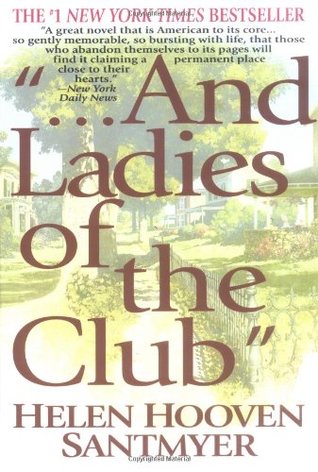
And Ladies of the Club, by Helen Hooven Santmeyer *****

andLadiesoftheclubThis tome was touted, at the time of its first publication, as the book written by “a little old lady in a nursing home”. May we be forever ashamed to pigeon-hole the elderly in such a manner again. What they MIGHT have said, is that this woman was a college dean of students and a professor of English. She was too busy to finish her book until her retirement. How lovely it was that she lived long enough to see it published!

In sumptuousness and richness, it is like Gone With the Wind without the racism. Most wonderfully of all, it is written in the manner in which time seems to go by, as we follow the life of a woman graduating from a women’s college in the late 1800’s. When she is young, a single year takes up many chapters, but when she is very elderly, one chapter spans years and years. As we age, time goes by so quickly.

Her use of the language is so brilliant that I now count hers as one of my favorite novels. It is thicker than some dictionaries, but infinitely more absorbing, and so I read it twice, once when I was a young mother with my first tiny babes at home; we were poor enough that I saved box tops and waited for double coupon day to buy groceries, but the Book of the Month Club was our one luxury, and they sent this. I read it again later when I was teaching. I gave my mother a copy for Christmas one year, and she loved it too.

I just may go back and read it again..
If you have grown up in the era of instant gratification and sound bites, this is not your book. This is a book to curl up with on a chilly afternoon and let the world fade away. Patience and a fairly high vocabulary level and awareness of the past will help, but give it a try if you aren’t sure. It will be worth it.

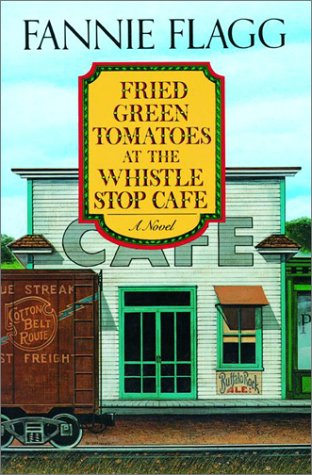
Fried Green Tomatoes at the Whistle Stop Cafe, by Fannie Flagg *****

friedgreentomatoesIf I had to whittle several decades of reading down to thirty favorite books, this one would make the cut. It is wonderful on so many levels. Flagg has published a number of glorious, whimsical yet not shallow novels, always set in the deep South. This one is the jewel in her literary crown.

Have you seen the movie? If you have, this book may be easier for you to read. I read it, and absolutely (as you can see) loved it. The issue for other readers I’ve talked to is that the book hops back and forth in terms of setting, including time period, and it doesn’t provide an obvious heads-up that this is what is happening.

There are two stories being told, one that of a contemporary woman who is unhappy with her life, menopausal and fearful that she is losing her husband’s attention, bored and feeling worthless. She is spending part of her weekend at a nursing home where her husband’s wife resides, but the woman hates her and won’t let her in the room. It is in the lobby where she is faithfully stationed, downing the candy stash from her purse for comfort, that she meets one of the home’s residents, who tells her pieces of her life story, a little more each visit. But in the book, we are taken back in time in other ways. Suddenly we are reading a small town newspaper, and if you are a person who skips chapter headings, you’re likely to find yourself entirely confused.

I won’t give away more of the plot, but for the time in which it was written, this novel bravely took up one progressive (IMHO) cause about which not much was being written. It’s very subtle. Other parts of the story will leave you laughing so hard that you either can’t catch your breath, or if you are old enough, you may not hang onto…something else.

Highly recommended.

One of Ours, by Willa Cather *****

OneofoursI always seem to love Willa Cather’s writing. Just imagining the country as it was a hundred years ago or more is time-travel of the imagination, and Cather can help a person get started, with her meticulous research and careful, thought-provoking shaping of the protagonist and other characters as well. I feel that the cover description provided on this site is a spoiler, since it takes the reader at least halfway through the book; if you haven’t read it yet and like strong historical fiction, save the goodies as a surprise.

I don’t have any publishers to thank here. I bought this novel on my annual pilgrimage to Powell’s City of Books in Portland, Oregon, where I grew up. Once I’d read the first chapter, I wondered why I hadn’t read it before. It’s not as if I’ve ever been too busy for books.

Claude is a wonderful protagonist; he is flawed, and I find myself wanting to go up to him, as if he were before me, and tell him he needs to stand up for himself. And I want to yell, “Don’t DO it! Don’t marry her!” But he is at Cather’s mercy, and she shows us what love and beauty look like, but poor Claude also sees some real heartbreak. As a mother of grown sons, I identified somewhat with his mother, even though she is not a main character.

Tipperary, by Frank Delaney *****

Aside

review “The most eloquent man in the world”? It’s entirely possible.

This hyper-literate narrative inside a narrative inside a narrative unfolds as a simple tale at first, then becomes more complex as this deft tale-spinner pulls the scope out one notch at a time.

In addition, we are provided with a passionate re-telling of the atrocities visited on the Irish by the Anglo and Irish-Anglo ruling class. Delaney puts such genuine feeling into the narrative of the republican movement as it progressed in the early 20th century that I am surprised the writer doesn’t find himself on the do-not-fly list. His honesty and appreciation of the struggle is refreshing, at times surprisingly witty, and disarming.

At the story’s beginning, I really do not care much for Charles O’Brien and his stalker-like behavior toward April Burke. No means no. What’s WITH this guy?

But then later, the narrator (who is a character within the story) says more or less the same thing, and in due time, I find myself warming toward this awkward but well-meaning fellow. And as the narrator’s camera zooms out and encompasses so much more, I read more closely.

Occasionally I made the error of trying to read it AFTER I took the sleeping pills, and found I had to go back the next time and reread. It is not a story for the short attention span or one who wishes to multitask; it is absorbing, and requires one’s entire focus. But I found it rewarding enough to devote the necessary time and attention, and even found myself doing web-crawls to see how much of one or another historical detail was true, and how much was fictional or unknown.

In the end, my book was jammed full of sticky notes, and I felt as if I had traveled over oceans and centuries. An eloquent story, indeed!

All Quiet on the Western Front, by Erich Maria Marque *****

This has been labeled the best anti-war novel ever written. I agree. We see the first world war (“The Big One”) through the eyes of a young German soldier.

Some have held “Johnny Got His Gun” to be the best anti-war novel; I disagree, because that novel holds out no hope. When all is lost at the beginning and never gets better, it fails to draw the reader’s emotion. Marque is singularly skilled at reaching right down into the reader’s chest and wrapping his scholarly fingers right around our heartstrings. (Don’t look for this term in a physiology text.)

AQWF, on the other hand, develops character and setting sufficient to take us there, to nearly climb inside the skin of someone going through the experience.

Is there such a thing as a war worth fighting and dying in? I think so…but very rarely so, and this novel helps us understand the need for restraint and caution.

Note to teachers: though this is outstanding literature and many students enjoy it, it requires a very strong reader in terms of ability and vocabulary.

Billy Bathgate, by EL Doctorow *****

I have to admit, E.L. Doctorow is one of those writers whose work is a sure fire hit for me. I love historical fiction, and I admire great word-smithery. Doctorow is skilled with both.

This one is a period piece, a look at a hard time and the ugly risks that some folks took from desperation and perhaps a misplaced idea of what greatness might look like. To be sure, the government wasn’t exactly setting a good example; those who searched for less-than-conventional means were, in my view, right to reject the American Dream as a lot of smoke and mist. But organized crime is another form of corruption. Doctorow shows that pretty well too.

All told, it isn’t the moral I seek in a book like this, so much as a good story. Doctorow is a master storyteller, and the reader will always get his or her money’s worth.

I buy a lot of books used, but for this man, I pay full cover price and am glad it’s available. A treasure.

Cloudsplitter, by Russell Banks *****

 cloudsplitterThis book is a novel based on what truth is available. The story centers on Owen Brown, the youngest and last living son of John Brown. What I was looking for, of course, was information about John Brown himself. However, because he understood the need for secrecy in his movements, considered himself (and usually really was) a hunted man, he did not leave copious journals. In fact, writing was not one of his talents. What he did care about were the 3 million men, women and children shackled to the plantation system, sometimes literally. He was the only white man recorded in history to have been friends (real friends) with Black people, who understandably were deeply suspicious.

Telling it all through Owen’s eyes is a strong device. Banks is a really good writer, and I think this is my favorite among his published works.

The question that hangs in the air for historians interested in this time period, and in Brown in particular, has always been whether he was sane or a madman (and as a history teacher, I have to say that at least one text mentions him only briefly, and comes down strongly on the side of his being a crazy man).

There is one undeniable fact, whichever side one takes: he was the first white man to kill and die for Black men. At that time, and for a long time after, his name carried great respect among Black men and women in the U.S. I am inclined to agree with them.

In these modern times, we know that it is possible to be mentally ill, and yet not be unable to function. I’m willing to bet that most families, if you trace the lines hard and long enough, will have at least one such person. And reading this novel convinced me that this was the case with John Brown.

Owen’s life was not an attractive one. At times, it appeared that their father had deserted the family; he would go away on one religious/political (for Brown, they were inseparable) mission or another, and not come back for years. There were times that the children of the family nearly starved to death, and their lives were not only desperately poor, but beset by constant danger. The stress alone might be enough to unhinge almost anyone.

I think I should leave the story as Banks tells it to the reader. His prose is brilliant and compelling. This is a very long book, but I finished it pretty quickly, because I couldn’t leave this family in danger until I had seen the very end. Banks brings characters alive in a way few writers do. I was a member of the Brown family until the book was over; their struggle became mine, and each poor decision made me flinch and my stomach felt leaden. Doom!

It also left me with the question we can never answer: what if Brown had waited another (roughly) ten years to lead the revolt? Might he have met with greater success?

If you like seeing characters developed well and also like historical fiction when it is done well, this book is terrific. (It is also very large, and heavy. If you have a nook or Kindle and it is available, consider reading it that way).

A Blaze of Glory, by Jeff Shaara *****

ablazeofgloryI am a longstanding fan of Jeff Shaara’s. I see occasional criticism of his work that sometimes approaches hysteria, and frankly, I don’t get it. Like his Pulitzer-winning father before him, Shaara uses a combination of extensive knowledge of the war; a fertile imagination; and considerable writing skill to turn America’s most pivotal war into stories. Story, in turn, is a tremendously effective vehicle for teaching about history.

At this point, I should mention that I got my copy courtesy of the Goodreads First Reads program; my thanks go to the publisher. This copy will hold a place of pride in my personal library, alongside the other books of Shaara’s that were given me as gifts or purchased outright for full jacket price. Is it worth full price? I say yes, with this qualification. It’s worth it if you have a serious interest in the American Civil War, and if you are open to reading historical fiction. It’s so named because any time one takes the known facts and adds dialogue, or inner dialogue, presuming to know the thoughts of historical characters, then of course part of it is made up. If you can’t live with that, either stick to nonfiction or go away.

Interest in the Civil War is key here because nobody can turn the battle of Shiloh into a fun read. It isn’t a fun subject. It was tragic. So if you want a fluffy beach read, this book isn’t that.

I was somewhat surprised to note that my own Goodreads shelves had listed this book as read by me, and the rating as 4 stars. I think it may have been an error, because I usually write a review, even if the book wasn’t free to me. However, another possibility exists: if I read it on the e-reader I owned when this book was first published in 2012, a reader now moribund so I can’t go in and check, it might have negatively influenced my perspective. Don’t read this book on your e-reader! You need to be able to see the maps, which are pivotal to understanding the action as Shaara describes it. If you didn’t need it, the author and publishers would not have devoted the space to it. I flipped back a few times to give those maps a second and third glance as I was reading. I do love my (new) e-reader and I use it a lot, but when possible, I read military history and historical fiction on paper. It’s more effective.

When I taught American history, I always kept some of Shaara’s other work on my classroom shelves. Fiction is often more accessible to students who have come to believe that history is a meaningless list of names, places, and dates. When story is used, the reader comes to understand that what took place involved real human beings and sometimes, they even recognize that their lives today might be different from what they are if things had unfolded differently back then. And had I not read Michael Shaara’s The Killer Angels, I might not have decided to read The Battle Cry of Freedom, the Pulitzer winning nonfiction tome by McPherson. I found this was also true of my students, that fiction was often a necessary conduit that made them more willing to read nonfiction on the same topic. And once that bridge is crossed, it doesn’t matter that there was no actual soldier named Bauer who did the things Jeff Shaara’s foot soldier did.

This brings me to the last thing I want to say about this well researched, carefully crafted book. Is a writer of strong historical fiction bound to include only real players in the story he reels out before us? Of course not. It’s fiction; he can write anything he wants to.

Well then, if he invents a character and gives him as much breath and life as the others, who were real, is his writing unworthy of our time and attention? I stand by the writer in this case. There were so many fresh-faced young soldiers out there who won no permanent place in our nation’s history. The working class, the lowest on the totem pole, are often disenfranchised by the fact that their history goes unwritten. For Shaara to create a single character to show that these men are not forgotten is gutsy and laudable. While leadership was critical to winning the war, it’s very important not to forget all those unknown boys and men who marched, slept in the rain and the mud, and sometimes died of dysentery before the next day’s march began. Others can say what they wish, but I really appreciate what Shaara has done in helping us remember the common soldier.

The more good historical fiction I read, the more I am inspired to read more of McPherson, Sears, and Catton. The Shaaras inspired me to read the memoirs of Grant and Sherman; I have a biography of Stonewall Jackson as my next-in-line galley. But the more I read of these masters of nonfiction, the more credible Shaara’s work looks to me.

Again, is this worth your bookstore dollars, or is it something only to be read free or cheap? If you have a strong interest in both historical fiction and the battle of Shiloh, there’s nothing better. Buy the book and read it; if you have to pay the full cover price, do it. It’s a worthwhile investment, and maybe some young person in your life will be inspired to borrow it. What could be more important?