Home from the Hill, by William Humphrey *****

homefromthehillHome from the Hill, a National Book Award finalist about to be re-released, is the kind of story that lingers and affects the reader’s mood long after it is over. Upon completing the DRC, I felt a sense of loss that only comes with really splendid literature. So thank you Open Road Integrated Media, and thank you Net Galley for hooking me up. And if the spirit of the late, great author lingers among us, I want to thank him for tearing out my heart and feeding it to me with a spoon. It’s that good.

We know from the get-go that this one won’t end well. We think we are prepared for it. The people that live in that sleepy little Depression-era Texas town are a closed-mouthed lot, but the narrator is telling us things that the stranger in their midst doesn’t know. We know it’s a tragic tale because of this, but later we get so caught up in the magic being spun that we forget ourselves, and we cannot help hoping.

Boomer-gens like this reviewer may find colloquialisms and slang terms they had long forgotten; my own family, some of whom harkened from that neck of the woods, used them liberally some fifty years ago. Between this and the skillful use of setting and character, I felt as if I were sitting in the Captain’s den (though women are really not allowed there) listening to Chauncey spin his hunting stories, ones borne of longstanding oral tradition. I almost fell off the bed when I saw the word “larruping”. I had thought it was an onomatopoeia until I read it. I had forgotten the term entirely, but Humphrey brought it back, and I could hear it in my father’s voice, though he has been dead most of my life.

Ahem. The story. All right, let’s try this: what if Shakespeare had written Romeo and Juliet, but instead of his characters fantasizing and vowing not be Capulet or Montague, they had said, “Well of course, I am a Capulet, and you are a Montague, but we’ll give it time. They’ll come around.” But oh my my my, they would have been so very wrong. Nobody is going to do anything of the sort.

In a sense, Humphrey almost makes Shakespeare seem shallow, because the foundation of his tragic love story is this: we may love someone our families may not prefer, yet we are still what we came from. Even as we strive to be better people, different people than those who bore us and those that came before them, a piece of them remains at the core of what we are.

So although Theron wants to be someone better than his mother and certainly better than his father, it’s just not that simple. He is an independent, whole new person, with his own ideas, dreams, and resolutions…and he is still his father’s son. And he is still Hannah’s lad.

Libby loves her parents dearly, and when things go wrong, it is them she turns to. But of course, there is Theron. She loves him, and nobody else will really do. Surely, in a world made of fine people with the best of intentions, there ought to be a way?

Not so much.

I’ve read a few sad-sack reviews written by former literature students who have whined that they were required to read this in college. I want to smack those people upside the head and tell them to be grateful, and maybe go back and read it again.

All I know for sure is that it not only immersed me in another time and another place…it also reminded me of who I am.

The 19th Wife, by David Ebershoff ****

19thwifeEbershoff is a strong story teller. In The 19th Wife, he weaves the stories of polygamy in and out of one another, often to hilarious result, and at other times thought provoking.

Ann Eliza Young was the 19th wife, at least according to some accounts, of Brigham Young, famous pioneer leader of The Church of Jesus Christ Latter Day Saints, referred to by members as LDS, and to most others as Mormons. Ann Eliza was a rebel, and she left Young, refusing to be stuck in a polygamous marriage. Ebershoff has used this real-life bit of history to create a fictional journal for her and other historical figures that played a role in her life, some of whom were real, and others who weren’t.

The formal prose that he uses in spinning her first person narrative, and that of others in her story, creates a startling juxtaposition with his present-day characters, chief among them Jordan Scott, one of the so-called lost boys who have been booted out of a current day polygamous sect in order to scale down the competition for young, nubile brides so that the old farts can have a greater supply of women. But the geezers didn’t really have to worry about Jordan taking their ladies, since he is gay. So honey, go from the formal speech of religious people in the 19th century, to that of a gay Californian in the year Y2K, and well there you go. The leaps that Habershoff depicts between their speech mannerisms almost have to make you laugh out loud.

I accidentally read this book twice, once around the time it came out, and then, having forgotten I’d already read it and given it away, I got another copy from the library and was almost done by the time deja vu struck.

Both times I read it (oh yes, I remember now) the story and dialogue were drop-dead funny at first, but by the end I just wanted to be done. Since I have a greater than average attention span and am generally fine with a really long book, I took a day to think about why the joy went out of this juicy novel toward the end.

There are two reasons, I think (though it is still a really good tale) that it loses steam. One is that Ebershoff goes from building situations for their hilarity, to trying to solve his character’s problems in a way that makes sense. My own opinion is that if he was starting with chaos–and the set-up is that Jordan’s mother has been framed for murdering his father, and he sets out to Utah in order to rescue her–then he should have stuck with chaos. It’s all outrageous in the beginning, but toward the end we seem to be veering toward a reasonable ending, at least in many ways, and a moral to the story that isn’t needed and is almost out of place.

The other reason is that the toxic waste that is polygamy isn’t something I want to steep in for very long. It’s a little like a trashy tabloid that momentarily excites our curiosity but leaves us feeling a little soiled if we flip through it for too long. For me, then, had this been wrapped up more quickly, the pacing would not have been lost and I could have emerged laughing as hard at the end as I was at the get-go.

All told: a fun romp that could have been even better.

A Slant of Light, by Jeffrey Lent *****

aslantoflightSome great novels are painterly, and we sink into them like a warm bath, lost in a wholly different time and place. Others are hair-on-fire page-turners that leave us unable to do one single thing until the book is done. Lent has managed to combine both kinds into one brilliant work, creating tangible characters and a setting that is nearly palpable as well. My thanks to Bloomsbury Publishers and Net Galley for the DRC. The book will be released in early April 2015. The novel opens with a scene of horrible violence; think of The Shawshank Redemption, or of Deliverance. Then we walk the string back to see whence it all came, and we see it from a variety of perspectives. Only then can we move forward to the conclusion. Malcolm Hopeton has fought in the American Civil War, and refused to buy his way out of his duty to the Union; when he was wounded in action, he could have gone home, but chose to stay and stamp out the Confederate threat instead. Had he known what was happening at home, he’d have chosen differently. Witness to the violence at Hopeton’s farm and all that preceded it is Harlan Davis. Harlan has been there since the death of his parents, first as orphan helping out to earn his keep, and then later as hired man. In fact, once the other players are dead or in jail, Harlan is the only one who has seen absolutely everything…and he isn’t talking. August Swartout, the widowed farmer who has hired Harlan’s sister as a housekeeper since the death of his wife, sees it as his Christian duty to bring Harlan back to his place after the dust has settled. He tries to do the right thing, but life is complex, and sometimes that choice can be fraught with little traps and riddles. Ultimately, A Slant of Light is about integrity, honesty, and loyalty. Ask Harlan. He knows. He may not say much, though. I was interested to learn that “The Friend” refers not to Quakers, but to a religious offshoot that took root during this time period. It’s an interesting historical tidbit, along with a great many other details that appear to drop into the story as naturally as can be, yet had to require meticulous research before it could be written. I have written over 700 reviews between one place and another, and this is the first time I have ever said that a book would be a good choice for a book club. I kept finding myself with questions and no one to discuss them with. It’s a fascinating story, and the ambiguity within makes it all the more so. Get it in hard cover, paperback, digitally; get it in a brick and mortar bookstore, order it online, or seek it out at a library; but if you like strong historical fiction, you have to read this book. Tautly worded, yet lushly descriptive; brilliant.

At the Water’s Edge, by Sara Gruen *****

bythewatersedgeBy the author of Water for Elephants comes a gripping tale of cowardice,deception, love, and heroism. My great thanks go to Net Galley and Random House for the DRC. It was a quick read and a great deal of fun.

The setting: World War II, primarily on a remote Scottish island. The story: three spoiled, wealthy, entitled brats misbehave publicly and are sent away by their chagrined parents. Since their allowance has been cut and they have to get gone anyway, they decide it might be just the thing to track down the Loch Ness Monster; not only will it be heaps of fun, but Father will be so pleased. He always wanted proof it existed! And what war? When one is wealthy enough, one cannot possibly be in danger! Just haul out the cash and start bribing others. Nothing to it, really!

Now we’re cooking. We’re on a remote Scottish island after endless seasickness aboard a ship that is constantly fired upon by u-boats. We have a crumbling castle; a Scottish warrior; a fainting damsel; a fiendish conspiracy; several working class heroes of both genders; a love story; and of course, there’s the loch! Get your gum boots ready; it’s soggy out there. Toss in a dash of magical realism, and we’re all set.

Gruen does a wonderful job developing Maddie Hyde, our protagonist, who receives more than one wake-up call whilst she is marooned on this island in the middle of a war that is now real and present. The treatment of husband Ellis and pal Hank is perfect; the writer is subtle, but not so subtle that we miss what’s happening. Angus is such a magnificent character that I found myself wondering what actor ought to play him when the movie comes out.

So I absolutely forbid you to regard this book as Water for Sea Monsters! No, no, no.

Gruen’s wonderful nugget will be released at the end of March 2015, just in time for spring break. If you’re going to be somewhere warm, it’s the perfect beach read. If you’ll be at home or in a cozy cabin watching the rain pound down, it’s the perfect curl-up-by-the-fire book.

Your reviewer isn’t usually fond of love stories, but for Sara Gruen, an exception will always be made. A must-read!

Wayfaring Stranger: A Novel, by James Lee Burke *****

wayfaringstrangerThis reviewer has long been in awe of James Lee Burke’s poetic lyricism and his ability to weave together complex story elements so that they segue together at the novel’s end in a miraculous yet entirely credible manner. At times the author hints at magical realism, but the buck always ends right on solid ground. I wouldn’t care to see it any other way.

This is his most recent release, but I didn’t receive an ARC for this; I got it for Christmas. It was perched at the top of my wish list, and rightly so. Take Burke’s capacity to spin great fiction—here it is a blend of historical and detective fiction—and add to it his absolute disillusionment with American capitalism, in particular with regard to oil companies, and with the cops who favor the elite and shaft the poor, and he’s talking my kind of talk.

The cherry on the sundae? This man is old enough to be your grandfather, most likely, yet he has labeled this book Weldon Holland #1. That’s right, it’s the beginning of a new series.

I love it.

Our story commences in the dust bowl, in the midst of a worldwide depression. Two badass youngsters named Bonnie and Clyde have shot up the South. Burke sends them across the Holland family property at the outset, but they disappear and the story continues. I was momentarily confused, because I had heard that this novel was about Bonnie and Clyde. Now that I’ve read it I can tell you honestly that it isn’t, but it is.

Weldon Holland grows up and fights during World War II; he rescues a starving woman from the rubble of a concentration camp, and he falls in love with her. They are married, and when he comes home, he brings her with him. It is a miracle that he makes it back alive, given the incompetent leadership of his platoon. And yet, that same arrogant, self-absorbed son of a bitch that nearly got him killed ends up funding the pipeline that Weldon and his war buddy and business partner, Hershel start up. Sometimes life bites you in the ass and comes back for seconds, and this is one such instance.

“When you live in a democracy, there are certain things you believe will never happen to you. Then a day comes when the blindfold is removed and you discover the harsh nature of life at the bottom of the food chain.”

Time and again, those with wealth and power find ways to insult and ignore people in whose footprints they are not fit to walk. When they do things that are morally wrong, they become inaccessible rather than own up to their misdeeds. When they absolutely must discuss these things, they take the passive voice. It’s the same one mass killers use to address their victims’ families in a court of law after their lawyer tells them that an apology may make a difference in their sentencing. They never say they did things; things happened.

And Bonnie and Clyde? What of those two angry young people that the sheriff never intended to even try to arrest rather than kill? How do they fit into this more contemporary tale?

I think the answer is that they become a metaphor of sorts; it’s entirely possible that their foolishness was just their way of “getting even for the rest of us.”

When I write reviews, I generally do so quickly and easily. It’s not usually a hard thing to do. Yet in this case, I’ve stewed about this book for three days since I finished reading it, and I am still not satisfied that I have done it justice.

I guess that’s the thing about magically realistic literature; it has to be read to be understood.

You just have to read it. Pay for the book. Pay for it in hard cover. You won’t be sorry.

The Burying Ground, by Janet Kellough ****

theburyinggroundThis is the fourth book in Kellough’s Thaddeus Lewis series, but it was brand new to me, and I was able to follow the story quite well as a stand-alone. My thanks go to Net Galley and Dundurn Group for the DRC. This book comes out in early August, and I will run my review a second time on my blog then to remind readers that it’s available.

Kellough has merged two enjoyable genres, mystery or detective fiction and historical fiction, and added a splash of social justice–the sort that slides into the story neatly and without preaching. Lots of different story threads eventually braid together elegantly into an ending that satisfies deeply.

The settings are Montreal close to the time of the Industrial Revolution, and outside of Montreal in a village called Yorke. Our protagonists are Thaddeus Lewis, a Methodist Episcopal preacher who travels the circuit, and his son Luke, a physician who serves as the junior partner to a taciturn elderly doctor named Christie. At times Luke has his hands full; there’s a typhus outbreak, but it seems to be a mystery in itself why some entire households are spared while others are consumed and nearly none left standing. But no worries; that is not our only mystery, nor our chief one.

The primary mystery is that of the grave robbers. The sexton for the local cemetery, The Burying Ground, Morgan Spicer, has interrupted robbers who dig up the interred, but leave the body. Yet there are also some caskets that have two bodies in them. What’s up with that? An invigorating combination of red herrings mixed with interesting historical minutiae spice up the tale as it unfolds.

What’s up with the overly eager woman who resorts to a form of blackmail to lure eligible bachelors into her parlor? Why isn’t the local law protecting local Black folk from marauding American slave catchers looking to put them on the auction block back in the States?

Kellough tosses it up all up and keeps us on our toes. And now that I have enjoyed her work, I will look for opportunities to read the other three novels in her series.

Watch for this title, on sale this summer.

Alexander’s Bridge, by Willa Cather ****

alexandersbridgeYour reviewer is presently finishing up a couple of ARC’s; meanwhile, let’s look at a classic that has kept its appeal over the years. There’s nobody who writes like Willa Cather.

Alexander is an architect who designs bridges. Right now he has two problem bridges. One is in Canada. Stunning, innovative, and unusual, it draws a great deal of publicity. The problem is that it’s flawed. In fact, as he comes to realize with horror, it isn’t actually safe.

The other problem is his relationship bridge; he has two women, one of whom he is married to in the USA, the other in London. That great big pond isn’t quite large enough to keep the two sides of his life from banging into one another. He loves both and doesn’t want to lose either of them, but he is essentially a monogamous person, and he doesn’t feel so good. He’s cheating on his wife and she doesn’t know about it; he keeps meaning to end it with Hilda, but when he sees her, he can’t.

The whole thing is resolved in a manner both brilliant and unanticipated until it is upon us. A novella rather than a novel, but quite well done. I do love Cather’s work!

Ice Brothers, by Sloan Wilson ***-****

icebrothersSloan Wilson was a veteran of the second world war, and he served in the Greenland Patrol. Here he uses his knowledge of the place to create an entirely unique setting. In fact, Greenland itself is very nearly a character in Ice Brothers. Thank you to Net Galley and Open Road Media for the ARC.

At the start, I was torn. Although I enjoy both historical fiction and military history a great deal, I deliberately avoid World War II stories that take place in the Pacific theater. My reason is that I don’t like to see Japanese people referred to with racist slurs, even though I know that at the time it was commonplace among many Caucasian members of Allied nations. The”J” word is every bit as offensive to me as the “N” word is. I understand that there was a time when Euro-Americans freely bandied both terms about. However, most editors have the sense to remove it and substitute a less heinous term these days, unless the use of the term serves an important purpose in the story. (For example, check the use of anti-Semitic language by the villainous skipper, Lowery, against whom we develop the bright and personal Nathan Green, who hears his name misused one time too many and vows to change it back to “Greenburg” once he is back in the US.)

So I wanted to read this book, about which little description was available, for two reasons: one was the setting, which will serve as the hook for a lot of readers. What did I know about Greenland? I didn’t even know it was Danish territory! A trip down my upstairs hallway to the large world map hanging on the wall there confirmed the story’s assertion: sure enough, right there underneath the word “Greenland”, writ large albeit in parenthesis, it says “Denmark”. How typically North American of me to have assumed it was Canadian! I surely needed to learn more, and good historical fiction is the most enjoyable way to learn many things.

The second reason for my interest was that it was described as a story in which the protagonist hunts for a Nazi ship. GOOD. So, Japan is unlikely to surface, and I can comfortably read without the story exploding in my face.

So when I hit the “J” word, which was not at all important to the story, but thrown in perhaps as set dressing or to set the tone of the story, I was shocked. The further extraneous reference by a character in the story who asserted that “…those little yellow bastards can’t fight” made it worse. (Of course, there was no reference to the internment of Americans of Japanese descent; extraneous material here is limited to that which is ugly and prejudicial.) I told myself I would take a break and read it a little bit later.

Every time I remembered my obligation to Open Road and Net Galley, I picked up my e-reader, but I had other galleys and other obligations, and each time I thought I would give Sloan’s work another try, I found myself reading a different ARC instead. This persisted for over a month; I can usually finish and review a book faster than that, unless asked to hold my review for publication.

Finally, I had to make a choice. I went back and reread the introduction. I steeled myself and forged onward. It’s a good thing that the plot, setting, and character development were so well done, because that word was used about ten times, and it never contributed a single thing to the story itself.

All right; let’s look at the story, then.

I know very little about watercraft, and was delighted with the accessible, instructive manner Sloan used to clarify the various types of ships and boats and the nautical terms that are most commonly used. I was also surprised and bemused by the stratification of resources apportioned to the Coast Guard as opposed to the Navy, with the Coast Guard serving as the poor cousin that receives whatever the Navy doesn’t need. The ingenious ways in which our fictional Coast Guard officers and crew work around the lack of resources, often not at all legally, must have had at least some basis in fact. I found it really interesting, and it drew me closer to the story as I sympathized with the men on the trawler (The Arluk).

Sloan’s approachable way of describing Greenland’s weather and geography were also really useful.

Greenland is a dangerous place to sail. Today it is different than it was during that time period. I did a web crawl and was horrified to see how much of it has melted now. Back then, at least, it was possible for a sturdy ship to weave its way into a fjord (which is like a peninsula made of water that pokes into the ice mountains), and then have everything freeze, and the ice might crush the ship and its crew against the mountains. The ever-present tension of a possible encounter with Nazis created a sense of suspense that made the book hard to put down after a certain point was reached, even with the racist terminology, which continued to grate and became worse when Paul and Nathan discussed the loyalties of the “Eskies” or “Eskimos” with the Danish inhabitants. The Inuit people were treated as cartoon characters, and the static, repeated description of their faces as round and copper-colored and their mentality as “child-like” made me wonder where this capable writer’s otherwise outstanding skill with varied language had gone. Yet the story still tugged at my interest, and so I made a note in my e-reader and forged on.

Another facet of the story that kept me reading late into the night was the ambiguity of the Danish residents of Greenland, and in particular, the character of Brit. Were these folks really held by force by the Nazis that we could not even see, or were they complicit? Whose side were they on? Would Brit betray Paul to them? When he acceded to her request to see the ship, and she curiously nosed into every odd corner, asking technical questions about the engine and radar, I wanted to pick her up bodily and toss her off the ship!

Sloan was a strong writer for a very different time. His work could still be really compelling, but I doubt I am the only reader who will take exception to the racial slurs that do nothing to drive the plot or develop the characters. I hope either his heirs or his editors will go in and update this work. It can only improve the story to do so.

Recommended, with the qualifications mentioned.

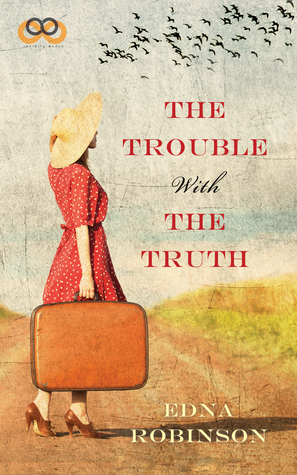
The Trouble with the Truth, by Edna Robinson ****

thetroublewiththetruthThree and a half stars, rounded up. My thanks go to Betsy Robinson, the late author’s daughter, who invited me to preview an ARC and review it. It’s been a fun read.

Lucresse and her brother Ben have an unusual life. On the one hand, they aren’t starving, as many people around the world were during the Great Depression. But on the other hand, their circumstances require a constantly changing back-story in order for them to be accepted by polite society, which was much harsher and more judgmental than it is today.

For one thing, their mother is dead, and their father, a much older man than their classmates’ fathers, has not remarried. Not unless you count Fred, their chauffeur, butler, and otherwise highly respectable servant whose devotion to their family is not fully understood until a crisis strikes. Fred does not sleep with Father, of course. He has separate quarters, but no separate life. They’re pretty much his whole story.

Lucresse has the trouble with the truth that gives our novel its title. Her whole life is predicated upon a series of courteous lies; every time they pack everything and move to a new town, which occurs as often as four times annually, she and Ben are thrown birthday parties. There’s a good reason to do that, but it’s not true that it’s their birthday, and they both know it. And when Father cultivates the acquaintance of a well-known actress and she moves into their guest room, a visiting aunt is told she is the book keeper. It’s another lie, for the sake of appearances.

This highly accessible, charming novel is set out in brief chapters, and in most cases the chapter represents a new story within the overall story, so it is almost like reading a series of consecutive short stories featuring the same characters. With quirky good humor and also a certain amount of ambiguity regarding our head of household, I found myself smiling and nodding at the fib-to-cover-another-fib.

Though the family’s life is bizarre, the children are loved and well cared for; this is no Glass Castle. Rather, it is a portrait of a fictional family that never quite meets the conventional standard society seems to expect.

Recommended for those who like a little whimsy now and then.

The Smoke at Dawn, by Jeff Shaara *****

thesmokeatdawnI hungered for this book! I am a great fan of Shaara’s work. I didn’t get the ARC, but Seattle Public Library came through. Had it not done so, this is one of the very few books for which I would have paid full jacket price.

Shaara writes historical fiction about American wars, sometimes in the form of trilogies, and here he wraps up a trilogy on the Western campaign of the American Civil War. The scenario: Rosecrans, the Union officer who heads the Army of the Cumberland, has had a strong victory followed by a stunning defeat. First he used brilliant gamesmanship and planning to attack and take Chattanooga; this went largely unnoticed by the press, which was beside itself, understandably, over the twin victories of Vicksburg and Gettsburg. But then, unfortunately, Rosecrans pushed his luck too far, getting his ass kicked and a lot of good men dead at Chickamauga. The result was that he ran like hell, dug himself in, and refused to go forth again. Unfortunately, the Confederate troops led by Braxton Bragg cornered him and he was besieged. When Grant was given overall command of armies in the west, he was asked to choose whether to keep Rosecrans in place, or send him packing and promote George Thomas. He chose the latter.

Shaara is generally brilliant at crafting character based upon the historical record. I found Bragg to be almost a caricature—and hell, for all I know, maybe he didn’t have many good characteristics from which to draw; I haven’t studied him much. Grant is portrayed with warmth in a way that sits right with me; the same holds true for Sherman. Thomas has always been something of an enigma, and he clearly is for Shaara also. Sherman and Grant both said in their memoirs that he was slow. (My own memory of Sherman’s is a letter to Grant in which he says, “We both know Thomas is a little slow,” and I sensed irony and understatement in his tone). Yet other historians swear that he was in fact misunderstood. Shaara gives him the benefit of the doubt while allowing for some ambiguity.

I read my copy digitally, and I was pleased at the way I was able to zoom important maps that made it much more possible to see what troops were moving where.

The most controversial aspect, judging from what other reviewers have said about this trilogy, is the creation of Bauer. When I have wanted to confer 4.5 stars on one of his novels in this series, I round up, and it is for Bauer that I do so. Bauer is the only character that is entirely fictional, but Shaara chose to create him to represent that nameless, faceless soldier who represented the vast number of those who bore the greatest burden. They didn’t become famous or have their belongings shown in museums. It’s rare to find a foot soldier’s whole story. Some kept journals, but these were often lost during a battle, scuttled during a hard march when everything non-essential got tossed on the road, or drenched in rain or during a river crossing. No journalist ever followed a humble private around to record his experiences and opinions. For his effort to include the every-man in spite of the flack he would endure from the purists among his readership, I give Shaara high marks.

Next up: Shaara will tackle Sherman’s march through Georgia, through the flames of Atlanta, to the sea. This is my favorite part of the whole thing, and I am excited as I look forward to reading it.

If you enjoy historical fiction based on the American Civil War, and especially if you do not harbor any cherished sentiments toward the dead lost “Cause”, you can’t go wrong with this one. Historical fiction at its best, from a master of the genre.