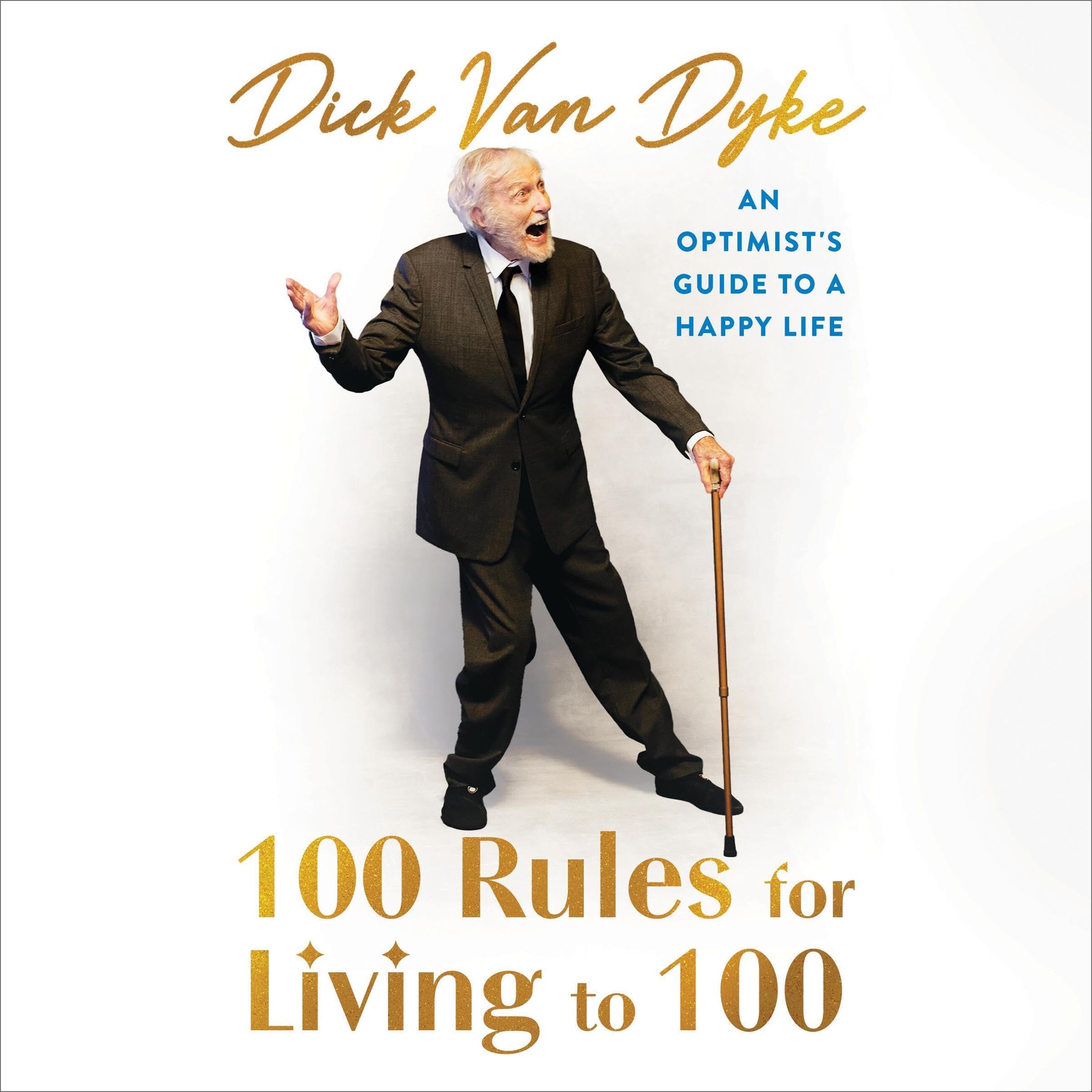
100 Rules for Living to 100, by Dick Van Dyke****

Version 1.0.0

Dick Van Dyke was a wonderful part of my childhood, and this lovely audiobook has put a little more bounce in my step. It’s not really about rules, of course, but the format is a perfect scaffold for a combination memoir and self-help book. My thanks go to NetGalley and Grand Central Publishing for the review copy; this book is for sale now.

Van Dyke entered my consciousness when I was a kindergartener, and the original movie Mary Poppins brought droves of families to theaters. I was not the only family member that was entranced, and all of us sang along to the sound track once the record was on our stereo turntable. The movie, and its lead characters, played by Julie Andrews and Van Dyke, glowed with humor and optimism.  What a wonderful message to share, the idea that the best we can give our children is our time and our attention. In the early 1960s, the suggestion that adults ought to listen to children was ahead of its time and much needed.

Many of the anecdotes the author conveys have to do with experiences shared between him and Arlene, his current wife. Despite the May-December romance, it sounds like a wonderful union. He talks about the recent and horrific events with the Santa Ana fires that took the homes of so many—though his own was spared. My favorite parts, though, are the ones in which he discusses the future roles he’d like to play, because he isn’t really retired from the industry. Way to go, Dick!

Reader Tom Bergeron does a nice job, and as a bonus, he sounds quite a bit like the author.

I recommend this little gem to everyone that could use some positive energy, and to all that love the author.

Words for My Friends: A Political History of Tupac Shakur***-****

3.75 stars, rounded up.

Tupac Shakur lived for just 25 years, but he left an outsized legacy. Author Dean Van Nguyen has published a “political history,” a biography of sorts focusing on Tupac’s political ideology and the foundation on which it was formed. My thanks go to NetGalley and Doubleday for the review copy. This book is for sale now.

Van Nguyen begins his narrative with an overview of the Civil Rights Movement of the 1950s and ‘60s.  This is an area I’ve studied fairly closely, and so there was no new information in it for me, but I could see its value in a community college Black Studies or general history course. Once we’re past that, we enter into Tupac’s family background, and from there forward, his personal and political upbringings are intertwined. His parents were members of the Black Panthers, a militant, armed group of rebels seeking to force equity for Black people in the U.S. from a government that was long on promises and short on substance. There is a tremendous amount of the book given to the history of the Panthers, and most of what is recounted occurs either before Tupac was born, or while he was an infant.

Here’s my takeaway: I have often been curious about the Panthers, whose struggle I knew in broad strokes, but few specifics, and so this is interesting to me. But the book’s title has led me to believe that this book is primarily about Tupac, and we are at around the 40% before he even comes into the narrative. This is my sole complaint about this work, but it’s a significant one. Had the title been clearer that this is really a history of Tupac and the Black Panthers, I probably would have still read it, but because of the way it’s promoted, I feel frustrated when the 20% mark goes on by, then the 30% mark, and apart from a brief reference or two, Tupac isn’t even in it. In fact, we learn more about his mother than we do about him.

Once we do get to the meat of the matter, this is riveting material. What a gifted man he was, and yet he was still coming of age when he died. He loved reading classical literature, and he attended a fine arts high school where he was better able to develop his interests and talents, playing in Shakespearean productions; but as is often the case for children in low-income households, about the time he put down roots and made connections, his mother had to give up their lodgings, and that meant moving to a new town and a new school.

 This happens again and again. Single motherhood is hard anyway, but once you bring crack into it, the game’s all but over. And (here I suppress a primal scream,) because his father isn’t there and his mother is struggling, Tupac believes he must take care of his mother and long, long before he is old enough to bear such a burden. Teachers everywhere have seen that kid. He might be Black, Caucasian, or any other ethnic and racial background; he might be a she, for that matter. But children that take the responsibility that belongs to the head of the household are under a whole lot of stress, and the fracture lines often don’t show in their teens. They look as if they’re handling the job like an adult, often being praised by those in authority for their organization and focus. But—ask a social worker here—when they hit their twenties, that’s when they start falling apart. Because kids cannot be adults. When they are forced into the role, it will break them, sooner or later. And it seems clear to me that this is part of what led to Tupac’s early demise.

There’s a lot of interesting material packed into the relatively small part of the book that he occupies. We learn about the other famous performers he meets and befriends, first in school, then professionally, and about the political ideas he explores, serving for a while as a member and organizer of the local chapter of the Communist Party’s youth group. His willingness to dive deep into ethical and political ideas is reflected in his music, and to my knowledge, there is no other rapper that has included respect for women, along with an overtly pro-choice message, in their recordings. But just as his star begins to rise in earnest, he is killed.

Those considering reading this book should either be ready to read extensively about peripheral issues and events that don’t directly include Tupac, or should be ready to get the book with the intention of skipping a lot of material. As for me, I’m glad I read it.

Heartbreaker, by Mike Campbell and Ari Surdoval*****

Mike Campbell is a musician and songwriter who served as Tom Petty’s lead guitarist and songwriting partner from the band’s inception until Petty’s death in 2017. I’m a sucker for a strong musical memoir when I can find it; although the galley for this book was available, I chose not to request it, instead using an audiobook from Seattle Bibliocommons. I didn’t want the pressure of a deadline. I wanted to be able to lose myself in Campbell’s story, to take unlimited side trips to stream songs that he refers to, either because I haven’t heard of the song and want to listen to it, or because he’s identified a song that I have loved for a long time and want to hear again.

Although I listened to Tom Petty and the Heartbreakers from the late ‘80s onward, I was never one to follow the news about individual band members. In fact, before I read Warren Zanes’ biography of Petty, I didn’t even know who was in the band. I just knew that when I was in the car and I heard Petty’s voice on the radio, it was time to turn up the volume. And so I come to this memoir without any preconceived ideas, and also without a lot of prior knowledge. Sometimes when a luminary dies, people that have only known them peripherally come out of the woodwork with their stories, looking to make some quick money by inflating their own importance in that person’s life. Once I begin listening to Campbell—who narrates his own audiobook—I can see that this is definitely not that.

It’s also not a Tom-and-me kind of memoir. Petty appears in it of course, but this story is about Campbell, not about Petty, and once it gets rolling, I can tell that Campbell has plenty of interesting experiences worth hearing about independent of anyone else.

The audio takes me a little while to get used to. As it begins, I note the delivery that is nearly a monotone, and a less than fluid reading style. In a strange way, it reminds me of being in an elementary school classroom that’s doing round robin reading aloud. We have come to the student that doesn’t want to read aloud because he knows he won’t sound good. And just as I am thinking that surely for a book that has the kind of reach I expect it to have, they could have found a more engaging narrator, the penny drops, and I realize—oooh, this guy is reading his own book! That being the case, I resolve to stop being so picky and accept the author’s narrative style. Eventually I grow accustomed to it, and it’s a good thing, because I find Campbell’s experiences fascinating! What a lot these musicians endured in order to be heard. Hunger, homelessness, and the derision of their elders; broken down cars, unfriendly cops, and shifty bar owners that want the music, but don’t really want to pay for it. And I am so glad they persevered, because the world of rock and roll would have been so much poorer without them.

I strongly recommend this memoir to those that enjoy listening to Tom Petty and the Heartbreakers.

Charlie Chaplin vs. America, by Scott Eyman*****

Charlie Chaplin rose to fame over 100 years ago, but his fame hasn’t faded over the years. One of the most visionary movie makers in modern history, he rose from desperate poverty and homelessness during his childhood to become one of the wealthiest and most respected men in his chosen profession. And yet, for some odd reason, the U.S. government relentlessly pursued him as if he were an enemy agent, eventually forcing him to retire abroad. It’s a bizarre episode in U.S. history, and a fascinating one.

When I saw that Scott Eyman, an author whose biographies of actors I have previously enjoyed—John Wayne, Jimmy Stewart, Henry Fonda—had written about this case, I had to read it. My thanks go to NetGalley and Simon and Schuster for the invitation to read and review. This book is for sale now.

Charlie was born in 1889 in London. His mother Hannah was an actress, a loving mother whose health was dreadful. In addition to more conventional illnesses, she was sent repeatedly, and for longer stretches each time, to mental hospitals; it has been speculated that she suffered from syphilis, which eventually had devastating effects on her brain. Charlie’s father was a businessman who left the family and refused to pay a single shilling of child support because one of Charlie’s brothers was conceived with another man. And as an aside, if there is an afterlife, I sincerely hope that Charles Chaplin, Senior is roasting eternally in the flames of hell.

For a while, Hannah’s relatives cared for Charlie and his older brother, Syd, but eventually the boys found themselves in a workhouse, beaten, abused, sickened, and barely fed. It was his brother Syd who first discovered that acting could keep him out of the workhouse and put food on the table, and once he was so employed, Syd took his pale, sickly little brother to the theater and persuaded his boss to use Charlie, too. Thus was a star born.

His tremendous suffering during his childhood gave Charlie a lifelong sympathy with the working class, the impoverished, and the down and out. Early in his career, a director gave Charlie a costume and told him to come up with a character, and this was when he invented The Little Tramp.

I’ve known for most of my life about Charlie’s expulsion from the U.S., but I’ve never been sure whether he was a Communist. I’ve known people brought up in Communist households in America, and for many years, they existed strictly underground, so I wondered, did Chaplin deny his affiliation because he wasn’t a Communist, or because he was? Eyman’s meticulous research demonstrates once and for all that Charlie was not political. He told the truth about himself: “I am not a Communist. I am a peace monger.”

Nevertheless, once he gained prominence in the American movie industry, he had a target on his back. It’s difficult to understand why politicians and bureaucrats in California and in Washington, D.C. hated him so fiercely.

“A month after the revocation of [Chaplin’s] reentry permit, the FBI issued a massive internal report documenting more than thirty years of investigations focused on Chaplin, a copy of which was dispatched to the attorney general. The report revealed that, besides the FBI, Army and Navy Intelligence, the Internal Revenue Service, the Central Intelligence Agency, the Department of State, and the U.S. Postal Service had all been surveilling Chaplin at one time or another. In short, the entire security apparatus of the United States had descended upon a motion picture comedian.”

Eyman has done a wonderful job here. Because I had fallen behind, I checked out the audio version of this book from Seattle Bibliocommons, and I alternately listened to it and read the digital review copy. Of course, anyone reading this book for the purpose of academic research should get a physical copy, but those reading for pleasure may enjoy the audio, which is well done; this is a through, and a lengthy biography, and the audio makes it go by more quickly.

I confess I haven’t read any other Chaplin biographies, so I cannot say for certain whether this one is the best, but it’s hard to imagine a better one. For those sufficiently interested to take on a full length biography, this book is highly recommended.

Deliver Me from Nowhere, by Warren Zanes*****

I’m a diehard Springsteen fan and also loved Zanes’s biography of Tom Petty, and so when I saw this book, I was all in. My thanks go to Net Galley and Crown Books for the review copy; this book is for sale now.

Springsteen, yes; but why Nebraska, of all albums? Nebraska just may be the one song that leaves me cold. In the early portion of this story, I wasn’t as enthused as I expected to be, but as the narrative moved forward, I totally got it. Nebraska was written and performed during a crisis period in Bruce’s life. He had grown up in horrible, grinding poverty, and now suddenly he had all this fame and money. On the outside, his life was looking mighty good, but inside, the walls were crumbling. He was clinically depressed, sometimes suicidal, having never dealt with the traumas of his formative years. He rented himself a farmhouse and went there by himself to write songs and tape some demos. He took no friends or family, nor his band; he took one guy along to see to his creature comforts, and that guy’s second job was to be invisible. For most of the book I was convinced that the farmhouse was in Nebraska; nope. New Jersey. And it seems that my lack of enthusiasm for this music was not atypical:

“Nebraska was going to ask a lot of the listeners. If they loved Springsteen for the sliver of hope and possibility of redemption his songs offered, they were out of luck with Nebraska. If they loved the sound of the E Street Band and the way Springsteen led the group, that, too, was gone. If they loved the way he produced and arranged the songs into recordings rich in dynamics, nope, it wasn’t there in the same way…This was the sound of a man forcing out songs while held under water, a rough hand on his neck.”  

The album’s structured to tell the story of murderer Charles Starkweather and his accomplice, Caril Fulgate. He tells the story without judgment, and considers the characters to be a pivotal part of his work.

Here’s the fun part. As Springsteen wrote and recorded the songs, one after another, right there in the master bedroom of the house he was renting, he didn’t worry about any of the finer points of recording, because these were essentially supposed to be demos. For musicians that don’t read or write music in the formal manner, the demos are critical. How will you remember the song you came up with when it’s time to put the album together? You need a recording. So there was Bruce, perched on the end of the bed, with the water damaged Panasonic boom box nearby. He pops in a cassette and commences recording. He writes prolifically, practically vomiting up song, after song, after song. Sometimes you can’t feel better until you get it all out of your system, right?  

But later on, when it’s time to do the mixing and whatever technical processes usually go into a professional recording—which Zanes describes in an easy to follow manner—nothing works. After trying every imaginable method, they end up publishing the music on the cassette, exactly as he recorded it.

Those that want the full story of Springsteen’s life should read his autobiography, Born to Run, which is excellent. But there’s a lot to recommend this smaller little slice of the least known part of this rock and roll icon’s life. For those that love Springsteen’s music, and for those interested in rock music in general, or the technical side of recording, this book is highly recommended.

The Making of Another Major Motion Picture Masterpiece, by Tom Hanks*****

Tom Hanks has more than one talent, that’s for sure; or perhaps he is an artist that’s ridiculously talented at telling stories, whether they be on the page or screen. One thing I’ll tell you now: I am completely convinced that he did indeed write this book himself, and it’s damn good, too.

My thanks go to Net Galley and Alfred A. Knopf Publishing for the review copy. This book is for sale now.

The story begins with a child prodigy, an artist living in Lone Butte, California, who as he matures, becomes a comic book illustrator. Fast forward about thirty years, and that comic becomes a movie.

Our story doesn’t have just one protagonist, and it is intentional, or so it appears to this reviewer. We have the big boss, Bill Johnson, his assistant, Candace, and the assistant she recruits in Georgia, Allicia. We learn something of their backgrounds and their personalities, but mostly, we see how important they are to the success of the movie. When the movie is finished with Atlanta, Allicia, who now goes by Al, comes along and is eventually promoted; she then finds someone to take her place. We learn more about other people that are working the production, and I am amazed by the sheer number of people involved, and how much must be done to keep everyone on an even keel. Eventually we meet the two big stars of this action movie; one is hardworking, cooperative, and comes up with a host of useful ideas; the other is an egotist, a Do-You-Know-Who-I-Am type, and everybody walks on eggshells in an effort to make him happy, and to make him want to show up and do his job.

In the hands of a less talented writer, this whole thing might feel list-like, but Hanks sculpts these characters so that I feel I know them, and I care about what happens to them.

There’s more than a little wry humor in this tale, and the copious footnotes at the end of each chapter are a part of that. I read them all, because some of them are hilarious, but readers that lack the patience for it can breeze right on by them without missing anything critically important. And here’s a nugget that cracked me up:

“Of late, Bill had been using military-style call words rather than expletives. Fuck was Foxtrot. Asshole was Alpha Hotel. Cocksucker? Charlie Oscar Charlie Kilo Sierra.”

As a bonus, artist Robert Sikoryak has written the comics themselves, and they are included in the book. Those that love comics should probably get this book in hard cover, because a lot of the detail is hard to see in the digital version that I read. As for me, I don’t give one single poo about comics, and I skipped them.

Movie buffs will be fascinated with the vast amount of movie making minutiae here. I am not a big movie viewer, but I eat it all up, anyway, because I had no idea of the amount of time, personnel, and materials necessary to creating a major movie, masterpiece or otherwise.

Although he doesn’t beat the drum hard enough to distract from the overall story, Hanks’s message is crystal clear: everyone involved in creating a movie is important. If the crew doesn’t have enough restrooms, it affects the movie. If nobody brings lunch to the set, some people will be miserable and perform below par, whereas others will slip away in search of food and not be available when needed. And if just one person is a horse’s ass and drags his feet, or if he blabs things to the press that aren’t supposed to be released yet, he can add millions of dollars to the cost of the production. Here’s a perfect quote:

“What advice can you give us to make it in Hollywood?” She talked about the great divide between solving problems and causing them, and the importance of being on time.”

Through all of this, I keep wondering when we will see the young artist that made the comic again. If we started with him, it makes sense we will see him again at some point, right? Yes. This detail—along with every other—is done beautifully.

There’s not one thing about this book that I don’t love, and the feel-good ending is icing on the cake. Highly recommended to those that love movies as well as excellent fiction.

The Answer Is, by Alex Trebek*****

I first sought to read this book when its author was still alive. I couldn’t get the galley, and so I obtained a copy of the audiobook from Seattle Bibliocommons, by which time Trebek had left us.

It’s a curious thing, the attachment so many of his viewers, myself included, felt toward him. He was a game show host. There are other game shows that have longstanding hosts, but when they die—if they haven’t already—it will register as nothing more than a footnote, a handy answer in Trivial Pursuit. But somehow, with his polished yet soothing demeanor, Trebek found his way into our hearts. Go know.

The audio is read alternately by Trebek and by Ken Jennings, a record-breaking champion that found a measure of fame himself. It works nicely. Here are the things that surprised me. First, Alex’s family lived in a small town in Canada near Ottawa. They struggled financially, and so in order to pursue higher education, Alex had to have a scholarship. He got one, but while enrolled, he got into a power battle with a particularly hated teacher. Alex was expelled. That was a good school, though, in spite of the man Trebek so hated (and about whom he never changed his mind!) In the end, he and his father returned to the school, met with the administrator, and begged. A more sympathetic teacher/mentor agreed to be in charge of young Alex, and he was able to go back and complete his degree.

His career started in radio, working as a disc jockey. He had a love of classical music, and found his way to the Canadian Broadcast Corporation. Later, he was invited to audition for a game show in the States. So much more money! From there he hosted quite a number of game shows, finally landing his berth in Jeopardy in 1984. Later on he briefly considered trying to move into acting, but he came to know some actors that worked on the same set where Jeopardy was filmed, and he soon found out that they were making the same money as he was or less, but he only worked for a couple hours each day, home in plenty of time to eat dinner with his family and pursue hobbies and whatnot, whereas the actors were keeping grueling schedules. At that point, he decided he liked it just fine right where he was.

In parting, he reminded his listeners that everybody dies, and he is in his nineties. He’s had a good life. It’s time to go. I found this tremendously graceful, because pancreatic cancer has a reputation for being one of the most painful forms of the disease. But maybe that was Trebek’s magic:  always putting the other person at ease.

Highly recommended.

Now Is Not the Time to Panic! by Kevin Wilson****-*****

Now is Not the Time to Panic is, according to its author, Kevin Wilson, “a book about friendship, about memory, and about what it means to hold on to the person who we were, even as we become someone else. It’s about the ways in which art is the door that lets us walk into a new life, one that never seemed possible.”

Frankie is kind of a quirky kid, friendless and grieving her parents’ divorce and her father’s abandonment of his kids. She has nothing but time this summer, and so when Zeke, an even quirkier new kid, moves into the tiny town of Coalfield, Tennessee, the two are drawn together.

My thanks go to Net Galley and Ecco Publishing for the review copy. This book is for sale now.

Frankie invites Zeke over one day; her dad has flown the coop, and her mom is at work, so in order to make it clear that she hasn’t invited him over for carnal purposes, Frankie talks to him about her love of writing. Zeke says that he likes to draw, and so together, they make a poster. The words are Frankie’s, and they are indeed well written for a kid of sixteen years: “The edge is a shantytown filled with gold seekers. We are fugitives, and the law is skinny with hunger for us.” Zeke fills in the rest of the page with his artwork, and for good measure, they prick their fingers and comingle their blood on the poster. Then they dig out an old photocopy machine in Frankie’s garage, and make copies with which to furtively festoon the whole town. (After all, Coalfield isn’t a big place.) They don’t tell anyone it’s theirs, and enjoy the reactions to their guerilla art as sly observers.

The two teens share a lot in common. Both are outsiders; both are creatives; and both are living through the implosions of their families, with fathers that cheat and then leave, and mothers that are beside themselves with anger and shame.

Once the posters become noticed around town, rumors begin, and then copycats come along and make improvements, sometimes. There’s a hysterical piece in the local paper suggesting that their work is Satanic. Frankie and Zeke don’t say one word to anyone. They watch and they listen; they talk about it only with each other.

The crafting of these two characters, and their relationship, is well done, and I ache for both of these kids. The only time I see character slip is with regard to Frankie’s attitude toward sex. Her dispassionate take on it—she isn’t sure she really wants to, but maybe she should just do it and get it over with? Is not a mindset I’ve ever seen in a teenage girl, and believe me, I’ve known plenty of quirky ones. No, that’s a male attitude, and I suspect that Wilson would do better to use male protagonists, or else run his female ones by several very honest females in his chosen field, prior to publication.

As the summer goes on, I keep expecting the two to launch another joint project, but they don’t. She does some writing, and he draws, but there is no sequel, no follow-up. The poster is the poster. Shantytown, gold seekers, fugitives, hunger. Boom. That’s it. But years into the future, Frankie is still putting these damn things up. The heck…? I believe this of her; she is one strange person. Zeke’s mental health deteriorates that summer, and where that goes is completely credible. Those that work in the field will recognize Zeke, who is by far the better drawn of the two main characters.

This fascinating novel can be enjoyed by young adult audiences, because both of the protagonists are teenagers; however, this is also fiction that can be enjoyed by anybody. If you don’t read YA—and the truth is, I don’t, not anymore—you can still appreciate this one, and I recommend it to you.

Elvis and Me, by Priscilla Presley****

Priscilla Presley is the ex-wife of the king of Rock and Roll. I was a teenager when he died, and neither I nor most of my peers were fans; in the event his name did come up, we’d invariably ask, “Wait. Do you mean young hot Elvis, or old pudgy Elvis?” But I do love a good memoir, and those written by or about musicians are high on my list. My thanks go to Net Galley and Macmillan Audio for the review copy. This audio version of the author’s 1985 memoir is for sale now.

The relationship between Priscilla and Elvis took place in a completely different time, with completely different sexual mores and assumptions. That said, this was still a truly messed up pairing. Today, Elvis would probably be considered a predator, but within the context of the American South in the 1950s and early 1960s, he was regarded as a romantic, and women threw themselves at his feet. A quick online peek at old film and television clippings says it all.

Priscilla grew up in a strict but loving household. Her stepfather, the only father she knew, since her own died when she was an infant, was a military man, and so the family moved often. It was while they were stationed in Germany that one of Elvis’s employees saw Priscilla and invited her to meet with Elvis, who was doing his own tour of duty.

I have to feel for the bind her parents were in. On the one hand, she was just fourteen years old, and Presley was twenty-four, a grown man. On the other hand, if they refused to let her go, she would never have forgiven them; this was an invitation that literally millions of girls yearned for. Seeking a happy medium, her stepdad set boundaries: they were to be chaperoned, never alone together, and he wanted her home at a certain time. He groused about the fact that someone other than Elvis would be transporting her, but the reason was a legitimate one: Elvis could not drive himself anywhere without the car being mobbed. It was genuinely unsafe.

Rather than being the single event that the family anticipated, Elvis made their visits regular ones; when her parents balked, Elvis spoke to them personally, turning all of his charismatic charm on them, and telling them everything they wanted to hear. Most of it was untrue, of course, but the one thing he adhered to was not having sexual intercourse. During this time period, the Madonna-Whore dichotomy was alive and well, and any girl or woman known to have sex outside of marriage was likely to be ostracized by former friends and in some cases, family. It’s hard to imagine now, but at that time, no birth control pill had been invented, and a pregnancy outside of marriage was likely to ruin a young woman’s entire life.

Priscilla reads this memoir to us herself, and that makes it much more fun to hear. As we age our faces and our bodies change a lot, but our speaking voices change very little. Remembering some of the silly moments from that time, the author lets out a brief, girlish giggle, and it’s almost impossible to believe that she is now a grandmother.

Priscilla acknowledges that this was a monstrously unequal relationship. Elvis dictated whom she could talk to, what she wore, and sometimes even what room in the house she was supposed to be in. At one point, when he is going to be touring for months on end and she will be left at home with his grandmother, she goes out and gets a job. She’s so proud of herself. He makes her quit immediately. When he phones from the road, she had by God better be there. Priscilla compares this to Pygmalion. He has all the power, and she is in his thrall before she has even had a chance to grow up.

I have read two other Elvis biographies, and as dreadful as all of this sounds, the other authors were less gentle. In fact, this is part of Priscilla’s stated reason for deciding to tell her own story.

There are advantages to reading this particular biography. The official version of events is often what is published, but Priscilla is positioned to know the real story, more often than not. For example: when Elvis is drafted, the official story is that, although stars of his caliber are often offered soft assignments that involve singing to the troops, or making inspirational training films, Elvis insisted on doing the same job as every other American man.  On the other hand, Priscilla states that this is all his manager’s doing, because it will make Elvis appear noble. Enough new songs were taped in advance for there to be regular new releases on the radio throughout his tour of duty; toward the end, Elvis feigns illness because he’d prefer to be in the hospital being swarmed by nurses than marching around and getting dirty.

Her memory of Elvis, despite everything he put her through, is mostly a tender one. The spiral that led to his death, his issues with mental health, back before much was known, coupled with the immense number of strong prescription drugs he used to wake up in the morning and go to sleep at night—or to NOT go to sleep at all, and just stay up, night after night—set him up for relationships with unscrupulous characters, and nobody could rein him in, because he was the King.

Recommended to those that like vintage rock music or well-written memoirs of famous musicians.

Lies My Mother Told Me, by Melissa Rivers**

I hadn’t heard of Melissa Rivers, but when a friend mentioned that the daughter of the legendary comic, Joan Rivers, had an audio book nearing its publication date, I wanted it. My thanks go to Net Galley and RB Media for the review copy. This book is for sale now.

Joan Rivers was an icon, one of the first fierce women to breach the world of standup, an old boys club if ever there was one. She was scrappy, fearless, and very, very funny. Like all of the early women comics, she incorporated a good deal of self-deprecating humor, a defense against all of the nasty things that reviewers and audience members might throw at her, but she also made fun of the rich, the famous, and the powerful.

Joan died in 2016, and although she was eighty-one years old, news of her passing came as a shock. She hadn’t been ill, and had been admitted to a hospital for surgery of a fairly minor nature; her death was caused by errors made by the doctors and hospital. Her only child, Melissa, had been developing a standup career of her own, and now steps fully into the spotlight left vacant by her mother’s death.

I had never heard of Melissa or her work when I found this audio book, but I expected great things; often a talent is passed down within a family, after all. Sadly, there’s no joy to be had here. Melissa’s tone is grating and abrasive; whereas Joan sometimes veered in that direction, she had the skill and instincts that told her when to pull back or soften things. Joan’s trademark phrase, “Can we talk?” created a sense of intimacy, and drew me in. Melissa’s repels me. Apparently, I am not alone; I was playing this audiobook while preparing dinner, and when other family members came into the kitchen, they either wanted it turned off, or they left immediately. Nothing she said made any of us laugh, or even smile. Nothing. I have never heard a comic so obnoxious.

Wikipedia tells me that Melissa Rivers is known for her work in comedy, and for philanthropy, as heir to her parents’ considerable estate. I haven’t seen or heard any of Melissa’s other work, but if this book is representative, she might do better to focus on her charity work, brightening the world by embracing the causes dearest to her parents’ hearts, and her own.

Not recommended.