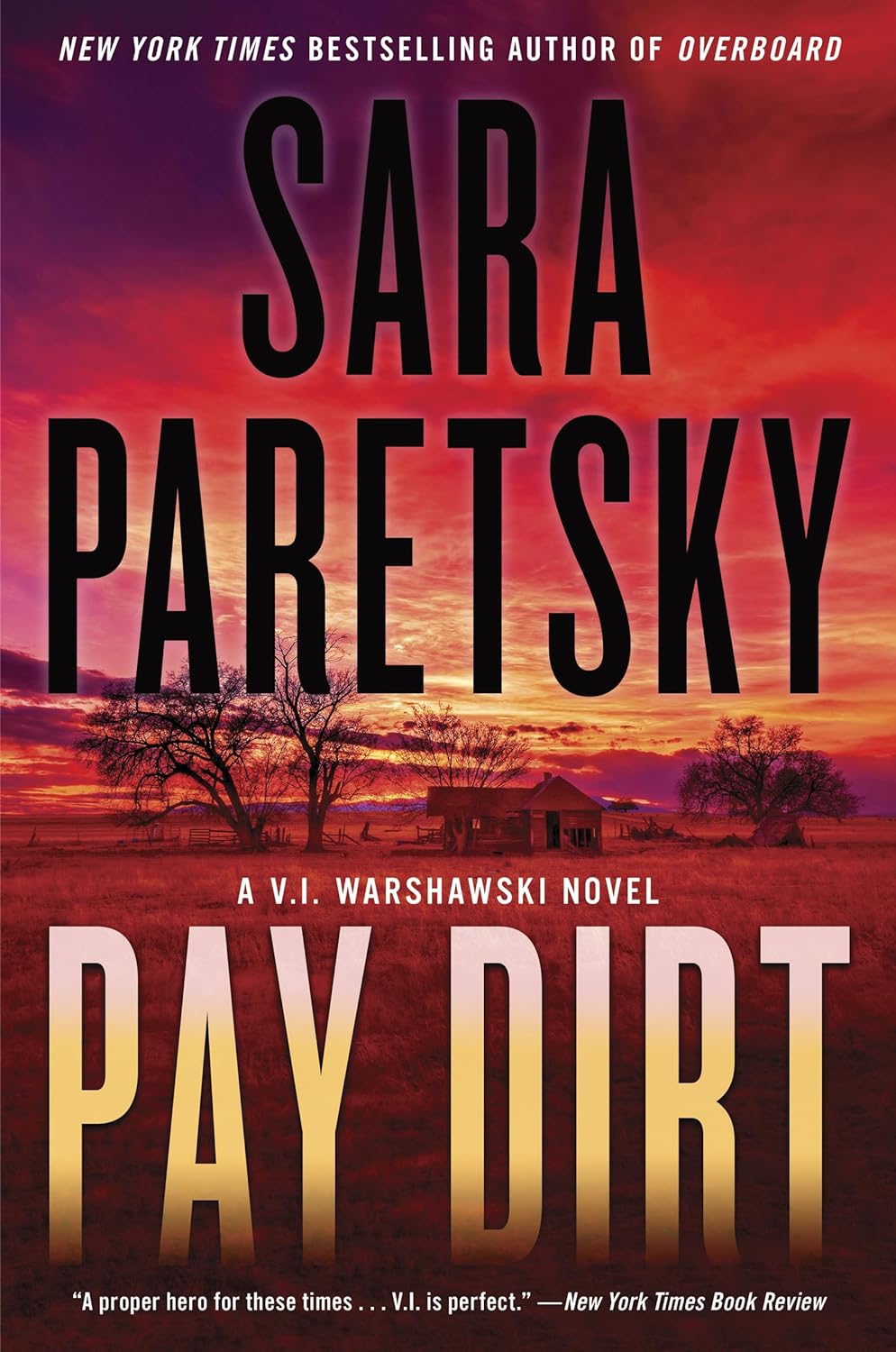
Pay Dirt, by Sara Paretsky*****

Sara Paretsky is a badass author with a badass protagonist. Her hero, Vic Warshawski, is a rough and ready private eye, and though based in Chicago, she sometimes—as now—finds herself elsewhere when duty beckons. Author Paretsky is one of the three that pioneered the hardboiled female private eye subgenre; the first in this series, Indemnity Only, came out in 1982, over 40 years ago, and that is how long I have been reading them. And though I was lucky to receive a review copy, thanks to NetGalley and William Morrow, this is one of those rare books that I would have paid full price to read if that was the only way I could get it.

This book is for sale now.

This story finds Vic in bad shape, both mentally and physically. She has attempted to help a student of her boyfriend Peter’s, a trans youth whose father blew out the kid’s brains rather than accept their new identity. The brains stuck to Vic, and the experience sent her reeling emotionally. She’s been forgetting self-care, not eating or exercising. What she needs is rest and quiet.

But that’s not how it goes.

Her godchild Bernie persuades Vic to attend a basketball championship game in Kansas. A group of them will be going down there; it’s just what Vic needs, she says. Reluctantly, Vic agrees, but once they are there and the game is over, one of the parties disappears, and Vic is enlisted to find her. When Vic finds the missing basketball player, she inadvertently finds a dead body. The cops in Lawrence, Kansas as well as the FBI like her for the killing. It’s so convenient to have a mouthy, street smart outsider blunder in; hopefully, they can pin it all on her, and then life will go on as it has been. And so Vic must stay behind because she’s been told not to leave town, but also in order to clear her name.

Now, this is one of the elements that generally irritates me in most mysteries; the whole clearing-my-name trope is desperately overdone. There’s another trope that shows up later in the story, but I won’t share it here because it’s a spoiler. But for every rule, there is an exception, and in the case of both tropes, Paretsky breezes through, and I barely bat an eye; this is because the characters are so real to me, and the situation they’re in is so immediate, that I blow it off so I can find out what happens next.

And as is so often the case, Vic Warshawski finds herself up against the town’s wealthy power brokers, who have a vested interest in not having the real killer caught. As for Vic, she makes friends with a few people that have no wealth and no power, but the small ways they assist her make all the difference.

Once she solves the crime, persuades the local police and others that she is innocent and that the blame lies with the men in the suits, are they hauled off in shackles? Don’t hold your breath. As one of her new pals reflects, “That is justice in America, plain and simple, before you wrap it up in a pretty package of Constitutional rights that only the rich get to have.”

The thing that sets this particular book apart from the other very good mysteries I’ve read recently is the development of the protagonist. She’s vulnerable because of her earlier trauma; her boyfriend left the country on business, and he hasn’t been responding to her texts. She is miserable, and she’s isolated. But as the pressure builds, Warshawski delivers. The last quarter of this novel is impossible to put down, and even before that, I set aside my usual rotation of books, because I wanted to read this, and only this.

This novel is written in such a way that a first time reader can jump into the series, but chances are good that once you do, you’ll reach back for some or all of the others. Highly recommended to those that love gritty, rough and tumble detectives; feminists; and those that lean to the left.

The Hunter, by Tana French*****

In 2020, Tana French gave us The Searcher, the first in the Cal Hooper detective series. By that time I was already an established fan, but I loved that book particularly well, for reasons I’ll revisit in a moment. Now we have the second in the series, The Hunter, and if anything can reduce this crusty old English teacher to a blushing fan girl, this is it. Two books in, this is already on my short list of favorite series. My thanks go to NetGalley and the Penguin Group for the review copy. This book will be available to the public Tuesday, March 5, 2024.

The series debut introduced the characters, with the protagonist being a retired Chicago cop that found this tiny Irish village on vacation and, needing a new home far from his ex-wife, yet affordable, discovered a bargain fixer of a home and decided to stay. The story’s main problem revolved around a nearly feral tween that kept popping up at Cal’s place. The scrappy little stinker that was relieving Cal of food, occasionally, and doing other unsettling things turned out to be a girl; her name is Teresa, but she’s known as Trey. Her family was in dire straights following the departure of Trey’s father; her brother had left, intending to return, but never had. The mystery was where Trey’s brother had gone, what had become of him, and why. In the interim, she became greatly attached to Cal, who enjoyed her company and taught her some woodworking skills, but also kept a careful distance, lest rumors start and grow.

Now Trey is a bit older, and she is more civilized. She is close to both Cal and Lena, the local woman that Cal has been seeing. But as life settles into a civilized hum, one that would be comfortable had climate change not created a drought that has local farmers at the near end of their wits and their bank accounts, the unexpected happens once again: Johnny Reddy, Trey’s no-account father, has returned. Cal is prepared to step back, if need be, in case Trey wishes to bond with her actual dad rather than himself. Meanwhile, Johnny vows to visit Cal with some local moonshine, and “make a night of it.”

“Trey says nothing. If he does that, she’ll get Cal’s rifle and blow his fucking foot off, and see can he make his way down the mountain to Cal’s after that.”

Johnny never succeeds in bonding with Cal, who doesn’t like the look of him. “Johnny gives him the urge to pat him down and ask him where he’s headed. There are guys like that, who flunk the sniff test just going to the store; it’s a good cop’s job to work out whether they’re actually doing something hinky, or whether it’s just that they will be sooner or later, probably sooner.”

The village is a tiny one, and outsiders are few. Everyone in the vicinity knows that Johnny’s back; everyone wonders what he’s up to. They haven’t long to wait; he’s brought a man with him, one whose family once lived here, or so he says; and the man is interested in seeing if there’s gold on some of the local properties. “He has a rich man’s smile, easy and understated, the smile of a man who isn’t required to put in effort.”  Now the question is whether this “plastic Paddy” is a shyster trying to rip off the locals, or if he is someone that Johnny is seeking to fleece. Meanwhile, Trey has a different agenda, a private one.

The thing that makes this story so much better than your standard mystery is the characterization. If you are in search of a thriller that is all page-turning action, this isn’t your book. However, if you love a layered story with complex, convincing characters, this is for you. I said in my previous review of the first in the series that Trey is what makes an otherwise solid story a golden one, and that’s even truer here. One could even argue that it’s really her series, with Cal existing as scaffolding. Time will tell.

In particular, though, anyone that works with, or has worked with at risk youth cannot, must not miss this story. French has taken hold of my heartstrings hard, and I don’t want her to let go. Highly recommended.

The Ghost Orchid, by Jonathan Kellerman****-*****

4.5 stars rounded upward. My thanks go to Random House Ballantine and NetGalley for the review copy. This book will be available to the public February 6, 2024.

The Ghost Orchid marks the thirty-ninth entry in the Alex Delaware series, one of the longest series in publication. It’s easy to see why it’s lasted so long. The protagonist and side characters are engaging, and the dialogue never loses its sparkle.  In this one, Alex has been recovering from a savage beating that he took at the hands of the murderer in our last mystery. Milo, his BFF, is a homicide cop who often hires him to assist the LAPD with cases where a psychologist is needed, but now Milo is so mired in guilt that he can hardly look at his friend. Finally, with a nudge from Delaware’s longtime (and slightly boring) girlfriend, Milo includes him in another case, and we find snappy dialogue that never fails to entertain.

This time it’s a double homicide in Bel Air. The man and woman are found by the pool, naked and dead. The investigation reveals that he is the son of a mega rich European shoe magnate; she is the wife of another rich man, a young, socially awkward member of the ruling elite who isn’t pleased to learn what his wife has been doing when he’s away on business. But then we learn that she was using an assumed name, and so the whole thing is even more mysterious. Who is this dead woman, and who killed her?

At the same time, Alex is engaged to interview a child in his early teens whose adoptive parents have decided to bail. They are divorcing; neither of them wants the kid.

The main storyline is a lot of fun. Everyone enjoys seeing the super-rich suffer. With wealth of this magnitude, there’s no chance any of Kellerman’s readers will identify with the male murder victim or the husband of the female victim, either. The way it’s resolved is believable, and it’s done without any of the prurient or kinky sex that Kellerman inexplicably included for a handful of books in this series a few years back. The half star is withheld from my rating because the other storyline, the one about the teenager, sort of fizzles without going anywhere, and it’s hard to see why he included it in the first place. Kellerman’s career, and this series, were originally launched around crimes where kids were involved, often as witnesses, and those initial books are fascinating. I’d love to see the author return to his roots, write some more episodes that incorporate his credentials and experience in child psychology.

You can read it as a stand alone novel if you choose, but you’ll want to read the others afterward.

Nevertheless, if you are looking for a fast, fun whodunit, this book is a hard one to beat. I highly recommend it to those that love the genre.

Dogboy Vs. Catfish, by Luke Garcias*****

“Dirty deeds, done dirt cheap,

Dirty deeds, done dirt cheap.

Dirty deeds, done dirt cheap;

Dirty deeds and they’re done dirt cheap.”

AC/DC

This may have been the biggest sleeper of 2023. Dogboy vs. Catfish is a true thriller by Luke Gracias, one that grabbed me by the front of my shirt at the beginning and didn’t let me go till it was done with me. My thanks go to NetGalley for the review copy. This book is for sale now.

A couple of Goodreads friends raved about this book, and right away, I was curious. The title: not your usual formulation. Then there’s the setting; I haven’t read many books set in Australia, and fewer Australian mysteries and thrillers than fingers on my hand. And finally, the book’s premise: a well-to-do, famous, glamorous woman turns up at a lawyer’s office, and she’s excited, because she’s been married to this man she doesn’t care much about for nearly 18 months, and in Australia, that is the magic time length that will entitle her to take him to the cleaners, particularly with regard to her daughter’s support. He has a lot of money, but it’s about to be hers. She expects this attorney will be thrilled, because what a payday it will be! Sadly for her, the attorney has principles and scruples, and she backs away from the case.

But then the man—Dogboy, of course—turns up missing. He’s told his best friend that he is certain his wife is going to leave him and take almost everything, and he’s not sure what he can do about it; now he is nowhere to be found. Is he alive? Nobody seems to know.

In investigating the man and his estranged wife, the internet darling named Catfish Kelly, it soon becomes clear she is mixed up in money laundering and drugs. The search takes the cops to Thailand, where their informant is literally shot to death before their very eyes. And all of these things happen early, so I am giving nothing away. The book goes quickly at the start, then ramps up to an even more heart pounding pace.

It’s difficult, with a thriller that moves so rapidly, to find a way to establish characters. Nobody here is a truly dynamic character, but we don’t need a lot of character development. What is most admirable is the lightning quick way Gracias bonds us to Dogboy, whom we mostly don’t even see. We know three things about him. First, we know that he married a terrible woman who’s about to bleed his assets out from under him. Second, we learn early on that he is concerned that his investors’ funds will likewise be siphoned away, and to prevent this happening, he returns all of their investment moneys to them before he disappears, so that he will be Catfish’s only victim. And third, we know that he is unusually appealing to dogs, to the point where dogs that do not know him and have never met him, nonetheless seek him out, and also try to protect him when danger is present.

With just these three facts, given to us briefly, we cannot not love Dogboy. I’ve never seen this done so fast and so smoothly.

I know nothing whatsoever about Australian law or its justice system, and perhaps that helps, too. At one point, the investigators are burning through what appears to be a lot of the state’s resources without obvious or immediate results, and just as one of my eyebrows lifts and I begin to think that this could never…I realize that I don’t know whether it could happen or not. Probably not in the U.S. Most likely not in England. Australia? What the hell do I know about Australia? So instead, I just take the author’s word for it.

There is not a single misstep in this story, no slow part, no inconsistency. The ending is enormously satisfying. For all that love the genre, this book is highly recommended.

In the Pacific Northwest, October evenings are a great time to stay home. Of course, some people put on their hunting jackets, grab their gear, and head out into the woods; some are party animals seeking a good Halloween bash; and some are charitable souls that organize haunted houses and other seasonal attractions, with the proceeds going to good causes. But a fun fact is that a majority of us do exactly what I plan to do: curl up at home with my beagle, my book, a cup of hot apple cider and a bunch of Halloween candy that trick or treaters never show up to claim. Can’t let all that chocolate go to waste, now can we. If my plan looks good to you, check out these scary reads that I’ve collected over the years. A note of apology: ten years with Word Press isn’t enough, apparently, for me to adequately intuit all of the layout options. I have tried mightily to post each of these choices in a reasonable arrangement with links, but there are gremlins involved. Once again, then, I must ask that if you wish to read my review of one or more of these goosebump-worthy selections, please enter the title in the search bar. All of them are waiting for you!

The Golden Gate, by Amy Chua****-*****

“If I told a jury that Japs killed Santa Claus, I could prove it beyond a reasonable doubt. Everything changes, Sullivan, once you’ve got a different color defendant in the box. There isn’t a jury in this state that wouldn’t send a Jap to the gas chamber if they had a chance.”

4.5 stars, rounded upward.

‘The Golden Gate marks the authorial debut for Amy Chua, a badass author whose stories will be read for a long, long time. My thanks go to Net Galley, Macmillan Audio, and St. Martin’s Press for the review copies. This book is for sale now.

Our story is set during two time periods, 1930 and 1944, in Berkeley, California. Detective Al Sullivan is investigating a murder whose roots are inextricably tangled with those of another, in 1930. Our point of view shifts often, both in time period and narrator. Most of it is told in the first person, either by Sullivan or by the elderly Genevieve Bainbridge, grandmother of the victim in the 1930 murder, now ready, in full Mama Bear protective mode, to do whatever she must to protect what family she has left.

The narrative has a strong noir flavor, and I halfway expect to find Humphrey Bogart around the corner, smoking and looking pensive. However, there is something Chua brings to the story that Bogart never did: a frank look at the injustices of the period, from the immense disparity of wealth among the denizens of Northern California, to the shameless victimization of people of color, who were much fewer in number in this part of the world then, than now.

I put this information up front, because in the early portion of the novel it isn’t obvious that the racism isn’t being highlighted, rather than propagated. I nearly discontinued reading this book because the “J” word is a hot button for me, and I initially believed that it was being used as a lazy way to depict the culture of Anglo Caucasians during this time period. I’ve seen it done many times, the use of the racial slur against Japanese because the author believed it increased the story’s authenticity. In Chua’s case, it’s the opposite.

The solution provided at the end relies overmuch on the journal of Mrs. Bainbridge, and in places, the details of the murder, and the motivation for same, are a stretch. For that reason, I initially rated this fine novel four stars. In the end, though, I realized that the social justice component more than makes up for it.

I was fortunate enough to have both the audio and digital galleys. Although the readers do a creditable job, the complexity of the story, including frequent changes of place, time period, and point of view, make for a confusing listening experience. For that reason I recommend the print version over the audio, unless both are available together.

Highly recommended.

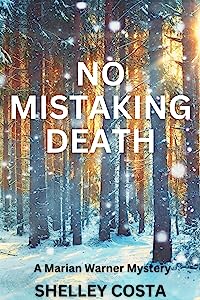
No Mistaking Death, by Shelley Costa*****

I love a wry mystery series, especially when it features a wry female sleuth. Kinsey Millhone is done and there’s nothing I can do about it, but Marian Warner is here, and this series is just getting off the ground. My thanks go to Net Galley, Level Best Books, and Shelley Costa for the review copy.  This book is for sale now.

Marian is a private eye, mostly; when there isn’t enough custom to pay the landlord, she does other things on the side. But now, her sister Joan is sending her to investigate whether a former Jesuit Mission house in Carthage, Ohio qualifies for National Landmark status. Carthage is a tiny little hamlet in the middle of nowhere, but it contains Marian’s old flame, Charlie. She goes.

The first book of a mystery series poses extra challenges to its author, who must simultaneously spin out the mystery itself while also introducing and developing its protagonist and any repeating secondary characters, all without slowing the pace. Costa does both splendidly.

By the time Marian hits town, things have grown more complicated; you see, the possibly-historical mission house now sports its own murdered corpse. From here, the story builds in a way that is undeniable, and occasionally laugh-out-loud funny. In particular, there is quirky figurative language sprinkled throughout, and it jumps at the reader unexpectedly.

By the story’s conclusion, I feel as if I’ve just stuffed myself with something delicious. Nothing here is predictable, and I can’t wait to see more of Marian Warner. Highly recommended to those that like a cozy mystery with a bit of an edge.  

The Bitter Past, by Bruce Borgos***

2.5 stars, generously rounded upward.

The Bitter Past is the first in the Porter Beck series by Bruce Borgos, and if I liked it, I’d be thrilled to read more. On balance, though, I don’t. Nevertheless, my thanks go to Net Galley and St. Martin’s Press for the invitation to read and review. This book is for sale now.

The setting is the hinterlands of Nevada; part of the story takes place in the 1950s, and part of it is in the present. I rate the historical threads as 3.5 stars, and the contemporary part as 1. The premise is that Porter Beck is the local sheriff who is called when a grisly murder is discovered; in addition, a sister-wife goes missing. Sana Locke is the woman that the Feds send in, uninvited. The premise for the other thread is that a Russian operative named Georgiy Dudko lands in Nevada, tasked with entering the nuclear test site and stealing a nuclear warhead. Toward the book’s conclusion, we see how the two stories are joined.

Before I am even twenty percent of the way into this story, my hackles are up. I haven’t seen an author write with such brazen disrespect for women in a very long time, and I hope not to see it again. You see, Beck is God’s gift to women, and it’s a good thing, too, because none of them prove smart enough to find their butts with both hands until he sails in and fixes everything. From the instant Agent Sana enters the narrative, introducing herself as FBI, Beck is the guy in charge, and Sana is his li’l buddy, his sidekick. Good thing he is here to educate her. It is Beck that finds a hidden room in a house they’re searching; it is Sana whose eyes “go big.” He has to dive quickly to save her from the bad guy with the gun. He tells her what to do, and she does it. Here are some quotes that set my teeth on edge:

“Before [Sana] can speak, I place a finger over her lips.”

“Sana appears confused.”
“I bring my finger under her chin. ‘Look up.’”

And no collection of sexist bilge is complete without the old saw about how women are unable to get along with other women: “[Sana’s] still miffed about Brinley, [Beck’s sister] and it’s clouding her judgment…I glare at Brin, a warning to her to retract her claws.”

Beck feels completely free to comment on Sana’s physical features, particularly her “exquisite ass,” but of course, Sana likes that in a guy. She’s in the sack with his middle-aged, um, butt in no time flat.

For a long time I hold out hope that things will turn around, and the author will prove to us that actually, Beck is about to get his just desserts, and Sana had been sent to take him down for some reason, but the only comeuppance she deals him at any point is when she pulls a jujitsu move on him, and that’s only once.

What else? Ah yes, the sister-wife. The girl’s husband is a good FLDS neighbor, Beck tells Sana. They don’t force anyone to marry. She’s seventeen years old, so it’s fine.

What the fuck. Seriously? Excuse me while I grab my blood pressure medication.

In addition to all of this, there is the constant use of the word “illegal” to describe a person that is in the U.S. without documentation. They don’t even call them illegal immigrants, or illegal residents. They don’t merit a full grammatical description.

The thread that takes place in the past is more palatable. Georgiy needs into the nuclear test site, and so he befriends a scientist that works there, and is introduced to Kitty, the scientist’s daughter, whom he courts and accidentally falls in love with. Kitty is not developed as a character any more than Sana is, but at the same time, during the 1950s in the U.S., marriage and motherhood were very nearly the only acceptable path for women, so within the context of time and place, this is believable. I like Georgiy much better than Beck, that’s for sure!

There’s a twist of sorts at the end, but it’s not all that impressive, and it mitigates nothing.

I was provided with the digital review copy and the audio as well, and so I listened and read at the same time. Narrator James Babson does a fine job portraying the characters as they are written, and he isn’t to blame for the way I feel as I read.

That’s it in a nutshell. If all of this sounds just fine to you, then go ahead and get this thing, and stay away from me. Does anyone have any matches I can use?

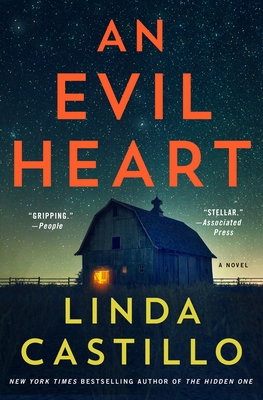
An Evil Heart, by Linda Castillo****

Four stars for the printed version.

Although An Evil Heart is the fifteenth entry in the Kate Burkholder series, it is my first, and also the first time I have read a book by Linda Castillo. I came to this one on the advice of Goodreads friends, and they weren’t wrong. My thanks go to Net Galley, Macmillan Audio, and St. Martin’s Press for the review copies. This book is available to buy now.

Our story is set in the fictitious town of Painter’s Mill, Ohio, where the Amish make up about a third of the population. Kate Burkholder, the chief of police here, is preparing for her wedding when a call comes in about a bizarre murder. A young Amish man, Aden Karn, has been shot with a crossbow and left to die. This would be unusual anywhere, but for the peaceable Amish, it is a tremendous blow. Who would do such a thing? And then there’s another murder as well. Are they linked, and if so, how?

Of course, things are not what they seem. Eventually, Emily Byler, Aden’s girlfriend, comes in to the station accompanied by both of her parents. Emily has finally confessed the horrible deeds that Aden has visited upon her. As the girl, burdened by “a dark mix of horror, shame, and grief,” buries her face in her mother’s shoulder, her mother says “Let me tell you about Aden Karn. The devil whispered his name and Aden Karn took his hand and went.”

But Emily didn’t kill Aden, so the case is far from being solved; if anything, it’s become more complex. Now Kate wonders whether Aden did such things to other girls as well.

At the outset I listen to the audio version of this book, and friend, it’s dreadful. For awhile I wonder whether it’s read by an A.I., because the sound is choppy, the words cut off in a way that suggests it’s not the fault of any narrator. But as I reach the 20th percentile, I realize that actually, the reader is not doing well, either. When it comes to voicing the male characters, the narrator sounds amateurish, and I have never said this about a narrator before. I begin to dread opening this book again, and that’s when I abandon the audio entirely and settle in with the digital review copy instead. It is the right thing to do. Castillo is a good author with a poor narrator, and I hope the glitches in the sound quality have been dealt with now that it’s publication day.

The ending is somewhat predictable, but not until the last quarter or so of the book. I would cheerfully read further entries into this series, and can tell you from experience that you can jump in right now without concerning yourself over the first 14 books if you choose. I recommend the printed version of this book to all that love the genre.

Bad, Bad Seymour Brown, by Susan Isaacs*****

Susan Isaacs has been writing bestsellers since the late 1970s, and she’s hilarious! I’ve been a fan since then. During that earlier time, a period of third wave feminism, her tales often featured rotten husbands and ex-husbands reaping what they’d sown. Her creativity and trademark snark have always kept me running back for more. Her new novel, Bad, Bad Seymour Brown is the second in the Corie Geller detective series, and it’s deeply satisfying. My thanks go to Net Galley and Grove Atlantic for the review copy. This book is for sale now.

Seymour Brown was an accountant for the Russian mob. “I’ve never heard of a violent accountant before,” my mom observed. “At worst, they’re a little pissy.” But by all accounts, Seymour was a rotten guy. “He made regular bad look good.” Bad to everyone, that is, except his five year old daughter April, his only child, for whom the sun rose and fell. But Seymour’s family was tucked away for the night when an unknown assailant came and burned the house to the ground with the Browns inside it. Happily, April made it out the window alive. The case was never solved.

Now April is an adult, a professor in film studies. She’s put her past behind her, and now, all of a sudden—someone is trying to kill her! She contacts the detective that was assigned to the murder investigation; he’s retired now, and he is Corie Geller’s father.

All of the things that I love about Isaacs’s work are here in abundance. The story is full of feminist moxie—Geller isn’t an assistant to her father, but rather retired from the FBI in order to raise her stepdaughter—she is his partner in this new investigation, and as it happens, in the new detective agency they’ve begun. But another thing I’ve always loved about Isaacs’s prose is her trademark snark, and I snickered and chortled all the way through this engaging novel. The pages flew by, and I found myself looking for extra reading time when I could sneak off to plunge in once more. Susan Isaacs writes the most creative figurative language I’ve seen anywhere. She’s funny as hell.

You can read this book as a stand-alone, but I’ll tell you right now, once you read the second, you’ll want to read the first one, Takes One to Know One also.

Highly recommended, particularly to feminist boomers.