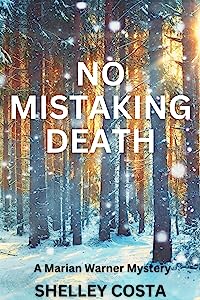
No Mistaking Death, by Shelley Costa*****

I love a wry mystery series, especially when it features a wry female sleuth. Kinsey Millhone is done and there’s nothing I can do about it, but Marian Warner is here, and this series is just getting off the ground. My thanks go to Net Galley, Level Best Books, and Shelley Costa for the review copy.  This book is for sale now.

Marian is a private eye, mostly; when there isn’t enough custom to pay the landlord, she does other things on the side. But now, her sister Joan is sending her to investigate whether a former Jesuit Mission house in Carthage, Ohio qualifies for National Landmark status. Carthage is a tiny little hamlet in the middle of nowhere, but it contains Marian’s old flame, Charlie. She goes.

The first book of a mystery series poses extra challenges to its author, who must simultaneously spin out the mystery itself while also introducing and developing its protagonist and any repeating secondary characters, all without slowing the pace. Costa does both splendidly.

By the time Marian hits town, things have grown more complicated; you see, the possibly-historical mission house now sports its own murdered corpse. From here, the story builds in a way that is undeniable, and occasionally laugh-out-loud funny. In particular, there is quirky figurative language sprinkled throughout, and it jumps at the reader unexpectedly.

By the story’s conclusion, I feel as if I’ve just stuffed myself with something delicious. Nothing here is predictable, and I can’t wait to see more of Marian Warner. Highly recommended to those that like a cozy mystery with a bit of an edge.  

The Bitter Past, by Bruce Borgos***

2.5 stars, generously rounded upward.

The Bitter Past is the first in the Porter Beck series by Bruce Borgos, and if I liked it, I’d be thrilled to read more. On balance, though, I don’t. Nevertheless, my thanks go to Net Galley and St. Martin’s Press for the invitation to read and review. This book is for sale now.

The setting is the hinterlands of Nevada; part of the story takes place in the 1950s, and part of it is in the present. I rate the historical threads as 3.5 stars, and the contemporary part as 1. The premise is that Porter Beck is the local sheriff who is called when a grisly murder is discovered; in addition, a sister-wife goes missing. Sana Locke is the woman that the Feds send in, uninvited. The premise for the other thread is that a Russian operative named Georgiy Dudko lands in Nevada, tasked with entering the nuclear test site and stealing a nuclear warhead. Toward the book’s conclusion, we see how the two stories are joined.

Before I am even twenty percent of the way into this story, my hackles are up. I haven’t seen an author write with such brazen disrespect for women in a very long time, and I hope not to see it again. You see, Beck is God’s gift to women, and it’s a good thing, too, because none of them prove smart enough to find their butts with both hands until he sails in and fixes everything. From the instant Agent Sana enters the narrative, introducing herself as FBI, Beck is the guy in charge, and Sana is his li’l buddy, his sidekick. Good thing he is here to educate her. It is Beck that finds a hidden room in a house they’re searching; it is Sana whose eyes “go big.” He has to dive quickly to save her from the bad guy with the gun. He tells her what to do, and she does it. Here are some quotes that set my teeth on edge:

“Before [Sana] can speak, I place a finger over her lips.”

“Sana appears confused.”
“I bring my finger under her chin. ‘Look up.’”

And no collection of sexist bilge is complete without the old saw about how women are unable to get along with other women: “[Sana’s] still miffed about Brinley, [Beck’s sister] and it’s clouding her judgment…I glare at Brin, a warning to her to retract her claws.”

Beck feels completely free to comment on Sana’s physical features, particularly her “exquisite ass,” but of course, Sana likes that in a guy. She’s in the sack with his middle-aged, um, butt in no time flat.

For a long time I hold out hope that things will turn around, and the author will prove to us that actually, Beck is about to get his just desserts, and Sana had been sent to take him down for some reason, but the only comeuppance she deals him at any point is when she pulls a jujitsu move on him, and that’s only once.

What else? Ah yes, the sister-wife. The girl’s husband is a good FLDS neighbor, Beck tells Sana. They don’t force anyone to marry. She’s seventeen years old, so it’s fine.

What the fuck. Seriously? Excuse me while I grab my blood pressure medication.

In addition to all of this, there is the constant use of the word “illegal” to describe a person that is in the U.S. without documentation. They don’t even call them illegal immigrants, or illegal residents. They don’t merit a full grammatical description.

The thread that takes place in the past is more palatable. Georgiy needs into the nuclear test site, and so he befriends a scientist that works there, and is introduced to Kitty, the scientist’s daughter, whom he courts and accidentally falls in love with. Kitty is not developed as a character any more than Sana is, but at the same time, during the 1950s in the U.S., marriage and motherhood were very nearly the only acceptable path for women, so within the context of time and place, this is believable. I like Georgiy much better than Beck, that’s for sure!

There’s a twist of sorts at the end, but it’s not all that impressive, and it mitigates nothing.

I was provided with the digital review copy and the audio as well, and so I listened and read at the same time. Narrator James Babson does a fine job portraying the characters as they are written, and he isn’t to blame for the way I feel as I read.

That’s it in a nutshell. If all of this sounds just fine to you, then go ahead and get this thing, and stay away from me. Does anyone have any matches I can use?

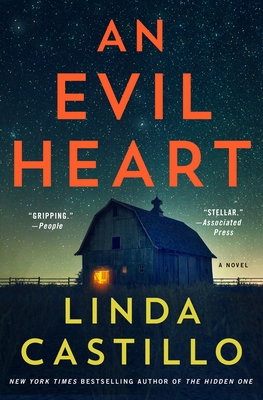
An Evil Heart, by Linda Castillo****

Four stars for the printed version.

Although An Evil Heart is the fifteenth entry in the Kate Burkholder series, it is my first, and also the first time I have read a book by Linda Castillo. I came to this one on the advice of Goodreads friends, and they weren’t wrong. My thanks go to Net Galley, Macmillan Audio, and St. Martin’s Press for the review copies. This book is available to buy now.

Our story is set in the fictitious town of Painter’s Mill, Ohio, where the Amish make up about a third of the population. Kate Burkholder, the chief of police here, is preparing for her wedding when a call comes in about a bizarre murder. A young Amish man, Aden Karn, has been shot with a crossbow and left to die. This would be unusual anywhere, but for the peaceable Amish, it is a tremendous blow. Who would do such a thing? And then there’s another murder as well. Are they linked, and if so, how?

Of course, things are not what they seem. Eventually, Emily Byler, Aden’s girlfriend, comes in to the station accompanied by both of her parents. Emily has finally confessed the horrible deeds that Aden has visited upon her. As the girl, burdened by “a dark mix of horror, shame, and grief,” buries her face in her mother’s shoulder, her mother says “Let me tell you about Aden Karn. The devil whispered his name and Aden Karn took his hand and went.”

But Emily didn’t kill Aden, so the case is far from being solved; if anything, it’s become more complex. Now Kate wonders whether Aden did such things to other girls as well.

At the outset I listen to the audio version of this book, and friend, it’s dreadful. For awhile I wonder whether it’s read by an A.I., because the sound is choppy, the words cut off in a way that suggests it’s not the fault of any narrator. But as I reach the 20th percentile, I realize that actually, the reader is not doing well, either. When it comes to voicing the male characters, the narrator sounds amateurish, and I have never said this about a narrator before. I begin to dread opening this book again, and that’s when I abandon the audio entirely and settle in with the digital review copy instead. It is the right thing to do. Castillo is a good author with a poor narrator, and I hope the glitches in the sound quality have been dealt with now that it’s publication day.

The ending is somewhat predictable, but not until the last quarter or so of the book. I would cheerfully read further entries into this series, and can tell you from experience that you can jump in right now without concerning yourself over the first 14 books if you choose. I recommend the printed version of this book to all that love the genre.

Bad, Bad Seymour Brown, by Susan Isaacs*****

Susan Isaacs has been writing bestsellers since the late 1970s, and she’s hilarious! I’ve been a fan since then. During that earlier time, a period of third wave feminism, her tales often featured rotten husbands and ex-husbands reaping what they’d sown. Her creativity and trademark snark have always kept me running back for more. Her new novel, Bad, Bad Seymour Brown is the second in the Corie Geller detective series, and it’s deeply satisfying. My thanks go to Net Galley and Grove Atlantic for the review copy. This book is for sale now.

Seymour Brown was an accountant for the Russian mob. “I’ve never heard of a violent accountant before,” my mom observed. “At worst, they’re a little pissy.” But by all accounts, Seymour was a rotten guy. “He made regular bad look good.” Bad to everyone, that is, except his five year old daughter April, his only child, for whom the sun rose and fell. But Seymour’s family was tucked away for the night when an unknown assailant came and burned the house to the ground with the Browns inside it. Happily, April made it out the window alive. The case was never solved.

Now April is an adult, a professor in film studies. She’s put her past behind her, and now, all of a sudden—someone is trying to kill her! She contacts the detective that was assigned to the murder investigation; he’s retired now, and he is Corie Geller’s father.

All of the things that I love about Isaacs’s work are here in abundance. The story is full of feminist moxie—Geller isn’t an assistant to her father, but rather retired from the FBI in order to raise her stepdaughter—she is his partner in this new investigation, and as it happens, in the new detective agency they’ve begun. But another thing I’ve always loved about Isaacs’s prose is her trademark snark, and I snickered and chortled all the way through this engaging novel. The pages flew by, and I found myself looking for extra reading time when I could sneak off to plunge in once more. Susan Isaacs writes the most creative figurative language I’ve seen anywhere. She’s funny as hell.

You can read this book as a stand-alone, but I’ll tell you right now, once you read the second, you’ll want to read the first one, Takes One to Know One also.

Highly recommended, particularly to feminist boomers.

Unnatural History, by Jonathan Kellerman****

Unnatural History is the 38th entry in the wildly successful Alex Delaware series. I began reading it soon after the first volume was published; When the Bough Breaks came out in 1985, so the series has been going strong for close to forty years, and very well may continue for many more. My thanks go to Net Galley and Random House Ballantine for the review copy. This book is for sale now.

For the uninitiated, Delaware is a child psychologist; Kellerman is also a child psychologist, and his earlier books incorporated his area of expertise, placing him in a subgenre all his own. I’ve wished many a time that he would write more books along these lines, but he hasn’t done a lot of it lately, and in this book,  there are only glimpses of it. Nevertheless, the story held my attention.

I’m not giving you much of the plot, because there’s a synopsis for that, but in large strokes, the story is about the murder of the son of one of the world’s wealthiest men. He’s an odd duck, not terribly bright; his mother is dead, and his father is a hands-off parent, to say the very least. Our victim has unlimited access to money, and that’s about it. He makes a splash in the art world by photographing homeless people in costumes that reflect their deepest dreams. Find a derelict street person, and find out what they always wanted to be. A pilot? A surgeon? A ballerina? Offer them the chance to be photographed as if that’s what they are now, and give them a juicy wad of cash for their trouble; then send them back to the streets where they came from.

The family structure for this strange young artist is truly bizarre; the father marries, and he fathers a child. One child, no more. Then, a couple years later, he divorces his wife and does the same thing again. The children of these unions are never introduced to one another.

Thus, Milo has plenty of meaty material to work with, and with such strange circumstances, Alex is tapped to analyze the participants.

Delaware works part time as a kiddie shrink, often consulting when there is a court case involving insurance claims or divorce. However, he still has plenty of time to work for the Los Angeles Police Department, consulting on cases where a psychologist’s input is valuable. His BFF, Milo Sturgis, is a homicide detective, spurned by others in the department because of his sexual orientation. Often as not, Delaware ends up riding along as an unofficial partner.

This aspect of the series—the almost-a-cop—is usually where things start to slip a little, when anything does. I want to buy the premise, and so I can go along with it as long as it doesn’t become too obviously unrealistic. We all want to be entertained, right? So when Alex trots out to the patrol car and slides in beside Milo, I smile and nod, and I push away the little skeptic within me that says, “But really…?”

There have been a few Delaware books that have gone sideways for me for that reason, books where Delaware puts on his Kevlar vest and packs a revolver. I am happy to say that this isn’t one of them. In fact, the manner in which these details are dealt with is one of its strengths. First of all, there are times when Milo wants Alex to go with him, but Alex is busy. He has to be in court that morning. Thank you! Then later on, toward the climax, there’s a situation that (no spoilers) shakes out in a way I find the most believable of anything Kellerman has written. It’s satisfying, without sacrificing the fun of the story.

The whodunit at the end might be the nicest touch of all.

I recommend this mystery to Kellerman’s faithful readers, and to those that love the genre.

Everyone in My Family has Killed Someone, by Benjamin Stephenson****

When life gets you down, it’s time to kick back and relax with a nice little book about multiple murders. Benjamin Stevenson’s nifty little mystery is just the ticket. This book is for sale now.

My thanks go to Net Galley and Random House for the review copy.

Once in a while, a novelist will disarm his audience by speaking to them directly; this is known as breaking the fourth wall. Stevenson doesn’t just chip a corner of plaster; he comes in with a wrecking ball, because that’s just the kind of writer he is. The product is as funny as the title. Each chapter is devoted to a family member, and some of them get more than one.

The premise is this: narrator Ernest Cunningham is invited to a family reunion at an out of the way mountain lodge, a ski resort in the dead of winter. The event is timed to coincide with Ernest’s brother, Michael’s, release from prison, where he was sent for…well. You know. And as is true with all families, there’s all kinds of baggage, both literal and figurative; there are grudges, guilt, and oh yes, secrets. So many secrets!

The first body turns up in less than twenty-four hours. Is there a mass murderer at large, perhaps the one in the news dubbed “The Black Tongue?” If so, is s/he a Cunningham?

The whole story is told in a jocular, familiar tone, explaining to the reader what the rules are when writing a murder mystery. He assures us that he is a thoroughly reliable narrator, which immediately makes us wonder, because if so, why bring it up? Most narrators are reliable. So…?

I enjoy reading this thing, and am impressed at how well the author juggles a sizeable collection of characters. It doesn’t take me long to straighten out who everyone is, and this may be because we are apprised of who is annoyed with whom over what, fairly quickly. When he brings in reasons why certain people avoid each other, it helps me recall who they are.

There are two things I would change if I could. The book would be even funnier if he cut back on the side remarks to the reader long enough to let us forget he’s doing it; then, when it surfaced again, it would get more laughs. I note that toward the end, he tells us—in another side reference—that his editor has suggested he pare back some of the chatty parts, and that he isn’t going to do it. That makes me laugh too, because I have been harboring the same notion.

The other thing that I’d change is a detail that distracts me. The author refers early on, and then another time later, to a plot hole big enough to drive a truck through, but he never tells us what it is; possibly the detail that distracts me is the thing he refers to. Early on in the story—so probably not a spoiler—Ernest is badly injured, to the point where one of his hands isn’t usable. Yet throughout the story, when he could go to a hospital, he doesn’t do so, and he doesn’t even address the possibility. People come; people go. Yet there’s Ernest, with an oven mitt stuck over one hand to protect it, and nobody suggests he hop into town and have it looked at. Toward the end of the story there’s a general reference to the Cunningham stubbornness preventing family members from leaving the reunion, but it doesn’t hold water with me.

Nevertheless, this is a fun book. While I was reading it, I was reading several others, but this one became the go-to at lunchtime and whenever I had a spare minute, and so I recommend this book to those looking for a light, amusing read.

The Furies, by John Connolly*****

The Furies is #20 in the Charlie Parker detective series, by John Connolly. Several entries ago, Connolly began introducing supernatural elements so that each novel now is either a detective story laced with elements of horror, or else a true hybrid. Friends, nobody does this better than Connolly. Nobody.

My thanks go to Atria Books and Net Galley for the review copy. This book is for sale now.

This particular book is singular in that it is a pair of novellas in one volume, but they share the same characters, and flow so smoothly that I forget, at times, that it’s two different stories. Each of them has women that are either at risk of death or grave bodily harm, or that appear to be. The characters are brilliantly crafted; some are old favorites that Connolly’s faithful readers will recognize. We have Angel and Louis, not much, but enough to satisfy; the Fulci Brothers return, and these guys make me laugh out loud. (Notice that I don’t say that Connolly makes me laugh. I believe the characters enough that most of the time, my readerly relationship isn’t with the author, but with the characters themselves.) And we have some brand new baddies as well.

I won’t even tell you about all of the ne’er-do-wells that frequent these pages, because there are a host of them, but the most memorable and salient are Raum Buker, a career criminal, and Bobby Wadlin, an opportunistic slumlord who runs a boardinghouse for the formerly incarcerated. Let’s take a look at Raum:

“There are men who are born into this world blighted, men who are blighted by the world, and men who are intent upon blighting themselves and the world along with them. Raum Buker somehow contrived to be all three in one person, like a toxic, inverted deity….Raum became his own worst enemy by election, and decided by extension to become the worst enemy of a lot of other people, too….Gradually, like fecal matter flowing down a drain, gravity brought Raum to Portland. He kept company with men whom others avoided, and women who were too foolish, desperate, or worn down by abuse to make better life choices.”

Unfortunately for Raum, he has obtained, extralegally, of course, a rare coin that is also a supernatural talisman. It’s a bit like the ring that Bilbo Baggins and Gollum vie for in The Hobbit, but the coin is loose in modern society among humans during the pandemic.

Bobby Wadlin runs The Braycott Arms where Raum lives, along with some other questionable people. Wadlin is too lazy to be truly evil; he inherited this pile from his late daddy, and he rents rooms to former convicts because they are the least likely to make a fuss over repairs and such that most people expect from their rental lodgings. Wadlin sits behind the front desk during most of his waking hours and sometimes other hours, too, watching endless Westerns on his little television. When things start to go sideways, he turns to an herbal product that is named in the book, and as I read, I became sold on its anti-anxiety attributes and bought some for myself. It works, too! As long as it doesn’t turn me into Bobby Wadlin, I’ll be okay.

There are small but important ways in which Connolly’s skill sets him apart from other writers. An essential component is his timing. Less experienced and analytical authors might create an amusing character or situation, and it’s funny, and then it’s over. For others, they know they’ve struck gold, so then they beat it to death to where it’s stale and loses its magic. Connolly seems to know precisely at what point to bring back the humorous bits for maximum effect. He lets us forget all about that hysterical situation or person back there, earlier in the novel, and so when he brings it out again, the hilarity hits us right in the funny bone. There’s never a wasted word, with everything carefully measured and edited down for maximum effect.

If there is one area in which this author might improve, it’s in the way he writes female characters. When I finish a Parker novel, it’s always the men that I remember. Connolly demonstrates tremendous respect for women, but he doesn’t fully develop any of them. There it is, a challenge.

Nonetheless, The Furies is brilliant and entertaining, and I recommend it enthusiastically to you.  

Murder Book, by Thomas Perry*****

Harry Duncan is a former cop, now a private investigator. His ex-wife, Ellen, is the U.S. Attorney for the region, and she asks him to check out a small town that appears to have a racketeering problem. Is it serious enough to warrant the attention of the FBI? Harry agrees to explore the situation, which turns out to be far more serious than either of them imagined.

My thanks go to Net Galley and Random House for the review copy. This high octane thriller is for sale now.

Perry’s feet have hardly hit the ground in this tiny Indiana backwater before he discovers a protection racket. A local businesswoman is determined not to pay; how can a bar or restaurant pay $300 daily and still stay open? The profit margin just doesn’t allow for it. And the thugs know that. But let’s not get ahead of ourselves. Rather than give anything away, I’ll just say that there’s more to this than meets the eye in this tiny, out of the way burg.

Perry is king when it comes to details involving stealth and unobtrusive investigation. Whereas a cop cannot use the unorthodox (and okay, illegal) methods that Duncan employs, a consultant can and does, or at least, he can and does in this story.

And if one were to criticize this novel, that’s the soft spot—because almost nothing about this tale is realistic. It’s so much fun to read, though, that by the time I thought, “Wait a minute…” the rest of my thoughts shushed my inner cynic as if it were a noisy jerk in the back row at a movie theater.

Highly recommended.

The Devil Aspect, by Craig Russell

3.5 stars, rounded upward. I read this creepy tale during the last half of October, and it is indeed a good way to get into the Halloween spirit. I am disgracefully late with my review—3.5 years late, as it happens—but I do thank Net Galley and Doubleday for the review copy. This book is, of course, for sale now.

Here is what drew me in. This is horror of the old school variety, with gothic towers and half a dozen criminally insane inmates. It’s set in Czechoslovakia, which I seldom see. The flavor, overall, is similar to the stories we told as children around campfires or late at night during slumber parties. Of course, it has a more adult approach, but even so, this is classic horror.

Our protagonists are Viktor Kusarek, a Jungian psychiatrist who comes to the asylum to conduct experiments on the patients, or inmates, in order to prove a theory, and police chief Lukas Smolak, who is pursuing a serial killer that is running amok in Prague.

This is a story that is more about the journey than the destination, though perhaps not intentionally so. Hearing about each of the six savage killers as Viktor interviews them is vastly entertaining. There’s one spot about a third of the way in, where a patient, partially sedated, is explaining that he is innocent, and also that a guest sorely provoked him. Always so critical! He was determined to impress her with his cooking, and indeed, the longer he worked at the stove, the more reasonable she became. Viktor points out that the guest had stopped complaining because he had her head in the skillet. I laughed out loud! The middle of this novel is unmissable.

There are three things I would change. First, the book is a little overlong, and could bear some tightening. Second, the whole Nazi menace has nothing to do with the problem or its resolution. It seems more like window dressing than anything else, but it doesn’t add a thing to the story. If I were the editor, I would cut that part of it out and voila, some of the tightening would be achieved. And third, the ending is so, so predictable. I stuck with the story until around the 85 percent mark, at which point I figured all hope of an ending other than what I expected was pretty much gone. At that point I skipped to the end. Yup. There it was. I would have liked a less formulaic ending.

Still and all, fans of old fashioned horror could do a lot worse. If this sounds like your kind of book after everything I have said, then go for it. I am old and cranky, and what seems obvious to me might seem new and clever to those that haven’t read many books of this ilk. And one way or the other, getting there is a lot of fun.

When the Stars Go Dark, by Paula McClain***-****

I have never read Paula McClain’s work before, but a number of Goodreads friends expressed enthusiasm about her novels, so I decided to see what the excitement was about. I came away a little underwhelmed, but nevertheless, thanks go to Net Galley and Random House Ballantine for the review copy. This book is for sale now.

Our protagonist is Anna Hart, and she’s a missing persons detective in San Francisco. A tragedy has sent her running off to lick her wounds, and the bulk of the story is dark and brooding in tone. Then a missing persons case appears that bears striking similarity to one she was confronted with many years ago, and she becomes a dog on the hunt. There’s a bit of magical realism sprinkled in, things she “just knows” that help her solve the case.

Here is a note I wrote during the first half of the book, and it effectively sums up how I felt for most of the story:

“This is one of those stories where the first person narrator bobs and weaves, trying to tell us a few things while withholding all sorts of important, motivating events in her past. It’s getting tiresome, and I want her to just fucking spit it out so that we can move on.”

I suspect that if McClain had used a lighter hand with the veiled references, mentioning them less frequently and then returning to them later, I might have had a more charitable viewpoint.

As it stands, I wouldn’t call this a bad novel, just not a great one. If you are a fan of her earlier work, you may love this book just as much. But if you haven’t read McClain before and are about to lay down your money for just one book within this genre, I advise you to choose something else.