The Tin Roof Blowdown, by James Lee Burke*****

thetinroofblowSometimes people say they “ran across” a book, and that is close to how I came to read James Lee Burke for the first time. I had been tidying up for company, and my daughter had selected this book from the “free” pile at school, then decided she didn’t want it. She is a teenager, so instead of finding our charity box and putting it there, she dropped it on the upstairs banister. I scooped it up in irritation..then looked at it again. Flipped it over…read the blurb about the writer. This man is a rare winner of TWO Edgars. Really? I examined the title again; I hadn’t read any novels based on Hurricane Katrina, so why not give it a shot?

There are about a dozen writers whose novels I will read just because they wrote them. This man is now one of them. I appreciated his ability to develop characters, deal respectfully but realistically with the tragedy and travesty that was Hurricane Katrina (followed by Rita) and recognize it as such; and keep about a million plot threads going without ever dropping anything. In fact, the complexity of the character line-up–somewhere between a dozen and fifteen important people to remember, when I was on the verge of falling asleep for the night–gave me pause, but then this is #6 in a series, so it is possible that if I’d begun with #1, some of them would have been old friends by now, with just a few new ones introduced (and some disposed of before the story was over).

The setting was entirely unfamiliar to me; I have never spent time in the deep southern part of the USA, unless you count a trip with my family to Disney World, and have never set foot in Louisiana. Burke knew it well enough for both of us. His word work was sufficient to lay the canvas before me,and the devastation that was visited upon those who had previously been poor but stable was laid bare:

“They drowned in attics and on the second floors of their houses. They drowned along the edges of Highway 23 when they tried to drive out of Plaquemines Parish. They drowned in retirement homes and in trees and on car tops while they waved frantically at helicopters flying by overhead. They died in hospitals and in nursing homes of dehydration and heat exhaustion, and they died because an attending nurse could not continue to operate a hand ventilator for hours upon hours without rest.”

He gave due credit to those who, in an official capacity or otherwise, worked tirelessly for up to 72 hours on end to save the lives of the vulnerable who had been unable to get out in time, or whose parents had made the wrong choice for them. But he also tells the truth about the condition of the levee that was supposed to protect the residents of New Orleans, and how it had been permitted to deteriorate, when Federal funds were dropped by 50% without a moment’s notice or explanation, and permitted to deteriorate worst in the Black part of town. The narration spills out with disgust the “latent racism…that was already beginning to rear its head.”

Meanwhile, our hero, cop Dave Robicheaux, is trying to find out the whereabouts of a “junkie priest” who perished trying to evacuate his parishioners, but died in the flood waters when criminals stole his boat. He also keeps track of his best friend Clete, a bail bondsman and private detective who will follow him around if he is not included in the search, because some of the people Robicheaux is trying to locate are also bail skippers, and therefore also his bread and butter. Clete is an alcoholic and makes some really bad decisions; Robicheaux tirelessly tries to keep him under his wing and under control, all the while also trying to keep his wife and daughter safe from a local mercenary he’s investigating. The bad guy knows that Robicheaux’s family is his greatest treasure, and threatens them as an attempt to make him back off.

While parts of New Orleans appear untouched by Katrina, others have had their entire infrastructures destroyed, and there are virtually no navigable roads; the waters are treacherous as well, with downed power lines and debris just below the surface. In short, he has his work cut out for him.

Burke’s bad guys are complicated characters. All come from hideous family situations, and childhood has left its unalterable mark on them, but they are layered in the depths to which they will stoop in seeking wealth, power, or simply revenge. One is capable of property crime, violence, even rape, but finds he cannot look an unarmed man in the eye and shoot him; another can do it without a hitch in his heartbeat. The street smart voices I heard within these chapters felt real to me.

But the consistent thread which lies at the core of the story, of the storm, of everything that takes place between its covers, is one which the writer has hold of like a pit bull with a rat. He has his jaws around it and shakes it without ever letting loose of it, whatever other events weave in and out of his pages, the racism that caused the most harm to be brought upon those with the fewest resources, intentionally and maliciously. He will not let go of the racism that rules New Orleans.

“The original sympathy for the evacuees from New Orleans was incurring a strange  transformation. Right wing talk shows abounded with callers viscerally enraged at the fact evacuees were receiving a onetime two-thousand-dollar payment to help them buy food and find lodging. The old southern nemesis was back,naked and raw and dripping–absolute hatred for the poorest of the poor.”

I can see why this guy has a pair of Edgars to bookend his mantel. He spins a compelling, absorbing tale, and the values and priorities that lay at the core of his work are ones I share and appreciate. It was in reading this novel that I became a die-hard James Lee Burke fan. I wrote this review before I had a blog on which to put it, and this book is a must-read for those that love good fiction, good mysteries, or that care about social justice.

The Man Who Cried I Am, by John A. Williams*****

TheManWhoCriedIAmThe Man Who Cried I Am was originally published during the turmoil of the late 1960’s, in the throes of the Civil Rights and antiwar movements, and following the assassinations of President Kennedy, his brother Bobby, Martin Luther King Junior, and Malcolm X. Now we find ourselves in the midst of a long-overdue second civil rights movement, and this title is published again. We can read it digitally thanks to Open Road Integrated Media. I was invited to read it by them and the fine people at Net Galley. I read it free in exchange for an honest review. It is available for purchase now.
The story is a fictionalized account of the life of writer Richard Wright, one of the giants within African-American literature. I am ashamed to say that although I did pick up a copy of both Native Son and Black Boy, his two most famous books, they were still perched on my to-read pile when this invitation rolled in. I found myself perusing this meaty material without knowing anything about Wright himself, apart from his legendary stature and his occupation. I wanted to be able to give my readers a strong critical analysis of this novel, but I have really struggled with it. I found myself having to do a Wiki search in order to figure out whether Max Reddick or Harry Ames was supposed to be Wright. It’s embarrassing. I will read it over again and try to publish something more useful than this review in the future, but I promised to publish my thoughts on the book no later than today—a week following its release—and so I’m going to tell you what I can.

As literary fiction, it’s strong. Ames, who is Wright, as it turns out, and Reddick, who is James Baldwin fictionalized, go on an Odyssey all their own, leaving the USA and its myriad racial issues behind for Europe. A number of other historical luminaries are recognizable in its pages by different names, in addition to those called by their real names, such as Dewy and Truman, and philosopher Camus. The time period spans from post-World War II to the Civil Rights movement.

So many social issues are embraced here that I found myself making far more notes and highlighting more quotes than I can use. The debate unfolds as to how the Communist Party USA treats artists, as opposed to workers, and even touches briefly on the assassination of Trotsky at the hands of a Stalinist agent. Discrimination against African-American (then referred to as Negro) soldiers in the Buffaloes is part of Reddick’s inner narrative. Black Pride had not yet had its day, and Black men often coveted relationships with Caucasian women, partly, as Malcolm X later pointed out, from self-hatred, partly as a social status symbol, and occasionally for the practical material benefits of marrying into, or becoming aligned with, a woman that had access to money. But this was also a double-edged sword, because the women’s movement hadn’t occurred yet either, and women were supposed to stay home and have babies while their men went off to work.

The whole thing is very complicated.

In this time prior to the 1973 Roe vs. Wade decision that made abortion legal for American women, an unwanted pregnancy is dispatched by a doctor who is supposed to be quite good and risk free, but of course, the procedure is not legal, and there are no emergency facilities available. One of the characters loses the woman he loves when she bleeds to death after a back-alley abortion. This is not intended to be the primary focus of the book, but it’s huge to me, and so it stayed with me.

Be aware that there are scores of ugly racist terms, used for the purpose of highlighting racism, as well as sexist terms and references to gay men as the f-word. All references are either there because of the time period in which the story is set or for the purpose of defining the struggle of the Black man in America, but readers have a right to know and to brace themselves. There are descriptions of the atrocities visited upon European Jews during the war, as well as references to their struggle in the USA, primarily New York City; again, there are some ugly terms used.

Should you read this title? Not at the beach. This excellent novel is for the serious student of African-American history and for the history student focused on social justice. It’s more than worth your while, and I will re-read it myself after I have read Wright’s work. Just understand that there are many, many historical references that will make you reach for Google. The story was written during a time when the average reader had most of these things—from clothing styles such as zoot suits and pegged pants, to offhand references to the cigarette jingles that once punctuated our radio and television broadcasts as frequently as Coke and Pepsi do now, to slang terms whose use is either gone or worse, changed to mean something else. For example, if someone is high, they haven’t been using street drugs; they are drunk. None of these things is explained to the reader. We must have them stored in our memories; search for the meanings of unfamiliar references; or attempt to understand the text without knowing them.

I consider this literature to be accessible only to those that read at college level.

Highly recommended for those that take African-American literature and history seriously, and whose reading ability is well above average.

Evicted: Poverty and Profit in the American City, by Matthew Desmond*****

EvictedI was cruising for something new to read, something that wasn’t yet another mystery or thriller. I ran across this title and requested it from Net Galley, then asked myself what I had been thinking! Who wants to read an entire book about eviction? What a grim prospect. I was even more surprised, then, when I opened it and couldn’t put it down. Desmond approaches his subject in a way that makes it not only readable but compelling. Thanks go to the people at Crown Publishing and Penguin Random House for approving my request for a DRC. This book is available to the public March 1.

Desmond undertook his study as part of his study of sociology while attending the University of Wisconsin, and continued it into his graduate studies at Harvard. The whole book is based on rentals among high-poverty families living in Milwaukee, Wisconsin, and Desmond explains why this location is a good case study as regards the rest of Midwestern urban America.

Most of the text is told as narrative nonfiction, with the author shadowing eight families, some African-American, some Caucasian, through trailer parks and ghetto apartments in Milwaukee. There is a great deal of dialogue, all of which was captured with permission via digital recorder, so the text flows like good fiction. One Black landlord and one Caucasian landlord are also shadowed, and although I came away feeling that both landlords—one of whom, to my horror, was a former fourth grade teacher—were lower than pond scum, Desmond is careful to also demonstrate the ambiguities, the times when one or the other let things slide when an eviction could have been forced; brought over some groceries for a new tenant and did not ask for repayment; gave tenants opportunities to work off back rent to avoid eviction.

At the same time, we see how ultimately, almost all of what appear to be landlords’ small kindnesses are actually adding to their profit margins.

The text is nicely organized. The beginning and ending are expository in style, as a newspaper or magazine article would be, with the statistics that demonstrate how much more of a renter’s income is eaten by housing than was true in previous years; how a bad credit history can lead a low-income family into an apartment that is substandard and costs as much or more than a nice apartment of the same size in a calmer neighborhood that might be rented by someone with a good credit history; and the terrible dance that must be done to keep both heat and rent paid sufficiently to avoid being cut off with winter on the way, or evicted. It also points out that there are people living in low income apartments that should not even be living independently due to mental health issues or extremely low IQ; Desmond recognizes the times—though they are a tiny minority—in which someone takes that welfare check and does something tremendously stupid with it, not using it for housing, utilities, food, or even clothing for the kids.

He clues us in to the fact that while huge numbers of Black men are getting locked up, huge numbers of Black women, particularly mothers, are getting locked out.

Desmond discusses the various ways landlords manage to avoid fixing even the most desperate plumbing and structural issues in rental housing. He discusses the inevitability of eviction for a renter that calls police—or for whom someone else calls police—due to domestic violence. The problem is considered a “nuisance” by the city; three visits by cops in a month mean huge fines for the landlord unless an eviction is ordered, in which case fines are waived.

It’s enough to make you sick.

Particularly appalling is the situation in which Lamar (all names are changed ) is diligently scrambling to paint apartments and clean out a basement to avoid eviction. The man has no legs, but he can’t collection SSI, because theoretically, he could do a desk job. He crawls around on his stumps to paint the areas his elementary-aged neighbor kids have missed, climbs through filth and muck in a half basement, and is cursed at by his landlord, who says he is trying to disrespect her by doing such a terrible job.

He is evicted anyway, and the landlord becomes unavailable to do repairs for other tenants soon, because she and her co-owner spouse are off to Jamaica.

There are some people that would fit so cleanly into Dante’s seventh circle.

It is the individual stories of the eight families, the various fascinating rationalizations of the two terrible landlords, which keep this from simply becoming a dark place the reader would never want to go. Some of the cultural nuances were really interesting to me, and I have lived in some hard neighborhoods back in the day, and taught many high poverty students. I’ve been to some of their homes. Yet Desmond taught me a great deal.

For those interested in America’s housing crisis; for anyone that has ever been evicted; for those interested in sociology and culture, this book is a must-read.

Blanche On the Lam, by Barbara Neely*****

BlancheontheLamI was already a Barbara Neely fan when I received this DRC, courtesy of the Brash Priority Reviewers Circle, in exchange for an honest review. I’ve been reviewing books for Brash Books and others for the past couple of years, and had read three other Blanche White mysteries out of order, so when I saw that the first in the series—which I think was the only one I hadn’t read yet—was up for grabs, I nailed it right away. It’s available for purchase now.
The amazing thing to me is that although these novels were originally published in the ‘90s, they are extremely relevant right now. For those new to this Anthony, Macavity, and Agatha Award winning book and series, Blanche White is author Barbara Neely’s foil for a number of social issues that are best approached with humor, yet also with absolute, stark clarity. Those that have supported the #BlackLivesMatter movement should order this fantastic book right away. It’s a double win, treating those of us that favor social justice and also enjoy strong fiction. On the other hand, those that don’t understand the current of Black anger that pumps through the small towns, fields and cities of the United States may want to read this book and catch a clue.

She makes everything crystal clear.

Here’s the premise: Blanche, who does domestic work and also has custody of her late sister’s children, is in trouble with the law. She has written some checks she can’t cover, and the fact that they’ve all been paid in full by the time she stands before the court doesn’t make much difference to the judge. She is given two months in the slammer, but a much greater disturbance distracts the officer who’s supposed to lock her up, and without a moment’s hesitation, Blanche slips out a side door to freedom. She knows she has to get gone and figures on leaving the state as soon as she has the money for travel, but in the meantime she escapes by using the greatest camouflage possible…because nobody looks a domestic worker in the face.

The family that has hired her has problems of its own, and Blanche can’t leave once the shit hits the fan, because if a domestic worker suddenly disappears when a crime has been committed, the thing will automatically be blamed on them. Instead, she is pinned like a butterfly, stuck in the kitchen of a horribly dysfunctional—and criminal—family. But Blanche is a born survivor, and the cynical things she does in order to keep herself from harm’s way, and ultimately to avenge the death of a nice man that didn’t deserve his fate are both amusing and riveting.

It is here that we meet Mumsfield, an engaging character who will turn up later in the series.

Blanche’s attitude toward the sheriff and the situations that feature him made me want to stand up and cheer!

I took the opportunity to read Blanche White mysteries as they became available, and I am glad I did. Reader, you have the chance, if you haven’t begun the series yet, to read them in order. Neely’s writing is both politically on-point and also seriously funny. What more could you ask for? Once you read this one, you’ll want to continue the series.

Highly recommended!

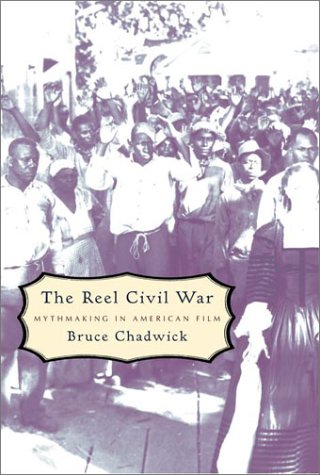
The Reel Civil War: Mythmaking in American Film, by Bruce Chadwick****

thereelcivilwarI found this gem at my favorite used bookstore in Seattle, Magus Books, which is just a block from the University of Washington. Its strength, as the title suggests, is in tracing the story of the American Civil War as told by the cinema. Those interested in the way in which movie impacts both culture and education in the USA would do well to find this book and read it.
Chadwick spends a considerable amount of time and space carefully documenting the myth produced by Gone with the Wind, a completely unrealistic, idealized portrait of the ruling planter class of the deep South. Many of us would, in years gone by, have been inclined to dismiss this concern by saying that after all, the book and movie were primarily intended as a love story, but Chadwick demonstrates that this is not so. He ferrets out actual interviews with Margaret Mitchell herself in which she insists that this is exactly the way it was. Her sources? Former plantation owners, of course.

To this day, if an avid reader goes to Goodreads.com and under the caption “explore”, goes to “listopia” and from there selects a list of readers’ favorite Civil War titles, GWTW will place within the top ten, and sometimes be the foremost title, selected over nonfiction as well as more accurate fiction. I find this horrifying.

The research regarding the Civil War itself is nothing I haven’t seen before, but Chadwick makes excellent use of strong secondary sources to document the fact that Black folks in the pre-war South were neither happy nor well treated. He takes apart the myth Mitchell constructed in a meticulous manner, one damn brick at a time. Hell yes. About ten percent of the way into the book, Chadwick’s removed, scholarly tone changes to one of articulate outrage, and I found this tremendously satisfying.

Chadwick follows Civil War films forward, after first also examining Birth of a Nation, a painfully racist film which was famous at the time because of its length; its original claim to fame was not content, but technology. For those that have not seen the film, this will be interesting reading also, and those that have seen it may pick up some new information as well.

A couple of generations later, the more realistic and highly acclaimed Roots television miniseries told the story of Black America in a way that hadn’t been represented on film before. Chadwick is again careful in his documentation and clear in his explanation.

The book’s final film treatment is of the most positive and accurate film depiction of African-Americans is the film Glory. This reviewer used this film in the classroom. It depicts the Black Massachusetts infantry that tried to take Fort Wagner and in doing so, inspired President Lincoln to order more Black troops to be armed and trained for combat in the American Civil War.

For those interested in the connection between film and American history, and of the American Civil War in particular, this book is recommended.

MJ: The Genius of Michael Jackson, by Steve Knopper****

MJthegeniusofmichaeljacksonJackson was a musical prodigy whose talent was almost limitless. His brilliant career was derailed by scandal, and his final 50 city tour was aborted by his death the night before it was to commence. Knopper does the best job of objectively recounting Jackson’s life and death that I have seen so far. His portrait is intimate without being prurient. Thanks go to Net Galley and Scribner for the DRC, which I received in exchange for this honest review.

Jackson was born in the 1950’s, a time when the race barrier kept Black performers from being seen by a general audience, with only the rarest exceptions. Black folks could play music for Black folks, and nobody else. The family was terribly poor, with eight or nine people crowded into a house better suited to three or four. They lived in Gary, a steel town in which Black poverty was more the rule than the exception. His father was a struggling musician until it became obvious that his sons had inherited his talent plus some. By the time Michael was five years old, he was the charismatic center of the Jackson Five, who soon were contracted to Motown, the center of African-American music in the USA.

Knopper explains how the family’s progression from a Motown act, where they were not allowed to actually play their own instruments on stage and could not use music they wrote themselves; to an independent family act, apart from one son who chose to remain with Motown; to the final day when Michael got himself an agent and a lawyer and set out on his own, divorcing his family so that he could have full control over a solo act. Until he was independent, iconic creations such as Thriller and Smooth Criminal would most likely never have been launched. And he recounts the family drama that ensued, with bodyguards pulling guns to discourage Michael’s angry brothers when they tried to force their way past the gates of his estate, shouting that he owed them money.

As a fan of excellent music and performance, I was sucked into the maelstrom produced by the press both during his life and afterward. It’s embarrassing to admit how completely I was played. For years I would not permit Jackson’s music to be played in my home because I thought he was a sick creep who used his fame to gain private, inappropriate contact with smooth-faced young boys. Somehow it escaped me that he had never been proved guilty in a court of law; on the one hand, it made sense to pay one family off in order to take the heat off his career, and Knopper documents the advice experienced, famous musicians gave Jackson to do whatever he had to do to shut that shit down so he could go back to focusing on music. But the press was merciless, and the payoff, which came too late to do damage control effectively, was portrayed as a tacit admission of guilt. And I bought it.

A few months after Jackson’s death, I was in a hotel room on vacation with my family, and my youngest son, who is Black, turned on the television, and there was the second round that Knopper documents, the round of memorial tributes that brought a lump to one’s throat as we saw Jackson’s miraculous career unspooled. He pioneered music videos in so many ways I had failed to appreciate, and he employed so many Black musicians that might never have had a steady job, while at the same time reaching out to Caucasian performers as well, creating a bridge between Black music and Caucasian sounds, transitioning from disco-like R and B to the “King of Pop”. I was horrified at the way I had misjudged him.

About a year ago, I read Michael Jackson’s memoir, Moonwalk, and while I took parts of it with a grain of salt, I also came to believe that the guy just didn’t know what was socially appropriate at times because he had never had a normal childhood. I was sold. Poor Michael.

Knopper has a more realistic take on all this. He certainly should; he used over 450 sources, and he wasn’t anybody’s mouthpiece. And so the truth turns out to be more complicated.

What left me somewhat stunned, in the end, was not the sex scandal, and it wasn’t the postmortem resurrection of Jackson as some sort of musical saint. Instead, I was absolutely floored at the number of people that worked for the guy, some of them for a lot of years, who he left without paychecks for weeks, then months on end. Jackson had a tremendous load of debt, was on the verge of bankruptcy and was saved only by his investment in song publishing, a piece of advice given him by friend Paul McCartney that he had followed through on. Yet he continued to buy one extreme luxury estate after another, holding residences he would likely never use again, shopping extravagantly (the example of taking a new friend shopping and telling him to do it “like this”, as he swept entire shelves of merchandise into his cart, astounded me) while leaving his employees, regular working folk with bills to pay for the most part, with no paychecks. There was money for shopping, but not for them, and some of them took him to court for it. It made me a bit sick. This man knew what it was like to be poor, and he knew what hunger was like, but as long as he didn’t have to see the people that he had betrayed, he could continue to play out the Peter Pan thread, irresponsibly trashing the lives of those he had told they could count on him, then leaving them with empty wallets and eviction notices.

Maybe you think I have over-shared. I have news; this is only the tip of the iceberg. If you have followed this review all the way to its conclusion, you will like this book. It is available for purchase October 20.

Unlocking Minds in Lockup: Prison Education Opens Doors, by Jan Walker*****

unlockingmindsinlockupJan Walker has spent a large part of her life developing and implementing educational programs, primarily parenting programs, for inmates, and the textbook she has written for these classes is used in prisons around the USA. This book is her account of her work with prisoners of both genders in Washington State. Most of her material addresses her work with serious offenders housed on McNeil Island, a place with a notorious reputation locally because it houses sex offenders. Thank you, Net Galley and Picata Press for allowing me to access the DRC. This book is hot off the presses, and you should read it.

The primary purpose of Walker’s memoir is to let us know that 95% of those currently incarcerated will be released to their families at some point in their lives. A small percentage have their parental rights terminated, and a small percentage are in prison–really and truly–for their whole lives. Almost everybody gets out, and almost everyone goes back to their family. Wasn’t it Robert Frost who wrote that “Home is the place that when you get there, they have to take you in?” And so it is with former inmates. They’re going back to those kids. It’s in everyone’s best interest that they know how to talk to them and how to treat them when they return, as well as while they are incarcerated. She points time and again–and there is so much information and so many anecdotes in between, that it’s a good idea to bring her point back to us–to the fact that most domestic abusers were themselves abused as kids. The only way to break the cycle is to teach inmates how to take responsibility for what they have done; and how to let their children know that they have made a mistake; that prison is the consequence; and that it is not the child’s fault.

Some of this may seem obvious to you, reader, but the woman knows a tremendous amount. And as a former educator in a low income middle school, I can personally attest to the way that children internalize the things that happen to them. Some of them regard themselves as responsible for their parents’ divorces; I’ve had those kids in my classrooms. And when my first husband died in a manner both sudden and tragic, our children didn’t just think it was their faults; they knew it. They were absolutely sure. It took years of therapy to pull them out of that dark place.

Inmates are frequently semi-literate, and literacy skills are crucial to the ability to think critically. So the community college classes that seem like an absurd perk for inmates to receive free of charge, the tab paid by the tax-paying public, are actually beneficial, not only to the inmates and the children that we hope will not repeat their mistakes; they also benefit society in the long run. Better readers are better thinkers; better thinkers make better choices, and they’re better parents in most cases.

Walker has seen and heard plenty of the ugly underbelly of serious offenders’ lives, attitudes, and habits. There was more than one moment when she questioned her personal safety when the prison was short-staffed and she was alone with her classes, no one to help even within range of a good holler. She chose not to wear the gear that guards have because she wanted to differentiate her own role in her students’ minds. The gamble paid off more often than not. But she knew there were some mean, tremendously hard people there. This isn’t about that.

So don’t think she is some namby-pamby bleeding-heart enabler, because she is far from it. We know that she has seen plenty of ugly more from the way she avoids telling us the most shocking material, rather than because she flings it at us (which she doesn’t). But the anecdotes she chooses to share–with names changed for the purpose of privacy, of course–underscore her talking points, and the work is also painstakingly documented. Do you read the sources and end notes in nonfiction? I do. That part of the book says a lot about whether a writer is just referencing other writers, writing up their own opinions, or speaking as an expert. Walker is an expert.

The book starts out dry. Fight your way through that initial fifteen percent; by the time you hit the twenty percent mark, you will be really glad you stuck to it. Although I recommend this outstanding work to everyone, I recommend it especially to public school teachers, particularly those that teach at high poverty schools with large numbers of children of color. I did that for twenty years, and I have seen how deeply affecting it is for children and adolescents to have a parent in prison. Some are ashamed; a lot of them are angry or confused. Some go for a visit that involves a stiff weekend commute, sleeping in the car, and then they fall asleep at their desks on Monday. But the ones that suffer most are those that were promised a visit they didn’t get; that were expecting their parent to be released, and then the parent wasn’t; and those that are convinced their parent is innocent.

And here, though you may roll your eyes, I have to address the one little nugget that ricochets inside my brain when Walker discusses teaching inmates to own what they did and tell their children that they made a mistake; prison is their consequence, it’s not your fault. I understand the rationale, because probably 99.9% of those incarcerated (primarily on McNeil Island, which is near Tacoma, Washington, about an hour from my Seattle home) are not only guilty of what they are in prison for having done, but more offenses for which they weren’t caught. It’s also true that there are no millionaires on death row, and anyone that has read Michelle Alexander’s study of the racial disparity in The New Jim Crow, or who has followed the data produced by the NAACP and other organizations centered on #BlackLivesMatter, knows that Caucasians serve hard time far less often than people of color that commit the same crimes.  But that does not mean that those that are there didn’t do the crime; they did….most of them.

At the same time, my mind kept going back to exceptional people–none of them on McNeil–that I am convinced are innocent. Should Leonard Peltier tell his children that he made a mistake, when he was framed? What about Mumia Abu Jamal? What about the lesser-known Mark Curtis, whose rape case was so clearly bogus that the local chapter of NOW endorsed his case? I know that in the last case, parole was denied over, and over, and over again because he refused to sit down and be rehabilitated for a crime he did not, did not, did not commit and would rot in prison for his entire life before he would crumble and confess to a lie just to get out of that place. He’s out now, but he sat through his whole sentence because he could not have parole by maintaining his innocence.

So although these cases are exceptions rather than rules, and I actually think Walker’s program is both strong and essential, it’s worth bearing in mind that once in awhile, someone that says they didn’t do it, really didn’t do it.

I have so many outstanding passages I flagged, so many poignant anecdotes, so much compelling evidence. I finished reading this book a week ago, but it is the really excellent ones like this that I have to mull over for awhile before I can write the review. I had 187 notes, and it was impossible to select some over others. I went back and reread them, and apart from a few paraphrased instances mentioned above, I think you’ll do better to read them in context, the way she wrote them.

The heartbreaking thing is that now that her classes and text have been adopted around the nation, they have been canceled at McNeil. Some wise ass somewhere decided that volunteers could be found to do this work. Sure, maybe once. Really sturdy do-gooders might last six months, even. But the work has to be done consistently, and you can’t fire a volunteer who phones in sick all the time, or just doesn’t show up, and those that are incarcerated need to develop a relationship with a single reliable professional instructor. I hope the Washington State legislature will reconsider this critical, valuable part of rehabilitation in our prisons. If we can’t raze those prisons to the ground, as the old folk song suggests, then let us at least make a difference for the children of those that are in them.

Highly recommended for all educators, for Civil Rights activists, and for anyone concerned about social justice. Actually, I recommend it to everyone. You can get it right now.

Blanche Passes Go: A Blanche White Mystery, by Barbara Neely*****

blanchepassesgo“Blanche’s mind rang with remembered slights and taunts, and echoes of that awful, heartbreaking instant of fear that was a part of every trip into the white world—a fear of being refused or given poor service because she was black, stopped by a cop because she was black.”

I finished reading Blanche Passes Go on the second anniversary of the death of Michael Brown, who was shot dead by a cop for jaywalking. Bernie Sanders, the candidate who fancies himself the liberal savior for all progressive-minded Americans, spoke here in Seattle that day. The purpose of his talk, apart from campaigning and fundraising, was to celebrate the birthday of Social Security. The speech was disrupted by a pair of African-American women who took exception to his myopia.

So I guess you could say that everyone, even those that don’t generally enjoy mysteries, ought to be reading this book right about now. In particular, if the reader is still trying to figure out why so many people, particularly people of color, get upset with the clueless slogan “All lives matter”, this book is here, just for you. Neely approaches issues of race, class, and gender in a way that is clear but not unkind. It’s her best work to date, and could not have been published by Brash Books at a more appropriate time. My great thanks go to them and the people at Net Galley for providing me with a DRC, and to Neely for laying it all out so that anybody who has a willing heart can get the picture.

In this fourth Blanche White mystery, Blanche has gone home to Farleigh, North Carolina for a vacation, and to try partnering a catering business with her best friend, Ardell. But Farleigh is a small place, and she can’t avoid running up against David Palmer, a Caucasian man that raped her. She never reported it, of course; were they really going to haul the well-heeled, powerful white man for a sperm sample, given the long history of Caucasian men raping Black women with impunity? Not likely! So when her long-simmering rage is ignited by the sight of him, she vows to not only get mad, but to get even as well.

Blanche White novels always have multiple threads that weave in and out of the plot line, but this is the most complex and impressive yet. Not only does Blanche have to grapple with Farleigh and Palmer, she is back in her home town, and her mama is still here. Like many women, Blanche has hit middle age and menopause with a renewed, powerful yearning to know more about her mama, who never stops talking but never gives away the personal information Blanche is almost begging for, and about her father, about whom virtually nothing has been told her. Blanche decides that once a person has children, their privacy is no longer as sacred as it was before, and a lot of personal information becomes family property. I loved that.

Well into the book, Ardell accuses Blanche of sounding exactly like her mother, and Blanche is dumbfounded to realize it’s true. I threw back my head and laughed out loud. It’s the rare woman that doesn’t hear her own mother coming out of her mouth sooner or later, and the moment was built so deftly and executed so well that it landed hard on my funny-bone.

Other Blanche novels have accentuated the protagonist’s tightly held independence. Here, she meets a fine man named Thelvin on the Amtrak coming into Farleigh, and at some point, she has to decide just how flexible (or inflexible) she is going to be.

Another component is Mumsfield, an acquaintance that has Down’s Syndrome and is about to be married to someone who may be after his money. This aspect of the story, like the others, is skillfully crafted. Mumsfield is not completely helpless, and the fact that he has Down’s does not make him Blanche’s friend, as he claims to be. There is still that division of white privilege. It’s not that Blanche could not have a white friend, but it would have to be someone with ownership of what that means.

Because all of these components are told in the third person omniscient, and because the writer is a complete badass, we are privy to all the intricacies involved here. Add a problem with domestic abuse next door to the Miz Alice where Blanche is staying, and you have an interesting stew indeedy.

Highly recommended.

Live From Death Row, by Mumia Abu-Jamal*****

livefromdeathrowMumia is a former Black Panther. The facts support his having been framed in the murder of the cop, a crime for which he was nearly executed.

Live from Death Row, written before his sentence was commuted, is not, however, a vehicle he uses to advocate for himself or plead his own case to the public. He has written other books I haven’t read, and I don’t know if he did that there.

Instead, here he uses his own situation to discuss the racism inherent both in the U.S. court system; he also talks about racism on death row.

The mandatory fresh-air time, prized and treasured by men who rarely see the clear blue sky, is an Apartheid one, at least in Supermax, RHU,SMU, and SHU (ultimate maximum security prisons, which he says have swelled since jailhouse overcrowding has made prisons tenser places and more people are tossed into “the hole”). The vast majority of prisoners are Black, though they are a minority of the population at large, and in the Pennsylvania prison he describes, 80% of those maximum security cases, those who wear Black skin, are crowded into a courtyard. They can’t see green grass or the outdoors, only four brick walls and way up there, blue sky. Why? And where are the other prisoners going?

The other prisoners (who are also maximum security) who are not Black have a SEPARATE courtyard, which is surrounded by chain=link fencing with razor-wire, but has the view. The 20% have the perk of a much less crowded space and the capacity to see Mother Earth during their treasured time outside prison walls.

As to the racist system that places Blacks on death row at such a startlingly high rate, he offers the following statistics and footnotes all of them like the scholar he was before being incarcerated, and continues to be behind prison walls. He uses a Georgia case because it is one which caused the Supreme Court to recognize the following facts:

*defendants charged w killing Caucasian victims are 4.3 times as likely to be sent to death row as those charged w/killing Blacks;

*the race of the victim determines whether or not a death penalty is returned;

*nearly 6 of 11 defendants who received the death penalty for killing Caucasians would not have received the death penalty if their victims had been Black;

*20 of every 34 defendants sentenced to death would not have been given the death sentence if their victims had not been Caucasian.

He continues to pound one damning fact upon another, and cites court cases to back them up; those above come from McClesky vs. Kemp (1987). If the case sounds old, I would argue that precedents are set by very old cases indeed, and of course, this book was published early into the 2000 decade. I doubt a more recent gathering of data would return more favorable information; in the case of jail overcrowding, I suspect the recession has made it worse.

A person would have to be hiding under a rock or in a coma not to be aware of the level of violence visited upon African-Americans by cops and vigilantes within the past year.

I applaud Mumia for using his well-known case to set the facts before us, rather than trying to build momentum to save himself. There was a considerable amount of public pressure NOT to execute him, and I do think that had to do with his sentence being commuted; as it was, my kids’ urban U.S. high school was “barely holding together”, according to a counselor I knew there, the day that Mumia’s case was turned away by the U.S. Supreme Court.

If you are interested in reading about social justice issues, this relatively slender volume holds an astounding amount of really critical information. I appreciate Mumia’s relentless effort to make the public, both in the US and internationally, aware of the atrocities that continue to visit Black prisoners in the USA, and it’s more relevant now than ever!

God Help the Child, by Toni Morrison *****

godhelpthechildI’d been looking forward to reading this book, and I’d been dreading it. The fact that Morrison is such an outstanding writer makes the pain in her prose more tangible than most. One doesn’t feel the pain of a character; one feels the pain of a friend. And so even though I have three of her books I haven’t read yet sitting on my to-read stack, challenging me as if to ask why I had skipped them so many times when it was their turn, I still asked for this hot-off-the-presses title for Mother’s Day. When I opened it, my son (the eldest, the one who worries about me now and then) said gently, “So Mom…you know…have you read Toni Morrison? Because…” And I told him I had, and I knew, and that I would also read something light or funny during the time I read this one, to break up the horror.

Going into it with that level of caution, not unlike going out to pick flowers when I was seven, wanting the heavenly fragrance of the posies that grew in our California yard but not wanting to encounter the rattlesnakes that sometimes lay coiled in their vines, I was actually pleasantly surprised. Because although there is certainly plenty of pain to go around, our protagonist advocates for herself; she takes charge. I came away feeling as if there was more that was good in the world, and in people, than bad.

And when we go to the contest for best first lines, hers should be a contender, particularly when one considers context: “It‘s not my fault.” Lula Ann’s mother was horrified at the very sight of her newborn: “Midnight black, Sudanese black.” She and her husband were both light-skinned people, “What we call high yellow”.

“You should have seen my grandmother; she passed for white and never said another word to any of her children.”

It’s all there on that first page: betrayal, betrayal, betrayal, and in the case of Lula Ann’s parentage, betrayal suspected (by her father) and denied (by her mother) and a marriage undone.

I think of my own family; when I was born, everyone in my family, and all of the photographs carefully lined up of those that had gone before, were of the super-pale variety found on the British Isles and in Northern Europe. Turn us loose in the sun for twenty minutes without sunscreen and we look like a family of lobsters.

And yet, over the generations, we have chosen to marry and procreate with people of color. Then, since there were already Black and Asian children in the family, the family members that could not have children adopted two children, the first one white, the second Black. At family parties, the Black relatives all congregate for part of the festivities, then move out to rejoin the rest of us.

And I know it’s not at all the same as for Morrison’s fictional family, because Lula Ann’s parents didn’t have the choice to be all white, or to bring people of color into the family. My generation and the Caucasian members of subsequent generations have had the power to choose who would be in their immediate family; of course, our Black and Asian relatives also had a choice of who to marry, but they also had less power socially and economically, so again: not the same thing. They have none of the history, none of the rage that is inherent of being a son or daughter of a grandson or granddaughter of slaves.

Lula Ann is instructed to call her mother “Sweetness”. There’s deniability there. Her mother doesn’t want people to think…to think something is wrong.

She grows up, ironically, to become a model who is prized for her dark skin. She turns it into a brand, with help from a friend, and wears only white, using the name “Bride”. White clothing day in, day out, to emphasize her darkness. She owns a cosmetic brand but wears no cosmetics. She needs to appear pure in order to carry it off.

She has a man, until he finds out the secret that is buried in her past. Actually, he doesn’t know the whole thing, and that’s where the trouble begins.

Literary fiction often carries power and authority that nonfiction can’t convey, and so it is with God Help the Child. I suspect professors that teach African-American Studies are putting it on their required reading list, and that’s a great thing, because there is so much to think about packed into this slender volume.

If you don’t have this book, get it and read it. If you don’t have the money, go to your local library and put yourself on the waiting list. And if it is assigned to you to read for a class, please, please, don’t buy a paper to get out of reading it (and don’t copy this blog post and turn it in as if it were your own). Don’t read the Cliff Notes. Read the book. It is both accessible and potent. It may be the most important book you read all year, and you won’t forget it.