The Battle Cry of the Siamese Kitten, by Philipp Schott*****

Philipp Schott is a Canadian veterinarian, and he’s very funny. This meaty compendium of essays runs the gamut, and the overall effect is a calming one, like the fish tank in your doctor’s waiting room, but more entertaining. My thanks go to Net Galley and ECW Press for the review copy. This book is for sale now.

I came to Dr. Schott’s work through the back door, so to speak. A friend on social media recommended a mystery he wrote, Fifty-Four Pigs. While I was requesting the galley for that one, I saw that this was also available, so I put in for it as well. I am glad I did, because while the mystery is pretty good, this little gem is even better.

I have never said this before without intending it as an insult, but I do so now: this book is great for insomnia. Here’s what I mean. I’m tossing and turning and after half an hour of that, studies suggest that one must give the battle up and go do something for a bit in order to reboot the brain. When we cannot sleep, it eventually upsets us, and when we are upset, it’s even harder to get to sleep.

When I am sleepless, I am too groggy to do much. I’ve had a sleeping pill, and my motor skills make me unfit to clean house or do anything else that is useful. Once my eyes are able to focus on text, reading is the obvious activity to breach the difficult night hours, but I cannot be certain I’ll remember what I’ve read the next day, and I’m not with it enough to take in complex literature or nonfiction. Thrillers are completely out; they’ll wake me up further, once I’m coherent enough to understand what I am reading.

When all is said and done, short stories or collections of essays, are the best, and Dr. Schott’s are particularly congenial. Each is engaging; a few are tear-jerkers, and while some are persuasive or informational, most are humorous. Although Dr. Schott’s practice is almost entirely there for house pets that are mammals—so, cats and dogs—he has a handful of essays describing cases where he has gone far afield. The zoo wants an ultrasound of that pregnant snow leopard? He’s on it! Beluga whales? YES!

There’s one in which he waxes eloquent about the healing bond that occurs between the very elderly, particularly those in assisted living facilities, and elderly cats and dogs, and he decries the way most such facilities exclude pets; he advocates for a large scale effort to remedy this, including volunteer corps to assist with the extra labor that including these beloved beasties creates. He makes a strong case.

Funniest of all, however, is the title piece, in which he and his wife attempt to take their own cat to the office for shots and whatnot:

I don’t think we veterinarians appreciate how difficult it is to bring some cats to the clinic. Dogs are more easily fooled, only catching on once they get to the clinic door, but it is the rare cat who cheerfully saunters into their carrier, purring in euphoric anticipation of the double joy of a car ride AND a veterinary visit…

“Lucy, look! Extra treats today! And that special catnip mouse! Don’t you want to go in?                                                                                                      Her facial expression was clear: ‘How dumb do you think I am?’                         Play our cards wrong, and she could bolt for the cat sanctuary above the basement ceiling tiles.  The cats think of it as their secret rebel base; we know where it is, but we still can’t get them out of there.

 The pandemic has inspired countless previously petless households to seek out four-pawed companionship, and so, during the period when many businesses have suffered from a lack of customers, Dr. Schott has been even busier than usual. It’s lucky for us that he’s found the time to sit down and write these agreeable essays. In addition to aiding the sleepless, it’s a fine addition to a guest room or yes, the bathroom, because each entry is fairly brief, and the reader can be assured that they’ll have time to finish what they’ve started. Regarding the book, I mean.

Highly recommended.

Elvis and Me, by Priscilla Presley****

Priscilla Presley is the ex-wife of the king of Rock and Roll. I was a teenager when he died, and neither I nor most of my peers were fans; in the event his name did come up, we’d invariably ask, “Wait. Do you mean young hot Elvis, or old pudgy Elvis?” But I do love a good memoir, and those written by or about musicians are high on my list. My thanks go to Net Galley and Macmillan Audio for the review copy. This audio version of the author’s 1985 memoir is for sale now.

The relationship between Priscilla and Elvis took place in a completely different time, with completely different sexual mores and assumptions. That said, this was still a truly messed up pairing. Today, Elvis would probably be considered a predator, but within the context of the American South in the 1950s and early 1960s, he was regarded as a romantic, and women threw themselves at his feet. A quick online peek at old film and television clippings says it all.

Priscilla grew up in a strict but loving household. Her stepfather, the only father she knew, since her own died when she was an infant, was a military man, and so the family moved often. It was while they were stationed in Germany that one of Elvis’s employees saw Priscilla and invited her to meet with Elvis, who was doing his own tour of duty.

I have to feel for the bind her parents were in. On the one hand, she was just fourteen years old, and Presley was twenty-four, a grown man. On the other hand, if they refused to let her go, she would never have forgiven them; this was an invitation that literally millions of girls yearned for. Seeking a happy medium, her stepdad set boundaries: they were to be chaperoned, never alone together, and he wanted her home at a certain time. He groused about the fact that someone other than Elvis would be transporting her, but the reason was a legitimate one: Elvis could not drive himself anywhere without the car being mobbed. It was genuinely unsafe.

Rather than being the single event that the family anticipated, Elvis made their visits regular ones; when her parents balked, Elvis spoke to them personally, turning all of his charismatic charm on them, and telling them everything they wanted to hear. Most of it was untrue, of course, but the one thing he adhered to was not having sexual intercourse. During this time period, the Madonna-Whore dichotomy was alive and well, and any girl or woman known to have sex outside of marriage was likely to be ostracized by former friends and in some cases, family. It’s hard to imagine now, but at that time, no birth control pill had been invented, and a pregnancy outside of marriage was likely to ruin a young woman’s entire life.

Priscilla reads this memoir to us herself, and that makes it much more fun to hear. As we age our faces and our bodies change a lot, but our speaking voices change very little. Remembering some of the silly moments from that time, the author lets out a brief, girlish giggle, and it’s almost impossible to believe that she is now a grandmother.

Priscilla acknowledges that this was a monstrously unequal relationship. Elvis dictated whom she could talk to, what she wore, and sometimes even what room in the house she was supposed to be in. At one point, when he is going to be touring for months on end and she will be left at home with his grandmother, she goes out and gets a job. She’s so proud of herself. He makes her quit immediately. When he phones from the road, she had by God better be there. Priscilla compares this to Pygmalion. He has all the power, and she is in his thrall before she has even had a chance to grow up.

I have read two other Elvis biographies, and as dreadful as all of this sounds, the other authors were less gentle. In fact, this is part of Priscilla’s stated reason for deciding to tell her own story.

There are advantages to reading this particular biography. The official version of events is often what is published, but Priscilla is positioned to know the real story, more often than not. For example: when Elvis is drafted, the official story is that, although stars of his caliber are often offered soft assignments that involve singing to the troops, or making inspirational training films, Elvis insisted on doing the same job as every other American man.  On the other hand, Priscilla states that this is all his manager’s doing, because it will make Elvis appear noble. Enough new songs were taped in advance for there to be regular new releases on the radio throughout his tour of duty; toward the end, Elvis feigns illness because he’d prefer to be in the hospital being swarmed by nurses than marching around and getting dirty.

Her memory of Elvis, despite everything he put her through, is mostly a tender one. The spiral that led to his death, his issues with mental health, back before much was known, coupled with the immense number of strong prescription drugs he used to wake up in the morning and go to sleep at night—or to NOT go to sleep at all, and just stay up, night after night—set him up for relationships with unscrupulous characters, and nobody could rein him in, because he was the King.

Recommended to those that like vintage rock music or well-written memoirs of famous musicians.

The Wedding Dress Sewing Circle, by Jennifer Ryan***

Jennifer Ryan has created a niche for herself as a novelist that writes stories for and about women during World War II, set in England. In this one, a group of villagers form a club for the purpose of recycling and reusing wedding gowns, which are otherwise impossible to procure due to war rationing. We have three main characters and a manageable number of side characters. My thanks go to Net Galley and Random House Ballantine for the invitation to read and review. This book is for sale now.

I experienced an odd mix of reactions to this novel, at various points. At the outset, it’s an information dump tied together by story components. That’s okay; I’ve seen it before. We get it over with so that we can go forward knowing the relevant facts.

Our main characters are Cressida Wescott, a London fashion designer driven back to the manse of her birth when both her home and business are struck by Nazi bombs; Grace Carlisle, an underconfident vicar’s daughter who’s about to enter a marriage of convenience to a much older man of the cloth; and Violet Wescott, niece of Cressida, who is desperately in search of an appropriate Royal peer to marry, because she deserves nothing less. Through circumstances, the three become close friends. Using Cressida’s professional experience and the generous donations of women in the village, and eventually beyond it, they are able to create lovely dresses for themselves and others, with the understanding that each dress must be passed on to another bride once the first user’s nuptials are over.

By the 40% mark, my notes say that although this story is becoming a bit predictable, I am so in love with these three women that I don’t mind at all. There are some bumps along the way, to be sure. For example, Violet is aghast when she is called up by the British government to serve her time doing war work. On the one hand, I had never known that (many) British women were drafted during this conflict to serve in noncombatant roles, so this is interesting; on the other hand, it takes about ten pages for Violet to transition from the world’s most obnoxious snob, to a positively egalitarian one-of-the-girls. There’s no process, no development; it’s as if Houdini has appeared suddenly, drawn his cape over her, whisked it away, and presto, she’s a different person. At this stage, however, I make a note to myself and then resolve to enjoy the rest of the story.

At the same time, I am becoming uncomfortably aware, having read three of Ryan’s four novels, that these books follow the same formula: different women are thrown together during the war in order to solve a problem of some sort; we have a character from the lower income bracket; another character is a wealthy woman; and there’s a complete brat that will nevertheless be transformed and redeemed by the story’s end. Group hug.

There’s another concern here, too; Violet is assigned to drive a brash American officer around London. Every time she does so, the guy hits on her, and not subtly, either. He stalks her, he harasses her, and so she falls for him. Better make her a dress.

Have we not progressed beyond this hazardous trope?

The story has a hurried quality to it. At first, as I note that every time someone is happy, they grin—never smiling, smirking, chuckling, guffawing, or giggling, they grin, grin, and grin some more—I chastise myself for picking at a perfectly lovely story and I move on. But it gets worse, and by the end, I run a quick search, thanks to my digital galley and my reading app’s features—and discover the word has been used 51 times.

Editor?

By the time we reach the conclusion, everything seems so obvious that I wonder if someone’s AI did most of the work here. And yes, of course that is hyperbole, but it’s also a disappointment.

Those that haven’t read anything by this author and that love historical romances may enjoy this book, but by the merciful end, I confess that I no longer did.

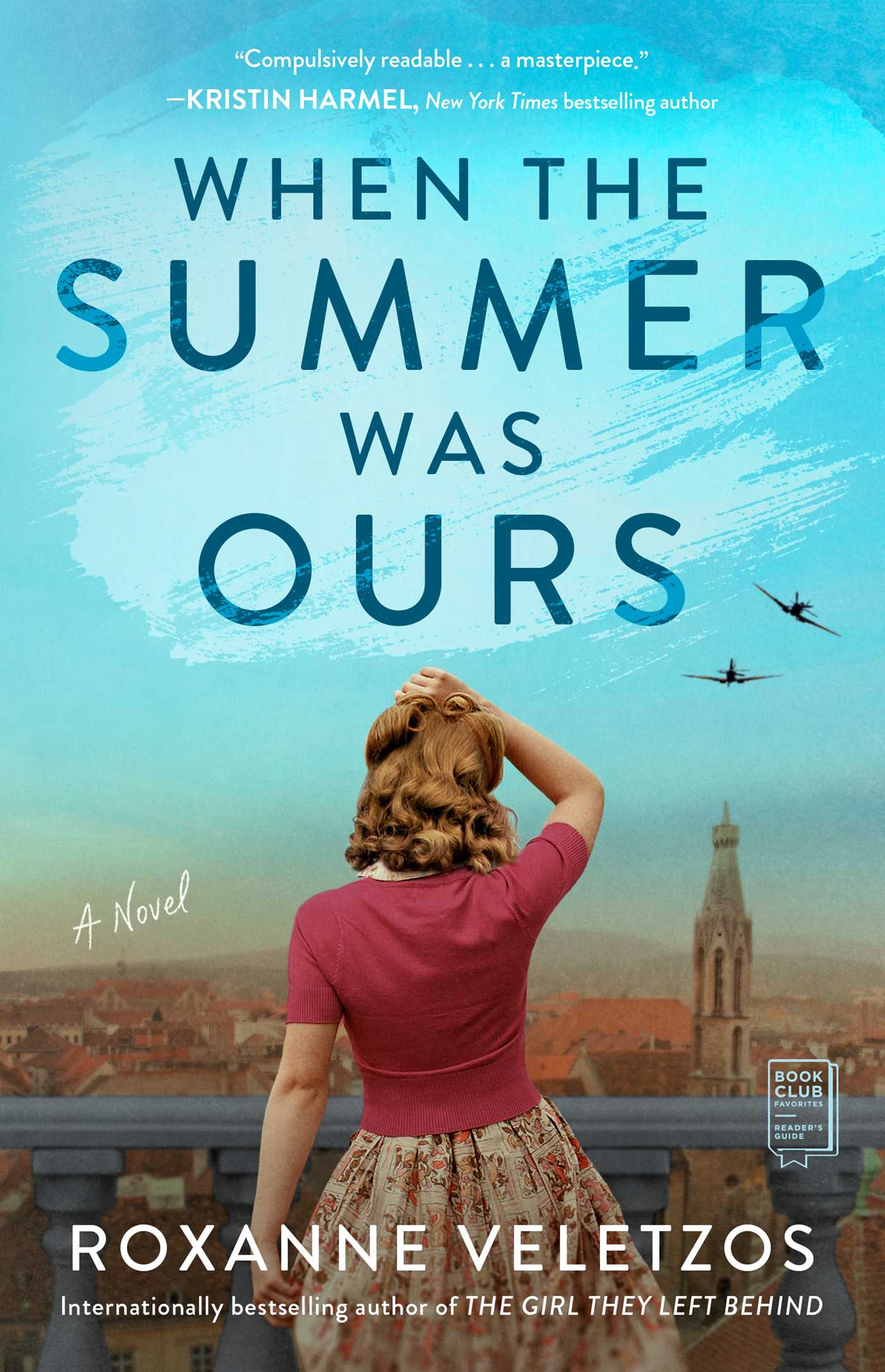
When the Summer Was Ours, by Roxanne Veletzos***-****

3.5 stars, rounded upward. I had proclaimed myself to be over and done with World War II fiction; there’s been a glut of it in the publishing world, and I have well and truly had my fill. My soft spot, however, is for any book written by an author whose work I have read and enjoyed. I reviewed Veletzos’s charming debut, The Girl They Left Behind, in 2018, and so when the opportunity came up, I agreed to read and review this one, too. It was a good decision.

My thanks go to Net Galley and Atria Books for the invitation and review copy. This book is for sale now.

Eva Cesar, daughter of the well-to-do but terribly strict local bourgeois, falls in love when Aleandro, a Romani artist stops in her tiny town in Hungary. He is a painter and a fiddler, raising his younger brothers alone following the deaths of their parents. Eva’s father knows nothing of this romance, and it’s a darned good thing. Not only is her father a Nazi sympathizer and bigot, but she is already engaged to marry Eduard, a dedicated Red Cross physician whom she also loves.

The story follows all three of them over the years, shifting points of view. All three are likable characters; Aleandro is obsessive enough that he seems a little creepy at the outset, but as the story develops, that’s no longer the case. Eduard is a stable, likable human being, but he is the one that is least developed. Eva often makes passive decisions, which I find grating, yet these are the early 1940s, and women don’t yet know they’re entitled to be decisionmakers, at least in many regards. The plot seems to go all over the place, but it comes together quite nicely at the end.

There are two related developments I would have liked to see handled differently. First—and I’m telling you this because it occurs early—Eva becomes pregnant after just one night of passion with Aleandro. Picture me sticking two fingers down my throat. Gag, spit, gag some more; what an overused trope. But then it gets worse. Eva heads to a clinic where abortions are performed quietly, since the procedure isn’t legal; the facility is filthy, and the staff are rude; we briefly meet the doctor, who virtually has horns and a spiky tail, and dines regularly on the flesh of aborted embryos and fetuses. More or less, anyway. And with women’s rights to choose our own reproductive decisions under attack, this is the very worst possible time to put such vile propaganda into a novel. She flees, of course, and has the baby, of course. In fact, as I write this, I question my choice to knock off only half a star from my rating. I’m growing madder by the minute, just writing about it.

Moving on!

The most difficult aspect of a complex story like this one is deciding how to end it. I come back around when I see how tastefully and realistically this is achieved. The ending is both credible and sweet.

There it is; you decide.  

The World Cannot Give, by Tara Isabella Burton**

Four years ago, I read Tara Isabella Burton’s Social Creature, a novel that was one of my favorites that year. I said it was “full of sass and swagger…genius pacing…a novel that should take all of us by storm…the makings of a cult classic.” Did I love it? Yes I did. So imagine my excitement when I saw that she had a new one coming out. Sad to say, The World Cannot Give doesn’t reach the same level. It’s dull, and it takes itself far too seriously.

Nevertheless, my thanks go to Net Galley and Simon and Schuster for the review copy. This book is for sale now.

Laura Stearns arrives at St. Dunstan’s Academy; she is inspired by a novel written by a long-ago alum named Sebastian Webster. Laura yearns to find the “shipwreck of the soul” she finds in Webster’s book. Indeed, Webster has an enthusiastic band of followers at St. Dunstan’s, and so in a sense, Laura has come to the right place.

So we have these elements: a private boarding school—and this setting is in danger of being overused lately, but nothing that excellent writing cannot overcome, although that doesn’t happen here. We also have a slavish clique and hyper-religious students; and we have a whole lot of navel gazing. Or, as the synopsis tells us, “The World Cannot Give is a shocking meditation on the power, and danger, of wanting more from the world.”

If anything here makes your pulse quicken, by all means, go get this book. As for me, I tried. I did. When I couldn’t push myself through my digital copy after multiple tries, I checked out the audio version from the library; if anything, it was more pretentious and obnoxious than the written version. Yikes. I stuck with the audio version through the first two torturous hours, and then I threw in the towel.

This shipwreck is available to the public now.

The It Girl, by Ruth Ware****

Ruth Ware’s novels are one more reason to look forward to summer. I’ve read four of her mysteries, and this is among my favorites. My thanks go to Net Galley and Gallery Press for the review copy. This book is for sale today.

Our protagonist is Hannah, and the setting is England with alternate time periods about ten years apart. In the past, we are in Oxford, where Hannah is a poor-girl-making-good. Today she works in a bookstore, is married to Will, whom she met in school, and she’s pregnant with their first child.

Hannah doesn’t graduate from Oxford; she is too traumatized by the murder of her roommate, who was also her best friend, and whom she found that night. The flashback scenes—not only the night of the murder, but the close friendships that she developed there, along with her relationship with Will, and an assortment of memories, some of them good ones—are so well depicted that I feel as if I am there with her. The group in which she travels consists of herself, Will—who was her roommate April’s boyfriend at the outset—along with Emily, Ryan, and Hugh. These last three aren’t as intimately developed, but that doesn’t matter much, because the two that count for the most in terms of her memories are Hannah herself and April. I feel as though I could pick either of them out of a crowd.

April comes from a ruling class family, and she tells other students that she has been admitted largely due to her family’s money. Eventually Hannah realizes that this isn’t entirely true; yes, her family is rich, and they’ve been generous with the school, but April is also a highly capable student and a diligent one. In fact, April seems to be very everything; today we might say that April is a lot, that she sometimes sucks all the air out of the room. She’s effusive, she’s generous, and she’s given to pulling pranks that are nasty enough to cross a line. Perhaps it’s true that opposites attract, because though Hannah is a more low-key person from a working class household, the two of them bond immediately, and Hannah considers her friendship with April more important than her attraction to Will.

The night April is murdered, Hannah and Hugh see a security guard leaving their building. He’s not supposed to be there, but he is a sleaze bucket, that guy, sometimes using his passkey to enter Hannah and April’s room, and who knows what he was doing this time? When April’s body is discovered, freshly killed, it doesn’t take long before Neville, the creepy security guard, to be arrested, convicted, and put away for life. (A note: there are a lot of Britishisms here that I had to look up. Apparently, a security guard is called a proctor, at least at Oxford.)

Now, in the present day, a friend of Ryan’s that is also a journalist contacts Hannah. All of the students in their group have been overwhelmed by press requests since the murder, and usually, they avoid them like the plague, but Ryan thinks this pal of his is onto something. The friend, Durant, believes that Neville, who has died in prison, was innocent. Now Hannah is moving heaven and earth to find out whether her evidence has sent the wrong person to prison. But who might have done it? Not Hugh, since he entered with her that night; what about the others in their group, including her own husband?

I must confess that I have a bit of trouble accepting Hannah’s sense of mission, and the extent to which she pursues it. This man was not exactly a pillar of rectitude; today he might have been fired or even charged for his misbehavior toward the girls he was supposed to be protecting. And the fact is, he’s dead. He’s never coming back, no matter what Hannah’s amateur detective work reveals. Why upset the apple cart like this, especially when she considers her own husband might be implicated? But she is pregnant, and I know from experience that when our hormones are jumping, we can sometimes have over-the-top reactions. So okay. I guess.

The other thing that gives me pause is Will’s puppyish devotion. During the last half of the book, Hannah does something that I would think would be a marriage ender. That toothpaste is never going back into the tube. Why does Will come panting back to her? This one is harder to accept.

Nevertheless, I was riveted. By the forty percent mark it was impossible for me to read anything except this book until the last page was turned, and so I recommend it to you.

Patricia Wants to Cuddle****-*****

“You have to watch out for the quiet ones.”

I had an ugly upper respiratory flu, and this excellent novel was exactly what the doctor ordered. My thanks go to Net Galley and Zando Publishing for the review copy. Patricia Wants to Cuddle will be available to the public Tuesday, June 28.

As the story begins, we are midway through filming “The Catch,” which is a reality television show similar to “The Bachelor.” Our cast includes the four lucky women to have made it this far; producer Casey; a handful of crew members; and oh dear, Jeremy, a scuzz bucket if ever there was one. Jeremy is this season’s catch. We also have a handful of locals, since we are filming on location; included is a bashful cryptid in the woods, a lonely creature that reacts very badly to stressful situations. As you may guess, Patricia is that cryptid.

These people are on Otter Island, a fictional addition to the San Juan Islands off the coast of Washington State. Think deep woods, rain, and glamping. And…what the hell was that, just now? Too big to be a bear. And why are the sheep so agitated?

Baaaaa.

The contestants are mostly not interested in love; they are interested in publicity, for various reasons of their own. The shooting schedule leaves them sleep deprived on an almost permanent basis, and so given the premise of the show—competition, not cooperation—it doesn’t take long for the women to turn on one another.

Samantha Allen is new to me, but she’s on my radar now. This story is snicker-worthy at the outset, and by the time we reach the climax, I am howling with laughter. Part of the joy comes from the plot and pacing, but the biggest laughs for me are those that combine these outrageous events with some of the funniest figurative language I have ever read. In fact, were I to rate this story solely on its humor, without rating the more traditional elements such as character development, this would be a five star read.

This book will appeal most to those that lean to the left.

Recommended to those that love darkly hilarious fiction.

Did Ye Hear Mammy Died, by Seamas O’Reilly*****

Seamas O’Reilly is an Irish journalist; as far as I can tell, this is his first book. He was just five years old, one of the youngest of eleven children, when cancer claimed his mother, leaving his father—an extraordinary man, if even half of Seamas tells us is accurate—to raise them all. This is their story. My thanks go to Net Galley; Little, Brown and Company; and Fleet Audio for the review copies. This memoir is for sale now.

Of all the ways in which one can write about the death of a parent, this is one that I never considered. O’Reilly describes his family, his mother’s demise and the impact it has on his family and the community; and the subsequent years of his own and his family members’ lives, and he is hysterically funny. How he manages to achieve this without breaching the boundaries of good taste and respect is nothing short of pure alchemy. Somehow he finds just the right combination of irreverent humor, poignant remembrance, and affection, and it’s pitch perfect.

His finest bits are assigned to his father. I’m giving you just one example, because I want you to experience everything else in context. This isn’t his most amusing anecdote, but it’s a worthy sample of his voice. After heaping praise on him for other things, he tells us:

“He is alarmingly cocky when it comes to his skill at killing mice, a species he hates with a malevolent, blackhearted glee. It’s an odd facet of his character; a man regarded by his friends as one of the kindest, gentlest humans on earth, and by mice as Josef Stalin. He takes particular joy in improvising weapons for the purpose, and has killed rodents with a shoe, a book, and at least one bottle of holy water shaped like the Virgin Mary. He famously dispatched one with a single throw of a portable phone, without even getting out of bed. I know this because he woke us so we could inspect the furry smudge on his bedroom wall…”

I have both the audiobook and the DRC, and rather than alternate between the two, or listening to the audio and then skimming the DRC for quotations and to answer any of my own questions, which is my usual method, I chose to read them both separately, because this story is good enough to read twice, a thing I seldom do these days. Whereas I usually think that having the author read his own audio is ideal, since the author himself knows exactly where to place emphasis and deliver the piece the way it is intended, this time I am ambivalent. O’Reilly speaks faster than any audio reader I’ve yet heard, and he doesn’t vary his pitch much, and as a result, there are some funny bits that I miss the first time through; I am doubly glad to have it in print also. As the audio version progresses, I grow more accustomed to his speaking style, and I miss less than I did at the outset. Nevertheless, if the reader has a choice and doesn’t greatly prefer audiobooks, I recommend print over audio. Ideally, I suggest doing as I did and acquiring both versions.

There’s no doubt in my mind that this will be among the most memorable and enjoyable books published in 2022. Highly recommended.

Lies My Mother Told Me, by Melissa Rivers**

I hadn’t heard of Melissa Rivers, but when a friend mentioned that the daughter of the legendary comic, Joan Rivers, had an audio book nearing its publication date, I wanted it. My thanks go to Net Galley and RB Media for the review copy. This book is for sale now.

Joan Rivers was an icon, one of the first fierce women to breach the world of standup, an old boys club if ever there was one. She was scrappy, fearless, and very, very funny. Like all of the early women comics, she incorporated a good deal of self-deprecating humor, a defense against all of the nasty things that reviewers and audience members might throw at her, but she also made fun of the rich, the famous, and the powerful.

Joan died in 2016, and although she was eighty-one years old, news of her passing came as a shock. She hadn’t been ill, and had been admitted to a hospital for surgery of a fairly minor nature; her death was caused by errors made by the doctors and hospital. Her only child, Melissa, had been developing a standup career of her own, and now steps fully into the spotlight left vacant by her mother’s death.

I had never heard of Melissa or her work when I found this audio book, but I expected great things; often a talent is passed down within a family, after all. Sadly, there’s no joy to be had here. Melissa’s tone is grating and abrasive; whereas Joan sometimes veered in that direction, she had the skill and instincts that told her when to pull back or soften things. Joan’s trademark phrase, “Can we talk?” created a sense of intimacy, and drew me in. Melissa’s repels me. Apparently, I am not alone; I was playing this audiobook while preparing dinner, and when other family members came into the kitchen, they either wanted it turned off, or they left immediately. Nothing she said made any of us laugh, or even smile. Nothing. I have never heard a comic so obnoxious.

Wikipedia tells me that Melissa Rivers is known for her work in comedy, and for philanthropy, as heir to her parents’ considerable estate. I haven’t seen or heard any of Melissa’s other work, but if this book is representative, she might do better to focus on her charity work, brightening the world by embracing the causes dearest to her parents’ hearts, and her own.

Not recommended.

Fifty-Four Pigs, by Philipp Schott***-****

3.75 stars, rounded upward.

Fifty-Four Pigs is the first in the Dr. Bannerman vet mystery series, set in a tiny town in Manitoba, Canada. My thanks go to Net Galley and ECW for the audio review copy. This book is for sale now.

Peter Bannerman is a quirky guy, a rural veterinarian with particular tastes and a fierce loyalty to his friends. When his good buddy Tom’s barn is torched in the middle of the night, killing all 54 of his pigs and leaving behind a mysterious human corpse, the Mounties want to question him, but he’s nowhere to be found. Has Tom been killed? Kidnapped? Perhaps he’s on the run, panic-stricken. Peter is eager to try out his amateur sleuthing skills on this case; Kevin, his brother-in-law as well as the local law enforcer, is equally eager that he should not. Yet, Peter is concerned that his friend, whom he knows to be a decent, peaceable soul, could never commit murder, and who surely wouldn’t harm his own pigs. If he doesn’t clear Tom’s name, who will?

This novel is a cozy mystery, despite all the dead porkers (about whom there is blessedly little detail.) It’s humorous in places, and is already building a budding fan base. I love Peter’s dogs, Merry and Pippin; the latter goes just about everywhere with him, and is helpful when push comes to shove. Some of the vet cases make me snicker out loud; I’m gardening as I listen, and hope the neighbors won’t think I’ve lost my mind, all alone and cackling in my lettuce bed.

As for me, I find the first half to be a bit on the slow side, with more extraneous details that aren’t directly relevant to the story than I would prefer. However, I usually am not a cozy mystery lover, either. The second half of the story ramps up the suspense and the intrigue, and when Bannerman heads out to the ice fishermen’s shacks with a storm in the immediate forecast, it’s impossible to put this book down.

The audio is performed by actor Miles Meili, and I find his narrative to be an acquired taste; he tends to sound wryly amused even during the serious parts of the story, and during the first half, I wish wholeheartedly for a print version to refer to. However, once the excitement begins, I can’t think about anybody except poor Peter, who’s out there in that raging storm, and so Mr. Meili’s stylized delivery no longer distracts me.   

The ending is hilarious.

I recommend this book to cozy readers, and I do lean toward the print version, but if you are an audio-or-nothing reader, go ahead and get it in the form you love best.