Queen Meryl, by Erin Carlson**

I read this biography free and early thanks to Net Galley and Hachette Books.

I have enjoyed Streep’s movies and her feminist moxie since the first time I saw her, and so I figured this would be a good fit for me. Sadly, there’s nothing new here at all. There’s no depth of analysis, no stories of inner struggle or insight into her development. The overall tone is uniformly adulatory, which is fine as far as it goes; I don’t enjoy seeing a journalist do a hatchet job on a performer, so if she has to lean in one direction or another, I’m glad it’s on the positive side. But once again—I have seen every single thing in this book somewhere else already. I knew about the friction between Streep and Dustin Hoffman (who is also a great favorite of mine,) and I knew she takes roles that show strong women. I knew she wanted to sing, and she did it in Mama Mia. Readers that have followed this actor’s career over the decades with a magazine article here and there can’t expect to cover new ground. It’s shallow and superficial for the most part, and for me, the only good thing is that I didn’t pay for this book.

Streep’s fans that haven’t followed her career in the press may find more joy than I do here; nevertheless, my advice is to read it free or cheap if you decide you want it. It will be available to the public September 24, 2019.

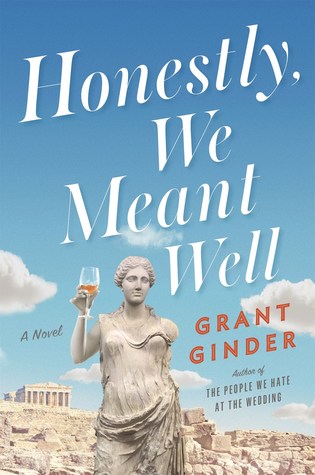
Honestly, We Meant Well, by Grant Ginder****

“All art is appropriation.”

Sue Ellen Wright is a professor of Greek classics; she’s headed for Greece to deliver lectures and reminisce about the experiences of her youth. At the last minute, her philandering husband Dean and the couple’s lovesick son Will decide to tag along. Grant Ginder has made a career of writing hilarious prose about disastrous families, and Honestly, We Meant Well made me laugh out loud more than once.  Thanks go to Net Galley and Flatiron Books for the review copy. This book is for sale now.

The book opens as Sue Ellen is conferring with a freshman who’s come to her office to challenge his midterm exam score:

“’I’m pretty sure I got this one right.’

“Connor points to a picture on his midterm…it’s an artifact that he was meant to identify.

“’That’s not a bong, Connor. That’s a Corinthian urn from the fifth century B.C.E…’

“But can’t you see how it could have been a bong?’

“’No,’ Sue Ellen says, ‘Actually, I can’t.’”

Teachers, are you experiencing flashbacks here? And those of you that aren’t teachers can appreciate that Sue Ellen needs a break, one that takes her as far away as possible. Her bags are packed.

Dean is a professor as well, and he’s a celebrated one. As the writer of a bestselling novel, The Light of Our Shadows, he is permitted to cherry-pick which students may enroll in his seminars. He knows he ought not to have sex with any of them, but they’re so insistent; and why shouldn’t they be? He’s a genius. At the moment, though, he’s a genius with writer’s block, and he thinks a Grecian holiday might just be what he needs; it will strengthen his marriage and get his creative juices flowing as well.

Will is a student, but who can chart a course, academic or otherwise, when his heart has been shattered? His boyfriend broke up with him and has instantly turned up on Instagram with kissy-face photos of himself with his new squeeze. It’s humiliating. It’s horrifying. Worse: everyone is liking those photos. Meanwhile, he has committed an unforgivable academic sin, one he’s desperate to keep his parents from learning.

Ginny Polonsky works at the university, and she knows where the bodies are buried. Readers know what Ginny knows—well, most of it anyway—and as the family unknits itself and copes with one unforeseen event after another, we are waiting for Ginny’s other shoe to drop on them. It’s immensely satisfying when it does.

There’s not a lot of character development here, but not much is needed. I believe each of these characters, which are written with admirable consistency. The prose is tight and the resolution surprises me. I would read this author again in a heartbeat.

The Wrights are Caucasian and middle class, and this is the demographic most likely to enjoy this book. It’s just the thing to toss into your suitcase or carry on when you’re headed on a trip of your own.

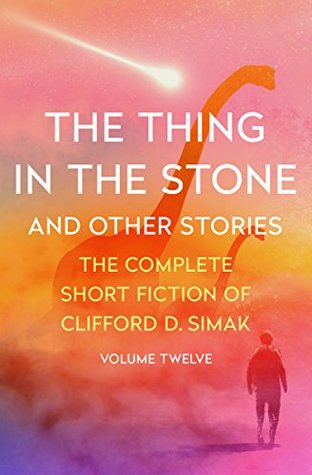
The Thing in the Stone and Other Stories, by Clifford D. Simak***-****

Clifford D. Simak was given the third Grand Master Award by the Science Fiction and Fantasy Writers of America; he wrote short stories proliferately for several decades in the last century.  His work was generally published in magazines, but with the digital age comes the release of his collected work in twelve volumes.  My thanks go to Net Galley and Open Road, from whom I received a review copy…two years ago. Ouch. As you might expect, this title is for sale now.

Here’s the thing about this collection as a whole: not all of it is science fiction. Simak wrote a lot during the 1940s and 1950s, and back then it was Western stories that sold big. For fans of science fiction, then, these stories are definitely a mixed blessing. The Thing in the Stone and Other Stories is the twelfth and final collection in the series.

The tltle story is excellent, and it shows why the editor has not chosen to separate Simak’s sci fi and Western stories into separate volumes: some of his stories—some of his best ones in fact—blend the two genres. In this one, Daniels sits on his farmhouse porch and chats with the sheriff; there are concerns about chicken thieves in the area. But even at the outset, small references here and there tell us that this is no ordinary Western story. For one thing, up North is an area casually referred to as “the Canadian Shield.” And as the sheriff departs and the rest of the story unfolds, Daniel learns that he is not alone, and his visitor is an unusual one indeed. This story contains a beautifully written inner monologue, and I find myself rereading passages out of admiration for the word smithery involved.

The next two stories are fun ones. “The World of the Red Sun” is suspenseful, and “Skirmish”, which is a man-versus-machine tale with a degree of prescience is laugh-out-loud funny in places. These stories, alas, are followed by an interminable Western—not blended, just cowboys and more cowboys—that I finally gave myself permission to skip. The rest of the stories offered after it are good, but the first three are the ones I like best.

Should you buy this collection? I suggest that if you are new to Simak’s writing, you purchase the first collection in the set, I Am Crying All Inside and Other Stories. It doesn’t matter whether you read the collections sequentially, but this is a solid short story collection and his best selling one also. I have read and reviewed eight of the twelve volumes in the set, and although The Thing in the Stone and Other Stories is well written and entertaining, there are five volumes, all reviewed here, that I rate as five stars. Of course if you have the opportunity to buy the entire set and have a serious love of old school sci fi, you won’t be disappointed.

Fifty Things That Aren’t My Fault, by Cathy Guisewite****

Guisewite began publishing the comic strip “Cathy” in 1976, the year that I graduated high school. It was a time of high expectations for women, and the unrealistic suggestion that we would be able to “bring home the bacon, fry it up in a pan, and never let you forget you’re a man,” as Madison Avenue decreed, was daunting.  Through her sharply perceptive humor, Guisewite let her peers know that it wasn’t just us; we were judging ourselves with an unfair yardstick. She kept it real, and in doing so, kept us sane.

My thanks go to Net Galley and G.P. Putnam for the review copy.

So how does cartooning translate to prose?  Whereas the cute, punchy single-page entries and single sentence proclamations—and the lists—are her most familiar territory, my favorite parts of this memoir are the least cartoonish ones. Yes, I love the way she takes down the women’s fashion industry and the unhealthy way it affects our body images.  She was good at it forty years ago, and she’s good at it now. But the passages that drew me in and let me get lost in her story are the more vulnerable, deeply perceptive parts of the narrative, her fears for her aging parents; the struggle and triumph of raising a daughter, one with special needs, alone; and the failure of her marriage. I am in awe of the fact that she and her ex made each other laugh until the tears came as they planned their divorce. Who does that? And of course, she made me laugh too.

Guisewite stays inside her usual parameters, never veering outside of the middle class Caucasian realm with which she has experience. Younger women won’t get much joy out of this memoir; women that came of age between 1965 and 1985 are right in her sweet spot, and it is to them that I recommend this book. It’s available now.

The Book Woman of Troublesome Creek, by Kim Michele Richardson***-****

3.5 rounded up.

Cussy Mary Carter delivers books to the rural poor folk of Troublesome Creek, Kentucky during the Great Depression. I read this quixotic tale free and early, thanks to Sourcebooks and Net Galley; it’s available for purchase now.

Cussy is the daughter of a miner; her mother is dead, and her father is dying slowly of Black Lung, known to them locally as “the miner’s sickness.” She has no siblings. The government pays her to follow every possible winding path to reach out-of-the-way homes, loaning books, magazines, and the scrapbooks assembled of odds and ends by the librarians themselves. It provides a bright spot in an otherwise grim little town.

I like Cussy Mary, but I have to admit that I am more attached to Junia, her mule—and if you read this book, you’ll see why. Everything Cussy does is fraught with peril, and though I seldom do this, I cheat and look ahead because although I can tolerate any fate for the human characters here, I need to know whether anything will happen to Junia. Junia serves as Cussy’s transportation, watchdog (watch mule?) and best friend. Ordinarily I am no more attached to hoofed animals than any other city dweller, but this plucky critter has me at hello.

One of the best single moments in historical fiction occurs when Cussy Mary is confronted by a rattlesnake on a path. A shot rings out, and a neighbor woman steps out of the trees holding a gun and yells, “Back. That’s my supper.”

The story’s greatest strengths all have to do with setting and historical detail. Cussy Mary and her father are among a relatively rare racial group that no longer exists, people possessed of blueberry-blue skin. They were often shunned by those they lived among, some of whom regarded them as “colored” (as did local law), and others of whom feared they carried a curse. I had never known about the “blues” before reading this novel, and this is historical fiction at its best, that which educates us and makes us like it.

I would have liked to see more subtlety and ambiguity in the development of Cussy Mary and the lesser characters. Everyone here is either a good person or a bad one. Richardson’s good people never have bad moments or vice versa. I understand when Cussy Mary turns down offers of food even though she is hungry; part of it is the pride that is an inherent part of the culture, and she also fears that those making the offer may be giving up their only food of the day. I understand this the first time she tells us, and the second, and the third…but by the time I see it again (and again, and..) I am rolling my eyes and wishing fervently that once, just once she will say thank you and scarf down the biscuit, or the apple, or the whatever. On the rare occasion she accepts food, she takes it to someone else, and then she goes home and eats thistles. It makes it difficult to believe her character, because nobody is that saintly every minute of every day.

Nonetheless, I recommend this book to you, because there’s nothing else like it. If there were a body of fictional literature widely available regarding this time, place, and its people, I might say differently, but as far I can see, this is it, and the setting is strong enough to just about stand on its own. Those that enjoy the genre will want this book.

Things My Son Needs to Know About the World, by Fredrik Backman***

Purely by serendipity, Backman’s collection of essays came out in the US as my own son is initiated into fatherhood. My thanks go to Atria Books for the review copy; it’s for sale today.

Backman is known to me as a fiction writer, and I have read most of his novels, which are beloved worldwide. Here he delivers nonfiction with the same gently philosophical voice.  Despite the title, the essays are written for adults; this is not a children’s book.

Backman waxes eloquent on diverse topics, and it sounds sweetest—as always—when he focuses on what real men do. For example, all his life, he says he has been told to stand up like a man, but he wants his son to know that a real man should also know how to “stay seated, shut up and listen.”  Women the world over, myself among them, cheer this, and in saying it Backman helps make the world a better place. Other parts are funny as heck, as when he describes trying to change a diaper on an airplane.

The book’s only weakness is the overuse of the words “stuff” and “crap,” throughout the text, and knowing the author’s signature style, I suspect that this began as deliberate repetition for emphasis and as a form of figurative language that somehow didn’t translate effectively.

That said, it’s a sweet little book and a good read, and its timing begs for it to be a reverse-Father’s Day gift in the US, from fathers –or better still, grandfathers—to sons.

The Department of Sensitive Crimes, by Alexander McCall Smith*****

The author of the renowned #1 Ladies Detective Agency books has begun a brand new series, and when I found a chance to get in on the ground floor, I hopped onto it. This one is the first in the Detective Varg series, and the author’s signature drollery is in full effect. Big thanks go to Edelweiss and Random House Pantheon for the review copy. It’s for sale now. 

Detective Varg works for the sensitive crimes unit of the Malmo police. The unit exists for the purpose of investigating cases that require research. The setting is one of mind numbing blandness; Martin, our investigator’s dog, is growing deaf, and Varg is teaching it to lip read. We read about skin problems, a dairy farm, aging bikers, and my eyes begin to glaze over. And then, eureka! A case! There’s been an assault in the market. Someone has entered the puppet theater and stabbed its proprietor in the back of the knee. Not only a crime, but a crime of violence! Everybody wakes up and roars into action. Varg and Anna, his partner, head for the scene of the crime; they could conduct their interviews at the station of course, but Anna needs to buy eggs anyway. 

The stabbing is the first of three stories, but each piggybacks on the last, so you should read them in order. Once the stabber has been caught, tried, and has tearfully confessed, we move onto a missing person’s case featuring an imaginary boyfriend that can’t be found anywhere, followed by other disappearances. Yes, things are hopping at the Department of Sensitive Crimes. 

Smith has a dry, sneaky sense of humor, so if you read this while you are partly thinking about something else, you’ll miss a lot of the funniest bits. This is what I appreciate most about this author. Some humor writers assume that the reader is as stupid as a sack of rocks, and they drop the joke, but they can’t leave it there, and so they drop it again and then explain it, and it ruins the whole thing. Smith is the opposite. He’ll include a remark that is almost offhand, and then there’s a beat of about three seconds where I start to read on, and then it hits me, and my eyes scroll back. Did he say…oh my god. That is hysterical. And so if you’re paying attention you’re in for a treat, and if you’re checked out, it’s your loss. 

This satirical series is off to a strong, vastly amusing start, and I rate it five giggles. Mother’s Day and Father’s Day are right around the corner; could your parent use a laugh or two? Who knows. If you buy it for your parent, they might let you read it when they’re finished. Highly recommended. 

Nanaville, by Anna Quindlen*****

Author Anna Quindlen is queen of all things warm and wise, and so it’s not surprising that her ode to grandmothering  hits just the right note.  I was lucky and read it free and early, thanks to Random House and Net Galley, but it would have been worth the purchase price had it come down to it. This friendly little book is available to the public now.

Quindlen’s memoir can double as a primer for her peers that are new grandparents also, but that’s not where its greatest strength is found. The most resonant aspect is that common chord, the eloquence with which she gives voice to our common experience. It makes me feel as if she and I are sitting together with our baby pictures—the grandbabies and our children that created them—and as she speaks, I am saying, “I know, right?” I chuckle as she recounts trends in the advice given by experts to new parents:  when our first babies were born, we were told to put them to bed on their stomachs so they wouldn’t spit up and choke to death on it; then later children slept on their sides, which seems like a safe bet either way, but babies don’t stay on their sides very long; and now babies are supposed to be safer on their backs. And she voices so well the pride we feel when an adult that we have parented turns into a wonderful parent in his own right. And I nod in agreement as she says of her toddler grandson, “No one else has sounded that happy to see me in many, many years.”

Quindlen speaks well to the ambivalent moments as well, to the need to hold our tongues when we want to offer advice that hasn’t been requested; at the same time, there’s the relief that comes of not being in charge of all the big decisions.  And I echo the outrage that she feels when some ignorant asshole suggests that our biracial grandchild is not part of our blood and bones. (A jerk in Baby Gap wants to know where she got him; she replies that she found him at Whole Foods.)

Unequivocally joyful is the legacy grandchildren present. “I am building a memory out of spare parts…someday that memory will be all that’s left of me.”

And then, there are the books:

“’In the great green room…’

“’Mouse,’ Arthur says.

“’There is a mouse,’ I say…falling down the well of memory as I speak, other children, other chairs.”

Go ahead. Read it with dry eyes. I dare you.

Quindlen is writing for her peers. If you aren’t a grandparent and don’t expect to become one anytime soon (or perhaps at all,) then this memoir will probably not be a magical experience for you. But the title and book jacket make it clear exactly where she is going, and I am delighted to go with her.

Highly recommended to grandparents, and to those on the cusp.

Southern Lady Code, by Helen Ellis****

Helen Ellis makes me laugh out loud. If you can use some of that, you may want to read this book. Thanks go to Doubleday and Net Galley for the review copy.

Southern Lady Code is a title that carries a code of its own.  Some people use the word “lady” to describe European royalty; some to describe a courteous woman, which is what I anticipated here; and some use it to describe a well-mannered woman with a very comfortable income, which appears to be the author’s operating definition. In terms of the “code,” I thought I’d be reading straight satire, but discovered that she has provided a combination of self-help tips and searing, sometimes raucous humor. It works surprisingly well.

I have never made a cheese log before or wanted one, but Ellis’s recipe sounds so persuasively delicious that I may try it. That said, my favorite essays were short on advice and long on humor. I nearly hurt myself laughing over the construction man she found masturbating in her bedroom—did I mention that she gets a little edgy here?  And “The Ghost Experience” is massively entertaining.  There’s a lot of good material here.  Though at times her outlook is a little more conservative than my own, I like the things she says in support of gay and trans friends.

Ultimately, I suspect that I am not the target audience for Ellis, who in her middle-aged years is dispensing life skills wrapped in bountiful amounts of humorous anecdotes. She is writing to her peers and to those women younger than herself.  I am ten or twenty years older than this woman, but I still came away impressed. So, ladies and women, if you can look past the assumption of a greater-than-average income, you’ll have a good time here, and if you can’t, try to get this collection at the library and read selectively, because more of these essays will resonate than not, for all of us.

I rate this book four giggles, and it will be available to the public tomorrow, April 16, 2019.

The Last Act, by Brad Parks***-****

Tommy Jump needs money.  His acting gig is about to end and his girlfriend Amanda is pregnant. Then an old childhood friend contacts him about an unusual acting role—that of criminal. Tommy and Danny go back a long way; Danny invites Tommy to sit down and asks him to do a job for the FBI that involves infiltrating a prison. It’s risky and involves being locked up for a goodly while, but the money is enough to live off of for years, and the upfront payment will provide for Amanda and the baby while he is away. It doesn’t take long for Tommy to agree.

I was invited by Random House Dutton to read and review this psychological thriller, the first of a new series.  Author Brad Parks has won the Shamus, Nero, and Lefty awards, so it’s fun to get in on the ground floor here. This book is for sale now. (Another title by this author, “Closer Than You Know,” was released the same day but isn’t from this series.)

While Tommy—who now poses as Pete Goodrich, a high school teacher locked up for his one and only felony—is away, Amanda, who’s an artist, gets an invitation to meet with a prominent gallery owner. Turns out the gallery owner wants Amanda to share something more personal than paintings, and here I have to wonder why this thread is even included.  Jodie Foster, an actor, producer, and director, once remarked that men all tend to go down the same path when determining motivation for a female character.  Almost reflexively, they say it was rape. She must’ve been raped. She is traumatized by rape. And so when the gallery owner reaches into Amanda’s shirt, I roll my eyes and say, here we go again.

Fortunately, this event has little to do with the rest of the story, and once we are past it and back in jail with Tommy Pete, the pace quickens and tightens. Our protagonist is charged with getting close to a big player in a Columbian cartel, a man in possession of important documents that Danny says can crack this whole case. Tommy takes risk after risk in ways that were never planned and that could, if things go amiss, either buy him an extended sentence he’ll probably have to serve, or worse, could get him dead. The prose is taut, and the pages turn themselves. Who’s lying, and who’s telling the truth?

The story is almost entirely Tommy’s, but we briefly meet Tommy’s mother. Amanda and Tommy go visit her before he pleads guilty, and initially I bristle when they agree on the drive over to tell Tommy’s mother to ‘behave herself.’  Perhaps it’s because I am the mother of three grown sons, but I felt a snarl forming when I read this. Don’t talk to your mother that way! But that disappears completely when we meet this woman, whose nickname is “the BBC” because of her propensity to share personal information widely. I love this character! I. LOVE. THIS. CHARACTER. Our time spent with her is way too fleeting, but since we are on book one of the series, I suspect she is introduced to us for future reference. I hope Park will develop her with care and skill. I want to see Park develop a female character, but in particular, I want to see him develop this one. Because I really, truly, very muchly looove—wait. Did I already say this?

Ahem. I may have gotten carried away. Now where were we? Ah yes, this is the place where I ruin the ending by telling you how it all shakes out. No, of course not! Go get it and see for yourself.

Recommended to Parks’s readers, and to those that enjoy a good series.