
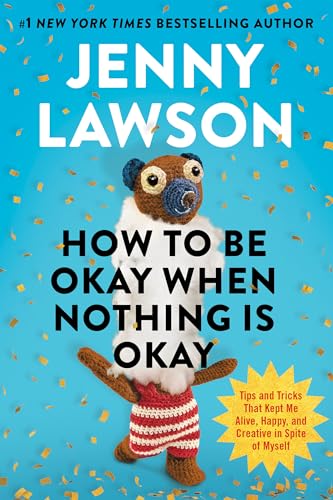
How to Be Okay When Nothing is Okay, by Jenny Lawson****

Jenny Lawson is queen of the mental health memoir. I’ve read her for years and appreciated her candor, wit, and willingness to shine a light on the kinds of experiences that historically, others have mostly kept mum about. Her latest book, How to Be Okay When Nothing is Okay, is not her strongest work, but this says more about how remarkable her earlier books are than anything detrimental about this one.
My thanks go to NetGalley and Viking Penguin for the review copy.

I first encountered Lawson through her blog over a decade ago when she wrote about gifting her husband with a huge metal chicken sculpture. There’s something truly cleansing about laughter, not the gentle or wry type, but the gut-busting type that leaves us gasping for breath. I encountered this on subsequent occasions when she wrote in her quirky, sometimes bizarre way that was, at the same time, absolutely relatable and crystal clear. And I have to confess that I missed that quality this time around.

Instead, Lawson has written practical suggestions, ones that she has utilized herself, to help her get past stressful situations in which her mental health has threatened to melt her down. And in that sense, this book is more of a self-help book and perhaps less of a memoir. It may be tremendously useful to others encountering similar situations. I’ve been there; a great many others have, too. But right now, my own mental health is fine, and perhaps that accounts for some of the disconnect I experienced in reading this one. I suspect, however, that a whole lot of people will get a whole lot of help from this slender little book.

Recommended for those in a space where they need support and ideas for getting through a difficult time or situation.
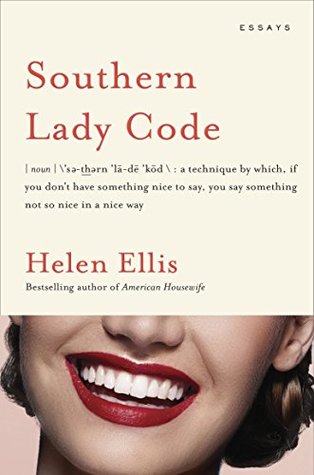
Southern Lady Code, by Helen Ellis****

Helen Ellis makes me laugh out loud. If you can use some of that, you may want to read this book. Thanks go to Doubleday and Net Galley for the review copy.

Southern Lady Code is a title that carries a code of its own.  Some people use the word “lady” to describe European royalty; some to describe a courteous woman, which is what I anticipated here; and some use it to describe a well-mannered woman with a very comfortable income, which appears to be the author’s operating definition. In terms of the “code,” I thought I’d be reading straight satire, but discovered that she has provided a combination of self-help tips and searing, sometimes raucous humor. It works surprisingly well.

I have never made a cheese log before or wanted one, but Ellis’s recipe sounds so persuasively delicious that I may try it. That said, my favorite essays were short on advice and long on humor. I nearly hurt myself laughing over the construction man she found masturbating in her bedroom—did I mention that she gets a little edgy here?  And “The Ghost Experience” is massively entertaining.  There’s a lot of good material here.  Though at times her outlook is a little more conservative than my own, I like the things she says in support of gay and trans friends.

Ultimately, I suspect that I am not the target audience for Ellis, who in her middle-aged years is dispensing life skills wrapped in bountiful amounts of humorous anecdotes. She is writing to her peers and to those women younger than herself.  I am ten or twenty years older than this woman, but I still came away impressed. So, ladies and women, if you can look past the assumption of a greater-than-average income, you’ll have a good time here, and if you can’t, try to get this collection at the library and read selectively, because more of these essays will resonate than not, for all of us.

I rate this book four giggles, and it will be available to the public tomorrow, April 16, 2019.