
 Ed Scott Junior was one of the first Black catfish growers in the USA, a “Delta titan,” and he was the very first to own a catfish processing plant. My thanks go to Net Galley and the University of Georgia Press for the review copy. It’s inspirational, well written, and well sourced. The book will be available to the public tomorrow, July 10, 2018.
To say that this story is out of my usual wheelhouse is an understatement. I’m a city woman, Caucasian, living in the Pacific Northwest. The two slender ties that drew me to this biography are my interest in civil rights, and my love of a good plate of catfish; yet I enjoyed it a lot, and I think you will too.
Scott was the son of a successful Black farmer, a former sharecropper that bought land incrementally until he owned hundreds of acres in the Mississippi Delta. The first third of the book explains how he did that, and the experiences that Scott Senior and Junior had with the Civil Rights Movement and the local power elite. It’s a little slow at the outset, but the narrative wakes up in a big way around the 35% mark.
As Scott’s farm grows, he encounters one obstacle after another, and the racism is naked and blatant. Local white agribusiness runs him out of the rice growing business—and he has the nerve to drive a better truck than some of the white farmers in the area, which is an affront they can’t let pass. Left with hundreds of acres and no seeds to plant, Scott decides to dig ponds. Rankin is clear: by ponds, he means bodies of water the size of 15 football fields. Big damn ponds.
Caucasian farmers are able to get subsidies and FMHA bank loans, but Scott is declined, not on the basis of his credit score, but because he is African-American. Bank officers and local government officials are so certain of their positions of power that they put their refusals on the basis of race in writing, and up the road, that is what Scott will use to bring them down.
Prior to the 1980s, catfish was not sold in supermarkets. It was considered a lowly bottom-dwelling fish by many, and so its consumption was limited to the families of sport fishermen and poor Southerners . When it made its debut and was purchased by “Midwestern homemakers”, this reviewer was among them, puttering in the back of a Kroger in Toledo, Ohio. “Huh,” I said, “Catfish. Now we’ve never tried that.” I missed the cheap, readily available salmon I’d grown up with in the Pacific Northwest, and was jonesing hard for fish. I had no clue that an immense power struggle lay behind the little foam tray of fish in my shopping cart, but once I’d dipped it in a cornmeal mixture and fried it up, there was no turning back. Yummers.
I read multiple books at a time now that I’m retired, and some of the thrillers I favor make poor companions at bedtime. This biography was perfect then. It’s linear for the most part, focused, and although I was angered by the way Scott was treated, I could tell he was going to emerge victorious, so it didn’t keep me awake after the light was out.
Rankin wants to be clear that there’s a whole lot that needs to change before we will be able to say that every race is treated equally in the Delta, or elsewhere the US. One might hope this would be obvious. But everyone needs to read victory stories to boost their morale and remind them of what is possible. If you need a story where the good guys win, then you should get this book and read it.
 Voice, voice, voice; nobody writes like Sharyn McCrumb. Here her dry, dark humor combines with her expertise in Appalachian culture and above all, her deep respect for the working poor, and the result is a masterpiece of an historical mystery. Thanks to Net galley for the DRC, and to Atria for sending a hard copy galley and a finished copy of this excellent novel. However, had I paid full freight, I’d have come away happy. This book will be available to the public September 12, 2017.
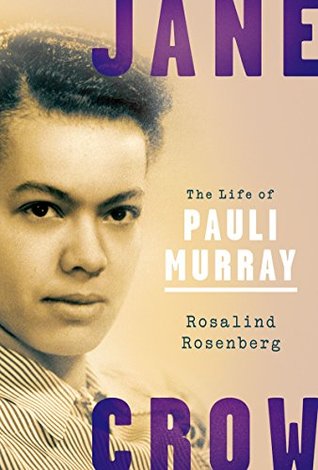 Pauli Murray is the person that coined the term “Jane Crow”, and was the first to legally address the twin oppressions of color and gender. I had seen her name mentioned in many places, but this is the first time I’ve read her story. Thank you to Net Galley and Oxford University Press for the opportunity to read it free in exchange for this honest review. This biography is for sale now.
 I was browsing the pages of Net Galley and ran across this gem of a memoir. Often when someone that isn’t famous gets an autobiography published by a major publisher, it’s a hint to the reader that the story will be riveting. Such is the case here; my many thanks go to Net Galley and Atria for the DRC, which I read free in exchange for this honest review. You can order it now’ it comes out Tuesday, May 9.
 I was originally turned down for a DRC of this novel when I requested it last spring, and I took the unusual step of following up with Atria, more or less begging for it. I’ve been reviewing titles for Net Galley for two years and have received nearly 300 DRCs, so it is a sign of my interest level that I went to this extreme to read this one in advance in exchange for an honest review, and it’s a sign of decency and responsiveness that a representative from Atria Books invited me to review it after all. Although I am grateful , this five star review is not about gratitude, but a measure of the importance I attach to the issues it addresses and the skill with which the story is told.
 Lewis M. Steel has a long, noteworthy career as a civil rights attorney. He was an observer during the Attica Prison riots; worked for the NAACP during the Civil Rights movement, and later defended boxer Hurricane Carter against a frame-up charge of murder. And I was permitted to read this story free and in advance, thanks to Net Galley and St. Martin’s Press in exchange for this honest review. I rate it 3.5 stars and round upwards; it is now available to the public.
 Flo Kennedy was a force to be reckoned with, dismissed by a portion of mainstream Caucasian America as a kook, yet far too clever, too cagey, and too damn smart to be wished away by those that wanted to defend the racist, sexist status quo. When I saw that a memoir of her life was up for grabs at Net Galley I requested a copy immediately, and then took a long time to finish reading it. Part of my tardiness is a stubborn dislike for the PDF format, and so I apologize to University of North Carolina Press and my readers for being so slow; yet a small part of it was the surprisingly dry quality of the memoir. Given the subject, I had expected this biography to set my hair on fire.
 Second Daughter is historical fiction based on the true story of an enslaved woman that went to court and won her freedom in New England around the time of the American Revolution. I received this DRC free from Net Galley and Open Road Integrated Media in exchange for an honest review. And it’s just as well, because if I had paid any money at all for this brief but troubled book, I would be deeply unhappy.
 The Man Who Cried I Am was originally published during the turmoil of the late 1960’s, in the throes of the Civil Rights and antiwar movements, and following the assassinations of President Kennedy, his brother Bobby, Martin Luther King Junior, and Malcolm X. Now we find ourselves in the midst of a long-overdue second civil rights movement, and this title is published again. We can read it digitally thanks to Open Road Integrated Media. I was invited to read it by them and the fine people at Net Galley. I read it free in exchange for an honest review. It is available for purchase now.
 Chasing the North Star is a compelling narrative of two teenagers escaped from slavery on their flight toward the North. Thank you to Net Galley and Algonquin Books for the DRC, which I received in exchange for an honest review. This book becomes available to the public April 5, 2016.
 Seattle Book Mama