Unknown's avatar

About seattlebookmama

Greetings! I am Donna Davis, a retired teacher living in my favorite city in the world. I've found that one of the greatest comforts in life is a good book. We can all use a little of that. Welcome, and enjoy! Donna Seattle Book Mama

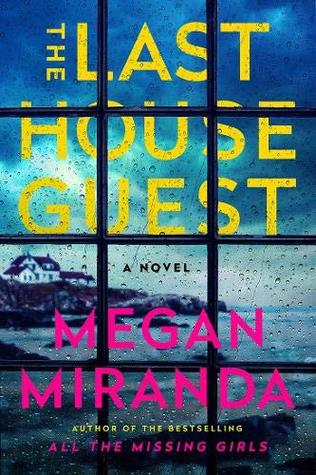
The Last House Guest, by Megan Miranda***-****

3.5 rounded up.  My thanks go to Simon and Schuster and Net Galley for the review copy.  This book is for sale now.

Avery and Sadie were best friends, as close as sisters. After her parents died in a terrible crash, Avery came to live with the Loman family and was included in nearly everything, almost like extended family.  The Lomans are the local gentry, vastly more wealthy and influential than any other family for miles around.  In some ways it was like a dream; Avery grew up as an only child whose working class parents struggled to pay for the bare necessities, and like others in this touristy little beach town, she had been awed by the Lomans, who lived at a lofty remove from ordinary people. But now Sadie is dead, and although Avery is employed by the Lomans as a property manager for their vacation cottages, it is painfully obvious that she is no more family to them than any of the other full time residents here.

Police say that Sadie killed herself, but Avery doesn’t think so. She turns over one clue after another, all of them suggesting that this isn’t as it appears. But once she is able to persuade the cops that Sadie didn’t jump over the cliff’s edge, she becomes their primary person of interest in a murder investigation. Now she is even more motivated to find out what happened that night.

Miranda is a champion when it comes to creating murky, haunting settings and a sense of disorientation. I believe Avery as a character through about 80 percent of this story, but the ending doesn’t hold up this time, and when plot becomes as preposterous as this one has, the character can’t stand up either.

I’ve read and reviewed this author three times now, and each time I found aspects of the ending that raised my eyebrows, but this is the first time that I couldn’t make myself buy into it for the sake of a good yarn. I was aggravated, a feeling similar to what I’d experience if an old friend looked me up and spent an evening with me, only to conclude by asking me for money, or trying to persuade me to join an odd religion. In short, I felt like I’d been had.

Miranda’s fans may want to get a copy of this novel and see what they make of it, but I’d counsel you to get it free or cheap unless your pockets are deep ones.

Today We Go Home, by Kelli Estes**-***

I expected to love this book, and I wanted it to be great. The premise is terrific: Larkin, a wounded warrior home after falling apart while on tour in Afghanistan, finds the diary of Emily, a woman that fought in the American Civil War (albeit in drag.) It’s a cool idea, and between the feminist moxie and my enthusiasm for local writers, I was ready to be wowed. It didn’t work out that way, but my thanks still go to Net Galley and Sourcebooks Landmark for the review copy.

The contemporary component is the part I found strongest and most appealing. I haven’t seen a lot of novels featuring women in uniform (or freshly out of one,) whether in the Middle East or elsewhere, and the pain that Lark carries for her best friend, Sarah, is visceral and in places, haunting. Sarah served with Lark and died in an ambush that Lark believes she could have prevented. Lark sees her die, and then has flashbacks and nightmares that make my gut roil. Lark’s mama is dreadful, and I am heartily weary of seeing mothers take it on the chin in fiction, but I like the relationship between Lark and her grandmother and the way it is developed.

I had hopes for the second thread, the one about Emily fighting alongside her brother in the Civil War, but this part is unfortunately plagued by historical revisionism and too much convenient coincidence. For a woman to be as forward-thinking as the politically correct Emily—and this is the first time I have ever used this term in a negative way, leaning much farther to the left than your average American—would have been very unusual indeed, and for Emily to have slipped beneath the social radar in other regards would have been nearly impossible. Emily thinks at one point that her brother David is gay, for example, but she worries only for his safety, because she herself is sure that gay people are just made that way by God. And while this is a lovely sentiment, a researcher could turn under every historical rock and go through every collection of Civil War diaries and letters, and she would probably not find this sentiment in any of them. And in another case, Emily is sympathetic toward a runaway slave, not only in the sense that slavery is wrong or that the runaway is toast if his pursuers find him; she views him as her social equal. Aside from the late and admirable John Brown, and possibly his sons, it would be a hard thing indeed to find such a Caucasian person in the early 1860s, North or South. Many that fought against slavery assumed that former slaves would be deported to Africa; nearly nobody is on record during that period suggesting that Black folks were equal to whites, or that they could become friends and neighbors on equal footing.

I imagined Ta-Nehisi Coates reading this novel and howling with laughter at its naiveté.

To round it out, Emily virtually trips over another woman-disguised-as-a-male soldier, and given the vast numbers of men fighting in the Civil War, even the most generous estimate of women that served covertly makes this unlikely enough to be ludicrous.

I am not sure whether the pacing of the novel is also slow, apart from these inaccuracies and inconsistencies, or whether it was slowed by them, that sad moment akin to one in which Toto has pulled the curtain aside and revealed that Great and Powerful Oz is actually just a little dumpy bald guy talking into a microphone. All I know is that by the thirty percent mark, I was forcing myself to continue reading because I had a review copy and an obligation. I actually like having one galley with a sedate pace that I can read before I turn out the light, but my frustration with the issues noted above prevented me from reading it and then dropping off into peaceful slumber. At the sixty percent mark, I let myself off the hook. I took a quick look at the denouement to check for mitigating developments at the end, and then closed the book.

Estes is a talented writer, but I believe she has tried to do too much here. A simpler novel focusing exclusively on Lark would likely have been stronger. However, she is a writer to watch, and I believe she will do fine work in the future.

This book is for sale now.

Becoming Dr. Seuss, by Brian Jay Jones*****

Say this name to schoolteachers and children’s librarians and watch our faces light up, our backs grow a trifle straighter, our steps quicken. Dr. Seuss is the closest thing we have to a patron saint, and when I saw this biography, I wanted it as badly as I’ve wanted any galley. Big thanks go to Net Galley and Penguin Dutton, and many apologies for my tardiness. It’s a strange thing but true: when I must write an unfavorable book review, I know just what to say and can do it the same day I finish reading, but for a momentous work such as this one, I need some time for my thoughts to gel. Brian Jay Jones writes biographies of quirky visionaries such as Washington Irving, George Lucas, and Jim Henson, and he doesn’t cut corners. This biography is highly recommended to adult readers, but don’t go handing it off to your precocious fifth grader until you’ve read it yourself. Geisel’s life held some very deep shadows.

Geisel grew up with comfort and privilege as the heir to a family beer making business; the slings and arrows that came his family’s way during Prohibition taught him that small minds can do ugly things. Still, his youth was mostly untroubled; he attended Dartmouth , where he was voted Least Likely to Succeed, and then Oxford, where his studies in Medieval German floundered, his attention drifting to the margins of his notebook, where he drew fanciful creatures and turreted buildings that would later become iconic. It was Helen, his sweetheart, who suggested he follow his heart and pursue art for a living. His early success came in advertising for Flit bug spray.  Once he and his bride became financially stable enough to move out of their low rent neighborhood and into a tonier area, he discovered he had no use at all for pretension, and he wrote:

“Mrs. Van Bleck

Of the Newport Van Blecks

Is so goddamn rich

She has gold-plated sex

Whereas Miggles and Mitzi

And Bitzi and Sue

Have the commonplace thing

And it just has to do.”

He served in the military during World War II with Francis Ford Coppola making propaganda and training films. His pro-intervention cartoons are surprisingly hawkish—I have the collection titled Dr. Seuss Goes to War on my shelves—but he later realized that it was wrongheaded to demand the internment of Japanese Americans, and in some bizarre way, he intended Horton Hears a Who to be his apology for it.

His family was not Jewish, but his surname confused some people, and he received some anti-Semitic shade that inspired him to stand up for the rights of Jewish Americans.  

Jones deserves credit for confronting the anti-Japanese racism and xenophobia in this author’s early years; he doesn’t gloss over it, and he doesn’t turn it into something prurient either. He lays it straight out, along with Ted’s more enlightened thinking in his later years, and it strikes exactly the right tone. This isn’t comfortable material, but then it shouldn’t be.

The most amazing thing is to learn that Seuss—known to family and friends as Ted—wasn’t a successful author until well into middle age. He vacillated between advertising and “brat books” but hit it big when he submitted How the Grinch Stole Christmas to Bennett Cerf at Random House, which would be his second home for many years. Though he and his wife moved to Southern California and much of his work was mailed in, he became known for coming to read his book to the Random House staff in person when it was publication time.  (He was also known for being difficult at times, micromanaging the publication of his work, and this may be part of the reason he wasn’t urged to attend business in person on a more regular basis.)

Ted and Helen were unable to have children, a painful fact that they chose not to share with the public. When asked during publicity tours why a man with such a great heart for children had none himself, Ted deflected it by saying others should have the children and he would write for them.

Helen’s illnesses and Ted’s infidelity were aspects of this author’s life I knew nothing about.  It’s hard to read about, but again, Jones includes these things in the narrative not to shock us, but because they have to be there.

He was widely known and revered for his insistence that books should be fun for children to read and should not preach or moralize, but instead, should respect the readers.  He was a pioneer in this regard, and I owe him a great debt for teaching me to love literature as a preschooler, and for providing such wonderful books for my own children and students later in my life. It is this legacy that remains when the rest falls away, that reading should open new worlds for its young readers; it should not trick or manipulate its audience, but instead should speak to children with respect using language they can understand.

Highly recommended to an adult readership.

The Grammarians, by Cathleen Schine*****

Oh hell yes. This charming little book had me on the first page, and when it was over, I was sorry to be done.  Big thanks go to Net Galley and Farrar, Straus and Giroux for the review copy.  This is the first time I have read anything Schine has written, but it cannot possibly be the last. You can buy it now.

We start in the dark; we start behind bars. Happily, it’s because our protagonists are infants, and they’re in a crib. As light streams through the open door, we enter the lives of Daphne and Laurel, who are identical twins. They are brilliant, and they are in love with the written word from the get-go.

At the outset this story seems like a romp, but its success is in the details. As children we see the girls move in lock step; the first one out of the womb is the alpha, and they both understand this. But as they grow up and define their places in the world, there’s tension and at times, competition. In order to develop relationships and families separately, they have to pull away from each other, and when two people are very close, the only way they can become independent is through a hard break. Schine is absolutely consistent in the development of her characters, and this also includes their intellectual gifts.

One aspect of fiction that grates on my nerves is when I see a gifted child protagonist that’s developed in an amateurish way. Some writers want to use a child in their writing, but don’t have any clue about the qualities inherent in a child at the age they have chosen, and so they build giftedness into the character as an excuse, so that they can provide the child with adult-level dialogue and dodge the stages of childhood.  Schine doesn’t do that. Instead, she creates completely believable little geniuses that are nevertheless coping with the growing pains, developmental milestones, attitudes and frequent self-centeredness that characterize children and adolescents. Her care and skill result in characters that are entirely believable. I like the side characters a lot also.

The wit and sass shown by Daphne and Laurel as they indulge in their secret twin language as well as word play using standard English is original and makes me laugh out loud more than once, but as they grow older, both twins encounter broader philosophical issues that connect language with class, ethnicity, and other variables, and they must find their way through the ethical slough. They don’t choose the same paths, and their anger and pain toward one another is visceral. But in the end…well. You’ll have to find that out for yourself.

This book is highly recommended to those that have twins in their lives; those that love the English language; and those that want to howl with laughter. However, I don’t recommend it to anyone whose first language isn’t English.

I read several books at a time, and while I was reading this one, it became the reward for finishing a chapter in a less rewarding read. You, however, can reward yourself right now by ordering a copy.

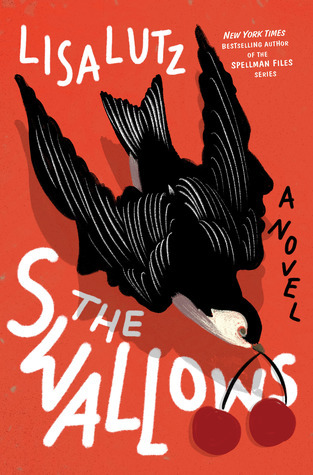
The Swallows, by Lisa Lutz**-***

2.5 rounded up.

Alexandra Witt is desperate for work and to get out from under parental pressure, and so she accepts a job teaching at Stonebridge Academy, a third tier boarding school. She uncovers a dark tradition that victimizes female students, and she helps them fight back. Thanks go to Net Galley and Random House Ballantine for the review copy. This book is for sale now.

As the story opens, Witt discovers that a sick sext of a girl in her first class is circulating; students are commenting on it with their phones during her class. For no reason that I can discern, Witt doesn’t take this problem to counseling or administration, but decides to deal with it, and with the larger problem it represents, by becoming an unofficial advisor to an unofficial revenge club. This turns out to be the better idea, because at Stonebridge, the faculty are either complicit, in denial, or too caught up in their own private woes to care.  At any rate, this hip new teacher is dubbed “the Pied Piper of Stonebridge Academy,” and students—mainly girls–begin confiding in her.

My response to this book mirrors Lutz’s earlier novel, The Passenger. The beginning grabs me immediately, and the author’s crackling wit and swift pacing make me certain I am going to love this book. As the story develops, I occasionally doubt the credibility of a detail here or there, and as a teacher, I wince at the willingness Witt shows in tossing colleagues under the bus, but the story on the whole is still entertaining enough that I set my doubts aside. You can never enjoy a thriller without buying the premise, and so I continue, thinking now that maybe this is a four star read rather than five, but it’s still absorbing, and I want to see where it goes. But when I reach 66%, cracks start to form and so at the climax, instead of being riveted, I feel as if I’ve been had.

The tipping point for me is the amount of prurient detail given to the various sexual acts, most of them either sexual assaults or sex as payback. It is as if the reader is expected to get a charge out of this material, but since there’s obviously something seriously wrong with it, Lutz casts it as a call to arms so that readers won’t feel guilty about immersing themselves in sleaze.  I was ready to toss it aside at 66 percent; that’s enough for me, friends. I don’t care how it ends anymore.  But at the same time I was on the hook for a review and I could tell the rest would be a fast read, so I gritted my teeth and finished it.

And there’s the other problem, a common one in this genre: it’s always so much easier to set a thriller up than it is to resolve it. The way this story plays out has no feminist spark whatsoever—thus nullifying even the faint murmur of MeToo that could be found earlier if you squinted a little and didn’t think too hard—and is also preposterous.

A lot of other people have read this book and loved it; call me a hard-ass if you will. But I always call them as I see them, and I see this as dross. Don’t pay full freight unless your pockets are deep and your tolerance phenomenal. Or you could just buy a better book instead.

What Rose Forgot, by Nevada Barr****-******

Nevada Barr’s newest stand-alone mystery is a humdinger. My thanks go to Net Galley and St. Martin’s Press for the review copy; this book is for sale now, and you should read it.

Rose Dennis wakes up ragged and half naked in the bushes. Sturdy staff members close in on her and drag her back to the secure wing of the Alzheimer’s unit.  She overhears an administrator in the hallway opine that she’s unlikely to last a week, and she knows she has to get out of there. But proving she’s not suffering from dementia is a tall order, and saving herself calls for desperate measures.

Barr’s wit and sass are at their best here, and the pacing picks up at ten percent and never flags. Rose and her thirteen year old granddaughter Mel are well crafted characters. Although I appreciate Rose’s moxie and self reliance, Mel is the character that impresses me most. I spent decades teaching children of about this age, and so I am overjoyed to find a writer that can craft a believable seventh grader. For Mel to do the things she does, she has to be gifted—as Barr depicts her—and again, this character is right on the money, clever without losing the developmental hallmarks of adolescence. The dialogue is resonant and I love the moment when Rose borrows Mel’s cell phone for most of a day. The suffering Mel tolerates for her beloved grandmother is priceless.

But now let’s go back to Rose, and to her situation. A lot of Barr’s readers are Boomers; I am perched on the margin, retired but not yet drawing Social Security.  Looking through Rose’s eyes at the way senior citizens are treated gives me the heebie-jeebies.  As a younger woman I had regarded assisted living facilities as a sensible approach to aging; my mother lived the last few years of her life in one, and I have often joked to my children, whenever I have done them a favor, to “remember this moment when you choose my nursing home.” But after reading this novel, I am not going into one. Not ever.

Now of course most places aren’t complicit in murder for profit schemes, but there is so much here that is completely believable.  Nursing assistants talk to the patients as if they are toddlers. “Diapers are our friend.” Rose is planted in a day room in front of a picture of Sponge Bob and a handful of crayons.  Do we really believe such patronizing behaviors aren’t present in real-life nursing homes? It makes my skin crawl. And the pills that render senior citizens passive and helpless: “Her brain floats in a chemical soup concocted by evil toddlers in a devil’s pharmacy.” And this place has a two year waiting list!

Rose isn’t going gently, and before we know it, she’s on the loose. Now and then the things that she does in her own self-defense make me arch an eyebrow, but the fact is that people age very differently from one another. Some are still kicking butt and taking names when they’re eighty; others pick up the knitting needles and head for the rocker at sixty. And more to the point, what Rose does makes me want to cheer, and so I choose to believe.

My only quibble here is with the way Barr depicts large women. She’s done it for decades; I wrote to her about it once, and her response was that these negative notions weren’t her own thoughts but those of Anna Pigeon. Well folks, here we are with Rose Dennis, and the Nurse Ratchet character here is—oh of course—huge. I would love to see Barr feature a plus size character, oh just once, that is a good person. Please let’s lose the stereotype; other authors have managed it, and Barr should too.

Should that hold you back from buying and reading this book? It should not. I laughed out loud more than once, and the subtext is powerful.  I recommend it for Barr’s many readers, and for all feminists at or near Boomer-age.

Right After the Weather, by Carol Anshaw****

Carol Anshaw has written a good deal of fiction, but this is the first time I have read her work. Right After the Weather turned up on Net Galley when I ran a search for humor; thanks go to Net Galley and Atria Books for the review copy.  This book will be available to the public October 1, 2019.

Cate is a set designer working in Chicago. She’s divorced and looking for the right woman to settle down with. She’s in her early forties, and the clock keeps ticking; Dana is the one she wants, but she wants to be more than Dana’s woman-on-the-side, and Dana isn’t leaving her girlfriend for Cate. Cate meets Maureen who is actually fairly awful, but Maureen makes her life easier and wants her desperately, and so she is trying to persuade herself that Maureen is the woman she wants. Meanwhile her ex-husband, a nice guy that she dumped when she came out, is camped out in her apartment. All of these things make it hard for Cate to move forward.  Her role model is her best friend Neale, a single mother that lives nearby, but all hell is about to break lose at Neale’s place.

Alternately with Cate’s narrative, we have infrequent but unsettling blurbs from a different point of view.  Nathan and Irene are addicts, “casual sociopaths.”  Every now and then there’s a page or two– distinguished by a different font—that articulates their priorities and plans, such as they are.  Anshaw is clever as hell, planting these tiny landmines that let us know that at some point, Cate and our criminals’ lives will intersect; at the same time, when it comes to people like this, less is more, and so they pop into the story just long enough to leave me feeling a little jarred, and then it’s such a relief to return to Cate’s story that I immediately forget about these other guys. The author plays fairly in letting us know that something is coming, but it takes awhile before I start anticipating what their role in this story will be. It’s so much easier to not think about them.

There’s some very uncomfortable material about Maureen about ten percent of the way into the story, and if I hadn’t had a review copy I might have stopped reading. However, that business gets put into context right away, and the rest of the story, though edgy, isn’t in that same out-of-bounds zone. Instead, Anshaw makes me laugh out loud several times with her dry humor and the perception that goes with it; in particular the scene with Cate’s mother is uproariously funny. I am ordinarily not pleased by bad-mother humor because it’s becoming a cliché, but when Anshaw goes there, she outclasses others and there’s no putting this book down.

I would read this author again in a heartbeat.

Night Boat to Tangier, by Kevin Barry*

I have never in my life dropped a galley so quickly. Thanks still go to Net Galley and Doubleday for the review copy, but I couldn’t finish this thing. Actually, I couldn’t even hold to my own reviewing rules.  This book is horrible.

The promotional description mentions several qualities that appeal to me.  I like literary fiction; dark humor; Irish fiction; and the Booker Prize nomination sealed the deal.  I was also aware that there would be violence and and that the characters would include terrible men, but I read grit lit—in small frequent bites when I can’t deal with longer stretches than that—and have reviewed many titles that include these things. But this is something else.

The distinctive writing style doesn’t appeal to me; I like a good paragraph, and having vast yawning spaces in between single brief entries seems wasteful to me. But that isn’t the deal breaker. The deal breaker is the hostility toward women.

Now of course one could say that twisted misogyny is not the author’s perspective but that of the characters, and blah-de-blah-blah, but let’s extend this a step further, for the sake of those that buy that kind of bilge as an excuse. Let’s write the whole thing, the whole book, as repeated child rape, with graphic descriptions and maybe a quick comeuppance or two at the end to make the reader feel better.

Would you buy that? Would you read that?  Then maybe you should give this a miss as well.  After all, this is fiction; its two purposes are to entertain and to convey ideas through the art of literature. How do either of these jibe with ugliness such as this?

My usual practice for a galley I don’t favor is this:  I read up to about 30% in order to give the author a chance, and then if I am still not engaged I skip to the last 25% to make sure there isn’t something wonderful about the climax and the conclusion that might make me reconsider. Fair is fair. But this book feels like a form of violence against women all by itself. I had trouble sleeping after having read five percent; I gave it a couple of days and came back, read another four or five percent, and queasily realized that this novel is the exception to my policy. I am not reading more of it for anyone or anything.

Usually when I don’t recommend a book, I consider whether there’s a niche audience that might still like it. Sometimes a lukewarm book gets a recommendation to read the book free or at a deep discount. But for this thing I confess that I would rather not be around anyone that wants it any time for any reason.

Carnegie Hill, by Jonathan Vatner***

My thanks go to Net Galley and St. Martin’s Press for the review copy.  This work of fiction started out like gangbusters and left me feeling confused in the end. What the heck is the author’s purpose here?

The premise is that Pepper, the child of hugely wealthy, influential parents, has left home to live an adult life without her mother’s interference. She meets a man from a working class background and they fall in love; they purchase an apartment at the prestigious Chelmsford Arms, and the ancient chairman invites her to join the building’s board of directors. She likes Pepper’s pedigree, and the board is comprised entirely of elderly people, so it’s good to have some fresh perspective. Or so the old lady thinks.

At the outset, I think this will be a satirical poke at the rich, and as the story unfolds it is on its way to being just that. We see the building through Pepper’s eyes, and we see it through the eyes of the door men that work there. The only people of color here are employees, and Pepper’s effort to create a more diverse community meet a wall of resistance. And Pepper’s fiancé, whom her parents distrust, turns out to be untrustworthy.  There are several places that make me laugh out loud, and I have high hopes.

But as we move on, the message becomes muddy and the pace slows considerably. Pepper’s fiancé has his own concerns, and we see things through his perspective—all points of view are told in the third person omniscient. Part of the time he seems to be exactly the dirt bag that Pepper’s parents say that he is, but part of the time he is just a loving, misunderstood guy. Ultimately, after a plot that goes all over the place with no apparent destination, it is he that proves to be the most dreadful racist of all of them.

When the board meets, Pepper makes the acquaintance of two other couples, both of them elderly, and both apparently in content, long-term marriages, and she believes they will be her role models, since her own parents are divorced. However, neither couple is happy, and we see their relationships deteriorate. Indeed, the healthiest relationship she sees is between two of the doormen, who are closeted at first, but later come out.

None of these characters is developed much, but the one that seems least credible to me is Sergei, who does a complete turnabout in his willingness to come out of the closet and be in a public relationship with Caleb. We don’t see any kind of struggle on his part and the change is abrupt. Given the importance that Vatner attaches to these two men, I would have thought we would see much more of Sergei’s perspective leading up to the transition.

The worst part for me is that in the end, all of the characters seem much more equal to one another, the filthy rich having their share of misery and the working class being content. Give me a damn break.

Despite this rant, it’s clear that Vatner has talent. There are several passages that make me sit up and take notice. The challenge he faces is in creating a bigger picture with better developed characters, and better pacing. Since this is his debut, he has plenty of time to grow, and I look forward to seeing what he publishes in the years to come.

Heaven, My Home, by Attica Locke*****

Attica Locke is a force to be reckoned with and the first mystery in the Highway 59 series, Bluebird, Bluebird was outstanding, so I jumped when I saw this, the second in the series available to review. My thanks go to Net Galley and Mulholland Books for the review copy. It will be available to the public Tuesday, September 17, 2019.

Darren Mathewsis a Black Texas Ranger, and his work is to unmask and prosecute members of the sinister Aryan Brotherhood of Texas. When the story opens we see that our protagonist is still drinking; he and his wife Lisa, who were estranged during the last book, have reached a détente of sorts. He will still drink, but it will be civilized consumption in front of his wife. A glass of beer. There. See, was that so bad? He has it handled. In exchange, he agrees to bring his work off the road, and so he is assigned to a supervisory position directing other officers in pursuit of the ABT. He doesn’t want to drive a desk, but it’s a concession he makes for her.

But Darren has gotten himself into an awkward spot, a compromising one. His mother—a woman that did not raise him but with whom he has recently developed a relationship of sorts—says it’s a shame that nobody has found the .38 used to kill Ronnie Malvo. Mack, who is dear to Darren, is a suspect in that homicide, and his mother has the gun. He tells himself that his frequent contact with her is a sign that they have a closer relationship and that the money and gifts he brings her are a pleasure for him to provide. But it’s not true; actually, his mother is blackmailing him.

And before you know it, he’s drinking hard, anywhere and everywhere that Lisa can’t see it.

Everyone that reads a lot of fiction in general or mysteries in particular develops a mental list of things they are tired of seeing. I for one could die happy if I never saw another alcoholic protagonist; I am also weary of seeing mean mothers. Why does every author have to take a pot shot at motherhood? But for every item on my list, there’s an exceptional writer that gets a pass because their prose is so solid, their voice so clear and resonant, their pacing so flawless, their characters so credible. Locke is one of those writers. (And to be fair, there are other features on my no-no list that Locke avoids nicely.)

So there’s the iffy marriage; there’s the bottle; there’s the blackmailing mama. But that’s not the half of it. Darren is sent into the field, despite his protests and his promise to Lisa, because there’s a missing child–the child of a member of the ABT– who has last been seen in a historically Black community, and the Rangers need a Black lawman to ease the way of the investigation. The Rangers don’t have a lot of Black officers to call out.

So next thing we know Darren is out in the boondocks, serving as a companion officer to a Caucasian sheriff that doesn’t really want much to do with Darren. In fact, the local power brokers, all of them white, are visibly uncomfortable in his presence, particularly when he enters private homes. And he knows that information is being withheld from him, not only by these people but also by Leroy Page, an elderly African-American man that was the last one to see Levi alive.

Locke is noteworthy for the way she creates a sense of disorientation, a murk that starts with the setting—swampy, dark, wet—and extends into the characters that withhold information and make remarks that are both overly general but also sometimes loaded with double meaning that he can’t decode. And into all of this mess comes his best friend Greg,  a Caucasian FBI man that has been sent in to explore the possibility of a hate crime here.

Part of Locke’s magic is her perceptive nature and the way she segues political events into the storyline. And so the pages fairly vibrate with betrayal when Greg, who knows from Darren that Leroy has not been forthcoming and won’t permit a warrantless search of his home, says that Leroy is guilty of a hate crime. The current administration takes a low view of such matters, Greg points out, and after all, Leroy referred to him as the “HCIC; Head Cracker In Charge.” Darren takes exception:

Cracker and nigger are not the same, and you know it,” Darren said.

“If we don’t prosecute hate crimes against whites—if that’s what this is,” Greg said, just to get Darren to hear him out, “if we don’t prosecute crimes against white lives to the degree that we do those against black lives—“ 

Darren laughed so hard the bourbon nearly choked him.

“They need to see the FBI taking every hate crime seriously.”

“So this is the Jackie Robinson of federal hate crime cases?”

It’s preposterous, of course. For one thing, as Darren points out, there’s no body. The child may be alive. But he is shaken by his friend’s behavior, and when Lisa drives out to visit on her day off, Darren is further concerned by how intimately she and Greg regard one another. It’s one more thing he doesn’t need, and at this point he has nobody left, apart from his very elderly uncle, who tells him the truth and isn’t hiding anything.  He does his best to help Leroy, but Leroy doesn’t trust him and is also not telling him everything, and he’s forced to recognize that this elderly man that reminds him of his uncles and Mack is, after all, another stranger.

Meanwhile, Darren makes a decision that knocks up against the ethics that his upbringing and his profession demand.

The tension builds and there’s no putting this book down. I stayed up late because I couldn’t sleep until I knew the outcome, which I did not see coming.

Locke is brilliant and seems to me like a shoo-in for a Grand Masters Award. This book and the one before it are highly recommended.