
The Story of Arthur Truluv, by Elizabeth Berg****

TheStoryofArthurThe Story of Arthur Truluv is a gently philosophical story centered on an elderly widower. Arthur visits the cemetery every day and has lunch at his late wife’s grave so that he can talk to her. Those interred there make pieces of their stories known to him at times; it’s a bit like crossing Fannie Flagg’s The Whole Town’s Talking with the work of Fredrik Backman. I read it free and early thanks to Random House and Net Galley in exchange for this honest review. I rate this book as 3.5 stars and round upward.

Arthur, an octogenarian, and Maddy, who is 17, meet at the graveyard. Maddy is in a spot herself; her home life is not good; she’s been dumped by a much older boyfriend; she’s a pariah at school; and on top of all these things, she is pregnant. She and Arthur form a tentative friendship, though she is wary of trusting him at first. A bond is formed, and Arthur becomes a mentor to Maddy.

Added into the mix is Arthur’s lonely next door neighbor, an older woman named Lucille, who has never married or had children. These three characters make up the vast majority of the story, but it’s not a story with three protagonists; as the title suggests, the story is Arthur’s, and Maddy and Lucille are here primarily to develop him.

The story is a sweet one and has some nice moments, particularly where gentle good humor is employed; yet at the same time, I felt a little let down. Perhaps it was the hype; there’s been so much buzz about this book. But although I liked most of it, I found it somewhat derivative. I had 90 percent of the ending figured out a third of the way into the story. The character of Lucille felt wooden to me, and a lot of Berg’s sentimentality and allegory could use a lighter hand.

This one is a good choice for those needing a little light, feel-good fiction, but I wouldn’t pay full jacket price for it. This story is available to the public tomorrow, November 21, 2017.


Gods in Alabama, by Joshilyn Jackson*****

godsinalabamaThis book was just what the doctor ordered. Whenever I find myself steeped in too much important-yet-grim literature, I have a handful of go-to authors that are guaranteed to leave me feeling better about the world. Jackson is one of them. I bought my copy of this book used via Powell’s City of Books, online using the gift certificate they bestow on reviewers from time to time. I recently won another one and have ordered some more books by this writer to brighten the winter to come.
Arlene had vowed never to return to her family in Alabama. Dark things have been done there, and she did some of them herself. Let’s examine, for instance, the murder of Jim Beverly. Arlene promised God that if he let her get out of the state after it occurred, she would never return, and despite her family’s hurt inquiries, she never has. Now things are different, though. A visitor from her hometown has come to her apartment asking about Jim. In addition, Arlene’s boyfriend Burr, who is African-American, has told her that if she won’t introduce him to her people, regardless of what they are like or how they will treat him, he will leave her. And so Arlene is forced to break her vow with the Almighty and head south.

Arlene’s family is unforgettable; Aunt Flo, who raised Arlene after her mother’s breakdown, is one of the finest strong female characters of all time. I have read several books since I read this one, and yet Arlene and Flo are still riding around in my head. That’s what excellent literature does.

As to Jim Beverly and Arlene’s vow, there’s more to all of it than meets the eye, and the ending is so surprising yet so completely believable that I can only roll my eyes in admiration. Highly recommended to those that love excellent fiction.

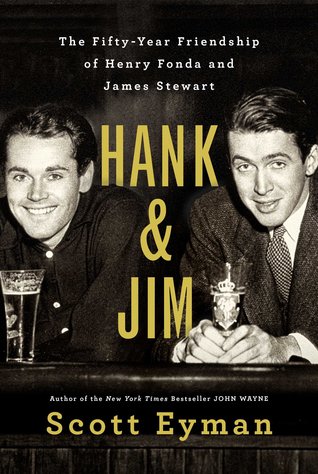
Hank & Jim, by Scott Eyman****

HankandJimFans of Henry Fonda and Jimmy Stewart will want to read this biography, written by the author that recently wrote a biography of John Wayne. I was invited to read and review by Net Galley and Simon and Schuster, and so I read it free in exchange for this honest review. It’s for sale now.

The book is well crafted, and multiple aspects contribute to its success. The first is the unglamorous but essential research. Eyman used extensive interviews with both actors’ families as well as directors and other actors that had worked with them. The second is the thoughtful analysis. Eyman’s insights are intelligent and fairly measured, never becoming prurient, gossipy, or mawkish. The third is his friendly, congenial narrative, peppered with telling anecdotes that keep the pages turning.  It’s well organized and doesn’t rely on photographs to tell the story.

These actors belonged to my parents’ generation, and so for a long time I was not much interested in them. More recently, though, I’ve found it’s interesting to see their craft, their lives, and their work  as creatures of the time in which their careers blossomed, and as part of American entertainment history.

The truth is that I never cared much for Henry Fonda. The only one of his movies I saw in the theater was On Golden Pond, and the harsh way he spoke to his daughter on the screen—who was also his daughter in real life, Jane—was so brutal that I never wanted to see anything more that he’d done, apart from the occasional old movie I ran across on television.  Learning later that he was more or less the same father to her in real life didn’t help much. Eyman is unsparing as he describes this aspect of the Fonda family, but he also points to the mellower man he became later in life, and to the tremendous loyalty he showed his friends, Stewart foremost among them.

I was more interested in Jimmy Stewart, who left a more timeless body of work. Harvey is a film I loved enough to search out and watch in turn with each of my children.  Of course, at Christmas time I am inclined to pull out It’s a Wonderful Life, although none of my kids would watch it with me more than once. There was such heart in his roles.

Because I like Stewart’s work, I had already read one biography fairly recently. Robert Matzen’s Mission: Jimmy Stewart and the Fight for Europe dealt well with his war years as well as the early years of his life, and so I didn’t enjoy the first half of Eyman’s book—which covered the same ground again—as I did the second half, which I found both comforting in places as well as mesmerizing.  The second part also has more quotes by his children, who weren’t around for much of the stars’ earlier lives. And I came away with renewed respect for Jane Fonda, who had a harder road than I had previously understood.

Now I have half a dozen movie titles I want to watch, or watch again; that’s a sure sign of a strong biography. And it makes me think warmly of my own longstanding friends, some of whom I’ve known and loved almost as long as the 50 years that Hank and Jim were friends.

Recommended to fans of Fonda and Stewart, and to those that love good biographies; this would also make a nice Christmas gift for older relatives.

The Quantum Spy, by David Ignatius*****

“America is a country where race matters. The more people say they are, what, color-blind, the more it is a lie.”

thequantumspyDavid Ignatius writes gripping spy fiction, and this is his best work.  The basis of this one is the longstanding intelligence war between the CIA and its Chinese counterpart; the story is fictional, but his careful research ensures that this could have happened.  Lucky me, I read it free thanks to Edelweiss and W.W. Norton and Company Publishers. This book will be available to the public tomorrow, November 7, 2017.

Harris Chang is Chinese-American, raised to respect the red, white and blue.  He works for the CIA, and has been sent to investigate a leak in a quantum research lab. As the USA and China struggle to achieve technological dominance, tensions rise. Chang wonders if he has been chosen to investigate based on his ethnicity, since he knows very little about China or even his own family tree; why yes he has. The Chinese expect to be able to turn him because of it, and over the course of time, his bosses begin to suspect that it’s happened.  Harris is loyal, and he chafes at the unfairness of his treatment, but is determined to succeed. After all, what could prove his loyalty more clearly than to perform above the standard to which most of the Agency’s employees are held?

The setting changes constantly as spies chase other spies all over the world, but the story takes place primarily in Arlington, Virginia and in Singapore. There are also some especially tense, intriguing scenes set in Mexico, and I love the side details about Trotsky’s house, which is now a museum.

Ignatius dumbs down nothing for anyone, and so the reader should have literacy skills that are sharp and ready. Don’t read this one after you take your sleeping pill. Trust me.

The story can be read—and mostly will be, I think—as an enjoyable bit of escapism. With current events so intense, we all need some of that, and it’s what I expected when I requested the DRC. But I find it much more rewarding because of the racial subtext. It’s an area that’s important to me, and at first my back was up when I saw hints of it without knowing what the writer’s intentions were. So many are astonishingly clueless, or worse, when it comes to this aspect of fiction. But as I saw where he was taking it, I had to completely reevaluate my opinion. I would love to be surprised in exactly this way more frequently.

The ending made me want to stand up and cheer.

Highly recommended to those that love strong thrillers, and even more so for those that also cherish civil rights in the USA.