The Mystery Guest, by Nita Prose****-*****

“The maid is always to blame.”

4.5 stars, rounded upward.

Author Nita Prose introduced Molly the Maid to us in 2022. Now Molly is back. She’s the head maid now, and considerably more confident than when we first met her. Her boyfriend Juan Manuel has moved in with her, but he is conveniently out of town for most of this novel, and it’s just as well, because there’s another murder about to occur at The Regency Grand Hotel, and once more, Molly will be instrumental in identifying the killer.

My thanks go to Net Galley and Random House Ballantine for the review copy. This book will be available to the public November 28, 2023, so you can plan your gift lists accordingly.

The hotel is in high gear, planning for the big gathering that will introduce the large, new, lovely tearoom. Business has been down at TRG since the murder last year, and this special occasion should bring new life into the hotel. In fact, Molly has given up her vacation with Juan so that she can see to the set-up; everything must be cleaned, shined, and buffed to perfection. You see, famous author J.D. Grimthorpe has an important announcement to make, and he’s chosen the tearoom as the venue from which to do so.

The stage is set, and the fans arrive. Molly’s protégé, Lily, has arranged the tea cart perfectly. Grimthorpe takes the podium, and is presented with his tea. After doctoring it to his own tastes, he takes a sip and ascends the stage once more, but before he can get to the surprise announcement, he keels over dead, right on top of Lily!

Lily is terrified. She’s always been a quiet one, but now she is virtually mute. When the police come in to question her, Lily is nearly undone.

“Molly, I’m afraid.” Her eyes are round pools of trepidation.

“I know,” I say. “But why?”

“Because a famous man is dead. Because they always blame the maid. You of all people should know that.”

“You’re not in any trouble, Lily.”

“Bit soon to tell,” the detective replies.

With that, we’re off and running. The book is one hell of a page turner, and it’s over before I know it. There’s lots of spunky dialog that jumps off the page. I seldom regret putting away my book because I spend so much time reading each day, but for this one, I stayed up late.

My only quibble—a small one—is that a key part of the solution is a bit of a reach. But this is a fun story, and so I make a quick note and move on.

For those that enjoy a sparkling mystery interspersed with wry humor, this book is for you. The profound respect for the working class is icing on the teacake.

Highly recommended.

The Golden Gate, by Amy Chua****-*****

“If I told a jury that Japs killed Santa Claus, I could prove it beyond a reasonable doubt. Everything changes, Sullivan, once you’ve got a different color defendant in the box. There isn’t a jury in this state that wouldn’t send a Jap to the gas chamber if they had a chance.”

4.5 stars, rounded upward.

‘The Golden Gate marks the authorial debut for Amy Chua, a badass author whose stories will be read for a long, long time. My thanks go to Net Galley, Macmillan Audio, and St. Martin’s Press for the review copies. This book is for sale now.

Our story is set during two time periods, 1930 and 1944, in Berkeley, California. Detective Al Sullivan is investigating a murder whose roots are inextricably tangled with those of another, in 1930. Our point of view shifts often, both in time period and narrator. Most of it is told in the first person, either by Sullivan or by the elderly Genevieve Bainbridge, grandmother of the victim in the 1930 murder, now ready, in full Mama Bear protective mode, to do whatever she must to protect what family she has left.

The narrative has a strong noir flavor, and I halfway expect to find Humphrey Bogart around the corner, smoking and looking pensive. However, there is something Chua brings to the story that Bogart never did: a frank look at the injustices of the period, from the immense disparity of wealth among the denizens of Northern California, to the shameless victimization of people of color, who were much fewer in number in this part of the world then, than now.

I put this information up front, because in the early portion of the novel it isn’t obvious that the racism isn’t being highlighted, rather than propagated. I nearly discontinued reading this book because the “J” word is a hot button for me, and I initially believed that it was being used as a lazy way to depict the culture of Anglo Caucasians during this time period. I’ve seen it done many times, the use of the racial slur against Japanese because the author believed it increased the story’s authenticity. In Chua’s case, it’s the opposite.

The solution provided at the end relies overmuch on the journal of Mrs. Bainbridge, and in places, the details of the murder, and the motivation for same, are a stretch. For that reason, I initially rated this fine novel four stars. In the end, though, I realized that the social justice component more than makes up for it.

I was fortunate enough to have both the audio and digital galleys. Although the readers do a creditable job, the complexity of the story, including frequent changes of place, time period, and point of view, make for a confusing listening experience. For that reason I recommend the print version over the audio, unless both are available together.

Highly recommended.

Zero Days, by Ruth Ware****-*****

What would spring be like without another Ruth Ware mystery?  I hope never to find out. My thanks go to Net Galley and Gallery Books for the review copy.  This book goes up for sale Tuesday, June 20, and those that love a fast-paced, high octane read should order a copy.

One of the finest things about Zero Days is the premise. Our protagonist is Jacintha “Jack” Cross, and she and her husband, Gabe, run a pen testing business. I had never heard of pen testers before; these are people that are hired by corporations to hack into their systems and then report their areas of vulnerability so that they can be corrected before unfriendly hackers find them. Jack is the physical penetrator, and so while Gabe is home worming his way into the client’s network, Jack is on site, physically breaking into the business’s building.

This reviewer has two immediate family members that are fairly high on the IT food chain, so I asked both of them whether this is a real thing; they assured me that it is, although they had never heard the abbreviation. Most penetration testers don’t physically breach the physical building; usually it’s a tech breach only.

On this occasion, Jack meets up with a security guard that doesn’t believe she’s there legitimately, and by the time she straightens things out and gets home, her husband is dead.

When I read my notes, I can find plenty to criticize. At the outset, as Jack is breaking into the site, she has her earbuds in and Gabe is talking to her, and there is some conversation about the sex they’re looking forward to after the job that I find jarring and out of place. Yes, the purpose is to let the reader know that their marriage is strong, but I would have preferred greater subtlety. Then the cops decide Jack is their number one suspect, and when I see that Jack is going to investigate in order to clear her own name and find Gabe’s killer, I actually groan, because this is such a tired, overused trope. And the vast majority of this novel is Jack being chased, Jack running, Jack hiding, Jack running some more.

However, when it’s time to read–and I have several books going at a time, some galleys, some not–I find myself reaching for this one every time. Ware’s pacing never flags, and there’s creativity in the choices Jack makes that are reminiscent of Thomas Perry’s legendary Jane Whitefield series, but with technology added. I love that it’s the woman in this pen business doing all of the physical work, and Jack is a genuine badass, which makes my feminist heart beat harder. She is injured badly in one escape, and I fret over her and even wonder how she’s carrying it off, given the severity, but Ware convinces me that Jack is propelled by adrenaline and a complete indifference to her own safety and health, now that Gabe is gone. There is a small twist thrown in at the end that I find annoyingly predictable, but it’s almost an afterthought, and so it doesn’t impact the main body of the story. And there are occasional brilliant, original bits of figurative language that I love.

In point of fact, I wouldn’t mind seeing Jack Cross again.

For those that love an adrenaline rush, this book is recommended.

Mastering the Art of French Cooking, by Colleen Cambridge****

This charming cozy mystery, set in Paris during the postwar years, had me at hello. Tabitha is an American expat, and her best friend, Julia Child, is teaching her how to cook. But one evening, during one of the Childs’s many soirees, a woman is murdered…and the knife in question came from Julia’s kitchen!  To make matters even worse, the victim was carrying a card with Tabitha’s name and address on it when she was found. For some young women, this would be a wakeup call, and the morning would see them on the next available plane to Detroit; but Tabitha is made of sterner and more curious stuff, and so she begins snooping.  

My thanks go to Net Galley and Kensington Books for the review copy; this book is for sale now.

To cope with the horror of the previous night’s events, Julia is roasting a ham.  “I just had to take my mind off everything. Can you even believe it, Tabs? Someone murdered a woman in this building—with my knife! That means they had to have been in my kitchen! This kitchen!”

Like many an amateur sleuth in other mysteries, Tabitha begins poking around. Sometimes she has smart ideas, and at other times she is breathtakingly dense, but there is never a time that I am thinking about the author rather than the protagonist, and that means that I believe the character. There are some familiar tropes and the occasional cliche: “She knew too much!” But it never becomes a problem, possibly because this is a novel that doesn’t take itself too seriously. Now and then the author breaks down the fifth wall, or nearly so. For example, Tabitha tells us that she knows what to do because she has read plenty of Nancy Drew mysteries.

The solution to this whodunit is fairly transparent, and I am able to predict the solution, along with the conclusion of the additional thread of incipient romance early in the book, but the whole thing is so adorable that I never become annoyed. “Just like an Agatha Christie novel—all the questions answered at the end, and the villain is caught, and everyone else is happy.”

Because I had fallen behind, I supplemented my review copy with the audio version, obtained from Seattle Bibliocommons, and narrator Polly Lee does a brilliant imitation of Julia Child! In fact, all of the passages involving Julia are brilliant, and that is my favorite aspect of this story.

Sometimes an author manages to step on multiple pet peeves of mine, and yet I emerge pleasantly entertained anyway, and that’s what has happened here. This is light reading, but it isn’t insipid. I look forward to reading the next in this lovely new series. Recommended to cozy readers.

Unnatural History, by Jonathan Kellerman****

Unnatural History is the 38th entry in the wildly successful Alex Delaware series. I began reading it soon after the first volume was published; When the Bough Breaks came out in 1985, so the series has been going strong for close to forty years, and very well may continue for many more. My thanks go to Net Galley and Random House Ballantine for the review copy. This book is for sale now.

For the uninitiated, Delaware is a child psychologist; Kellerman is also a child psychologist, and his earlier books incorporated his area of expertise, placing him in a subgenre all his own. I’ve wished many a time that he would write more books along these lines, but he hasn’t done a lot of it lately, and in this book,  there are only glimpses of it. Nevertheless, the story held my attention.

I’m not giving you much of the plot, because there’s a synopsis for that, but in large strokes, the story is about the murder of the son of one of the world’s wealthiest men. He’s an odd duck, not terribly bright; his mother is dead, and his father is a hands-off parent, to say the very least. Our victim has unlimited access to money, and that’s about it. He makes a splash in the art world by photographing homeless people in costumes that reflect their deepest dreams. Find a derelict street person, and find out what they always wanted to be. A pilot? A surgeon? A ballerina? Offer them the chance to be photographed as if that’s what they are now, and give them a juicy wad of cash for their trouble; then send them back to the streets where they came from.

The family structure for this strange young artist is truly bizarre; the father marries, and he fathers a child. One child, no more. Then, a couple years later, he divorces his wife and does the same thing again. The children of these unions are never introduced to one another.

Thus, Milo has plenty of meaty material to work with, and with such strange circumstances, Alex is tapped to analyze the participants.

Delaware works part time as a kiddie shrink, often consulting when there is a court case involving insurance claims or divorce. However, he still has plenty of time to work for the Los Angeles Police Department, consulting on cases where a psychologist’s input is valuable. His BFF, Milo Sturgis, is a homicide detective, spurned by others in the department because of his sexual orientation. Often as not, Delaware ends up riding along as an unofficial partner.

This aspect of the series—the almost-a-cop—is usually where things start to slip a little, when anything does. I want to buy the premise, and so I can go along with it as long as it doesn’t become too obviously unrealistic. We all want to be entertained, right? So when Alex trots out to the patrol car and slides in beside Milo, I smile and nod, and I push away the little skeptic within me that says, “But really…?”

There have been a few Delaware books that have gone sideways for me for that reason, books where Delaware puts on his Kevlar vest and packs a revolver. I am happy to say that this isn’t one of them. In fact, the manner in which these details are dealt with is one of its strengths. First of all, there are times when Milo wants Alex to go with him, but Alex is busy. He has to be in court that morning. Thank you! Then later on, toward the climax, there’s a situation that (no spoilers) shakes out in a way I find the most believable of anything Kellerman has written. It’s satisfying, without sacrificing the fun of the story.

The whodunit at the end might be the nicest touch of all.

I recommend this mystery to Kellerman’s faithful readers, and to those that love the genre.

Everyone in My Family has Killed Someone, by Benjamin Stephenson****

When life gets you down, it’s time to kick back and relax with a nice little book about multiple murders. Benjamin Stevenson’s nifty little mystery is just the ticket. This book is for sale now.

My thanks go to Net Galley and Random House for the review copy.

Once in a while, a novelist will disarm his audience by speaking to them directly; this is known as breaking the fourth wall. Stevenson doesn’t just chip a corner of plaster; he comes in with a wrecking ball, because that’s just the kind of writer he is. The product is as funny as the title. Each chapter is devoted to a family member, and some of them get more than one.

The premise is this: narrator Ernest Cunningham is invited to a family reunion at an out of the way mountain lodge, a ski resort in the dead of winter. The event is timed to coincide with Ernest’s brother, Michael’s, release from prison, where he was sent for…well. You know. And as is true with all families, there’s all kinds of baggage, both literal and figurative; there are grudges, guilt, and oh yes, secrets. So many secrets!

The first body turns up in less than twenty-four hours. Is there a mass murderer at large, perhaps the one in the news dubbed “The Black Tongue?” If so, is s/he a Cunningham?

The whole story is told in a jocular, familiar tone, explaining to the reader what the rules are when writing a murder mystery. He assures us that he is a thoroughly reliable narrator, which immediately makes us wonder, because if so, why bring it up? Most narrators are reliable. So…?

I enjoy reading this thing, and am impressed at how well the author juggles a sizeable collection of characters. It doesn’t take me long to straighten out who everyone is, and this may be because we are apprised of who is annoyed with whom over what, fairly quickly. When he brings in reasons why certain people avoid each other, it helps me recall who they are.

There are two things I would change if I could. The book would be even funnier if he cut back on the side remarks to the reader long enough to let us forget he’s doing it; then, when it surfaced again, it would get more laughs. I note that toward the end, he tells us—in another side reference—that his editor has suggested he pare back some of the chatty parts, and that he isn’t going to do it. That makes me laugh too, because I have been harboring the same notion.

The other thing that I’d change is a detail that distracts me. The author refers early on, and then another time later, to a plot hole big enough to drive a truck through, but he never tells us what it is; possibly the detail that distracts me is the thing he refers to. Early on in the story—so probably not a spoiler—Ernest is badly injured, to the point where one of his hands isn’t usable. Yet throughout the story, when he could go to a hospital, he doesn’t do so, and he doesn’t even address the possibility. People come; people go. Yet there’s Ernest, with an oven mitt stuck over one hand to protect it, and nobody suggests he hop into town and have it looked at. Toward the end of the story there’s a general reference to the Cunningham stubbornness preventing family members from leaving the reunion, but it doesn’t hold water with me.

Nevertheless, this is a fun book. While I was reading it, I was reading several others, but this one became the go-to at lunchtime and whenever I had a spare minute, and so I recommend this book to those looking for a light, amusing read.

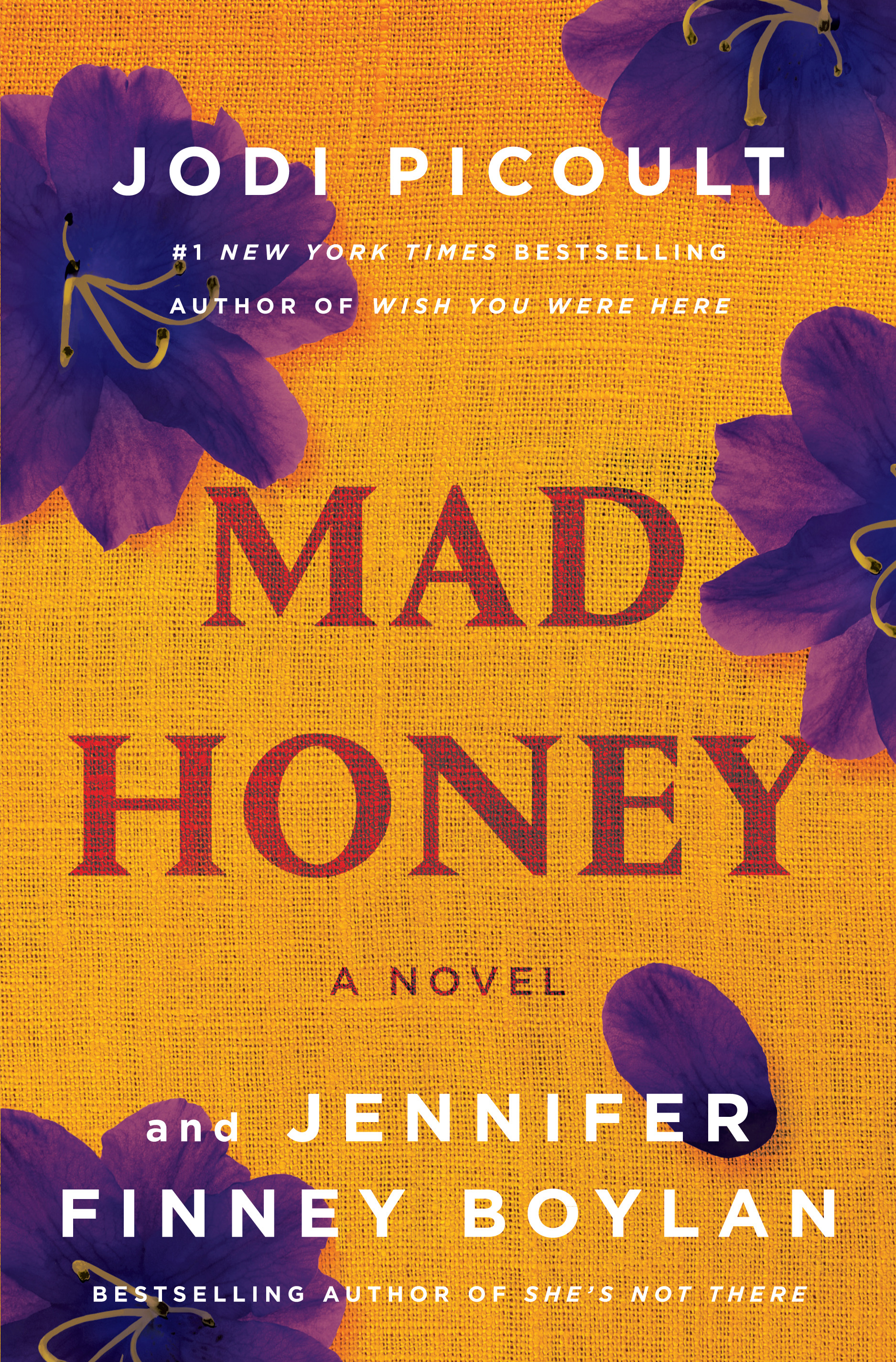
Mad Honey, by Jodi Picoult and Jennifer Finney Boylan*****

Mad Honey is the joint endeavor of bestselling author Jodi Picoult and Jennifer Finney Boylan. My thanks go to Net Galley and Random House Ballantine for the invitation to read and review.  This book is for sale now, and I recommend it to you.

The hallmarks of Picoult’s work are immediately evident. She frames her story around a particular area of interest, and so when one of our main characters, Olivia, is a bee keeper, I figure I am in for an education with regard to bees and honey; I am not wrong. Of late, Picoult has also used some of her fiction to promote social justice causes, and that’s here, too; I did a quick search on Boylan, her co-author, and learned that Boylan is one of the first transgendered Americans to write a bestseller, and this is the other focal part of Mad Honey, which features a trans character.

We have Olivia, then, the bee keeper, and her son, Asher, who is the light of her life. She took Asher and fled an abusive marriage, and enjoys her new life. She is close to Asher, and they talk openly and often; yet, there are things that Asher isn’t telling his mother, and she doesn’t see that.

Then there’s a new girl in town, Lily Campanello, a cellist, and Asher falls for her. Later, Lily is found dead, and suspicion falls on Asher. Olivia stands behind her son, and yet a corner of her mind has doubts. What if, when push comes to shove, Asher is his father’s son after all?

It’s tricky to write fiction that focuses on a controversial topic, and the critical ingredient is characterization. If the characters feel real to us, the story flows and the message becomes an integral part of their lives. We can’t reject the theme without rejecting the character. But it would take a true Grinch to step away from Olivia, Asher, and Lily. I want what’s best for the characters, and so I’m not focused on the authors and what they have chosen to discuss within this framework, but on the story. The writing flows like melted butter, smooth and inviting, and later, the suspense ratchets up almost unbearably, and I have to know what becomes of Olivia and Asher.

Because I am a bit behind, I check out the audio version of this novel at Seattle Bibliocommons.  There are multiple narrators, but the one that resonates most for me is the reader voicing Lily. I say this, despite the fact that she butchers the pronunciation of place names in the Pacific Northwest. Eugene, Oregon is not hard to say. Siuslaw and Willamette are trickier, but there’s only one pronunciation for each, and the reader should have done due diligence.

And now that I’ve said this, I can urge you to get this book and read it. For those unfamiliar with trans people, there’s some good information, and the story is a compelling one. There’s a twist at the end, and I would probably have left that out, as it doesn’t add much, although I can also see the reason it is included. Nevertheless, this is a story worth your time and money, whether as an audiobook or in print.

One by One, by Ruth Ware*****

We can’t party this Halloween, but I have the perfect pandemic book for you. Ruth Ware has been called the modern Agatha Christie, and her latest mystery, One by One, is like a modern version of Dame Agatha’s And Then There Were None. There are plenty of differences, naturally, so you won’t be able to figure out the ending. Personally, I think it’s Ware’s best book to date, and when you curl up with it tomorrow, you’ll forget about your usual Halloween activities. Get your bag of treats, the beverage of your choice, and your favorite quilt, and you’re good for the evening.

 Big thanks go to Net Galley and Gallery Books for the review copy. This book is for sale now.

Erin and Danny work for a resort company, running a European ski chalet that caters to small companies and the well-to-do. A start-up company called Snoop schedules a retreat, but no sooner have the loud, entitled Snoopers disembarked and gone skiing, than an immense avalanche thunders down, leaving the vacationers stuck. Nobody can get cell service; everyone is grumpy. And one of them hasn’t come back from the slopes.

From there, things only get worse. At least there’s enough food to last awhile; but then the electricity goes off, and someone else is found dead in their room, most likely murdered! Oh, it surely isn’t pretty. Erin and Danny are scrambling, trying to improvise amid the bickering guests, whose in-groups are becoming more rigid; small hostilities increase. But it isn’t just about personalities; there’s a company buyout on the table, and a great deal of money is at stake. They have to hold everything together until the authorities can reach them.

This is a fun book, with lots of snappy dialogue and just the right number of variables. We backtrack after the murder is discovered, figuring out who was in the right place at the right time; and with the missing person still gone, it’s increasingly likely that we have two murders, not one. But as the alibis and witness statements unfold—all unofficially, since the cops can’t reach the chalet, which is still nearly buried in snow—it becomes evident that most of what’s offered is hearsay. Person A couldn’t have done this, because they were somewhere else. But…do we know for sure that’s true? They say so, but they could be lying. And as more murders and more stories unfold, we have a tasty little puzzle indeedy.

I have read and reviewed all but the first of Ware’s novels, and in each case I was drawn in, reading avidly, only to throw up my hands at the preposterous revelations and developments that I found in the last twenty percent of the book. But that doesn’t happen this time. I go all the way through it, and in the end the story stands up and I feel as if Ware has played fairly. The suspense is palpable and it builds steadily leading up to the climax. This is a good solid mystery, and I have new respect for this writer.

So there you go. Get your copy, and you can thank me later. But turn on the lights and lock the doors before you commence, cause this one is a humdinger.

Night Moves, by Jonathan Kellerman****

Night MovesI always enjoy the Alex Delaware series. It takes a fun read to make me look forward to my stationary bike–which is generally not my favorite thing–and this did that. My rule for myself is that I am allowed to stop pedaling early, but if I do, the audio book gets turned off, and sure enough, I have been riding it full tilt to sneak in a few more pages.

The best parts are the dialogue, and of course, the adolescent characters that only Kellerman can craft so effectively. That said, I cringe when Milo tells Alex to wear a Kevlar vest when they go in to make the bust; I have bought the premise of the psychiatrist riding around as if he were Milo’s partner, since it makes for a good story and is so well written, but when the bulletproof vests come out, my eyes roll. Noooo, don’t be silly.

John Rubenstein does a fantastic job of reading, and his voices for the many characters are bang on.

Doubt in the 2nd Degree, by Marc Krulewitch*****

doubtinthesecondThis is the fourth and best installment to date in the Jules Landau series. Thank you Net Galley and Alibi for the DRC, which I scooped on the date of publication in exchange for an honest review. This title is for sale now, and if you like a good whodunit, you should get it too.

The shores of Lake Michigan are inhabited by rich white people, and Jackie Whitney is one of them. Once she is found dead and stuffed on the shelf in her own walk in closet, however, the good times are over.  Kate, Jackie’s girl Friday who hails from Appalachia, is arrested and the public defender asks Jules to look into the case. She doesn’t trust the state’s own people to find reasonable doubt without some outside assistance, but she cautions him that she isn’t going to pay him to find out who did it; all she needs is for him to muddy the waters enough to prevent conviction.

She might as well spit into the wind.

Landau is fired up, and he knows that Kate will be convicted if he can’t find another suspect. Partly this is because cops like to wrap up a case, and once they think they have someone they can convict, they stop looking anywhere else; but there’s another reason, too:

“Corruption and Chicago followed each other like conjoined twins.”

The more rocks Landau turns over, the more suspects he finds. It’s getting to the point where he hardly has time to get home and feed the cat. There are many wry remarks that give this story its kick; it’s a novel that’s part noir, part cozy locked-room-mystery, and whereas the author’s disinclination to settle himself neatly into one area of the genre may cost him in sales, I have to admit that I really like it this way. His clear eye on class divisions and his snarky sense of humor lit me up like Christmas, and I can’t wait to see what he does next.

Although this is the fourth book in the series, I think it works just fine as a stand-alone novel.  Highly recommended!