Somewhere Toward Freedom, by Bennett Parten*****

Bennett Parten is a fine historical writer, and here he examines General William Sherman’s renowned march through Georgia during the American Civil War through the lens of the formerly enslaved people that followed him. It’s a job that needed doing, and I’m glad that Parten was the one to do it. My thanks go to Simon and Schuster and NetGalley for the review copy. This book is for sale now.

The Union’s approach to formerly enslaved people evolved considerably over the course of the war. (This is your reviewer talking, not Parten.) In the beginning, when both North and South thought the conflict would be a brief one—ending, of course, in their own victories—anyone that left a plantation without permission to follow the Union army was promptly returned to their owner. But this was problematic from the start, if only logistically, as such practices slowed the army’s pace and drained resources from it, all in service to the enemy. For a while, then, everything was unofficial, as gradually, the formerly enslaved were sometimes folded into the army as support staff, helping cook, set up camps, pave roads, and whatever other noncombat roles needed to be filled. Eventually the practice was codified, not because slaves were declared free—not yet—but as “contrabands” of war. The idea was that by taking the enemy’s property that one runs across, be it livestock, crops, or (wince!) human beings, one’s own forces were strengthened, the enemy’s weakened. And after the Emancipation Proclamation, the formerly enslaved could theoretically go wherever they chose, but since guns and dogs can render such a proclamation from a far away and often unrecognized authority, it seemed like a wise plan for the formerly enslaved to follow the Union army.

Prior to reading this book, I was unaware of the relative size of the crowd of followers as opposed to the army itself. As Sherman’s forces made their way through Georgia waging total war, razing fields and burning cities, the crowd behind it grew from hundreds, to thousands, to tens of thousands!

Sherman’s first obligation, as he saw it, was to win this war. The army had to be his focus. Yet, as enthusiastic followers swarmed, they needed food, shelter, and sometimes other assistance. Initially, the troops were instructed not to give food to anyone other than those followers tapped to serve the army, but it proved difficult to enforce. There were children there, and they might well starve if not fed. The army had, as an intentional strategy, denuded the farms and villages of food and other necessary resources, so telling the followers to go find their own food was disingenuous. The army had nearly all the food there was; unfortunately, it wasn’t enough for thousands of extra mouths. And at times, Sherman and his generals made an effort to prevent, or to at least not help, the followers from remaining with them.

The greatest scandal was the one at Ebenezer Creek. (Sherman himself was not physically present for this, but what happened was consistent with his policies.) Georgia was full of rivers, swamps, creeks, and bogs, and in order to cross them, sometimes the engineers constructed bridges, and then either burned them behind themselves to prevent the enemy from following, or retrieved them for later use. In this instance, the enemy was close at the rear, and the order was given to pull up the bridges just as soon as the last soldier was across. The result was horrifying: with the hounds baying behind them, the desperate followers used every possible means to try to stay with the army. Some drowned; others were captured and either returned to slavery or killed. Women and children perished in those muddy waters, and later, the Federals launched an investigation.

There were other less dramatic, yet still tragic, incidents of the same sort.

In order to solve this conundrum, Sherman ordered a series of abandoned plantations in Port Royal, an island in South Carolina, to be turned over for the use of the freedmen and women. The book goes into a fair amount of detail about how these were run, with a fierce competition between two sides for control. Despite an overly colonial administration, formerly enslaved people were able to farm for themselves, and in some cases were able to buy land with the money they earned. It was a sound, if flawed program that was ultimately destroyed when Lincoln was murdered and Andrew Johnson, a sympathizer of the South, became president and gave the plantations back to their original owners, making no provision whatsoever for the farmers that now worked them.

It is this aspect of which I knew nearly nothing. Part of this is because I am a coward; I have a dozen or more books about Reconstruction that I say I will read, but then I don’t, and that is because I know the ending will be heartbreaking. But there’s also this: conventional histories of the Civil War tend to follow one or another army, general, and so forth, and very few tell the story of what happens after the army marches onward. And so I learned a good deal from this portion of the book; and yes, my heart broke, but not as much as those of the people that were first assisted, and then abandoned by the U.S. government.

Finally, I want to comment on the notes and sources used here. They are beyond reproach, with many primary sources used, multiple sources per endnote in most cases, and well-integrated. I particularly appreciated the quotations of the followers themselves.

I highly recommend this book to all that are interested in the American Civil War, Reconstruction, and the many social and racial problems that have continued to weigh on American society ever since.

The Chinese Question, by Mae M. Ngai****-*****

Mae Ngai is an award-winning author and a professor at Columbia University. In her third book, The Chinese Question, she examines the race relations and to some degree, the economic underpinnings of the Chinese diaspora.

My thanks go to NetGalley and W.W. Norton and Company for the review copy. I am disgracefully late, but when I began reading this book I realized that if I were to absorb and retain anything here, I would need to take it in small bites. That said, this is an unusually well researched work, and it’s well worth the time and attention of anyone interested in the topic.

Usually when I see research having to do with Chinese immigration, it is within the context of immigration to the United States, or an examination of the push factors of emigration, examining why Chinese chose to leave their native land and embark upon an expensive, dangerous, and uncertain journey to a place they’d never visited—in most cases—and where they usually did not speak the language. Instead, Ngai examines it as a global diaspora that includes English speaking nations, namely South Africa, the United Kingdom, Canada, Australia, and the United States. In doing so she is able to highlight the similarities of treatment, to put it politely, and also to dismantle some of the stereotypes that have rooted themselves in English speakers’ knowledge of history.

For starters, she wants us to know that Chinese immigrants were not necessarily “coolies” or indentured workers, and they didn’t always face conflicts with Caucasian powerbrokers. But there certainly were a great many blood chilling abuses, sometimes brought about by White fear of the “other,” but oftener from greed and the desire to exploit the Chinese working class and eliminate competition from the businesses of better off Chinese.

This study is adjacent to my own graduate study topic of many years ago, when I examined the “Model Minority,” and the attempt to counter the demands of U.S. Civil Rights activists of the 1950s and 1960s with the suggestion that Black people quietly accept abuse and quietly climb the economic ladder, or not, as Asians of Chinese and Japanese descent had supposedly done. Ngai demonstrates that Chinese immigrants weren’t all that quiet, and they weren’t all that accepting of maltreatment at the hands of employers and local officials. This is interesting material indeed, and I wish I had known these things sooner.

As a general read for a wide audience, this may be a four star book because it is dense and has an academic approach that not all pleasure readers will appreciate; however, for those with a strong interest in the topic, whether for academic research or personal knowledge and growth, it is hands down the best work I’ve seen in decades.

Highly recommended to those passionate about the issue.

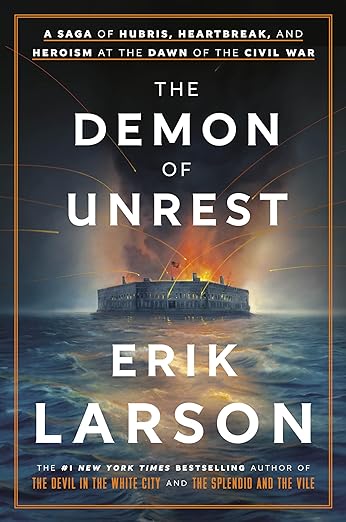
The Demon of Unrest, by Erik Larson*****

When it comes to history, it’s hard to conjure a more capable author than Erik Larson. I’ve thought this for some time, but his Churchill biography, The Splendid and the Vile (2020) cemented this impression.  I am therefore gushingly grateful to NetGalley and Crown Books for the review copy. I would have paid full cover price for this book if that was the only way that I could get it—or the only way that I could get it soon.

This book focuses on Fort Sumter, the Federal fort off the coast of South Carolina that became the catalyst for the opening guns of the American Civil War. The Southern states that seceded from the US, or that attempted to do so, believed themselves entitled to seize the forts, munitions, and indeed, every single ounce of American property located within the borders of their states—and although Fort Sumter and the lesser, partially constructed forts around it were on islands rather than inside the state’s boundaries, they expected to annex those, too.

Meanwhile, as most know, Major Robert Anderson was the fort’s commander, and he desperately wanted orders from Washington. The period following Lincoln’s election, up until he actually took office, was a critical one, but President Buchanan was determined to postpone any official acts until he could hand the responsibility to someone else. He didn’t want his legacy marred by the beginning of a civil war, or indeed, by any sort of noteworthy strife whatsoever, and so he mostly just hid from everyone. Representatives from South Carolina—would-be ambassadors that came to conduct international business—were turned away without official recognition, and that’s about the only worthwhile thing the guy did. And during this fraught period, Anderson and those he commanded waited tensely to learn whether they would be ordered to evacuate, or to defend the fort.

They waited a long damn time; too long.

This is a complex story and an interesting one, and so there are many historical characters discussed, but the primary three that take center stage are Major Anderson; Edmund Ruffin, a South Carolinian firebreather, stoking the fires of secession; and Mary Chesnut, the highly literate wife of a member of the ruling elite. Others of importance are, of course, President Lincoln; Allan Pinkerton, the head of the notorious Pinkerton Agency, which is tasked with keeping Lincoln alive; and a Southern power broker named Hammond, with whom the story begins.

In starting the narrative by discussing Hammond, Ruffin, and Chesnut, Larson gives us a fascinating window into the minds of the South Carolinian ruling elite, known among themselves as “the chivalry.” They style themselves as if they were characters from out of Arthurian legends, placing their own somewhat bizarre code of honor above every other possible principle, and beyond matters of simple practicality. I’ve always been fascinated by the way that leaders of morally bankrupt causes arrange their thoughts and rationales so that they can look at themselves in the mirror every morning and like what they see, and nobody can explain it quite the way Larson can. Everything is crystal clear and meticulously documented. I’m a stickler for documentation, and so although I feel a little silly doing so for someone of his stature, I pull two of his sources, Battle Cry of Freedom, by James McPherson, and Mary Chesnut’s Civil War, which is the diary she wrote leading up to and during the war, from my own shelves, and turn to the pages indicated in a couple of the notes. There they are, just where Larson said they’d be! This may not impress you, but it makes me ridiculously happy.

The story commences with Hammond, a wealthy planter with a highly elastic moral code. There’s a fair amount of trigger worthy material here—though the term had not been coined yet, he was a sexual predator of the highest order, and delighted in writing about the things he did to his nieces. Although this information, drawn from primary sources, does its job by letting us know exactly what kind of person helped shape the rebellion, it’s hard to stomach, and I advise readers that can’t stand it to either skim or skip these passages, because one can easily understand the majority of the text without them.

Once upon a time, this reviewer taught about the American Civil War to teens, and yet I learn a hefty amount of new information. In particular, I find the depiction of Anderson illuminating. I have never seen such a well rendered portrait of him before.

I could discuss this book all day, and very nearly have done so, but the reader will do far better to get the book itself. Highly recommended, this may well be the best nonfiction book of 2024.

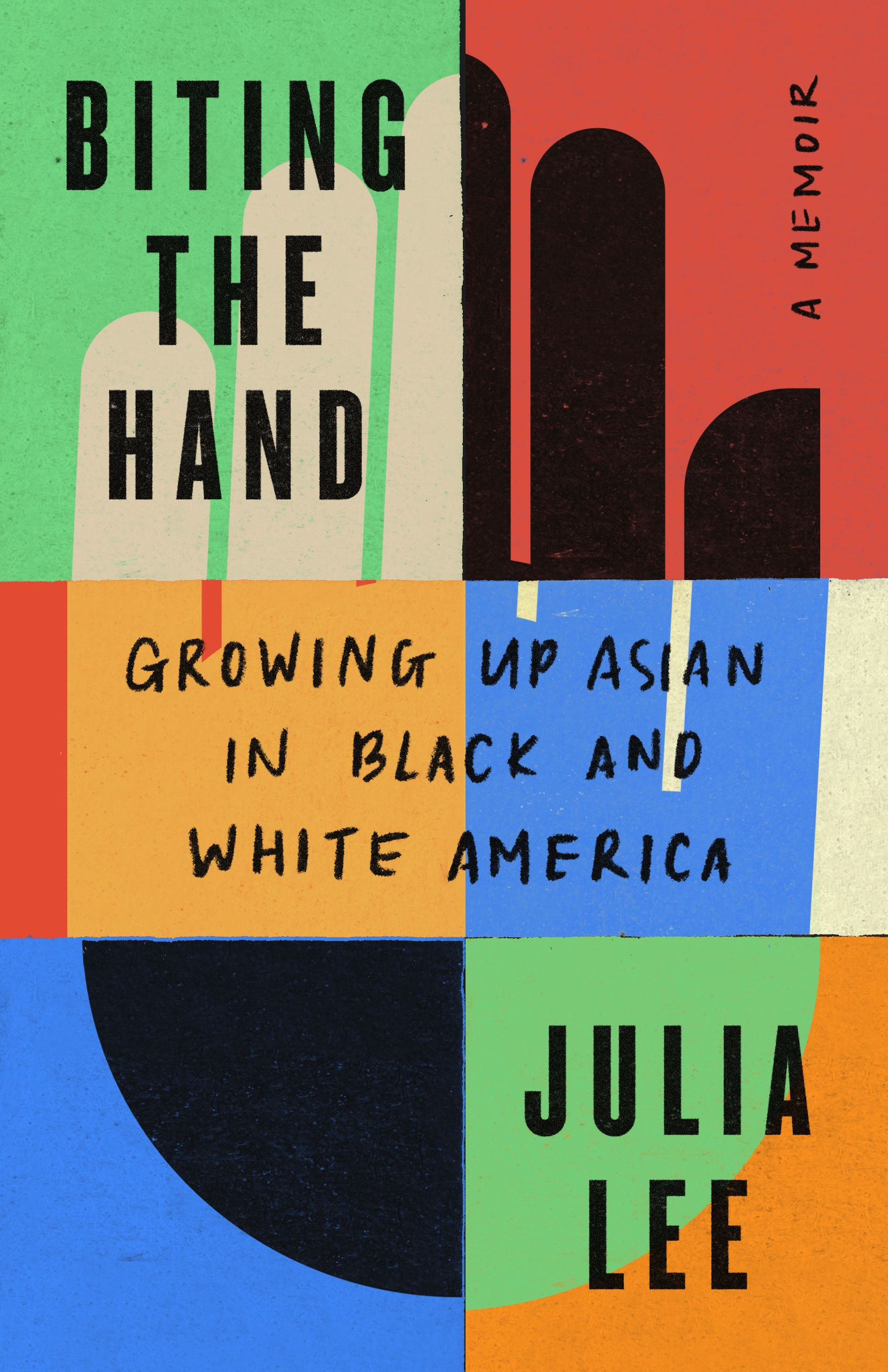
Biting the Hand, by Julia Lee****

Julia Lee is not amused, and she’s decided to say the things nobody else is saying. In this deeply analytical, provocative memoir, she tells us about her own experiences growing up, and the issues faced by Asian immigrants and Asian Americans in the United States, where “we are critical to the pyramid scheme of the American Dream.”

My thanks go to Net Galley, Henry Holt Publishers, and Macmillan Audio for the review copies. This book is for sale now.

In some ways, I feel as though I am reading someone else’s mail as I read this, because it is clearly intended for an audience of people of color. However, I did read it, and I’m going to review it.

When the discussion of race in the U.S. comes about, it is, as Lee states, almost always a conversation about Black people and Caucasians. Those that don’t fit into either group are sidelined. Perhaps more harmful is the way that people of Asian descent are presumed to be sympathetic to the status quo. Ever since a major news periodical dubbed Asians as “the model minority” back in the early 1960s, expectations and assumptions have leaned in that direction. And the roots of this division—Black versus Asian—make this a particularly thorny assumption to untangle. After all, a large percentage of African-Americans can trace their lineage to slavery; their ancestors weren’t born in the States, nor did they choose to come here, but were kidnapped and brought by force. Angry? You bet! But Asian immigrants came of their own accord, oftentimes fleeing untenable circumstances in their countries of origin. And so, their children, and those that have come after, have largely been indoctrinated to be appreciative. If things don’t go well, they tell them, then we must work harder!

This Caucasian reviewer comes to you without the Asian background, appearance, or experience that Lee speaks of; yet I live in a city that has one of the largest Asian populations in the U.S., and am married to an Asian immigrant, and parent to a child that is half-Japanese. So many of the stories—strangers that ask where you’re from, and won’t accept the truth of “California,” where Lee was born, or “Seattle,” my daughter’s hometown, are familiar ones.

Lee is fed up with the mainstream news stories that endeavor to pit Asian and Black people against each other. Her parents were small business owners in a mostly Black part of Los Angeles during the riots of 1992, and her experiences inform her conclusion, that there must be solidarity between all people of color in order to successfully fight for significant change.

The one bone I have to pick is the casual manner in which she dismisses the question of social class as a key factor. Her very brief note about this is that it’s a tomato and to-mah-to issue, not worth much discussion, because most people of color are working class. This is simply untrue, and it enforces a stereotype of Black people as being mostly poor and dispossessed, when in actuality, eighty percent of Black people in the US live above the poverty line. There are African-Americans that have far more money than I will ever see; some of the many Asian groups have a higher median income than Caucasians. So yes, social class is a huge factor here, one that Lee should examine more critically. There are working class Whites that can be allies; there are wealthy families of color that would shut down the struggle, given half a chance. The missing star in my rating reflects her failure to recognize this, and to offer concrete solutions to this problem.

The book’s title comes from Lee’s mentor at the otherwise very white-supremacist dominated Harvard—Jamaica Kinkaid. I actually gasped when I saw this. What a luminary she found to guide her!

Both the audio and print version of this book are equally readable, so go with whatever you usually prefer.

This is a fine resource for those seeking to examine Asian and Asian-American racial dynamics. Read it critically, but do read it. There’s a lot here that has needed to be said for a long, long time.

Our Man in Tokyo, by Steve Kemper****

My thanks go to Net Galley and Mariner Books for the invitation to read and review; Our Man in Tokyo is for sale now.

For the most part, my curiosity about World War II has been slaked, but this book has a different point of view than any other I’ve seen. American history students know of the miserable experience of the two Japanese ambassadors to the U.S., whose own government did not even give them a clue that Japan was about to bomb Pearl Harbor, right there on American soil. But I had never heard a word about their counterpart, the U.S. ambassador to Japan. Joseph Grew was a skilled and seasoned diplomat, and he tried mightily to find common ground between the two nations. Of course, in the end he was more or less shouting into the wind. But I had never read a single thing about him, and so this biography caught my interest.

Readers should know that the last two thirds are much more interesting than the beginning. I don’t care about Grew’s early life, or his marriage, or his golf game. I’m in this strictly for the historical record regarding the U.S. and Japan during the period leading up to the war; also, of course, I wanted to know what happened to him, stationed over there as he was, once war broke out. All of these things are explained clearly and in a conversational manner that is easy to read or listen to. (Since I had fallen behind, I checked out the audiobook from Seattle Bibliocommons, and it sped things up for me.)

The various politicians with whom Grew dealt are interesting indeed. The divisions within the government itself, and also within the Japanese military, created all manner of problems with communication and decision making. There are some bizarre circumstances, and they’re well described. But also interesting to me are the less historically necessary, yet fascinating tidbits that he picks up along the way, living for a decade or so in Japan. Here’s just one nugget for you: Mt. Fuji was (and is) a popular vacation destination, but just prior to Japan entering the war, a terrible trend developed. Young people in their twenties and even their teens went to Mt. Fuji in order to throw themselves into the volcano! When 500 young lives had been lost, the government acted. There were no mental health clinics, and no counselors. Instead, they simply made it illegal to sell anyone a one way ticket to Mt. Fuji. And the really weird thing is, it worked! I am still shaking my head over this one. Kemper’s biography is full of these odd little bits that I doubt you will find anywhere else. His research and documentation are sterling.

As to the audio book, the reader does a serviceable job, apart from his dreadful pronunciation of Japanese names. Shudder.

I recommend Our Man in Tokyo to anyone interested in reading nonfiction about American diplomacy in Japan just prior to the outbreak of war between that country and the U.S. Don’t be ashamed to skip a couple of chapters at the outset if you wish; there’s not much there that will become important later.

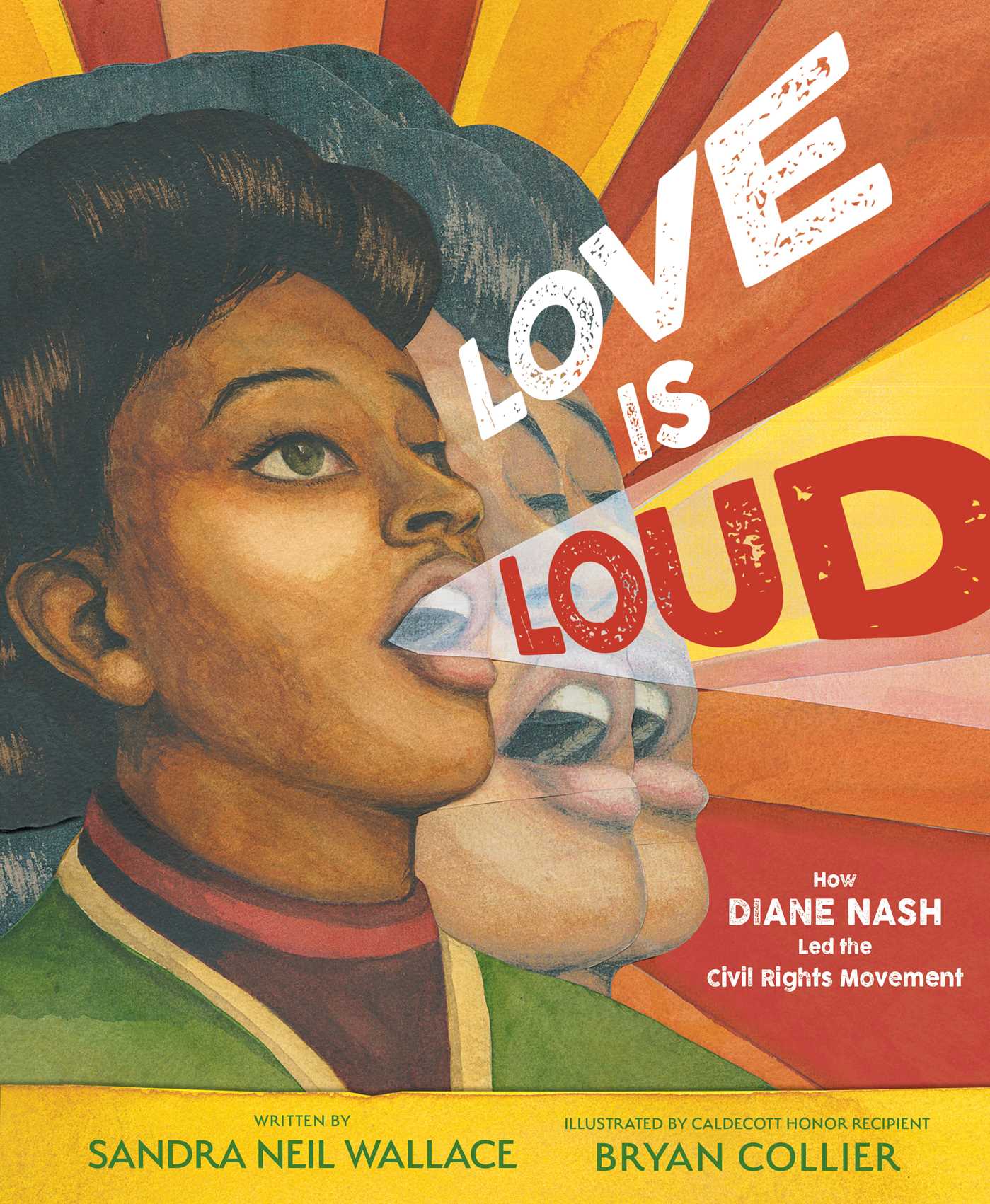
Love Is Loud: How Diane Nash Led the Civil Rights Movement****

Just in time for Dr. King’s birthday! This lovely biography by Sandra Neil Wallace introduces a little-known leader of the Civil Rights Movement, Diane Nash. Nash fought for equal rights for people of color, and had a significant part in the changes that were won.

My thanks go to Simon and Schuster for the copy I received for review purposes. This book is for sale right now.

Most of us have never heard of Nash, who was active during a time when Black people and women were sometimes overlooked, and at other times, excluded in historical narratives. She grew up in the South side of Chicago, where there were many skin colors and cultures, but not many Caucasian people. It was when she went to college in Nashville that she gained firsthand experience of Jim Crow laws, which required separate (and generally inferior) facilities for African-Americans. And Diane was having none of it.

This sumptuously illustrated picture book details the key stages of her development and achievements. My one concern is with the references to “love” in the title and text which are never explained. Is the love in reference to her religion, a philosophy, or something else? The word is thrown in there several times with no context at all. If her mission was to bring change about using nonviolent methods, as Dr. King chose to do and encouraged others to do as well, it is not mentioned. Did she see Gandhi as a role model? We aren’t told. Instead, it appears that the word is injected to sanitize, to offset the word “fight,” perhaps because this story is written for young people. But children aren’t stupid, and without any cohesive portrayal of Nash’s character and underlying motivation, I fear they may forget her. Literature has power, and so although I am glad to see Nash introduced to young people, the effect is diluted when proper character development—which is necessary, even in a children’s picture book—is not provided.

That said, the literacy level is perfect for upper elementary students, and would also make a fine read-aloud for a teacher to frame a single lesson around. It would also be first rate for a sub plan, and teachers know that’s something we always need on hand.

Bryan Collier is the illustrator, and his artwork fills every inch of every page, with the text superimposed on top of it. This is lush, gorgeous work that elevates the story with its presence.

Recommended for classrooms, libraries, and to parents and other guardians of children in grades 4, 5, and 6.

The Black Cabinet, by Jill Watts***-****

3.5 stars, rounded upward.

The premise sounds exciting: a cabinet consisting of African-American luminaries that advised Franklin D. Roosevelt, widely regarded as the best president the U.S. has ever had; well, as far as white folks went, anyway. Wouldn’t it be cool if he had Black advisors, even if it was kept away from the public eye?

It would have been cool, except mostly, he didn’t. Not really.

My thanks go to Net Galley and Grove Atlantic for the review copy. This book is for sale now; in fact, it’s been for sale for a long time. I’m very late with this review, because I was very late finishing the book, because it depressed me so deeply that I couldn’t face it.

Watts is a fine writer and has done the research. The issue for me is that this cabinet, which consisted of outstanding academics and other highly respected Black professionals, had incredibly little clout. They were kept secret. They were unofficial. And it sounds as though FDR tolerated them more than he appreciated them. Despite all of their labor and their eloquence, the New Deal left people of color standing in the rain without an umbrella.

The 1930s were a dreadful time for African-Americans, to be sure. The Jim Crow stranglehold on the South, along with less formal, mostly uncodified discrimination in the North, made it more or less impossible for most bright young Black men to make any headway in their chosen professions, apart from within the Black community (and for Black women? Fuhgeddaboudit.) So, it made my heart sing to learn that there was this exceptional group that advised FDR; but actually, they got crumbs off the president’s table. It makes me a little bit ill to see that this huge study turned up so very little.

For those still interested: there it is.

Elvis and Me, by Priscilla Presley****

Priscilla Presley is the ex-wife of the king of Rock and Roll. I was a teenager when he died, and neither I nor most of my peers were fans; in the event his name did come up, we’d invariably ask, “Wait. Do you mean young hot Elvis, or old pudgy Elvis?” But I do love a good memoir, and those written by or about musicians are high on my list. My thanks go to Net Galley and Macmillan Audio for the review copy. This audio version of the author’s 1985 memoir is for sale now.

The relationship between Priscilla and Elvis took place in a completely different time, with completely different sexual mores and assumptions. That said, this was still a truly messed up pairing. Today, Elvis would probably be considered a predator, but within the context of the American South in the 1950s and early 1960s, he was regarded as a romantic, and women threw themselves at his feet. A quick online peek at old film and television clippings says it all.

Priscilla grew up in a strict but loving household. Her stepfather, the only father she knew, since her own died when she was an infant, was a military man, and so the family moved often. It was while they were stationed in Germany that one of Elvis’s employees saw Priscilla and invited her to meet with Elvis, who was doing his own tour of duty.

I have to feel for the bind her parents were in. On the one hand, she was just fourteen years old, and Presley was twenty-four, a grown man. On the other hand, if they refused to let her go, she would never have forgiven them; this was an invitation that literally millions of girls yearned for. Seeking a happy medium, her stepdad set boundaries: they were to be chaperoned, never alone together, and he wanted her home at a certain time. He groused about the fact that someone other than Elvis would be transporting her, but the reason was a legitimate one: Elvis could not drive himself anywhere without the car being mobbed. It was genuinely unsafe.

Rather than being the single event that the family anticipated, Elvis made their visits regular ones; when her parents balked, Elvis spoke to them personally, turning all of his charismatic charm on them, and telling them everything they wanted to hear. Most of it was untrue, of course, but the one thing he adhered to was not having sexual intercourse. During this time period, the Madonna-Whore dichotomy was alive and well, and any girl or woman known to have sex outside of marriage was likely to be ostracized by former friends and in some cases, family. It’s hard to imagine now, but at that time, no birth control pill had been invented, and a pregnancy outside of marriage was likely to ruin a young woman’s entire life.

Priscilla reads this memoir to us herself, and that makes it much more fun to hear. As we age our faces and our bodies change a lot, but our speaking voices change very little. Remembering some of the silly moments from that time, the author lets out a brief, girlish giggle, and it’s almost impossible to believe that she is now a grandmother.

Priscilla acknowledges that this was a monstrously unequal relationship. Elvis dictated whom she could talk to, what she wore, and sometimes even what room in the house she was supposed to be in. At one point, when he is going to be touring for months on end and she will be left at home with his grandmother, she goes out and gets a job. She’s so proud of herself. He makes her quit immediately. When he phones from the road, she had by God better be there. Priscilla compares this to Pygmalion. He has all the power, and she is in his thrall before she has even had a chance to grow up.

I have read two other Elvis biographies, and as dreadful as all of this sounds, the other authors were less gentle. In fact, this is part of Priscilla’s stated reason for deciding to tell her own story.

There are advantages to reading this particular biography. The official version of events is often what is published, but Priscilla is positioned to know the real story, more often than not. For example: when Elvis is drafted, the official story is that, although stars of his caliber are often offered soft assignments that involve singing to the troops, or making inspirational training films, Elvis insisted on doing the same job as every other American man.  On the other hand, Priscilla states that this is all his manager’s doing, because it will make Elvis appear noble. Enough new songs were taped in advance for there to be regular new releases on the radio throughout his tour of duty; toward the end, Elvis feigns illness because he’d prefer to be in the hospital being swarmed by nurses than marching around and getting dirty.

Her memory of Elvis, despite everything he put her through, is mostly a tender one. The spiral that led to his death, his issues with mental health, back before much was known, coupled with the immense number of strong prescription drugs he used to wake up in the morning and go to sleep at night—or to NOT go to sleep at all, and just stay up, night after night—set him up for relationships with unscrupulous characters, and nobody could rein him in, because he was the King.

Recommended to those that like vintage rock music or well-written memoirs of famous musicians.

Scorpions Dance, by Jefferson Morley****

The Watergate burglary’s fiftieth anniversary has passed, and Jefferson Morley, a longtime journalist and political biographer, has written a history of that event; the focus is Richard Helms, the man that ran the CIA and had to walk a tightrope between the demands of President Richard Nixon, and what best served the CIA. This book is for sale now.

If you are searching for just one book to read about the Watergate debacle and/or Nixon, this isn’t it. However, if you are a hardcore Nixon buff, as I am, or if you are a researcher, looking for specific information for academic study, you can hardly do better.

My thanks go to Net Galley and St. Martin’s Press for the invitation to read and review.

Helms was a slick operator, walking a tightrope as he sought to protect the reputation of the agency while maintaining cordial relations with Nixon and those around him. For some of this, there’s a heavy irony involved here; how can anybody ever make the CIA look less than sleazy? But of course, leftists like me are not the ones Helms wanted to impress in the first place.

As the administration sought to damage political enemies that might prevent Nixon’s reelection for a second term, its shady dealings—hiring thugs to ransack a psychiatrist’s office in search for dirt on an opponent, and planting bugs in the office of the Democratic Party in the Watergate Hotel—proved to be the president’s undoing.

Two of the ugly characters in service to Nixon were in charge, for example, of interviewing candidates for a “riot squad” of counterdemonstrators to oppose the anticipated throngs of antiwar demonstrators that were anticipated in Washington. “One of them was Frank Sturgis, whose reputation for violence preceded him. ‘The men were exactly what I was looking for,’ Liddy rumbled in Will, his best-selling memoir. ‘Tough, experienced and loyal. Hunt and I interviewed about a dozen men. Afterward Howard told me that between them they had killed twenty-two men, including two hanged from a beam in the garage.’”

The burglaries had too many moving parts to be kept completely under wraps, and consequently, the president and his top advisors were soon looking for scapegoats below themselves, men that could be packed off to prison while the country regained confidence in the administration that had supposedly brought them to justice. At one point, they had Helms in their sights as a possible fall guy, and the former CIA director, McCord, who was retired, caught wind of this and was having none of it. In a letter, he said, “If Helms goes and the Watergate operation is laid at the feet of the CIA where it does not belong, every tree in the forest will fall. It will be a scorched desert. The whole matter is at the precipice now.”

There are moments when I wonder if the ghost of Richard Nixon haunts the White House, cackling with glee to see a former president in far more trouble today than he himself experienced when he was there. Who knows what the old dog would have thought about the political machinations unfurling today?

Morley has a conversational narrative tone that works wonders. Because I had fallen behind, I checked out the audio version from Seattle Bibliocommons, and narrator John Pruden does a fine job bringing it to life. But the most impressive aspect of this book is the research behind it, with treasure troves of primary documents and brilliant integration of data from multitudinous places. The endnotes are impeccable, enabling other researchers to trace back the facts to their original sources if they need or desire it.

For a niche readership of researchers, this is a five star work, but I suspect most interested parties will be of a more widespread readership; for them, this is still a fine read at four stars. Most satisfying.

The Road Less Traveled, by Philip Zelikow***

Is this going to be on the test?

My thanks go to Net Galley and Public Affairs for the review copy. This book is for sale now.

I am initially drawn to this title when I see the subtitle—an opportunity to make an early peace that went unanswered—and I also want to read more about World War I. I love military history, and am sick to death of World War II material, so this felt like it might be a breath of fresh air.

Or not.

There is no doubt that Zelikow knows his field, and his research is above reproach. Students and researchers may find this book useful, albeit with a careful eye toward a very conservative point of view that affects his analysis. However, for those of us just in it for the joy of learning, I must caution that this is a slog. I read the first half in the digital format I was given, and after publication, I also availed myself of the audio version available at Seattle Bibliocommons, and it’s difficult to focus on either for long at a time, because it’s just Zzzzzzzz

Oh, I’m sorry! Was that me? Let me try again. The research is splendid; the analysis is reactionary; the presentation is a little zzzzzzzzzzzzzzzzzzzzzzz

I might have spared myself some frustration had I researched the author. Once I was able to focus long enough to get a feel for his political leanings, I ran a brief Google search, and discovered he’d been with the U.S. State Department under the Reagan and Bush administrations.

Oh.

At this point, you know enough to decide whether you want to read this thing. If you have a strong interest in the topic and aren’t squeamish about drawing information from the far right, then this is your book. Not mine, though.