The Doorman, by Chris Pavone*****

“It’s up to everyone to draw a line, and hold it.”

Chris Pavone writes white-knuckle thrillers, and he’s one of the best in the business. His new novel, The Doorman, is one you won’t want to miss. My thanks go to NetGalley, Macmillan Audio, and Farrar, Strauss and Giroud for the review copies; this book will be available to the public May 20, 2025.

Our story rotates around three main characters, providing the point of view of each in turn; the setting is The Bohemia, an exclusive apartment building in New York City. Julian Sonnenberg, a middle aged art gallerist whose marriage is dying, lives there, as does Emily Longsworth, wife of the ultra-wealthy and ultra-hated Whit Longworth, racist war profiteer; and Chicky Diaz is the doorman, who sees all and hears all. They don’t know it yet, but their fates will soon be linked.

I’ve been reading Pavone’s novels for a long time, and each time he surpasses himself. The common thread that I treasure most, however, is his deep affinity for the working class, and his respect for women. In fact, I don’t know of any male novelist that is better than Pavone when it comes to developing female characters, and that is even more impressive when I consider his genre, because in most true thrillers, the pace is so fast and furious that there’s no time to develop any characters at all. Yet somehow, Pavone does it, and he does it without sacrificing the heart pounding, screaming pace that accelerates until the almost unbearable climax, which in turn is very close to the conclusion.

I was lucky enough to have access to both the digital and audio versions of this story; Edoardo Ballerini does a fine job narrating the latter. You can’t go wrong in either direction.

Highly recommended to those that love the genre and lean to the left.

The Second Coming, by Garth Risk Hallberg***-****

Garth Risk Hallberg is the author of the epic, memorable novel City on Fire, which was among my short list of favorites the year it was published. My thanks go to NetGalley and Alfred A. Knopf for the invitation to read and review his new novel, The Second Coming. This book is for sale now.

The story begins in New York City when Jolie, who is thirteen years old, is nearly struck by a train. Her parents are divorced, and she hasn’t seen her father in quite a while. Ethan is addicted, and his cravings make him unreliable. He makes promises he won’t keep, and Jolie has more or less given up on him, but her brush with death convinces him that she is in a darker place than her mother realizes, and that only he can save her.

Heaven help the girl!

The episode is the beginning of a twisted, bizarre odyssey. Jolie’s mother is distracted, not paying a lot of attention to her daughter, and Jolie becomes involved with a complete stranger, young man much older than herself. As a reader, I became frustrated and wanted to shake Jolie’s mama and tell her to wake up and take care of her kid. Just because they look grown at 13, doesn’t mean they are grown.

On glorious display here is Hallberg’s remarkable word smithery. The man has a gift, and he’s not afraid to use it. Portions of this book were a joy to read, simply because his prose is matchless.

For me, however, the plot and characterization of Ethan got in my way. Addicts and alcoholics in literature are becoming a trope, and I had vowed to myself to steer clear of them. I read the synopsis of this one and knew what I was walking into when I accepted the galley; I had hoped the author’s talent and skill would take a tired old plot point and make it seem new. He partially succeeded; I didn’t throw my reader across the room as soon as the addiction material appeared. But I didn’t love it the way that I loved City on Fire. Also, large portions of this are in epistolary form, from letters that Ethan writes to his daughter, and although they have been edited down considerably between the galley I read and the polished, finished result, they still got in my way.

So, this is a competent effort, but not a magical one. If you enjoy fiction with addicted characters, or if you like books about fathers and daughters, this book may be a happier experience for you than for me. However, I was expecting great things, and I came away feeling somewhat disappointed.

Crook Manifesto, by Colson Whitehead*****

The Ray Carney mystery series is among the most exciting new series to emerge during the past decade, and that is hardly surprising, given that it’s written by Colson Whitehead, who has two Pulitzers and a host of other prestigious awards to his credit. The first in the series is Harlem Shuffle, which came out in 2021. Crook Manifesto is his second. I was unable to get the galley this time, but happily, my son bought it for me for Mother’s Day. I mention this because it’s rare that I pursue a book once I’ve been denied the galley. In this case, it was worth it!

Ray Carney, when we met him first, was a man who’d sometimes been known to bend the law in the past, but as a family man, it was important to him to lead a straight, steady life now. Carney owns a furniture store, financed by money his father had socked away before he died. Ray politely refused to deal with the sort of merchandise that, you know, fell off a truck. That had been a big part of his father’s life, but it wasn’t his.

The place is, of course, Harlem, in New York City; the time is the 1970s.

Ray’s dad had lived on the wrong side of the law. Decent, above board jobs were hard for a Black man to come by in Harlem, so when something needed to exchange owners, or a decrepit building needed to be set ablaze, Mike Carney was your guy.

But not Ray.

I seldom read a book printed on paper anymore, so when I do, I put it in the bathroom. No novel that remains in the bathroom from start to finish can have five stars. In the case of Crook Manifesto, it emerged immediately, but after a few chapters, it went back in, and it managed to stay there until an electrifying moment at the 78% mark, when I sat bolt upright and dragged the book over to the bed.

It all starts out with a corrupt white cop who forces Carney to accompany him on a shakedown. There’s the carrot, and there’s the stick. On the one hand, he can give Carney tickets to see the Jackson 5 live in concert; Carney’s daughter has a birthday coming up, and would give a great deal to see that concert. Tickets are impossible to get, but the cop has some. And then there’s the stick; the cop can make Carney’s life very, very difficult. And so Carney has no real choice.

But among all of the wrongdoings occurring in Harlem, there’s an arson that nearly kills a boy, puts him in the hospital. Carney is obsessed with this. It’s over the line, and he wants to find out who did it and make them pay. And in the process, which involves side business and some interesting new characters, he is forced to reckon with exactly how his own father managed to support his family.

And so that whole middle section of the story, which is atmospheric but relatively low key, is the calm before the storm, but oh honey, that storm is coming. Believe it!

I cannot wait for the third book in the Ray Carney series to come out. When it does, I’ll be ready. If you love this genre, you should start with Harlem Shuffle, then advance to Crook Manifesto directly. Highly recommended.

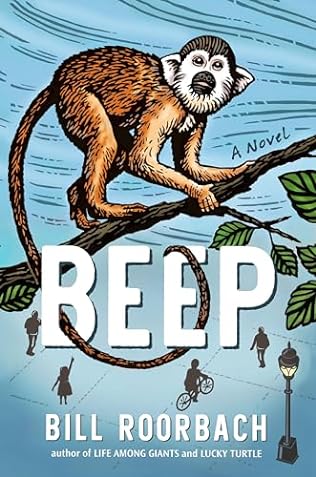
Beep, by Bill Roorbach****

Beep is squirrel monkey, born and raised in the rain forest of Costa Rica. He’s not a baby anymore, and his old uncles have informed him that all the females are spoken for, and he must travel to a new area to mate and propagate. It’s tricky business, though, because human encroachment has separated the forests from one another, so Beep cannot get to the next forest without going through areas developed by humans. Beep’s odyssey takes him much farther than anyone imagined, and in the end, he finds fame and satisfaction.

My thanks go to NetGalley and Algonquin for the invitation to read and review. This book is for sale today.

Much of the book is devoted to the relationship that Beep develops with a human child named Inga. While traveling through neighborhoods, a bit lost and unsure where the next forest might be, he spots her eating some delicious fruits in her backyard, so he introduces himself in order to get lunch. Inga’s mother comes out and meets him also, and this passage provides an idea of the story’s character:

“’Squirrel monkey,” the mother said warmly, ‘Ooooh. They aren’t usually solo. Oooh, ooh. Keep your eyes peeled, there will be more.’

“Ugh, eyes peeled? ‘I’d like some fruit,’ I said clearly.

“’Oh, how charming,’ said the mother. ‘Hoo-hoo, monkey.’ She’d wiped most of yesterday’s blood from her lips, but at the edges of the enormous mouth some remained (probably she’d caught and eaten a bird). Also, part of her outer wrappings had come loose and her poor chest looked more distended than ever, wrapped in a bright banner of some kind. Somemonkey once said they look like us, but come on: they do not.”

But this is not Inga’s permanent home; she is on vacation. When her family returns to New York, which Beep calls Nyork, she smuggles him in with her carry-on items and it is in New York City that he meets fame after surviving several harrowing situations.

For the most part, I find this novel charming. There’s no need to concern ourselves about the credibility of the overall story line, because after all, we’ve begun with a monkey providing the narrative, so it’s clear that we just need to roll with it. It is funny in places, a bit dark in others, and then—as with the above quote—sometimes it’s darkly funny. Some of the reviews I’ve read take issue with the ending, but I’m good with it. My sole dissatisfaction, and unfortunately it’s one of my pet peeves, is Roorbach’s failure to develop Inga appropriately in keeping with her age. There’s a scene at the airport when she starts to cry because her stuffed animals are being taken away to be scanned by security, and another soon afterward where she is walking her doll buggy in Central Park, so I’m figuring she’s maybe six years old; but subsequent scenes make her seem much older, and finally we’re told that she’s eleven years old. It doesn’t take years of study to know that an eleven year old girl doesn’t wail about her stuffed animals or take her dolls for a walk in the park. Get real.

Happily, as the story unfolds from there, Inga settles into being a real eleven year old, and my irritability ebbs so that I can enjoy the rest of the book.

All told, this is a delightful read. Because of its dark characteristics, which I will not provide because they’d be spoilers, this is not a book to read to your little ones, but if you have a young Goth in your home who is able to read alternate spellings and dialects, then this book would likely be that kid’s happy place. The overall message is a worthy one, although Roorbach is probably not going to change hearts and minds about the environment, since those in favor of unchecked development in the face of environmental devastation and disaster aren’t going to buy this book. All told though, it’s a fine read for those that are ready for something a bit different and that can handle dark humor.

Bright Lights, Big Christmas, by Mary Kay Andrews****

I tend to avoid heartwarming holiday stories and romances because so many of them are infused with saccharine and require the reader to put their I.Q. in a box until the book is over. But two years ago, I was happily impressed with Mary Kay Andrews’ The Santa Suit, and so when I was invited to read and review Bright Lights, Big Christmas, I happily agreed. My thanks go to Net Galley, St. Martin’s Press, and Macmillan Audio for the review copies. This book is for sale now.

The Tolliver Christmas tree farm is an institution, not only at home in North Carolina but as far north as New York City. As a child, Kerry sometimes accompanied her family to New York to set up a tree stand and sell the trees, but as an adult, she’s had other priorities. This year, though, she finds herself unexpectedly jobless, while at the same time, her father’s health prevents him from executing the task. Kerry must take his place, traveling to the Big Apple with her brother, Murphy. They set up the stand, and they sleep in the ancient pink trailer nicknamed “Spammy” because of its resemblance to a canned ham. Adventure awaits.

Kerry’s love interest pops up before we’re even ten percent into the story, but it appears that the author planned for us to know that, and it doesn’t hurt anything. Over the weeks they are in New York, various small (and large) crises present themselves and are worked out with team work, ingenuity, and the occasional well-placed bribe. They have Murphy’s dog Queenie with them, but she is primarily left in the background where she belongs.

What I appreciate most about this novel is how well grounded the plot is, and the author’s restraint in not permitting any elements to go over the top. There are a host of stereotypes possible, but every time I see one coming, Andrews chooses a different path, and it keeps the story fresh and original. Small details that might be overlooked by someone less detail oriented are seen to, and it keeps the narrative credible. Examples are the need for a shower or bath, given the length of their stay in a trailer without working plumbing; the cost of living in New York; the hazards of theft and vandalism, especially active at Christmas. None of these sidetracks the plot or slows the pace, but the questions a reader might have are tidied away, and this makes for greater enjoyment.

One small criticism involves a situation where theft and vandalism occur at a time when Murphy has to be away, and immediately, other men folk clamor over the need to have someone—someone with a Y chromosome, folks—to do lookout duty, protecting the fair damsel, her trees, and so on.

Apart from that, this is a delightful story. However, for awhile I wasn’t sure I liked it, because I was listening to the audio version, which is poorly done. The male characters are voiced in a way that is choppy, wooden, and unconvincing; but worse is Kerry’s voice, which is performed in a high-pitched, girly-girl voice so off-putting that it took me awhile to realize that the problem wasn’t the author’s, but rather the voice actor’s. The children’s voices are much better, and I actually howled with laughter when the baby in a stroller wailed!

As the story reaches its climax, Kerry has to make some serious choices, and I admire the way this part is resolved. The side character Heinz, an elderly man that lives in the neighborhood and often stops by the tree stand, is terrific.

When all is said and done, I rate the printed version of this novel 4+ stars, and the audio version 3+ stars, with an overall score of 4. I recommend the print version of this book, but not the audio.

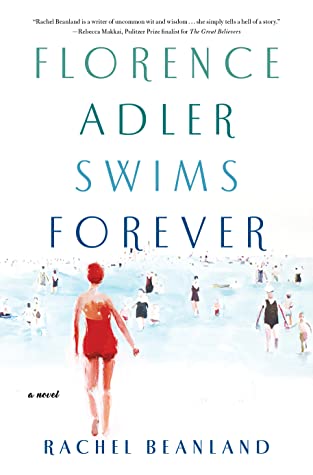
Florence Adler Swims Forever*****

It’s hard to believe that Florence Adler Swims Forever is a debut novel. Rachel Beanland has stormed our literary beaches, and I hope she does it forever. Big thanks go to Net Galley and Simon and Schuster for the review copy. This book is for sale now.

The title character dies almost immediately, which is a bit unusual all by itself. The central storyline centers on Fannie, Florence’s sister, who is in the midst of a dangerous pregnancy. She’s already had one premature baby that died at 3 weeks, and so this one Is being closely monitored. Because of this, the family closes rank in order to prevent Fannie from knowing that Florence has died until after the baby’s birth, lest she miscarry. However, Fannie isn’t the main character; the point of view shifts between the present and the past, from one family member to another, eight all told, in fairly even fashion.

My first reaction to this premise—keeping her sister’s death from Fannie for what, two months—is that it’s far-fetched to think such a plan could succeed. But as the story unfolds, I realize that information was not a constant presence during the late 1930s, as it is now. There was no television yet; a radio was desirable, but not everyone had one. Fannie asks for a radio for her hospital room, but she’s told they’re all in use. Too bad, hon. Newspapers and magazines were explicitly forbidden for visitors to bring in; the lack of news is explained in general terms as “doctor’s orders,” and back then, doctors were like little gods. If “Doctor” said to jump, everyone, the patient most of all, leapt without question. And then I see the author’s note at the end, that this story is based on an actual event from her family’s history! It blows me away.

Besides Fannie and Florence, we have the parents, Joseph and Esther, who have a meaty, complicated relationship; Fannie’s husband Isaac, who is an asshole; Fannie and Isaac’s daughter, Gussie, who is seven; Florence’s swim coach, Stuart; and Anna, a German houseguest whose presence creates all sorts of conflict among the other characters. Anna’s urgent need to help her parents immigrate before terrible things happen to them is the story’s main link to the war. All characters except Stuart are Jewish.

Because I missed the publication date but was eager to dive into this galley, I supplemented my digital copy with an audiobook from Seattle Bibliocommons. This is a wonderful way to read, because when something seems unclear to me, I can switch versions, and in the end, I feel well grounded. The audio version is read by eight different performers, and the result is magnificent.

Read it in print, or listen to the audio; you really can’t go wrong. The main thing is that you have to read this book. As for me, I’ll have a finger to the wind, because I can’t wait to see what Beanland writes next.

Paris Never Leaves You, by Ellen Feldman**-***

2.5 stars rounded upward. I was invited to read and review this novel by Net Galley and St. Martin’s Press.

World War II fiction is a crowded place, and I have left it, for the most part, having had more than my fill. I am initially interested in this story because it takes place in 1950s New York, and that’s a setting I haven’t seen much. However, this setting alternates with the protagonist’s memories of Paris during the war, and so there I am again, back in Europe during the war.

Charlotte is a young widow, working in a bookstore to make ends meet. Her infant daughter, Vivi, is often with her. A German soldier is drawn to her, and she snubs him repeatedly, but when he brings food and milk for her starving child, she caves. When Vivi becomes sick, he smuggles in medication. Yes, this is one of those I-hate-you-but-I-love-you stories. This isn’t new; I’ve seen plenty of forbidden love stories, especially with regard to German soldiers. I’ve also seen plenty of love-hate romances.

But what strength I see in this one is in the grey areas. Is it all right to fraternize with the soldiers that are responsible for the deaths of loved ones, if those you’re befriended by can save other loved ones, particularly children? Is it all right to let someone think you’re Jewish, once the war is over, if that means they will save you? Is it acceptable to be Jewish, whether inobservant or otherwise, but pretend you are not, if it increases your odds of survival? What if that means taking other Jews prisoner, serving your enemy?

I’ve said this before in other reviews, and I’ll say it again here. It irritates the bejesus out of me, this World War II forbidden-romance storyline that is always, always, always between a Caucasian European, or Euro-American, and a German. Maybe someone has been wildly creative and included an Italian, but I haven’t seen it if they have. What do we never, never see? Ever? Never? (I could go on all night like this, and don’t provoke me or I’ll do it!) We never, ever see a WWII relationship between a Caucasian civilian from an Allied nation and a Japanese soldier. Or civilian. Or anything. It’s almost as if there’s a whispered subtext that insists, “It’s okay. After all, we’re both white, and that’s what really matters.” And authors that are far too progressive, too modern, too civilized to use any of the zillion ugly epithets that were common usage at the time by Allied service people and citizens toward Germans and Italians, nevertheless decide it’s somehow acceptably authentic to use the J word for Japanese. You know the one I mean. And Feldman is a serious offender here.

Because I was having trouble plodding through this story’s text, I visited Seattle Bibliocommons and borrowed the audio version. (Laurie Catherine Winkel does a fine job as the reader.)  I had listened to about seventy percent of this story when Charlotte has a conversation with her landlord, sponsor, etcetera about his own war experience, and boy does he pour it on. I think I must have found the J word on damn near every page, sometimes more than once. I nearly stopped reading, and I nearly gave this book a single star. I fast-forwarded a bit, and when the passage involving this veteran’s way-too-long speech ends, I don’t hear the word again, so I take a deep breath and forge onward to see how it ends.

The ending is bittersweet, and it’s not formulaic.

So there it is. This book is for sale now, but my advice is to either give it a miss, or read it for free or cheap. And if another forbidden WWII white-on-white romance turns up in my inbox, it’s going straight to my round file. Stick a fork in me, cause I am done.

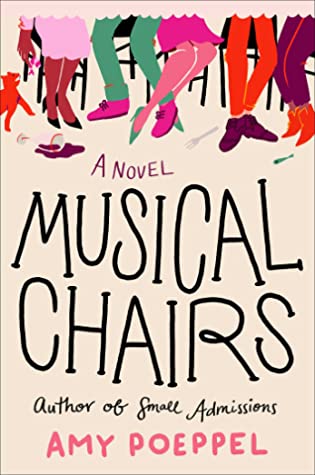
Musical Chairs, by Amy Poeppel*****

We need more writers like Amy Poeppel. Her previous novels, Admissions and Limelight, are whip-smart and hilarious; both involve well-developed characters stuck in odd but credible situations. Her new novel, Musical Chairs, shares these attributes, but it’s even funnier, and even more insightful. Lucky me, I read it free and early thanks to Atria Books and Net Galley. It’s available to the public August 1, 2020.

Our protagonists are Bridget and Will; they are family to one another in the modern sense, the sense that sometimes we adopt our most important friends and declare them to be kin. They’ve been together as performers in the Forsyth Trio since college. Bridget has never married; Will is divorced. They have seen one another through thick and thin, and well meaning outsiders think they must surely harbor romantic feelings for one another. Will has no children, but has served as a father figure to Bridget’s twins, both grown.

Summer is here, and Bridget is preparing to spend it in her summer house in Connecticut. Her boyfriend, Sterling, will be joining her; she thinks that he may be the one. But you know what they say about the best laid plans. Sterling dumps her on her ass without a moment’s hesitation, and both of her children descend on her unannounced. Her octogenarian father lands in the hospital. Nothing that happens is the way she had planned it.

At the same time, Will has been looking forward to some time on his own in the city, but Bridget is in distress and so he drops his other plans for her. Not one thing goes as planned.

I don’t usually enjoy books about rich people, and Bridget’s family is wealthy indeed. This one works for me because the disparity in wealth between Bridget and Will, who is an ordinary starving artist, is addressed in a natural, organic way throughout the narrative; but beyond that, I feel I know Bridget, and so she is not the rich woman, not the heiress, but instead she is Bridget, and she feels like a friend. We always forgive our dearest friends for things that are generally deal breakers with others. Finally, Poeppel has no tolerance for pretension, and more than anything, her honesty turns a good story into a terrific one.

The pacing here never slackens; one crisis is nearing resolution when another one pops loose. At one point I am convinced that Poeppel is driving home a message about the destructive nature of secrecy, but by the ending I can see she’s done no such thing. Sometimes secrets are great. Sometimes they work out well. And sometimes they are only secrets for a while as their owner waits for an appropriate time to reveal them.

The side characters here are brilliant as their perspective contrasts with that of the protagonists. The internal monologue involving Bridget and Will is personal, even intimate, and so we see everything as they do; but then Jackie, the ambitious young assistant that Edward has hired for the summer, looks these folks over and weighs in, and her observations make me laugh out loud. In fact, this book marks the first time since the pandemic began (at the beginning of March, here in Seattle) that anything I’ve read has made me laugh. It felt great! Then later, another side character’s pet parrot Ronaldo pipes up and it happens again. (My laughter woke my husband, and I was a little bit sorry, but also not.)

The dialogue between Edward and Will near the end makes me shake my head in awe.

At the outset, I am puzzling over the title. Musical Chairs turns out to be a website for job-searching musicians, but later I see a broader reason that this title was chosen. Throughout the chaos that unfolds for Bridget and Will this summer, the characters are constantly changing places, rotating, and assuming new positions, and it’s fine, because—and here’s our real message—change is not failure.

The references to the musical “My Fair Lady” are icing on the cake.

Highly recommended, and likely to be one of this year’s best books.  

Takes One to Know One, by Susan Isaacs****

I have loved Susan Isaacs’s work for decades, and so when I saw her newest novel up for grabs on Edelweiss, I jumped at the chance to read it. This book is for sale now.

Corie Geller is a former FBI agent. Now she is the stay-home mom of a fourteen year old stepdaughter, and the wife of a prominent judge.  She works as a scout for quality Arabic fiction. And she’s bored out of her mind.

But old habits die hard, and she can’t help noticing that a member of her regular lunch group, Pete Delaney, has habits that raise red flags. He’s too normal, almost as if he’s working at it. His appearance is forgettable, his occupation is dull…but he always sits facing the door when he goes out to lunch. He sets Corie’s professional sense a-jangling. Is Pete really this bland, or is it a front for something more sinister?

The few people that Corie confides in are sure she is jumping at shadows. She needs a job, or a hobby. Briefly I wondered whether Pete and Corie were going to fall madly in love, but then I remembered who my author is. Isaacs would never.

The one person that takes Corie’s questions seriously is her father, a retired cop who’s bored also. As she and her papa peel away Pete’s façade, they grow closer to uncovering his secrets. And Josh—Corie’s husband, whose work requires a whole lot of travel—knows nothing of any of it.

The thing that elevates Isaacs above other novelists is her feminist snark. It’s put to excellent use here. Aspects that don’t work as well for me are the detailed descriptions of upscale furnishings and other expensive possessions, and the whole Arabic literature thing, which adds nothing at all to the story and is a trifle distracting; I kept wondering when it would become relevant to the story, but then it didn’t.  But both of these are minor factors.

The reader should also know that this is not a thriller. There seems to be a trend among publicists to promote all mysteries as thrillers, and perhaps this helps sales in the short run, who knows; but it doesn’t serve the author well in the long run. Isaacs doesn’t write thrillers, she writes solid, feminist mysteries that pull the reader in with the story arc characteristic of strong fiction. When I hit the 62% mark at bedtime one evening, I understood that the next time I read it, I would have to finish it, and indeed, it was too exciting to read flopped in bed as I usually do. I had to sit up straight, and I kept finding myself leaning forward as I read, as if I might need to jump up at any minute.

I would love to see Isaacs use this protagonist in a series. I’ve missed this writer and look forward to her next book, whether it’s another Corie Geller story or something else. I recommend this book to feminist mystery readers that are ready for a chuckle or two. 

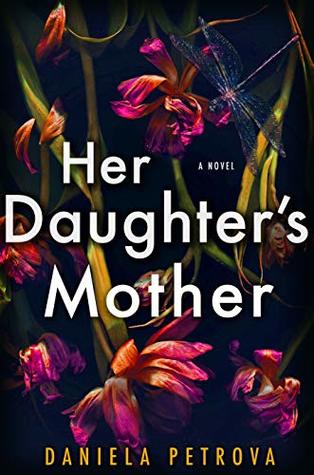
Her Daughter’s Mother, by Daniela Petrova***

I requested and received a galley for this debut novel based on a review I read on another blog. Thanks go to Net Galley and Putnam for the DRC. This book is for sale now.

The concept is terrific, and it is what caught my attention. A Manhattan couple is unable to get pregnant, and they sign up with an agency to use a surrogate. All the details are supposed to be confidential, but the infertile mother has requested a bio-mom of an ethnicity that is pretty rare, even in New York City; using this fact and some skillful research, she finds out who the woman is…and she starts following her around. An unforeseeable event forces them to meet; a friendship develops. Soon we learn that the pregnant surrogate knows perfectly well who this woman is.

The execution didn’t work as well for me. There’s a lot of information about infertility, surrogacy choices and blah blah blah that slows the pace significantly. The book is billed as a thriller, and if I were locked into the genre, I’d have called this a two star novel, because in places, it just drags. The issues between the expectant couple create more drag. I’d like to see tighter writing with more urgency. I guessed the ending when I was ten percent of the way into it.

At the same time, the writer clearly has potential, and since my own children are grown, I am most likely outside of the target demographic for this novel.

Unless the reader is also dealing with infertility and surrogacy issues, I recommend obtaining this book free or on the cheap if you go there. At the same time, I wish this author well; she has promise and is a writer to watch.