Holy Lands, by Amanda Sthers*****

HolyLands


“Does keeping the memory fresh prevent history from repeating itself? Surely not. Memories are meant to be forgotten. History is meant to be repeated. That of Jews, of women, of Arabs, of people who suffer, of Little Red Riding Hood. And the grandmother always, always has sharp teeth.”

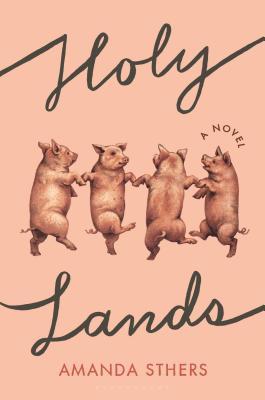
Seldom do I make a decision to read a galley based almost entirely on the book’s cover, but really. A dancing pig in the Holy Land? How can that story not be interesting? Big thanks go to Net Galley and Bloomsbury. This book will be available to the public January 22, 2019.

The whole book is a series of letters and emails sent between five characters. We have four family members: Harry and Monique are divorced, yet it’s one of those complicated divorces where there’s no clean break; David and Annabelle are their adult children.

Harry is an American expatriate who has moved to Israel, but instead of embracing his culture and homeland in a more conventional way, he has opted to become a pig farmer in Nazareth, one of the few places in this Jewish nation where the animals are not straight up illegal. And so the fifth character is the rabbi, who entreats Harry to give up the pork business. He’s upsetting people, and he should respect his roots a little more. Jews have been through enough, nu? And before we know it, there’s mention of the Holocaust.

Harry wants to keep his pigs, and he thinks it is time for Jews to lighten up about the Holocaust, maybe tell a joke about it now and then. The rabbi is floored. Joke? About the Holocaust? And so it’s on.

You would think that with such edgy subject matter the story would veer over the boundary of good taste, but Sthers—who has many bestsellers to her credit, though this is her American debut—is deft, insightful and very, very funny. The prose is angry, hilarious, and aching all in turns, not unlike our feelings for our kin.

Families are such fertile territory, and this one is among the best fictional families in literature. David, Harry and Monique’s son, is a gay playwright whose father has not come to grips with David’s sexuality. David writes him endless letters; Harry won’t respond. We see how Harry thinks and feels about David through his correspondence with the rabbi, and with the things Annabelle learns when she comes for a visit. Meanwhile, David’s new play is about to open, and it’s titled “Kosher Pig.” It’s about his father. Oh, how he wants Harry to be there for the opening! But Harry remains incommunicado.

This is a slender little book, just 176 pages, and so I expected a casual romp, but it’s more than that. It’s a quick read, not because it’s lightweight literature but because it’s impossible to put down. I recommend you should get it and read it, and then…maybe you should call your parents. Better yet, go visit them.
Best General Fiction of 2018

Image

TheCaregiver

Best Humor 2018

MrFloodsLastHonorable Mentions: 


Best Memoirs 2018

To choose one of these over the other would be unfair. I was tempted to go with the Mandela book because everyone has heard of Westover, but again…fairness. So here. You should read them both, period.


Best History 2018

Image

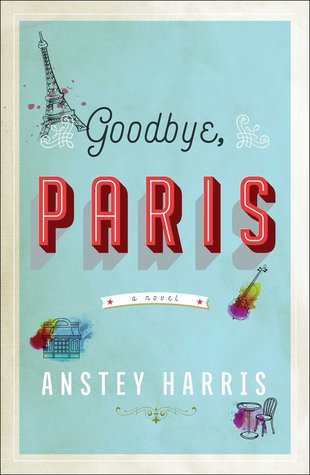
Goodbye, Paris by Anstey Harris*****

GoodbyeParisThis novel took me by surprise. The first time I saw it, I passed it by, because the cover suggested a light romance, and that’s not a genre that appeals to me.  It’s been compared to Jojo Moyes and Eleanor Oliphant; I read neither. Later I saw an online recommendation for this book and changed my mind, and I am so glad I did. Big thanks go to Net Galley and Touchstone for the review copy. This book is for sale now.
You see, when we begin we recognize that Grace is deluded about David. Oh, how many of us have either been that woman or had her as a friend? Grace and David have been together for eight years, except when he needs to be present at home, for the sake of his children. Grace tells us that David is a devoted father, a dedicated dad who’s promised that he will do a finer job than his own father did, and so even though there’s nothing left between him and his wife, he cannot divorce her until the kids are grown. No, really. And then of course there’s some concern about her mental stability. What if he files, and then she does something awful?

So Grace totally understands why she must be alone every Christmas:  David is with his kids. Grace spends all the most important occasions of the year by herself, making stringed instruments in her workshop; and David is with his family in Paris. He wouldn’t say it if it weren’t true, and she doesn’t ask too many questions, because he is terribly sensitive.

It’s all about trust.

She assists in staying out of the public eye, and she is ever so discreet, but then a random event puts David’s face in the news, a hero that pulls a woman off the Metro tracks just before the train comes. Who is this mysterious man, they ask. And then it all hits the fan. And as we knew—we tried to tell Grace, but she wouldn’t listen—David isn’t a stand up guy. He isn’t even that good as a parent. David is just a philanderer, and Grace has spent eight years of her life planning a future with this asshole, not because she is stupid, but because she is a decent person that expects others to be as upright as she is.

I have never assaulted another human being in my life. I am getting old. But let me tell you, if David had been flesh and had been standing before me, who’s to say he wouldn’t be the exception? I fumed as I prepared dinner, did the dishes, let the dog out.  That rotten scoundrel, treating poor sweet Grace this way. Oh, how crushing for her. It isn’t fair; it really isn’t.

Every reader sees it coming, but what surprises me is that David is outed so early in the book. And here’s the glorious thing: this story appears to be a romance, but it isn’t. It isn’t about Grace and David, and no new knight arrives toward the climax to sweep her away. No, the story is about Grace, and it’s about the ways that friends—true friends—help us pull ourselves together when everything seems to be coming apart. And the metaphors are resonant ones:


“I have to take into account that this violin didn’t really work very well, didn’t have much of a voice. If I take these ribs off completely and remake a whole new set, it will give the instrument a better chance to sing.”


Grace rebuilds her career as she rebuilds herself, scaffolded by the warmth and emotional nourishment of the friends that love her, and one of them tells her, “You have to grasp life by the balls, Grace…and don’t bloody let go until you have to.”

Ultimately, this is a charming story you won’t want to miss. Highly recommended.

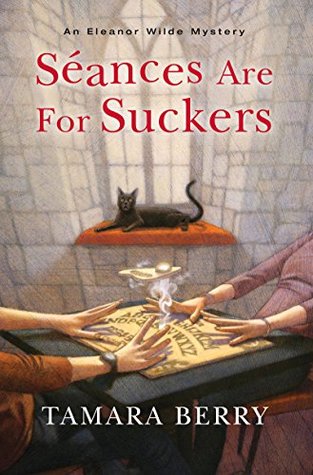
Seances Are For Suckers, by Tamara Berry****-*****

SeancesareforTamara Berry is the queen of snarky humor, and now that I have read the first installment of the Eleanor Wilde series, I am primed and ready for those that follow it. Big thanks go to Net Galley and Kensington Books for the review copy; this book is for sale now.

Ellie narrates her own story in the first person. She explains that she makes her living through fraud, scamming those that want to talk to their dead relatives and solve their Earthly problems via séances. A referral brings her a wealthy Brit that wants a fake medium to vanquish the ghost his mother believes is haunting their mansion. Expenses paid, she flies out to join him and is delighted to find that he lives in an actual castle. His mother, however, hates houseguests and discourages them with miserably small, terrible meals and bad accommodations. As preparations are made for the séance, guests exchange furtively obtained and hoarded snacks in order to avoid starvation.

Nicholas is a hunk; he and Ellie are both drawn toward each other and repelled in classic fashion, and there’s a lot of crackling banter that keeps me snickering. Other well drawn characters include Nicholas’s mother, his sister and her teenage daughter, and a couple of other men, one of whom works for the family. When she comments to the reader, “Bless the sturdy and simple folk of this world,” I nearly fall off my chair. The narrative and dialogue are wonderfully paced and hugely amusing. The solution to the mystery is both partially obvious and wildly contrived, but since this is satire, that makes it even better. In fact, there’s more than one tired old saw that works its way into this story, but it’s with a side-eye wink every time, and I love it.

As the narrative unspools, a corpse is found and then lost, threats and warnings heighten the suspense, and we wonder along with Ellie which of these guests and family members are truly as they seem, and which might be a killer.

The scene leading into the séance is so hilarious that I nearly wake the mister with my cackling.

The only aspect I find unappealing here is the somewhat saccharine story having to do with Ellie’s dying sister. Ellie’s dishonest vocation is, she tells us, necessary so that she can pay for her catatonic sister’s nursing care, and while squeamish cozy readers may find it comforting, I am more than ready to dispatch sis to the great beyond and just let Ellie be Ellie anyway. Happily, this doesn’t hold the story back, particularly since most of the sister’s part of this tale is told at the start and is out of the way by the time we are rolling.

I can’t wait to see where life—and the wakeful dead—will take Ellie next. Highly recommended for mystery lovers ready to be entertained.

A Shot In The Dark, by Lynne Truss****

AShotintheThe world is a serious place right now, and everyone needs to step away from it now and then in order to stay sane. Here it is, your very own mental health break. In fact, if you look at the hourly rate of a good therapist versus the number of hours you’ll read this mystery, even at the full jacket price, Truss’s book is clearly the more economical choice, and it’s far more fun. Lucky me, I read it free courtesy of Net Galley and Bloomsbury. It’s for sale now.

The story doesn’t start as well as it might. It begins with a note from the author explaining that she has written this book exclusively for the purpose of joining a particular writer’s club. It’s likely intended to be a tongue-in-cheek reference, but it comes across as an in-joke between people other than me. I almost feel as though I have walked into a party to which I am not invited.

Then, to make matters worse, the opening chapters contain some jokes that fall completely flat. At about the quarter mark, I consider skimming and then bailing, but I am reluctant to do this with a galley, so I double check the author and publisher first. That changes everything. Bloomsbury is not some small, desperate press that will take any old thing, so that gives me pause. Then I see that Truss also wrote Eats, Shoots and Leaves as well as Cat Out of Hell. At this point the tumblers click into place. I liked both of those books quite well, but I felt exactly the same at the quarter mark of the latter story as I feel about this one. Truss is a writer that takes her time warming up, but she is worth the wait. Soldier through the start as she sets up her characters and puts the story in motion, because once she is on a tear there is no stopping her, and then she’s funny as hell.

Our story starts in a little tourist town in Britain. Twitten is the eager new guy on the force; Sargent Brunswick is unimaginative but sincere, shackled by the lead cop, a bureaucratic blowhard that avoids doing police work by pretending that Brighton has no crime. Since this is the first in the Constable Twitten series we know he won’t be killed, but everyone else is at risk.

Our story features performers from the Brighton Royal Theatre, a woman that works as a cleaner and occasional secretary for the constabulary, a love triangle, a playwright, and an ambitious journalist. The satire is both thick and at times, subtle. I appreciate a writer that can sneak humor into odd nooks and crannies without hitting me over the head with the fact that she’s made a joke, and Truss does that even as she lays out the larger joke in an unmissable way. Ultimately, even the captain must acknowledge that a crime has taken place:

“’May I offer you a sherry before you go?’ And then she opened the door to her front living room, and let out a scream of horror. Furniture was in disarray; ornaments shattered, curtains torn, blood dripped from the fireplace and was sprayed in arcs across the walls. There was no doubt that a life-and-death struggle had taken place inside this room–the biggest giveaway being the lifeless remains on the best Persian rug, of the magnetic young playwright Jack Braithwaite, whose own personal Gas Man had arrived unexpectedly to read his meter and collect his dues.”

The glory of satire is that instead of needing to dream up a variety of innovative twists and turns to liven up the plot, Truss instead can take the oldest and tritest murder mystery elements and make us choke with laughter as we read them.

An added perk is that this is the first in a series, and so the reader can get in on the ground floor. Just don’t trip over the corpse.

Once Truss warms up, her humor is hilarious. Cancel that expensive therapy appointment and order this book instead.

The Water Diviner and Other Stories, byRuvanee Pietersz Vilhauer****

ALT.FINAL_The WaterI read this book free and early thanks to Net Galley and University of Iowa Press. This distinctive collection is for sale now.
All told there are fifteen stories, all of them featuring Sinhalese Sri Lankans, most of them expatriates that have moved to the United States.  Before commencing I knew very little about the culture of this small island country, apart from its having been colonized by Britain earlier in its history. I still know very little, but this collection is an approachable way to introduce oneself, in addition to being well crafted fiction.

Several of the stories are dark, dealing with the racism and ignorance with which immigrants are often greeted. The angriest of the stories is “A Burglary On Quarry,” in which a student is accused of burglary by her well-to-do, bigoted landlord who doesn’t want to face the obvious perpetrator: her own son.  It reads like a manifesto, and it makes me want to pump my fist and yell, “Tell it!”

This, however, is something none of the characters in these stories would do, apart from the privileged Caucasian American in “Accident.”  David nearly comes to great harm while visiting his new wife’s homeland, largely due to his own obliviousness; it hasn’t occurred to him that he himself might be deemed unacceptable for his race and nation of origin, having lived all of his life as an affluent member of the dominant culture. He is from Texas, and he’s drunk, and he doesn’t even try to understand discretion or subtext. As his wife’s neighbors ogle him suspiciously and the police consider that he may have caused an auto accident for which he is not responsible, he continues to assure his wife—in English—that everything is just fine. He says nothing quietly, ever, and it takes a political connection on the part of his wife’s relatives to extricate him from the hard place he doesn’t know he’s in.

Other entries are also bittersweet, and “Sonny’s Last Game” stands out as one of these. However, “Leisure” literally made me laugh out loud. Well, guffaw, actually: “Cutex! Who does she think she is!”

The last entry, “Hello My Dear”, is both funny and bittersweet, as Prema is faced with the question of whether an email from a stranger is a scam or the real deal.

I enjoyed this collection tremendously and would read Vilhauer again in a heartbeat.

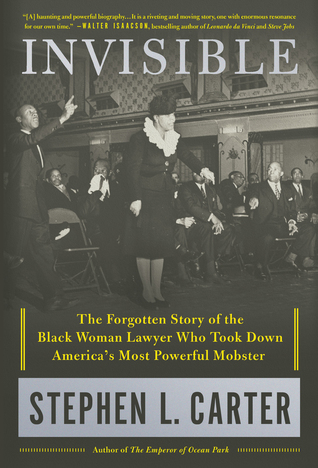
Invisible, by Stephen L. Carter****

InvisibleI received a review copy of this affectionate, well-documented biography free and early thanks to Net Galley and Henry Holt. This book is for sale now.

Eunice Hunton Carter was the author’s grandmother, and though her name is little known today, she was an exceptional woman, a scholar, political activist, and social diva that did extraordinary things during a time period when it was nearly impossible for women of color to rise professionally. Carter tells of her impact on what he calls “the darker nation” and in particular, of her role in taking down notorious gangster Lucky Luciano. She was largely invisible to the mainstream press; this was a time when Black people virtually never won acclaim, and women didn’t either, but it was she that devised the strategy that was needed to try to convict him.

The author is a Yale professor and has a number of successful books to his credit already. This biography is written with the professionalism one would expect; the tone is conversational and keeps the pages turning; transitions are buttery smooth; and the documentation is flawless and meticulous. Those interested in African-American history, or particularly in that of African-American women should read this book.

Carter was born into a well-to-do Atlanta family, leaders among the Negro petite-bourgeoisie. (The author uses the term “Negro” because it was the accepted, polite term during the period in which his grandmother lived.) However, the rise of terrorist groups like the Klan forced successful families of color out of the South, and so most of Eunice’s story takes place in New York City, and it is there that she became a famous woman.

Eunice was a die-hard Republican, and the author reminds us that in the early 1900s, it was still known as the party of Lincoln. Though she did not initially aspire to be politically active—a hat that her mother, Addie, already wore—she became involved in Dewey’s various campaigns after working with him in the prosecutor’s office.

The story is well documented and the voice is distinctive. Two things got in the way of my enjoyment of this biography. The first and technically most significant is focus. The author seems at times torn between his desire to write his grandmother’s biography and perhaps a desire to write about his entire family. I’ll be absorbed in the events that shape Eunice, but then her mother is mentioned—as is appropriate, since her mother is so influential in Eunice’s development—but then we’ll see more about her mother. More, more, more. Pages of Addie. When the author smoothly returns us to Eunice I sigh with relief, snuggle into my chair, and then a few pages later, there we are again. Numerous times I have typed into my reader’s notes, “Whose story is this, anyway?” Eventually I become so frustrated by Addie’s success in hijacking her daughter’s story that I stop making notes and highlight every transition, from Eunice to Addie, Addie, Addie, and ah, back to Eunice (and then to Addie again).

This irritating diversion, one that makes me feel as I am sitting in the parlor of some elderly, garrulous, lonely individual that has just poured me more lukewarm tea and picked up yet another photo album—Did I tell you about my cousin Rudy? Now there was a character, they say—mercifully abates about halfway into the story, as we move into the Luciano case. Here we are focused, and it’s a fascinating read. But during the last portion of the book, it is brother Alphaeus that needs editing down. Again, this brother has good reason to be here, since Eunice is convinced that her career suffers from his membership in the Communist Party USA; yet I feel as if a strong editor’s pen would be useful for this relative as well. Or better still: maybe let’s not read about Eunice. Maybe let’s have a biography of Alphaeus instead, since it is he that is driven to try to make the world a better place.

Because Eunice, it’s clear, is really out there for Eunice. The author makes no bones about this; yet his glee at her snobbery, social-climbing, and vast ostentatious displays of wealth is not inspirational.

When all is said and done, however, Eunice Hunton Carter deserves a place in history. Had she been born Caucasian and male, who knows? She might have become president, or at least governor of the state of New York. Her drive, talent, and energy seem to have been limitless.

As a read for general audiences, I’d say this is a 3.5 star read, rounded upward, but for those with a special interest in African-American history, or that are doing research for a more specific topic such as African-American women in politics or law, this is a must read.